The Cinnamon Bun Book Store Summary, Characters and Themes
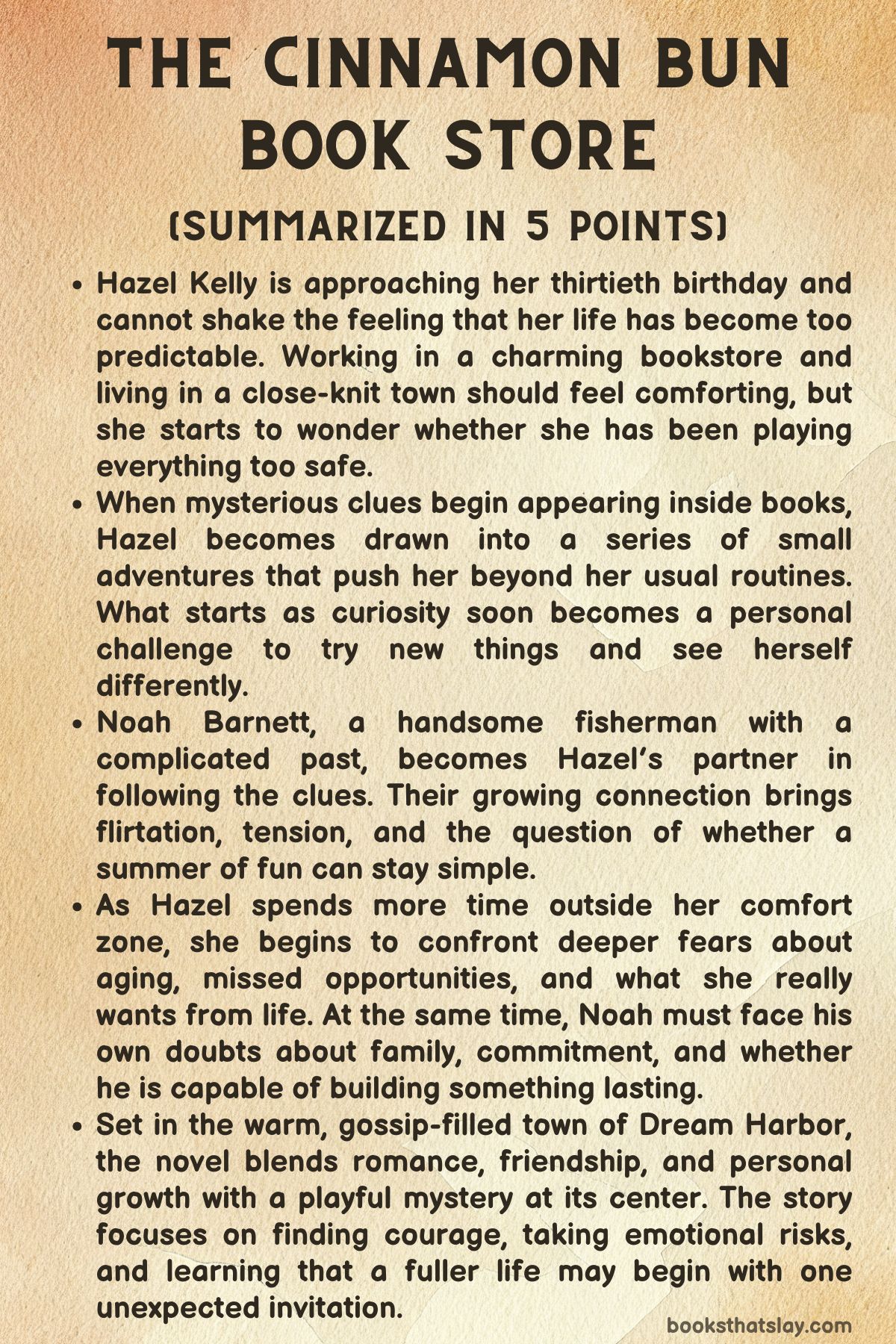
The Cinnamon Bun Book Store by Laurie Gilmore is the second novel in the Dream Harbor series, a small-town romance built around books, friendship, and the quiet fear of standing still while life moves on. At its center is Hazel Kelly, a bookstore manager nearing thirty and starting to wonder whether she has played life too safely.
When mysterious clues begin appearing inside romance novels, they push her toward a summer of choices she never expected to make. Along the way, she grows closer to Noah Barnett, a charming fisherman with his own fears about worth, family, and commitment. The story blends light humor, chemistry, and emotional growth in a warm community setting.
Summary
Hazel Kelly has spent years living a steady, familiar life in Dream Harbor. She works at The Cinnamon Bun Book Store, knows nearly everyone in town, and moves through a routine that feels safe but increasingly limiting.
As her thirtieth birthday approaches, she becomes painfully aware that she does not feel like the heroine of her own life. Surrounded by stories every day, she realizes she has very few stories of her own.
That uneasy feeling sharpens when she discovers a romance novel on the shelf with a folded page and a highlighted line inviting her toward adventure. At first, she thinks it is a joke, but the message stays with her.
Not long after, Hazel finds another marked book with a clue that seems to point her toward something new. These discoveries arrive at a time when she is already feeling restless, and they begin to seem less random and more like an invitation to stop hesitating.
Noah Barnett, a fisherman who often visits the bookstore, becomes interested in the clues too. Noah is attractive, playful, and easygoing on the surface, but Hazel also sees him as someone who has actually lived.
Compared with her own life, his seems fuller, rougher around the edges, and more exciting. During a tipsy conversation after a bonfire with friends, Hazel admits that she wants an adventurous summer before her birthday.
She asks Noah to help her, and in a sudden burst of courage, she kisses him. Though he refuses to take advantage of the moment while she is drunk, he agrees to join her in following the clues.
From there, the scavenger hunt begins shaping Hazel’s summer. One clue leads to milkshakes, another to a carnival, another to the beach, cider, and eventually a trip out on Noah’s boat.
Each stop pushes Hazel slightly outside the habits that have kept her life small. What begins as a playful challenge becomes a way for her to test herself.
She learns that adventure is not only about dramatic acts. Sometimes it is about saying yes, risking embarrassment, or allowing herself to want more.
As Hazel and Noah spend more time together, the flirtation between them becomes impossible to ignore. Hazel knows Noah has a reputation as someone who avoids serious relationships, and that makes her cautious.
She tells herself that whatever happens between them can stay light and temporary, matching the spirit of her summer experiment. Yet their growing closeness quickly makes that idea harder to maintain.
Noah pays attention to small things, making sure she is comfortable at the beach, bringing her tea, and showing up when she needs him. He treats her like someone worth caring for, and that has a deep effect on Hazel, who has not always felt fully desired or chosen in past relationships.
Noah, meanwhile, is dealing with insecurities of his own. He is drawn to Hazel from the beginning, but he believes she is too good for him.
He comes from a family whose fishing business grew into a large company, and he has long carried guilt for walking away from the life expected of him. While his family built something successful, he drifted from place to place before settling in Dream Harbor.
He now works as a fishing boat captain and secretly spends time restoring old cottages by the water. That project matters to him because it represents stability, vision, and the kind of future he has never trusted himself to build.
Still, he doubts whether others will see him as capable, especially Hazel.
Their physical relationship deepens after weeks of growing tension. What starts as chemistry turns into real emotional dependence, even when both of them keep insisting that the arrangement is casual.
Hazel is thrilled by how alive she feels with Noah, but she is also afraid. If this is only temporary, then wanting more could leave her hurt.
Noah feels the same pressure from the other side. He cares for Hazel far more than he intends to, but he assumes she could never truly choose a man who sees himself as unfinished.
The mystery of the clues continues in the background, giving shape to the season and also becoming tangled with Hazel’s feelings for Noah. Her friends Annie and Jeanie quickly suspect Noah is responsible.
Hazel resists the idea at first, but part of her wants to believe it. If he is the one arranging these adventures, then maybe it would mean he sees her, understands her, and wants something real.
That hope grows stronger as their relationship becomes more intimate.
Outside the romance, both characters are pushed to face larger questions about adulthood. Hazel has to reckon with the story she has been telling herself, that she is dull, overly cautious, and somehow late to her own life.
Noah has to confront his family history and his fear that he has never measured up. When he considers presenting his plan to renovate the old fisherman’s cottages into vacation rentals, his confidence nearly collapses.
He is shaken by public doubt and by his own instinct to retreat before anyone can reject him. Hazel sees the value in his idea more clearly than he does, but their communication is often blocked by defensiveness and mixed signals.
A major turning point comes during a boat trip that should have been another exciting clue. Hazel plans to talk honestly with Noah about her feelings, but a sudden storm interrupts the day.
Noah safely gets them to shelter, and in the quiet afterward they share one of their most peaceful and intimate moments together. Hazel is ready to say what she feels, but Noah tells her that he will be leaving after her birthday to return to his family for a while.
Though she understands why it matters, she is crushed. To her, it sounds like proof that whatever they have has an ending built into it.
Soon after, the clues lead Hazel to what seems like a final grand reveal on her birthday. By this point, she is convinced Noah must be behind the scavenger hunt.
Instead, she discovers that the clues were arranged by her father and many people in town, all working together to push her toward joy and novelty before her milestone birthday. The revelation is loving, but it is also embarrassing.
Hazel feels exposed, as if the whole town saw her as someone who needed fixing. She is also privately disappointed that Noah was not the one who created the journey that changed her summer.
Even at the party, with everyone celebrating her, she cannot shake that feeling.
The next morning, however, Noah gives Hazel something that is truly from him. He leaves her a stack of books marked with passages about love, friendship, and what she means to him.
This gesture is personal in a way the earlier clues were not. It is not about pushing her toward adventure for its own sake.
It is about showing that he knows her language and wants to speak it. He asks her to meet him by the water, near the cottages he has been restoring.
There, Noah finally tells the truth. He loves her, wants a future with her, and plans to come back to Dream Harbor after helping his family.
He no longer wants to hide behind flirtation or the excuse of being temporary.
Hazel meets his honesty with her own. She tells him that he does not need to prove he is worthy of her love.
She already believes in him. In fact, she has quietly supported his cottage project by getting the paperwork ready, showing that she has seen his potential all along.
Their reunion resolves the misunderstandings that kept them apart and lets both of them choose each other openly.
In the months that follow, Noah returns after spending time with his family, and his personal life begins to heal alongside his romance with Hazel. He grows closer to his relatives again, while Hazel moves into a future that no longer feels limited or stale.
By the epilogue, they have built a shared life shaped by work, affection, and a clearer sense of possibility. On vacation together, Noah suggests marriage, and Hazel says yes, ready for all the stories still ahead of them.
Characters
Hazel Kelly
Hazel Kelly is the emotional center of The Cinnamon Bun Book Store, and her character arc is built around dissatisfaction, self-discovery, and emotional courage. At the beginning, she feels trapped inside a life that is orderly but too predictable.
She works among novels and romance every day, yet privately believes that she has not lived a memorable story of her own. Her approaching thirtieth birthday sharpens this fear, making her question whether she has confused safety with fulfillment.
What makes Hazel compelling is that her unhappiness is not dramatic on the surface. She is not in crisis in any obvious way, but she carries a quiet ache that many people would recognize: the fear of waking up one day and realizing that comfort has slowly turned into limitation.
Hazel’s early choices show that she has become deeply accustomed to routine. She knows the town, the people, the bookstore, and the shape of her daily life so well that even the smallest disruption feels significant.
This is why the hidden clues matter so much to her. They are not simply playful prompts.
They become symbolic permission to act differently. Hazel responds to them because part of her has been waiting for an excuse to step out of the version of herself she has been living for years.
Her hunger for adventure is really a hunger for expansion. She wants to know whether there is a larger, braver self beneath the careful woman everyone already knows.
As the story progresses, Hazel becomes more active, more impulsive, and more honest about desire. Her summer with Noah allows her to test out a version of herself that is flirtier, bolder, and more physically confident than she has been before.
Yet her growth is not just about having fun or becoming less reserved. It is also about learning that wanting love, excitement, and change does not make her foolish.
For much of the story, Hazel tries to frame her connection with Noah as casual because that seems safer than admitting how much he affects her. She tries to control the emotional stakes by pretending she can separate experience from attachment.
The longer this continues, the clearer it becomes that Hazel is not actually afraid of Noah alone. She is afraid of being disappointed after finally allowing herself to hope for something bigger.
One of Hazel’s most affecting traits is the insecurity beneath her intelligence and warmth. She does not think of herself as especially adventurous, magnetic, or unforgettable.
She often assumes other people, especially Noah, must be living more vivid lives than she is. This insecurity shapes many of her misreadings of the relationship.
Even when Noah shows up for her, cares for her comfort, and clearly values time with her, Hazel struggles to fully believe she could be chosen in a serious way. That uncertainty is tied to her past experiences, where she did not feel especially wanted.
Because of that history, emotional reassurance matters to her more than she initially admits.
Hazel’s growth reaches its fullest form when she begins to understand that adventure is not something handed to her by others. The clues help open the door, but she is the one who walks through it.
By the end, she is no longer only reacting to prompts or waiting for life to happen around her. She actively supports Noah’s future, acknowledges her own feelings, and accepts that love does not require her to become someone else first.
She learns that she was never as stuck or as small as she feared. Her transformation is convincing because it does not erase her original personality.
She remains bookish, thoughtful, and deeply rooted in her community, but she becomes more confident in inhabiting those qualities without seeing them as signs of an incomplete life.
Noah Barnett
Noah Barnett is introduced as charming, flirtatious, and somewhat hard to pin down, but beneath that easy surface he is a character shaped by avoidance, self-doubt, and a longing for belonging. He is the kind of man others may initially reduce to a type: attractive, casual, and unlikely to settle down.
The story gradually reveals how unfair and incomplete that image is. Noah is not emotionally shallow.
Rather, he has learned to present himself in a way that keeps deeper vulnerability out of reach. His humor, flirtation, and apparent lack of seriousness function as protection against rejection and disappointment.
A major part of Noah’s characterization comes from his estrangement from his family. He grew up in a family whose small fishing business became highly successful, and he never found a comfortable place within that world.
While his relatives built and expanded something tangible, Noah responded by leaving. That history leaves him carrying guilt and inferiority.
He believes he has disappointed people who mattered to him, and over time that guilt becomes part of his identity. He does not merely think he made choices that hurt his family; he seems to suspect that he himself is the kind of person who falls short.
This makes his confidence fragile even when he appears socially relaxed.
What gives Noah depth is the contrast between how he sees himself and what he is actually doing with his life. He may think of himself as directionless or unserious, but his actions tell a different story.
He works hard, he creates a life for himself in Dream Harbor, and he secretly restores old fisherman’s cottages with patience and vision. The cottage project is especially important because it reflects a side of Noah that wants permanence and purpose.
He may be uncertain in romance and in family matters, but he is not empty or careless. The project shows that he wants to build something lasting.
The problem is that he struggles to believe others will see value in what he creates.
His relationship with Hazel brings out both his tenderness and his fear. He is attracted to her, but more than that, he respects her.
He sees her as kind, smart, and somehow beyond him, which is why he often acts as if he should not want too much. Noah repeatedly underestimates his own worth in her eyes.
He assumes that she could enjoy him physically or casually, but he has a harder time believing she could choose him for the long term. This emotional pattern explains why he sometimes defaults to flirtation just when seriousness is needed most.
When conversations become too honest, he tends to redirect or defend himself before he can be exposed.
At the same time, Noah is one of the most attentive characters in the story. He notices what Hazel needs, remembers the things she likes, and takes care to make new experiences easier for her.
He does not push her recklessly. Instead, he encourages her while also protecting her comfort and dignity.
That balance makes him a strong romantic lead because his appeal is not only physical or witty. It rests in his capacity to make Hazel feel seen.
Even his hesitation around her reveals how deeply he values her opinion.
Noah’s emotional turning point comes when he begins to reconnect with his family and, through that process, revises the story he has been telling himself. He has spent years assuming he was the family disappointment, but conversations with his father and sisters begin to loosen that belief.
As he becomes more secure in his place within his family, he also becomes more capable of imagining a stable future with Hazel. By the end, his declaration of love carries weight because it is not just a romantic confession.
It is the sign of a man who is finally willing to stop hiding behind the idea that he is not enough. His arc is about accepting that he can be loved without first becoming flawless, richer, more accomplished, or more impressive than he already is.
Annie
Annie plays an essential supporting role as one of Hazel’s closest friends and as a voice of emotional realism throughout the story. She is observant, outspoken, and deeply invested in Hazel’s well-being.
Unlike Hazel, who often hesitates to name what she feels, Annie tends to recognize emotional truths quickly and say them aloud. This makes her an important counterbalance in the narrative.
She can see Hazel’s attraction to Noah before Hazel is ready to admit it, and she also recognizes the risks involved in getting attached to someone with Noah’s reputation.
What makes Annie effective as a friend is that she is neither blindly encouraging nor unnecessarily negative. She wants Hazel to have fun, but she also wants her to stay emotionally safe.
Her warnings about Noah do not come from cynicism. They come from protectiveness and from her understanding of Hazel’s tendency to hope quietly while pretending not to.
Annie seems to know that Hazel is more vulnerable than she appears, especially once feelings become involved. That instinct makes her one of the people who helps ground the romance in a wider network of care.
Annie also represents the intimacy of small-town friendship. She knows Hazel’s habits, understands when something is off, and notices when Hazel begins to disappear into a new relationship.
Her concern is not framed as judgment. Instead, it shows the strength of bonds that have been built over time.
She is the kind of friend who pushes for honesty because she believes Hazel deserves to live truthfully. In that sense, Annie helps move the story forward not just through dialogue but through emotional pressure.
She repeatedly nudges Hazel toward admitting what she actually wants.
Jeanie
Jeanie adds warmth, humor, and social energy to the story, but she is more than a lively side character. Like Annie, she forms part of Hazel’s emotional support system, and her role helps show that Hazel is not isolated even when she feels personally stuck.
Jeanie is attentive to the undercurrents around her, quick to notice changes in behavior, and fully involved in the rhythms of town life. Through her café and her links to the local social circle, she becomes one of the people through whom community observation and gossip flow.
Jeanie’s importance lies partly in how she normalizes connection. Hazel may feel that her life is static, but Jeanie is one of the people showing that stability can also be rich with affection and involvement.
She is engaged with her friends’ lives, emotionally available, and part of a network that makes Dream Harbor feel lived in rather than decorative. Her reactions to Hazel and Noah also help mirror what the reader is meant to see: that this relationship matters, that it is obvious to others, and that both people are kidding themselves when they insist it is only casual.
Her own relationship milestones, especially in connection with Logan and her brother Bennett, also broaden the emotional landscape of the novel. She belongs to a world where choices about commitment, home, and future plans are actively being made.
This helps place Hazel’s personal fears in a wider context. Jeanie is not simply present for comic relief or friendship scenes.
She helps create the atmosphere in which love, partnership, and shared futures feel possible and visible.
Logan
Logan serves as one of the steadier and more quietly perceptive figures in the story. He is closely connected to both Hazel and Noah, which places him in a unique position.
As Hazel’s longtime friend and Noah’s closest friend in town, he becomes an informal bridge between the two, even when he is not actively trying to manage their relationship. Logan’s protective side appears early when he warns Noah not to hurt Hazel.
That moment reveals how deeply he cares for her and also establishes him as someone who takes emotional consequences seriously.
Unlike some of the more openly talkative characters, Logan often feels measured and dependable. He does not dominate the story, but when he appears, his role is meaningful.
He offers reassurance at key moments, especially when Hazel feels humiliated or confused after the birthday reveal. His comfort matters because it is calm rather than dramatic.
He understands that Hazel’s embarrassment is not really about the scavenger hunt itself. It is about being seen too clearly at a moment when she already feels emotionally exposed.
Logan also helps reinforce one of the story’s central ideas: that community can be intrusive, but it can also be loving. He is part of the town’s social fabric, yet his loyalty to Hazel feels sincere rather than meddlesome.
Through him, the story shows how friendship can provide perspective when romance becomes clouded by fear and misunderstanding.
Mayor Kelly
Hazel’s father, Mayor Kelly, is one of the most interesting secondary characters because he plays both a personal and symbolic role in Hazel’s journey. On a personal level, he is part of her family life and shares regular rituals with her, such as their standing breakfast meetings.
These details suggest familiarity, affection, and a stable bond. He clearly knows his daughter well enough to sense that she needs a change, and his encouragement for her to have a fun summer shows concern rather than control.
At the same time, he also becomes the architect of the scavenger hunt that drives much of the plot. This reveal reframes many of the earlier events.
What seemed mysterious and possibly romantic turns out to be a community effort rooted in paternal care. That choice says a lot about him.
He is loving, proactive, and perhaps a little theatrical. He wants Hazel to experience life more fully and is willing to involve the town in helping make that happen.
His plan is generous, but it is not without complexity. When Hazel learns the truth, she feels embarrassed as well as touched.
This means his gesture, though affectionate, also reveals a blind spot. He underestimates how vulnerable she might feel upon realizing that so many people saw her restlessness.
Mayor Kelly is therefore not just a warm father figure. He also embodies one of the story’s tensions between support and overinvolvement.
His actions come from love, but they also show how easily care can tip into assumption. Still, by the end, his role in helping Noah with the cottage project suggests that he is not only invested in Hazel’s happiness in an abstract sense.
He is willing to recognize Noah’s potential and support the future Hazel may build with him.
Hazel’s Parents
Hazel’s parents, though not always foregrounded individually, contribute to the sense that she comes from a place of steadiness and care. They are part of the network that loves her and wants her to move toward a fuller life.
Their presence helps explain why Hazel’s dissatisfaction is not rooted in neglect or chaos. She is not yearning to escape a damaged home.
Instead, she is struggling with a subtler problem: how to grow beyond a life that is already decent.
This matters because it shapes the tone of her character arc. Hazel’s challenge is not survival but expansion.
Her parents represent the secure background from which she can take emotional risks. Their involvement in her birthday surprise may embarrass her, but it also confirms that she is deeply known and loved.
In romance fiction, that kind of foundation often changes the emotional stakes. Love with Noah is not about rescue.
It is about recognition, growth, and choosing a future.
Alex
Alex has a relatively small role, but characters like this help make the setting feel active and believable. As a coworker in the bookstore, Alex contributes to the everyday environment in which Hazel’s life unfolds.
Their presence matters because the bookstore is not only a romantic setting but also Hazel’s workplace, her comfort zone, and the place she may need to outgrow emotionally without abandoning completely. Alex helps reinforce the rhythm of that daily world.
Even brief interactions with Alex support the mystery around the clues and highlight Hazel’s growing preoccupation with them. By asking whether anyone has been messing with the books, Hazel is already moving from passive curiosity to active investigation.
Alex’s inability to explain what is happening strengthens the sense that something unusual is unfolding inside an otherwise familiar place.
Kira North
In The Cinnamon Bun Book Store, Kira North appears more briefly than many other named characters, but her introduction serves an important narrative purpose. As a newcomer who purchases the old Christmas tree farm and refuses the town’s expectations, she acts as a contrast to both Hazel and Noah.
Kira’s refusal to be persuaded unsettles the social atmosphere and reminds everyone that not all arrivals in town will fold neatly into community wishes. Her stance creates a moment of uncertainty around change, progress, and local identity.
For Noah in particular, Kira’s entrance indirectly affects his confidence. Her resistance makes him question whether new ideas, including his cottage plan, will be welcome.
In that way, Kira functions less as a deeply developed individual in the summary and more as a catalyst. She sharpens Noah’s insecurity by showing that a person with property, plans, and independence can still stand outside the town’s emotional consensus.
That effect adds tension to Noah’s attempts to imagine a future for himself in Dream Harbor.
Themes
Stagnation, Restlessness, and the Fear of Wasting One’s Life
Hazel’s emotional crisis grows out of a quiet but deeply recognizable fear: the possibility that a life can look perfectly fine from the outside while feeling painfully small from within. She is not trapped by poverty, cruelty, or obvious unhappiness.
Instead, she is trapped by repetition, by the slow accumulation of safe habits that have left her with very little sense of motion. That makes this theme especially effective, because it speaks to a form of dissatisfaction that is harder to name and therefore harder to fix.
Hazel has built a life that is stable and respectable, yet as her thirtieth birthday approaches, she begins to feel that she has mistaken security for fulfillment. The emotional weight of this realization comes from how long she has been ignoring it.
She is surrounded by books, romance, and other people’s stories every day, which sharpens the irony that she no longer believes she is living one of her own.
The clues hidden in books become important because they interrupt this emotional stillness. They are not magical solutions, and they do not instantly transform her.
What they do is expose how ready Hazel already is for change. The mystery matters less as a puzzle and more as a device that gives structure to her longing.
Each clue functions as a challenge to the passive life she has been accepting. Go out.
Try something new. Let yourself be seen differently.
Risk discomfort. The theme works because Hazel’s transformation is not dramatic in the usual sense.
She does not become a completely different person. Instead, she becomes more fully herself, but without the limits she once treated as fixed.
The novel is careful to show that restlessness is not the same as ingratitude. Hazel’s dissatisfaction does not mean her community, job, or daily life are worthless.
What troubles her is the realization that she has allowed these familiar things to become excuses for emotional stillness. This distinction gives the theme maturity.
The answer is not that she must reject her town or abandon the life she knows. The answer is that she must stop shrinking inside it.
By the end, her growth comes from understanding that adventure is not reserved for people who are naturally fearless or constantly in motion. It can begin when someone finally decides that wanting more does not make them unreasonable.
In The Cinnamon Bun Book Store, this theme gives the romance much of its emotional foundation, because Hazel’s love story only becomes possible once she starts confronting the larger question of how she wants to live.
Love as Recognition Rather Than Rescue
The romance works because it is built not on fantasy or rescue, but on recognition. Hazel and Noah do not save each other from external disaster.
Instead, they help each other feel more visible, more believable to themselves, and more capable of imagining a future that is larger than the one each has privately accepted. This theme gives the relationship emotional depth.
Hazel is not waiting for a man to arrive and fix her life, and Noah is not presented as someone whose love automatically solves all of her fears. Their connection matters because it reveals parts of them that have gone unconfirmed for too long.
Hazel begins to feel desired, interesting, and emotionally chosen in ways she has not felt before. Noah begins to feel that his tenderness, ambition, and loyalty may have value, despite the dismissive view he has formed of himself.
This idea becomes especially powerful because both characters initially try to reduce the relationship to something casual. That choice is not based on freedom or confidence as much as fear.
Hazel thinks that keeping things light will protect her from disappointment. Noah assumes he can only occupy a temporary role in her life because anything more serious would require a level of worthiness he does not think he has.
In this sense, their romance is not threatened by lack of chemistry. It is threatened by the stories they tell themselves about what they are allowed to want.
Love becomes meaningful because it challenges those false stories. The tenderness between them is often expressed through attention to detail rather than grand declarations at first.
Noah remembers what Hazel likes, anticipates what might make her uncomfortable, and encourages her without mocking her fears. Hazel sees value in Noah’s plans and abilities even when he cannot trust them himself.
These moments matter because they communicate understanding before either character is ready to speak plainly.
The theme also benefits from the fact that recognition can feel more frightening than attraction. Physical desire is easier for both of them to manage than emotional clarity.
Once they realize they are being truly seen, the stakes become higher. To be recognized by another person means losing the protection of distance and ambiguity.
That is why so much of the tension comes from hesitation, defensiveness, and poor timing rather than from lack of feeling. When the relationship finally reaches honesty, it feels earned because both have had to move beyond the comfort of being underestimated.
Love here is not presented as transformation through outside force. It is presented as the experience of being known accurately and loved anyway.
Self-Worth, Shame, and the Need to Feel Deserving
Much of the emotional tension in the story comes from the gap between how the characters appear and how they privately judge themselves. Both Hazel and Noah struggle with self-worth, but the shape of that struggle differs for each of them, which gives the theme complexity.
Hazel’s insecurity is quieter and more internalized. She worries that she is forgettable, too cautious, or somehow less vivid than the kind of woman who naturally becomes the center of an exciting love story.
Noah’s insecurity is more directly tied to shame. He sees himself as the family member who left, the man who did not fulfill expectations, and the person who may always be less substantial than he appears.
In both cases, the problem is not simply low confidence. It is the belief that being fully loved may require qualities they do not possess.
Hazel’s self-doubt affects how she interprets attention. Even when Noah is caring, patient, and clearly invested in her, she struggles to trust what those actions mean.
She can believe in attraction more easily than devotion. That detail says a great deal about the emotional world she is living in.
She has not fully internalized the idea that she can be wanted in a complete way, with affection, admiration, and seriousness all at once. This is why her experiences with Noah matter beyond romance.
They help expose the emotional limitations she has quietly accepted for herself. Noah’s self-worth problem is shaped by his family history and by his view of masculinity, success, and usefulness.
He feels that he has to prove himself before he can claim a future with Hazel. Even his cottage project becomes tied to this need.
It is not just a business idea. It is evidence, to himself more than anyone else, that he can build something meaningful and stable.
What makes the theme powerful is that neither character is healed by praise alone. Other people care for them throughout the story, but they still misread situations because shame distorts perception.
Noah can hear affection and still assume disappointment is the deeper truth. Hazel can experience closeness and still fear that she is asking for too much.
Their eventual progress comes when they begin to challenge the underlying belief that love must be earned through perfection, achievement, or emotional self-protection. The romantic resolution is satisfying because both characters move closer to a healthier sense of worth.
Noah starts to understand that he does not need to become an idealized version of himself before returning to family or committing to Hazel. Hazel starts to understand that she does not need to become more adventurous, glamorous, or bold in order to deserve a full life.
The story treats self-worth not as a simple lesson in confidence, but as a deeply rooted emotional struggle that shapes every choice about intimacy and future.
Community as Comfort, Pressure, and Shared Identity
Dream Harbor is more than a charming setting. It functions as an active force that shapes the story’s emotional reality.
The town offers warmth, familiarity, and support, but it also produces pressure, visibility, and occasional embarrassment. This theme is important because it keeps the novel from becoming a romance that exists in isolation.
Hazel and Noah do not fall in love in a private world. They do so within a community that notices, comments, assumes, helps, and sometimes interferes.
That communal presence can feel affectionate one moment and overwhelming the next, which makes the setting emotionally dynamic rather than merely cozy.
For Hazel, the town represents both belonging and confinement. She is known there, loved there, and deeply rooted there.
At the same time, its familiarity contributes to her sense that her life has stopped changing. Everyone knows who she is, which can make it difficult for her to imagine becoming someone more daring or unpredictable.
The town’s role in organizing the clues reveals this dual quality clearly. On one hand, the gesture is loving.
People care enough about Hazel to want her to have fun, to shake her out of routine, and to celebrate her. On the other hand, the reveal leaves her feeling exposed.
She realizes that her restlessness was more visible than she thought, and that can feel humiliating even when the intention is kind. The story does not simplify this.
Community support is shown as meaningful, but not always comfortable.
For Noah, the town becomes the place where he may be able to belong without pretending to be someone else. Unlike his family history, which he associates with failure and guilt, Dream Harbor offers him the possibility of becoming known through the life he is building in the present.
Yet even here, community comes with scrutiny. His reputation precedes him, people have opinions about his intentions, and his future projects seem vulnerable to public judgment.
This creates tension around whether community acceptance is nurturing or conditional. The answer, interestingly, is both.
The theme becomes especially rich because the town is not portrayed as cruel or simplistic. Its nosiness is often comic, sometimes frustrating, but rarely malicious.
People watch because they care, and that care can cross boundaries without losing its sincerity. The result is a portrait of communal life that feels emotionally true.
Belonging means being supported, but it also means being visible. In The Cinnamon Bun Book Store, community matters because it gives the central relationship a wider human context.
Hazel and Noah are not only choosing each other. They are also choosing to live openly inside a network of people, habits, and mutual knowledge that can hold them accountable while also making home feel real.