The Unmagical Life of Briar Jones Summary, Characters and Themes
The Unmagical Life of Briar Jones by Lex Croucher is a fantasy novel about power, exclusion, memory, friendship, and the dangerous consequences of allowing a privileged institution to decide who deserves knowledge.
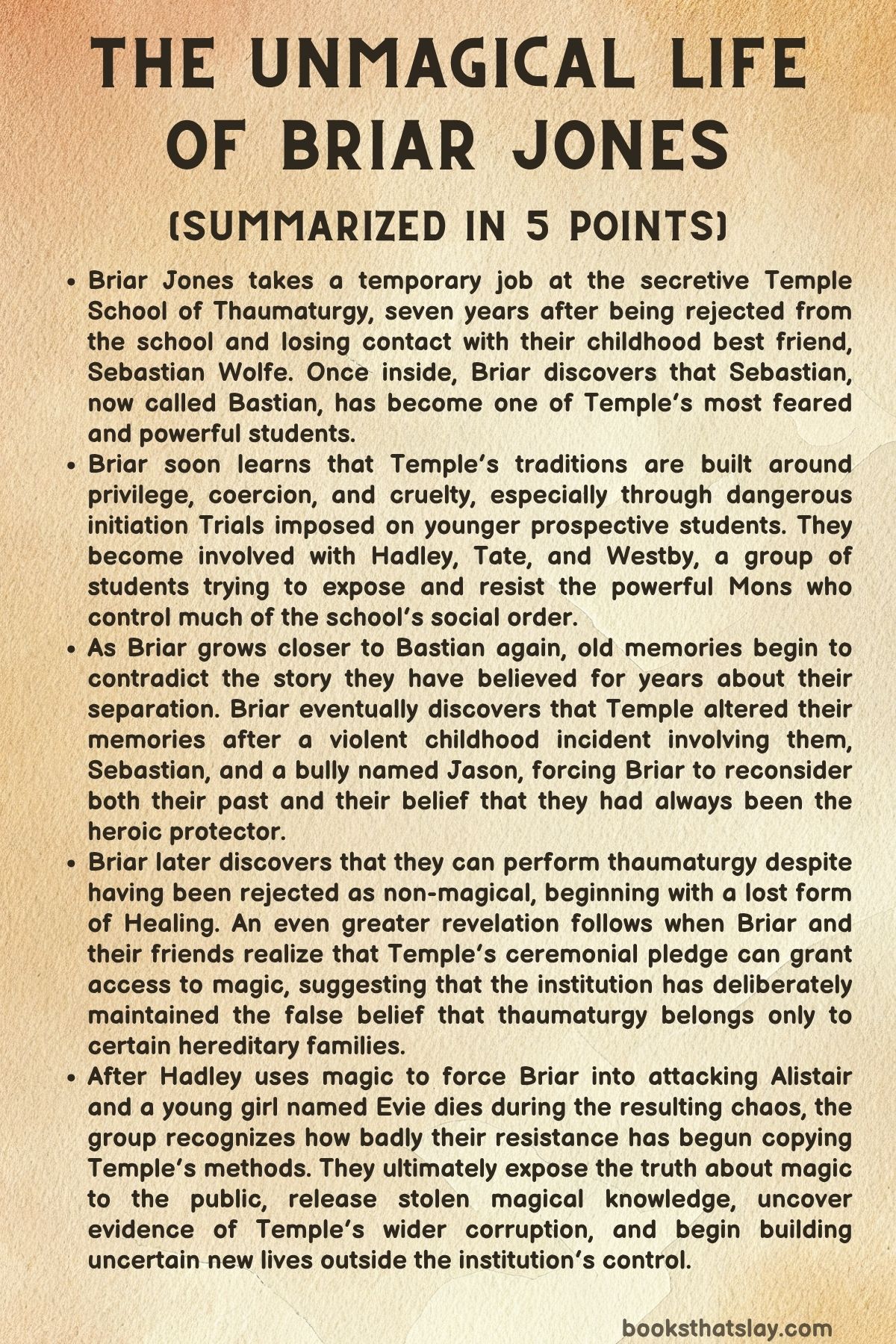
Eighteen-year-old Briar Jones enters the secretive Temple School of Thaumaturgy as temporary staff, seven years after being rejected as a student and losing their closest childhood friend, Sebastian Wolfe, to the school. What begins as a chance to satisfy an old curiosity soon forces Briar to confront institutional cruelty, buried memories, compromised friendships, and unexpected truths about magic itself. At its centre is a difficult question: who gets to possess power, and who gets to decide?
Summary
Eighteen-year-old Briar Jones arrives at the Temple School of Thaumaturgy for a temporary summer job, entering a place they have spent much of their life wondering about. Temple was once the centre of Briar’s childhood ambitions, especially because Briar and their best friend Sebastian Wolfe had dreamed of attending it together.
Sebastian came from a wealthy family with a long connection to Temple, while Briar grew up in a financially strained but loving household connected to Sean’s dairy farm. Despite their different backgrounds, Briar and Sebastian were intensely close, with Briar frequently protecting the sensitive, anxious boy from bullies and from the emotional damage caused by his demanding father.
Their friendship changed when they applied to Temple. Sebastian received an acceptance letter, while Briar received nothing at all, and the silence surrounding Briar’s rejection became inseparable from Sebastian’s disappearance from their life.
Seven years later, Briar enters Temple as a temporary staff member responsible for sorting a huge attic filled with abandoned books, furniture, documents, and magical objects. Eugenia, the administrator overseeing Briar, explains that Temple’s magic is known as thaumaturgy or the Work, immediately confirming that the world Briar once obsessed over was real.
Briar is placed in a small attic room previously used as a private hangout by three older students: Crispin Westby, Tate Adams, and Hadley Watson. Through them, Briar begins learning Temple’s vocabulary, social structure, traditions, and deeply unequal hierarchy.
The darker side of the institution becomes clear almost immediately. Briar witnesses powerful senior students known as the Mons humiliating a younger prospective student through magic, and the person exercising the greatest power among them turns out to be Sebastian, now known as Bastian Wolfe.
Bastian initially pretends not to know Briar. To everyone else at Temple, he is an exceptionally powerful and dangerous scholar whose abilities inspire fear, leaving Briar unable to reconcile him with the frightened, emotionally vulnerable boy they once protected.
Briar soon discovers that the abuse they witnessed is not unusual. Prospective students are subjected to secret Trials designed and overseen by the Mons, and Temple’s adults know enough about these traditions to have effectively accepted them.
During one Trial, children are forced underwater in a ritual presented as an initiation. Hadley, Westby, and Tate interfere with the ceremony, revealing that their friendship group has been fighting the Mons for some time.
The danger of that resistance becomes obvious when Alistair Buckingham, one of the most powerful and cruel Mons, deliberately shoots Westby in the leg while arranging the incident so that it can be dismissed as an accident. Temple treats the attack as little more than scandalous gossip, demonstrating how thoroughly status protects its most privileged students.
Meanwhile, Briar attempts to understand a magical book found in the attic. Tate explains that thaumaturgy depends on mastering a complex language called Procedural and comprehending the logic of a Working until it becomes something like an agreement with reality itself.
Briar cannot understand the text, apparently confirming the childhood judgment that they are incapable of magic. The failure is painful because Briar had secretly continued hoping that Temple’s rejection had somehow been mistaken.
Bastian remains another source of confusion. Briar encounters him during moments of panic and emotional distress that closely resemble Sebastian’s childhood episodes, suggesting that the person Briar remembers still exists beneath the intimidating identity he has developed.
Their encounters alternate between hostility and familiarity. Briar condemns his participation in Temple’s cruelty, while Bastian repeatedly shows flashes of concern, especially when Alistair uses Conduct magic to compel Briar, humiliate them, and physically hurt them during a party.
Bastian’s distress causes a window to explode, injuring both Briar and Alistair. Afterwards, Bastian gently removes glass from Briar’s face, but Briar rejects his care because his kindness cannot erase his involvement with the people responsible for the abuse.
As Briar becomes closer to Hadley, Tate, and Westby, they learn how complicated each of them is. Their opposition to Temple’s elite does not make them morally uncomplicated, because all three have been shaped by the institution and have their own histories of unhealthy behaviour, emotional dependence, manipulation, or secrecy.
Hadley eventually asks Briar to exploit Bastian’s unresolved feelings in order to obtain information about future Trials. Briar agrees because they want to protect younger students and punish the Mons, even though the plan requires deceiving Bastian and hiding the truth from Tate and Westby.
During another Trial, Briar watches prospective students being encouraged to hurt one another. The ritual makes clear that Temple is not simply testing whether children can withstand cruelty; it is teaching them to participate in it as a condition of belonging.
Briar’s attempt to interfere brings them into direct conflict with Bastian, and their argument unexpectedly turns into a kiss. Their old attachment is still powerful, making Briar increasingly unable to separate the role they are supposed to perform for Hadley from their genuine feelings.
At the same time, evidence begins challenging Briar’s memories of childhood. An old message reveals that Sebastian tried to contact them after being accepted to Temple, contradicting Briar’s long-held belief that he abandoned their friendship without explanation.
Briar then learns that Temple has methods of altering memories. Their mother’s recollections of the period after Sebastian left also conflict with Briar’s, making it increasingly likely that the missing parts of their childhood were deliberately removed.
The relationship between Briar and Bastian slowly becomes more intimate. While they clean together as punishment, old habits return naturally, and Briar recognizes how easily they still understand one another despite seven years of separation.
Bastian insists that Briar’s account of the past is incomplete. He also challenges Briar’s tendency to see themself as Sebastian’s protector and the moral hero of their childhood, suggesting that their history was considerably messier.
Briar finds proof in Bastian’s belongings. A vicious childhood letter written in Briar’s own handwriting triggers fragmented memories of violence, fear, and an event that Briar cannot fully recover.
Eventually Bastian agrees to help restore the missing memory. Briar remembers that they and Sebastian once encountered Jason, a boy who regularly bullied Sebastian, and the confrontation became violently physical.
Briar attacked Jason with uncontrolled anger and experienced satisfaction while hurting him. Sebastian then used emerging magic when Jason attacked Briar, and Briar continued the confrontation by shoving Jason near a dangerous drop.
Jason fell into the brambles below and suffered catastrophic injuries. Powerful adults connected to Temple responded by altering Briar’s memory rather than allowing either child to understand or confront what had happened.
The restored memory destroys Briar’s belief that they had always been Sebastian’s heroic protector. Bastian then explains how Temple transformed him after their separation: frightened and emotionally unstable, he entered an environment that rewarded power, emotional suppression, intimidation, and obedience while his father encouraged the qualities that made him increasingly dangerous.
Understanding Bastian’s past does not erase his responsibility for what he has done. It does, however, allow Briar to see that he was shaped by years of institutional pressure rather than becoming cruel for no reason.
Their growing reconciliation is interrupted when Alistair captures Briar and uses Conduct magic to torture them. He forces Briar to break their own fingers, demonstrating the horrifying possibilities of power that can make another person’s body obey without consent.
Bastian rescues Briar and takes them to safety. While recovering near one of Temple’s neglected magical texts, Briar suddenly understands its Procedural structure and successfully performs a Healing Working.
The discovery overturns everything Temple taught them. Briar was supposedly incapable of magic, yet they can perform a lost form of thaumaturgy powerful enough to repair injuries.
Bastian learns from the same text and heals Briar’s broken fingers. Their emotional reconciliation becomes romantic, and Briar openly tells Bastian that they love him, offering him affection that they insist is consciously and freely chosen despite his fear that his power makes genuine consent impossible.
The fragile trust between them collapses when Hadley, Tate, and Westby discover the relationship and Bastian learns that Briar originally approached him as part of Hadley’s plan. Because Bastian already fears that people cannot freely choose him, the revelation makes their relationship appear like another form of manipulation.
Briar’s friends are simultaneously astonished to discover that Briar can perform magic. Their experiments suggest that Temple’s claim that magical ability belongs only to selected hereditary families may be false.
Hadley then crosses a disastrous moral boundary. Obsessed with defeating Alistair, she magically commands Briar to attend the next Trial and kill him.
Under the influence of the Working, Briar believes murder is entirely reasonable. They enter the Trial carrying Hadley’s knife and cut Alistair’s throat while he is tormenting Westby and using younger students as instruments of punishment.
Alistair survives and chaos follows. Hadley and the Mons issue competing magical orders to the children, reducing the prospective students to weapons in a conflict they cannot control.
A young girl named Evie becomes trapped between these commands, and another child, Orpheus, is compelled to stab her. Briar desperately attempts Healing but lacks the knowledge necessary to save her, and Evie dies.
Her death exposes the failure of Hadley’s resistance. In attempting to fight people who relied on coercion, Hadley began using the same methods, eventually sacrificing the autonomy and safety of the very people she claimed to protect.
Briar escapes with the injured Hadley and Orpheus and seeks help from Daniel, a librarian who had previously seemed sympathetic. Daniel instead attempts to use thaumaturgy against Briar, revealing his loyalty to Temple’s system.
Bastian stops him, while Eugenia helps the fugitives hide. Once Tate and Westby rejoin them, an accidental experiment produces the discovery that transforms their understanding of thaumaturgy completely.
Bastian writes down Temple’s ceremonial pledge, and Orpheus performs it. Before taking the pledge, he cannot understand Briar’s magical text; afterwards, he can.
The group realizes that Temple’s ceremonial covenant is itself a foundational Working that grants access to thaumaturgy. Magic may therefore not be an inherited ability restricted to elite families at all.
This means Temple has maintained its power by convincing both scholars and outsiders that only certain bloodlines can perform magic. The institution has monopolized knowledge that might otherwise be accessible to enormous numbers of people.
Briar and their friends decide that exposing the truth is more important than preserving Temple’s secrecy. Eugenia agrees to help them retrieve as many neglected magical books as possible.
Alistair responds by turning Temple’s students against the fugitives and organizing a hunt across the school. Bastian uses the immense abilities once associated with fear and domination to protect his friends as they escape.
Hadley releases the truth publicly and demonstrates that ordinary people can gain access to thaumaturgy. Eugenia escapes with a vehicle full of magical texts, allowing the group to take both the secret and the knowledge needed to prove it beyond Temple’s control.
They eventually hide at a Westby family cottage on the Norfolk coast and begin publishing lessons and recordings explaining Workings such as Healing and Inquiry. Initial disbelief disappears when ordinary people successfully reproduce the magic themselves.
Recovered texts reveal forms of thaumaturgy with enormous potential in medicine, agriculture, protection, water access, and other areas. Temple’s monopoly becomes impossible to justify as knowledge spreads far beyond the families who once controlled it.
The group also uncovers the truth surrounding Robert Parker, a man who disappeared after investigating Temple years earlier. Evidence he left behind documents corruption, political interference, blackmail, suspicious deaths, and the deliberate suppression of magical knowledge.
Police later investigate Temple and discover human remains, although Parker’s fate remains uncertain. His evidence confirms that the institution’s abuses extended far beyond student traditions.
The survivors are left with no simple victory. Hadley must confront what she did to Briar, Westby continues grieving his father, Bastian struggles to understand himself without Temple, and Briar has to accept both their capacity for violence and their ability to change.
Yet the future is no longer controlled by a fence surrounding a secret school. Briar once believed Temple contained everything extraordinary that had been denied to them, but by exposing its greatest lie, they discover that possibility was never Temple’s property to grant.
Characters
Briar Jones
Briar Jones is the central consciousness of The Unmagical Life of Briar Jones, and much of their development depends on the gradual destruction of the story they have always told about themself. At eighteen, Briar enters Temple carrying resentment over rejection, unresolved love for Sebastian, economic anxiety about their future, and a deeply rooted conviction that they were the loyal friend who was unfairly abandoned.
Their strongest quality is their instinct to protect people who appear vulnerable. This explains their childhood devotion to Sebastian, their immediate intervention when younger students are humiliated, their loyalty to Westby and the others, and their desperate attempt to save Evie.
That protective instinct, however, has a dangerous counterpart. Briar can become violent when convinced that someone deserves punishment, and the recovered memory of attacking Jason forces them to recognize that righteousness can become a justification for cruelty.
Briar’s relationship with Temple is equally conflicted. They despise its inequality yet remain fascinated by its libraries, architecture, history, and magic because the school represents the future they once believed would rescue them from financial and social limitation.
Learning Healing transforms Briar’s understanding of rejection. They discover that Temple’s judgment was not simply personally hurtful but connected to an entire system designed to control who receives knowledge.
Briar’s greatest development comes through abandoning the need to be the hero. By the end of the story, they can admit wrongdoing, love someone without pretending that love erases responsibility, and fight an unjust institution without imagining themself morally untouched by the struggle.
Sebastian “Bastian” Wolfe
Sebastian Wolfe, known at Temple as Bastian, is one of the most complicated figures in The Unmagical Life of Briar Jones because the frightened child Briar remembers and the feared young man Temple created are both genuinely part of him. His story explores what happens when extraordinary ability is cultivated without emotional safety or ethical responsibility.
As a child, Sebastian is sensitive, bookish, affectionate, anxious, and deeply dependent on Briar. His father’s emotional coldness and his periods of withdrawal already make him vulnerable before Temple gains control over his education.
Temple then teaches him that power is the safest identity available to him. Teachers reward his exceptional ability, students fear him, his father approves of strength, and Sebastian gradually learns that intimidating others is more useful than allowing himself to need them.
His relationship with Alistair demonstrates how badly his understanding of intimacy has been damaged. Bastian moves through relationships where power, coercion, fear, loyalty, and desire are difficult to separate, leaving him suspicious even of affection.
This explains his intense anxiety about consent with Briar. Because his Workings can become unusually strong and can survive beyond their intended limits, he fears that anyone who agrees with him may be responding to magical influence rather than genuine choice.
Bastian is responsible for participating in Temple’s abusive culture, and the story does not erase that responsibility by revealing his suffering. Instead, his development depends on understanding how victimhood and harmful behaviour can exist within the same person.
His eventual decision to use his abilities to protect the fugitives rather than reinforce Temple’s hierarchy represents a major moral shift. Outside the institution, he must begin constructing an identity that is not based on being feared, powerful, useful, or impossible to hurt.
Hadley Watson
Hadley is intelligent, confrontational, politically aware, determined, and furious at the culture Temple protects. She understands earlier than Briar that the Trials are not simply a collection of cruel traditions but a mechanism through which the institution reproduces its values.
Her willingness to resist makes her initially appear more morally decisive than many other students. She gathers evidence, organizes sabotage, challenges the Mons, and refuses to accept that powerful families should escape consequences simply because the institution expects everyone else to tolerate them.
Her greatest weakness is that opposition gradually becomes obsession. Hadley increasingly evaluates decisions according to whether they damage Alistair and Temple rather than whether those decisions respect the autonomy of the people around her.
The command she places on Briar to assassinate Alistair marks the point at which she adopts the same principle she claims to oppose. She decides that her objective is important enough to override another person’s ability to choose, effectively reproducing Temple’s belief that those with power may decide what others should do.
Evie’s death forces Hadley to confront the real consequences of that thinking. Her later remorse matters because she does not merely witness a failed plan; she recognizes that she turned friendship into a tool and allowed revenge to become more important than the people she wanted to protect.
Crispin Westby
Westby presents himself through humour, exaggeration, alcohol, theatrical confidence, and a seemingly effortless ability to mock even serious danger. His personality initially makes him one of the most entertaining members of Briar’s new social circle, but his jokes consistently conceal greater vulnerability.
Being deliberately shot by Alistair reveals both the danger surrounding him and his tendency to minimize his own suffering. Calling the injury a minor flesh wound allows Westby to preserve emotional control in an environment where visible weakness is often exploited.
His family background explains much of that performance. At his father’s estate, Briar sees Westby surrounded by wealth, social expectation, prejudice, emotional avoidance, and relatives who treat grief as an inconvenience to be handled through manners and alcohol.
The death of his father finally overwhelms Westby’s ability to perform composure. His desperate request for Tate’s Ease demonstrates how unbearable his emotions have become and also shows why dependence on emotional magic is so dangerous for him.
Westby is nevertheless intellectually serious beneath the jokes. His understanding of Procedural language becomes essential to Briar’s magical awakening and later to the effort to teach thaumaturgy beyond Temple.
Tate Adams
Tate is warm, approachable, curious, and often the member of the group most willing to explain Temple’s magical principles without making Briar feel foolish. His patience provides Briar with some of their first genuine understanding of how the Work functions.
His speciality, Ease, reveals the ethical complexity of apparently benevolent power. Tate can remove pain, anxiety, and distress, but he understands that doing so repeatedly may create dependence and prevent people from experiencing emotions necessary to ordinary psychological life.
His relationship with Westby makes this conflict especially difficult. Tate cares deeply about him yet knows that giving immediate relief whenever Westby suffers could eventually become destructive.
Tate therefore represents restraint more clearly than many other magical characters. He has access to a power people actively want him to use, but maturity requires him to recognize that helping someone is not always the same thing as giving them what they request.
He also becomes central to the investigation of Robert Parker and the discovery of Temple’s secrets. His intellectual curiosity allows the group’s rebellion to develop beyond student politics into a serious examination of the institution’s historical crimes.
Alistair Buckingham
Alistair is the clearest example of power without meaningful accountability. He is wealthy, influential, magically capable, socially protected, and almost completely convinced that other people’s autonomy matters less than his own desires.
His Conduct magic makes his character especially disturbing because it turns domination into a literal ability. He can make people move, kneel, obey, injure themselves, and participate in acts they would otherwise reject.
Alistair’s cruelty is not hidden from Temple. His attack on Westby, abuse of Briar, leadership of the Trials, and treatment of younger students repeatedly occur within a culture that has already decided people like him are too valuable to lose.
He therefore matters not merely as an individual antagonist but as the product Temple is designed to create. His behaviour represents the logical outcome of teaching privileged young people that power proves superiority while consequences can be avoided through family influence and institutional silence.
Even when the resistance begins collapsing, Alistair continues treating children as instruments. His willingness to issue competing commands during the final Trial contributes directly to the conditions that kill Evie.
Eugenia
Eugenia initially appears to be a brisk, practical administrator whose main responsibilities involve Briar’s temporary employment and the mundane running of Temple. Her lack of magical status places her in an unusual position because she works inside the institution without fully belonging to its privileged scholarly class.
Her concern for Briar gradually separates her from the people who protect Temple’s reputation above individual safety. She becomes angry when Briar is injured, helps the group during increasingly dangerous situations, and eventually chooses people over institutional loyalty.
Eugenia’s importance becomes greatest during the escape. She hides the fugitives, risks her employment, retrieves magical books from the attic, and helps move knowledge beyond Temple’s control.
Her decision to participate in the exposure of thaumaturgy demonstrates that meaningful resistance does not always come from the people with the greatest power. Eugenia possesses little magical authority, yet her practical courage becomes essential to the destruction of Temple’s monopoly.
Daniel
Daniel initially appears to offer Briar an alternative model of adulthood within Temple. As a friendly librarian and teacher, he seems ordinary, approachable, and sufficiently removed from student hierarchy to be trustworthy.
That impression proves dangerously incomplete. When Briar arrives with Hadley and reveals the Healing text, Daniel responds by using thaumaturgy against Briar and preparing to involve Temple’s authorities.
His betrayal demonstrates how institutions preserve themselves through apparently reasonable participants as well as obvious abusers. Daniel does not need to behave like Alistair to remain part of the structure that protects Temple’s secrets.
The character therefore challenges Briar’s assumption that kindness and moral independence are automatically connected. A person can be pleasant in everyday interactions while still choosing institutional loyalty at the moment when genuine ethical courage becomes necessary.
Orpheus
Orpheus begins as one of the children endangered by the Trials and becomes permanently marked by the adults and older students who use magic around him. During the disastrous confrontation, he is compelled into stabbing Evie, forcing him to participate in an act he never freely chose.
His experience makes the abstract problem of magical coercion devastatingly concrete. The people giving commands may have different political goals, but Orpheus is the person left carrying the memory of what his body was made to do.
He later becomes central to the discovery concerning Temple’s pledge. Because he cannot initially read the magical text but gains access after performing the covenant, he provides the clearest evidence that thaumaturgy may be granted through a foundational Working rather than inherited through blood.
Orpheus therefore stands at both extremes of magical possibility. He experiences magic as a violation of autonomy and then helps prove that access to the same power has been unjustly restricted.
Evie
Evie represents the human cost that ideological conflict can obscure. To Briar, she becomes a reminder that the pips are individual children rather than symbols in a campaign against Temple.
Her death occurs because competing older students use magical commands while treating younger people as instruments. Neither side maintains meaningful control once coercion becomes the accepted method of achieving its objective.
Briar’s failed attempt to heal Evie is particularly important because Healing had seemed to offer proof that damage could be repaired. Evie’s death establishes a necessary limit to that hope: some consequences cannot be reversed simply because someone eventually recognizes that a terrible mistake has been made.
She consequently becomes the event that destroys any remaining fantasy that Hadley’s resistance is automatically righteous. After Evie, victory can no longer be measured solely by whether Alistair or Temple loses power.
Kay
Kay belongs to Briar’s ordinary life outside Temple and provides an important contrast to the obsessive secrecy of the magical world. Conversations with Kay allow Briar to reconnect temporarily with friendships, films, gossip, future plans, and the ordinary concerns of people who have not been raised inside a hidden magical hierarchy.
Kay also provides one of the clearest external assessments of Briar’s personality. When Briar asks what kind of person they are, Kay describes someone emotionally guarded, difficult at times, capable of violence when provoked, and badly in need of confronting unresolved problems.
Because Kay has no investment in Briar’s heroic self-image, her judgment helps Briar reconsider the identity they have constructed. She represents a version of friendship based less on mythologizing the past and more on knowing someone’s flaws without needing to turn them into either a hero or a monster.
Briar’s Mother
Briar’s mother represents care, stability, and the ordinary world Briar repeatedly hides from while working at Temple. Her earlier concern about Briar taking the job comes from knowing how badly the original rejection and Sebastian’s disappearance affected them.
Briar’s inability to tell her about injuries, Trials, Sebastian, or magical coercion demonstrates how Temple’s secrecy separates people from support systems that might otherwise protect them. The NDA does not merely conceal magic; it makes honest family relationships more difficult.
Her memories eventually become crucial evidence that Briar’s childhood recollections have been altered. When her account of the first Christmas after Sebastian’s departure conflicts with Briar’s, the possibility of memory manipulation becomes impossible to dismiss.
Sean
Sean is connected to the affectionate but financially pressured environment in which Briar grows up. His farm represents a life based on practical labour and family responsibility rather than hereditary privilege.
Although he remains outside most of Temple’s central events, his presence contributes to Briar’s economic conflict. Briar’s future is shaped not only by personal ambition but by the realistic possibility that financial difficulties may keep them working on the farm rather than following the paths available to wealthier young people.
That contrast helps explain why Temple’s rejection hurts so deeply. For Briar, magical education once represented not merely adventure but access to an entirely different range of possibilities.
Robert Parker
Robert Parker is physically absent from most of the story, yet his presence grows stronger as Briar and the others uncover what he left behind. His abandoned office, notes, broken glasses, newspaper history, and hidden evidence gradually transform him from a forgotten figure into an earlier opponent of Temple’s secrecy.
Parker discovers corruption extending far beyond student misconduct. His evidence points toward political interference, blackmail, suspicious deaths, insider activity, and the deliberate restriction of magical knowledge.
His disappearance demonstrates the danger faced by anyone who attempts to expose the institution from within. Whether he was killed, forced into hiding, or deprived of his memories remains uncertain, but the records he leaves behind allow later characters to continue the work he could not finish.
Parker therefore connects past resistance with Briar’s rebellion. The struggle against Temple did not begin with Hadley or Briar, and the institution’s ability to erase uncomfortable history is itself one of its greatest sources of power.
Pete Grayson
Pete Grayson, Robert Parker’s former partner, serves as an important connection between Parker’s vanished life and the evidence discovered years later. His earlier report of Parker’s disappearance confirms that Parker did not simply leave Temple voluntarily and disappear without concern from those who knew him.
Through the material connected to Pete, Briar and Tate obtain access to information Parker deliberately preserved. His role reminds the reader that people harmed by Temple leave relationships and loved ones outside its walls, even when the institution attempts to make their disappearance look insignificant.
Jason
Jason exists primarily through Briar and Sebastian’s restored childhood memory, but his role completely changes Briar’s understanding of themself. He had bullied Sebastian, and Briar’s anger toward him initially appears consistent with their identity as Sebastian’s defender.
The confrontation exposes something darker. Briar repeatedly attacks Jason and experiences satisfaction in hurting someone they believe deserves punishment, while Sebastian’s fear triggers the dangerous emergence of his own power.
Jason’s catastrophic fall becomes the event that Temple’s adults choose to erase rather than address. His fate demonstrates the consequences of violence, the danger of uncontrolled power, and the moral damage caused when adults protect children from accountability by destroying their memories instead of helping them understand what happened.
Sebastian’s Father
Sebastian’s father is one of the strongest influences on the development of Bastian’s adult identity despite appearing mainly through Sebastian’s memories and Briar’s recollections. He is cold, demanding, status-conscious, and emotionally harmful toward a child who desperately needs security.
Instead of protecting Sebastian after he enters Temple, he rewards the qualities the institution values. Power, emotional control, authority, and usefulness receive approval, while vulnerability is treated as something to overcome.
His parenting helps explain why Bastian becomes so susceptible to Temple’s values. A child who rarely receives unconditional reassurance learns that achievement and fear may be the only reliable routes to recognition.
The Temple Headmaster
The headmaster embodies institutional authority rather than personal intimacy. He expects obedience from Briar despite Briar being an employee rather than a student and operates within a system that officially distances itself from the Trials while repeatedly permitting the conditions that allow them to continue.
His leadership reflects Temple’s preference for plausible deniability. The school does not need to openly endorse every act of cruelty if it continues protecting the structures, traditions, and powerful students responsible for them.
The headmaster therefore represents administrative complicity. His authority could theoretically interrupt the culture of abuse, yet the institution’s priority remains continuity rather than meaningful accountability.
Ben
Ben, Temple’s caretaker, offers Briar a rare relationship based on ordinary shared labour rather than magical status. His quiet presence contrasts with the elaborate hierarchy surrounding the scholars.
Working beside him allows Briar brief contact with a version of Temple that is practical rather than ceremonial. Like Eugenia, he also reminds the reader that the school depends on non-magical staff whose work sustains an institution that nevertheless reserves prestige and knowledge for others.
James
James, the infirmary nurse, appears when Briar requires treatment after being injured by shattered glass. His medical care briefly restores a sense of ordinary physical reality to a setting where magical violence is frequently normalized.
His role also exposes the strange contradiction within Temple. The institution has people capable of treating the aftermath of harm while failing to eliminate the culture that repeatedly produces those injuries.
Belcourt
Belcourt belongs to the group of elite students aligned with Alistair and Bastian during the period when the Mons dominate Temple’s younger scholars. Although less individually developed than Alistair, Belcourt contributes to the collective power surrounding the Trials.
The character’s significance lies partly in the safety of belonging to an abusive group. Temple’s hierarchy allows several powerful students to reinforce one another’s behaviour, making cruelty appear like accepted culture rather than a series of individual moral choices.
Sokolov
Sokolov is another member of the powerful group identified by Hadley as an enemy. The limited individual information about Sokolov places greater emphasis on the character’s structural role within the Mons.
Together with the other elite scholars, Sokolov helps create the impression that domination is not dependent on one unusually cruel student. The problem is collective, protected by hierarchy and tradition rather than originating solely with Alistair.
The Prince
The Prince’s title immediately associates him with the extreme social privilege surrounding Temple’s elite. He is present among the powerful students who participate in a culture where wealth, status, magical ability, and protection from consequences reinforce one another.
His limited individual development is meaningful because the title itself expresses the world Briar has entered. Temple is closely connected to people who already possess extraordinary social authority before magic gives them an additional source of control.
Connor
Connor belongs to Briar’s friendship group outside Temple and appears mainly through conversations that reconnect Briar with ordinary life. Along with Kay and Rhys, he represents the relationships Briar has formed after losing Sebastian.
His presence matters because it demonstrates that Briar’s life did not literally stop after childhood, even if part of their emotional identity remained fixed on Temple and the friendship they lost. The contrast between these friendships and Briar’s Temple relationships also emphasizes how abnormal the school’s constant danger gradually becomes.
Rhys
Rhys similarly belongs to Briar’s non-magical social world and helps establish the normality from which Briar becomes increasingly separated. Casual conversations involving friends, entertainment, plans, and gossip offer a sharp contrast with coercion, secret rituals, and magical violence.
Characters such as Rhys also reveal what Briar stands to lose by allowing Temple to consume their identity again. The outside world may initially seem ordinary compared with magic, but it contains forms of freedom that Temple’s students often lack.
Hadley’s Teacher Boyfriend
Hadley’s older teacher boyfriend is never developed as fully as the student characters, but the relationship itself is important evidence about Temple’s culture. An unequal relationship between a student and an older authority figure is treated with disturbing casualness.
Hadley’s repeated return to that relationship shows how awareness of exploitation does not automatically free someone from unhealthy patterns. Her political understanding of Temple can be sharp while her personal boundaries remain damaged by the same environment she wants to challenge.
Themes
Power, Privilege, and Institutional Control
Power in The Unmagical Life of Briar Jones is never limited to the ability to perform thaumaturgy. Wealth, family reputation, political connections, education, secrecy, social class, and control over knowledge all reinforce one another until Temple becomes capable of protecting its privileged students from consequences that would be unavoidable elsewhere.
Alistair can shoot Westby, magically abuse Briar, torture them, and oversee violent initiation rituals because his individual power exists inside a system already prepared to excuse him. The most disturbing element is therefore not simply that cruel people possess magic, but that an institution has spent generations teaching them that possession of power is evidence that they deserve to use it.
The hereditary story surrounding thaumaturgy strengthens this hierarchy by presenting inequality as natural. If only certain families can perform the Work, then their dominance can be framed as an unavoidable fact rather than a political arrangement.
The discovery that the Temple pledge can grant magical access destroys that justification. What appeared to be biological exclusivity is revealed as controlled access to knowledge, meaning the institution’s authority depends upon maintaining a story that benefits the people already inside it.
Opening magical knowledge to the public therefore becomes more radical than defeating Alistair. It attacks the mechanism that allowed generations of Alistairs to exist.
Memory, Identity, and the Stories People Tell About Themselves
Briar begins with a clear personal history: Sebastian abandoned them, Briar was rejected by Temple, and they were the devoted friend who tried to protect a vulnerable boy. Recovering the missing parts of their childhood demonstrates that identity can be constructed around memories that are incomplete, distorted, or deliberately manipulated.
The discovery of Sebastian’s forgotten messages first destabilizes Briar’s certainty. Their mother’s conflicting recollections, the cruel letter in Briar’s handwriting, and finally the restoration of the Jason incident force Briar to acknowledge that the past they trusted was partly manufactured.
The deeper challenge is moral rather than factual. Briar has built their self-image around being the protector, but remembering the pleasure they experienced while hurting Jason makes that identity impossible to preserve unchanged.
Bastian faces a related problem from the opposite direction. He has spent years believing that being feared is safer and more reliable than being loved, allowing Temple’s perception of him to become part of his own identity.
Both characters must eventually live without simple versions of themselves. Briar is neither a flawless protector nor an irredeemably violent person, while Bastian is neither the innocent childhood Seb nor simply the monster Temple expects him to be.
Memory matters because people require truthful access to their own history if they are to take responsibility for it. By altering memories, Temple does more than hide secrets; it interferes with the ability to understand the self.
Consent, Coercion, and the Meaning of Choice
Thaumaturgy turns questions about consent into practical dangers because several characters possess the ability to alter emotions, desires, behaviour, or physical action. Alistair represents the clearest abuse of that power, treating another person’s will as an obstacle that his abilities entitle him to remove.
The horror of Conduct is visible when Briar is forced to kneel, obey commands, and eventually break their own fingers. Their body performs the action while their mind remains aware of its unwillingness, exposing the extreme violation involved in separating physical obedience from personal choice.
Yet coercion is not limited to obvious villains. Hadley eventually commands Briar to attempt murder because she decides that killing Alistair matters more than Briar’s autonomy, proving that a righteous objective does not make coercive methods morally acceptable.
Tate’s Ease presents a quieter version of the same question. Removing pain can appear compassionate, but dependence upon another person’s power can gradually undermine emotional independence.
Bastian’s relationship with Briar brings these concerns into intimacy. Because his commands may acquire magical force, he fears that affection, agreement, and desire offered to him might not be freely chosen.
Their relationship can only become meaningful when both recognize that love requires more than feeling strongly about another person. It requires preserving the other person’s ability to refuse, disagree, leave, and make choices that cannot be overwritten by power.
Healing, Accountability, and the Possibility of Change
Healing initially appears as an extraordinary lost form of magic, but its larger significance comes from the moral questions surrounding damage. Briar’s ability to repair physical wounds creates hope that things Temple has broken do not always have to remain broken.
That hope is immediately given limits. Briar can heal injuries and Bastian can repair their broken fingers, but neither of them can erase the years they spent apart, Bastian’s participation in abuse, Briar’s violence toward Jason, or the betrayal created by Briar’s original deception.
Evie’s death provides the harshest limit of all. Briar knows Healing and desperately tries to save her, yet knowledge, determination, and regret are insufficient.
The distinction between repair and erasure becomes central to the characters’ development. Real change cannot mean pretending the damage never happened, because that would reproduce Temple’s approach to wrongdoing: remove inconvenient memories, protect powerful people, and continue as before.
Briar and Bastian move toward a healthier relationship only after admitting what each has done and what has been done to them. Hadley can begin changing only after recognizing that her command to Briar was an abuse of trust rather than a necessary act of resistance.
The public release of magical knowledge extends this idea beyond individual relationships. Healing becomes both a literal practice and a model for social change: identify what has been damaged, understand how the damage happened, accept that some losses cannot be reversed, and use newly shared knowledge to prevent the same system from causing identical harm again.