To a Darker Shore Summary, Characters and Themes
To a Darker Shore by Leanne Schwartz is a fantasy novel about sacrifice, faith, identity, and the dangerous consequences of allowing institutions to decide who deserves safety and who can be discarded.
At its center are Alesta, a brilliant young inventor determined to escape a system that considers her expendable, and Kyr, her closest friend and the presumed future king who has spent his life hiding behind expectations. Their separate struggles lead them toward Orroccio, an island believed to be the home of monsters. What they discover there forces them to reconsider nearly everything they have been taught about holiness, sin, monstrosity, love, and themselves.
Summary
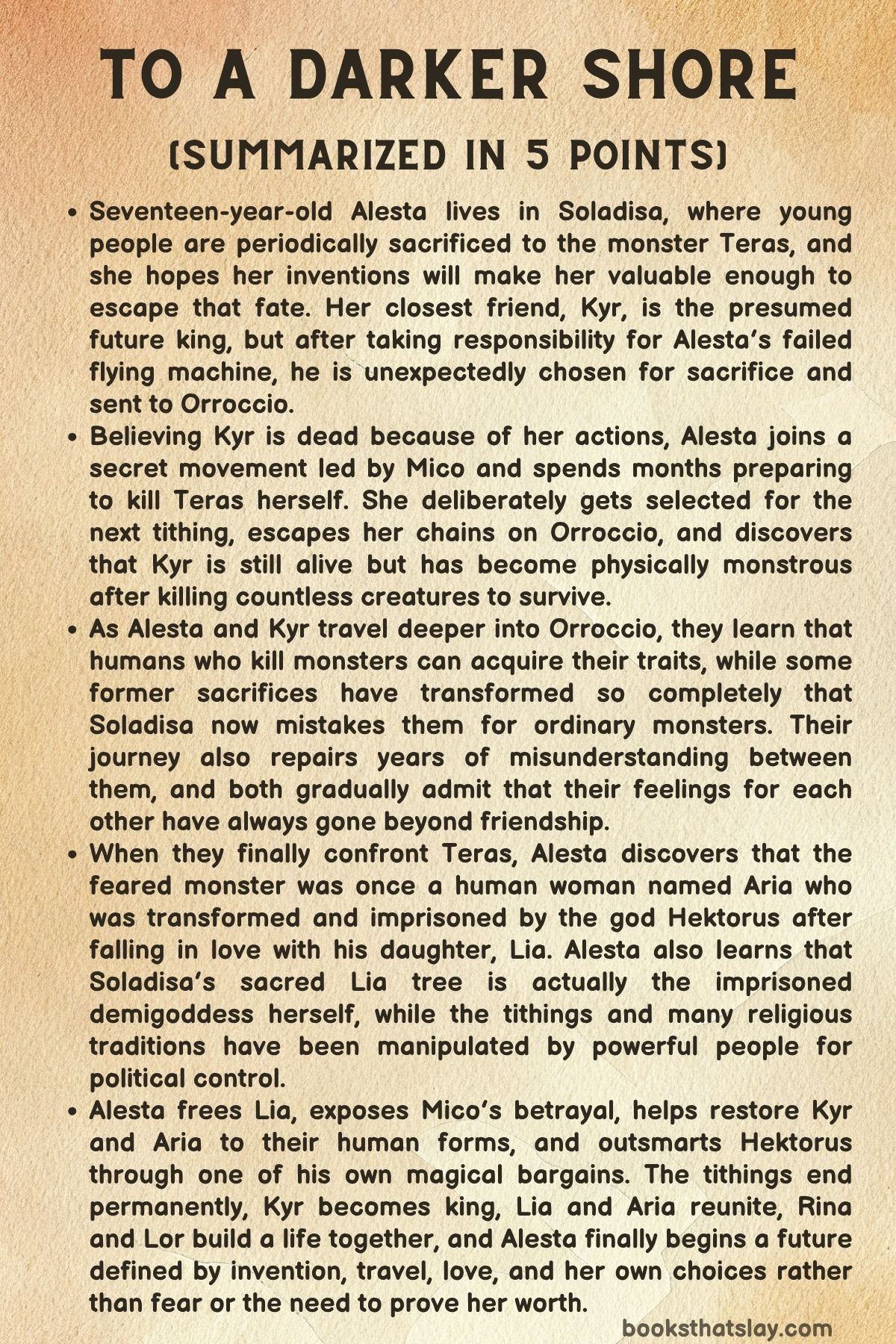
Seventeen-year-old Alesta lives in Soladisa with her grandmother Nonnina, earning her living as a shepherdess while dreaming of attending university. She is intelligent, inventive, practical, and capable of killing the monsters that occasionally threaten the countryside, but she lives beneath the constant fear of Soladisa’s tithing system, through which young people are periodically chosen and sacrificed to Teras, the terrifying creature said to inhabit Orroccio.
Her closest companion is Kyrian, usually called Kyr, a young nobleman expected to become Soladisa’s next king. Although Kyr appears graceful, polite, and perfectly suited to court life, public expectations exhaust him, and he feels that the person everyone admires is largely a carefully maintained performance.
Alesta has her own reasons for feeling inadequate. Religious teachings repeatedly tell her that her body, appetite, behavior, and differences represent failures that must be controlled, while class divisions constantly remind her that people such as Kyr are protected in ways that people such as her are not.
Determined to become too useful to sacrifice, Alesta designs a flying machine and hopes to impress university officials with it. Kyr secretly helps her obtain kharis, a sacred substance ordinarily unavailable to common people, and their work together reveals the depth of their affection even though neither is willing to confess romantic feelings.
The machine initially succeeds spectacularly during a public demonstration. Disaster follows when the combination of kharis and monster hide causes its wings to deteriorate, sending the invention crashing into Rina, the daughter of the influential Davina Bianca.
Knowing that she could lose both her university future and possibly her life, Alesta begs Kyr to accept responsibility because his social position will protect him. He does so, but the use of sacred kharis with monster material turns the accident into a religious scandal, and Kyr’s reputation suddenly becomes far more vulnerable than either of them expected.
Soon afterward, Kyr is selected for the next tithing. He asks for Alesta before his departure, hoping to see the person who has mattered most to him since childhood, but Nonnina becomes gravely ill and Alesta never receives the message in time.
Kyr leaves believing Alesta deliberately abandoned him. Alesta discovers the truth only after his ship has departed and becomes convinced that her request for him to claim responsibility for the failed invention ultimately caused his death.
Her grief transforms into determination when Mico introduces her to a secret movement attempting to end the sacrifices. They intend to send someone to Orroccio who can survive long enough to kill Teras, and Alesta volunteers after months of study, combat training, and weapons development.
During this period she finally enters university, but the achievement provides little satisfaction because her real purpose has become reaching Orroccio. After Nonnina dies, Alesta deliberately commits acts that she believes will cause the religious authorities to select her for sacrifice, even destroying the sacred Codex Anima.
Rina assists her and becomes an unexpected friend. Their growing trust helps Alesta recognize how thoroughly guilt has shaped her behavior, while Rina reveals that she too lives under intense pressure from the expectations of her powerful mother.
Alesta succeeds in being selected and arrives on Orroccio prepared to escape her chains. Using hidden weapons and chemicals, she frees herself and descends into the island, expecting to find the monster responsible for Kyr’s death.
Instead, she discovers that the truth about Orroccio is far stranger than Soladisa’s official teachings suggest. Its creatures can speak, organize themselves, create social structures, and display forms of intelligence and culture that contradict the simple distinction between civilized humans and mindless monsters.
Her greatest discovery comes when an enormous horned creature captures her. After noticing Kyr’s old clothing, paintings, and carvings inside its cavern, Alesta assumes the monster murdered him and prepares to kill it, only to recognize one of its familiar gestures at the final instant.
The creature is Kyr.
Kyr survived his sacrifice because the enormous quantity of kharis placed on him before departure initially protected him. His survival came at a terrible cost, however, because killing monsters without religious absolution transfers aspects of those creatures to the killer.
Over the course of a year, Kyr has killed so many monsters to remain alive that he has become nearly unrecognizable. He possesses scales, claws, horns, altered senses, great physical power, and a frightening appearance, yet beneath these changes he remains the sensitive young man Alesta remembers.
Their reunion exposes a year of misunderstandings. Alesta believes she destroyed Kyr’s life, while Kyr believes Alesta rejected him and remains convinced that his love and desire for her represent dangerous impulses he should suppress.
As they descend together, Alesta learns that some former sacrifices survived long enough to become almost completely monstrous. Some of the creatures Soladisans kill when they approach their homeland may therefore be transformed humans instinctively attempting to return.
Alesta herself begins acquiring monstrous characteristics after killing creatures without kharis. The experience forces both of them to reconsider the categories of human and monster, particularly when they discover that monsters can gain human qualities by killing and consuming humans just as humans gain monstrous qualities by killing monsters.
Their emotional bond gradually repairs itself. Kyr repeatedly protects Alesta while trying to prevent her from sacrificing herself for the mission, and Alesta increasingly realizes that saving him matters as much as destroying Teras.
Eventually they reach the lowest regions of Orroccio, where Teras rules over a strange monster court. When they finally confront the creature, Alesta receives a vision revealing that Teras was once a human girl who was transformed through the actions of the god Hektorus.
Teras does not demand continued human sacrifices. What she truly wants is Lia, the sacred source of Soladisa’s divine magic, and she promises to end the tithings permanently if Lia is returned to her.
Alesta chooses not to kill Teras. She instead accepts the possibility that the creature Soladisa has condemned for generations may herself be a victim, and she escapes with Kyr after using one of her weapons to create a route from Teras’s chamber.
During their ascent, the emotional truth between Alesta and Kyr finally becomes impossible to avoid. Alesta tells him that her desire to save him is not simply guilt and that she loves him, while Kyr slowly begins accepting that his feelings are returned.
Escaping Orroccio creates another problem because Kyr’s transformed body cannot simply return through the sea. Alesta attempts to engineer wings from flying monsters, but an attack destroys her work, forcing Kyr to kill numerous creatures until actual wings grow from his body.
He carries Alesta across the poisonous sea, and during their journey they finally kiss and openly admit their love. They return to Soladisa intending to fulfill Teras’s bargain, only to encounter a new betrayal.
Mico refuses to surrender Lia and reveals that his supposed campaign against the tithings has always been connected to his own political ambitions. He shoots Kyr, murders King Enzo, and attempts to frame Kyr for the king’s death while proposing that Alesta help him seize power.
Alesta refuses and escapes. Rina then reveals another devastating truth through her newly awakened Sight: the tithings have never been impartial divine selections.
Religious authorities have deliberately chosen sacrifices, frequently targeting poor people, outsiders, girls, or anyone considered politically inconvenient. Kyr was selected because Albero Paolo and Davina Bianca wanted him removed after the scandal surrounding Alesta’s invention.
Alesta now understands that neither divine judgment nor her own wrongdoing sent Kyr to Orroccio. Human institutions manipulated religious belief to maintain power.
Further visions lead Alesta to an even greater discovery. Lia is not truly a sacred tree but Hektorus’s demigoddess daughter, whom he transformed and imprisoned after she fell in love with a human woman named Aria.
Aria is the woman who eventually became Teras.
Hektorus separated them by binding Lia to divine power and Aria to monstrous power, forces destructive to one another. Soladisa then spent generations harvesting Lia’s imprisoned body for magical resources while worshiping the system that kept her trapped.
Alesta realizes that her own remaining monstrousness can destroy Lia’s tree form. She embraces the tree and allows the opposing forces to burn against each other, successfully freeing Lia.
Lia heals Alesta and then restores Kyr’s human body, removing the monstrous qualities he accumulated while surviving on Orroccio. She also exposes the religious history surrounding Hektorus as a story of control, bargains, punishment, and concealed truth rather than the simple divine morality Soladisans were taught.
Mico attempts to preserve his authority, but Kyr and Alesta publicly expose his crimes and explain what truly happens to sacrifices. With public opinion turning against Mico, the group prepares to return Lia to Aria before Hektorus can interfere.
Alesta uses the larger flying machine she secretly constructed during her grief to carry Lia, Kyr, and Rina toward Orroccio. When they encounter the endangered ship carrying Lor as a replacement sacrifice, Kyr and Rina leave the flier to rescue those aboard while Alesta continues with Lia.
On Orroccio, Lia attempts to free Aria from the monstrous power binding her to the island. Hektorus arrives before the process can be completed, forcing Alesta to confront the god whose teachings influenced so many of her insecurities.
Hektorus offers Alesta beauty, social approval, an easier mind, Kyr’s safety, and other things she once believed she needed. She recognizes that these offers depend upon convincing her that she is fundamentally inadequate, and she refuses to let him define what a better version of her should be.
Instead, Alesta traps Hektorus through his own rules by making a carefully worded bargain. She asks him to restore the holy magic she lost a thousandfold into the same hand where it burned away, knowing that the wording can refer to Aria rather than herself.
Hektorus agrees before understanding the trick. His divine power flows into Aria, breaking her connection to Orroccio and restoring her human form, after which Lia seals the ancient promise Hektorus once tried to prevent by choosing Aria openly.
With Hektorus defeated by the terms of his own bargain, the supernatural crisis ends. Kyr returns safely to Alesta, and the two are finally able to love each other without treating affection as something shameful or dangerous.
Months later, Soladisa has begun changing. Kyr has become king but refuses to imitate the rigid performance expected from previous rulers, while the tithings have permanently ended and Mico has been imprisoned.
Rina and Lor can openly build their life together, while Lia and Aria marry and work to locate former sacrifices who survived as monsters. Alesta travels beyond Soladisa, discovers new fields of knowledge, and encounters the concept of autism, which gives both her and Kyr a new way of understanding experiences they were previously taught to regard as personal deficiencies.
Alesta continues inventing and plans to establish greater exchange between Soladisa and other lands. Most importantly, she no longer believes she must continually prove that she deserves to exist, and for the first time her future belongs to her rather than to fear, usefulness, religious judgment, or sacrifice.
Characters
Alesta
Alesta is the central force of To a Darker Shore, and much of her development comes from the conflict between how capable she actually is and how inadequate she has been taught to feel. She begins as a practical, scientifically curious young woman who understands machinery, biology, materials, and survival, yet she measures her value almost entirely through usefulness because Soladisa has convinced her that being useful might be the only way to avoid becoming expendable.
Her invention of the flying machine represents both brilliance and desperation. Alesta genuinely loves creating things, but she initially treats achievement as evidence that she deserves to live, which means even her creativity becomes connected to fear and social judgment.
Her relationship with her body reflects the same conflict. Religious authorities and other members of society shame her appearance, appetite, clothing, and behavior so consistently that she often assumes cruelty toward herself is simply realism.
Kyr’s hidden portrait becomes important because it confronts Alesta with physical evidence that someone who knows her deeply sees beauty where she has been trained to see failure. She does not immediately accept that perception, but it begins weakening the certainty with which she condemns herself.
Guilt becomes another major part of her personality after Kyr’s sacrifice. Because she asked him to accept responsibility for the failed flier, she convinces herself that she caused his death and begins treating her own survival as something she no longer deserves.
Her decision to reach Orroccio initially appears heroic but contains a strong self-destructive element. She wants to end the tithings, yet she also chooses herself for the mission because grief has made it easier to regard her own death as acceptable.
Meeting Kyr again begins dismantling this belief. Once she discovers that he survived, that his transformation came from his own struggle to remain alive, and that his tithing was deliberately manipulated, the moral structure behind her guilt begins collapsing.
Alesta’s greatest strength is not simply intelligence but her willingness to revise her understanding when reality contradicts what she has been taught. She begins by believing monsters are enemies and holy power represents goodness, but experience eventually teaches her that labels mean very little without examining who benefits from them.
This intellectual independence reaches its fullest expression when she refuses both Teras’s expected destruction and Hektorus’s tempting bargains. Rather than accepting someone else’s definition of the correct choice, she studies the situation, recognizes the mechanisms involved, and creates another possibility.
Her final development is therefore more personal than political. Ending the tithings matters enormously, but Alesta’s deeper victory lies in accepting that her life does not require justification through achievement, sacrifice, beauty, obedience, or usefulness.
Kyrian “Kyr”
Kyr is one of the most psychologically layered characters in To a Darker Shore because his privilege and suffering exist simultaneously rather than cancelling each other out. He is wealthy, beloved, politically protected, and expected to become king, yet nearly every advantage he possesses comes with expectations that leave little room for an authentic private self.
Courtly perfection functions as Kyr’s survival strategy. He learns to control his speech, reactions, clothing, manners, and sensory discomfort so effectively that most people admire a version of him that has been constructed to prevent criticism.
Painting offers one of his few spaces of genuine self-expression. His secret artwork shows that beneath the polished heir exists a deeply observant and creative young man whose emotional life is far richer than the safe language he uses in public.
His relationship with Alesta is important because she is one of the few people around whom performance becomes unnecessary. He admires her intelligence, determination, unconventional thinking, and physical appearance long before she can imagine herself worthy of that admiration.
Kyr’s central emotional weakness is his tendency to interpret disagreement or desire as evidence that something may be morally wrong with him. Authority figures repeatedly teach him that independent thought disturbs harmony, causing him to mistrust his own instincts even when those instincts involve compassion or reform.
His love for Alesta becomes trapped inside this pattern. Because she describes them as friends and because religious teaching encourages him to fear uncontrolled desire, he interprets his attraction as a dangerous weakness rather than a natural part of loving another person.
Orroccio makes this internal conflict physical. Every monster Kyr kills in order to survive alters his body until he outwardly resembles exactly what his society has taught him to fear.
The transformation therefore becomes more than a fantasy mechanism. Kyr already believed that something unacceptable existed beneath his carefully managed exterior, and Orroccio gives that fear horns, claws, scales, wings, and enormous physical power.
Yet his behavior repeatedly demonstrates that appearance does not determine morality. Even at his most frightening, he protects Alesta, avoids unnecessary killing, creates art, remembers childhood tenderness, and worries more about harming others than about his own pain.
Returning to human form does not simply restore the old Kyr. By then he has learned that becoming himself cannot mean returning to the mask he wore before his sacrifice.
His eventual kingship reflects this development. He reshapes leadership around honesty, practical responsibility, and his actual limitations rather than attempting to perform an idealized image of royalty, making his political transformation inseparable from his personal acceptance.
Mico
Mico initially appears to be one of the novel’s most important allies. He recognizes the horror of the tithings, organizes resistance, helps Alesta prepare for Orroccio, supports her university ambitions, and seems willing to challenge a system that powerful people have accepted for generations.
His later betrayal reveals that his opposition to injustice is conditional. Mico wants the tithings ended, but only in a manner that preserves the power structure and sacred resources he intends to control.
That distinction makes him more dangerous than a simple villain who openly supports sacrifice. He can recognize genuine suffering while still viewing suffering people primarily according to whether they are useful to his political goals.
His treatment of Alesta demonstrates this clearly. He encourages her talents and provides opportunities she desperately needs, but eventually admits that much of his support was an investment in someone he hoped to turn into a politically valuable hero.
Mico’s proposed future with Alesta further exposes his worldview. Even marriage becomes strategic because he imagines her popularity, achievements, and apparent purity as tools that could help legitimize his claim to power.
His murders of Enzo and Ciro show how completely ambition has overtaken whatever reformist principles he may once have possessed. By the end, he reproduces the same logic he supposedly opposed: individual lives can be sacrificed whenever doing so protects the system he wants.
Rina
Rina initially enters Alesta’s life through disaster when the failed flying machine crashes into her. Because she belongs to the wealthy court world that has often humiliated Alesta, she could easily have remained a symbol of privilege, rivalry, or resentment.
Instead, she develops into one of Alesta’s most important friends. Her willingness to forgive Alesta for the accident challenges Alesta’s belief that punishment is the natural consequence of failure.
Rina also demonstrates that privilege does not eliminate personal pressure. Davina Bianca expects her daughter to develop the Sight, fulfill social expectations, and eventually participate in political arrangements that serve the family’s ambitions.
Her anxiety over disappointing her mother creates an important connection between her and Kyr. Both grow up surrounded by advantages, yet both are pressured to perform predetermined identities that leave little space for uncertainty or personal choice.
Rina’s eventual development of the Sight gives her an ability her family valued, but she ultimately uses it against the structures her mother supports. She exposes manipulated tithings, warns Alesta about Mico’s conspiracy, and chooses Lor despite the political future others planned for her.
Her decision to follow Kyr from the flying machine because Lor is aboard the endangered ship captures her final priorities. Love and loyalty become more important than obedience, prestige, or safety.
Lor
Lor receives less narrative attention than Alesta, Kyr, or Rina, but her position reveals the cruelty of Soladisa’s political and religious systems. She belongs to the younger generation whose futures can be destroyed whenever authority figures need a convenient victim.
Her relationship with Rina represents a form of affection that exists outside the future Davina Bianca intends for her daughter. That makes Lor personally important and politically inconvenient at the same time.
When Bianca arranges for Lor to become the next sacrifice, the tithing system is exposed as an instrument of punishment rather than divine necessity. Lor’s selection proves how easily sacred language can conceal personal retaliation.
Her survival also contributes to the hopeful conclusion. By ending with Rina rather than disappearing into Orroccio, Lor becomes one of the clearest examples of a future reclaimed from authorities who believed they had the right to decide it for her.
Nonnina
Nonnina provides Alesta with her closest family connection after the death of her parents. Her poor health makes Alesta both protective and anxious, particularly because caring for her ties Alesta emotionally to the life she is trying to build in Soladisa.
Unlike many authority figures around Alesta, Nonnina encourages her to question other people’s judgments. She wants Alesta to enjoy what life offers rather than allowing every decision to be controlled by fear of social condemnation.
Alesta initially finds this advice difficult to accept because judgment in Soladisa has material consequences. Being disliked, labelled sinful, or considered useless can literally contribute to whether someone lives or dies.
Nonnina’s death removes Alesta’s last strong reason to protect her own life, helping explain why she volunteers for sacrifice. Her absence therefore becomes an important part of Alesta’s movement from grief-driven self-destruction toward eventually discovering reasons to value herself independently.
King Enzo
King Enzo represents the limitations of political authority inside a society where religious institutions possess hidden mechanisms of control. As king, he appears enormously powerful, yet he does not fully understand how the tithings are manipulated.
His treatment of Kyr after the flying-machine scandal also exposes class inequality. A mistake that could destroy Alesta’s life results mainly in delayed political advancement and temporary confinement when society believes Kyr responsible.
Enzo’s love for Kyr becomes most visible when his son is chosen for sacrifice. His decision to cover Kyr with an extraordinary quantity of kharis cannot stop the tithing, but it unexpectedly gives Kyr the protection required to survive his first encounters on Orroccio.
When Kyr returns, Enzo’s reaction contains grief and shame because his son’s transformed body forces him to confront the human cost of institutions he helped preserve. Yet even then he hesitates at the idea of surrendering Lia, showing how deeply societies can become dependent upon benefits produced by injustice.
His murder prevents him from completing that moral reckoning. Nevertheless, his final confrontation with Kyr establishes an important political question: whether preserving prosperity can ever justify sacrificing people who lack the power to refuse.
Davina Bianca
Davina Bianca embodies the alliance between social ambition and institutional control. Her early efforts to connect Rina romantically with Kyr seem like ordinary court maneuvering, but later revelations show that her willingness to manipulate people’s futures extends much further.
She participates in the system that directs supposedly sacred tithing selections toward chosen victims. Her involvement demonstrates that religion in Soladisa is not merely mistaken but actively exploited by individuals who understand how useful fear can be.
Her treatment of Rina is similarly controlling. Rather than allowing her daughter to determine her relationships or future, Bianca imagines Rina as part of a political arrangement capable of strengthening the family’s position.
Selecting Lor for sacrifice becomes her most disturbing action because private disapproval is converted into a death sentence disguised as divine will. Bianca therefore represents the kind of authority that rarely needs to commit violence personally because institutions can be instructed to perform it.
Albero Paolo
Albero Paolo represents religious authority at its most controlling and self-protective. He teaches moral categories in a way that encourages shame, particularly when judging Alesta’s body and behavior.
His conversations with Kyr reveal another aspect of his influence. When Kyr proposes reforms that might help poorer students enter university, Paolo does not seriously examine the injustice Kyr identifies but instead frames change itself as a threat to harmony.
This response teaches Kyr to mistrust moral instincts that challenge established systems. Paolo’s power therefore operates not only through rules but through convincing people that questioning those rules indicates personal failure.
His involvement in Kyr’s deliberate selection for tithing confirms that his religious authority has become political power. Once sacred rituals can secretly remove inconvenient individuals, Paolo’s language of virtue and sin becomes a mechanism for maintaining hierarchy.
Lia
Lia first exists in the public imagination as Soladisa’s sacred tree, a divine resource whose leaves, fruit, bark, and other materials provide extraordinary powers. The revelation that she is actually a living demigoddess transforms the meaning of everything Soladisa has called holy.
Her imprisonment reveals that an entire nation’s prosperity has depended upon treating a person as a resource. Generations have harvested her body while celebrating the structure that prevents her from choosing her own life.
Once freed, Lia behaves very differently from the divine system associated with her father. She heals Alesta and Kyr without demanding bargains, obedience, sacrifice, or repayment.
Her love for Aria gives her character further significance. Hektorus attempts to define whom Lia may love and transforms both women when she refuses, turning their separation into the foundation upon which Soladisa later builds its religious order.
Lia’s freedom therefore represents more than rescue. It restores personhood to someone who has been transformed into an institution, a resource, and a symbol for so long that almost nobody remembers she possesses desires of her own.
Aria / Teras
Aria is initially known only as Teras, the enormous monster Soladisans have been taught to regard as the ultimate source of evil. Every tithing is justified as a necessary payment to prevent this creature from destroying the kingdom.
The revelation that Teras was once Aria changes the moral structure of the entire story. She was a human woman who loved Lia and was punished by Hektorus for that relationship.
Her monstrous form is therefore not evidence of moral corruption. It is the physical result of divine punishment, imprisonment, separation, and centuries of suffering.
Aria’s fragmented memories of green landscapes, songs, and her former life allow traces of the person beneath Teras to remain visible even before Alesta understands the truth. Her fury is inseparable from loss because she has spent generations trapped away from the woman she loves.
Her demand for Lia initially appears threatening because Soladisa understands Lia only as a magical resource. Once Alesta realizes that Lia is a person, Aria’s demand becomes tragically simple: she wants the woman taken from her.
Restoring Aria to human form finally breaks the identity imposed upon her. Her reunion with Lia demonstrates that a person labelled monstrous for centuries can still possess a history, a name, a love, and a self that existed before others defined her.
Hektorus
Hektorus is powerful not merely because he possesses divine abilities but because he controls situations through bargains, language, mythology, and other people’s desires. His influence remains present throughout the story long before he physically appears.
Soladisa’s religious culture treats him as a moral authority, allowing institutions associated with his worship to classify people as virtuous, sinful, holy, or monstrous. The eventual revelation of his personal history exposes how unreliable those classifications are.
His treatment of Lia and Aria demonstrates a deeply possessive understanding of power. Rather than accepting Lia’s choice, he manipulates the terms of a promise and then transforms both women so their opposing natures prevent them from being together.
His confrontation with Alesta reveals why his power has been so effective. Instead of simply attacking her, he identifies her insecurities and offers to remove everything she has been taught to dislike about herself.
Alesta defeats him by refusing the assumption beneath those offers. Once she no longer believes that beauty, social approval, neurological conformity, or even safety must come through someone else’s permission, Hektorus loses much of his ability to control her.
Phoebe
Phoebe offers one of the clearest examples of the novel’s complicated treatment of monstrosity. She possesses curiosity, intelligence, aesthetic interests, and social awareness, yet she also treats human beings as collectible objects.
Her partly human appearance is especially disturbing because it was acquired through killing and consuming humans. She demonstrates that movement between human and monstrous characteristics can occur in both directions without producing moral improvement.
Phoebe’s fascination with Alesta is therefore possessive rather than compassionate. She desires human qualities while showing little respect for the humanity of the people from whom those qualities are taken.
Her decision to exploit Alesta as Kyr’s weakness also reveals her ability to understand emotional relationships. Phoebe is not frightening because she lacks intelligence or feeling but because intelligence can exist alongside cruelty.
Kyr’s Mother
Kyr’s mother loves her son but has internalized the values of the court so deeply that much of her care takes the form of attempting to correct him. She believes his security depends upon fitting the role designed for him.
After the flying-machine scandal, she encourages him to abandon the barn, experimentation, and Alesta so he can return to acceptable royal behavior. Her reaction reveals how parents can reproduce harmful expectations while genuinely believing they are protecting their children.
Her terror when Kyr is selected for sacrifice demonstrates that her love is real. Yet she lacks the ability to challenge the larger structure until that structure turns directly against her son.
The later rebuilding of their relationship suggests that reconciliation is possible, but it requires accepting Kyr as a person rather than as a royal project whose differences must be concealed.
The Seer Graziela
Graziela is largely present through the records she left behind, but those records shape Alesta’s first understanding of Orroccio. Her writings provide practical information that helps Alesta survive the early stages of her descent.
At the same time, Alesta eventually discovers that historical accounts cannot perfectly explain a reality filtered through incomplete knowledge and inherited belief. Graziela therefore represents the importance and limitation of recorded knowledge: documents can preserve vital truths while still requiring later readers to question what their authors could not fully understand.
The mysterious guidance connected to Graziela also becomes part of Alesta’s eventual discovery of Lia and Aria’s history. Through these fragments, the past begins challenging the official version of Soladisa’s religious origins.
Ciro
Ciro has very little direct presence in the events described, so his characterization remains limited. His greatest narrative significance emerges through the revelation that Mico murdered him with branzono poison as part of his effort to position himself for political power.
That revelation expands the scale of Mico’s corruption. Ciro’s death demonstrates that Mico’s later murders and betrayals are not sudden acts committed under pressure but part of a longer willingness to remove human obstacles through violence.
Themes
The Use of Religion to Create and Protect Power
In To a Darker Shore, religious authority becomes dangerous when spiritual belief is converted into a system that cannot be questioned. Soladisans are taught that tithings are sacred necessities, that kharis smoke identifies sacrifices through divine judgment, and that obedience maintains harmony, creating a culture in which resistance can easily be described as sin.
The later discovery that religious officials intentionally direct the tithing selections changes the meaning of the entire practice. Poor people, outsiders, politically inconvenient individuals, and those considered socially undesirable are not dying because a supernatural power selected them; they are dying because authorities learned that divine language could make political violence appear inevitable.
Kyr’s experience shows how this system controls even privileged people. Albero Paolo repeatedly teaches him to interpret challenges to existing structures as evidence that his judgment is defective, which encourages Kyr to police his own thoughts before anyone else needs to silence him.
Alesta experiences the same mechanism through shame surrounding her body, behavior, appetite, and usefulness. When people believe their natural characteristics might reveal moral failure, power no longer needs to rely solely on punishment because individuals begin disciplining themselves.
The exposure of Lia’s imprisonment deepens this criticism. Soladisa has literally constructed prosperity around harvesting an imprisoned person while calling that exploitation sacred, demonstrating how easily collective benefit can prevent people from questioning what their comfort actually costs.
The story ultimately separates faith from unquestioned institutional obedience. Moral responsibility requires examining consequences, asking who benefits, listening to those who suffer, and retaining the freedom to challenge any authority that declares injustice necessary.
Humanity, Monstrosity, and the Danger of Labels
The distinction between human and monster initially appears absolute. Soladisans are taught that people belong to civilization while the creatures of Orroccio represent corruption, danger, and moral disorder, making their destruction seem unquestionably justified.
Kyr’s transformation destroys that certainty. He becomes physically terrifying through the acts required to survive, yet his compassion, creativity, loyalty, fear, and love remain recognizable beneath his altered appearance.
The revelation that former sacrifices may have become the monsters attempting to return to Soladisa creates an even more disturbing reversal. Creatures killed as threats may actually be people who were first abandoned by their homeland and then attacked when they tried to return.
Alesta’s own transformation forces her to experience the instability of these categories directly. Monstrous characteristics can enter a human through killing, while creatures such as Phoebe can acquire human characteristics through consuming humans, proving that physical qualities cannot function as reliable measurements of morality.
Aria represents the most extreme example of false classification. For generations she is remembered only as Teras, yet behind the monster exists a human woman whose body was transformed through punishment and whose rage grew from centuries of imprisonment and separation.
The theme therefore asks readers to distinguish appearance from action and inherited labels from actual history. A frightening body can belong to a compassionate person, a beautiful courtier can be cruel, a supposedly holy institution can commit atrocities, and a feared monster can be someone whose humanity was deliberately hidden.
Self-Worth Beyond Usefulness, Beauty, and Conformity
Alesta spends much of the story believing that survival must be earned. She wants university admission not simply because she loves knowledge but because becoming visibly useful appears to offer protection in a society where people judged unimportant can be sacrificed.
This belief affects nearly every part of her identity. Achievement becomes proof of worth, physical appearance becomes evidence in a case she continually builds against herself, and failure feels less like an ordinary mistake than confirmation that other people’s contempt may be justified.
Kyr experiences a parallel struggle through performance rather than productivity. He learns to imitate the manners, expressions, speech, and behavior expected of an ideal heir so thoroughly that he fears the person beneath the performance may be unacceptable.
Both characters therefore spend years constructing acceptable versions of themselves. Alesta performs confidence and usefulness, while Kyr performs effortless royal perfection.
Their relationship gradually provides another standard of value. Kyr sees beauty and brilliance in Alesta even when she fails, while Alesta continues recognizing Kyr beneath scales, horns, claws, and every other characteristic that should theoretically make him unacceptable.
Hektorus’s final temptation turns the theme into a direct confrontation. He offers Alesta the body, mind, approval, and social ease she once thought would make her worthy, but accepting those gifts would require agreeing that her present self is a defective version awaiting correction.
Her refusal shows how far she has developed. By the ending, achievement can still matter and personal growth can still matter, but neither determines whether she deserves dignity, love, safety, or a future.
Love, Choice, and the Right to Determine One’s Own Future
Love repeatedly comes into conflict with systems that treat people’s futures as property. Alesta and Kyr are constrained by class expectations, royal responsibility, religious shame, and fear, while Lia and Aria are separated by a god who refuses to accept his daughter’s choice.
Rina and Lor face a similar struggle on a smaller scale. Their relationship becomes unacceptable not because it harms anyone but because it interferes with the political marriage others have imagined for Rina.
The tithings represent the most extreme denial of choice. Young people are told that their bodies belong to the survival of the kingdom and can therefore be surrendered without meaningful consent, while survivors who become monsters lose even their names and identities within Soladisa’s historical memory.
Against these systems, love becomes important not because it automatically solves conflict but because genuine love repeatedly recognizes another person’s right to remain a person. Alesta refuses to abandon Kyr because his changed body does not erase who he is, while Kyr eventually learns that protecting Alesta cannot mean deciding that his own death would be best for her.
Lia’s reunion with Aria completes the argument. Their relationship was originally destroyed by Hektorus’s refusal to accept Lia’s right to choose whom she loved, and restoring that choice overturns centuries of suffering built upon his interference.
The ending extends this principle beyond romance. Kyr chooses what kind of king he will become, Alesta chooses a life of learning and invention without making achievement a condition of worth, Rina and Lor choose each other, and Lia and Aria finally determine their own future, turning freedom itself into the foundation upon which a different Soladisa can be built.