Westerly Summary, Characters and Themes | Susan Donovan Bernhard
Westerly by Susan Donovan Bernhard is a multigenerational novel about identity, family, secrecy, survival, and the consequences of truths kept hidden for too long.
Beginning with a German child displaced after World War II, the story follows the life she constructs in America under the identity of a dead Irish girl and examines how that decision affects her husband, daughters, granddaughter, and the sister she left behind. Moving between Ireland and Maine across several decades, the novel asks whether silence truly protects the people we love or simply transfers pain to the next generation. At its center is the difficult possibility of accepting the past without allowing it to determine the future.
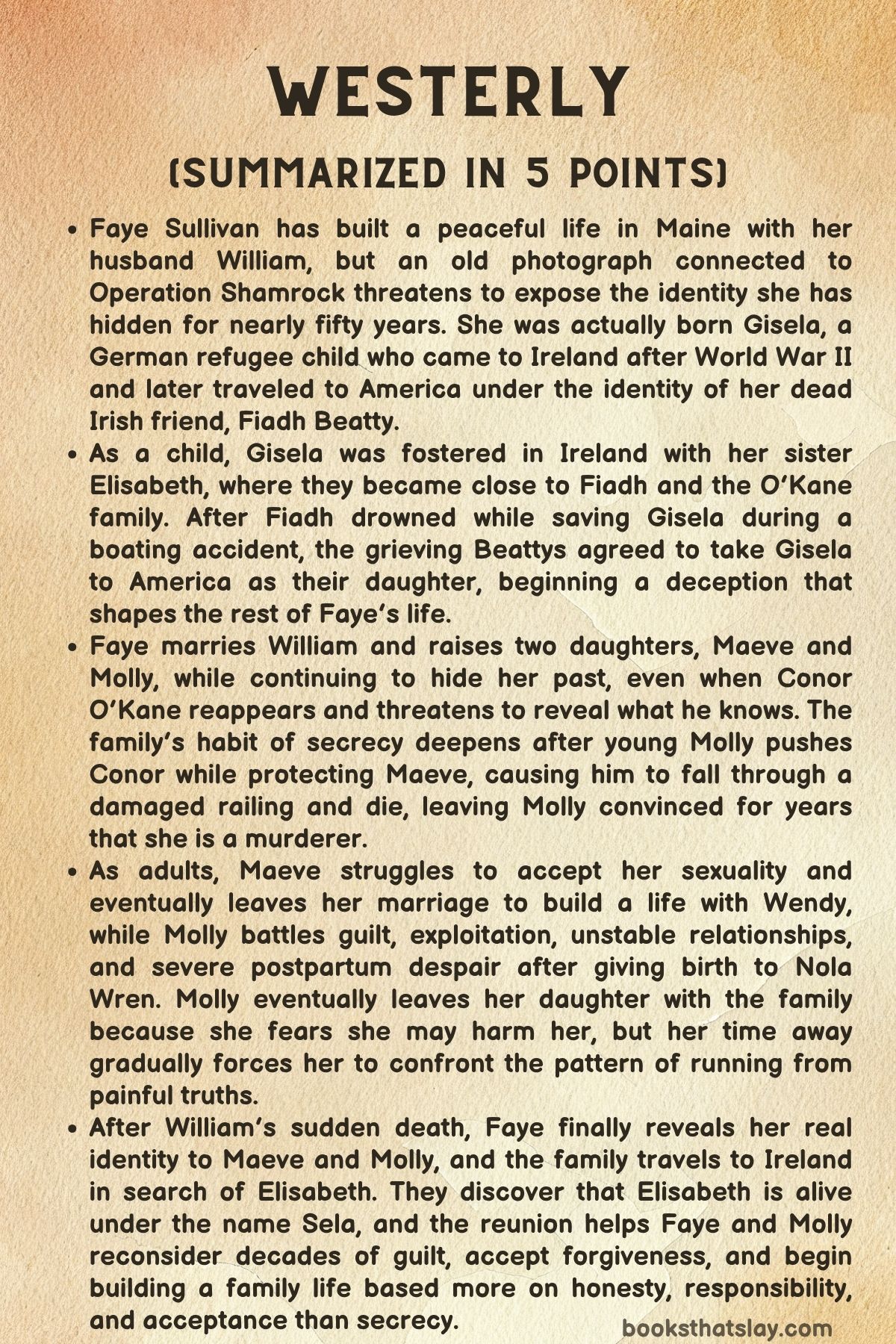
Summary
In 1995, Faye Sullivan is living at her farmhouse in Maine with her husband William when an issue of The Irish Times unexpectedly threatens the life she has built. An article commemorating the fiftieth anniversary of Operation Shamrock contains a photograph of German children brought to Ireland after World War II, and William casually asks whether the girls pictured are children Faye once knew.
Faye recognizes herself in the photograph, but the girl William believes he is looking at is not really the woman he married. Nearly fifty years earlier, Faye had been Gisela, a German refugee child whose identity became permanently entangled with that of an Irish girl named Fiadh Beatty.
The roots of the secret reach back to 1946, when Gisela and her younger sister Elisabeth arrive in Ireland through Operation Shamrock. Both have survived postwar Germany, where hunger, bombing, orphanages, and abuse have taught Gisela to distrust safety, while Elisabeth remains more willing to hope.
The sisters refuse to be separated and are eventually fostered together by Hannie and Hugh Flanagan in West Cork. Their new life introduces them to Fiadh Beatty, an energetic Irish girl who quickly becomes their closest friend, and to the neighboring O’Kane brothers, Denis, Jem, and Conor.
For the first time in years, Gisela begins to experience ordinary childhood pleasures. She learns English, plays outside, works around the farm, and begins believing that Ireland might offer the security she has never known.
That brief happiness changes when Fiadh learns that her parents, Thomas and Jean Beatty, intend to emigrate to Maine after inheriting property from Thomas’s brother. Before Fiadh leaves, she, Gisela, and Elisabeth take a secret boat trip to Carbery Island as a final adventure together.
On their way home, Gisela loses her balance and falls into the sea. Fiadh immediately jumps after her and succeeds in keeping her alive long enough for help to arrive, but Fiadh herself does not survive the accident.
The Beattys are devastated. Jean has already endured the deaths of two sons, and losing Fiadh leaves her almost incapable of facing another future, while the family’s planned immigration to America becomes complicated because their documents assume they will travel with their daughter.
In the confusion that follows, the possibility arises that one of the German girls could travel in Fiadh’s place. Terrified of returning to Germany and of the danger and deprivation she associates with her former life, Gisela takes the decisive step herself: she asks Thomas and Jean to take her to America and declares that she will become Fiadh.
Gisela crosses the Atlantic under the dead girl’s identity. Jean, unable to bear hearing Fiadh’s name attached to another child, gradually renames her Faye, and the German refugee begins constructing an American identity around a deception that originally emerged from childhood fear and survival.
By 1959, Faye is a young woman working in a flower shop in coastal Maine. Her past remains largely unspoken even within the Beatty household, and she has learned to live as though the life before America belongs to somebody else.
She meets William Sullivan, a widower whose own life has been marked by terrible loss. William served during World War II, witnessed the aftermath of Nazi brutality, and later lost his first wife Pauline and their infant son Sterling during childbirth.
Their mutual familiarity with grief draws Faye and William together, although William does not know the true nature of hers. He falls deeply in love with Faye, and she sees in him the possibility of finally belonging somewhere without fear.
They marry in 1960, but the wedding brings the past back into Faye’s life through Conor O’Kane. Now living in America, Conor immediately recognizes her as the girl he remembers as Fiadh and begins making unsettling references to Ireland and the fatal boating accident.
Conor becomes increasingly dangerous because he knows enough to threaten Faye’s identity while also blaming Gisela for Fiadh’s death. His later encounters with Faye become intimidating and sexually aggressive, yet she refuses to tell William what Conor knows because she fears that confession would destroy her marriage.
Faye and William eventually have two daughters, Maeve and Molly. Although their home appears stable and affectionate, Faye continues protecting it through secrecy, convincing herself that concealing painful information is an act of love.
The pattern passes silently to the next generation. As a teenager, Maeve realizes that she is attracted to women and begins a secret relationship with Wendy Walker, but fear of rejection persuades her to conceal a central part of herself from her parents.
Conor discovers Maeve and Wendy together and uses Maeve’s vulnerability to humiliate and threaten her. Soon afterward, he comes to the Sullivan farmhouse and taunts Maeve and Faye, creating a confrontation that young Molly witnesses.
When Conor follows Maeve upstairs, Molly believes her sister is in danger. She kicks and shoves him, and Conor falls through a defective railing to the foyer below, suffering injuries from which he dies.
Rather than explain what happened, William and Faye construct a story in which an intoxicated Conor accidentally fell. Their intention is to protect the girls from scandal and guilt, but Molly interprets the silence differently and grows up believing she killed a man.
Maeve also loses Wendy soon afterward when Wendy’s family leaves Maine. Unable to acknowledge her grief openly, Maeve eventually constructs a socially conventional life with Sam, marries him, and becomes the mother of Dylan and Opal.
Molly responds to the family’s silences in a different way. She becomes rebellious, troubled, and increasingly convinced that something inside her is fundamentally dangerous, while her grandfather Thomas remains one of the few adults who seems capable of accepting her without demanding that she become someone else.
Years later, Maeve unexpectedly reunites with Wendy when Wendy works as a nurse during the birth of Opal. Their former attraction returns, and what begins as renewed friendship develops into an affair that forces Maeve to confront the difference between the life she has built and the life she actually wants.
When Sam discovers the affair, Maeve can no longer maintain both identities. She eventually tells William and Faye that she is leaving Sam and building a life with Wendy, discovering that William’s love is far less conditional than she had feared.
Faye’s first reaction is more focused on secrecy and difficulty, but she eventually recognizes that Maeve did not choose her sexuality; she chose concealment because she had learned to fear what honesty might cost. The realization begins exposing the damage caused by Faye’s own lifelong belief that difficult truths should remain hidden.
Molly’s adulthood is even more unstable. After leaving college, she moves to Washington, DC, works as a nanny, and is sexually exploited by Charlie Grant, who uses money and authority to ensure her silence.
Once again, Molly responds to harm by disappearing rather than speaking. She later meets Leo Doria, whose affection gives her a genuine opportunity for intimacy, but she becomes frightened that he will eventually discover everything she despises about herself.
Molly leaves Leo without explaining herself and soon discovers she is pregnant. She refuses to tell him and eventually returns to Maine, where she gives birth to Nola Wren.
Motherhood intensifies rather than resolves Molly’s buried trauma. During a period of severe postpartum despair, she experiences a terrifying intrusive image of throwing Nola Wren over the same railing associated with Conor’s death.
Believing herself capable of harming her child, Molly leaves Maine and spends two years moving across the country. Maeve and Wendy become Nola Wren’s primary caregivers, while Faye, William, Sam, Dylan, and Opal form a larger family around her.
During her travels, Molly slowly begins recognizing that running has become the central pattern of her life. She finally understands that Thomas’s dying instruction to “go and love” did not mean loving people and then leaving them, but having the courage to remain where love makes her vulnerable.
She finds Leo and tells him that they have a daughter. Leo is devastated that she concealed Nola Wren from him but immediately wants to know his child, forcing Molly to face the consequences of secrecy without escaping.
Back in Maine, the arrival of the Operation Shamrock newspaper photograph finally convinces Faye that she should tell William the truth. Before she can do so, however, William suddenly dies, leaving her with the painful knowledge that the man she trusted most never knew who she had originally been.
Molly returns home just as the family is confronting William’s death. Soon afterward, Faye finally tells Maeve and Molly everything: she was born Gisela, Fiadh died in Ireland, and Thomas and Jean brought Gisela to America under Fiadh’s identity.
The confession triggers another. Molly produces the old photograph she found near Conor’s body and admits that she pushed him, explaining that she has spent years believing herself responsible for his death.
For the first time, the family recognizes how badly their silence injured Molly. Faye decides that the only way forward is to return to Ireland and discover what happened to Elisabeth.
Faye travels there with Maeve, Molly, and Nola Wren. Records initially indicate that Elisabeth died in 1947, apparently confirming Faye’s worst fear that the sister she abandoned survived only briefly after their separation.
At the cemetery, however, the truth proves far more complicated. The grave identified as Elisabeth’s actually contains Fiadh Beatty because the identity changes following the accident confused official records.
Elisabeth is alive and has spent her life in Ireland under the name Sela. She married Jem O’Kane and built a family in the same region Faye spent decades being too afraid to revisit.
The reunion between the sisters is loving but difficult. Faye finally admits that Thomas and Jean originally intended to take Elisabeth to America, but Gisela herself asked to go instead because she feared being returned to Germany.
Sela is hurt, yet she also reveals that she carried knowledge and burdens of her own. Both sisters eventually understand that the decisions they made as children were responses to war, abandonment, abuse, and the desperate need to survive.
Molly also confesses her role in Conor’s death to Sela. Rather than condemning her, Sela explains Conor’s later cruelty and criminal behavior and helps Molly understand that a frightened child trying to protect her sister cannot reasonably bear full moral responsibility for the fatal fall of an intoxicated adult.
Faye and Sela eventually begin forgiving each other and themselves. Molly decides to remain temporarily in Ireland with Nola Wren so that she can recover without simply repeating another act of abandonment.
Back in Maine, the family reorganizes itself around greater honesty. Maeve and Wendy move into the farmhouse with their children, while Faye begins imagining a new shared future built around the farm rather than around preserving an appearance of perfection.
Jean’s long-lost journal finally gives Faye another perspective on the past. It confirms the guilt Jean carried over replacing her dead daughter with another child and reveals that Jean’s emotional distance was rooted not in simple cruelty but in grief she never learned how to face.
Eventually Molly and Nola Wren prepare to return to America, where Leo is waiting to become part of his daughter’s life. Sela sends Faye an image of a memorial stone bearing the names Fiadh, Gisela, and Elisabeth together, allowing the three girls whose lives were altered by one childhood tragedy to be remembered without requiring one identity to erase another.
Characters
Faye Sullivan / Gisela
Faye is the emotional and moral center of Westerly, and nearly every major conflict can be traced to the decision she makes as a frightened German child. As Gisela, she has already experienced hunger, bombing, displacement, exploitation, and uncertainty, so her request to become Fiadh is not initially an act of calculated dishonesty but an attempt to escape a world she associates with danger.
The difficulty comes from what happens afterward. Childhood survival gradually becomes adult concealment, and Faye repeatedly chooses silence even when she has opportunities to tell William the truth.
Her strongest contradiction is that she genuinely loves her family while repeatedly misunderstanding what love requires. She believes protection means controlling information, preventing pain, and keeping threatening truths outside the home, but those choices create conditions in which Maeve learns to conceal her sexuality and Molly carries unbearable guilt alone.
Faye is also shaped by unresolved shame about being German in the aftermath of World War II. William’s wartime experiences make her especially afraid that he could associate her with the country whose crimes traumatized him, even though she herself was a child victim of war rather than a participant in it.
Her development depends on learning to reinterpret herself. The photography book she encounters after William’s death allows her to see Gisela as a displaced child rather than as somebody who must spend her entire life paying for survival.
Her reunion with Sela completes that process without simplifying it. Faye must admit that she actively asked to be taken instead of Elisabeth, accept her sister’s anger, and recognize that forgiveness requires acknowledging responsibility without turning responsibility into lifelong self-punishment.
William Sullivan
William represents one of the novel’s clearest examples of love complicated by incomplete knowledge. A veteran who witnessed the consequences of Nazi violence and then endured the deaths of his first wife and infant son, he has more reason than most characters to fear loss, yet he repeatedly responds to the people he loves with patience rather than control.
Faye underestimates him for most of their marriage. She assumes that knowledge of her German origins and stolen identity might destroy his love, but his later response to Maeve’s sexuality and Molly’s disappearance suggests that he is capable of accepting truths far more complicated than Faye imagines.
William is not entirely outside the family’s culture of silence. After Conor’s fatal fall, he helps construct the false explanation that protects Molly and Maeve from legal and public scrutiny, showing that his protective instincts can also contribute to concealment.
The difference is that William generally approaches weakness without demanding perfection. His willingness to tell Molly that frightened people sometimes make desperate choices becomes one of the insights that finally enables Faye to reconsider her own German mother.
His sudden death is especially painful because it occurs just when Faye decides to trust him with the complete truth. William therefore becomes both the great security of her adult life and the person whose acceptance she never allows herself to test.
Maeve Sullivan
Maeve grows up in a household that appears loving and stable but quietly teaches her that difficult truths can threaten family harmony. Her developing attraction to Wendy therefore becomes something she experiences through both desire and fear, and secrecy initially feels safer than asking whether her parents can accept her.
Her relationship with Wendy reveals the difference between knowing who she is and being willing to live openly. Wendy recognizes her sexuality earlier and more confidently, while Maeve spends years trying to build a conventional identity around marriage, motherhood, and social respectability.
Her marriage to Sam is not portrayed as meaningless. Maeve genuinely values him and discovers real confidence through motherhood, which makes her eventual decision more complicated than simply rejecting a false life.
When Wendy returns, however, Maeve can no longer ignore the emotional part of herself she abandoned. Her affair causes harm, particularly to Sam, but it also forces her to confront the cost of organizing her life around fear.
Maeve’s later struggle over Nola Wren demonstrates another side of her character. After raising the child for two years, she becomes fiercely attached and begins treating Molly’s return as a threat, showing how love can create a sense of ownership even in people who believe they are acting selflessly.
Her journey to Ireland broadens her understanding of family. She eventually recognizes that biological connection, caregiving, sexuality, history, and chosen commitment can all be real at once without one form of belonging automatically cancelling another.
Molly Sullivan
Molly is the character who most visibly absorbs the psychological consequences of the family’s secrecy. As a child, she pushes Conor while trying to protect Maeve, sees him fall to his death, and then receives no meaningful explanation because the adults decide that silence will help her forget.
Instead, Molly builds her identity around the belief that she killed a man. Her nightmares, rebellious appearance, thefts, instability, distrust of intimacy, and repeated urge to flee are different expressions of a guilt she cannot properly examine because nobody will openly acknowledge its source.
Her bond with Thomas offers one of the few alternatives to that pattern. He treats her as someone whose strangeness does not need to be corrected, and his command to “fight your fight” gives her a language of survival that she understands only years later.
Molly repeats the family’s habits even while resenting them. Charlie Grant exploits her, yet she remains silent; she loves Leo, yet disappears; she becomes pregnant, yet refuses to tell him; and she leaves Nola Wren because fear convinces her that absence can function as protection.
Her postpartum despair brings the inherited pattern to its most dangerous point. The image of throwing Nola Wren over the railing connects motherhood, Conor’s death, and Molly’s childhood guilt until she interprets herself as a threat to her own child.
Her later growth depends on remaining present when truth becomes uncomfortable. Telling Leo about Nola Wren, confessing Conor’s death, returning to her daughter, and accepting Sela’s forgiveness all require Molly to do what earlier generations repeatedly failed to do: stay in the relationship after disclosure.
Elisabeth / Sela
Elisabeth begins as Gisela’s younger sister but often functions as the emotionally stronger of the two children. She refuses separation, holds onto optimism despite hardship, and repeatedly tries to create continuity in a world that has destroyed nearly every stable structure around them.
After Gisela disappears into the Beatty family, Elisabeth experiences abandonment as a profound betrayal. Her later choice to live as Sela shows that she too undergoes an identity change, although hers develops within Ireland rather than through international deception.
Sela’s adulthood demonstrates an alternative response to trauma. She does not escape suffering, but with Hannie’s guidance she learns that survival cannot consist entirely of living backward, and she eventually builds a loving life with Jem.
Her reunion with Faye prevents Westerly from treating forgiveness as automatic. Sela is genuinely hurt when she learns that Gisela asked to be taken in her place, and her anger gives moral weight to the sister who was left behind.
At the same time, Sela refuses to reduce either of them to the worst decision made during childhood. Her willingness to forgive Faye and later Molly comes from experience rather than sentimentality: she understands that damaged children often make choices using the limited forms of safety available to them.
Fiadh Beatty
Fiadh exists physically for only part of the childhood story, yet her absence shapes nearly every decade that follows. Energetic, affectionate, adventurous, and immediately welcoming toward Gisela and Elisabeth, she represents the ordinary childhood freedom the German sisters have been denied.
Her death is fundamentally an act of rescue. She jumps into the water to save Gisela, and that selfless action becomes tragically transformed into the foundation of guilt, secrecy, resentment, and identity substitution.
Afterward, Fiadh becomes several different things to different people. To Jean she is the irreplaceable daughter whose memory prevents full acceptance of Faye; to Thomas she is a painful lost child; to Conor she becomes the basis for blaming Gisela; and to Faye she becomes the life she believes she stole.
The novel ultimately resists allowing Fiadh to exist only as an identity Faye occupies. The memorial that joins Fiadh, Gisela, and Elisabeth restores her as one of three distinct girls whose lives became permanently connected.
Thomas Beatty
Thomas combines tenderness, pragmatism, guilt, and moral compromise. After Fiadh’s death, he participates in taking Gisela to America under his daughter’s identity, apparently convincing himself that the arrangement can save both his devastated wife and a displaced child.
Unlike Jean, Thomas becomes capable of loving Faye as his daughter. His insistence that she stop looking backward gives her emotional security, but it also encourages the belief that difficult history should be sealed away rather than confronted.
His handling of Conor reflects similar instincts. Thomas recognizes Conor as dangerous and eventually rejects his presence around the family, yet he never fully explains the historical connection that gives Conor such power.
Thomas is especially important to Molly. His affection for her unusual appearance, love of stories and poetry, and refusal to respond to her rebellion with panic give Molly an experience of acceptance that she does not consistently receive elsewhere.
His final advice contains the moral possibility the family eventually grows toward. “Fight your fight” and “Go and love” encourage action and attachment rather than shame, although Molly must first misunderstand those instructions before learning what they require.
Jean Beatty
Jean is one of the book’s most difficult characters because grief has damaged her capacity to separate love from possession. Having already lost two sons before Fiadh dies, she experiences her daughter’s death as another unbearable removal and participates in replacing Fiadh with Gisela without ever truly accepting the emotional consequences.
Her inability to call the child Fiadh leads to the new name Faye. That renaming reveals the contradiction at the center of Jean’s relationship with her adopted daughter: she needs Gisela to occupy Fiadh’s place for practical and emotional survival, yet she cannot tolerate pretending that the girls are actually the same.
Jean’s coldness toward Faye and later Maeve is harmful, but her journal eventually complicates any simple judgment of her. She understands that what happened in Ireland was morally wrong and recognizes that another human being cannot erase the daughter she lost.
Her attachment to Conor also becomes understandable through grief. He represents Ireland, the O’Kanes, and the life in which Fiadh was still alive, making him a connection to a past Jean cannot release.
Conor O’Kane
Conor is the primary human threat across several generations of the family. As a boy he participates in the childhood world around Fiadh, Gisela, and Elisabeth, but as an adult his knowledge of the identity switch gives him unusual power over Faye.
He deliberately attacks her deepest guilt by blaming Gisela for Fiadh’s death. His intimidation becomes sexual as well as psychological, revealing that his attachment to Fiadh has developed into an unhealthy sense of entitlement toward the woman occupying her identity.
Conor later directs the same invasive behavior toward Maeve. Discovering her with Wendy allows him to exploit another private truth, and he immediately uses sexual humiliation and threats rather than empathy.
His death complicates his role because Molly spends years interpreting him primarily as her victim. Glenda’s grief intensifies that interpretation until Sela later supplies a broader account of his cruelty, criminal associations, and betrayal of his own brother.
The story does not require Conor to become sympathetic in order to acknowledge that his death matters. His role instead demonstrates how a destructive person can still become the center of another person’s guilt when the circumstances of death are surrounded by silence.
Wendy Walker
Wendy represents a form of self-knowledge that Maeve initially lacks. As a teenager, she is more willing to name her sexuality and does not understand why their relationship must be treated as something shameful.
Her frustration with secrecy is therefore central to her relationship with Maeve. Wendy wants love to exist openly, while Maeve has learned that concealment is the price of belonging.
When Wendy reappears during Opal’s birth, she returns not merely as an old romance but as evidence that Maeve’s suppressed identity never disappeared. Their renewed relationship eventually becomes an affair, placing Wendy in the morally complicated position of helping Maeve become more truthful while participating in deception against Sam.
Wendy also becomes one of Nola Wren’s primary caregivers. Her attachment to the child makes Molly’s return painful, showing that chosen parenting can create bonds as intense as biological ones.
Leo Doria
Leo enters Molly’s life when she has already become skilled at leaving people before they can reject her. His openness, persistence, intelligence, and obvious affection challenge her belief that intimacy inevitably ends in humiliation or abandonment.
Molly repeatedly tests the relationship by hiding important parts of herself. Even when Leo expresses commitment, she interprets ambiguity as rejection because fear matters more to her than the evidence in front of her.
His response to discovering Nola Wren is significant because he does not minimize Molly’s wrongdoing. He is furious and devastated that years of his daughter’s life were kept from him, yet his first concern is whether Nola Wren is healthy and whether he can meet her.
Leo therefore represents accountability without abandonment. Molly must learn that another person can be angry with her, demand answers, and still remain connected.
Hannie Flanagan
Hannie offers Gisela and Elisabeth their first sustained experience of safety after Germany. Her willingness to foster both sisters together respects the bond between them at a time when other adults are prepared to separate them for convenience.
Her later role in allowing one of the girls to leave with the Beattys is far more morally complicated. Compassion for Jean’s grief leads Hannie into a decision that solves one immediate crisis while creating decades of confusion and suffering.
The letter discovered years later shows that Hannie understood the seriousness of what had happened. Her belief that the act could not be undone captures one of the novel’s central problems: people may recognize a wrong while still choosing silence because correction appears impossible.
With Sela, however, Hannie eventually helps create a healthier relationship with memory. Her guidance teaches Sela that surviving trauma requires building a life in the present rather than continually returning to what was lost.
Hugh Flanagan
Hugh is quieter than Hannie but represents the stability of the foster home the German sisters enter in Ireland. By accepting both girls, he helps preserve their connection and provides a domestic environment entirely different from the displacement and insecurity they experienced before arriving.
His significance is therefore less about individual conflict than about the possibility of ordinary safety. The Flanagan household gives the sisters food, routine, work, community, and enough security for Gisela briefly to begin lowering the defenses created by war.
Jem O’Kane
Jem is initially one of the neighboring O’Kane boys but later becomes Sela’s husband. His adult role provides an important contrast with Conor because two brothers from the same family develop into very different kinds of men.
Sela describes Jem as kind, and the life they build together suggests continuity, patience, and rootedness. He becomes part of the Irish future Gisela never imagined for Elisabeth after leaving.
Jem also helps demonstrate how mistaken Faye’s assumptions about the past have been. While she spends decades imagining catastrophe, Sela has remained in the region and created a stable family life.
Denis O’Kane
Denis occupies a smaller role but becomes important through what Sela later reveals about Conor. As adults, the brothers become connected to criminal activity, and Conor allows Denis to bear consequences that ultimately contribute to Denis dying in prison.
His fate deepens the characterization of Conor. It shows that Conor’s willingness to betray or exploit others is not limited to Faye and her daughters but extends into his own family relationships.
Theresa O’Kane
Theresa’s photograph of the six children becomes one of the most consequential objects in the story. What begins as an ordinary picture of children together eventually survives as documentary evidence capable of challenging the identities adults have tried to rewrite.
Her role demonstrates how material objects can preserve truths that memory and deliberate silence attempt to suppress. Decades later, the photograph links Faye to Gisela, Fiadh, Elisabeth, the O’Kanes, and the childhood moment from which the family secret emerged.
Glenda O’Kane
Glenda humanizes the consequences of Conor’s death without excusing his behavior. To Molly, Conor has existed mainly as a frightening man she believes she killed, but Glenda remembers him as her husband and the love of her life.
Her anger toward the Sullivans becomes devastating because Molly has never been given the emotional tools to distinguish accidental involvement in a death from deliberate murder. Glenda’s grief therefore reinforces the harshest version of Molly’s self-judgment.
At the same time, Glenda knows only part of Conor’s life. Her account demonstrates how every character’s understanding is limited by the version of events available to them.
Sam
Sam represents security during the years when Maeve is trying to construct a conventional adult life. He is kind and dependable, and Maeve’s decision to marry him cannot simply be dismissed as meaningless because their children and years together are genuine parts of her identity.
His discovery of Maeve’s affair exposes the human cost of prolonged self-denial. Maeve has been harmed by secrecy, but Sam is also harmed when that secrecy becomes betrayal.
His continued place within the extended family after their separation suggests that relationships can change without being erased. He remains Dylan and Opal’s father and continues participating in a family whose structure no longer resembles the one Maeve originally tried to maintain.
Nola Wren
Nola Wren is still a very young child for most of the novel, but she becomes central to the emotional choices of the adults around her. Her existence transforms Molly’s private struggle into a question of whether inherited fear will continue into another generation.
She is loved by several people who occupy parental roles. Molly is her biological mother, Leo is her previously uninformed father, and Maeve and Wendy spend two years raising her as part of their household.
The conflict around Nola therefore challenges simple definitions of motherhood. Love, daily caregiving, biological connection, absence, recovery, and responsibility all have legitimate emotional weight.
Nola also gives Molly a reason to confront rather than merely escape her past. The question Sela poses about whether Molly will pass fear to her daughter becomes one of the clearest challenges to the family’s inherited pattern.
Dylan and Opal
Dylan and Opal represent the younger generation growing up inside a family structure that becomes increasingly unconventional but also more honest. They are Maeve and Sam’s children, yet Wendy becomes part of their household and emotional world after Maeve’s separation.
Their attachment to Nola Wren also reveals how children experience family through belonging rather than through legal categories. Opal’s insistence that nobody will take away her little sister captures the emotional reality produced during Molly’s absence.
Pauline and Sterling
Pauline and Sterling never participate directly in the main action because both die before William’s relationship with Faye begins. Their deaths nevertheless shape William’s emotional life and explain why love, marriage, and pregnancy are associated with both hope and terror for him.
They also affect Faye’s understanding of William. Knowing that he has survived such profound loss makes her want to protect his restored happiness, but she uses that knowledge to justify withholding the truth rather than trusting his ability to endure it.
Brett
Brett plays a limited but consequential role in Maeve and Wendy’s teenage story. His conflict with Wendy at the prom leaves her stranded, creating the circumstances in which Maeve and Wendy retreat together and are discovered by Conor.
His later death in the car accident intensifies the secrecy surrounding the night. Maeve knows Wendy was not with Brett when the crash occurred but cannot explain where Wendy actually was without exposing their relationship.
Oskar
Oskar, the German exchange student who accompanies Maeve to the keg party, has a relatively small role but carries symbolic significance. Maeve’s parents’ discomfort with Germany has already made the country and language mysterious to her, so his presence indirectly brushes against a history she does not yet know belongs to her own family.
The party also marks the beginning of Maeve’s movement away from isolation. Through that experience, she starts reconnecting with people her own age and becomes more aware of her attraction to Wendy.
Claire
Claire belongs to Maeve’s earlier social life and is connected to the rumors that leave Maeve increasingly isolated. Although her individual role is limited, the breakdown of that friendship helps establish the social environment in which Maeve begins treating personal difference as dangerous.
Her presence therefore contributes to Maeve’s fear of judgment. Before Maeve has fully understood her sexuality, she has already learned that social belonging can disappear quickly.
Herbert
Herbert represents the danger from which Gisela is desperate to escape. During the sisters’ postwar instability, his abuse contributes to Gisela’s association of Germany and family dependency with fear rather than safety.
The later revelation that Elisabeth knew what Herbert was doing adds complexity to the sisters’ childhood relationship. Sela’s efforts to help remove them from his home show that she was protecting Gisela even when Gisela later experienced herself as the sister who had to secure survival.
Gisela and Elisabeth’s Mother
The girls’ German mother exists largely through fragmented childhood memory, and Faye spends decades believing that she abandoned her daughters. That interpretation becomes one of the earliest foundations of Faye’s belief that leaving someone can be an act of selfish survival.
William’s compassionate explanation of Molly’s departure later causes Faye to reconsider the memory. She realizes that Elisabeth had bolted the door and that their mother may have left temporarily in search of food rather than deliberately abandoning them.
The correction matters because it changes the emotional inheritance passed through three generations. Actions that look like rejection may sometimes emerge from desperate attempts at protection, although the harm caused by separation remains real.
Charlie Grant
Charlie represents adult exploitation disguised by social power and respectability. As Molly’s employer, he uses his position, her dependence, and his wife’s absence to pressure her sexually, then relies on money and silence to protect himself from consequences.
His behavior reinforces Molly’s existing belief that harmful experiences should be concealed. When she later sees him with another frightened nanny, however, she recognizes that silence does not merely protect the victim from exposure; it may also leave the aggressor free to harm someone else.
That recognition becomes an important stage in Molly’s movement toward responsibility. She begins to understand that speaking can be frightening without automatically being more destructive than concealment.
Sideny Grant
Sideny occupies a smaller role and is largely connected to the household in which Molly works. Her wealth and professional status help create the environment of privilege surrounding Charlie, although the supplied story does not suggest that she knowingly participates in his exploitation of Molly.
The diamond bracelet Molly steals from her becomes symbolically important. Molly carries it long after leaving Washington, allowing an object connected to shame, anger, wrongdoing, and retaliation to remain part of her identity until she eventually pawns it during her journey toward change.
Brenda
Brenda offers Molly a practical form of solidarity after the Grant household collapses around her. As a former nanny, she recognizes enough of the situation to encourage Molly to report Charlie rather than disappear quietly.
Molly refuses, but Brenda’s response is still important because it provides an alternative to the family lesson Molly has internalized. Someone finally tells her that wrongdoing can be named rather than privately absorbed.
Yarrow
Yarrow helps Molly begin another stage of her life after the Grant family. Through the communal house and the connection to the organic bakery, Yarrow becomes part of an environment in which Molly can temporarily exist outside both her family identity and her Washington experience.
This period does not resolve Molly’s trauma, but it gives her enough stability to form new friendships and eventually meet Leo. Yarrow therefore contributes indirectly to one of the few periods in Molly’s early adulthood when a healthier life appears possible.
Camille
Camille becomes an important friend during Molly’s attempt to create a different life. Unlike people from Molly’s childhood, she is not connected to the hidden history surrounding Conor, Faye, or Ireland, allowing Molly to experiment with being someone less defined by inherited guilt.
Later, Camille becomes important again when Molly is deciding whether to continue running. By telling her that Leo is in Boston and urging her to confront him, Camille pushes Molly toward the difficult honesty that eventually changes the direction of her life.
Themes
Identity, Reinvention, and the Fear of Being Exposed
Identity in Westerly is never presented as a single fact determined only by birth, nationality, sexuality, family name, or biology. Faye is simultaneously Gisela, the German refugee child; the girl who traveled under Fiadh Beatty’s identity; the daughter Thomas genuinely came to love; William’s wife; and the mother and grandmother created through the American life that followed.
The problem is not simply that Faye adopts another identity. The deeper conflict comes from believing that one part of herself can survive only if another part remains permanently hidden.
Maeve repeats the same structure through sexuality. She knows that her attraction to Wendy is real, but she initially treats heterosexual marriage and conventional family life as evidence that she can become the version of herself most likely to be accepted.
Molly reinvents herself through appearance, cities, jobs, relationships, and disappearance. Each transformation gives her temporary distance from guilt, but none changes the underlying belief that the person beneath those identities is dangerous or unworthy of love.
The eventual movement toward healing comes when the characters stop treating identity as a competition in which one truth must destroy another. Thomas can remain Faye’s real father in an emotional sense despite not being her biological father, Maeve can be both a mother and openly gay, and Nola Wren can have meaningful parental bonds with more than one adult.
The memorial joining Fiadh, Gisela, and Elisabeth captures this resolution. The names are finally allowed to exist beside one another rather than requiring one girl’s identity to erase another’s.
Silence, Secrecy, and Inherited Trauma
Silence repeatedly begins as an attempt to protect somebody. Thomas and Jean hide the identity switch because acknowledging it could threaten immigration, expose moral wrongdoing, and force a grieving family to confront circumstances they are barely capable of surviving.
Faye adopts the same logic in adulthood. She hides her origins from William because she fears hurting him, conceals Conor’s behavior to preserve her marriage, and later participates in hiding the circumstances of Conor’s death because she believes Maeve and Molly will be safer if the event simply disappears.
The consequences reveal the weakness in that logic. Maeve learns that unacceptable truths belong in hiding, while Molly is left without any adult explanation for the most terrifying event of her childhood.
Because Molly cannot discuss Conor’s death, she cannot test her belief that she murdered him. The absence of conversation allows a child’s interpretation to harden into an adult identity built around guilt.
The pattern continues when Molly conceals Charlie’s exploitation, disappears from Leo, hides her pregnancy, and eventually leaves Nola Wren. She has learned that survival means removing the truth or removing herself before somebody else can respond.
Breaking the pattern therefore requires more than revealing Faye’s original name. Each character must learn to remain present after disclosure, tolerate anger and disappointment, and understand that truth may disrupt a relationship without necessarily ending it.
The novel treats secrecy as an inheritance not because children are explicitly instructed to lie, but because they observe how adults respond to fear. Healing begins when that behavioral inheritance is finally recognized and interrupted.
Motherhood, Protection, and the Limits of Sacrifice
Motherhood repeatedly raises the question of whether an action remains loving when fear distorts its consequences. Gisela’s German mother is remembered for years as someone who abandoned her children, yet Faye later realizes that she may have been searching for food and attempting to keep them secure.
Jean’s motherhood is similarly contradictory. She loves Fiadh so completely that losing her destroys Jean’s ability to accept another child without comparison, leading her to participate in the identity substitution while emotionally resisting the very replacement she helped create.
Faye believes good motherhood requires shielding Maeve and Molly from pain. Her intentions are often loving, but because protection becomes control over information, she unintentionally teaches both daughters to treat vulnerability as dangerous.
Molly faces the theme most directly after Nola Wren’s birth. Her postpartum despair convinces her that she may harm her baby, and she therefore interprets leaving as a maternal sacrifice rather than abandonment.
Maeve and Wendy complicate motherhood further by raising Nola during Molly’s absence. Their years of feeding, comforting, protecting, and loving her create a parental relationship that remains emotionally real even after Molly returns.
The story refuses to offer a simple definition of the “real” mother because biology, caregiving, sacrifice, presence, and responsibility do not always belong to the same person. Instead, the central standard gradually becomes whether love can move beyond fear into accountable presence.
Molly’s return to Nola matters because she stops assuming that protecting her daughter automatically requires disappearing. Learning to stay becomes a more demanding form of maternal love than leaving.
Guilt, Forgiveness, and Learning to Live Forward
Guilt shapes characters who have caused harm, characters who merely believe they caused harm, and characters who were children when impossible decisions were made for or around them. Faye spends much of her life treating survival itself as evidence of wrongdoing because Fiadh died saving her and Elisabeth was left behind when she went to America.
Molly develops an even harsher form of guilt. Because nobody explains Conor’s death honestly, she decides that pushing him makes her a killer and interprets later suffering as proof of an inner corruption that began on the staircase.
Jean carries guilt over accepting Gisela as a substitute for Fiadh. Hannie recognizes that allowing the exchange created something that could not simply be corrected, while Maeve later feels guilt for overlooking Molly’s childhood suffering because she was consumed with her own loss and fear.
Forgiveness does not erase responsibility in these relationships. Leo can be furious with Molly and still want to know his daughter, Sela can feel betrayed by Gisela’s childhood choice and still forgive her, and Molly can acknowledge the harm caused by leaving Nola without concluding that she must disappear permanently.
Sela’s philosophy of not living backward offers the clearest alternative to lifelong punishment. Remembering the past remains necessary, but using memory solely as evidence for permanent self-condemnation prevents new choices from becoming possible.
Faye’s final peace therefore does not come from proving that nobody did anything wrong. It comes from accepting that frightened people made damaging decisions, that those decisions had consequences, and that an honest future does not require endless punishment for the past.
The closing movement toward shared homes, repaired relationships, new family arrangements, and the memorial containing three names suggests that forgiveness becomes meaningful when memory is preserved without allowing guilt to control every life that follows.