When Dealing with Dragons Summary, Characters and Themes
When Dealing with Dragons by Dana Swift is a fantasy novel built around dragons, metal-based magic, social hierarchy, rivalry, family pressure, and the struggle to decide who deserves control over powerful resources.
At its center are Farren Walsh and James Murphy, two teenagers who appear to be fierce academic competitors but gradually discover how badly they have misunderstood each other. Their developing relationship unfolds alongside larger questions about the treatment of dragons, inherited privilege, abuse, secrecy, and medical ethics. What begins as a scholarship rivalry eventually becomes a fight over freedom, compassion, power, and the survival of creatures believed to have vanished from the world.
Summary
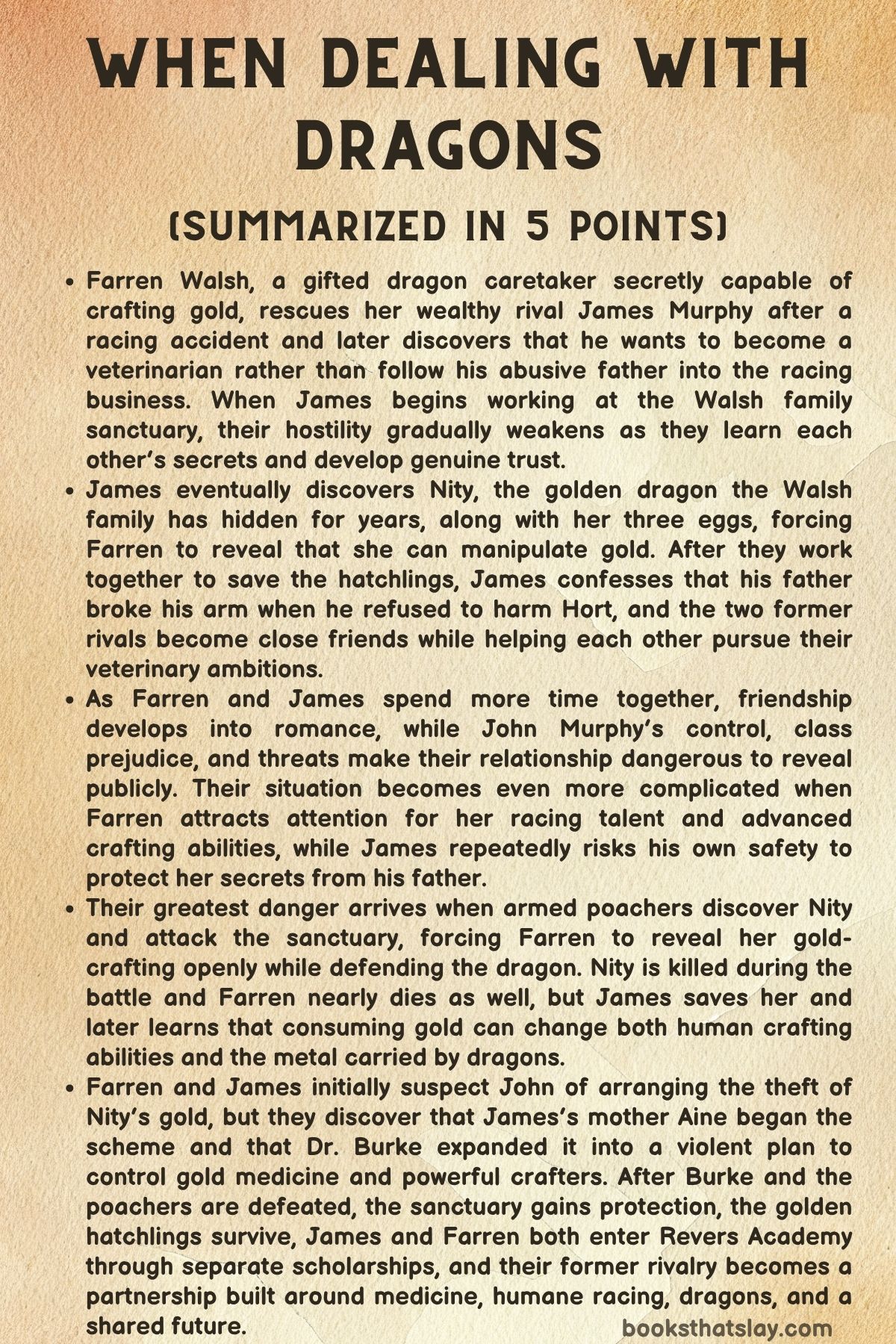
Farren Walsh grows up working beside her veterinarian father, Patrick, at the family dragon sanctuary, where rescued dragons are treated with patience rather than fear. She dislikes the racing industry because dragons are often frightened, injured, and exploited for the metal they produce, and she particularly resents James Murphy, a wealthy silver-crafter and champion rider competing with her for a scholarship to Revers Academy.
During the final dragon race of the season, Patrick notices that James is hiding an injured arm and asks Farren to watch him carefully. When James’s dragon, Hort, suddenly loses control and falls toward the lake, Farren dives after him with her Ocean Swooper, Daphine, rescues him from the water, and secretly uses an extraordinary medicine to save his life.
James survives with a broken arm, but returning home means facing his controlling and violent father, John Murphy. His mother, Aine, helps arrange for him to spend the summer interning with Patrick at the Walsh Sanctuary, allowing James to remain near Hort while gaining veterinary experience and temporarily escaping his father.
Farren is furious when James arrives because she assumes he is trying to strengthen his scholarship application. His presence also threatens a secret her family has protected for years, and Patrick warns James never to approach the cliffs surrounding the sanctuary.
Unknown to Farren, James has liked her since they were twelve. He does not truly want a career in racing; he wants to become a dragon veterinarian, and winning the Revers scholarship would allow him to pursue that future without depending on his father.
Life at the sanctuary forces James to reconsider much of what he has been taught. Dragons are not confined or deliberately frightened there, and the metal used by the Walshes comes largely from naturally shed scales rather than cruel removal, making him increasingly uncomfortable with his family’s racing operation.
Their relationship begins changing when they respond to an emergency involving Hendrix, a badly injured dragon owned by the Murphys. John decides Hendrix should be stripped of valuable silver before being euthanized, horrifying both Farren and James, and when Hendrix’s grieving mother Bex charges toward Farren, Farren instinctively uses hidden silver-crafting abilities to stop her.
Everyone assumes James restrained Bex, but James realizes the truth. He confronts Farren privately, and although she admits that she can craft above her publicly registered copper level, she continues hiding the full extent of her abilities.
James promises to protect her secret rather than use it against her. His decision weakens Farren’s belief that he is selfish and cruel, especially when she recognizes that many of her assumptions about him may have been wrong.
Farren is carrying a far greater secret than James realizes. Hidden in the cliffs is Nity, an enormous golden Rimback, despite golden dragons supposedly having been driven to extinction centuries ago, and Farren herself can craft gold.
The depth of her abilities is connected to the mysterious speed of James’s recovery. When he stopped breathing after his racing accident, Farren gave him gold from Nity rather than ordinary silver medicine, risking exposure of her family’s greatest secret to save someone she still claimed to hate.
During a thunderstorm, James follows Farren into the forbidden cliffs and discovers Nity. He is even more astonished to find three golden eggs, one of which cannot hatch without help, forcing Farren to reveal that she can craft gold.
Working together, Farren and James save all three hatchlings. One is golden, another carries both gold and silver, and the third is silver, showing that Nity had mated with a silver dragon and that metal inheritance is more complicated than society believes.
Afterward, James shares his own most painful secret. John had tried to force him to remove Hort’s scales, restrained him when he refused, and broke his arm, after which his parents tried to conceal the abuse by making the injury appear to have resulted from the racing crash.
Their rivalry changes into genuine trust. They begin teaching each other, with Farren sharing practical veterinary knowledge and James teaching her advanced silver techniques that can provide a public explanation for abilities she should not officially possess.
Farren also begins to understand James himself. The arrogant rival she thought she knew is revealed as someone deeply protective of dragons, frightened of becoming like his father, and determined to build a life based on healing rather than control.
Her feelings change as well. Farren has long wondered why she has never experienced the attraction her friends describe, but while working closely with James she develops her first undeniable crush and gradually accepts that she wants him in her life as far more than a rival.
Their growing affection must remain hidden because the Murphys openly oppose relationships between people from different metal classes. Farren also fears that attention surrounding James could expose Nity and the hatchlings, so the two continue publicly pretending to dislike one another.
John eventually forces James back into racing despite his lack of preparation. James must ride Bex, whose grief over Hendrix has made her dangerous, and the race becomes chaotic when she attacks the rider she associates with her son’s death.
Farren saves another falling rider, Colm, but accidentally reveals that she can craft bronze. James immediately claims responsibility for teaching her, protecting her secret even when doing so places him in greater danger from his father.
That night, Farren and James finally acknowledge their attraction and kiss. Their happiness is brief because Farren believes a relationship will create too much risk for Nity, yet their feelings cannot simply be returned to secrecy once they have admitted them.
John soon tests Farren’s abilities himself and confirms that she can manipulate metals above copper. When he threatens the Walsh family, James again takes responsibility, prompting John to strike him and triggering a confrontation in which Patrick openly challenges John’s control and abuse.
James eventually admits to Farren’s parents that he wants to be with her. Their families’ secrets remain dangerous, but Farren and James stop pretending with those they trust and begin imagining a future involving veterinary medicine, ethical dragon care, and perhaps searching for other surviving golden dragons.
Meanwhile, John retaliates economically against the Walsh Sanctuary by spreading accusations that the family steals silver. The Walshes lose wealthy clients, yet many lower-metal families remain loyal, revealing how strongly class divisions shape both reputation and opportunity.
As Jeffrey and Shelly prepare for their wedding, James crafts a copper shawl for Farren, an intimate gesture carrying romantic significance. They attend the wedding while continuing their public performance of hostility, but privately they accept that their friendship has become love.
Their happiness collapses when armed poachers enter Nity’s cave. Farren openly reveals her gold-crafting powers to defend the dragon, forms protective barriers from the gold surrounding the nest, and eventually rides Nity away to draw most of the attackers from the hidden hatchlings.
James refuses to remain behind while Farren faces the poachers alone. He joins the aerial fight with Hort, choosing to act according to the principle that has increasingly shaped his life: suffering and danger should not simply be watched from a safe distance when someone has the ability to help.
During the battle, Nity is fatally struck. Farren falls into the ocean as well, but James discovers that he can suddenly manipulate gold, slows her fall, finds her beneath the water, and performs CPR until she begins breathing again.
The reason for James’s new ability becomes increasingly important. Gold does more than heal; consuming dragon metal can alter crafting potential, meaning Farren’s decision to save him with gold fundamentally changed what he can do.
Farren awakens to devastating losses. Nity is dead, Patrick and Erin have been injured, and the poachers have stolen the gold from Nity’s cave, leaving the hatchlings without the substance necessary for their development.
A new discovery offers hope when Oria, Electrum, and even Hort begin developing golden scales after consuming Nity’s gold. Nity had apparently been feeding her offspring enough gold to change them, creating a possible path for golden dragons to survive despite the loss of the last known adult female.
Farren and James decide to recover the stolen metal and initially assume John arranged the attack. When they break into the Murphy estate, however, John appears genuinely confused by the gold hidden there, forcing them to reconsider everything.
The true betrayal comes from Aine. Desperate to escape her abusive husband, she had arranged for gold to be stolen so she could finance a new life with James, believing she could later frame John for the crime.
Aine claims she never intended anyone to be killed, but James rejects the idea that Nity’s death and the violence against the Walsh family can be justified as sacrifices made for him. Matters become worse when Dr. Burke appears and is revealed as Aine’s secret ally in the plan.
Burke has ambitions far beyond helping Aine escape. He understands that consuming stronger dragon metals can increase crafting ability and argues that gold could transform medicine and weaken the inherited hierarchy that keeps powerful families in control.
His vision, however, depends on exploitation. He wants to control the stolen gold, transform additional dragons, produce gold medicine, and force Farren and James to work for him, showing that claims of social progress can still become cruel when individuals believe an important goal excuses violence.
Burke attempts to have Farren killed and unleashes a badly abused Bex, but Hort reaches his mother and helps calm her. Bex turns against the poachers, Farren restrains Burke, and the police arrive before he can complete his plan.
The surviving conspirators are arrested, while Aine faces charges for her role in the theft and Nity’s death. John’s racing operation is separately investigated for fraud, illegal overscaling, and mistreatment of dragons, eventually costing him control of his animals.
James is finally able to buy Hort and chooses to remain with the Walsh family. Although he believes some relationship with his mother may eventually be rebuilt, he rejects his father’s values completely and defines superiority not through metal class but through compassion.
Farren no longer needs to hide her abilities after golden dragons become publicly known. She and James are officially confirmed as gold-crafters, while the sanctuary gains protection, financial support, and public attention that helps safeguard the surviving hatchlings.
Farren also repairs her friendship with Cara and receives an opportunity to pursue the humane form of racing she once imagined. James wins the Revers all-around scholarship, while Farren accepts a separate racing scholarship so both can attend the academy without one person sacrificing a future for the other.
By the end, their old competition has become partnership. James can pursue veterinary medicine, Farren can combine medicine with safer racing and the search for other golden dragons, and Nity’s surviving children continue developing as her legacy endures.
Characters
Farren Walsh
Farren is the central force of When Dealing with Dragons, and much of her character is shaped by the contradiction between enormous power and enforced invisibility. Publicly she is treated as a copper-crafter from a modest sanctuary family, while privately she possesses the almost unbelievable ability to manipulate gold.
Her secrecy is not simply a personal choice. Revealing what she can do would expose Nity, threaten the sanctuary, invite legal scrutiny, and attract people who see golden dragons primarily as sources of medicine, wealth, or power.
This responsibility makes Farren unusually self-sacrificing. She gives up recognition, advanced training, friendships, racing opportunities, and parts of her own identity because she believes Nity’s safety matters more than her personal ambitions.
Her greatest strength is her instinctive refusal to watch suffering without acting. She saves James despite believing she hates him, challenges John over Hendrix’s treatment, protects dragons during emergencies, rescues Colm even though she does not like him, and openly exposes her gold-crafting when Nity is attacked.
That instinct can also become a weakness because Farren frequently assumes she must carry danger alone. Her willingness to sacrifice herself prevents her from recognizing that secrecy can become harmful when it isolates her from people who would willingly help.
Her relationship with James forces her to confront her tendency to judge people through assumptions. She has built an image of him as privileged and callous, but repeated evidence shows that much of his behavior came from awkwardness, fear, hidden affection, or his own struggle against the expectations of his family.
Romantically, Farren experiences something new and disorienting. She has wanted love in the abstract without previously experiencing attraction, so developing feelings for James forces her to reconsider what she believed about herself without suggesting that her earlier experiences were somehow defective.
Her final development comes through balance. She remains committed to protecting dragons, but she also begins allowing herself ambition, friendship, love, racing, and professional goals rather than treating happiness as something she must permanently sacrifice.
James Murphy
James is one of the most substantially transformed characters in When Dealing with Dragons, although much of that transformation involves revealing qualities he already possessed but had learned to hide. His reputation as an arrogant silver-crafter and champion racer conceals a frightened teenager living under the control of an abusive father.
His desire to become a veterinarian is therefore both professional ambition and an act of resistance. Veterinary medicine allows him to build an identity around healing rather than racing, profit, fear, and domination.
James has learned to survive through emotional masks. He behaves differently depending on what his father, classmates, competitors, or wealthy families expect, leaving Farren with a distorted impression of who he actually is.
At the sanctuary, he gradually experiences a life in which affection does not have to be earned through victory. Patrick teaches him without humiliating him, Erin treats him as family, the dragons respond to him without fear, and Farren eventually sees the person beneath his performance.
His connection with Hort is particularly important. Refusing to descale Hort is one of James’s earliest acts of direct resistance against John, and his determination to protect the dragon demonstrates that his moral values existed long before he had the safety to express them openly.
James’s affection for Farren also reveals his patience and insecurity. He has liked her for years, yet class expectations, his family’s prejudice, and Farren’s apparent hatred make him assume that wanting her is something he must conceal.
His most important growth involves rejecting passivity. Early in his life he admired Farren because she acted when others watched suffering, and later he consciously chooses the same principle when he enters the battle against the poachers instead of remaining safely behind.
By the conclusion, James separates strength from the definition imposed by his father. Courage becomes compassion, vulnerability, loyalty, and intervention rather than domination, allowing him to imagine becoming a veterinarian, Hort’s permanent guardian, Farren’s partner, and a member of the Walsh family.
Patrick Walsh
Patrick is both Farren’s father and the moral center of the sanctuary’s veterinary philosophy. His approach to dragons is based on observation, respect, medical responsibility, and an unwillingness to treat living creatures merely as sources of valuable metal.
His relationship with James is especially important because Patrick becomes an alternative model of adult masculinity. He teaches, reassures, protects, and praises James without demanding obedience through fear.
Patrick recognizes the signs of John’s abuse before James openly explains them. Rather than forcing a confession, he provides safety and allows James enough control to decide when he is ready to speak.
He also represents practical moral courage. Patrick understands that protecting Nity requires secrecy, but he repeatedly places himself between vulnerable people and those threatening them, including confronting John when the situation becomes openly violent.
As a father, he is protective without treating Farren as incapable. He recognizes the risks created by her extraordinary abilities while still respecting her knowledge and eventually allowing her to make increasingly difficult decisions for herself.
Erin Walsh
Erin provides emotional stability within the Walsh household. Her warmth, humor, curiosity, and direct affection create an environment radically different from the Murphy home, particularly for James.
She quickly treats James as more than an employee or temporary intern. When his abuse becomes impossible to ignore, her response communicates that sheltering him was never merely convenient but an intentional act of protection.
Erin also understands Farren well enough to notice changes in her emotional life before Farren wants to discuss them. Her questions about James may embarrass her daughter, but they come from engagement rather than control.
During the later crisis, Erin proves that the sanctuary’s compassion is not passive softness. She helps bring authorities into the conflict and remains part of the family’s resistance against people who believe wealth or metal status gives them the right to dominate others.
John Murphy
John is a major human antagonist and represents the most destructive form of the social hierarchy surrounding dragon metal. He values strength, status, profitability, obedience, and reputation while treating vulnerability as something shameful.
His abuse of James is central to understanding both characters. Breaking his son’s arm for refusing to harm Hort shows how completely John has confused parental authority with ownership and violence.
His treatment of dragons follows the same logic. Hendrix’s suffering matters less to him than the silver that can be removed, Bex is valuable only while she remains economically useful, and Hort’s welfare is secondary to racing regulations and family profit.
The later revelation that John did not organize Nity’s theft prevents him from becoming a simplistic villain responsible for every evil action in the story. He remains cruel and abusive, but the distinction matters because the book refuses to treat one obvious monster as the source of every form of exploitation.
John’s eventual loss of control is therefore significant. James does not defeat him by becoming more violent or wealthier but by rejecting the entire moral system through which John measures human worth.
Aine Murphy
Aine initially appears primarily as another victim of John’s control. She shows genuine concern for James, helps arrange the sanctuary internship, and wants to create enough distance between father and son to keep James safe.
Her later betrayal complicates that sympathetic portrayal. Aine arranges the theft of Nity’s gold because she wants money to escape her marriage and build a safer life, but she treats the possible harm to dragons and strangers as an acceptable cost.
The fact that her motivation contains genuine fear does not remove her responsibility. Her actions show how someone who has been harmed can still make destructive choices when desperation becomes permission to endanger others.
Her statement that Nity is only a dragon exposes a moral boundary between her and James. James recognizes dragons as living beings whose suffering matters, while Aine ultimately prioritizes her own escape plan over creatures she considers less important.
James’s decision to leave open the possibility of rebuilding trust is equally complex. Forgiveness is not immediate, and reconciliation is presented as something that would require accountability rather than the simple restoration of their former relationship.
Hort
Hort is James’s dragon and one of the clearest reflections of James’s own situation. Both have been constrained by John’s expectations, and both begin to develop more fully once they are removed from the Murphy racing environment.
His physical growth becomes evidence of the harm caused by racing regulations. The cramped stalls have restricted his wings, while life at the sanctuary allows his body and behavior to become healthier.
Hort’s loyalty to James is matched by his affection for Farren. His comfort around both characters helps transform their relationship because caring for him gives them a shared purpose before either is prepared to acknowledge deeper feelings.
His later consumption of gold becomes scientifically significant when golden patches appear on his body. Hort therefore helps prove that metal identity is not as fixed as society has always claimed.
Nity
Nity is the last known adult golden Rimback and the living secret around which many of Farren’s sacrifices have been organized. She represents both the wonder of a species believed extinct and the danger created when rare life becomes economically valuable.
Her trust must be earned rather than commanded. Farren’s bond with her is built through years of care, while James is accepted only after Farren demonstrates that he is safe.
Nity’s role as a mother gives the conservation conflict immediate stakes. Her eggs and hatchlings mean the possible survival of golden dragons depends not simply on protecting one remarkable creature but on allowing an entire future generation to live.
Her death is the book’s most significant loss because it proves that secrecy alone cannot permanently protect endangered creatures from human greed. Even after her death, however, the changes she created in her children ensure that her biological and symbolic legacy continues.
Daphine
Daphine is Farren’s Ocean Swooper and her most important flying partner. She participates in several of Farren’s rescues and demonstrates the level of trust that can exist between a dragon and rider when cooperation replaces coercion.
Through Daphine, Farren’s complicated relationship with flying also becomes visible. Farren genuinely loves the experience of flight even while rejecting the cruelty of conventional racing.
Daphine therefore connects Farren’s veterinary identity with her later decision to participate in a safer racing system. Flying itself is never presented as the problem; exploitation is.
Jeffrey
Jeffrey is part of the sanctuary’s extended family and contributes both practical support and emotional insight. His relationship with Shelly gives the story an adult example of commitment built on mutual care.
He recognizes James’s feelings for Farren before the teenagers fully understand what they are doing and encourages James to acknowledge them. His teasing is affectionate, but he is also willing to discuss the serious risks surrounding their relationship.
Jeffrey’s most serious mistake occurs when he secretly uses Farren’s emergency gold to help treat Shelly. The decision grows from love and desperation, yet it contributes to the chain of events that exposes the existence of gold and eventually places Nity in danger.
His actions reinforce one of the story’s recurring moral ideas: loving intentions do not automatically make secretive or dangerous choices harmless.
Shelly
Shelly combines warmth with a clear understanding of sacrifice because her recurring lymphoma repeatedly confronts her with the uncertainty of the future. Her illness also makes the unequal distribution of metal medicine personally meaningful.
Farren wants desperately to save her with stronger medicine but knows that using unapproved metal could reveal the family’s secrets. Shelly initially refuses that risk, showing how deeply the social system restricts even medical decisions.
Later, she encourages Farren to stop postponing every form of happiness. Shelly understands that devotion becomes destructive when protecting others requires a person to erase every desire, relationship, and ambition of their own.
Her eventual acceptance of silver medicine also reflects a gradual rejection of the idea that medical care should be determined by metal class.
Cara Moore
Cara is Farren’s former closest friend and one of the clearest examples of the personal cost of secrecy. Farren pushes her away not because their friendship lacks value but because Cara’s advancement in crafting makes her increasingly capable of noticing inconsistencies.
From Cara’s perspective, Farren’s behavior appears inexplicable. She watches her friend abandon opportunities, withdraw emotionally, and grow closer to James while refusing to explain why.
Her anger is therefore justified even though she does not possess the information necessary to understand Farren’s decisions. Cara reminds the reader that secrecy does not hurt only the person keeping it; it also injures people who are repeatedly excluded without explanation.
Their eventual reconciliation matters because Farren is not merely gaining public freedom. She is recovering relationships that secrecy forced her to sacrifice.
Willa Quinn
Willa Quinn represents a possible future for dragon racing rather than the cruel system Farren has always known. She recruits Farren for an all-women team built around safer and less violent competition.
Her offer matters because it proves Farren does not have to choose permanently between loving flight and caring about dragon welfare. A different version of the sport can exist if people are willing to redesign its values.
The scholarship Willa offers also becomes crucial to the ending. By accepting it, Farren can attend Revers without taking the all-around scholarship James needs to escape financial dependence on his father.
Colm Ditters
Colm represents many of the attitudes that make the traditional racing environment unsafe and dehumanizing. His reckless behavior contributes to Hendrix’s fatal injury, yet he remains concerned with competition, reputation, and blame.
His treatment of Farren further exposes his lack of respect for boundaries. After she risks herself to save him, he kisses her without consent rather than recognizing what she has actually done for him.
The incident becomes important for James as well because protecting Farren nearly causes him to abandon the public performance that they hate each other. Colm therefore becomes a catalyst for both conflict and greater emotional honesty between them.
Bex
Bex is Hendrix and Hort’s mother, and much of her apparent aggression is actually grief. Humans repeatedly interpret her behavior as evidence that she has become dangerous when the deeper cause is the traumatic loss of one of her offspring.
Her immediate calming response to seeing Hort demonstrates how badly the people around her have misunderstood her. Patrick and the teenagers approach her as a grieving animal rather than a defective racing asset.
Burke later attempts to weaponize Bex after she has been brutally descaled, but Hort’s presence again reaches her. Her decision to turn against the poachers transforms her from a creature treated as a threat into an active defender of her surviving family.
Hendrix
Hendrix has limited direct presence, yet his suffering changes several characters. His paralysis and brutal descaling expose the cruelty hidden behind the economic value of dragon metal.
His death deeply affects Bex and reinforces James’s growing rejection of his father’s racing culture. It also creates one of the first moments in which Farren and James share grief rather than competition.
Hendrix therefore functions as a moral turning point. What happens to him makes the cost of exploitation impossible for either teenager to ignore.
Thorn
Thorn is the dragon ridden by Colm during the race in which Bex attacks him. Although Thorn receives less individual development than many of the other dragons, his involvement demonstrates how one rider’s recklessness can place several animals and humans in danger at once.
The collision involving Thorn, Bex, James, and Colm also recreates the dangerous falling-rider situation that originally brought Farren and James closer. His role reinforces the broader argument that racing structures encourage risks extending beyond the individual rider who chooses to take them.
Dr. Burke
Dr. Burke is initially presented as a medical professional who appears trustworthy, compassionate, and potentially more flexible than the society around him. His willingness to help Shelly receive silver treatment strengthens that impression.
His eventual betrayal is therefore especially significant. Burke understands the hidden relationship between consuming dragon metal and gaining stronger crafting abilities, but instead of revealing the truth ethically, he builds a plan based on theft, coercion, experimentation, and violence.
What makes Burke dangerous is his ability to justify himself through claims of progress. He can plausibly argue that gold medicine might cure illness and undermine hereditary inequality, yet he believes those goals give him the right to exploit dragons and control unwilling people.
His character demonstrates that reform becomes another form of oppression when individuals decide that desirable outcomes excuse cruelty.
Art Whimbley
Art Whimbley is John Murphy’s chief scaler and one of the most physically threatening members of the poaching attack. His earlier presence during James’s abuse links him directly to the culture of cruelty surrounding the Murphy racing operation.
Art reinforces John’s beliefs about strength, masculinity, and domination rather than challenging them. He represents the kind of follower who enables abusive systems by treating cruelty as admirable or necessary.
During the attack on Nity, Art becomes the direct human threat confronting Farren. His use of obsidian is especially dangerous because it cannot be controlled through her metal-crafting, forcing her to rely on physical resistance, Nity’s cooperation, and quick judgment.
Zilar
Zilar is the golden male born from one of Nity’s eggs. His survival provides immediate evidence that golden dragons have not reached the absolute end of their species.
Like the other hatchlings, he turns the idea of conservation into something personal and immediate. Protecting golden dragons is no longer about preserving a mysterious adult animal but about giving vulnerable young creatures enough safety to grow.
His presence also supports James and Farren’s shared dream of building sanctuaries and searching for other survivors.
Electrum
Electrum is the hatchling born with both gold and silver metal, making him living evidence that dragons can cross metal categories. His unusual body challenges assumptions about rigid inheritance before the characters fully understand how flexible metal identity can become.
His later development of additional gold after consuming Nity’s metal strengthens the discovery that metal composition can change. Electrum therefore has importance beyond being one of the young dragons the characters love.
He represents biological possibility in a society that has built social certainty around supposedly fixed metal divisions.
Oria
Oria is the silver female hatchling whose egg Farren must carefully open with James’s guidance. Her difficult birth becomes one of the first major moments in which the former rivals must trust each other completely.
Because she is the only female hatchling, her silver coating initially causes concern about the future of a purely golden line. The discovery of golden scales developing after she consumes gold radically changes that fear.
Oria therefore becomes central to the possibility of restoring golden dragons. Her transformation suggests that the survival of the species depends on understanding change rather than preserving narrow ideas of purity.
Elin
Elin is the young silver Sprinter treated for painful ingrown scales during one of James’s early veterinary procedures. Her condition forces James to confront trauma because removing the scales resembles the abusive descaling his father tried to make him perform on Hort.
The difference lies in purpose and consent within veterinary care. James is not removing healthy scales for profit but treating painful growths to relieve an animal’s suffering.
Helping Elin allows him to separate medical intervention from cruelty and gives him one of his first genuine experiences of becoming the veterinarian he wants to be.
Deb
Deb is one of the rescued Skidders whose medical history Farren uses while teaching James about sanctuary work. Like the other rescued dragons, she has suffered because poachers removed metal from her body.
Her importance lies in the evidence she provides of Farren’s practical experience. James has received prestigious instruction, but Farren has learned through years of rehabilitation work involving animals whose injuries reveal the consequences of the very metal economy surrounding them.
Deb therefore helps James recognize that knowledge is not valuable merely because institutions officially certify it.
Themes
Power, Class, and the Politics of Metal
The metal hierarchy determines far more than magical ability. In When Dealing with Dragons, metal affects education, medicine, wealth, marriage expectations, professional opportunity, reputation, and the degree of authority society automatically grants an individual.
Farren is treated as socially inferior because people believe she can craft only copper, while James receives status simply for belonging to a wealthy silver family. Their actual abilities eventually expose how unreliable these categories are, since Farren has secretly reached gold and James later gains gold-crafting after receiving golden medicine.
The revelation that stronger metal can be consumed to expand human abilities changes the meaning of the entire hierarchy. Silver families have not maintained their position merely because they inherited superior natural gifts; privileged access to medicine has helped preserve the very advantages they present as proof of their superiority.
This creates a self-reinforcing system in which the powerful control the resources that produce power. They can then describe the resulting inequality as natural, allowing social privilege to appear biological rather than political.
The changing metal of Hort and the hatchlings challenges the same belief among dragons. If metal identity can be altered through environment and consumption, then the categories governing society are far less permanent than generations have been taught.
The story therefore questions any hierarchy that turns inherited advantage into a moral ranking. Farren and James ultimately reject the belief that silver or gold makes a person better, measuring worth instead through compassion, courage, responsibility, and the way power is used.
Care Versus Exploitation
Dragons are constantly positioned between two opposing ways of seeing living creatures. One approach recognizes them as beings capable of fear, grief, affection, trust, pain, family attachment, and individual preference, while the other treats them as sources of metal, profit, prestige, entertainment, and medical resources.
The Walsh Sanctuary represents care because the dragons are given space, medical treatment, and the freedom to shed metal naturally. The Murphy racing system represents exploitation whenever animals are frightened into producing scales, confined for commercial purposes, forced into dangerous races, or killed after their economic usefulness declines.
Hendrix’s treatment makes this conflict especially clear. Even after becoming permanently paralyzed, his suffering is treated as secondary to the value of the silver that can be removed from his body.
Bex shows the consequences of ignoring animal emotion. Her aggression is treated as a mechanical problem until Patrick and the teenagers recognize that she is grieving, and her immediate response to Hort proves that understanding suffering requires more than controlling symptoms.
Nity faces the most extreme form of exploitation because the value of her gold makes her life almost impossible to separate from human desire. Even Burke, who claims gold could improve medicine and weaken social inequality, sees her body as a resource that can be converted into a better human future.
The novel does not argue that dragon metal should never be used. Instead, it draws a moral distinction between resources obtained through care and cooperation and resources taken through fear, injury, coercion, or death.
Identity, Secrecy, and Freedom
Farren and James both spend much of the story hiding essential parts of themselves, though the reasons differ. Farren conceals her crafting ability to protect Nity and her family, while James conceals his vulnerability, ambitions, fear, and affection because his father has taught him that those qualities can be used against him.
Secrecy protects them in the short term but gradually becomes a form of confinement. Farren loses her friendship with Cara, refuses opportunities, remains trapped in lower-level education, and feels increasingly uncomfortable wearing copper as a public symbol of an identity that no longer describes her.
James develops emotional masks for a similar reason. He learns to show people whatever version of himself will keep expectations manageable, leaving even Farren unable to distinguish his actual character from the arrogant persona she believes she knows.
Their relationship becomes transformative because each gradually gives the other permission to become visible. James learns the truth about Farren’s abilities and protects it, while Farren learns about his abuse and responds with belief rather than judgment.
Yet the story also recognizes that revealing the truth is not always automatically safe. Nity genuinely does need protection, and James genuinely faces violence from John, meaning secrecy cannot simply be dismissed as cowardice or dishonesty.
Freedom arrives when the conditions requiring concealment begin to change. By the end, Farren can publicly acknowledge her abilities, James can reject his father’s control, Cara can understand what damaged their friendship, and both teenagers can pursue futures shaped by choice instead of disguise.
Love, Trust, and Chosen Family
Farren and James begin from a relationship defined by assumptions. She thinks he is arrogant, class-conscious, privileged, and selfish, while he believes she genuinely despises him despite having admired and liked her for years.
Trust develops not because either character makes one dramatic declaration but because their actions repeatedly contradict old expectations. James protects Farren’s secrets when exposing them would benefit him, while Farren repeatedly risks herself to protect James even before she admits that she cares about him.
Their romance therefore grows from friendship, shared values, and reliability rather than attraction alone. Farren eventually recognizes James as the kind, trustworthy person she would want as her closest friend, while James discovers that being loved does not require him to perform the version of himself demanded by his family.
The Walsh household expands this idea beyond romance. Patrick and Erin treat James as family long before any biological or legal connection requires them to do so, offering him a home defined by safety, boundaries, affection, and accountability.
This chosen family becomes especially meaningful because James’s biological parents both betray him differently. John uses fear and violence to control him, while Aine uses James as part of the moral justification for decisions that cause enormous harm.
Love is therefore measured through responsibility rather than possession. The people and dragons who truly love one another protect without demanding ownership, acknowledge mistakes, respect vulnerability, and allow each other to grow.
By the conclusion, Farren and James are not simply a romantic couple. They have become partners within a wider community of humans and dragons whose loyalty is based on care, shared purpose, and the freedom to choose one another.