When You Loved Me Summary, Characters and Themes
When You Loved Me by Beatriz Williams is a story about love interrupted by time, grief, family secrets, and the complicated ways people carry the past into adulthood.
At its center is Lucy Cooper, who returns to Winthrop Island after her father disappears and unexpectedly encounters Ben Ressler, the man she loved twelve years earlier. Their reunion unfolds alongside questions about her father’s apparent death, a legendary pirate treasure, hidden financial troubles, and a series of increasingly dangerous events. The novel combines second-chance romance, family drama, historical mystery, and suspense while repeatedly asking what people truly owe those they love.
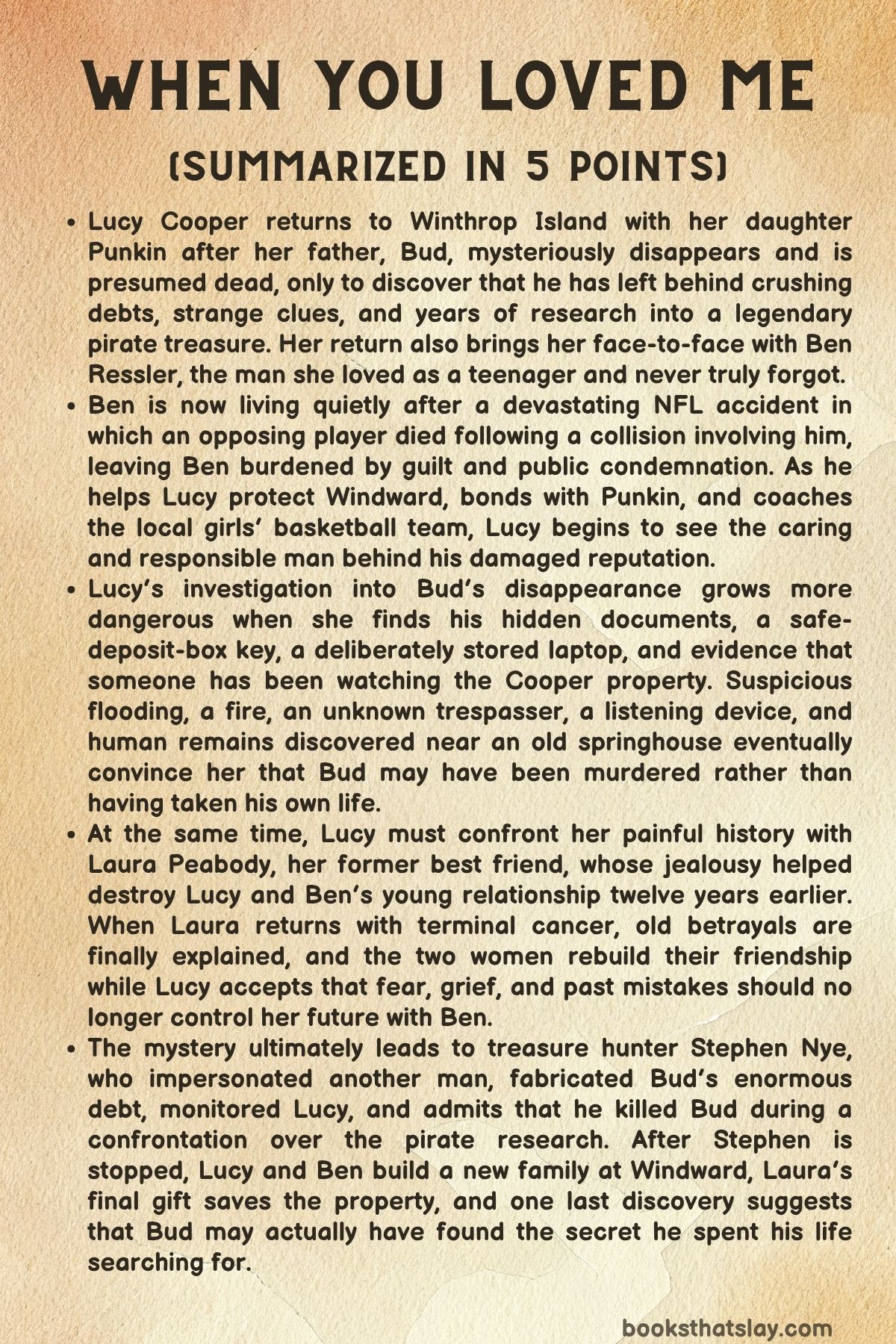
Summary
Ben Ressler is a thirty-two-year-old NFL free safety whose life changes during a conference championship game. Acting exactly as he has been trained to act, he anticipates a pass and hits an opposing player at the same moment one of his teammates makes contact from another direction, causing the player to suffer a catastrophic injury that ultimately destroys Ben’s career and leaves him carrying enormous guilt.
Months later, Lucy Cooper returns to Winthrop Island with her seven-year-old daughter Elise, whom everyone calls Punkin. Lucy has come back after twelve years away because her father, Bud Cooper, left his clothes neatly arranged on Poseidon Beach and disappeared into Long Island Sound, leaving the community convinced that he drowned himself.
Lucy must deliver a eulogy for a man she loved but had become distant from. Bud was charming, intelligent, financially reckless, and completely devoted to his belief that the pirate Ned Ramsay had hidden a fortune somewhere on the Cooper property.
At the memorial, Lucy notices someone from another painful part of her past. Ben Ressler, whom she knew during the final summer of her adolescence, has returned to Winthrop Island as well.
Ben is now living quietly in the caretaker lodge belonging to the Peabody estate. He had become friends with Bud and was the person who found Bud’s abandoned clothing on the beach.
Before disappearing, Bud gave Ben an envelope meant for Lucy. Instead of containing a farewell letter or explanation, the envelope holds a tiny brass key marked with the number 8238.
Lucy soon discovers that Bud left behind far more than emotional confusion. A man introducing himself as Topher Dumont claims that Bud borrowed large sums over many years and that the debt, together with interest, has reached more than two million dollars.
The supposed loans were secured against Windward, Lucy’s deteriorating family home. Suddenly she faces the possibility of losing the property almost immediately after returning to it.
While trying to understand Bud’s affairs, Lucy revisits the family legend that shaped much of his life. According to the story, pirate Ned Ramsay hid Spanish silver on the Cooper property during the eighteenth century, and generations of Coopers searched for it without success.
Lucy has always viewed this obsession with resentment because Bud devoted years to treasure hunting while his finances collapsed. His refusal to abandon the search helped destroy his marriage and left Lucy convinced that the legend had taken far more from the family than it had ever given them.
Yet Windward begins producing strange discoveries. In the basement Lucy finds bottles of rare Prohibition-era Scotch, proving that valuable objects really had been hidden on the property in the past.
Meanwhile, Lucy gradually learns what became of Ben after they separated. He became an extraordinary NFL player and celebrated star before the fatal collision ended everything.
Watching footage of the accident initially makes Lucy recoil from him. Her reaction is intensified by memories of her husband Arnaud, who was murdered in a random stabbing, leaving Lucy to raise Punkin alone.
Ben does not defend himself by minimizing what happened. Instead, he acknowledges that even an unintended action can have permanent consequences and believes that continuing to live means finding some way to make amends.
Their growing closeness is complicated by memories of the summer when they first fell in love. At eighteen, Lucy had arrived on Winthrop expecting to spend time with Laura Peabody, her closest friend, while still carrying an old crush on Laura’s brother Sedge.
Laura, however, had become deeply interested in Sedge’s Dartmouth friend Ben. What nobody anticipated was the immediate understanding that developed between Lucy and Ben.
Although Lucy came from a family associated with Winthrop privilege, the Coopers were nearly broke. Ben came from a working-class Pennsylvania background, had an incarcerated father, and had reached Dartmouth through discipline, intelligence, football talent, and the sacrifices of his mother.
Their shared awareness of what it meant to stand slightly outside the wealthy island world drew them together. After Ben rescued Lucy from a dangerous current during an early-morning swim, their friendship became increasingly intimate.
The two began secretly meeting at Horseshoe Bay. Friendship turned into love, but Lucy knew that every step toward Ben threatened her relationship with Laura, who was struggling with insecurity and an eating disorder and believed Lucy was the closest thing she had to a sister.
Lucy and Ben eventually confessed their love and planned to meet again in London. Their plans collapsed when Laura discovered their relationship and confronted Lucy at precisely the moment Lucy received word that her pregnant mother was suffering a life-threatening emergency.
Terrified and overwhelmed with guilt, Lucy abruptly left Winthrop and cut Ben out of her life. She never knew that he later traveled to London as promised and waited for her at Piccadilly Circus.
In the present, Ben steadily becomes part of Lucy and Punkin’s everyday life. He rescues Punkin after she falls into freezing water, helps repair Windward after an unexplained flood, and eventually becomes coach of the island school’s girls’ basketball team.
His patient treatment of the children reveals a side of him that sharply contradicts his public reputation. Punkin trusts him instinctively, while Lucy begins recognizing that the man before her cannot be reduced to the worst moment of his professional career.
More disturbing events begin occurring around Windward. A faucet is mysteriously left running while the family is away, Lucy discovers Ben’s missing shovel in the meadow, and an unknown man appears to be watching the property.
Ben becomes convinced somebody is targeting Lucy. She remains reluctant to accept his theory until the clues become increasingly difficult to dismiss.
The brass key eventually produces a breakthrough when Lucy’s mother recognizes it as a safe-deposit-box key. Inside the box, Lucy finds Bud’s maps, notebooks, genealogical records, and historical research concerning Ned Ramsay.
Someone else has already tried to obtain them. A woman had visited the bank claiming to be Lucy, demonstrating that an unknown person knew about Bud’s research and considered it valuable enough to steal.
Ben and Lucy also confront their unfinished romantic history. Ben tells Lucy he waited for her in London, while Lucy discovers that after losing her, Ben eventually became involved with Laura.
Their reunion is further complicated when Laura unexpectedly returns to Summerly. Lucy learns that Laura has metastatic lung cancer and has come home to spend the remaining part of her life near her family.
Lucy must therefore face the friend she abandoned twelve years earlier at the same time she is reconsidering a future with Ben. The old jealousy gradually gives way to a more mature understanding of what happened between the three of them.
Bud’s mystery continues to develop when Ben uncovers old graves connected with the Winthrop history. Lucy begins taking her father’s research seriously and realizes that his theories may have contained far more careful reasoning than she ever allowed herself to see.
Financial pressure nevertheless forces her toward selling Windward. When a mysterious buyer offers ten million dollars in cash on the condition that she immediately stop looking for other buyers, the offer seems like the only practical solution to the supposed Dumont debt.
At the same time, Lucy learns that an old springhouse still exists beneath the landscape. Bud’s map connects that location with a burial site, so Lucy and Punkin decide to investigate.
Inside the springhouse, they discover human remains. Police soon begin considering the possibility that Bud did not commit suicide but was murdered, and Ben becomes a person of interest because he was among the last people to see Bud alive.
Investigators also discover a listening device hidden in Bud’s study. Someone had apparently been monitoring the house, offering an explanation for the stranger, the attempted theft of the bank documents, and the strange incidents at Windward.
Laura finally tells Lucy the truth about their past. After Lucy left Winthrop, Laura tried to seduce Ben, but he rejected her because he was still in love with Lucy.
Humiliated, Laura falsely claimed they had slept together and told Sedge about Ben and Lucy. The resulting confrontation between Sedge and Ben damaged their friendship and contributed to Ben leaving Dartmouth.
Years later, Laura and Ben really did become lovers, but the relationship failed for the same basic reason. Ben cared about Laura deeply, yet he never loved her in the way she wanted.
Lucy finally stops treating fear as a reason to reject him. After so many years defined by deaths, separations, and missed opportunities, she chooses to accept that she still loves Ben.
Bud’s repaired laptop provides the next major clue. Remembering his repeated phrase “All is well,” Lucy realizes it may be his password, and the computer opens when she enters those words.
His files identify a treasure hunter named Stephen Nye. Bud had exchanged research with Stephen before their relationship deteriorated, and Stephen eventually sent him a death threat.
Evidence also suggests that the woman who tried to impersonate Lucy at the bank was Stephen’s wife, Jennifer. Police then discover another, far older skeleton near the springhouse, connecting the modern murder investigation with the centuries-old mystery.
The danger reaches its peak during the basketball tournament in Providence. Ben’s identity becomes public, reporters surround the team, and he faces renewed scrutiny over both his football past and the investigation into Bud’s death.
Then Lucy discovers that the man calling himself Topher Dumont is not Topher at all. Laura recognizes the impostor, and Lucy realizes that he is Stephen Nye.
Stephen and Jennifer had secured caretaker positions that gave them access to Winthrop Island. Stephen had fabricated Bud’s enormous debt, watched Lucy’s movements, planted evidence, and attempted to force her away from the Cooper property.
Stephen attacks Lucy and takes her and Punkin hostage in a locker room. While Lucy keeps him talking, he admits that he confronted Bud after becoming convinced Bud had stolen his treasure research and accidentally killed him during their confrontation.
Laura arrives despite her severe illness and strikes Stephen with her oxygen canister, giving Lucy a chance to survive. Ben and the police arrive moments later, and Ben uses the physical power that has haunted him since the football tragedy to stop Stephen and protect Lucy.
The act changes the meaning of Ben’s strength. The same instinct for impact that once became associated with death is now used deliberately to save the people he loves.
Months later, Laura dies. Lucy mourns not only the woman Laura became but also the years their friendship lost because of jealousy, secrecy, resentment, and misunderstanding.
Lucy continues Bud’s research and begins writing a novel inspired by Hephzibah Winthrop and Ned Ramsay. She develops her own theory that the historical identity preserved in the journal may be false and that Ramsay probably escaped with the treasure rather than abandoning it.
Ben considers coaching opportunities elsewhere but first wants to know whether Lucy truly sees a future with him. Lucy answers by revealing that she is pregnant with his child.
Laura leaves one final act of generosity behind. She had secretly used ten million dollars of her inheritance to purchase Windward and then left the property to Lucy, ensuring that Lucy would not lose the home because of the false financial crisis.
By summer, Lucy and Ben are married, Windward is being renovated, and both have found meaningful places in the island community. Lucy teaches permanently, Ben becomes athletic director at the school, and he begins the process of formally becoming Punkin’s father.
Yet Bud’s treasure mystery offers one final surprise. Near an old stone wall, Chief helps reveal a concealed shaft or well close to the place where Ben once saw Bud searching at night.
Punkin understands what Bud had been trying to communicate through the phrase that became his computer password. “All is well” was not only reassurance: it was also a clue pointing toward the well itself, suggesting that Bud may truly have found the answer he spent his life seeking.
Characters
Lucy Cooper
Lucy Cooper is the emotional center of When You Loved Me, and much of her development comes from learning that survival cannot consist entirely of avoiding situations in which she might be hurt again. After losing Arnaud violently and becoming Punkin’s sole parent, she has built a life around responsibility, emotional control, and the assumption that stability can disappear without warning.
Her return to Winthrop places her inside several unresolved histories at once. She must confront her anger toward Bud, her guilt over abandoning Laura, her unfinished love for Ben, and her complicated relationship with the privileged world from which her family came.
Lucy is also defined by skepticism, particularly toward Bud’s treasure obsession. She initially views his research as evidence of irresponsibility because she witnessed the financial and emotional consequences of his refusal to abandon it.
Her attitude changes only when she begins examining his work for herself. What once looked like irrational fixation gradually reveals intelligence, method, and genuine historical insight, forcing Lucy to reconsider both Bud and her own certainty about him.
Her relationship with Ben exposes another defensive habit. Lucy repeatedly assumes that leaving first is safer than trusting someone to remain, a pattern visible in the way she abandoned Ben as a teenager and initially rejects him again as an adult.
By the end, Lucy does not become fearless; rather, she accepts uncertainty without allowing it to make all her decisions. Marriage, pregnancy, her decision to remain at Windward, and her continuation of Bud’s research show that she has finally chosen participation in life over permanent emotional self-protection.
Ben Ressler
Ben is constructed around the tension between physical power and moral responsibility. Football gave him structure, education, achievement, and a way to direct the anger and force that emerged from a difficult childhood, but the same profession eventually leaves him associated with another man’s death.
What makes Ben compelling is his refusal to hide behind the fact that the fatal collision was accidental. He knows that intention does not erase consequences, and his isolation on Winthrop reflects a man who has begun to question whether he deserves an ordinary future after becoming the cause of irreversible suffering.
In When You Loved Me, Ben’s protective nature becomes both his strength and his weakness. He instinctively tries to save Lucy, Punkin, Laura, his players, and even Bud in the sense that he continues investigating circumstances surrounding Bud’s disappearance.
His need to protect can become excessive because he sometimes replaces openness with secrecy. The police sting involving Stephen demonstrates this flaw clearly: Ben withholds information because he believes secrecy will keep Lucy safe, only for his decision to leave her more vulnerable.
His relationship with Punkin is especially important because she judges him without reference to fame, scandal, or guilt. She experiences him simply as a patient, trustworthy adult who arrives when people need him.
Coaching the girls’ basketball team offers Ben a form of athletic identity that is no longer based on celebrity or violent impact. By the end, his decision to become an athletic director rather than chase immediate professional prestige suggests that he has found a healthier understanding of achievement, responsibility, and belonging.
Elise “Punkin” Cooper
Punkin functions as far more than Lucy’s precocious daughter. She represents curiosity without cynicism, which is why she can approach Bud’s treasure research with excitement while Lucy initially sees only failure and wasted years.
Her faith in other people is equally significant. She accepts Ben long before Lucy decides whether his past makes him dangerous, and her judgment repeatedly proves more accurate because she responds to the person Ben is in ordinary life rather than the public image attached to him.
Punkin also gives Lucy a reason to remain engaged with the world after Arnaud’s death. Lucy’s choices are constantly shaped by her need to create stability for her daughter, but Punkin frequently reverses that dynamic by encouraging her mother to take emotional risks.
Her involvement in the treasure hunt preserves a link between Bud and the granddaughter he never really knew. Most importantly, Punkin solves the final linguistic clue because she approaches Bud’s words literally and imaginatively rather than carrying Lucy’s resentment toward him.
Laura Peabody
Laura begins as a source of conflict but eventually becomes one of the book’s most complex examinations of insecurity, desire, friendship, and regret. As a teenager, she is privileged yet profoundly uncertain of her own worth, and her eating disorder reflects an attempt to make internal pain visible enough for other people to notice.
Her obsession with Ben grows partly from attraction and partly from her need to be chosen. When Ben chooses Lucy instead, Laura experiences his rejection not simply as romantic disappointment but as evidence that the person she loves like a sister possesses something she lacks.
Her decision to lie about sleeping with Ben is cruel and consequential. The lie damages Lucy and Ben’s future, contributes to Sedge’s confrontation with his friend, and allows resentment to survive for years.
Yet Laura is not frozen in her worst adolescent action. Her terminal illness forces her to reconsider what she spent so much time wanting, and she eventually admits that some of her jealousy toward Lucy came from confusing the desire to possess Lucy’s life with the desire to be loved by Lucy.
Laura’s final actions complete her development. She protects Lucy from Stephen despite being physically weak and later preserves Windward by secretly buying the property and leaving it to Lucy.
Her death therefore does not merely resolve an old romantic triangle. It restores the friendship that existed before jealousy corrupted it and allows Lucy to understand that Laura herself was part of what had been valuable in her past.
Bud Cooper
Bud is absent for most of the active story, yet his personality influences nearly every major event. He is remembered as charming, intelligent, loving, irresponsible, obsessive, financially unreliable, and capable of inspiring both affection and enormous frustration.
Lucy initially interprets him through the damage he caused. His treasure hunting contributed to financial collapse, humiliated the family, damaged his marriage, and made his daughter believe he had chosen fantasy over practical responsibility.
The investigation after his disappearance gradually complicates that judgment. His notebooks, hidden documents, laptop, map work, historical deductions, and carefully distributed clues show that his research was not merely random speculation.
Bud also seems to understand that he may be in danger before he disappears. Leaving the key with Ben, placing the laptop where Lucy can retrieve it, and securing his papers in a bank suggest deliberate preparation rather than confusion.
His real legacy therefore becomes more meaningful than the monetary treasure he wanted to find. Lucy ultimately inherits his curiosity and begins transforming his historical work into writing, while Punkin inherits his enthusiasm for solving mysteries.
Sedge Peabody
Sedge initially exists in Lucy’s memories as the boy she thought she wanted. Her youthful crush on him represents the future she expected before Ben complicated every assumption she had about romance.
As an adult, Sedge has become stable, capable, and grounded. His relationship with Audrey allows Lucy to recognize that her adolescent attachment to him belongs to the past rather than to an unfinished emotional future.
Sedge is also deeply loyal, although that loyalty sometimes causes him to act before understanding the entire situation. As a young man, he confronts Ben after Laura tells him about Lucy and spreads her false story, helping fracture one of his closest friendships.
Years later, however, Sedge becomes part of Ben’s route back toward ordinary life. When Ben is devastated by the football accident and his mother’s death, Sedge offers him refuge at Summerly and helps create the environment in which he can begin rebuilding himself.
Maman
Lucy’s mother is pragmatic, glamorous, resourceful, and deeply skeptical of depending emotionally on men. Her worldview has been shaped by disappointment, particularly her marriage to Bud, whose treasure obsession and financial irresponsibility convinced her that affection cannot substitute for security.
Her response to Sadiq’s collapse reveals both her toughness and her moral flexibility. Even while investigators examine the family finances, she immediately begins protecting whatever assets she can still control.
This attitude stands in sharp contrast to Lucy’s evolving understanding of love. Maman believes that self-protection must come first because people eventually disappoint one another, while Lucy increasingly recognizes that intimacy requires accepting precisely that possibility.
She nevertheless remains an important source of family cohesion. Her sudden Christmas arrival makes Windward feel populated and safe again, and her memory of the key’s purpose gives Lucy the breakthrough that leads to Bud’s hidden documents.
Stephen Nye
Stephen Nye is the destructive version of the obsession that Bud also carries. Both men become fascinated by Ned Ramsay’s treasure, but Bud treats historical investigation as a consuming intellectual mission while Stephen gradually treats possession of the answer as something worth deception, intimidation, and violence.
His impersonation of Topher Dumont shows considerable planning. By inventing a multimillion-dollar debt secured against Windward, he tries to create enough financial pressure to remove Lucy from the property without immediately revealing his real interest.
Stephen’s violence ultimately comes from entitlement. He convinces himself that Bud stole something that properly belonged to him, and that belief allows him to reinterpret every increasingly criminal act as justified retaliation.
His confession makes clear that Bud’s killing was not originally planned, but that distinction does little to redeem him. Stephen repeatedly chooses intimidation and control afterward, eventually threatening Lucy and Punkin when his scheme collapses.
Arnaud
Arnaud is dead before Lucy returns to Winthrop, but his absence shapes her emotional behavior throughout the story. His random murder taught Lucy that happiness can disappear without explanation and that a person can make ordinary plans one moment and be permanently absent the next.
Lucy’s grief is particularly tied to the future Punkin lost with her father. She does not only mourn the man she loved; she mourns all the years, conversations, milestones, and ordinary family moments that should have followed.
Arnaud’s death also affects the way Lucy initially interprets Ben. Because intentional human violence took her husband away, seeing footage in which Ben’s physical action causes another man’s death temporarily makes it difficult for her to distinguish between moral intent and terrible consequence.
Audrey Fisher
Audrey represents emotional steadiness in contrast with the unstable relationships surrounding Lucy’s past. Her relationship with Sedge is mature enough that Lucy can observe them together without feeling trapped by her old adolescent fantasy about him.
She is also woven into the practical community of Winthrop through her work as a chef and her involvement with the Mohegan Inn. Her willingness to help Lucy investigate the value of the old whiskey bottles demonstrates the informal network of relationships that gradually supports Lucy after her return.
Audrey’s engagement and marriage to Sedge provide a quiet marker of Lucy’s growth. Lucy can celebrate their happiness sincerely because she no longer confuses nostalgia with love.
Mrs. Peabody
Mrs. Peabody serves as one of the strongest links between family memory and Winthrop history. She has knowledge that younger characters either lack or have ignored, allowing apparently casual observations to become important clues.
Her revelation about the old springhouse directly advances the search for the truth about Bud. She also understands the emotional history surrounding Laura, Lucy, and Ben more clearly than most of the younger characters initially realize.
Her response to Laura’s illness is particularly revealing. She refuses to let Lucy escape from Summerly simply because the emotional situation is uncomfortable, recognizing that Laura needs the people whose relationships with her remain unfinished.
Sadiq
Sadiq first exists largely through the wealth surrounding Lucy’s mother, but his apparent success eventually collapses under allegations of major financial wrongdoing. His suicide attempt exposes how completely the family’s material security depended on circumstances Lucy did not understand.
His downfall serves as a parallel to Bud’s financial failures while also creating an important contrast. Bud loses money chasing something he passionately believes exists, whereas Sadiq appears to have built wealth through conduct serious enough to draw government investigation.
The crisis also forces Lucy to reconsider the difference between appearing secure and actually being secure. Her mother’s glamorous world proves no more permanent than deteriorating Windward, reinforcing the story’s suspicion of wealth as a reliable measure of safety.
Bixie Huxley
Bixie initially appears as a practical professional who helps Lucy understand Windward’s potential sale value. Through her, Lucy learns that the land may be worth millions even though the house itself has deteriorated badly.
Her role becomes more complicated when the mysterious ten-million-dollar offer appears. The extraordinary price should solve Lucy’s problems, but it also creates pressure to make a quick decision before she fully understands why somebody wants the property so badly.
Bixie is not ultimately the central villain, but her connection to the caretaking arrangement that gives Stephen and Jennifer access to the island demonstrates how ordinary social and professional systems can unintentionally create opportunities for manipulation.
Detective Jackson
Detective Jackson represents evidence-based judgment in a story filled with assumptions, emotional histories, and incomplete information. She does not immediately accept Lucy’s certainty about Ben because her responsibility is to investigate circumstances rather than trust personal loyalty.
Her suspicion of Ben is frustrating to Lucy but logically understandable. Ben was close to Bud, discovered his abandoned clothes, possesses a shovel connected with suspicious activity, and has a highly public history involving another man’s death.
As new evidence appears, Jackson adjusts rather than remaining committed to an early theory. Her investigation eventually becomes essential to exposing the fabricated Dumont debt, Stephen’s identity, the planted evidence, and the circumstances surrounding Bud’s death.
Monk Adams and Mallory
Monk and Mallory occupy smaller roles but contribute to the sense that Winthrop functions as an active community rather than merely as a backdrop for the central families. Monk is connected to Lucy’s memories of the island through music and later reappears as one of the people willing to help her in ordinary circumstances.
Their presence becomes especially important immediately before the fire at Windward, when they provide Lucy and Punkin transportation home. Characters such as Monk and Mallory help show that Lucy’s return is gradually reconnecting her with a wider network of people she abandoned when she left the island.
Themes
Love as Presence Rather Than Possession
Love repeatedly becomes meaningful through what people do when there is no guarantee of reward. When You Loved Me distinguishes between wanting someone, possessing someone, rescuing someone, and remaining available to someone even when the relationship may offer nothing in return.
Ben embodies this distinction most clearly. Even after Lucy tells him she cannot imagine a future with him, he continues helping her, protecting Punkin, repairing Windward, investigating threats, and responding whenever they are in danger because his care does not depend on securing Lucy as a romantic partner.
Laura represents the opposite understanding when she is young. She believes being chosen by Ben will prove something about her value, which causes her to treat Lucy’s relationship with him as theft rather than accepting that another person’s love cannot be claimed through friendship, suffering, or desire.
Her final months transform that understanding. Laura recognizes that Ben’s devotion belongs to Lucy, stops treating that fact as evidence of her own inadequacy, and begins acting from love without expecting possession in return.
Lucy eventually reaches a similar realization. Loving Ben does not mean securing a future protected from loss; it means choosing a shared life despite knowing how suddenly life can change.
This is why Ben’s definition of love matters so strongly: genuine care becomes visible when a person continues showing up even when there is nothing obvious to gain.
Grief, Guilt, and the Possibility of Beginning Again
Nearly every important relationship is shaped by something that cannot be undone. Lucy cannot restore Arnaud, Ben cannot reverse the football collision, Laura cannot recover the twelve years damaged by her lie, and Bud cannot repair the years his obsession cost his family.
The story does not suggest that healing requires forgetting these events. Instead, it examines whether people can accept permanent consequences without allowing those consequences to determine every future choice.
Ben initially believes guilt disqualifies him from happiness. Because another man died through his physical action, he begins treating suffering almost as something he owes the world, and his isolation on Winthrop becomes a form of self-imposed punishment.
Lucy reacts differently but reaches a similar emotional dead end. Losing Arnaud teaches her to anticipate future loss, so she repeatedly converts fear into withdrawal and calls that withdrawal practicality.
Laura’s approaching death makes the cost of such avoidance impossible to ignore. Her limited time forces everyone around her to ask whether pride, jealousy, fear, or guilt deserve another year of their lives.
Beginning again therefore does not mean receiving a clean slate. Lucy and Ben move forward while carrying Arnaud, the football death, Bud, Laura, and their younger selves with them, accepting that a second chance is valuable precisely because the first chance cannot be recovered.
Inheritance, Family Legacy, and Hidden Truths
Inheritance operates throughout the story as something far broader than money or property. Lucy inherits Windward, Bud’s debts, his unfinished research, the Cooper reputation, family resentment, and eventually a way of looking at history that she once rejected.
Other families carry comparable inheritances. Ben lives with the consequences of his incarcerated father and the sacrifices of his mother, while Laura and Sedge inherit privilege alongside the expectations and emotional habits created by the Peabody world.
Even Lucy’s mother demonstrates that material inheritance can be unstable. The fortune surrounding her marriage to Sadiq appears permanent until investigation and scandal reveal how little Lucy actually understood about its foundation.
Bud’s research offers the clearest transformation of inherited meaning. For years Lucy sees his notebooks and treasure hunt as evidence that he wasted his life, but examining his work reveals that he preserved questions, records, deductions, and historical possibilities that she can continue exploring.
Laura’s final gift develops the same idea from another direction. By purchasing Windward and leaving it to Lucy, she turns inherited wealth into an act of repair rather than possession.
The house therefore becomes valuable because of the relationships and histories attached to it, not merely because of its market price. Lucy ultimately inherits the responsibility to decide which parts of the past should be preserved, which should be questioned, and which should finally be released.
Obsession, Treasure, and the Meaning of Value
The treasure hunt continually asks what people believe is worth sacrificing their lives to obtain. Ned Ramsay’s legendary silver attracts Bud and Stephen for similar reasons, yet their behavior demonstrates how differently obsession can shape people.
Bud certainly allows the search to damage his finances and relationships. His conviction contributes to the collapse of his marriage and leaves Lucy with years of anger toward a father who seemed to value an imagined fortune more than ordinary responsibility.
Stephen takes the same hunger much further. Treasure becomes an entitlement for him, and once he believes Bud has taken knowledge that belongs to him, money and historical discovery become excuses for surveillance, fraud, impersonation, intimidation, and finally violence.
The great irony is that the material treasure may never have remained on Winthrop at all. Lucy’s historical interpretation suggests that Ramsay could simply have taken it away, meaning generations may have sacrificed time, relationships, and peace to recover something that was never waiting beneath their feet.
Yet genuine treasures repeatedly appear in nonfinancial forms. Bud leaves intellectual work that reconnects Lucy with him, Laura uses wealth to preserve Lucy’s home, Ben discovers purpose through coaching children, and Lucy recovers relationships she once considered permanently lost.
The final clue involving the hidden well keeps the possibility of physical treasure alive, but by then its monetary value is no longer the story’s central concern. The characters have already discovered that the things most worth preserving are people, memory, purpose, home, and the chance to use the time that remains wisely.