Whisper Creek Summary, Characters and Themes
Whisper Creek by Allison Brennan is a rural suspense novel built around a Texas ranching family fighting to protect its land, its future, and one another. At the center is widow Ellen McKenna, whose determination to preserve her family ranch places her in conflict with a powerful corporation seeking control of a strategically valuable piece of property.
What begins as financial pressure and unexplained damage soon expands into burglary, kidnapping, corruption, and questions surrounding the death of Ellen’s husband. Against severe storms and flooding, the McKennas must survive immediate danger while uncovering a scheme driven by ambition, desperation, and the belief that land is worth almost any price.
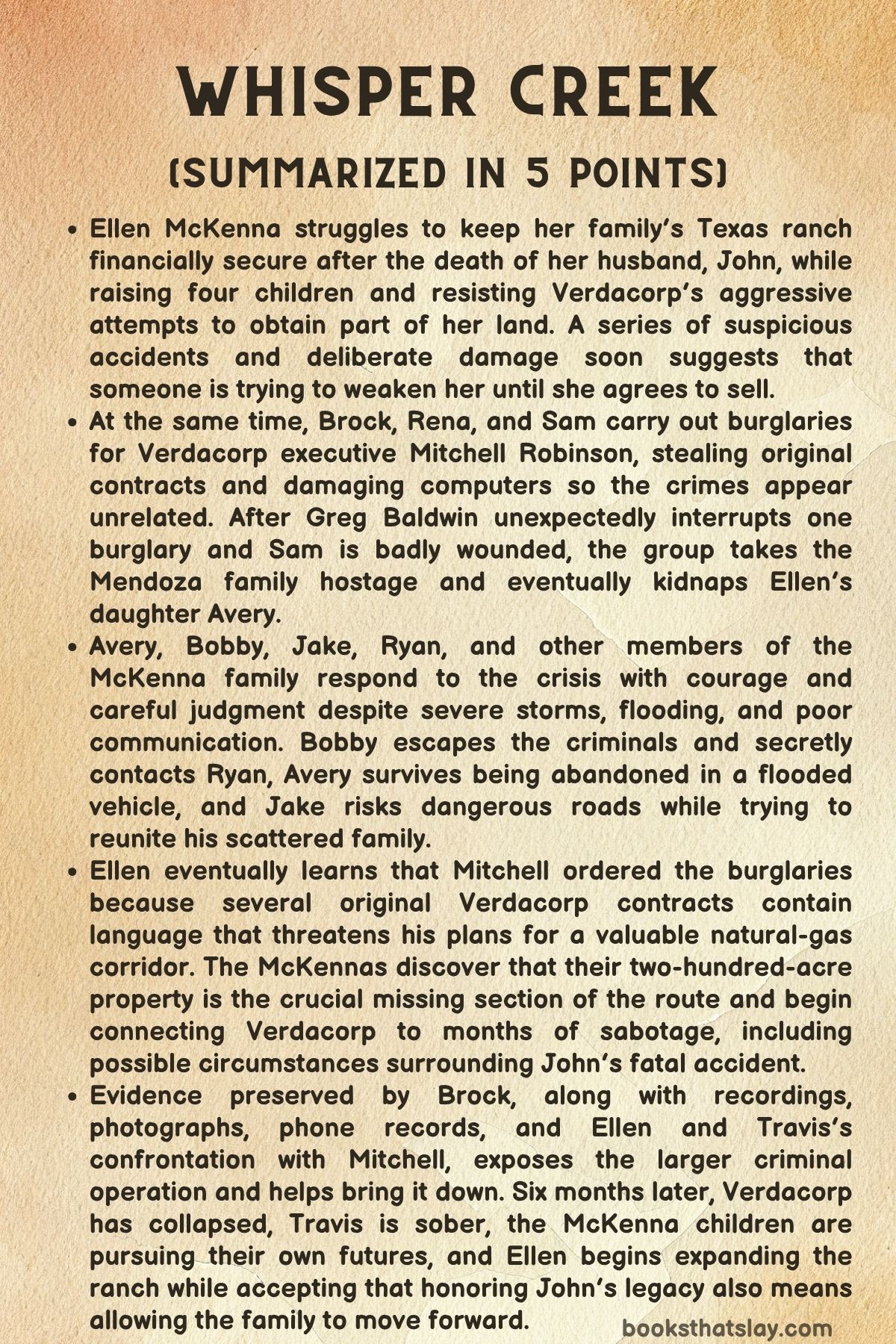
Summary
An unidentified man enters the McKenna family barn after a hailstorm and deliberately prepares it for serious water damage. He blocks gutters, cuts concealed openings into the structure, and intends the coming storm to destroy hay, feed, and parts of the building, adding another financial burden to Ellen McKenna’s already struggling ranch.
The saboteur has damaged the property before, and his thoughts reveal troubling guilt connected to the death of Ellen’s husband, John. He insists that John’s death was accidental, yet he clearly knows that the pressure campaign against Ellen has already produced consequences far beyond damaged property.
Elsewhere, Rena Jones travels through a violent storm with her husband, Brock, and her badly wounded younger brother, Sam. The three have been carrying out paid burglaries in which they enter supposedly empty houses, steal selected papers, destroy computers, and take ordinary valuables so the crimes appear unrelated to anything more serious.
Their latest assignment goes badly when landowner Greg Baldwin unexpectedly returns home. Gunfire leaves Baldwin injured, his German shepherd Timber wounded, and Sam shot badly enough that he may die without medical help.
Afraid that a hospital will expose their crimes, Brock and Rena seek shelter at the isolated Mendoza property. Brock forces Carl, Rose, and their partially paralyzed granddaughter Gianna to cooperate, transforming the criminals from burglars into hostage-takers.
At the McKenna ranch, Ellen is already fighting several battles. Eleven months after John’s death, she is trying to manage fourteen hundred acres, protect the family’s finances, raise four children, and continue the future she and John had planned together.
Representatives of Verdacorp, especially Clive Robinson and Tom Garza, continue pressuring Ellen to sell or lease a portion of her land. Verdacorp claims the deal would solve her financial problems, but Ellen distrusts provisions involving mineral rights and refuses to surrender property that has belonged to the McKenna family for generations.
Her children respond to John’s absence in different ways. Eighteen-year-old Jake increasingly assumes responsibility for the ranch, Avery dreams about building an agricultural business, thirteen-year-old Lyla proves exceptionally capable with animals and practical ranch work, and ten-year-old Bobby remains sensitive, observant, and deeply attached to both his family and animals.
Jake discovers the wounded Timber and returns him toward Greg Baldwin’s property, where he finds Baldwin unconscious after the burglary. By calling for emergency assistance and keeping Baldwin alive, Jake demonstrates that his resentment over Baldwin’s recent land sale does not prevent him from recognizing another family’s potential loss.
Meanwhile, Avery and Bobby travel to the Mendoza property. Avery soon realizes that armed strangers are holding the family hostage, while Bobby, separated from her, notices suspicious details including an unfamiliar Louisiana truck and blood near the house.
Avery attempts to escape but is caught by Brock. When Bobby unknowingly approaches, Avery is forced to speak to him over the radio without revealing what is happening because Brock threatens to kill Gianna and Bobby if she warns him.
Bobby senses that something is wrong and stays hidden rather than entering the house. His caution becomes one of the most important factors in the family’s survival because he avoids capture and later finds a way to communicate without using the McKenna family radio channel that the criminals may be monitoring.
At the same time, Ellen begins finding signs that the ranch’s storm damage is not natural. Water is entering the barn because someone deliberately blocked drainage and cut hidden openings, creating another disturbing connection to the place where John died.
Verdacorp’s desperation also becomes clearer. Mitchell Robinson, the driving force behind the company, urgently needs several original land contracts recovered because they contain language that threatens an enormous business plan.
Mitchell has hired Brock and his family to steal the originals from landowners and disguise the thefts as ordinary burglaries. He also uses his daughter Presley’s technical abilities, extensive surveillance, deceptive calls, and people under his control to manipulate residents and gain access to properties.
George and Millie Coulter become targets when a fabricated emergency involving their daughter is used to lure them from their home. Brock searches their property for an original Verdacorp agreement but initially fails to find it.
Mitchell later examines surveillance footage and realizes Ellen visited the Coulters and left carrying documents. Suddenly, Ellen is dangerous to him not merely because she refuses to sell her land but because she may unknowingly possess evidence proving that Verdacorp altered or intended to replace important contract language.
Conditions at the Mendoza house deteriorate further. Sam’s injury worsens, Rena becomes increasingly frightened, and Brock remains committed to finishing the assignments because he believes the final payment will allow them to disappear and start over.
Bobby eventually sees Avery restrained and tries to help her, but Rena notices him. Avery orders her little brother to run, and Bobby escapes into the storm while Rena chases him.
Unable to cross the flooded creek back toward home, Bobby shelters in an abandoned equipment shed. Remembering a private radio channel used by Avery and Ryan Perez, he switches frequencies and eventually reaches Ryan without alerting the kidnappers.
Ryan immediately reports the emergency rather than attempting a reckless rescue alone. Jake learns where Bobby is hiding and begins making his way toward him through increasingly dangerous flooding.
The criminals move Avery from the Mendoza house because Bobby has exposed their location. Rena forces Avery to drive while Sam lies critically wounded in the vehicle, but Avery deliberately chooses routes that keep the criminals away from her family’s ranch.
Ryan unexpectedly sees Avery while driving through the storm and turns around to help. Rena panics, causes the vehicle to crash into a flooded ditch, abandons Avery tied inside as the water rises, threatens Ryan with a gun, and escapes with Sam in Ryan’s truck.
Ryan manages to free Avery moments before the vehicle sinks farther into the water. Stranded without reliable communication, they make their way toward Greg Baldwin’s house.
Ellen eventually reaches the Mendoza property and discovers Gianna, Carl, and Rose restrained. After freeing them, she learns that Avery has been taken away and that Bobby had escaped.
Her fear is partially eased when she discovers that Jake knows where Bobby is hiding. Avery, however, remains missing, and worsening flooding prevents law enforcement from moving freely through the area.
Jake eventually reaches Bobby, who has survived cold, mud, isolation, and fear with remarkable judgment. Bobby has even memorized the Louisiana license plate of the criminals’ vehicle, giving authorities an important lead.
Their return home becomes difficult because roads are blocked by water, mud, fallen trees, and unfamiliar routes. Along the way, Jake and Bobby find the crashed Mendoza truck and fear Avery may be dead until Jake discovers the vehicle is empty.
Verdacorp continues its campaign against Ellen. Clive offers an extraordinary exchange in which the McKennas would receive eight hundred acres of valuable Baldwin property in return for only two hundred acres of their own land.
The offer makes little economic sense, especially because Verdacorp demands that the transaction be completed by Monday. Jake, Penny, Ellen, and Travis all begin realizing that the two hundred acres must have a hidden value far greater than they understand.
Mitchell sends Brock to Ellen’s house disguised as a county employee. Because Ellen is exhausted, worried about her missing children, caring for pregnant Margery Sutton, and dealing with deliberate damage to her barn and generator, she allows him inside to use the telephone.
Brock steals the Coulter agreement and returns it to Mitchell. Mitchell burns the recovered original contracts, believing he has destroyed the evidence that could expose his scheme.
The Monday deadline is eventually explained by a major proposed energy project. Mitchell needs all land arrangements completed immediately, and Ellen’s two hundred acres form a critical missing section in the route he is trying to assemble.
Meanwhile, Brock and Rena finally acknowledge that Sam will die without treatment. They discover that Ellen has medical training and decide to return to her property, even though Rena has nearly killed Ellen’s daughter.
Brock enters Ellen’s home with a gun and threatens her family until she agrees to treat Sam. Furious but unwilling to let a dying man go untreated, Ellen uses available medical and veterinary supplies to remove buckshot, control the infection, and stabilize him until professional care becomes possible.
In exchange, Brock reveals the truth. Mitchell hired them to steal Verdacorp contracts, destroy computers, and create the appearance of ordinary robberies, while Verdacorp’s surveillance enabled Mitchell to track Ellen’s possession of the Coulter papers.
Avery and Ryan, meanwhile, reach Greg Baldwin’s home, contact law enforcement, and then return toward Ellen rather than remain isolated. Jake and Travis are also approaching the ranch, gradually bringing the separated McKenna family back together.
Avery, Ryan, Jake, and Travis quietly assess the situation before confronting the armed intruders. When the family is finally reunited, Brock and Rena leave rather than continuing the confrontation, and Brock privately tells Ellen that he preserved copies of the stolen contracts.
The surviving evidence changes everything. Photographs, telephone records, and an audio recording connect Brock directly to Mitchell and contain instructions explaining how the burglaries were supposed to be carried out.
The family also studies the pattern of Verdacorp’s land purchases. They realize the properties create a narrow corridor suitable for a major natural-gas project, with the McKennas’ two hundred acres serving as a crucial link.
That discovery forces them to reconsider months of supposedly unrelated accidents. Broken equipment, escaped cattle, damaged refrigeration, barn flooding, and an electrified generator now appear to be part of an organized effort to weaken Ellen financially and frighten her into giving up the land.
The darkest possibility concerns John’s death. Because he died while repairing the same barn that was later proven to have been sabotaged, Ellen and Travis begin to suspect that previous deliberate damage may have indirectly caused the fatal fall.
Law enforcement captures Brock and Rena after flooding prevents their escape, while Sam survives long enough to receive hospital treatment under arrest. Greg Baldwin is also expected to survive his injuries.
Verdacorp still presents a challenge because proving Mitchell personally ordered every act of sabotage is more difficult than establishing his involvement in the contract burglaries. Ellen and Travis therefore visit Mitchell while secretly recording their conversation.
Ellen pretends to reconsider the land deal before confronting Mitchell with what she knows. She raises the burglaries, the altered contracts, the sabotage, and the possibility that John died because of deliberate damage ordered as part of the pressure campaign.
Mitchell becomes increasingly angry and careless. His statements reveal knowledge of activities he previously denied, expose conflicts between him and Clive, and demonstrate the depth of his obsession with defeating the McKennas and controlling the land corridor.
Six months later, the immediate crisis has ended and the family is rebuilding. Verdacorp has collapsed after failing to secure the continuous route needed for its project, while Ellen pursues Mitchell through civil action where criminal proof concerning all the sabotage remains difficult.
The McKennas are no longer trying simply to restore the life they had before John died. Jake chooses an equine-focused future, Avery plans to return with agricultural and business knowledge, Lyla continues developing her abilities with horses, and Bobby remains surrounded by the animals he loves.
Travis remains sober and creates a new purpose through dog training and work connected to the ranch. Gianna returns to college, neighboring land becomes available to Ellen, and plans for a winery and future expansion move ahead.
Ellen finally recognizes that honoring John does not require preserving every aspect of the past exactly as it was. The family can protect what he loved while still changing, growing, and allowing each person to build a future of their own.
Characters
Ellen McKenna
Ellen is the emotional and practical center of Whisper Creek, defined by endurance rather than invulnerability. She is grieving the death of her husband while simultaneously carrying responsibilities that would overwhelm almost anyone: running a large ranch, protecting its finances, raising four children, caring for neighbors, and resisting a corporation determined to exploit her vulnerability.
Her refusal to sell is sometimes interpreted by others as stubbornness, yet it comes from a much deeper understanding of what ownership means. The ranch represents family history, her marriage to John, her children’s inheritance, and her right to determine the direction of her own life rather than allowing Mitchell Robinson to determine it for her.
Ellen also has a powerful instinct to care for others even when she has every reason not to. Her treatment of Sam is the strongest example because she provides medical help to a man associated with the criminals who kidnapped Avery and threatened her family.
Her development ultimately concerns the difference between preserving a legacy and becoming imprisoned by it. By the end, she accepts that protecting what John built can include expansion, new businesses, different ambitions for her children, and a life that does not revolve entirely around grief.
Jake McKenna
Jake begins the story carrying an adult level of responsibility despite being only eighteen. John’s death has persuaded him that someone must take his father’s place, and Jake instinctively believes that person should be him.
This explains both his admirable reliability and his tendency toward unnecessary self-sacrifice. His plan to abandon or postpone veterinary ambitions troubles Ellen because she believes he is giving up his future out of guilt, while Jake sees remaining on the ranch as an expression of loyalty.
His actions during the crisis establish that his maturity is genuine. He saves Greg Baldwin despite resentment toward him, tends to Timber, searches for Bobby, navigates flooded roads, protects his younger brother emotionally, and continues looking for Avery despite his own fear.
His eventual conversation with Ellen is important because Jake finally separates his own dreams from John’s. He does not need to become a veterinarian simply because his father once considered that path, nor does he need to leave the ranch to prove that he possesses an independent future.
Avery McKenna
Avery combines independence, intelligence, courage, and an unusually strong capacity to think strategically under pressure. She initially appears through familiar concerns involving her future, her relationship with Ryan, and her desire to create an agriculture-based business, but the hostage crisis reveals the depth of her character.
Once she realizes the Mendozas are prisoners, Avery immediately thinks about escape and communication rather than simply waiting to be rescued. Even after Brock captures her, she carefully controls what information she reveals, especially protecting the fact that Ellen has medical training.
Her strongest instinct is consistently protective. She risks herself to prevent Bobby from being captured, deliberately directs Rena away from the McKenna property, and remains focused on the safety of others even while she is restrained, threatened, struck, and later abandoned in a flooding vehicle.
The ordeal does not reduce Avery to a victim within the book. Her judgment contributes directly to her survival, and her later plans for agricultural business and science reinforce the idea that she possesses both emotional resilience and a clear future beyond what happened to her.
Bobby McKenna
Bobby is only ten, yet he becomes one of the most unexpectedly capable people in the crisis. His defining characteristic is compassion, first expressed through his determination to find Cleo despite dangerous weather and later through his concern for Avery and the rest of his family.
What distinguishes Bobby is not physical bravery but judgment. He notices blood, an unfamiliar vehicle, unusual behavior at the Mendoza property, and the unnatural way Avery speaks to him over the radio.
Instead of rushing into danger, he hides, watches, remembers important details, and eventually uses a private radio frequency because he understands the normal family channel may be compromised. Memorizing the Louisiana license plate further demonstrates how observant he remains even while frightened.
Bobby also carries John’s influence in a particularly tender way. When he does not know what to do, he remembers his father becoming quiet, thinking, and praying before making difficult decisions, showing that John remains a living moral influence in the child’s mind.
Lyla McKenna
Lyla possesses a practical competence that makes her seem older than thirteen. She understands animals, ranch routines, storm preparation, and equipment well enough to identify problems that adults might initially dismiss.
Her role becomes especially important when she continues monitoring water damage and discovers trouble involving the generator. The electrical shock she receives proves that the sabotage is no longer merely an attack on property but a direct physical danger to the family.
Lyla is less outwardly dramatic than some of her siblings, but that restraint is part of her characterization. She contributes through observation, work, and calm persistence rather than through speeches or impulsive actions.
Her interest in horses also connects her future to Jake’s plans. She represents another branch of the family’s next generation that may continue ranch life without simply recreating the choices of those who came before.
Penny McKenna
Penny is the formidable elder of the McKenna family and a living embodiment of its history. At eighty-four, she has no interest in allowing age, corporate pressure, or social politeness to weaken her defense of the family property.
Her appearance with a shotgun during Verdacorp’s attempt to pressure Ellen immediately establishes her personality. Penny understands that the conflict is part of a much older struggle between families, and she recognizes manipulation even when it arrives disguised as a business opportunity.
At the same time, Penny is more than a symbol of toughness. She maintains domestic stability during chaos, helps Ellen continue functioning, notices when Rose Mendoza sounds wrong on the telephone, and later responds to survival with food and family gathering.
Her presence shows that endurance within the McKenna family is inherited culturally as much as biologically. She offers continuity without demanding that younger generations live exactly as previous ones did.
John McKenna
Although John is already dead when the main events occur, his presence affects nearly every member of the McKenna family. Ellen measures decisions against the life they created together, Jake feels responsible for continuing his work, Bobby consciously imitates his decision-making, and Travis remains trapped in grief over their final argument.
John therefore functions as both memory and standard. Each person has constructed an idea of what honoring him requires, and those interpretations sometimes create conflict rather than comfort.
The circumstances of his death also give the land dispute its darkest emotional dimension. Once the family realizes the barn was deliberately sabotaged on later occasions, the possibility emerges that earlier sabotage contributed to the fall that killed him.
Yet the ending changes John’s role within the family. Instead of remaining a reason everyone must preserve the past unchanged, his legacy becomes a foundation from which they are allowed to build something new.
Travis
Travis is one of the story’s clearest examples of personal recovery. A former Army medic who lost part of his leg in combat, he has allowed pain, grief, anger, and alcohol to convince him that the useful part of his life is over.
His relationship with Jake reveals both his wisdom and his failures. Travis correctly recognizes that Jake should not sacrifice himself merely because John died, but his own drinking prevents him from fully acting on the principle that life must continue after loss.
The rescue of Cleo and her kittens becomes his turning point. Forced to confront how physically and mentally impaired he has become through alcohol, Travis recognizes that he cannot protect the people he loves if he remains committed to destroying himself.
His sobriety restores more than physical usefulness. He participates in uncovering Verdacorp’s scheme, supports Ellen during the confrontation with Mitchell, begins dog training, contributes ideas for the property, and eventually emerges as someone capable of imagining a public role in the community.
Brock
Brock is a criminal antagonist, but he is not written as someone without conscience. His original motivation is tied to protecting Rena and Sam, particularly after having once helped them escape an abusive father, yet that protective instinct becomes corrupted by his repeated belief that one more crime will solve the consequences of the previous one.
He understands boundaries but continually crosses them. He does not want unnecessary deaths, dislikes the idea of threatening children, and is disturbed by how far Mitchell’s assignments have gone, yet he still takes hostages, terrorizes the Mendozas, kidnaps Avery, impersonates a public employee, and forces Ellen to treat Sam at gunpoint.
His great moral weakness is rationalization. Every escalation becomes acceptable because he tells himself it is temporary, necessary, or the final act required before his family can escape.
Still, Brock eventually preserves evidence against Mitchell and gives Ellen information that helps expose the larger operation. Those decisions do not erase his crimes, but they show that his conscience survives long enough for him to stop protecting the person who exploited his desperation.
Rena Jones
Rena is driven primarily by fear for Sam and loyalty to Brock, but those emotions repeatedly produce destructive choices. She participates in the burglaries because the group believes the money will provide a path toward a better life, yet the plan rapidly turns into violence and captivity.
Sam’s worsening condition causes Rena to become increasingly unstable. She takes Gianna’s medication, chases Bobby, threatens Avery, strikes her, causes the crash, abandons her in rising water, and points a gun at Ryan while trying to escape.
Unlike Mitchell, however, Rena does not view other people’s suffering with indifference. Guilt begins overwhelming her almost immediately after the worst of her actions, especially when she believes Avery may have died because of her.
Her eventual willingness to face arrest rather than let Brock surrender alone reflects the loyalty that has always defined her, although by that point she recognizes that loyalty without moral limits has helped destroy the very family she was trying to protect.
Sam
Sam is less active than Brock and Rena because his gunshot wound leaves him increasingly incapacitated, but his condition drives many of their decisions. His injury turns a planned criminal operation into a desperate struggle in which every attempt to protect him creates new victims.
He also represents the consequences of refusing accountability. Early medical treatment might have saved him from severe infection, but fear of arrest persuades the group to avoid the hospital.
As his condition worsens, Sam becomes almost symbolic of the collapsing logic behind Brock’s plan. The crimes were supposedly committed to secure a future for the family, yet the criminal effort itself brings Sam close to death.
Ellen’s decision to treat him is therefore especially significant. She separates the value of Sam’s life from the crimes committed around him, demonstrating a moral standard much stronger than the situational ethics used by Brock, Rena, and Mitchell.
Mitchell Robinson
Mitchell is the chief antagonist of Whisper Creek and the character who most clearly treats power as permission. His desire to build Verdacorp and restore what he sees as the Robinson family legacy has hardened into an obsession with controlling land, people, information, and outcomes.
He does not initially commit every crime personally. Instead, he uses money, corporate authority, surveillance, hired criminals, technological manipulation, political connections, and subordinate employees to create distance between himself and the consequences.
That distance helps him maintain an image of himself as a businessman rather than a criminal. Burglaries become document recovery, intimidation becomes negotiation, and sabotage becomes another instrument for solving resistance.
His greatest weakness is pride. Ellen’s refusal becomes personal because he cannot accept the possibility that someone with less money and power can simply tell him no.
By the final confrontation, his anger exposes what calculation had concealed. His obsession with the McKennas, his contempt for traditional landowners, and his determination to obtain the missing property reveal a man whose business ambition has become inseparable from resentment and entitlement.
Clive Robinson
Clive occupies an important moral middle ground within the Robinson family. He participates in Verdacorp’s aggressive pressure campaign and knows about the effort to recover problematic contracts, so he cannot be treated as innocent.
At the same time, he has limits that Mitchell increasingly violates. Clive is shocked when he learns how closely the contract scheme has become connected to kidnappings, violence, and sabotage.
His reaction during Ellen and Travis’s confrontation helps establish that he did not know everything Mitchell had authorized. The distinction matters because the story separates people who knowingly participate in unethical business conduct from those willing to accept almost unlimited harm.
Clive therefore represents compromised morality rather than total corruption. He stays too long, tolerates too much, and benefits from the same organization, but he has not erased every boundary in the way Mitchell has.
Tom Garza
Tom demonstrates how gradual compromise can trap someone inside conduct they would once have rejected. He assists Verdacorp, participates in schemes used to manipulate property owners, and is eventually linked to much of the sabotage campaign.
His discomfort grows as the consequences become more serious. The fabricated emergency involving the Coulters disturbs him because he understands how frightening the deception would be to a family.
The revelation that Avery has nearly died becomes especially important. Tom can no longer maintain the distinction between business pressure and violence because the operation has endangered a young woman who had nothing to do with Verdacorp’s contracts.
His eventual confrontation with Mitchell and decision to quit represent a late but meaningful attempt to reclaim moral agency. He cannot undo what he has done, including the damage that may have contributed to John’s death, but he finally refuses to continue allowing Mitchell to define what is acceptable.
Presley Robinson
Presley is nineteen and technologically capable enough to become useful to her father’s operations. Her skills allow Verdacorp to use artificial intelligence, surveillance, and personal information in ways that make deception considerably more convincing.
Her involvement illustrates how modern technology expands Mitchell’s power. A fake family emergency can be made believable, surveillance can track neighbors across the valley, and personal information can become a tool for manipulating ordinary people.
Presley is not presented with the same degree of cruelty or ideological obsession as her father. Instead, her role raises questions about what happens when technical ability is separated from serious consideration of how that ability is being used.
Her attempts to alert Mitchell later also show that she is not entirely comfortable with the direction events take. She remains compromised by participation, but she is not simply another version of him.
Sheriff Rick Perez
Rick represents lawful authority operating under unusually difficult conditions. Flooding, damaged roads, scattered communications, overlapping jurisdictions, and incomplete information repeatedly prevent him from responding as quickly as the endangered families need.
Despite those limitations, he treats each new piece of information seriously. Bobby’s license plate, Avery’s descriptions, the Mendoza hostages, Greg Baldwin’s shooting, the burglaries, and the evidence against Mitchell gradually become parts of one larger investigation.
Rick is also a father, which gives the crisis personal stakes once Ryan becomes involved. Even so, he continues acting as a sheriff rather than allowing parental panic to control his decisions.
His warning that Mitchell’s power and connections will make prosecution difficult adds realism to his role. Evidence matters more than certainty, especially when crimes have been carried out indirectly through employees and hired outsiders.
Ryan Perez
Ryan displays courage, loyalty, and a level of judgment that complements Avery’s. When Bobby contacts him, Ryan does not immediately rush into the hostage situation but alerts adults and authorities, demonstrating that bravery does not require recklessness.
His direct rescue of Avery later becomes one of his most important actions. He enters the flooded ditch and frees her from the vehicle just before conditions become even more dangerous.
Ryan also respects Avery as a capable partner rather than treating her solely as someone who needs protection. Once they survive the crash, the two make decisions together, seek communication, and work their way back toward the McKenna family.
Their relationship therefore gains depth through action rather than romantic declarations. They trust one another when the consequences of a mistake are potentially fatal.
Gianna Mendoza
Gianna is already rebuilding her independence after being partially paralyzed by a drunk driver when the hostage crisis begins. Her existing struggle gives additional meaning to the way Brock and Rena confiscate her wheelchair and restrict her movement.
Even in that vulnerable position, Gianna remains alert and communicates the truth to Avery as quickly as she can. Her information allows Avery to understand the danger and attempt an escape.
Her friendship with Avery is also connected to recovery. Avery has encouraged her to return to college and reclaim the parts of her future that trauma interrupted.
By the end, Gianna does return to college. That outcome reinforces one of the story’s broader ideas: suffering may change a person’s circumstances, but it does not have to become the permanent definition of that person’s life.
Carl and Rose Mendoza
Carl and Rose are ordinary people dragged into violence because desperate criminals need shelter. Their treatment demonstrates how quickly Brock’s supposedly controlled criminal plan begins producing consequences for innocent families.
Rose is forced to help care for Sam while living under threat, and even her telephone conversations are monitored. Penny nevertheless notices something unusual in her voice, showing how deeply established relationships help people recognize danger even when victims cannot speak openly.
Carl responds to the ordeal with anger and a determination to defend his property once freed. His reaction is understandable because his home, wife, and granddaughter have all been violated.
Their later decision to sell remaining land to Ellen also contributes to the restoration of the local community. Property changes hands through trust and mutual agreement rather than coercion, providing a direct contrast with Verdacorp’s methods.
George and Millie Coulter
George and Millie represent landowners who attempt to compromise with Verdacorp rather than resist it completely. They sign a right-of-way agreement believing legal review has protected them from the most dangerous terms.
Their experience shows that people do not need to be foolish to become vulnerable to a powerful organization. Complicated contracts, unequal resources, and carefully managed information can create risks that are difficult for ordinary landowners to detect.
The false emergency involving their daughter is especially cruel because Mitchell uses parental love as a security weakness. He knows they will abandon their house without hesitation if they believe their child needs help.
Their contract ultimately becomes one of the most dangerous pieces of evidence against Verdacorp. What appeared to be an ordinary property agreement becomes central to exposing a much larger operation.
Greg Baldwin
Greg Baldwin initially appears important mainly because of his land transaction. Jake resents him for selling property to Verdacorp despite an earlier understanding that the McKennas might acquire it.
His shooting immediately changes the way Jake sees him. Faced with the possibility that Greg may die, Jake remembers what losing a father feels like and chooses compassion over resentment.
Greg also becomes evidence that the burglary operation has escaped the control of the people behind it. His unexpected presence transforms a carefully planned theft into a shooting and begins the chain of events that eventually exposes the wider conspiracy.
His survival prevents another family from suffering the kind of loss that defines the McKennans. That parallel gives his recovery emotional importance beyond the criminal investigation.
Mateo Delgado
Mateo serves as a steady and grounded presence in the ranching community. His work with Jake shows that he understands both the practical demands of ranch life and the emotional burden Jake has placed on himself.
His advice that accepting help does not equal weakness addresses one of Jake’s central problems. Jake believes responsibility requires personally carrying whatever John would once have carried.
Mateo quietly offers a healthier model of strength based on cooperation. Ranching, like family survival, depends on people trusting one another enough to share difficult work.
Margery Sutton
Margery allows the book to show another part of Ellen’s identity beyond ranch owner and mother. As a pregnant woman experiencing worrying symptoms during severe weather, she depends on Ellen’s knowledge and willingness to help.
Ellen’s decision to remain responsible for Margery even while worrying about her own children demonstrates the seriousness with which she treats caregiving. She cannot simply abandon one vulnerable person because people she loves may also be in danger.
Margery’s condition also increases the pressure surrounding Ellen’s choices. Every decision about travel, flooding, medical observation, and returning home must account for both Margery and her unborn child.
Her presence therefore contributes less to the criminal plot than to Ellen’s characterization. She demonstrates that Ellen’s sense of responsibility extends beyond family boundaries.
Jeanne Culvers
Congresswoman Jeanne Culvers appears mainly through the political and economic structure surrounding Mitchell’s project. Her involvement shows that the land dispute is connected to something much larger than a personal feud between neighboring families.
The deadline attached to the major energy proposal gives Mitchell a financial reason for his escalating desperation. His political relationship with Culvers also suggests how private ambition can benefit from proximity to public power.
The story does not establish that Culvers knows about the burglaries, kidnappings, or sabotage. Her significance instead lies in showing the legitimate institutional environment within which Mitchell attempts to create an illegitimate advantage.
Travis later being encouraged to challenge her politically suggests that the consequences of the conflict may eventually extend beyond criminal and civil proceedings into questions of representation and accountability.
Cleo
Cleo initially seems to matter mainly because Bobby refuses to stop searching for her. His concern for the stray cat establishes his tenderness before his courage is tested in far more dangerous circumstances.
Her later appearance at Travis’s flooded cellar gives her a second function. Her determination to save her newborn kittens forces Travis into physical action at precisely the moment when he has been surrendering himself to alcohol and self-pity.
Saving Cleo and the kittens helps Travis recognize that he still possesses usefulness, skill, and responsibility. The animal Bobby wanted to rescue therefore becomes indirectly responsible for helping Travis rescue himself.
Timber
Timber is Greg Baldwin’s loyal German shepherd and another example of the story using animals to reveal human character. His injuries show the violence of the failed burglary before the full details become known.
Jake’s determination to help Timber immediately establishes his compassion, while Travis’s successful treatment of the dog demonstrates that his medical and practical abilities remain valuable despite his disability.
Timber also forms a quiet connection between separate families. Through the wounded dog, Jake becomes involved in saving Greg Baldwin and Travis is reminded that he still has something meaningful to offer.
Titan
Titan plays a smaller but useful role as Travis’s dog. His barking draws Travis’s attention to the flooded cellar where Cleo and her kittens are in danger.
That simple action becomes the beginning of Travis’s transformation. Without Titan’s insistence, Travis might have remained isolated and intoxicated instead of confronting an emergency that reminds him of his own capabilities.
Other Supporting Figures
Nicole, Grace Coulter, Susie Sutton, Dr. Ron Patel, Monica Baldwin, and members of the Chisum family occupy smaller roles but support important parts of the story. Nicole is connected to the preparation of Verdacorp contracts, while Grace becomes the identity exploited in the fabricated emergency used against her parents.
Susie and Dr. Patel support the medical storyline surrounding Margery, demonstrating that Ellen operates within a wider network of caregiving rather than acting entirely alone. Monica Baldwin remains largely offstage, but Jake’s awareness of Greg’s daughters influences his determination to save their father.
Maverick Chisum and his family provide unexpected assistance when Jake and Bobby need passage through private land. Their willingness to help reinforces the value of long-standing community relationships at a moment when corporate manipulation has made trust increasingly important.
Themes
Land, Ownership, and the Meaning of Home
Land in Whisper Creek carries emotional, historical, economic, and moral value at the same time. Ellen does not resist Verdacorp simply because she dislikes selling property; she understands the ranch as something inherited from earlier generations and temporarily entrusted to her before passing to those who come next.
Mitchell sees the same land from an almost opposite perspective. To him, property acquires meaning through control, expansion, infrastructure, profit, and the strategic advantage it can create.
That difference explains why the conflict becomes so intense. Ellen sees ownership as responsibility, while Mitchell increasingly sees ownership as entitlement backed by sufficient money and influence.
The extraordinary proposal to trade eight hundred acres for two hundred exposes the hidden value of the McKenna property. The land itself has not suddenly changed, but its position within Mitchell’s planned energy corridor makes it financially essential to him.
The novel therefore challenges the assumption that economic value is the only rational measure of property. Ellen’s refusal may appear financially unwise from Mitchell’s perspective, yet accepting his logic would mean allowing someone else to decide which forms of value deserve respect.
The eventual collapse of Verdacorp strengthens this idea. Mitchell attempts to build power by treating landowners as obstacles, whereas Ellen ultimately expands through voluntary purchases, community relationships, and agreements based on mutual choice.
Grief, Legacy, and the Freedom to Move Forward
John’s death shapes the McKenna family because each person responds by trying to preserve a different part of him. Ellen protects the ranch, Jake tries to assume his responsibilities, Bobby copies his habits of thought, and Travis remains trapped by the memory of their final conflict.
These responses show how grief can create obligations that the dead never actually demanded. Jake initially believes honoring his father means continuing his work, while Ellen fears that this commitment will cost her son the opportunities John himself once gave up.
Their eventual understanding becomes important because neither side completely abandons its position. Jake can remain connected to the ranch, but he must do so because the life genuinely suits him rather than because he believes grief has assigned him a duty.
Ellen undergoes a similar change. For much of the story, protecting the property is closely associated with protecting John’s memory, making any change feel dangerously similar to surrender.
By the end, she accepts expansion, a winery, new land, new business plans, and different ambitions for her children. Continuing John’s legacy no longer means reproducing the exact future they once imagined together.
Travis reflects the same theme through sobriety. His recovery begins when he recognizes that mourning John cannot justify destroying the rest of his own life, making forward movement an act of respect rather than betrayal.
Family Loyalty and the Limits of Protection
Nearly every major group in the story claims to act for family, but the consequences differ according to whether loyalty is controlled by moral boundaries. The McKennas repeatedly protect one another while still recognizing that each person must remain an individual capable of making independent choices.
Brock and Rena provide the darker version of the same instinct. Brock once protected Rena and Sam from an abusive father, creating a family bond strong enough that criminal activity can later be presented as another form of protection.
The problem is that their definition of loyalty gradually excuses everything. Burglary is justified by financial need, hostage-taking by Sam’s injury, kidnapping by fear of identification, and further violence by the need to escape consequences created by earlier decisions.
Their love for Sam is real, but the story makes clear that sincere motivation does not make harmful actions morally acceptable. In trying to protect one person without limits, they endanger an expanding number of innocent people and nearly cause Sam’s death anyway.
The McKennas repeatedly face similar temptations without following the same path. Jake wants to rescue everyone personally, Avery risks herself for Bobby, and Ellen would do almost anything for her children, yet they gradually learn that protection requires judgment, cooperation, and respect rather than possession or control.
Power, Corruption, and Moral Compromise
Mitchell’s rise is made possible not only by his own ambition but by the willingness of other people to participate in smaller compromises. His power grows because employees, relatives, hired criminals, political connections, technology, money, and surveillance give him methods of acting indirectly.
This makes responsibility one of the theme’s central questions. Brock can say Mitchell hired him, Tom can say he was following instructions, Presley can say she was providing technical assistance, and Clive can argue that he did not know the full extent of the violence.
Each defense contains some truth, yet none completely removes personal responsibility. The story repeatedly asks where cooperation becomes complicity and how long someone can remain inside a corrupt system before claiming ignorance is no longer convincing.
Tom represents the gradual recognition of that problem. His discomfort develops long before he quits, meaning his eventual moral stand matters precisely because the story also acknowledges how much harm occurred while he continued cooperating.
Clive faces a similar reckoning when he learns that Mitchell’s campaign extends beyond questionable contracts into sabotage and potential responsibility for John’s death. His shock separates him from Mitchell without making his earlier participation harmless.
Mitchell ultimately fails because he believes power can permanently control consequences. Evidence survives, employees turn against him, victims compare information, his hired criminals preserve records, and the landowners he underestimated refuse to behave like pieces on a business map.