Whistler Summary, Characters and Themes
Whistler by Ann Patchett is a reflective novel about memory, family, love, regret, and the unexpected return of relationships that once seemed permanently lost.
At its center is Daphne Fuller, a woman in her fifties whose carefully settled life changes when she encounters Eddie Triplett, the stepfather she has not seen since childhood. Their reunion forces Daphne to reconsider old assumptions about her parents, her marriages within a complicated family structure, and the events that shaped her fears and loyalties. Through aging, illness, reconciliation, and storytelling, the book examines how people can reinterpret their past without denying its pain and discover that love can survive decades of separation.
Summary
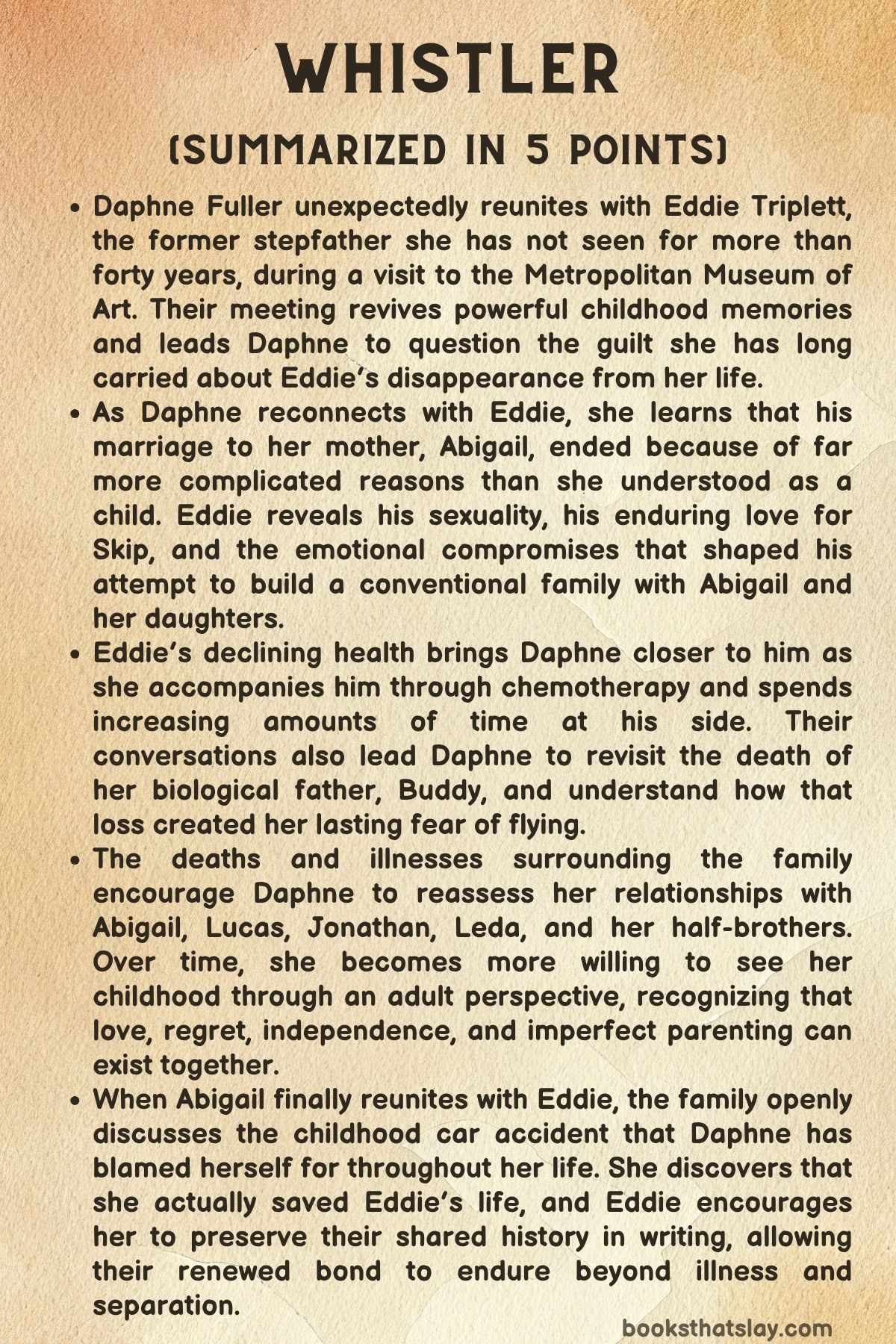
At fifty-three, Daphne Fuller is visiting the Metropolitan Museum of Art with her husband, Jonathan, when they become aware of an elderly man who seems to be following them. Jonathan finally approaches him and discovers that the stranger is Eddie Triplett, Daphne’s former stepfather, whom she has not seen for more than forty years.
When Eddie addresses Daphne by the childhood nickname “Duck,” the emotional distance of four decades suddenly collapses. Daphne begins crying, surprising Jonathan and even herself, because she had treated Eddie as someone belonging to a closed and almost unreachable part of her childhood.
Over lunch, Daphne learns that Eddie never remarried and never had children of his own. He still considers Daphne and her sister, Leda, the daughters he once had, and hearing this makes Daphne remember the brief but important period when Eddie brought books, attention, stability, conversation, and affection into the sisters’ unsettled family life.
The encounter sends Daphne directly to Leda, and the sisters begin revisiting the circumstances surrounding Eddie’s disappearance from their lives. Both have privately blamed themselves for the end of his marriage to their mother, Abigail: Leda connects it to an illness she suffered as a child, while Daphne believes the automobile accident she experienced with Eddie somehow destroyed the marriage.
Daphne has never told Jonathan the complete story of that accident, making Eddie’s return especially unsettling. Memories she had pushed aside are no longer distant events but living questions about responsibility, love, abandonment, and the explanations children create when adults fail to explain what has happened.
Jonathan soon leaves for Wisconsin with his sister Bea to clear their late mother’s house, giving Daphne more time to reflect on her own childhood. She thinks about Abigail’s later marriage to Lucas Ekker, the hugely successful author behind the Positivity! books, and remembers how alienated she felt when Abigail built another family with Lucas and their sons, Christopher and Matthew.
Leda had adapted to these changes more easily, while Daphne increasingly found security in reading and emotional independence. Jonathan also senses that Eddie’s return has affected his wife deeply, and his uneasiness exposes how much of Daphne’s earlier life remains outside the marriage they otherwise consider stable.
After Jonathan leaves, Daphne contacts Eddie and accepts an invitation to accompany him to a formal event. During the evening, Eddie finally tells her the truth about a part of himself that Daphne never understood as a child: he is gay, and his former Yale roommate, Skip Hotalling, was the defining romantic love of his life.
Eddie explains that his affection for Abigail and her daughters had nevertheless been genuine. He had hoped marriage could provide the conventional family life he wanted, but Abigail required him to abandon both Skip and his homosexuality, making their marriage dependent on a sacrifice Eddie could not permanently sustain.
With age, Eddie no longer speaks about Abigail simply as the person who rejected him. He recognizes his own responsibility, remembers her as a loyal friend whom he also hurt, and understands their marriage as an attempt by two people to create a life that could not survive the truth they were trying to suppress.
Eddie also tells Daphne about Mary Carter and her horse, Whistler, a story that originated in a nonfiction proposal he once wanted to publish. He has kept a photograph of the horse on his desk for decades, giving the story an unusual permanence in his life.
Before they separate that evening, Daphne asks Eddie not to disappear from her life again. Their accidental reunion becomes a deliberate relationship, and for the next ten months she regularly visits his apartment, brings him food, receives advance copies of books from him, and spends time inside the intellectual world that had first made him important to her as a child.
Their renewed happiness is threatened when Eddie’s health deteriorates. His white-cell count rises, his energy declines, and he eventually retires from the publishing career that has given shape and purpose to much of his adult life.
Chemotherapy becomes part of his routine, and Daphne insists on accompanying him. Rather than retreating from illness, she makes herself available for appointments and conversations, treating the responsibility as something intimate and personal rather than merely practical.
During one treatment, their conversation leads to Daphne’s biological father, Buddy. He had been emotionally distant for much of her life, but when he developed metastatic melanoma, Daphne cared for him and finally built the closeness with him that had been absent during her childhood.
Knowing Buddy regretted never seeing the Pacific Ocean, Daphne took him to Big Sur. The journey became one of their happiest shared experiences, but while they were flying home, Buddy suffered a pulmonary embolism and died in the seat beside her.
Daphne remained quietly next to his body until the plane landed because she wanted to complete the task of bringing her father home. Afterward, airplanes became inseparable in her mind from Buddy’s death, explaining why she has refused to fly ever since.
Eddie helps her see that her relationship with Jonathan also became connected to the aftermath of Buddy’s death. He further complicates Daphne’s understanding of her parents by revealing that Abigail never completely stopped loving Buddy, despite the marriages and decades that separated their earlier relationship from the life she eventually built with Lucas.
The family changes again when ninety-year-old Lucas dies suddenly at his home in Winchester. Daphne and Leda travel to Massachusetts to support Abigail, while Christopher and Matthew take responsibility for many of the practical arrangements surrounding their father’s death.
During the journey, Daphne asks how she and Leda managed to become functional adults despite the instability of their upbringing. Leda suggests that their childhood may have given them an unusual combination: they were loved enough to feel secure, but they were also left alone enough to develop courage, independence, and resourcefulness.
The idea forces Daphne to reconsider Abigail as a mother. Instead of viewing everything through the disappointments of childhood, she begins to recognize that Abigail’s refusal to organize her entire identity around motherhood may also have helped her daughters become capable of creating independent lives.
At Lucas’s home, the siblings come together and remember him affectionately. Christopher and Matthew recognize that Abigail devoted decades to caring for Lucas and suggest that his death, painful as it is, also leaves her free to decide what she wants from the remaining years of her own life.
Daphne privately asks both Lucas and Buddy to watch over Eddie, revealing how she has come to understand these different men as fathers in different ways. When Abigail worries that her children may someday feel relief rather than devastation at her own death, Daphne assures her that all four children will mourn her deeply.
The conversation creates a new tenderness between mother and daughter. Daphne no longer sees Abigail only as the woman whose decisions caused confusion and loss but as an aging person carrying her own history of difficult choices, compromises, desires, and regrets.
Eddie, meanwhile, continues trying to fill his days with everything he values: books, opera, theater, museums, lectures, friendships, and time with Daphne’s family. His body is becoming increasingly unreliable, however, and ordinary movement eventually requires a cane and considerable effort.
He tells Daphne that he and Abigail have begun writing letters to each other. Their correspondence gives them the chance to revisit the end of their marriage without the anger of youth, and both gradually release some of the disappointment, guilt, shame, and resentment they have carried for decades.
As Eddie becomes more conscious of death, he talks with Daphne about Buddhism, impermanence, and the idea of a transitional state after death. He asks her for a difficult form of loyalty: when his time comes, he wants her to help him accept death rather than encourage him to remain attached to life simply because she cannot bear to lose him.
After another exhausting chemotherapy session, Daphne refuses to let Eddie return home alone. When they arrive at his apartment, Skip is waiting with dinner, and Eddie immediately collapses into his arms.
Watching them together teaches Daphne that even people who love someone deeply may never completely understand the private reality of that person’s closest relationship. Skip knows a version of Eddie that belongs to their long romantic history, just as Daphne knows the man who once became her father and then unexpectedly returned.
Jonathan later reveals his own history of responding to illness very differently. During the chemotherapy treatments of his first wife, Candy, he often escaped into work because he was frightened by her suffering, and his confession makes Daphne’s commitment to remaining beside Eddie more meaningful.
Eddie improves temporarily, allowing another long-delayed reunion to occur. Forty-five years after their separation, Abigail travels to New York and visits him.
Instead of recreating the hostility of their divorce, the former spouses greet each other warmly. Abigail admires the publishing career Eddie built, while admitting that she regrets giving up much of her own professional ambition after marrying Lucas; Eddie, in turn, recognizes the value of the family and life she created.
Their meeting demonstrates how dramatically time has changed their understanding of one another. Neither needs to prove who was right anymore, and both can acknowledge what the other achieved as well as what each lost through the choices they made.
During the visit, Leda pushes the family to discuss the automobile accident that has haunted Daphne since childhood. Daphne finally tells Jonathan, Abigail, and the others what actually happened after the car crashed during a freezing winter night.
Nine-year-old Daphne climbed out of the wreck, crossed a snowy raspberry farm, became lost, recognized Eddie’s tie marking part of her route, found a house, summoned help, and then guided rescuers back to the injured man. What Daphne has remembered primarily as a disaster connected to Eddie’s disappearance was also an extraordinary act of courage.
Eddie gives Daphne the interpretation she has never been able to give herself: she saved his life. Abigail reduces the event to its most essential conclusion by reminding them that both Daphne and Eddie survived, challenging Daphne’s lifelong belief that the accident should be understood principally through guilt.
Later, Daphne and Eddie rest together at the Metropolitan Museum while Jonathan takes Abigail through the galleries. The museum where Daphne unexpectedly found Eddie becomes the setting in which their renewed relationship reaches its clearest expression.
Eddie urges Daphne to write everything: Mary Carter, the horse, the accident, the snow, the years apart, and the strange circumstances that brought them together again. He imagines Daphne as the writer and himself as the editor, preserving their relationship through a story whose ending does not need to follow the ordinary limits of mortality.
The book finally returns to the aftermath of the childhood accident. Inside the ambulance, Eddie proudly calls young Daphne his daughter and tells the rescuers that no daughter anywhere could be better.
Holding Eddie’s hand after surviving the freezing night, Daphne experiences a truth that complicates every later memory of the accident. Those frightening hours were also among the happiest of her childhood because, during them, she knew with complete certainty that she was loved as Eddie’s daughter.
Characters
Daphne Fuller
Daphne is the emotional center of Whistler, and much of her development depends on learning that memory is not the same as objective truth. She has spent decades interpreting childhood events through guilt, abandonment, and incomplete explanations, especially the accident involving Eddie and the eventual disappearance of her former stepfather.
Her adult competence conceals how strongly those childhood interpretations continue to influence her. She has become independent, intelligent, professionally committed, and capable of caring for other people, yet some of her most important choices still originate in experiences she has never properly examined.
Her refusal to fly illustrates this pattern clearly. What might appear from the outside to be stubbornness is connected to Buddy’s death beside her on an airplane, turning flight into a physical reminder of grief, helplessness, and the strange responsibility she assumed when she remained beside her father’s body until landing.
Daphne also has an unusually strong instinct for staying with people when they are vulnerable. She cares for Buddy when he is dying and later accompanies Eddie through chemotherapy, showing that her response to fear is often not withdrawal but service.
Her relationship with Abigail undergoes another important change. Daphne begins from a position shaped by childhood resentment, but gradually becomes capable of seeing her mother as a complicated person whose choices cannot be reduced to their effects on her children.
Most importantly, Daphne learns to revise the meaning of the accident she has carried for more than forty years. She remembers herself as a child connected to disaster and divorce, while Eddie remembers a courageous girl who saved his life, and accepting his version allows her to reclaim a part of herself that guilt had obscured.
Eddie Triplett
Eddie is both a father figure and the person whose return forces the past into the present. In Whistler, he represents the possibility that a relationship can remain emotionally significant even after decades of physical absence.
His love for Daphne and Leda was never casual. Although his marriage to Abigail failed, he continued to think of the girls as his daughters, and the fact that he never had children of his own makes that attachment even more central to his personal history.
Eddie’s sexuality explains much of the conflict surrounding his marriage without reducing that marriage to deception. He genuinely loved Abigail and wanted the family they created, but he also loved Skip and could not permanently live according to the heterosexual identity Abigail expected him to maintain.
Age gives Eddie the ability to acknowledge several truths at once. He can recognize Abigail’s demands as impossible for him while also seeing the ways he hurt her, allowing him to move beyond the simpler position of treating himself entirely as victim or entirely as offender.
His career as an editor is equally important to his personality. Books are not merely his occupation; they form the language through which he understands people, memory, possibility, and permanence.
As his illness advances, Eddie becomes increasingly concerned with accepting death without bitterness. His interest in Buddhism and impermanence reflects his desire to face mortality consciously rather than pretending that attachment can prevent change.
His final suggestion that Daphne write their story also reveals his deepest professional and emotional instincts. He knows the body cannot remain, but he believes stories can preserve a version of human connection, allowing the editor in him to imagine a form in which his relationship with Daphne does not have to end with his death.
Jonathan
Jonathan is a stable presence in Daphne’s adult life, but his role is more complicated than that of an unquestioningly supportive husband. Eddie’s sudden appearance unsettles him because Daphne responds with an intensity that exposes an entire emotional history he has never fully known.
His discomfort therefore reflects a reasonable realization that marriage does not automatically provide complete access to another person’s past. Daphne loves him, yet there are memories, fears, and relationships that existed long before him and have retained their power.
Jonathan’s history with Candy adds important depth to his character. During his first wife’s chemotherapy, he responded to fear by retreating into work, and he later recognizes that avoidance as a limitation in himself.
His confession gains significance when contrasted with Daphne’s determination to stay beside Eddie during treatment. Rather than becoming defensive, Jonathan admits the difference, demonstrating self-awareness and an ability to judge his younger self honestly.
His relationship with his sister Bea and his willingness to return temporarily to hospital administration also suggest that usefulness matters to him. Jonathan is at his best when he has practical responsibilities, which helps explain both his strengths and the way work once became a refuge from emotional pain.
Leda
Leda functions as both Daphne’s sister and one of the clearest alternative interpreters of their shared childhood. Because the sisters experienced many of the same family disruptions, their different reactions demonstrate that childhood events do not create one inevitable emotional outcome.
Where Daphne often withdrew, Leda adapted more readily. She appears capable of placing family instability within a broader psychological framework, particularly when she argues that she and Daphne were loved enough to feel secure but left alone enough to become independent.
Her interpretation is important because it challenges the assumption that good parenting means total parental devotion. Leda recognizes that Abigail and the other adults maintained identities beyond their children, and she sees this distance as one factor that encouraged resilience.
Leda is also more willing than Daphne to force difficult conversations into the open. Her insistence that the family finally discuss the accident helps break a silence that has shaped Daphne’s self-understanding for decades.
At the same time, Leda has carried her own irrational childhood guilt, believing that her appendicitis may somehow have contributed to Eddie’s departure. Her insight into others therefore does not mean she is immune to the emotional logic of childhood.
Abigail
Abigail is one of the book’s most complicated characters because she can be understood very differently depending on whether she is viewed as a mother, wife, former lover, aging woman, or individual who made difficult choices within the expectations of her time. Daphne initially remembers her largely through the instability she created, but later encounters a much more complicated personal history.
Her marriage to Eddie reveals both her desire for family stability and the limits of her acceptance. She wanted Eddie as a husband but required him to abandon his relationship with Skip and deny his homosexuality, making genuine reconciliation between Eddie’s identity and the marriage impossible.
Yet Abigail is not presented as permanently trapped within that earlier version of herself. Decades later, she and Eddie are able to correspond, reconsider their marriage, and finally meet with warmth rather than accusation.
Her marriage to Lucas gave her another family and a long period defined in part by caring for a highly successful husband. After his death, she acknowledges that she sacrificed much of her own career, introducing regret into a life that from the outside might otherwise appear secure and accomplished.
Abigail’s lingering feelings for Buddy further complicate her romantic history. The revelation that she never fully stopped loving him suggests that her marriages existed alongside emotional attachments that did not disappear simply because circumstances changed.
Her fear that her children may feel relief when she dies exposes a vulnerable side that Daphne has rarely considered. By reassuring her mother, Daphne shifts from being primarily the child evaluating Abigail’s failures to an adult capable of recognizing her mother’s need for reassurance, forgiveness, and love.
Lucas Ekker
Lucas occupies a significant position in Daphne’s family without becoming one of the people to whom she feels most emotionally attached. His immense success as the author of the Positivity! books shapes the household Abigail creates after her marriage to him and contributes to Daphne’s sense that a new family has been formed around her.
For Daphne, Lucas is partly associated with displacement because his arrival accompanies the period when Abigail builds a life with him and their two sons. Yet his death allows Daphne to reconsider him outside the resentment connected to adolescence.
Christopher and Matthew’s affection for their father reminds Daphne that Lucas cannot be reduced to the role he played in her own childhood dissatisfaction. He was a husband, father, public figure, and elderly man who depended increasingly on Abigail’s care.
Daphne’s later request that Lucas, along with Buddy, watch over Eddie is especially revealing. By mentally placing the three men together as father figures, she grants Lucas a place within her emotional family history that is more generous than the one she gave him when he was alive.
Buddy
Buddy, Daphne’s biological father, demonstrates how intimacy can arrive late in a relationship. For much of Daphne’s life he is emotionally distant, leaving her without the secure father-daughter bond she might have wanted during childhood.
His illness changes the relationship because Daphne chooses to care for him after he develops metastatic melanoma. The approach of death removes some of the distance between them, allowing both father and daughter to experience a closeness that their earlier life had failed to create.
Their trip to Big Sur becomes especially meaningful because Daphne is able to give Buddy something he deeply wanted: a chance to see the Pacific. His death on the return flight turns a joyful act of devotion into the origin of one of Daphne’s deepest fears.
Buddy also remains important through Abigail’s history. Eddie’s revelation that Abigail never truly got over her first love changes Daphne’s understanding not only of Buddy but of the emotional structure underlying her mother’s later marriages.
Although Buddy dies before the central events of the story, his influence continues through Daphne’s fear of flying, her understanding of caregiving, and her recognition that even an imperfect father can become deeply loved.
Skip Hotalling
Skip is essential to understanding Eddie because he represents the love Eddie could not erase in order to preserve a conventional marriage. Their relationship began when they were young men, but its emotional importance survives the social pressures and personal decisions that separated different parts of Eddie’s life.
For Daphne, learning about Skip changes her interpretation of Eddie’s marriage to Abigail. The divorce is no longer a mysterious adult event that may somehow have been caused by a child’s actions but part of a much larger conflict involving identity, sexuality, love, and social expectation.
Skip’s presence when Eddie returns exhausted from chemotherapy also communicates more than any long explanation could. Eddie collapses into his arms with complete trust, and Daphne immediately recognizes that their bond contains experiences she cannot fully access.
This realization helps Daphne accept a mature truth about love: closeness does not give one person ownership over every part of another person. She can be Eddie’s daughter without replacing Skip, just as Skip’s importance does not diminish Eddie’s love for her.
Bea
Bea, Jonathan’s sister, has a comparatively small role but contributes to the book’s broader attention to family responsibility. She works alongside Jonathan to clear their late mother’s Wisconsin home, participating in the practical process of closing one stage of family life after a parent’s death.
Their later journey to Norway suggests a comfortable sibling relationship and gives Jonathan companionship outside his marriage. Bea therefore helps establish that family bonds continue through shared duties, travel, memory, and the ordinary work required after loss.
Christopher
Christopher is one of Abigail and Lucas’s sons and Daphne’s half-brother. His presence demonstrates the expanded family structure Daphne once struggled to accept, particularly because the arrival of Abigail’s new household made Daphne feel that she had been moved to the edge of her mother’s life.
As an adult, however, Christopher is not presented as a rival. After Lucas dies, he helps manage practical arrangements and joins the family in remembering his father with affection.
His observation that Abigail has spent much of her life caring for Lucas also shows sensitivity toward his mother’s future. Rather than assuming that widowhood should define her entirely through loss, he recognizes that she may now have freedoms she has not experienced for many years.
Matthew
Matthew, like Christopher, is both Lucas’s son and Daphne’s half-brother. His adult relationship with his sisters shows how family connections created under emotionally difficult circumstances can become ordinary and affectionate with time.
He participates in the practical responsibilities following Lucas’s death and in the family’s shared memories of him. Through Matthew and Christopher, Daphne is encouraged to understand Lucas not only as the man connected to her mother’s remarriage but as a deeply important father to two other children.
Matthew’s role also helps show how the siblings have moved beyond the divisions created by their parents’ relationships. The four children eventually form a family unit capable of supporting Abigail despite having experienced very different versions of her as a mother.
Candy
Candy, Jonathan’s first wife, appears mainly through Jonathan’s memories, yet her illness exposes an important part of his emotional history. Her chemotherapy frightened him so deeply that he often responded by escaping into work rather than remaining present with her suffering.
She therefore becomes an indirect point of comparison with Eddie. As Daphne stays beside Eddie during treatment, Jonathan recognizes how differently she is responding to a situation that once overwhelmed him.
Candy’s role is not to condemn Jonathan but to reveal his capacity for retrospective honesty. Through remembering his behavior during her illness, he can acknowledge fear, avoidance, and regret without trying to rewrite himself as the person he wishes he had been.
Mary Carter
Mary Carter belongs to the nonfiction story Eddie once hoped to publish rather than to Daphne’s immediate family circle. Her importance comes from her connection with a horse that returns when she is close to death, an image Eddie preserves for decades through a photograph on his desk.
For Eddie, the story appears to represent return, loyalty, and the possibility that something believed to be gone can unexpectedly come back at precisely the moment it is needed. That meaning eventually becomes closely connected to his reunion with Daphne.
Mary Carter therefore operates partly as a parallel figure rather than as a fully developed participant in the central family story. Her experience gives Eddie and Daphne a language through which they can understand reunion without pretending that time, illness, or death can simply be erased.
Dr. Ocean
Dr. Ocean appears primarily in connection with Eddie’s cancer treatment and serves a practical rather than emotionally central role. Through the medical care surrounding Eddie, the story gains a concrete sense of the physical decline that neither intellectual discussion nor emotional attachment can prevent.
The character also helps create the setting in which many of Daphne and Eddie’s most revealing conversations occur. Chemotherapy becomes not merely treatment but repeated time together, allowing fear, family history, mortality, and unresolved memories to surface as Eddie’s future becomes increasingly uncertain.
Themes
Memory, Guilt, and Reinterpreting the Past
Memory in Whistler is never presented as a perfect record of what happened. Daphne remembers the accident with Eddie accurately enough in terms of events, yet the meaning she assigns to those events has been shaped by the assumptions of a frightened child who never received a complete explanation for why Eddie disappeared from her life.
For decades, she treats the accident almost as evidence against herself. Because Eddie’s marriage to Abigail ended afterward, Daphne unconsciously creates a causal relationship between the two events and carries responsibility for consequences that were actually produced by complicated adult choices.
Leda reveals the same tendency when she associates Eddie’s departure with her own childhood illness. Both sisters demonstrate how children may interpret family instability through self-blame because believing they caused something can feel more comprehensible than accepting that the adults around them had private lives they could not understand.
The adult characters gradually replace these isolated childhood interpretations with fuller accounts. Eddie explains his sexuality and his relationship with Skip, Abigail revisits the marriage from her own perspective, and the details of the accident are finally spoken aloud in front of the family.
The most important change is not that Daphne discovers her memory was false. She discovers that the meaning she gave the memory was incomplete.
The night she remembered as a source of guilt was also the night she demonstrated extraordinary courage and saved Eddie’s life. By accepting that truth, Daphne does not erase the fear of her childhood; she finally allows the same memory to contain survival, love, bravery, and belonging.
Parenthood, Family, and Chosen Bonds
Biological relationships and emotional parenthood repeatedly fail to match one another in simple ways. Buddy is Daphne’s biological father, yet their true closeness develops only near the end of his life, while Eddie becomes a deeply important father during a marriage that lasts only a relatively short period.
Lucas occupies still another position. He is not Daphne’s biological father and never carries the same emotional meaning for her that Eddie does, but he becomes the father of her half-brothers and remains part of the family structure that shapes her adulthood.
These differences challenge the idea that family roles can be understood merely through legal or biological definitions. Eddie has no children of his own, yet he continues to think of Daphne and Leda as his daughters more than forty years after losing regular contact with them.
Daphne eventually recognizes this multiplicity by thinking of Buddy, Lucas, and Eddie together as different forms of fatherhood. None replaces the others, and none has to satisfy a perfect definition of what a father should be in order to matter.
Leda’s interpretation of their upbringing adds another layer to the theme. She suggests that the sisters may have benefited from receiving enough love to create security while also being given enough independence to become capable adults.
The book therefore avoids presenting healthy family life as constant closeness or complete self-sacrifice. What matters more is whether love survives imperfection, whether adults can recognize the effects of their choices, and whether people are willing to accept relationships that do not fit conventional categories.
Love, Regret, and Forgiveness
Love throughout the story frequently survives circumstances that prevent people from building a life together. Eddie loves Skip, yet he also genuinely cares for Abigail and her daughters; Abigail builds a decades-long marriage with Lucas while never completely losing her feelings for Buddy.
These emotional realities resist simple judgments about which relationship was authentic. A person can love more than once, carry attachment from one period into another, and still make sincere commitments that do not cancel what came before.
Regret becomes especially important as the characters age. Abigail regrets sacrificing professional possibilities after marrying Lucas, Eddie recognizes the pain surrounding his marriage to Abigail, Jonathan regrets retreating into work during Candy’s illness, and Daphne recognizes how much of her life has been influenced by conclusions she formed when she was too young to understand the adults around her.
The story does not suggest that regret can reverse consequences. Instead, it shows that people may eventually become capable of discussing the past without demanding that someone be declared entirely guilty or entirely innocent.
Eddie and Abigail’s late correspondence demonstrates this process most clearly. Their younger selves could not reconcile Eddie’s sexuality, Abigail’s expectations, Eddie’s love for Skip, and their shared desire for family life, but their older selves can finally acknowledge these conflicting truths without trying to defeat one another.
Forgiveness therefore becomes less about announcing that past injuries no longer matter and more about releasing the need to keep prosecuting them. Age does not make the past disappear, but it can create enough distance for people to replace accusation with understanding.
Mortality, Impermanence, and the Endurance of Stories
Death surrounds Daphne long before Eddie begins preparing for it. Buddy dies beside her on an airplane, Jonathan has already endured Candy’s cancer, Lucas dies suddenly in old age, and Eddie’s illness gradually transforms ordinary activities into physically demanding tasks.
These experiences make mortality an everyday reality rather than an abstract subject. The characters must decide not whether death can be avoided, but how they will behave when they know that someone they love is moving toward it.
Daphne’s instinct is to remain present. She accompanies Eddie to chemotherapy, assists him when he becomes physically weak, and refuses to let his worsening condition turn him into someone she avoids because being near him is painful.
Eddie approaches the same problem through ideas of impermanence and acceptance. His interest in Buddhism reflects his desire to resist the human tendency to hold onto life simply because separation is frightening, and he asks Daphne to help him accept death rather than make his departure emotionally harder.
At the same time, acceptance does not require believing that everything disappears. Eddie’s lifelong work with books provides another possibility: a person cannot prevent death, but stories can preserve moments, voices, relationships, and versions of human experience.
His suggestion that Daphne write their shared history transforms writing into an answer to impermanence without pretending that it can defeat mortality. The physical relationship between Daphne and Eddie will eventually end, but the story can stop at a chosen moment, preserving them together and giving narrative form to a love that disappearance once interrupted but never destroyed.