White Lights by Lauren Kate Summary, Characters and Themes
White Lights by Lauren Kate is a supernatural fantasy centered on
Desdemona “Dez” Rae, an aspiring filmmaker whose pursuit of a creative future draws her into a hidden world where cinema, memory, angels, and death are inseparable.
What begins as an escape from an isolated life in Death Valley becomes a confrontation with questions far larger than artistic ambition. Dez discovers that the mysterious school recruiting her has access to entire human lives and serves a cosmic purpose connected to the final moments before death. At its center is also a complicated conflict between mortality, power, free will, and the dangerous value of love.
Summary
Rafael “Rafe” de la Cruz is an angel who becomes fascinated by a young filmmaker named Desdemona “Dez” Rae after seeing her on the Ventura pier. Unlike ordinary humans, Dez appears capable of seeing him even though angels should remain invisible to mortals, and Rafe’s former mentor Samael recognizes that this unusual ability may make her important.
Samael, once the Angel of Death, has recently surrendered his immortality to become human, leaving a dangerous vacancy in the celestial order. Rafe wants to succeed him and obtain the Crimson Pinion, the symbol of the Angel of Death’s authority, and Samael suggests that taking Dez as his protégé may help him achieve that ambition.
Dez, meanwhile, lives in Death Valley and works at her uncle’s Dairy Barn while saving money for film school. Her greatest hope rests on “Glimpse,” a short film she made with her friend Silas and Asher Ibrahim, a charismatic young man with whom she shared an immediate romantic connection before the two unexpectedly stopped communicating.
Her life changes violently when her younger brother Moses, known as Mo, arrives during her shift and becomes involved in a robbery. Mo owes money to dangerous people, and the masked man accompanying him behaves unnaturally, surviving injuries that should incapacitate an ordinary person.
Dez fights the robber and even tears out one of his eyes, but the confrontation becomes catastrophic when she throws hot fryer oil at him. Mo moves between Dez and the attacker and receives the oil across his face and neck, leaving him terribly burned before the masked man escapes with him.
The police eventually recover Mo, but the evidence makes Dez’s account appear impossible. Investigators cannot find convincing proof of the masked attacker, while Dez secretly keeps the severed eye because she believes it may someday prove that she has been telling the truth.
During this crisis, Rafe appears with an extraordinary offer. He claims Dez has been recruited by Acheron, a secretive filmmaking institution in the Colorado Rockies that will cover her tuition, housing, resources, and even legal assistance, but she must leave almost immediately.
With Mo hospitalized, the police suspicious of her, and her mother urging her to take the opportunity, Dez accepts. Rafe takes her aboard a nearly invisible aircraft and brings her to Acheron, an isolated Gothic campus hidden behind a supernatural boundary called the barbelo.
Life at Acheron feels both luxurious and threatening. Dez meets Simon Nelson, another first-year filmmaker who becomes her close friend, and Yael, an experienced student who shares their suite and seems to understand far more about the school than she initially reveals.
Students are divided according to their creative instincts. Scribes work primarily through language, while Visionaries think through images; Dez is identified as a Visionary and is eventually paired with Rafe as her mentor through a dangerous ritual that forces her to ski blindly down a mountain.
The school’s darker side becomes increasingly difficult to ignore. Strange deaths occur, official explanations seem unreliable, and badly damaged bodies occasionally fall onto the campus before maintenance teams remove them with disturbing efficiency.
Dez also enters the Vault, the hidden center of Acheron’s filmmaking system. There she receives a Lens, an apparatus that responds to thought and emotion and gives filmmakers access to complete archives of human experience rather than conventionally recorded footage.
Although Dez is assigned to create a film about an elderly poet named Lexa O’Rourke, her concern for Mo overwhelms the system. Her Lens unexpectedly opens his entire Lifeline, allowing her to watch moments from his childhood, adolescence, and adulthood, including events she never personally witnessed.
Dez decides to make an unauthorized film about Mo called “Lazarus.” While working through his life, she gradually realizes that reducing him to his addictions, mistakes, injuries, or the terrible night at the Dairy Barn would distort who he really was.
Recurring images of clouds allow her to construct a broader portrait of change, pain, beauty, and continuity. With Rafe’s assistance and a mysterious substance called Soma that alters her experience of time, Dez finishes the film and gives it to Rafe to deliver to Mo.
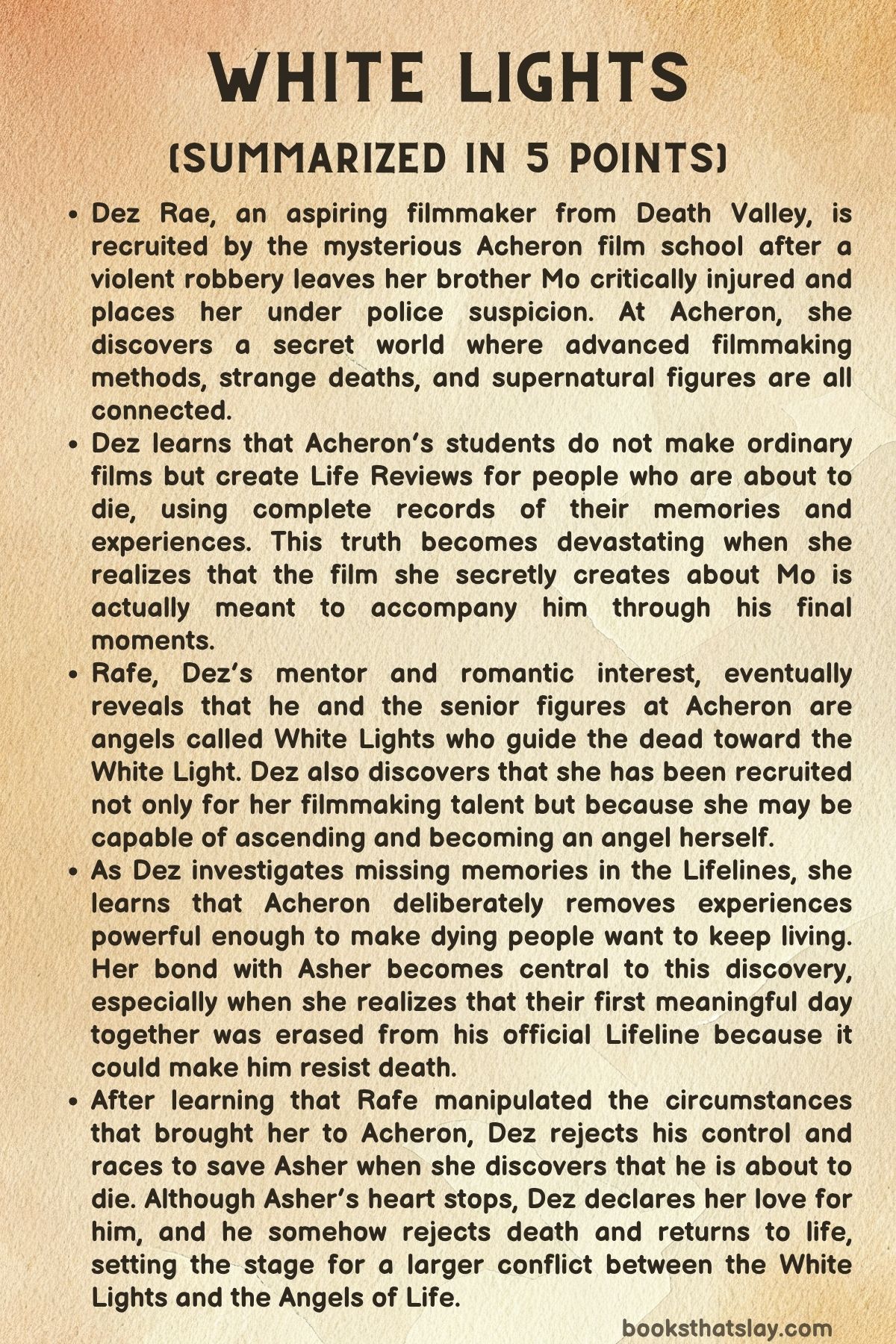
At a school gala, Dez finally learns what Acheron actually does. The films created there are Life Reviews designed for people who are about to die, organizing the memories that supposedly pass through a person’s consciousness in the final instant before death and guiding that soul toward the White Light.
The revelation means Lexa is dying, but it also reveals something far more devastating: Mo is dying too. Rafe soon confirms that Mo has already died and explains that “Lazarus” did not cause his death; instead, the film became the final arrangement of memory that accompanied him toward the White Light.
Rafe then reveals the truth about himself. He and Acheron’s senior students are angels known as White Lights, beings responsible for guiding the dead, while the disappearance of Samael has destabilized the entire system of death.
Dez also learns that Alice, a student believed dead, was actually expelled through a supernatural process that caused her to remember Acheron only as a dream. The more disturbing bodies falling onto campus are connected to people who reach the White Light but reject death, creating damaged beings and weakening the boundary between life and death.
Students must decide whether to leave or remain and train rapidly enough to help repair the crisis. Dez stays, partly because Rafe tells her that she was never recruited merely for filmmaking talent: her unusual ability to perceive angels reveals that she has the potential to ascend and become an angel herself.
Her relationship with Rafe becomes increasingly intimate, although he repeatedly refuses intercourse. Eventually he explains that an angel’s full sexual power can kill a mortal, meaning his restraint has been an attempt to protect Dez until she ascends.
Yet Dez cannot let go of Asher. Using the Vault, she discovers that his Lifeline strangely excludes the day they met, even though that encounter mattered deeply to both of them.
She eventually learns that Acheron deliberately removes certain memories from Life Reviews. Every person possesses moments powerful enough to make them desperately want to continue living, and those memories are censored because they might persuade a dying person to reject the White Light.
For Asher, that forbidden memory is his day with Dez. The discovery forces Dez to question whether Acheron preserves cosmic order by revealing the meaning of life or controls death by deliberately excluding the experiences that make life hardest to surrender.
Her distrust of Rafe becomes much worse when Yael reveals that a protégé’s ascension strengthens the mentor through a supernatural bond. Dez realizes that Rafe’s desire to make her an angel could greatly increase his own power and improve his chances of becoming the next Angel of Death.
When Dez confronts him, Rafe admits an even greater betrayal. He engineered the circumstances surrounding the Dairy Barn robbery by replacing Mo’s original mortal accomplice with the angel Jet, believing that the original criminal would have killed Dez.
Rafe insists that he saved her, but his intervention caused the chain of events that burned Mo, isolated Dez from her family, placed her under police suspicion, and made Acheron appear to be her only escape. There was no independent committee that selected her; Rafe personally chose her and manipulated her situation so that she would come with him.
Dez rejects him, Acheron, and the expectation that she should ascend for the sake of celestial order. Her experiences have instead strengthened her desire to live, and she begins questioning whether rejecting death is automatically wrong simply because the White Lights consider it dangerous.
Her conflict becomes urgent when Asher’s Lifeline appears as her final required Life Review. Realizing this means he is about to die, Dez refuses to complete his film and instead decides to prevent his death.
Using Soma to freeze time and Jet’s preserved eye to unlock a supernatural aircraft, she escapes Acheron and races to California. She finds Asher alive and follows him, searching desperately for whatever is supposed to kill him.
At first, Asher seems to remember experiences that Dez had illegally inserted into his Lifeline, but those memories begin disappearing as Rafe reverses her changes. Soon Asher remembers only their original meeting and eventually treats Dez almost like a stranger.
Then a white rattlesnake bites him. Asher collapses as the venom spreads through his body, while Dez accidentally poisons herself attempting to save him.
Rafe arrives carrying Asher’s completed Life Review. He removes the venom from Dez and gives her the opportunity to administer Asher’s film after his heart stops.
Believing she has failed, Dez tells Asher that she loves him and that her love would have grown had they been given more time. Despite his altered Life Review and stopped heart, Asher squeezes her hand, says her name, and somehow rejects death.
Dez later awakens in a seaside restaurant opposite Samael. He explains that Asher truly died but returned because Dez’s love gave him a reason powerful enough to refuse the White Light, making him a death-killer.
Asher has now been taken by the Angels of Life, another celestial faction preparing for conflict with the White Lights. Samael tells Dez that her unusual capacity for compassion and romantic attachment has made her highly important to the coming struggle.
To reach Asher, however, Dez will probably need the very transformation she had rejected: ascension. Samael advises her to reconcile with Rafe because he remains her best route into the angelic world, then leaves her with a drawing that shows what her future may become—a portrait of Dez with wings.
Characters
Desdemona “Dez” Rae
At the center of White Lights, Dez is defined by the tension between wanting to escape her limited circumstances and refusing to abandon the people who give her life emotional meaning. She begins as an ambitious filmmaker who sees art as a possible route out of Death Valley, but every major experience forces her to reconsider whether achievement matters if it requires separating creativity from love, family, memory, and moral responsibility.
Her devotion to Mo reveals both her greatest strength and one of her deepest vulnerabilities. She protects him even after learning about his involvement in the robbery, carries crushing guilt for his burns, risks her future to preserve evidence that might explain what happened, and later violates Acheron’s rules because she cannot accept treating her brother as merely another subject for a film.
Filmmaking is closely connected to Dez’s way of understanding reality. Her extraordinary ability as a Visionary comes from noticing emotional patterns that others miss, whether she is finding the recurring clouds that give “Lazarus” its meaning or sensing the missing moments that Acheron has deliberately removed from Lifelines.
That same instinct eventually becomes rebellion. Dez refuses to accept a version of truth chosen by authority when her own perception tells her something has been excluded, and this resistance grows from artistic independence into a larger moral challenge against the entire celestial system.
Her relationships with Rafe and Asher reveal two different forms of desire. Rafe represents dangerous intensity, supernatural attraction, ambition, power, and transformation, while Asher represents the unfinished possibility of an ordinary human future shaped by uncertainty rather than destiny.
By the end of the story, Dez has not simply chosen one man over another. She has chosen the principle that love, memory, and the desire to remain alive deserve to be taken seriously even when an established cosmic order declares them dangerous.
Rafael “Rafe” de la Cruz
Within White Lights, Rafe is simultaneously mentor, romantic interest, protector, manipulator, and ambitious angel. His attraction to Dez is genuine, but it exists beside a powerful desire to succeed Samael and become the new Angel of Death, preventing the reader from separating his affection from the benefits he might receive through her ascension.
Rafe understands Dez unusually well as an artist. He challenges her insecurity, recognizes the importance of her emotional way of seeing, assists with “Lazarus,” and repeatedly pushes her toward deeper visual meaning rather than superficial storytelling.
Yet his ability to understand Dez also makes his manipulation more serious. He knows exactly what she values and uses that knowledge to place her on a path toward Acheron, including engineering circumstances around the Dairy Barn that he claims were designed to protect her but that ultimately destroy the stability of her family life.
His moral weakness lies in believing that a desirable result can justify interference with another person’s freedom. Because he sees the cosmic system as larger than individual human suffering, he repeatedly makes decisions for Dez instead of trusting her to make informed decisions herself.
His refusal to have intercourse with Dez demonstrates that he is not without restraint or care. He genuinely protects her from the lethal consequences of angelic sexuality, even when doing so frustrates both of them, showing that his selfishness is complicated by a real willingness to deny himself when he believes her physical survival is at stake.
Rafe therefore remains difficult to classify as either trustworthy or cruel. He is capable of tenderness, loyalty, jealousy, deception, sacrifice, erotic vulnerability, and ruthless calculation, making his relationship with Dez dependent on whether he can ever learn that love without respect for another person’s freedom becomes another form of control.
Asher Ibrahim
Asher initially represents possibility rather than permanence. Dez spends only a single extraordinary day with him while making “Glimpse,” yet the emotional force of that encounter survives months of separation and becomes strong enough to challenge the principles on which Acheron operates.
His importance increases when Dez gains access to his Lifeline. She sees his childhood, family, losses, injuries, future ambitions, and eventual scientific interest in extending human life, allowing her to know far more about him than he consciously knows about her.
The absence of their meeting from his official memories turns Asher into evidence of Acheron’s moral compromises. His connection with Dez is removed precisely because it makes life harder to surrender, meaning the system considers one of his most meaningful experiences too dangerous to include in the final story of his existence.
Asher also becomes a test of whether love can survive manipulation. Even after Rafe removes Dez from his altered memories and Asher’s heart stops, he still recognizes her name after she declares her love, suggesting that emotional connection exists at a level deeper than the version of memory Acheron can control.
His return from death transforms him from a romantic possibility into a figure of cosmic significance. By becoming a death-killer associated with the Angels of Life, Asher demonstrates that one human attachment can threaten a system that has existed for ages.
Moses “Mo” Rae
Mo is central to Dez’s emotional development even though much of his story is experienced through her memories and his Lifeline. He is affectionate, troubled, self-destructive, and deeply loved, and his addiction creates choices that harm both himself and the family members trying to protect him.
His involvement in the Dairy Barn robbery shows how desperation can distort judgment without completely erasing love. Mo participates in a crime that endangers Dez, yet when the confrontation becomes lethal, he moves between her and danger and suffers devastating burns.
For Dez, Mo becomes inseparable from guilt. She initially sees the hot oil as the act that destroyed him, but while constructing “Lazarus,” she realizes that focusing only on his addiction, injuries, and death would reduce an entire human life to its worst moments.
His Life Review becomes one of Dez’s first major lessons about storytelling. A truthful portrait requires the joyful child, the difficult adolescent, the loving brother, the addict, the injured man, and every version between those points to exist together.
Mo’s death also exposes the emotional cost of Acheron’s secrecy. Dez is unknowingly making the final story her brother will receive while he is dying, and learning the truth afterward changes her relationship with both Rafe and the institution permanently.
Samael
Samael, or Sam, is the former Angel of Death whose decision to become mortal sets nearly every supernatural conflict in motion. After overseeing death for an immense period, he chooses mortality because eternal power can no longer offer what ordinary human existence promises, especially the possibility of love.
His decision makes him an important contrast to angels who treat mortality as an inferior state. Sam voluntarily gives up the authority that others, including Rafe, desperately want, suggesting that experience, vulnerability, and emotional freedom may ultimately be more valuable than immortality.
Sam is also a strategist who recognizes Dez’s unusual nature before she understands it herself. His early portrait of her and his encouragement that Rafe take her as a protégé indicate that he has anticipated at least part of her importance to the conflict surrounding death.
When he reappears after Asher returns, Sam becomes a guide toward the next stage of Dez’s life. He understands that her capacity for love can disrupt existing celestial rules and recognizes that this ability may make her crucial to the conflict between the White Lights and Angels of Life.
His final drawing of Dez with wings is therefore both prediction and challenge. Sam sees ascension not simply as acceptance of Acheron’s values, but as a possible way for Dez to enter the supernatural system strongly enough to change it.
Simon Nelson
Simon begins as one of the few people at Acheron who provides Dez with genuine companionship rather than mystery. His shyness, eccentricity, artistic ambition, and attachment to family make him feel recognizably human within an environment where many senior figures operate according to unfamiliar moral standards.
His development becomes particularly important because he ascends before Dez. Through Simon, the novel demonstrates that becoming an angel is not merely gaining wings or immortality; it changes perception, relationships, sexuality, priorities, and the meaning of a former human identity.
Before ascension, Simon is strongly attracted to Esther. Afterward, he becomes less certain about pursuing a mortal relationship, illustrating how angelhood can create emotional distance from the concerns that once shaped a person.
His growing intimacy with Jet also reveals the power of the mentor-protégé bond. Simon becomes an example of what Dez might gain through ascension, but also what she might lose if immortality weakens her attachment to ordinary human life.
Jet Connelly
Jet initially appears as an unsettling senior figure whose mismatched eyes hint at his hidden connection to Dez’s past. His interest in pain, his intense attention toward Simon, and the warnings surrounding him make him seem dangerous long before his role in the Dairy Barn robbery becomes clear.
The revelation that Jet was the masked robber radically changes the meaning of Dez’s arrival at Acheron. He participated in Rafe’s plan to replace Mo’s original accomplice and therefore became part of the manipulation that pushed Dez toward the school.
His lost eye provides one of the story’s most effective links between the mortal and angelic plots. Dez unknowingly carries physical proof of Jet’s involvement for months, while his replacement eye taken from a fragmented body demonstrates how casually certain angels treat physical identity and death.
Jet’s relationship with Simon is more ambiguous. Although others fear his intentions, Simon credits him with improving his writing and later willingly ascends under his mentorship, suggesting that Jet can be both threatening and genuinely effective as a teacher.
His character therefore reinforces the story’s refusal to divide the supernatural world neatly between safe and dangerous figures. Power, mentorship, sexuality, ambition, and exploitation repeatedly occupy the same relationships.
Yael
Yael first appears intimidating, sexually uninhibited, and dismissive of Dez’s discomfort. Over time, however, she becomes one of the most important sources of information about Acheron’s hidden rules and one of the few senior figures willing to question what Dez is being told.
Her protectiveness becomes especially visible when she removes Simon and Dez from Villains because she fears what their mentors may do. Although she often speaks cryptically, her warnings reveal that she understands how vulnerable first-years can be when paired with more powerful angels.
Yael also plays an essential role in exposing Rafe. By explaining chimerism and suggesting that Dez’s ascension could strengthen Rafe in his attempt to become Angel of Death, she gives Dez the information necessary to reconsider his motives.
Her character complicates first impressions. The woman who initially seems careless about boundaries eventually becomes one of the people most willing to warn Dez when those boundaries are being manipulated by others.
Director Moriah
Director Moriah embodies Acheron as an institution. She is authoritative, intimidating, secretive, and committed to preserving the system of Life Reviews even when doing so requires withholding information from the mortals recruited to serve it.
Her philosophy places cosmic stability above personal autonomy. Students receive only the knowledge the administration believes they are ready to handle, while dangerous information is controlled because Moriah assumes that ordinary individuals cannot be trusted with the full consequences of their choices.
Her conflict with Dez therefore becomes philosophical rather than merely disciplinary. Dez believes truthful storytelling requires access to the experiences that give a life its meaning, while Moriah believes a Life Review must be controlled enough to guide the dying safely toward death.
Moriah is not simply protecting institutional privilege because the breakdown of the Veil demonstrates that the danger is real. Her flaw is that legitimate responsibility has hardened into a conviction that control is automatically justified whenever the stakes are high.
Dr. Zarlengo
Dr. Zarlengo represents Acheron’s harshest artistic philosophy. He believes filmmakers must work beyond personal sentiment, accept assigned subjects, and transform pain into disciplined creative work rather than allowing private emotion to dictate their choices.
His treatment of Dez is deliberately severe. When she wants to focus on Mo, he dismisses her personal concerns because he believes artistic growth requires separating immediate suffering from professional responsibility.
Yet the development of “Lazarus” partly challenges him. Dez creates powerful work not by eliminating personal emotion but by examining it carefully enough to move beyond guilt and create a fuller understanding of Mo’s life.
Zarlengo is therefore valuable as a demanding teacher even when his philosophy becomes emotionally limited. He teaches discipline, but Dez demonstrates that discipline and love do not have to be opposites.
Dr. Ezekiel
Dr. Ezekiel serves as a quieter bridge between Acheron’s technical systems and its supernatural truth. He recognizes very early that Dez’s perception is unusual, particularly during the process that grants her access to the Vault.
Unlike Moriah or Zarlengo, he often appears more cautious than domineering. His reactions suggest that he understands the danger of Dez’s abilities without immediately reducing her to either a problem or a resource.
His later role becomes especially important when he informs Dez that her remaining ascension requirements have been waived and that Asher will be her final Life Review. Although the news triggers Dez’s rebellion, Ezekiel functions primarily as the messenger revealing how decisively the institution has begun arranging her future.
Eri
Eri, the bartender at Villains, occupies a position on the edge of Acheron’s formal authority. Because she speaks indirectly and appears to know information beyond what Dez has officially been told, conversations with her frequently encourage Dez to question accepted explanations.
Her most important influence lies in teaching Dez to pay attention to omission. She suggests that what Rafe refuses to say may matter as much as what he openly reveals, providing Dez with a useful way to interpret both her mentor and the institution around him.
Eri also gives Dez access to Soma, which later becomes essential to her escape. In that sense, she contributes practically as well as intellectually to Dez’s growing independence from Acheron.
Themes
Love as a Reason to Choose Life
In White Lights, love is treated not simply as an emotion but as a force capable of challenging the accepted boundary between life and death. Acheron’s entire censorship system depends on removing memories powerful enough to make dying people resist the White Light, which means the institution itself recognizes that certain attachments can become stronger than the willingness to accept death.
Asher’s erased memory of meeting Dez makes this conflict personal. Their connection is considered dangerous precisely because it reminds him of possibility, attraction, unfinished experience, and a future he might still want, turning romantic memory into something the White Lights regard as a threat to cosmic stability.
Dez gradually reaches the opposite conclusion from Acheron. After Mo’s death and Rafe’s manipulation, she no longer believes that wanting additional life is automatically selfish, and her refusal to prepare Asher calmly for death becomes an assertion that the desire to survive deserves moral significance.
The climax gives that belief literal power when Asher responds to Dez after his heart has stopped. His recognition suggests that love can survive altered memories and established supernatural mechanisms, making personal connection powerful enough to interrupt a system that treats death as orderly, necessary, and final.
Memory, Storytelling, and the Meaning of a Life
The Life Reviews raise a difficult question about whether any life can be reduced to a single coherent story without losing part of its truth. Acheron teaches its filmmakers to select images, establish patterns, and create meaning from enormous archives of experience, turning storytelling into an act with direct consequences for the dying.
Dez’s work on Mo demonstrates the responsibility involved in that process. If she defines him only through addiction, the robbery, his burns, and her guilt, she creates a technically accurate but emotionally incomplete version of her brother.
Finding the recurring clouds allows her to understand that meaning can emerge through selection without reducing a person to one mistake. The film becomes stronger when Dez acknowledges joy, change, family, failure, pain, and beauty as parts of the same existence rather than allowing the final catastrophe to dominate everything that came before it.
The ethical problem becomes sharper when Dez discovers that Acheron does not merely select memories but deliberately removes certain ones. Once institutions decide which experiences are too dangerous to include, storytelling shifts from interpretation toward control, and Dez’s rebellion begins because she believes an ordered narrative purchased through deliberate omission may no longer represent the life it claims to explain.
Free Will Against Protective Control
Many of the story’s conflicts arise because powerful figures claim the right to control other people for supposedly beneficial reasons. Rafe manipulates Dez’s path because he believes he is saving her from a worse danger, while Acheron conceals the truth about death, angels, ascension, and Life Reviews because its leaders believe too much knowledge would make students harder to manage.
These actions create a moral problem that cannot be solved simply by proving that the danger was real. Mo’s original accomplice may genuinely have threatened Dez, the Veil may truly be collapsing, and uncontrolled death-killers may genuinely create instability, but none of those facts erase the cost of removing another person’s ability to make an informed choice.
Rafe’s betrayal hurts Dez so deeply because he does not merely lie to her. He reorganizes the circumstances of her life, then presents the outcome as an opportunity she freely selected.
Dez’s eventual rebellion is therefore an attempt to recover ownership of her decisions. Stealing the jet, refusing Asher’s Life Review, questioning ascension, and challenging the White Lights all express her belief that protection without consent can become another form of domination, even when the protector insists that the alternative would have been worse.
Mortality, Immortality, and the Value of Human Experience
Angels possess extraordinary abilities, freedom from ordinary death, access to hidden realms, and a perspective far beyond normal human existence, yet the story repeatedly questions whether these advantages make immortality more desirable than mortal life. Samael gives up enormous authority because he wants the emotional possibilities available to humans, immediately undermining the assumption that eternal existence represents the highest state a person can reach.
Simon’s ascension provides another warning. He gains power and immortality, but his relationship with Esther and his attachment to previous mortal concerns begin changing almost immediately, suggesting that transformation can preserve existence while altering the qualities that once made that existence meaningful.
Dez faces this dilemma more intensely because ascension offers everything she once lacked: power, access, purpose, freedom from ordinary death, and the possibility of remaining physically close to Rafe. Yet it may also separate her from her mother, her human identity, and the emotional vulnerability that makes her capable of loving Asher strongly enough to challenge death.
The story therefore treats mortality as more than weakness. Limited time gives urgency to affection, possibility, regret, creativity, and choice, while the coming celestial conflict suggests that the very qualities immortals often dismiss as human limitations may contain a form of power that angels have forgotten how to understand.