Wildflower by Becky Jenkinson Summary, Characters and Themes
Wildflower by Becky Jenkinson is a fantasy novel about truth, magic, love, and the difficult process of deciding who deserves our trust.
At its center is Felicity “Fliss” Farrow, a florist cursed with the inability to deliberately lie, a condition that has made her useful to the crown but suspicious to almost everyone else. Her search for rare magical flowers draws her toward Willoh Vane, a feared sorcerer whose reputation proves very different from the man himself. As Fliss uncovers hidden histories, political failures, old betrayals, and dangerous magic, she begins questioning not only what she has been told but also the life others have chosen for her.
Summary
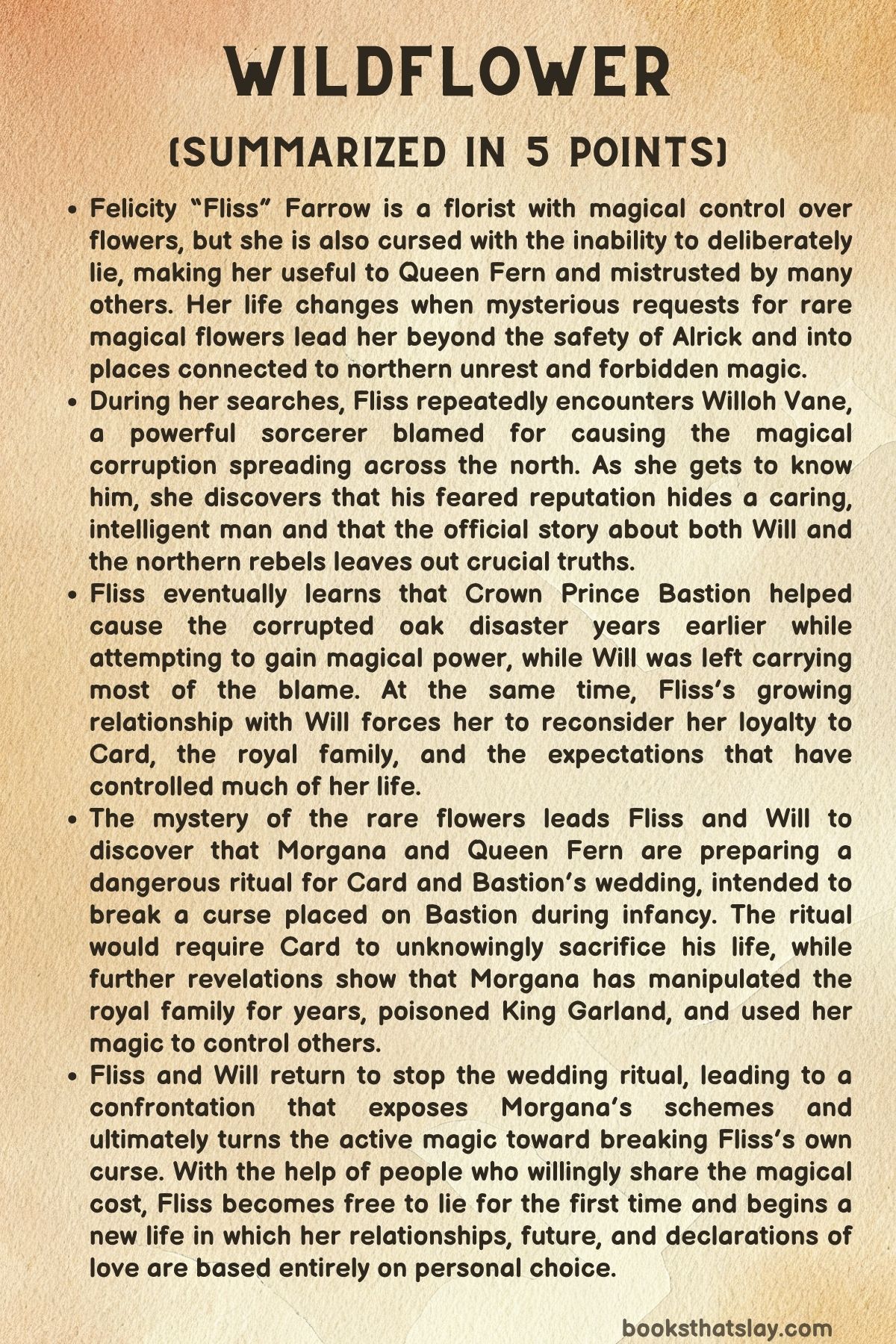
Felicity “Fliss” Farrow lives in the Kingdom of Alrick, where she runs a flower shop with her mother, Lilibeth. Fliss possesses a magical connection to flowers that allows her to strengthen the emotions associated with them, giving her work unusual emotional power.
Her gift, however, exists beside a far more difficult form of magic. Because of a curse, Fliss cannot deliberately tell a lie, and Queen Fern frequently uses this condition to force information from her.
The curse has damaged Fliss’s relationships with the townspeople, many of whom avoid her because they fear that anything she knows may eventually reach the queen. One of the few people who has remained close to her is Cardamine, known as Card, her childhood friend who is preparing to marry Crown Prince Bastion.
Fliss’s ordinary routine changes when an anonymous customer asks her to collect an unknown flower called the Feiyan. The request includes a map leading into the dangerous northern forest, an area associated with magical corruption and with rebels who have supposedly been attacking Alrick.
While searching for the flower, Fliss encounters Willoh Vane. Will is a powerful sorcerer who has spent years carrying the blame for a magical disaster involving a dead white oak tree whose corruption has spread across the north.
Fliss initially expects him to be dangerous, but Will behaves more like an irritatingly amused guide than a villain. He helps her cross a magical barrier and reach a remarkable meadow where the Feiyan grows, revealing both his knowledge of plants and a gentler personality than his reputation suggests.
A second anonymous request sends Fliss searching for the Odyssa on the dangerous Spinal Steppe. Her determination nearly kills her when a snowstorm leaves her injured and unable to descend safely.
She is rescued by Pigeon, a young woman connected to the northern resistance. From Pigeon, Fliss learns that the people labelled rebels are often ordinary northerners whose homes and livelihoods have been destroyed by spreading corruption while royal assistance has failed them.
Pigeon brings Fliss to Will’s cottage, where he heals her injured ankle. Fliss also meets his mother, Ruth, and begins realizing that almost everything she has been taught about Will fails to match the person she now knows.
Her connection with him gradually becomes more personal. She discovers that Ruth knows Lilibeth and that Ruth, Lilibeth, Queen Fern, and the sorcerer Morgana were once close friends, suggesting that Fliss’s curse is connected to a past her mother has carefully hidden.
Fliss and Will later travel together to Mithian, where she sees the effects of northern hardship directly. The villagers welcome Will warmly, showing that the feared sorcerer of the citadel is remembered elsewhere as a kind and helpful man.
Will also encourages Fliss to experiment with magic beyond her ability with flowers. Their friendship becomes increasingly intimate as Fliss experiences something rare in her life: a relationship in which another person does not demand access to her truth.
Their journey takes a dangerous turn when they discover the badly injured Prince Merit. Will heals him, but the arrival of royal guards threatens to expose both Will and the northern resistance.
Fliss is taken before Queen Fern and manages, through carefully limited answers, to conceal the people she wants to protect. Card recognizes that she is hiding something, however, and their confrontation brings years of frustration into the open.
Fliss accuses Card of failing to understand how deeply the royal family has exploited her curse, while Card feels abandoned as his wedding approaches. Their friendship breaks apart at the moment Fliss is already questioning many of the loyalties that once seemed unquestionable.
A third mysterious flower request, this time for the Lunarie, sends Fliss back to Will. During their search, Will finally shows her what happened five years earlier at the corrupted oak.
Fliss witnesses a magical reconstruction of the past and discovers that Bastion, desperate because he could not perform magic, attempted a dangerous spell intended to draw power from the tree. Will participated, but the spell failed catastrophically, killing the oak and beginning the corruption.
Rather than accept responsibility, the royal system allowed Will to become the convenient target of blame. The truth explains both Will’s bitterness and the destruction of his friendship with Bastion.
Soon afterward, a confrontation between the two men becomes violent. During the struggle, Will summons a sword just as Fliss moves into its path, and she is accidentally stabbed.
Will is imprisoned while Fliss lies close to death. During periods of partial consciousness, she overhears Queen Fern and Morgana discussing the rare flowers and a secret plan involving Bastion’s future.
Fliss realizes that the anonymous requests were never ordinary flower orders. Morgana and Fern have been using her to gather magical ingredients connected to Card and Bastion’s wedding.
Because the castle healers cannot save her, Fliss escapes her sickroom and reaches Will in the dungeons. Together they break out, and Will uses the last of his strength to carry her to Ruth, who successfully heals her.
During Fliss’s recovery, she and Will finally confront their feelings. Will struggles with guilt over injuring her, while Fliss rejects his belief that an accident proves he is inherently dangerous.
They eventually confess their attraction and begin a romantic relationship founded on voluntary trust rather than obligation. For Fliss, the relationship becomes especially meaningful because Will values what she chooses to tell him rather than treating her inability to lie as a resource.
Lilibeth then reveals the truth about Fliss’s curse. As a young woman, she had envied the lives and magical gifts of Ruth, Morgana, and Fern and agreed to let Morgana test a love spell on a man she desired.
The spell magically compelled Fliss’s father to love Lilibeth. When the enchantment eventually failed, he discovered what had been done and disappeared, while the magical cost of that deception emerged in their child.
Fliss was born unable to deliberately lie because she had been conceived through magically manufactured love. Ruth once attempted to remove the curse, but the attempt permanently damaged her eyesight.
Fliss and Will travel to the Library of Heris to investigate the Feiyan, Odyssa, and Lunarie. There they discover another hidden truth: Bastion himself has been cursed since infancy, explaining why he has never been able to perform magic.
Their research reveals the purpose of the three flowers. They can power a dark curse-breaking ritual in which one person declares genuine love and sacrifices the remainder of their life so that the loved person’s curse can be broken.
Fern and Morgana intend to activate this ritual during Card and Bastion’s wedding. Card will unknowingly declare his love through his wedding vows and die so that Bastion can finally possess magic.
Before Fliss and Will can stop the plan, Morgana captures Will and magically controls him. She sends him back to Alrick to kill King Garland, whom she has already been slowly poisoning.
Fliss races back and tries to warn the royal household. Will arrives under Morgana’s control and unleashes destructive magic inside the castle, while Fliss desperately attempts to reach the real man trapped beneath the possession.
Howell, one of the guards, believes Fliss when she explains that Will is being controlled. When part of the building collapses, Howell shields Fliss with his own body and dies saving her.
Will is devastated by the death, once again believing that violence performed through his magic makes him responsible. Fliss refuses to let him accept Morgana’s actions as proof that he deserves the monstrous reputation others have imposed on him.
On the day of the wedding, Fliss and Will return to the castle to stop the ritual. Fern, increasingly frightened and manipulated, refuses to abandon the possibility of freeing Bastion from his curse.
Morgana attacks Fliss and Will and nearly kills them, but they survive and reach the wedding ceremony. Fliss publicly reveals the truth about Bastion’s curse and explains that Card’s life will be sacrificed if the ritual continues.
Morgana activates the spell anyway. When Card is pulled into the magical circle, Will switches places with him and becomes trapped inside the ritual with Morgana.
The final confrontation exposes Morgana’s complete plan. Using enchanted nightshade, Will forces her to reveal that she has been poisoning Garland and manipulating Fern through years of fear, illness, and dependence.
Morgana also admits that she has loved Fern for years. She cursed Bastion as an infant partly to keep Fern vulnerable and emotionally dependent on her, later attempting to reverse the damage while removing anyone who stood between them.
When Morgana declares her love for Fern inside the activated ritual, the spell turns against her because Fern is not cursed. Morgana is defeated, but the magical mechanism remains active.
Will realizes that it could instead free Fliss from her lifelong curse and prepares to sacrifice himself. Card discovers that the cost may be shared if enough people willingly contribute their love and life force.
Lilibeth, Ruth, Card, Bastion, Will, and others join together. Their combined declarations break the curse without requiring Will’s death, and Fliss wakes to discover that she can finally lie if she chooses.
The aftermath begins repairing several damaged relationships. Bastion apologizes to Will and admits that jealousy, guilt, and fear allowed him to blame his former friend rather than face his own actions.
Pigeon survives earlier danger and is finally introduced to Bastion as someone whose experiences he must hear. The possibility of meaningful aid and negotiation for the north begins replacing the old pattern of dismissal and suppression.
Morgana is imprisoned, Garland begins recovering from the poisoning, and Fern is left to confront both Morgana’s manipulation and her own decisions. Card and Fliss also begin repairing their friendship on more equal terms.
Card and Bastion finally marry, while Fliss enters an entirely unfamiliar life. Without her curse, she can refuse questions, make mistakes, use sarcasm without certainty, and even deliberately say something untrue.
Will and Fliss imagine a future involving gardens, rare flowers, travel, his cottage, and the larger greenhouse she has always wanted. When Fliss tells him that she loves him, the words matter precisely because magic no longer forces her to speak the truth.
Her future is no longer defined by proving her usefulness to a queen, satisfying customers, supporting Card, or living according to other people’s expectations. Fliss ends the story ready to continue creating meaningful bouquets while discovering who she is when every choice, including every truth she tells, finally belongs to her.
Characters
Felicity “Fliss” Farrow
Fliss is the emotional and moral center of Wildflower, and much of her development comes from learning the difference between truth as a magical condition and truth as a personal choice. At the beginning of the book, she measures her value through usefulness, believing that reliability, obedience, and her skill with flowers may compensate for the social damage caused by her curse.
Her inability to deliberately lie has shaped almost every relationship in her life. Other people either distrust her because the queen can extract information from her or value her precisely because she can be compelled to provide facts, leaving Fliss with very little experience of being accepted without conditions.
This history explains why she works so hard to satisfy customers, protect Card, obey expectations, and avoid becoming inconvenient. Even her dangerous searches for rare flowers are partly driven by the desire to prove that she possesses worth beyond being Fern’s human source of truth.
Her relationship with Will changes that pattern because he is interested in what she chooses to say rather than what he can force from her. Through him, Fliss begins to understand that privacy is not dishonesty and that she is allowed to decide which parts of herself other people deserve to know.
Her encounters with Pigeon and the northern communities also develop her moral independence. Fliss has spent much of her life avoiding sensitive information because knowledge can become dangerous when Fern questions her, yet the crisis eventually becomes too serious for deliberate ignorance to remain morally comfortable.
She therefore moves from passive caution toward active judgment. Instead of assuming that royal authority determines what is true, she begins comparing official claims with the people and conditions she witnesses herself.
Fliss’s greatest weakness is her tendency toward self-sacrifice. She repeatedly pushes herself beyond safe limits, whether climbing a mountain for a flower, escaping while gravely wounded, or accepting responsibility for keeping everyone around her emotionally stable.
Her eventual freedom is therefore psychological as well as magical. Losing the curse matters because she can finally choose whether to tell the truth, but the deeper change is that she also learns to choose her relationships, desires, boundaries, and future.
Willoh “Will” Vane
Will is one of the most misjudged figures in Wildflower, carrying a public identity built largely from fear, rumor, and another person’s failure to accept responsibility. The kingdom sees him as a dangerous sorcerer associated with dark magic, while Fliss gradually discovers a knowledgeable, sarcastic, caring man who has spent years living with the consequences of being made into Alrick’s villain.
His humor functions partly as self-protection. Will often teases Fliss and presents himself with confidence, but the reconstruction of his past reveals how deeply Bastion’s rejection and the accusations surrounding the corrupted oak wounded him.
He is also marked by a powerful tendency to internalize blame. Even when Morgana controls his body and uses his magic to cause destruction, Will struggles to separate what was done through him from what he freely chose to do.
The same pattern appears after Fliss is accidentally stabbed. Instead of treating the injury as a terrible accident, he immediately fears that it confirms everyone’s belief that he is inherently dangerous.
Fliss becomes important to him because she refuses both romantic idealization and public condemnation. She recognizes his mistakes while also insisting that guilt must correspond to actual choice and responsibility.
Will’s knowledge of botany, healing, formal magic, and the Library of Heris also reveals a life that might have existed if his reputation had not pushed him into isolation. His later dream of returning to research represents a movement away from simply surviving the past and toward imagining a future.
His willingness to replace Card inside the ritual demonstrates both courage and the persistence of his self-sacrificing instincts. The ending gives him the possibility of love without martyrdom, reconciliation without pretending the past never happened, and belonging without surrendering the sharp humor and independence that define him.
Cardamine “Card”
Card is Fliss’s oldest and most important friend at the beginning of the story, which makes their conflict far more significant than an ordinary disagreement. His childhood acceptance gave Fliss a rare experience of companionship at a time when most people treated her curse as threatening or inconvenient.
Yet adulthood exposes weaknesses in their relationship that affection alone has concealed. Card has become accustomed to Fliss reorganizing herself around his needs, and his wedding preparations make that imbalance increasingly visible.
His misuse of their private emergency signal is especially revealing. Card does not intend cruelty, but the incident shows that he assumes Fliss will respond immediately because she always has.
His integration into the royal family creates a deeper conflict. Fliss cannot understand how her closest friend can comfortably join a household that has repeatedly allowed Fern to exploit her curse, while Card initially fails to recognize how painful this contradiction is for her.
Their argument is valuable because it forces both characters to say what their familiarity had allowed them to avoid. Card admits later that he has his own fears about royal life and should have shared them rather than expecting Fliss to remain permanently available as his source of support.
His role in finding an alternative to the ritual’s individual sacrifice demonstrates his loyalty at a decisive moment. By helping distribute the magical cost among people who freely love Fliss, Card participates in transforming love from an imposed obligation into a collective choice.
His final request for Fliss to remain his maid of honor is also important because he asks rather than assumes. Their friendship survives, but it survives in a form that has the potential to become more mutual and respectful.
Crown Prince Bastion
Bastion begins as a proud royal figure whose hostility toward Will appears to confirm the kingdom’s belief that Will caused the northern corruption. As the hidden history emerges, Bastion becomes a study in how shame can turn into blame when a person cannot bear to confront his own responsibility.
His inability to perform magic shaped him from childhood. Surrounded by magical people and royal expectations, he became desperate enough to attempt a dangerous spell that he did not fully understand.
The failed oak ritual is therefore rooted in insecurity rather than malice. However, Bastion’s greater moral failure comes afterward, when guilt and fear allow Will to carry the social consequences of a disaster they both helped create.
His jealousy intensifies this failure. Bastion eventually admits that he envied Will’s magic, family, and apparent freedom, making Will an especially convenient target for emotions Bastion did not know how to manage.
At the same time, the revelation that Bastion was cursed in infancy complicates his situation. His magical inability was not a personal deficiency, and he was denied information about his own condition by the adults who claimed to be protecting him.
His love for Card becomes crucial because Fern and Morgana assume that love can be converted into a resource for fixing him. Bastion’s horror at the planned sacrifice proves that he would never knowingly accept Card’s death in exchange for magical power.
By apologizing to Will and opening himself to Pigeon’s account of northern suffering, Bastion begins moving toward accountability. His ending does not erase his past choices, but it gives him the opportunity to become a more responsible prince by finally listening to people whose suffering royal narratives had hidden.
Queen Fern
Queen Fern represents the dangers of fear when it is combined with authority. Her love for Bastion is real, but that love gradually becomes an excuse for secrecy, control, and decisions that ignore the autonomy of everyone around him.
Her treatment of Fliss is one of the clearest examples. Because Fliss cannot deliberately lie, Fern repeatedly uses her as a compulsory source of information, treating a young woman’s curse as a convenient political instrument.
Fern convinces herself that obtaining truth justifies this behavior. What she fails to consider is the social and emotional cost Fliss pays whenever others fear speaking freely around her.
Her relationship with Morgana further exposes Fern’s vulnerability. Years of poisoning produce illness, paranoia, and instability, while Morgana encourages the fear that keeps Fern dependent on her advice.
This manipulation makes Fern a victim, but it does not remove her responsibility. She still chooses to proceed with a ritual that could kill Card because she becomes fixated on restoring Bastion’s magic.
Fern therefore occupies an uncomfortable position between victimhood and accountability. The book does not require her actions to be either entirely excusable or entirely independent of Morgana’s influence.
By the end, Fern must face the knowledge that someone she trusted manipulated her for years and that her own fear allowed her to harm people she claimed to protect. Her future depends on whether she can distinguish love from control in a way she repeatedly failed to do during the story.
Morgana
Morgana is the principal architect of the story’s oldest and most destructive magical problems. Her actions demonstrate what happens when extraordinary ability is combined with possessiveness and a belief that other people’s choices can be overridden for supposedly desirable outcomes.
Her early love spell for Lilibeth establishes this pattern. Rather than respecting the autonomy of the man Lilibeth desires, Morgana uses magic to manufacture love, producing consequences that eventually fall upon Fliss.
She later curses Bastion as an infant, creating another life shaped by magical interference before that person is capable of consent. Even when Morgana comes to regret aspects of what she has done, her response is not genuine accountability but further manipulation.
Her love for Fern is similarly possessive. Morgana wants Fern’s closeness so intensely that she weakens Garland, manipulates Fern’s health and perceptions, and attempts to arrange circumstances in which Fern will become increasingly dependent upon her.
Morgana is especially dangerous because she combines emotional obsession with intellectual sophistication. Her respected work on inherited curses is deeply ironic because she has personally created some of the suffering that makes such research necessary.
Her possession of Will represents the most extreme expression of her disregard for autonomy. She turns another person’s body and magic into a weapon, forcing him to enact violence that serves her agenda.
Her defeat through a declaration of love is therefore fitting. The emotion she has repeatedly used to justify control ultimately cannot save her because the story distinguishes genuine love from possession, coercion, and ownership.
Lilibeth Farrow
Lilibeth is a loving mother burdened by the consequences of a choice she made long before Fliss understood anything about her own curse. Her secrecy comes from shame, fear, and the belief that withholding the past might protect her daughter.
As a young woman, Lilibeth felt inadequate beside friends who seemed to possess things she lacked. Ruth and Morgana had remarkable magic, while Fern belonged to the royal world, and Lilibeth’s longing for love made Morgana’s experimental spell attractive despite its serious moral implications.
Her decision to use magic to compel affection becomes one of the foundational wrongs of the story. Fliss’s curse makes the cost of that decision impossible to confine to the people who originally made it.
Lilibeth nevertheless spends years caring for Fliss and trying to protect her. Her earlier attempt to have Ruth remove the curse demonstrates that she recognizes the harm, even though that attempt causes Ruth permanent injury.
Her later confession is important because she finally stops controlling Fliss through silence. By revealing the truth, Lilibeth allows her daughter to understand the origin of the condition that has defined her life.
The reconciliation between Lilibeth and Ruth also suggests that remorse has value when it eventually leads to honesty and changed behavior. Lilibeth cannot undo her past, but she can participate in breaking the cycle of secrecy surrounding it.
Ruth
Ruth is one of the story’s strongest examples of compassionate power. A gifted healer who has lost her sight, she provides Fliss with care without demanding information, allegiance, or repayment.
Her relationship with Will reveals a family life entirely different from the threatening image associated with him in the citadel. Their teasing affection helps Fliss understand that the feared sorcerer is also a son who has known warmth, safety, and ordinary domestic love.
Ruth’s blindness is connected directly to Fliss’s history. Her attempt to remove the truth-telling curse permanently damaged her eyesight, making her another person who has paid a physical cost for magic initiated by Morgana and Lilibeth.
Yet Ruth is not defined by bitterness. She refuses to tell Fliss the entire history when she believes the explanation properly belongs to Lilibeth, showing respect for personal responsibility even when revealing everything immediately would satisfy Fliss’s curiosity.
Her healing of Fliss after the sword injury becomes essential to the plot, but her larger importance lies in the moral model she offers. Ruth uses knowledge to care for people rather than control them.
Her participation in the final ritual also turns maternal love into active protection without making that protection possessive. She supports Will and Fliss while still allowing them to make choices for themselves.
Pigeon
Pigeon is crucial to Fliss’s political awakening because she gives a human face to the people Alrick has reduced to the label of rebels. Her first major act is not violence but rescuing Fliss from a mountain where she would probably have died.
Through Pigeon, Fliss learns that northern resistance grew from damaged communities, disappearing livelihoods, inadequate royal assistance, and desperation. This does not make every act of sabotage harmless, but it destroys the simple division between innocent kingdom and malicious rebels.
Pigeon also expresses remorse over Simon’s death, emphasizing that the resistance contains people capable of recognizing the human consequences of their actions. She therefore represents moral complexity rather than a replacement propaganda story in which one side is entirely innocent.
Her willingness to help Fliss and Will at the bridge demonstrates courage and loyalty. Even when her own survival is uncertain, she creates the opportunity they need to continue toward the Library.
Her reappearance near the end is politically important. By placing Pigeon directly before Bastion, the story turns the northern crisis from an abstract royal problem into a conversation with someone who has personally lived through its consequences.
Lark
Lark represents a relationship from Fliss’s past in which her curse became a source of resentment rather than acceptance. His romance with her collapsed partly because he wanted the emotional convenience of flattering or reassuring lies that Fliss simply could not provide.
The failure of their relationship teaches Fliss that truth alone does not guarantee healthy intimacy. Two people can know what is true and still lack the patience, respect, or compatibility necessary to remain together.
His purchase of asphodel, associated with regret, shows that he recognizes his own mistakes. Although he initially hopes to reconnect, Fliss is able to refuse him rather than return to something familiar simply because he is remorseful.
Their encounter at the bridge provides genuine closure. Lark apologizes, and Fliss discovers that she no longer needs either anger or renewed romance to define what he means to her.
His role therefore contrasts with Will’s. Lark once experienced Fliss’s curse as an inconvenience within their relationship, while Will helps her understand that intimacy should depend on freely offered trust rather than access to guaranteed truth.
Howell
Howell initially appears within the royal security system, but his most important quality is his willingness to revise his judgment when presented with a convincing truth. When Fliss explains that Morgana is controlling Will, Howell chooses to believe her despite the chaos surrounding them.
His death is one of the story’s most painful acts of sacrifice. He protects Fliss from the collapsing structure with his own body, transforming belief into immediate action.
Howell’s death also becomes a test of Will’s understanding of responsibility. Because the destruction was caused by magic performed through Will’s possessed body, Will tries to treat Howell’s death as another reason to condemn himself.
Fliss insists that Morgana, not Will, chose the violence. Howell therefore continues influencing the story after his death by forcing the characters to confront the difference between causing an outcome physically and choosing it morally.
Captain Ava
Captain Ava represents duty tempered by judgment. As an authority figure, she has legitimate reasons to distrust Will, especially after Howell’s death and the destruction surrounding the castle.
What distinguishes Ava is her willingness to listen when Fliss explains Morgana’s possession, Garland’s poisoning, Bastion’s curse, and the danger facing Card. She is not so attached to the official narrative that new information becomes impossible to accept.
At the same time, Ava does not immediately abandon her oath. Her hesitation shows that moral action becomes difficult when institutional duty conflicts with urgent personal knowledge.
Although Will ultimately puts her to sleep so that he and Fliss can proceed, Ava’s willingness to believe them marks a shift in the kingdom’s response. She demonstrates that authority does not have to depend upon blind obedience.
Nettle
Nettle is a determined member of Alrick’s security forces who repeatedly acts according to royal commands. Her capture of Fliss after the incident involving Merit shows how dangerous Fliss’s position has become once her loyalties begin moving outside the castle.
Nettle does not receive the same emotional development as the central characters, but she contributes to the pressure surrounding Fliss. Her presence reminds readers that royal power is enforced not only through Fern’s questioning but also through people whose duty is to control movement and respond to perceived threats.
Her later appearance beside Ava at the lake places her again between official orders and the larger truth Fliss is trying to reveal. By the ending, seeing Ava and Nettle participating in the wedding celebration helps indicate that the immediate period of pursuit and suspicion has finally ended.
King Garland
King Garland spends much of the story physically weakened, yet his illness becomes one of the clearest signs that something is wrong within the royal household. Early rumors suggest that his condition is more serious than the crown publicly admits.
The later discovery that Morgana has been poisoning him transforms his illness into part of her broader attempt to control Fern. Garland is weakened not simply because Morgana wants him dead but because removing him would leave Fern increasingly isolated and dependent.
His role is therefore less psychologically developed than those of Fern, Bastion, or Morgana, but he remains politically significant. His recovery at the end signals that one of Morgana’s long-term schemes has finally been interrupted.
Prince Merit
Merit becomes important when Fliss and Will find him seriously injured. Will’s decision to heal a royal prince, despite being treated as an enemy of the crown, provides strong evidence of the difference between his reputation and his actual moral choices.
Merit’s survival later creates suspicion because he remembers Fliss being near the place where he was rescued. His testimony unintentionally increases the pressure on her while also pointing toward the hidden involvement of Will.
Although Merit is not deeply developed, his injury becomes a turning point. It places Fliss directly between the royal family, Will, and the northern crisis, making continued neutrality increasingly impossible.
Tansy
Tansy appears alongside Pigeon during the revelation that the northern resistance is responsible for attacks and supply thefts. Her presence helps establish that Pigeon is not an isolated dissenter but part of a wider movement formed by people responding to the north’s collapse.
The limited information about Tansy prevents a deeper psychological portrait, but her role contributes to the book’s refusal to treat the resistance as a faceless enemy. She belongs to a group whose actions arise from material hardship and political neglect rather than simple hostility toward Alrick.
Creon
Creon, the local apothecary, provides an early counterweight to Fliss’s dangerous determination. When she asks about the Feiyan, even his extensive knowledge is insufficient to identify it, reinforcing how unusual the anonymous request truly is.
More importantly, Creon notices that Fliss’s commitment to fulfilling customer requests is approaching obsession. His warning identifies a weakness in her long before Fliss herself fully recognizes it.
Creon therefore serves as a small but meaningful voice of perspective. He sees that reliability has become more than professional pride for Fliss and has developed into a way of proving that she deserves to be valued.
Marceline
Marceline works as Fliss’s delivery assistant and occupies a supporting role within the everyday life of Farrow’s Flowers. Her delivery of Card’s emergency signal becomes the immediate cause of one of the moments that exposes the imbalance between Card and Fliss.
Because Marceline is not given extensive personal development, her significance lies mainly in grounding Fliss’s life outside royal politics and magical danger. The existence of workers, customers, deliveries, and routines gives the flower shop the sense of being a real occupation rather than simply a symbolic setting.
Anhora
Anhora appears during the trip to Mithian and helps reveal a version of Will that Fliss could never have discovered from citadel gossip. Her familiarity with him shows that Will has a history of being welcomed and remembered fondly in communities outside Alrick’s center of power.
Her teasing revelation that Will was once painfully shy is especially valuable because it disrupts his carefully maintained image of effortless sarcasm and confidence. Through Anhora, Fliss sees that reputations change according to who is telling the story.
Keeper Einar
Keeper Einar serves as a crucial source of magical knowledge at the Library of Heris. His information allows Fliss and Will to connect Bastion’s magical inability to a hidden childhood curse.
This discovery changes the interpretation of the oak disaster because Bastion had attempted to pull magic into a body that had already been magically prevented from receiving it normally. Einar therefore helps replace years of accusation with a more complete explanation of what actually happened.
His inability to explain the full ritual involving the three flowers is equally important. Rather than conveniently knowing everything, he directs Fliss toward Morgana, forcing her to confront the person most connected to her curse and the wider history of magical manipulation.
Simon
Simon is already dead when the story begins, but his death gives the northern conflict an immediate human cost. Fliss creates the mourning flowers for his memorial and witnesses the grief of his mother, ensuring that the violence cannot be treated as an abstract political disagreement.
Later, Pigeon’s remorse complicates the meaning of Simon’s death. The resistance did not intend to kill him, but unintended consequences do not make the loss disappear.
Simon therefore represents the ordinary people who suffer when political neglect, rebellion, fear, and violence continue without meaningful resolution. His absence remains a reminder that understanding the causes of conflict does not require denying its victims.
Gill
Gill, Will’s fluffy white cat, plays a small but revealing role in the book. Fliss first encounters the animal around the magical forest, and discovering Gill’s connection to Will provides one of the earliest signs that his private life is much softer than his public reputation suggests.
Gill also belongs to the domestic future Fliss eventually imagines with Will. The cat helps turn Will’s cottage from a mysterious refuge into a place associated with warmth, humor, home, and the possibility of an ordinary shared life.
Themes
Truth, Choice, and Personal Freedom
Fliss’s curse turns truth from a moral principle into a form of captivity. She does not simply value honesty; she has been magically denied the ability to choose otherwise, which means that even a quality usually considered admirable becomes oppressive when freedom is removed from it.
The problem becomes especially clear in Queen Fern’s treatment of her. Fern assumes that guaranteed truth gives her the right to demand answers, while the people around Fliss respond by withholding friendship and information because they know privacy cannot always survive royal questioning.
Wildflower gradually separates honesty from compulsory disclosure. Fliss learns that refusing to tell someone everything is not the same as deceiving them and that privacy can be necessary for trust, safety, and personal dignity.
Will plays a crucial role in this realization because he does not build their relationship around extracting certainty from her. He wants to know Fliss as a person rather than use her curse as proof that every statement can be trusted without question.
The removal of the curse therefore means more than gaining the ability to lie. For the first time, Fliss can decide what she says, what she withholds, when she jokes, when she makes mistakes, and whether the words coming from her are valuable because she chose them.
Her final declaration of love captures this transformation perfectly. Earlier, anyone could assume that Fliss’s words were true because magic prevented falsehood, but once the curse is broken, saying “I love you” becomes more meaningful because nothing forces her to say it.
Love Versus Possession
Several relationships explore the difference between loving another person and trying to control that person for one’s own emotional security. Morgana provides the darkest example because she repeatedly treats love as something magic can manufacture, manipulate, or use to justify interference in other lives.
The love spell performed for Lilibeth removes the chosen man’s ability to decide whom he loves. Although Lilibeth wants affection and family, the method turns another human being’s emotions into something imposed upon him.
Morgana repeats the same underlying violation through her relationship with Fern. Her feelings may be sincere, but she poisons Garland, curses Bastion, manipulates Fern’s fears, and attempts to create circumstances in which Fern will depend upon her.
The contrast with Fliss and Will is deliberate. Their relationship develops through voluntary disclosure, changing opinions, disagreements, attraction, trust, and the repeated decision to remain beside one another.
Will never needs magical certainty that Fliss cares for him. Fliss likewise refuses to define him by the identity other people have imposed upon him, allowing affection to grow from what she observes and chooses for herself.
The final ritual gives the theme its clearest expression. Morgana tries to use a declaration of love as fuel for a system built on sacrifice and control, while the people who genuinely love Fliss voluntarily share the cost of freeing her.
Love becomes healthy when it supports another person’s freedom rather than demanding ownership of that person’s choices. The book therefore treats consent not as a minor feature of romance but as one of the essential differences between love and possession.
Reputation, Prejudice, and the Stories People Accept
Will’s public identity demonstrates how easily a community can transform an incomplete explanation into an unquestioned truth. Alrick knows him as the sorcerer associated with the corrupted oak, and years of repetition make that reputation feel more reliable than the complicated events that actually produced the disaster.
Fliss initially participates in this system because she has little reason to challenge what Bastion and the crown have said. Her first meetings with Will begin changing her perspective simply because his behavior does not match the person she has been taught to expect.
The same process occurs with the northern resistance. People in the citadel understand rebels primarily through attacks and fear, while Pigeon introduces Fliss to communities dealing with destroyed homes, food shortages, damaged livelihoods, and inadequate royal support.
Neither discovery requires Fliss to pretend that harmful actions never occurred. Will participated in the original oak spell, and the resistance has committed theft and sabotage, but context prevents guilt from being reduced to simplistic labels.
Bastion’s role in creating Will’s reputation also shows the personal motives that can exist behind public narratives. His jealousy and shame make blaming Will emotionally easier than admitting that his own desperation helped create the disaster.
Fliss grows by learning to judge people through evidence, experience, and their choices rather than authority or repetition. Her development suggests that questioning a dominant story is not the same as automatically believing its opposite.
Real understanding requires the willingness to remain with uncomfortable complexity. People can make serious mistakes without becoming monsters, while respected institutions and trusted individuals can cause tremendous harm without initially appearing villainous.
Responsibility, Guilt, and Accountability
Responsibility appears throughout the story as something very different from simply feeling guilty. Several characters carry guilt for events they caused, failed to prevent, or were associated with, but the book repeatedly asks whether those feelings accurately reflect their actual choices.
Will struggles most visibly with this distinction. When he accidentally injures Fliss and later causes destruction while controlled by Morgana, he treats the results as evidence that he is dangerous regardless of intention or freedom.
Fliss challenges this reasoning because Morgana’s possession removes Will’s ability to choose his actions. The physical fact that the magic came through his body does not make him morally identical to the person who deliberately seized control of him.
Bastion represents the opposite failure. Instead of accepting appropriate responsibility for the oak spell, he spends years allowing Will to carry the blame because confronting his own guilt is emotionally painful.
Fern also occupies a difficult position between manipulation and responsibility. Morgana poisons and destabilizes her, but Fern still makes decisions that affect Fliss, Card, Bastion, and the kingdom, meaning victimhood cannot erase every consequence of her choices.
Lilibeth offers another version of accountability. She cannot undo the coercive love spell or the curse that resulted from it, but eventually telling Fliss the truth allows her to stop protecting herself through secrecy.
The story ultimately presents accountability as the courage to identify what genuinely belongs to a person without adding false guilt or escaping deserved responsibility. Healing becomes possible when characters stop either condemning themselves for everything or blaming others for what they were afraid to face.