Witch Season Summary, Characters and Themes
Witch Season (Broken Coven #1) by Julia Bianco is a contemporary fantasy novel about witches living within modern Los Angeles under a hidden system of magical laws, political control, and inherited privilege. At its center is Katherine Barnes, an enforcer whose commitment to protecting vulnerable witches is inseparable from a devastating mistake in her own past.
The story combines magical crime, institutional conflict, betrayal, guilt, romance, and questions about who deserves power. As Katherine investigates an illegal magical drug and tries to protect a frightened teenage witch, the people she trusts most force her to reconsider justice, loyalty, responsibility, and the kind of leader she wants to become.
Summary
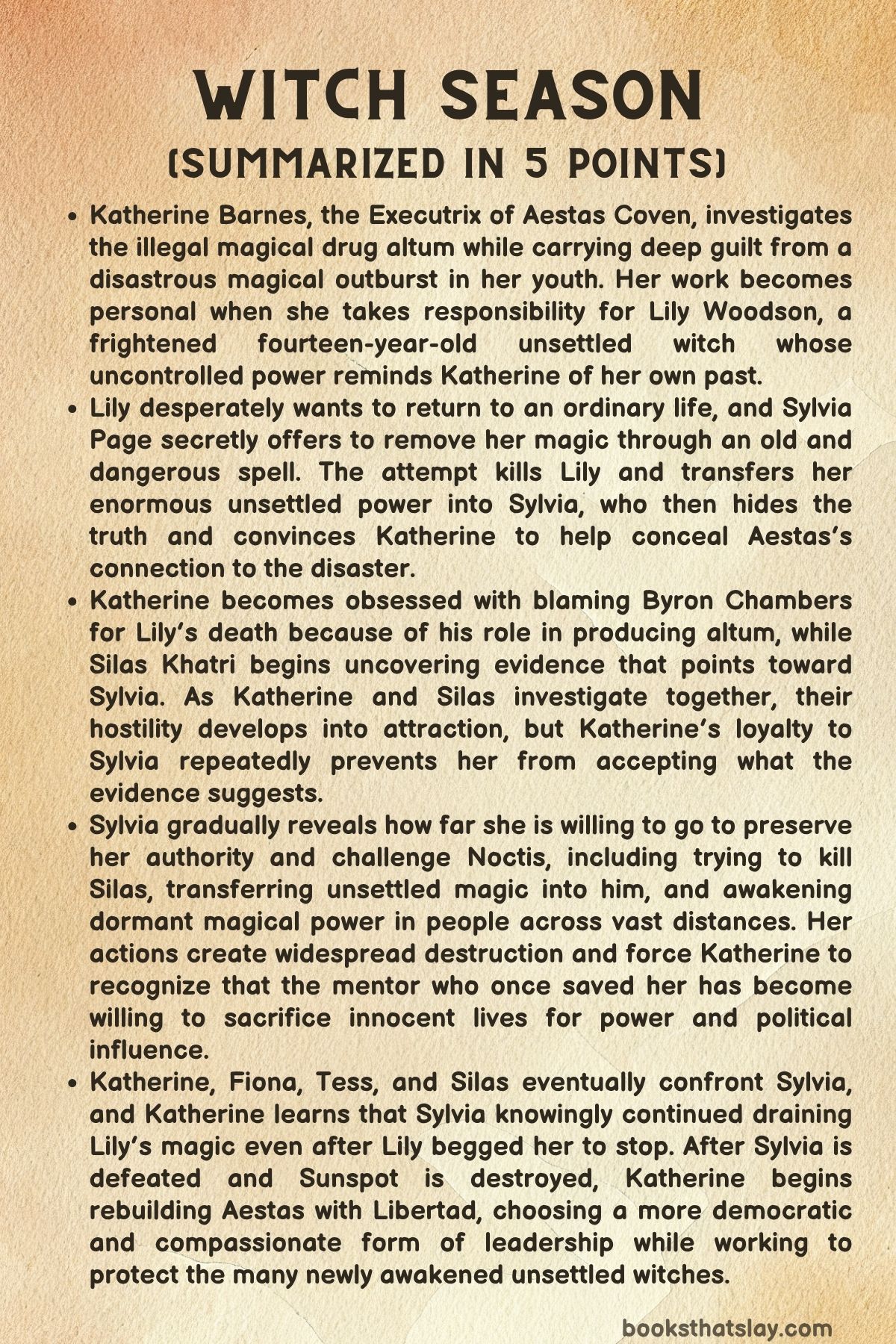
Katherine Barnes serves as the Executrix of Aestas Coven, a Los Angeles magical community led by her mentor, Sylvia Page. Katherine takes magical law seriously because she knows firsthand how destructive uncontrolled power can become, and she is particularly irritated by witches who treat magic as a personal advantage over ordinary people.
Her latest arrest is Joe, a witch selling altum, a dangerous powdered form of magic that gives ordinary people an intense sense of supernatural power. Katherine quickly realizes Joe is only a distributor because manufacturing the substance requires old knowledge, rare equipment, and resources far beyond his abilities.
Her suspicions settle on Byron Chambers, a wealthy and influential Aestas witch whom Katherine already distrusts. Sylvia refuses to allow an investigation because Byron’s family has political influence, and the coven is preparing for an inspection from Noctis, the powerful organization that controls much of organized witchcraft in the United States.
Katherine’s priorities change when fourteen-year-old Lily Woodson develops uncontrolled magical abilities. Lily has accidentally injured her younger brother during a violent magical outburst and runs away because she believes staying near her family will only place them in greater danger.
Katherine finds Lily and reveals that she is an unsettled witch, someone born into an ordinary family whose magical power emerges with unusual force before eventually settling. Katherine understands Lily’s fear because the same thing happened to her when she was sixteen.
As a teenager, Katherine lost control after being provoked at school and collapsed an entire section of the building. Twenty-six students were injured and three were killed, leaving Katherine so overwhelmed by guilt and fear that she fled Colorado and disappeared from her family’s life.
Sylvia eventually found her, gave her a new identity, taught her to control her abilities, and welcomed her into Aestas. Katherine has spent the following thirteen years trying to repay that rescue by protecting other unsettled children before they suffer disasters similar to her own.
Katherine takes Lily into the coven and begins showing her that magic can be controlled. Lily manages a small magical spark during training, but another sudden burst reminds her that she remains dangerous, and she makes it clear that she does not want to become a powerful witch; she simply wants her old life back.
During a large Aestas meeting, Joe is punished with a temporary magical dampener for selling altum. The gathering also introduces Silas Khatri, the wealthy son of Noctis’s leaders, who unexpectedly arrives as the organization’s new representative.
Katherine initially sees Silas as the embodiment of everything she dislikes about Noctis. He comes from enormous privilege, possesses easy access to rare magic, and represents the institution whose rules have repeatedly limited Aestas’s efforts to rescue unsettled witches.
Sylvia later leaves with Lily, supposedly intending to take her to Oak Grove, the facility where unsettled witches receive training. Instead, Sylvia tells Lily about an old spell that might remove her magic completely, and the desperate teenager agrees to attempt it.
The spell becomes a catastrophe. Sylvia extracts Lily’s enormous unsettled power into herself, and Lily dies during the process.
The newly acquired power changes Sylvia almost immediately. She begins experiencing violent magical reactions and causes massive destruction at Hollywood and Highland when fear and panic trigger an uncontrolled snap.
Katherine rushes to the disaster because she believes Lily may be responsible. She tracks Lily to a bathroom and finds the teenager dead in a large amount of blood.
Traumatized by the sight and terrified that people will discover her beside another dead child, Katherine reacts impulsively. She uses magic to reduce Lily’s body to ash, destroying the physical evidence and leaving herself with a new source of guilt.
Sylvia lies about what happened, claiming Lily ran away and later snapped. She persuades Katherine to help conceal Aestas’s connection to the disaster by arguing that Noctis will destroy their unsettled-witch program if the truth becomes known.
Katherine accepts the story because she trusts Sylvia almost completely. She also becomes obsessed with proving that Byron gave Lily altum and caused the fatal disaster, since blaming him offers her a clear criminal to punish.
Silas begins investigating independently and discovers Sylvia’s caster among police evidence collected from the scene. Rather than immediately reporting her to Noctis, he secretly takes it and gives Sylvia an opportunity to explain herself because Katherine’s account of Aestas has already made him question his family’s assumptions.
Meanwhile, Katherine and Silas grow closer. Their arguments gradually become personal conversations, and Katherine eventually tells him that she was once an unsettled teenager whose life was saved because Sylvia ignored Noctis policy.
Silas apologizes for the prejudices he absorbed from his family and begins reconsidering his role within Noctis. Their attraction deepens as both recognize qualities in the other that their original hostility prevented them from seeing.
Silas eventually confronts Sylvia with the evidence connecting her to Hollywood and Highland. He incorrectly concludes that Sylvia had been using altum to strengthen herself and offers her a chance to stop rather than exposing her immediately.
Sylvia interprets his mercy as another Khatri attempt to control her. Having spent decades resenting Noctis and the Khatri family, she decides Silas is a threat and magically traps him and Katherine in a burning hotel room.
They barely escape by climbing down the outside of the building. The intensity of the experience leads to physical intimacy, but their relationship breaks apart almost immediately when Silas suggests Sylvia may have tried to kill him and Katherine angrily refuses to believe it.
Katherine then breaks into Byron’s apartment and violently forces the truth from him. She proves he was involved in manufacturing altum, but she also learns he did not cause Lily’s death in the way she believed.
Her chosen explanation begins collapsing. At the same time, Silas acts from his own anger by destroying Libertad’s spellbook on Noctis orders, only to recognize afterward that he has harmed a community because he allowed resentment and inherited authority to determine his choices.
Sylvia eventually admits to Katherine that she deliberately caused the hotel fire, yet she manipulates Katherine’s loyalty by presenting the act as necessary protection for Aestas. Katherine still cannot fully accept that the person who saved her has become dangerous.
During a later inspection of Aestas’s protective wards, Katherine notices that Sylvia’s power feels strangely wild and familiar. Sylvia also secretly transfers some of Lily’s stolen magic into Silas before he returns to New York.
Katherine finally recognizes that Sylvia somehow possesses unsettled power. Fiona urges her not to confront Sylvia alone, but Katherine’s old habit of protecting others through isolation takes over, and she cruelly drives Fiona away before challenging her mentor.
Sylvia admits that she extracted Lily’s magic and that Lily died. She argues that Lily’s power can now be used to protect Aestas, oppose Noctis, and improve the treatment of unsettled witches.
Katherine refuses to accept that reasoning and attempts to arrest her. Sylvia easily defeats her and locks her inside Aestas’s detention cell.
Byron, now serving as Sylvia’s enforcer, tells Katherine that Sylvia intends to frame her for Lily’s murder. He also reveals that Silas has suddenly become unsettled in New York.
Silas’s uncontrolled power has already produced terrible consequences. During a magical snap, he kills his father, Vikrant Khatri, leaving him consumed by guilt and furious when he realizes Sylvia deliberately caused his transformation.
Sylvia’s plans grow even more extreme. She uses a massive locator-based spell to awaken dormant unsettled power in people across enormous distances, knowingly creating a crisis in which children and adults will suddenly lose control without training.
Her purpose is political. If communities everywhere become overwhelmed by unsettled witches, Sylvia believes they will have no choice but to depend on the expertise she and Aestas developed.
Silas returns to Los Angeles with Anika while newly awakened witches cause destruction throughout the city. An encounter with a frightened young person named Wren helps him understand that revenge cannot justify allowing innocent people to suffer.
Back at Aestas, Fiona and Tess rescue Katherine after Sylvia’s enormous spell weakens the building’s wards. Fiona finally challenges Katherine’s lifelong belief that suffering, isolation, and self-punishment are necessary payments for the deaths she caused as a teenager.
Katherine begins accepting that trusting other people does not make her weak. Rather than facing Sylvia completely alone, she allows Fiona and Tess to help prepare for the confrontation.
The final battle takes place at Sunspot. Katherine deliberately forces Sylvia to expend large amounts of unstable power while resisting her with spells, weapons, and the environment around them.
As Sylvia becomes exhausted, the full truth about Lily emerges. Lily had initially agreed to surrender her magic, but once the transfer began killing her, she became frightened and begged Sylvia to stop.
Sylvia continued anyway because she wanted the extraordinary power entering her. Lily’s death was therefore not simply a failed magical procedure; Sylvia knowingly chose power after understanding that the girl was dying.
Katherine manages to steal a small amount of Sylvia’s unsettled magic and briefly immobilizes her. Silas then arrives, and the two fight Sylvia together.
When they finally overpower her, Silas wants to kill Sylvia in revenge for Vikrant’s death. Katherine stops him because she refuses to reproduce the belief that possessing power gives someone the right to decide who deserves to live.
Their unstable magic causes Sunspot to collapse. Katherine saves Silas from a falling beam and is badly injured, while Sylvia survives and is later taken into Noctis custody for trial.
The victory does not restore what has been lost. Sunspot is destroyed, Sylvia’s crimes are exposed, Aestas loses its spellbooks and funding, and Silas becomes the new leader of Noctis after his father’s death.
Katherine and Silas separate on bitter terms as institutional responsibilities reopen the wounds between them. Yet Katherine no longer allows the collapse of her old life to define the future.
Aestas joins forces with Libertad, relying partly on older forms of magic and the spellbook Silas previously gave away. Hundreds of newly awakened unsettled witches now need help, and Katherine begins locating frightened children and bringing them to safety.
At the end, Katherine addresses the surviving magical community and promises to rebuild around fairness, shared power, and acceptance of witches rejected elsewhere. She is no longer merely Sylvia’s student or a woman trying to punish herself for the past; she becomes a leader willing to build something better from what remains.
Characters
Katherine Barnes
Katherine is the moral and emotional center of Witch Season, and nearly every important decision she makes is shaped by the school disaster she caused at sixteen. The deaths of three students convinced her that she must spend the rest of her life preventing harm, which explains both her commitment to magical law and her tendency to assume responsibility for problems that are not entirely hers.
Her work as Executrix gives her a clear structure through which she can separate right from wrong. She distrusts witches who use magic casually because she understands its consequences more personally than most of them do, yet the book gradually shows how grief can cause even someone devoted to rules to abandon those rules when certainty becomes emotionally necessary.
Her relationship with Lily exposes the compassionate side beneath her aggressive exterior. Katherine does not treat the frightened teenager as a dangerous object to be contained; she recognizes her fear, gives her language for what is happening, and offers the kind of guidance she desperately needed at the same age.
Lily’s death therefore strikes at the foundation of Katherine’s identity. Protecting unsettled children has allowed her to believe something constructive can come from her own tragedy, so failing to save Lily makes her feel as though she has repeated the worst failure of her life.
This guilt leads Katherine into serious moral mistakes. She destroys Lily’s body, participates in concealing evidence, pursues Byron without proper authority, assaults him, lies to friends, and repeatedly isolates herself while convincing herself that these choices are necessary sacrifices.
Her greatest weakness is not lack of courage but the belief that courage requires suffering alone. She repeatedly protects Fiona, Silas, and other people by pushing them away, failing to understand that denying others the right to help her is another form of control.
Katherine’s relationship with Sylvia is equally central to her development. Because Sylvia rescued her when she had nowhere else to go, Katherine has built much of her identity around gratitude, and that gratitude becomes so absolute that she struggles to evaluate Sylvia’s behavior objectively.
Recognizing Sylvia’s crimes therefore requires Katherine to separate love from obedience. She eventually understands that someone can once have saved her life and still become responsible for terrible choices later.
Her connection with Silas challenges her in a different way. He forces her to confront her assumptions about privilege, vulnerability, trust, and emotional intimacy, while she forces him to see the consequences of the institution he inherited.
By the conclusion, Katherine has not erased her guilt or grief. Her progress comes from accepting that leadership does not require endless self-punishment and that building a fairer community requires cooperation rather than martyrdom.
Sylvia Page
Sylvia is the central antagonist of Witch Season, but her importance comes from the fact that she is not presented as someone who was always cruel. She genuinely rescued Katherine, created a refuge for unsettled witches, challenged policies that abandoned vulnerable children, and spent years building a community that offered safety to people who lacked it elsewhere.
Her past explains why power becomes so important to her. Sylvia grew up poor and neglected, then entered an elite magical society where status, wealth, institutional authority, and access to magic belonged largely to people such as the Khatris.
As a young unsettled witch, her extraordinary abilities made powerful people notice and fear her. When that position disappeared and she later experienced exclusion and punishment from Noctis, she developed a deep association between possessing power and being safe from humiliation.
That history makes her motives understandable without making her actions acceptable. Sylvia increasingly believes that because her cause is worthy, almost anything done in its service can be justified.
Her treatment of Lily marks the decisive moral collapse. Lily initially consents to giving up her magic, but once she begins dying and withdraws that willingness, Sylvia knowingly continues because she does not want to surrender the power flowing into her.
Afterward, Sylvia repeatedly rewrites her behavior as sacrifice. She tells herself Lily’s death can protect future unsettled children, the attempt to kill Silas can protect Aestas, and the forced awakening of hundreds of dormant witches can create political change.
The danger in Sylvia is therefore not simply ambition. It is her ability to turn every personal desire for security, revenge, and authority into a moral argument about protecting others.
Her relationship with Katherine makes this especially painful. Sylvia knows Katherine’s fears, guilt, family attachments, and emotional weaknesses because she helped raise her, and she ultimately uses that knowledge to manipulate and threaten the person who trusts her most.
Sylvia becomes the opposite of the principles she claims to defend. She wants freedom for vulnerable witches but removes other people’s choices, condemns institutional abuse while abusing her own authority, and claims to protect unsettled children while intentionally creating thousands of them through trauma.
Her survival and arrest are important because the story refuses to simplify her into a monster who must simply be killed. Katherine must instead acknowledge both truths at once: Sylvia once gave her a future, and Sylvia later became responsible for murder and large-scale suffering.
Lily Woodson
Lily represents the human cost of every political and magical argument surrounding unsettled witches. At fourteen, she is not interested in power, magical status, revolution, or coven politics; she wants to be safe enough to return home to her family and continue the ordinary life she had before her abilities emerged.
Her first violent snap leaves her terrified because she injures her younger brother Noah without intending to. Rather than seeing her new ability as exciting, Lily begins to believe that removing herself from other people may be the only way to protect them.
Katherine gives her temporary hope by showing that uncontrolled magic does not automatically make someone evil. Lily’s first successful spark is important because it allows her to see beauty in something she has previously understood only as danger.
Even then, Lily never becomes fully comfortable with the future being chosen for her. Training at Oak Grove may save her life, but it also means losing school, friends, family contact, and the normal adolescence she desperately wants.
Her willingness to attempt Sylvia’s extraction spell must therefore be understood through desperation rather than simple recklessness. Sylvia presents removal as a possibility at precisely the moment Lily feels incapable of surviving years of dangerous magical instability.
Lily’s death becomes especially significant because of consent. She agrees to give up her magic, not her life, and when she becomes frightened and asks Sylvia to stop, her decision changes.
Sylvia’s refusal to honor that change transforms the extraction into an act of exploitation. Lily becomes a victim of someone who claims to understand and protect children exactly like her.
Although she dies relatively early, Lily influences nearly everything that follows. Katherine’s investigation, Sylvia’s rise in power, Silas’s transformation, the collapse of Aestas, and the eventual rebuilding of the community are all shaped by what happened to her.
Silas Khatri
Silas initially appears to Katherine as a symbol of inherited privilege. He is wealthy, highly educated in magic, connected to Noctis’s ruling family, and possesses resources that witches outside his social world could never easily obtain.
His perspective quickly complicates that first impression. Silas does not want the future his parents designed for him and would rather teach young witches than manage the institution he is expected to inherit.
His central conflict concerns responsibility. At first, he tends to believe that rejecting privilege morally separates him from the system that produced it, but Anika correctly challenges this idea by pointing out that walking away from power does not remove its consequences.
Silas repeatedly makes mistakes while trying to determine what responsible action looks like. He destroys Libertad’s spellbook when anger and family expectations overwhelm his judgment, then recognizes the damage and gives away his valuable personal spellbook as an attempt to repair what he can.
His relationship with Katherine accelerates his political development. Her history forces him to understand that Noctis’s abstract policies toward unsettled witches have life-and-death effects on people whom his family rarely understands personally.
Silas also demonstrates a capacity for reconsideration that distinguishes him from Sylvia. When Katherine challenges his assumptions, he is capable of admitting that he was wrong, apologizing, and changing his position.
His transformation into an unsettled witch radically changes his relationship with magical danger. The accidental killing of his father places him in a position painfully similar to Katherine’s, making uncontrolled power a personal source of guilt rather than a policy problem.
His desire to kill Sylvia shows how easily grief can turn justice into vengeance. Katherine stopping him becomes important because Silas must decide whether suffering gives him the right to reproduce the same logic of power that caused so much damage.
By the end, Silas remains conflicted rather than fully resolved. As the new head of Noctis, he uses institutional authority harshly against Aestas even after previously questioning that system, showing that personal growth does not automatically prevent someone from repeating inherited patterns.
Fiona
Fiona is Katherine’s closest friend and one of the strongest forces pulling her toward a healthier understanding of loyalty. She is affectionate, observant, humorous, and willing to challenge Katherine in ways that other Aestas members often are not.
She notices when Katherine is hiding injuries, taking excessive risks, or withdrawing emotionally. Her concern becomes increasingly important because Katherine’s instinct is always to transform fear into solitary responsibility.
Fiona’s most important role appears when she confronts Katherine’s belief that permanent suffering is a moral obligation. She points out that Katherine encourages other former unsettled witches to heal, seek help, build relationships, and forgive themselves while refusing to extend the same possibility to herself.
This challenge reaches deeper than reassurance. Fiona recognizes that Katherine has made guilt part of her identity and that self-sacrifice can become destructive when a person starts treating pain as proof of goodness.
Her willingness to return after Katherine cruelly pushes her away demonstrates the difference between blind loyalty and mature friendship. Fiona does not pretend Katherine’s behavior was acceptable, but she also refuses to abandon her when help is genuinely needed.
Her knowledge of older magical practices becomes practically important after Aestas loses access to Noctis-controlled spellbooks. Fiona therefore represents both emotional continuity and an alternative magical tradition capable of supporting the community’s future.
Tess
Tess initially occupies a quieter position as Sunspot’s chef and Fiona’s romantic interest, but her presence helps establish Aestas as a genuine home rather than merely an institution. Food, humor, routine, and ordinary companionship make the magical community feel livable, especially to frightened newcomers such as Lily.
Her developing relationship with Fiona also provides a contrast to Katherine’s fear of intimacy. While Katherine repeatedly assumes love creates vulnerability that must be controlled, Fiona and Tess gradually allow closeness to become a source of strength.
Tess proves useful during the crisis rather than remaining outside the central action. She helps protect people, assists Fiona, and participates in the effort to survive Sylvia’s collapse into violence.
After Sunspot is destroyed, Tess remains part of the rebuilding community. Her character reinforces the idea that communities survive not only through powerful leaders or spectacular magic but also through people who create practical safety, companionship, and continuity.
Byron Chambers
Byron represents entitlement within Aestas itself, preventing the conflict from becoming a simple argument in which local covens are good and Noctis is bad. His wealth, influence, prejudice, and involvement with altum show that abuse can develop inside institutions that define themselves as alternatives to larger systems of control.
His history with Katherine is personal because he mocked her as an unsettled outsider when she was younger. That past makes it difficult for Katherine to separate justified suspicion from personal resentment.
Katherine is correct that Byron is involved in manufacturing and distributing altum. However, her certainty that he must also be responsible for Lily’s death demonstrates how grief can turn a guilty person into a convenient explanation for crimes they did not commit.
Byron also exposes the weakness of Katherine and Sylvia’s moral compromises. After Katherine attacks him illegally, he gains leverage over the very people trying to hold him accountable.
His later appointment as Executor while Katherine is imprisoned is deliberately bitter. A system supposedly devoted to justice allows someone involved in dangerous criminal activity to gain authority because Sylvia values usefulness and secrecy over principle.
Niles
Niles leads Libertad as a critic of Noctis’s control over magical resources. His position gives voice to a broader political challenge: if one powerful family can determine who receives spells, which covens remain legitimate, and how magical communities are governed, access to magic becomes a form of social control.
He is particularly important because he challenges both Silas and Katherine. With Silas, he questions the fairness of inherited institutional authority; with Katherine, he questions the extreme loyalty she gives Sylvia.
Niles notices before Katherine does that devotion can become dangerous when one person is willing to sacrifice anything for a leader. His warning that nobody should require that level of loyalty anticipates Sylvia’s eventual manipulation.
After Sylvia’s downfall, Niles does not punish Katherine for failing to see the truth sooner. His willingness to work with her helps Katherine understand that accountability does not require claiming responsibility for every harmful choice another person makes.
Anika
Anika acts as Silas’s closest moral counterweight. She understands his frustration with the Khatri family and Noctis, but she refuses to let him turn discomfort with privilege into an excuse for passivity.
Her argument is that Silas cannot simply declare himself separate from advantages that continue to shape his life. He has access, influence, education, resources, and authority regardless of whether he wanted them, so the important question is how he chooses to use them.
This makes Anika one of the clearest voices on responsibility in the story. She does not ask Silas to remain obedient to his parents; she asks him to develop principles strong enough to guide action rather than repeatedly escaping situations that make him uncomfortable.
She also accompanies him back to Los Angeles after his transformation because she understands the danger created by his unstable emotional state. Her support combines loyalty with limits, making her an important contrast to relationships based on unquestioning devotion.
Nina Khatri
Nina’s history with Sylvia reveals that the conflict between Aestas and Noctis is partly institutional and partly deeply personal. As a younger woman, Nina is fascinated by Sylvia’s unusual power, and their relationship becomes emotionally intense before jealousy, ambition, changing status, and family obligations damage their closeness.
Her later position within Noctis places her on the side of the institution that once made Sylvia feel accepted and then excluded her. Sylvia comes to see Nina as proof that affection from powerful people is unreliable when it conflicts with hierarchy.
Nina is not responsible for Sylvia’s later crimes, but past failures contribute to the resentment Sylvia carries for decades. Her eventual acknowledgment that mistakes were made cannot repair a relationship already transformed by humiliation and competition.
Her fierce reaction after Silas nearly dies also emphasizes the personal stakes hidden beneath political decisions. For Nina, Sylvia is no longer merely a difficult coven leader but someone associated with danger to her family.
Vikrant Khatri
Vikrant represents the established authority of Noctis and the expectations placed on Silas from birth. He helps introduce Sylvia to the magical elite when she is young, but he also becomes part of the institutional world that later excludes and disciplines her.
For Silas, Vikrant is both father and symbol. Silas resents the future his father expects him to inherit while also remaining emotionally tied to him in ways that become clear only after his death.
Vikrant’s accidental death during Silas’s magical snap is crucial because it converts Silas’s abstract resistance to family expectations into unbearable personal guilt. Silas had wanted freedom from his father’s plans, but that resentment becomes psychologically painful once he has caused the death of the person he opposed.
His death also forces Silas into the leadership position he had spent much of the story trying to escape. Responsibility becomes unavoidable at the precise moment he feels least capable of carrying it.
Joe
Joe introduces the ideological problem of magical privilege in a direct and uncomplicated form. He believes witches possess an advantage over ordinary people and sees no convincing reason why they should not profit from it.
His casual exploitation of magic angers Katherine because it treats supernatural ability as an entitlement rather than a responsibility. Selling altum extends that belief from selfish behavior into dangerous criminal activity.
Joe is not powerful enough to create the drug himself, which makes him important as the first visible piece of a wider operation. His refusal to identify the manufacturer pushes Katherine toward Byron and begins the investigation that eventually becomes entangled with Lily’s death.
His lack of remorse also allows the coven’s justice system to be demonstrated early in the story. The temporary dampening of his magic is intended as a warning that possessing power does not exempt a witch from communal rules.
Wren
Wren appears during the chaos caused by Sylvia’s mass awakening spell and gives a personal face to the enormous number of people suddenly affected. Frightened, grieving, and newly dangerous, Wren resembles both Lily and the younger versions of Katherine and Silas.
Silas’s response to Wren shows how far his understanding of unsettled witches has changed. Rather than approaching the young person primarily as a magical threat, he recognizes fear because he now lives with the same unstable force inside himself.
Wren also interrupts Silas’s movement toward revenge. Helping someone who has lost almost everything forces him to think about the innocent people surrounding his conflict with Sylvia.
Through Wren, Silas recognizes that anger can have a specific target without becoming permission to harm everyone nearby. The encounter therefore helps transform his desire for indiscriminate retaliation into a more controlled pursuit of accountability.
Zac and Katherine’s Family
Zac and the rest of Katherine’s family remain physically distant from most of the story, but they represent the life she abandoned after her teenage disaster. Katherine secretly follows Zac online because she cannot fully sever her emotional connection to the people she left behind.
Their importance comes from what Katherine’s disappearance cost everyone involved. She believes leaving protected them, yet the evidence she sees suggests her absence produced its own lasting grief.
Sylvia later uses knowledge of Katherine’s family as a threat, revealing how deeply Katherine trusted her mentor with private vulnerabilities. This turns family love into another means of control.
Katherine’s continued concern for them also demonstrates that changing her identity never erased her earlier life. The past remains part of her even when she cannot return to it.
Noah Woodson
Noah is Lily’s younger brother and the person injured during the magical incident that begins her crisis. His injury immediately teaches Lily to associate her power with danger to the people she loves.
Although Noah has little direct role afterward, his importance is psychological. Lily does not run away because she wants adventure or independence; she runs because seeing her brother hurt convinces her that remaining close to her family may place them at risk.
His presence therefore helps explain why Lily becomes vulnerable to Sylvia’s offer. Returning to a normal relationship with Noah is part of the ordinary life Lily hopes magical removal will restore.
Henry Rodriguez
Henry Rodriguez serves as Aestas’s Bookkeeper and participates in the coven’s formal handling of Joe’s case. His position helps establish that Aestas has procedures, offices, and internal systems rather than functioning solely according to Sylvia’s personal wishes.
Although he does not receive extensive development, his presence contributes to the contrast between the community Aestas claims to be and what it becomes once Sylvia begins placing secrecy and self-preservation above those structures.
The later corruption of Aestas is therefore more significant because an organized framework for shared responsibility already exists. Sylvia’s failure is not caused by the absence of structure but by her willingness to place her own judgment above it.
Themes
Power, Privilege, and Control
Magic functions as a form of social privilege throughout Witch Season, and the story repeatedly asks whether possessing unusual ability creates entitlement or responsibility. Joe openly believes witches should profit from being superior to ordinary people, while Katherine believes greater power creates stronger obligations toward those who cannot defend themselves from it.
Noctis turns magical knowledge itself into institutional power by controlling spellbooks, access to advanced runes, and the legitimacy of covens. Silas benefits from rare spells and elite instruction not because he earned them individually but because he was born into the Khatri family.
Aestas initially appears to resist this hierarchy, yet Sylvia eventually reproduces the same logic in another form. She criticizes Noctis for deciding who deserves access and authority, then begins deciding for herself whose safety, consent, and life can be sacrificed for a larger cause.
The story therefore refuses to make power morally good merely because it belongs to an outsider rather than an established authority. What matters is how power is exercised, whether those affected retain meaningful choices, and whether leaders remain accountable to people with less control than themselves.
Katherine’s final vision offers an alternative based on shared access, democratic leadership, cooperation between communities, and protection without domination. Her challenge is to create institutions where magical strength does not automatically become the right to command.
Guilt, Self-Punishment, and Forgiveness
Katherine’s entire adult identity is shaped by unresolved guilt over the deaths caused by her teenage snap. She does not merely regret what happened; she quietly treats her life as a debt that can never be fully repaid.
Her work protecting unsettled witches becomes both meaningful service and a form of punishment. Saving others allows her to believe she is compensating for the people she could not save, but this also means every failure feels like further evidence that she still deserves suffering.
That mindset becomes especially destructive after Lily dies. Katherine hides evidence, pursues Byron recklessly, pushes Fiona away, accepts Sylvia’s manipulation, and repeatedly places herself in danger because she assumes carrying pain alone is the responsible choice.
Fiona challenges the basic logic beneath this behavior. Katherine readily believes other former unsettled witches deserve therapy, relationships, ordinary happiness, and forgiveness, yet she has created a separate moral standard for herself.
Silas experiences a parallel struggle after accidentally killing Vikrant. His grief produces a desire for vengeance because punishment appears easier to understand than living with irreversible responsibility.
The story distinguishes forgiveness from denial. Neither Katherine nor Silas can undo the deaths connected to their uncontrolled magic, but endless self-hatred cannot restore the dead either.
Katherine’s movement toward healthier leadership begins when she accepts help and stops treating suffering as proof of moral seriousness. Responsibility remains necessary, but responsibility can include healing, connection, and future action rather than permanent emotional imprisonment.
Consent, Protection, and Moral Justification
The conflict surrounding Lily establishes a crucial distinction between helping someone and deciding what is best for them regardless of their changing wishes. Lily genuinely wants her magic removed, and Sylvia uses that desire to defend the extraction spell afterward.
Yet consent is not permanent permission for every possible consequence. Lily agrees to surrender her power, but when the process begins killing her, she becomes afraid and explicitly wants Sylvia to stop.
Sylvia’s choice to continue reveals the danger of treating a vulnerable person’s initial agreement as unlimited authorization. At that moment, protecting Lily would have required respecting her revised decision even if doing so meant losing the extraordinary power Sylvia had begun receiving.
The same violation expands on a much larger scale when Sylvia awakens dormant magic in strangers. She claims the resulting crisis will improve the future of unsettled witches, but the people whose bodies and lives she changes are never given any choice.
Her reasoning demonstrates how easily the language of protection can become a justification for coercion. Once Sylvia decides she understands the greater good better than everyone else, individual people become tools within her plan.
Katherine ultimately rejects this logic when Silas prepares to kill Sylvia. Even after everything Sylvia has done, Katherine insists that power and suffering do not grant them unrestricted authority over another person’s life.
Justice in the story therefore depends not simply on having worthy goals. Methods matter, consent matters, and vulnerable people cannot be sacrificed merely because someone powerful believes the eventual outcome will justify what was done to them.
Belonging, Chosen Family, and Leadership
Aestas initially offers Katherine something she lost when she fled home: a place where she can belong without hiding the most frightening part of herself. Sylvia becomes mentor and parental figure, Fiona becomes family by choice, and Sunspot becomes a physical symbol of safety.
Lily briefly experiences the same possibility. Meals, jokes, friendship, training, and ordinary conversation show her that being a witch does not have to erase every familiar part of human life.
The destruction of Sunspot therefore represents more than the loss of a building. Katherine must confront the possibility that a home can be corrupted by the person who created it without making every relationship formed there meaningless.
This distinction becomes essential after Sylvia falls. Katherine could respond by deciding that Aestas died with its founder, but instead she recognizes that communities belong to the people who continue caring for one another, not solely to their leaders.
Her alliance with Libertad marks a major change in her understanding of leadership. Sylvia increasingly centralized authority around herself, whereas Katherine’s emerging model depends on cooperation, old and new magical practices, shared resources, and people willing to challenge one another.
Fiona’s refusal to accept Katherine’s self-isolation reinforces the same lesson at a personal level. Belonging requires allowing other people to make choices about the risks they are willing to share.
By the ending, Katherine’s strongest act of leadership is not defeating a more powerful witch. It is accepting that rebuilding must involve many people whose independence, disagreements, talents, and needs are treated as strengths rather than threats.