Worse than Strangers Summary, Characters and Themes
Worse than Strangers by Kyleigh Leddy is a contemporary family story about the choices people make when love, fear, ambition, and regret compete with one another.
Set largely on Nantucket, the book follows Lily Gardner as she returns home after losing her job and discovers that the people closest to her have histories she never fully understood. Alongside Lily’s struggle with heartbreak, anxiety, art, and adulthood, her mother Rose is forced to confront a romance she abandoned decades earlier. The story examines how families survive mistakes, how grief changes memory, and how courage sometimes means accepting an uncertain future rather than trying to restore the past.
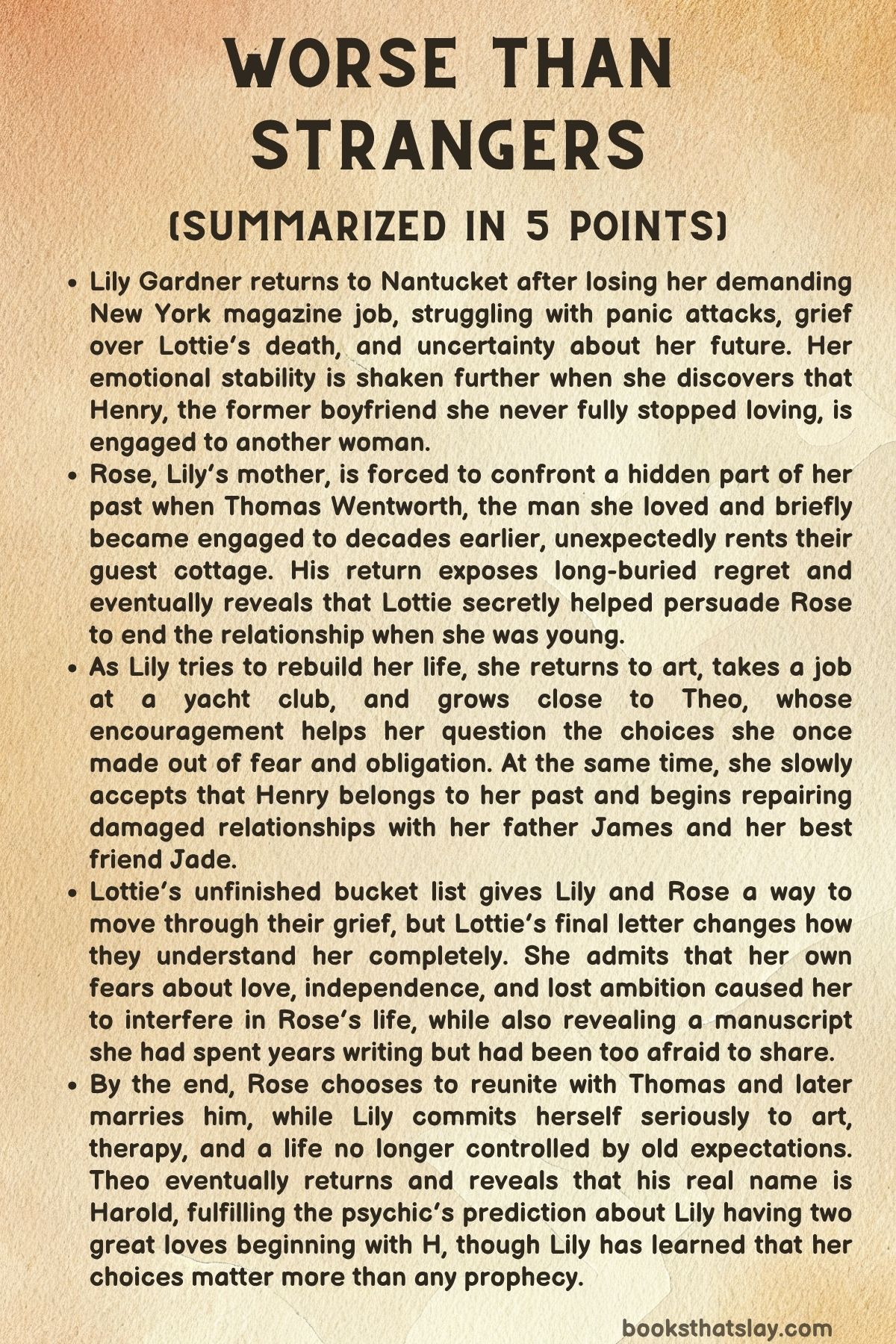
Summary
In 1998, Lottie lives on Nantucket with a secret she has carried for years. She receives a letter from California confirming that an attempt to repair an old mistake has come too late, and she realizes that revealing everything to Rose would now create pain without necessarily correcting the damage.
Lottie hides the letter behind a bookshelf before her husband Charlie sees it. She decides to live with the consequences herself, even though she knows the worst kind of regret may be the kind created by interfering with somebody else’s life.
Twenty-four years later, Lottie is dead after a long battle with cancer, and twenty-five-year-old Lily Gardner has returned to Nantucket after losing her job at a fashion magazine in New York. Lily feels embarrassed by what she sees as professional failure, frightened by the panic attacks that developed during her demanding career, and unsure what direction her life should take.
Her mother, Rose, welcomes her home with the warmth that has always defined their relationship. Yet Lily quickly discovers that even Nantucket cannot protect her from the life she has been avoiding when she encounters Henry Wright, the former boyfriend she never truly stopped loving, accompanied by his new fiancée, Mary.
Lily and Henry had broken up before the pandemic but remained emotionally connected through messages and calls. Because their relationship never completely disappeared, Lily secretly assumed that they might eventually return to each other, making his engagement feel less like ordinary heartbreak and more like the destruction of a future she had quietly kept alive.
Her disappointment arrives during an already difficult period. Lottie’s death has left both Lily and Rose grieving, Lily has abruptly abandoned her New York apartment and her best friend Jade, and the career she sacrificed so much for has collapsed.
Rose has troubles of her own, although she initially hides them beneath her usual composure. She has spent years caring for Lily and then for Lottie, while postponing her dream of opening an independent therapy practice, and she is now confronting the possibility of living alone again once Lily eventually leaves Nantucket.
A handsome older man named William begins pursuing Rose, and Lily encourages her to give romance another chance. Rose agrees, but her attention changes when the renter occupying the guest cottage turns out to be Thomas Wentworth, the man she loved more than thirty years earlier.
Rose and Thomas had fallen deeply in love when they were young and were briefly engaged. Rose believed her father opposed the marriage because Thomas lacked the social and financial position he wanted for his daughter, so she eventually ended the relationship despite loving Thomas intensely.
Thomas’s sudden return shocks Rose and fascinates Lily. Rose tries to avoid him, while Lily becomes increasingly convinced that his appearance offers her mother a rare second chance.
At the same time, Lily begins rebuilding parts of herself that had disappeared in New York. Encouraged by memories of Lottie, she starts drawing again, advertises her artistic services, searches for work, and eventually takes a job at the Great Harbor Yacht Club.
There she becomes close to Theo, a tennis instructor whose humor, kindness, and willingness to rethink his own ambitions make him different from Henry. Theo once imagined becoming a professional tennis player but has accepted another path and now hopes to study history and become a teacher.
Lily remains emotionally attached to Henry, however, and her confusion deepens when a psychic tells her that she will have two great loves whose names both begin with H. Because Henry clearly fits the prediction, Lily begins wondering whether fate might somehow return him to her.
Thomas gradually becomes important to Lily for reasons beyond his connection with Rose. During a private walk, he explains that after losing Rose he eventually married another woman, genuinely loved her, raised two daughters, and later lost his wife to illness.
His history forces Lily to see him as a full person rather than simply the man her mother should have married. Thomas has experienced love, parenthood, grief, anxiety, and reinvention during the decades separating him from Rose.
Lily nevertheless begins trying to bring Rose and Thomas together. She and Thomas eventually attend a wedding that Lily and Rose secretly crash while completing one of the activities on a bucket list Lottie left behind.
The list contains playful Nantucket experiences such as seeing the sunrise, visiting the observatory, going whale watching, entering a pickleball tournament, attending the Chicken Box, naming the cottage, crashing a wedding, and doing something brave. For Lily and Rose, completing the list initially feels like a way of remaining connected to Lottie.
At the wedding, Rose encounters Thomas while also attending with William. Thomas and Rose dance together, and their old intimacy immediately returns, but their conversation is interrupted before either can fully express what remains between them.
Thomas later tells Lily that he cannot continue allowing himself to be repeatedly rejected. Having already lost his wife, he refuses to make his emotional life dependent on elaborate schemes designed by Lily or his sister Rachel.
The confrontation makes Lily recognize that her matchmaking has sometimes ignored Thomas’s right to protect himself. She also begins to understand that Rose has an identity beyond motherhood and that she cannot control her mother’s emotional choices simply because she wants Rose to be happy.
Lily’s own romantic life becomes equally complicated. Theo is attracted to her, but he withdraws after seeing her leave a beach bonfire with Henry, believing Lily may still want to reunite with her ex.
Although Lily and Henry do not become physically involved, their private conversation crosses emotional boundaries. Henry complains about his wedding, expresses uncertainty about marrying young, and falls easily into the intimacy he and Lily once shared.
Lily eventually understands that participating in those doubts would be unfair to Mary. She deliberately begins separating herself from Henry, even as admitting the finality of their relationship remains painful.
Her professional struggles also continue. Marie Chen, a gallery owner, considers Lily for employment but ultimately rejects her after Lily’s former boss, Clive Bozeman, refuses to provide a positive reference.
The rejection triggers a severe panic attack. Thomas finds Lily and helps her through it using grounding techniques he learned after developing panic attacks following his wife’s death, strengthening the quiet bond that has formed between them.
Family tension increases when Lily’s estranged father, James, unexpectedly arrives on Nantucket. James had cheated on Rose, struggled with addiction, repeatedly disappeared from Lily’s life, and once failed to follow through after Lily finally responded to his attempts at reconciliation.
His arrival coincides with a much larger revelation. Rose’s father casually admits that the letter persuading young Rose to leave Thomas was written at Lottie’s urging, meaning the woman Rose trusted most had secretly contributed to one of the greatest losses of her life.
Rose feels profoundly betrayed. She had spent decades blaming her father while remembering Lottie as the person who supported her afterward, only to discover that Lottie had influenced the decision from behind the scenes.
The revelation changes Rose’s relationship with the bucket list. She refuses to continue treating Lottie as an unquestionable source of wisdom and recognizes that she must begin making decisions based on her own judgment.
Meanwhile, Lily finally has a genuine conversation with James. He explains that one of his earlier disappearances happened because he had relapsed and felt ashamed, believing withdrawal would protect her from seeing him at his worst.
Lily tells him that the silence hurt more than the truth would have. Their relationship cannot suddenly erase years of disappointment, but they cautiously agree to try rebuilding it.
James also encourages Lily to confront Clive about the damage he caused her career. Eventually Lily speaks directly to her former boss, tells him how badly he treated her, and secures his promise that he will stop sabotaging future references.
Her relationship with Henry reaches a healthier conclusion as well. During his bachelor celebration, Henry admits that he once imagined marrying Lily but now realizes they probably would not have made each other happy.
Lily recognizes the same truth. She later writes him a farewell letter intended not to win him back but to release the relationship she has been carrying long after it ended.
Her connection with Theo deepens, although another disappointment appears when she learns he plans to leave Nantucket and teach abroad for a year. Lily is hurt that he concealed the decision because their growing feelings had made the approaching separation important.
Thomas, meanwhile, reveals that he is buying a house on Nantucket and has no intention of structuring his entire future around Rose. He also gives Lily hand-carved signs, including one naming the cottage Lottie’s Way and another intended for Rose’s future therapy practice.
He then reveals that he has known for years that Lottie interfered in his relationship with Rose. After James left Rose, Lottie contacted Thomas and confessed, hoping that he and Rose might still reunite, but by then Thomas had already created another life.
Thomas nevertheless refuses to define Lottie entirely by her mistake. His ability to acknowledge the damage she caused without dismissing everything good about her helps Lily begin reconsidering her own judgment of Lottie.
Before Rose attends a major mental-health gala where she is being honored, Lily secretly invites Thomas. She also receives troubling information from Theo suggesting that William has a history of pursuing wealthy women and gaining control over their finances.
The gala becomes disastrous before anyone can calmly confront William. Mary discovers Lily’s farewell letter to Henry, interprets it as evidence that Lily has been pursuing her fiancé, storms into the event, publicly accuses Lily, and eventually slaps her.
Thomas intervenes, William attacks him, Theo punches Henry after misreading what happened, and the ballroom descends into chaos. In the middle of the confrontation, Thomas publicly declares that he loves Rose.
Rose later learns that William apparently believed she was wealthy because she owns Nantucket property. When she reveals that she has relatively little money beyond the inherited cottage, his motives become clearer, and she ends the relationship.
The more painful confrontation occurs between Rose and Lily. Rose accuses her daughter of repeatedly interfering in adult relationships she does not fully understand, while Lily accuses Rose of rejecting people whenever they disappoint her.
Their fight establishes a boundary that had long been blurred by their closeness. Rose loves Lily deeply, but she needs her daughter to remember that being close friends does not remove the difference between being a parent and being a child.
Lily then reconnects with Jade. Their conflict turns out to be easier to repair than Lily feared because both women admit their mistakes and recognize that silence allowed resentment to become larger than the original problem.
Finally, Lily opens the letters Thomas found among Lottie’s belongings. Lottie’s final confession reveals that she once dreamed of a glamorous New York career but instead married Charlie, moved to Nantucket, taught school, and created a life centered on marriage, students, and family.
Lottie insists that she loved Charlie and valued the life they built, yet part of her always wondered what another future might have offered. After Charlie died, those private doubts influenced the advice she gave Rose.
When Rose became engaged to Thomas, Lottie feared that Rose was giving away her independence too young. Instead of discussing those fears honestly, she persuaded Rose’s father to pressure his daughter into ending the engagement.
Years later Lottie understood that she had confused her own unresolved questions with Rose’s needs. Her attempt to repair the mistake came too late, and her regret taught her that loving someone deeply does not necessarily prevent a person from building an independent, meaningful life.
Lottie also explains that the famous bucket list was never the greatest unfinished project she left behind. Her real secret was a manuscript she had spent more than a decade writing but had been too frightened to show anyone.
Her confession transforms Lily’s understanding of courage. Lottie, whom Lily had remembered as fearless, had also allowed fear to direct important choices.
Lily recognizes the same pattern in herself. Her attachment to Henry was partly an attempt to recover the version of life that existed before Lottie died, her career failed, panic attacks disrupted her confidence, and adulthood became frighteningly uncertain.
Once she understands that, she is finally able to let the past remain where it belongs. She and Rose apologize for their fight and decide that although they no longer need to complete Lottie’s list out of obligation, they can finish it because they genuinely want to.
The remaining activities become celebrations rather than commandments. Rose also begins repairing her relationship with her sister Elizabeth and reconsidering long-standing judgments about her father and other family members.
Finally, Lily arranges one last meeting between Thomas and Rose. Thomas waits at the cottage with roses and the signs he carved, and Rose stops searching for reasons to protect herself from the relationship.
She kisses him, allowing a love interrupted for more than thirty years to begin again. Rose and Lily also complete another bucket-list challenge by performing together at the Chicken Box, ending the summer with a stronger understanding of one another.
A year later, Rose marries Thomas at the chapel connected with Lottie’s own history. Rose has opened her therapy practice, Thomas’s daughters are gradually welcoming the new family, James and Lily are rebuilding their relationship, and Elizabeth has become unexpectedly closer to Rose and Lily.
Lily has returned to New York, resumed therapy for her panic attacks, and committed seriously to art. Her portrait series becomes successful, giving her the career direction she once waited for other people to authorize.
Lottie’s manuscript may also find publication, extending her creative life beyond death. Theo eventually returns and reveals that he has been accepted into a teaching program in New York, meaning he and Lily will soon be living near each other.
Then Lily learns that Theo is only a nickname and that his real first name is Harold, making him the second important love beginning with H predicted by the psychic. Lily no longer needs the prediction to tell her what to do, because she has learned that uncertainty does not have to be controlled before a meaningful choice can be made.
The book ends with Rose, Lily, Thomas, and Theo running from the wedding celebration into the cold ocean together. Lily still cannot know exactly what her future will become, but she finally sees that not knowing can represent possibility rather than failure.
Characters
Lily Gardner
As the central figure in Worse than Strangers, Lily Gardner represents a young adult caught between the safety of a remembered life and the uncertainty of creating a new one. She returns to Nantucket believing that almost every important part of her adulthood has gone wrong: she has lost her job, abandoned her apartment, damaged her friendship with Jade, developed panic attacks, and discovered that Henry is marrying someone else.
Her humor often acts as protection against humiliation and fear. She has learned from Lottie to turn disaster into a story that can be laughed at, but the book gradually reveals that humor cannot substitute for confronting grief, anxiety, professional mistreatment, and unresolved love.
Lily initially responds to uncertainty by trying to control other people’s stories. She believes Henry may still belong in her future, tries to engineer a reunion between Rose and Thomas, interprets the psychic’s prediction as evidence of destiny, and assumes that understanding other people’s romantic lives will somehow make her own choices easier.
Her development comes from recognizing that love cannot be managed through prediction or interference. Thomas’s frustration, Rose’s anger, Mary’s reaction to the farewell letter, and Theo’s temporary withdrawal all teach Lily that good intentions do not remove the consequences of crossing emotional boundaries.
Art becomes the clearest sign of Lily reclaiming her identity. Rather than waiting for an employer or gallery owner to declare her legitimate, she begins drawing, painting, and eventually producing portraits that honor ordinary women whose lives might otherwise pass without formal recognition.
Her eventual success matters because it comes after she stops treating professional approval as the source of artistic worth. By returning to therapy, confronting Clive, repairing friendships, accepting Henry’s marriage, and allowing her relationship with Theo to remain uncertain, Lily becomes more comfortable building a life that cannot be guaranteed in advance.
Rose Gardner
Rose is a loving mother, skilled therapist, grieving niece, abandoned wife, and woman who has spent decades organizing herself around the needs of other people. Her closeness with Lily is genuine and sustaining, but it has also blurred the normal boundary between parent and adult child because the two have functioned almost like partners for much of Lily’s life.
The return of Thomas exposes the part of Rose that motherhood has hidden from Lily. She was once impulsive, intensely romantic, adventurous, and willing to imagine a completely different life, and Lily slowly understands that the woman she calls Mom existed long before she became a mother.
Rose’s greatest obstacle is not lack of feeling but fear of acting on feelings she cannot control. Thomas represents love powerful enough to threaten the emotional order she has spent decades creating, so she repeatedly avoids him even when her reactions show that she has never truly become indifferent.
Her anger toward Lottie demonstrates how deeply Rose depends on trusted narratives. She had built much of her emotional history around believing that her father destroyed her relationship while Lottie protected her, and learning that Lottie helped engineer the breakup leaves Rose questioning both her past and her own judgment.
Importantly, Rose eventually accepts responsibility for the choice she made. Lottie influenced her, and her father pressured her, but Rose recognizes that she was still the person who ended the engagement.
Her professional ambition provides another important dimension. Opening a private therapy practice allows Rose to choose something for herself after years of caregiving, and her eventual reunion with Thomas therefore does not require her to abandon independence in favor of romance.
Lottie
Lottie’s role in Worse than Strangers is shaped by the difference between how people are remembered and who they actually were. For Lily and Rose, she initially appears almost saintly: funny, imaginative, artistic, supportive, adventurous, and capable of turning ordinary experiences into meaningful lessons.
The discovery of her interference in Rose and Thomas’s engagement destroys that idealized image. Lottie acted from fear that Rose would repeat what she believed had happened in her own life, sacrificing too much independence for love before fully discovering who she might become.
Her mistake is serious because she imposed her unresolved questions onto another woman. Instead of trusting Rose to make an informed choice, she secretly recruited Rose’s father and helped influence a decision whose consequences lasted for decades.
Yet Lottie’s final letter prevents the book from reducing her to that failure. She admits what she did, explains the insecurity behind it, acknowledges that she misunderstood love and independence, and attempts to repair the damage even though circumstances make complete repair impossible.
Her hidden manuscript reveals that Lottie also failed to follow some of the courage she encouraged in others. She could urge Lily toward art and celebrate possibility while remaining afraid to expose her own creative work to judgment.
That contradiction makes her more human rather than less meaningful. Lottie ultimately teaches Lily and Rose not because she possessed perfect wisdom, but because her mistakes show the danger of allowing fear to disguise itself as certainty.
Thomas Wentworth
Thomas is introduced through Rose’s reaction before Lily understands anything about him, immediately establishing that his importance belongs to a much older emotional history. He represents a love Rose believed had been permanently removed from her life, but the man who returns to Nantucket is not simply the young Tommy she remembers.
During the intervening decades, Thomas built a successful career, married, became a father, loved his wife, and endured her death. His refusal to describe his marriage as secondary to Rose is important because it rejects the idea that people are allowed only one genuine love.
Thomas’s grief makes him more cautious than Lily initially realizes. He may still love Rose, but having watched his wife become ill and die, he is unwilling to repeatedly expose himself to rejection merely because Lily and Rachel think a reunion would be romantic.
His bond with Lily becomes one of the book’s strongest non-romantic relationships. He helps her through a panic attack without judgment, talks honestly about grief, challenges her assumptions, and demonstrates that vulnerability and strength can exist together.
Thomas also possesses a generous view of human imperfection. Although Lottie helped destroy his engagement, he refuses to define her entire life by one terrible decision.
His eventual reunion with Rose therefore feels less like the recovery of a frozen past than the beginning of a relationship between two people who have lived entire lives since they were separated.
Theo
Theo enters Lily’s life at a moment when she is still measuring everything against Henry. His importance gradually emerges because he responds to Lily as the person she is becoming rather than treating her according to the identity she once held.
Where Henry once minimized the damage created by Lily’s toxic job, Theo encourages her artistic ambitions without requiring professional proof that they are valid. He calls attention to the fact that Lily does not need a prestigious employer to authorize her identity as an artist.
Theo also understands what it means to revise a dream. He once pursued professional tennis but eventually accepted that another life suited him better, and his decision to become a teacher challenges Lily’s fear that changing direction automatically means failing.
His humor hides significant grief. The death of his mother by suicide when he was a child gives his optimism greater complexity, showing that his cheerful nature does not come from an easy life.
Theo nevertheless makes mistakes, especially when he conceals his plans to leave Nantucket because he fears the knowledge will damage his time with Lily. His avoidance parallels Lily’s own habit of postponing difficult truths.
The revelation that his real name is Harold completes the psychic’s prediction, but its deeper purpose is to show how much Lily has changed. By that point she no longer needs a prophecy to justify loving him.
Henry Wright
Henry embodies Lily’s attachment to a period of life that feels safer in memory than it actually was. Their relationship contained genuine love, attraction, friendship, and formative experiences, which explains why Lily cannot simply dismiss him when the romance ends.
Their continued communication after the breakup prevents Lily from mourning the relationship normally. Henry becomes emotionally present enough to preserve hope while simultaneously constructing a separate future with Mary.
His limitations become clearer when contrasted with Theo. Henry minimizes the exploitation Lily experiences under Clive and seems more comfortable with conventional ideas of success, while Theo sees artistic possibility in Lily before she fully trusts it herself.
Henry is not presented as purely cruel or manipulative. His bachelor-party confession shows that he has also reflected on their relationship and concluded that affection does not necessarily mean two people should marry.
His role ultimately concerns release rather than reunion. Lily’s growth becomes visible when she can remember what they had, wish him well, and stop treating their history as evidence that they still belong together.
James Gardner
James is one of the most difficult figures in Lily’s emotional history because his failures affected both her relationship with Rose and her understanding of abandonment. His affair with Maren damaged the family, while his addiction and repeated disappearances made any later attempt at reconciliation difficult to trust.
His return to Nantucket initially seems intrusive because it occurs without Lily’s consent. Yet the book gradually allows him to explain actions that Lily previously understood only as rejection.
James admits that shame surrounding relapse caused at least one of his disappearances. His belief that withdrawing would protect Lily was misguided, and Lily makes clear that unexplained absence created more harm than witnessing his struggle would have.
His willingness to defend Lily professionally becomes a small but significant step toward repairing their bond. Helping her confront Clive cannot compensate for years of instability, but it demonstrates that James can begin behaving like the protective father Lily needed.
The book wisely avoids presenting reconciliation as instant forgiveness. Lily agrees only to try, making their renewed relationship a process rather than a sentimental erasure of the past.
William
William initially appears to offer Rose a sophisticated, financially secure path toward romance after years spent concentrating on family and work. His wealth, yacht, polished manner, and confident pursuit create the image of a man who could provide an uncomplicated new beginning.
Gradually, his assumptions reveal how little he understands Rose. He imagines that she might stop working, spend winters in Palm Beach, and eventually sell Lottie’s cottage, even though her career and Nantucket home are central to her identity.
His condescension toward Theo further exposes his tendency to equate status and money with value. Lily immediately distrusts this attitude because Theo’s ambitions may be modest by William’s standards but are personally meaningful.
The later allegation that William targets wealthy women reframes his courtship. His interest in Rose appears partially connected to his assumption that property ownership on Nantucket indicates substantial wealth.
Rose’s amused reaction when she reveals her actual finances becomes an effective reversal. William ultimately serves as a contrast to Thomas, whose affection is based on understanding Rose’s character rather than imagining what her assets or lifestyle could provide.
Jade
Jade represents a friendship damaged more by avoidance than by true incompatibility. When Lily abruptly leaves New York after losing her job, Jade is left dealing with practical and emotional consequences, including the shared apartment lease.
Lily spends much of the summer imagining that repairing the friendship will require an enormous confrontation. When they finally speak, both women admit their mistakes and discover that affection survived beneath the anger.
Their reconciliation reflects one of Lily’s larger lessons about fear. She repeatedly postpones difficult conversations because she assumes the outcome will be unbearable, only to learn that honesty can be far less destructive than prolonged silence.
Jade also becomes connected to Lottie’s creative legacy by helping bring her manuscript to the attention of someone who may publish it. In that sense, the restored friendship contributes not only to Lily’s healing but also to preserving Lottie’s hidden artistic work.
Elizabeth
Elizabeth initially appears through Rose’s perspective as critical, vain, anxious, and closely aligned with their difficult father. Rose has spent years assuming that their emotional distance reflects Elizabeth’s personality rather than considering the experiences that shaped it.
Their conversation before the gala reveals a more complicated sister. Elizabeth was affected by their mother’s sudden death, remained tied to their father, and quietly resented the fact that Rose received the emotional refuge of a close relationship with Lottie.
Rose’s realization does not transform Elizabeth into a completely different person. She remains capable of criticism and difficult behavior, but the sisters begin recognizing that they experienced the same family history from very different positions.
Elizabeth therefore reinforces the story’s interest in perspective. People who appear cold, selfish, or shallow from one angle may be carrying grief and resentment that others have never bothered to understand.
Rose and Elizabeth’s Father
Rose’s father represents authority exercised without emotional sensitivity. His objections to Rose and Thomas encouraged her to prioritize fear, practicality, and social expectations over her own emotional conviction.
For decades Rose believes that he independently created the pressure that ended her engagement. His casual revelation that Lottie helped initiate the plan radically changes Rose’s understanding of the event.
His behavior also demonstrates how parents can continue judging adult children according to outdated expectations. His criticism of Lily’s employment and Rose’s financial choices shows that control remains part of his personality even many years later.
Yet he is not completely static. By the end of the story, he makes tentative efforts to ask Rose whether she is genuinely all right, suggesting that age and family upheaval may have opened a small possibility for greater emotional awareness.
Josie
Josie is Rose’s close friend and an important part of the support system she built on Nantucket. Her friendship becomes especially meaningful after Lottie’s death because Rose is entering a period in which she must imagine life without the person who served as her emotional anchor.
The misunderstanding involving Thomas briefly makes Josie appear threatening to Rose. Lily sees Thomas with her and assumes they are romantically involved, creating jealousy that forces Rose to confront how strongly she still feels about him.
In reality, Josie has been helping Thomas purchase a home. The misunderstanding demonstrates how easily assumptions become stories when people avoid direct communication.
Josie’s presence also emphasizes that Rose’s life contains relationships beyond Lily, Thomas, and Lottie. She is part of the adult community Rose has created for herself.
Rachel Wentworth
Rachel is Thomas’s sister and a surviving connection to the warm family Rose once loved. Rose remembers the Wentworth household as affectionate and emotionally open, making Rachel a reminder of the family life Rose once imagined joining.
Like Lily, Rachel believes Rose and Thomas deserve another opportunity. She therefore helps arrange circumstances that bring Thomas back to Nantucket and later cooperates with Lily’s matchmaking.
Her intentions are affectionate, but Thomas’s anger forces Rachel to recognize the same mistake Lily makes. Wanting somebody to find happiness does not justify disregarding that person’s fear of being hurt again.
Rachel eventually functions as a bridge between past and present. Her continued warmth toward Rose suggests that the emotional bonds surrounding the youthful romance were not entirely erased by time.
Mary
Mary is initially seen almost entirely through Lily’s jealousy, which makes her less a fully understood person than the symbol of the future Lily thought might belong to her. Her engagement ring immediately converts Lily’s vague hope of reconciling with Henry into a much harsher reality.
As the story continues, Mary’s existence creates an important moral boundary. Lily remembers the pain caused by her father’s affair and does not want to become someone who participates in another woman’s betrayal.
Mary’s confrontation at the gala is extreme because she interprets Lily’s goodbye letter as proof of continued romantic interference. Her anger produces public humiliation and physical aggression, but it also reminds Lily that private emotional choices can look very different to people outside them.
Mary ultimately helps force Lily to accept that Henry’s present relationship deserves to exist independently of Lily’s memories.
Clive Bozeman
Clive represents the professional culture that taught Lily to confuse exploitation with ambition. As her boss, he demanded excessive labor, treated her as both employee and personal servant, belittled her, and benefited from her determination to succeed.
His behavior contributes directly to the anxiety Lily associates with work. Henry’s willingness to dismiss this treatment as an ordinary stage of a competitive career makes the damage even harder for Lily to identify clearly.
Clive’s refusal to recommend Lily after years of sacrifice becomes especially cruel because it allows his authority to follow her even after she leaves the job. He can continue controlling her future through a single reference.
Lily’s eventual confrontation with him therefore matters more than his apology. The victory comes from finally telling him what his behavior was and refusing to let professional hierarchy silence her.
Marie Chen
Marie Chen plays a relatively limited role but becomes important to Lily’s understanding of external approval. Lily initially sees the possibility of working in Marie’s gallery as proof that her return to art might become professionally legitimate.
When Marie rejects her because of Clive’s reference, the disappointment initially reinforces Lily’s belief that other people control whether she can move forward. The rejection contributes to one of her most severe panic attacks.
Eventually, however, Lily builds an artistic identity without waiting for a gallery position to validate her. Marie therefore indirectly contributes to the shift from seeking permission to creating independently.
Becca
Becca connects Lily to the earlier period of her life when she first met Henry. Because she originally helped bring them together, her presence naturally carries memories of the relationship Lily is struggling to release.
Her casual revelation that Henry and Mary will marry on Nantucket wounds Lily precisely because Becca treats the information as an ordinary fact while Lily experiences it as the collapse of a private possibility. The moment shows how differently the same event can exist inside and outside the mind of someone who has not emotionally moved on.
Becca’s role is small, but she helps transform Henry’s engagement from something abstract into an unavoidable reality.
Emily
Emily functions primarily through Lily’s uncertainty about Theo. Lily notices her closeness with him and immediately wonders whether they are romantically involved, revealing how quickly insecurity encourages Lily to create explanations without evidence.
Theo’s interactions with Emily also contribute to Lily’s recognition that her feelings for him have moved beyond casual friendship. Jealousy becomes one of the first signals that Theo matters to her independently of Henry.
Emily therefore serves less as a romantic rival than as a mirror for Lily’s developing attachment.
Maren
Maren appears mainly through the history of James’s infidelity. For Lily, she becomes associated with the woman who helped break her parents’ marriage and therefore with a moral identity Lily strongly refuses to repeat.
That memory shapes Lily’s response when Henry asks to speak privately while engaged to Mary. Lily understands that emotional betrayal can cause damage even before anything physically romantic happens.
Maren’s importance consequently extends beyond her direct presence. She becomes part of Lily’s internal standard for what she does not want to become.
Charlie
Charlie is Lottie’s late husband and a crucial part of understanding her final confession. Lottie genuinely loved him, built a meaningful marriage with him, and shaped much of her adult life around the world they created together on Nantucket.
After his death, however, Lottie begins wondering whether organizing so much of her identity around marriage prevented her from pursuing another version of herself. Those private questions later distort the advice she gives Rose.
Charlie is therefore not presented as someone who restricted Lottie. The problem lies in Lottie’s later interpretation of her own choices and her decision to project those concerns onto Rose.
The Psychic in the Red Shawl
The psychic functions as an external expression of Lily’s desire for certainty. Her prediction about two great loves whose names begin with H gives Lily a structure she can use to make uncertainty feel manageable.
For much of the story, Lily treats the prediction as evidence that Henry might still belong in her future. Her fixation becomes so intense that she mistakes another woman in red for the psychic and publicly confronts her.
The final revelation about Theo’s real name gives the prophecy apparent accuracy, but Lily’s reaction is what truly matters. She no longer feels compelled to organize her life around the prediction.
The psychic therefore represents the difference between noticing coincidence and surrendering personal choice to it. Lily ends the story capable of appreciating mystery without allowing it to make decisions for her.
Bunny Andrews
Bunny Andrews appears briefly but performs an important practical function by exposing information about William. Through Theo, she provides the warning that William may have a pattern of targeting wealthy single women and exploiting their finances.
Her claim changes William from merely an incompatible romantic partner into someone whose intentions may be seriously dishonest. The revelation also allows Rose to see that his interest was partly based on a false assumption about her wealth.
Bunny therefore becomes an unexpected source of protection at exactly the moment Rose is preparing to leave William for other reasons.
Mark
Mark is Jade’s boyfriend and remains mostly outside the direct action, but his relationship with Jade has symbolic importance for Lily. Earlier in the summer, learning that Jade had moved forward romantically might have intensified Lily’s belief that everyone else was progressing while she remained stuck.
When Jade tells her that she and Mark are living together, Lily can finally respond with uncomplicated happiness. Her reaction shows that she has stopped measuring her own life against other people’s timelines.
Themes
Fear, Courage, and the Choices That Shape a Life
Fear repeatedly disguises itself as reason throughout Worse than Strangers. Lottie interferes with Rose and Thomas because she fears Rose will surrender her independence, Rose rejects opportunities for emotional honesty because she fears reopening an old wound, Lily keeps Henry emotionally alive because she fears losing the last connection to an earlier version of herself, and Theo hides his departure because he fears that acknowledging it will spoil his relationship with Lily.
The story gradually separates courage from fearlessness. Lottie appears fearless in Lily’s memory, yet her final letter reveals how often fear shaped her own choices, including her refusal to show anyone the manuscript she spent more than ten years writing.
Lily’s growth depends on understanding that courage frequently occurs while fear remains present. She confronts Clive without knowing whether he will retaliate, reaches out to Jade without knowing whether the friendship can be repaired, allows James back into her life without proof that he will remain reliable, and chooses art without guaranteed professional success.
Rose reaches the same realization when she finally kisses Thomas. She cannot know whether their second relationship will succeed, but she understands that permanent self-protection would simply create another version of the regret that shaped their first separation.
The open-ended instruction on Lottie’s bucket list to do something brave therefore applies differently to every character. Bravery becomes less about spectacular action than about refusing to let fear make every important decision.
Memory, Grief, and the Idealization of the Past
Grief alters memory throughout the story by encouraging characters to preserve lost people and lost periods of life in simplified forms. Lily remembers Lottie as almost endlessly wise, Rose remembers her as the adult who rescued her emotionally, and Lily remembers Henry not only as a former boyfriend but as a connection to the life she had before loss and anxiety transformed her world.
The revelation about Lottie demonstrates how dangerous idealization can become. Learning that she helped end Rose and Thomas’s engagement initially feels almost incompatible with the generous person Rose and Lily remember, because grief has encouraged them to preserve her as morally complete.
Thomas offers a healthier way of remembering when he argues, through his behavior and perspective, that one serious mistake does not erase everything good a person did. His attitude allows the family to hold two truths at once: Lottie caused lasting harm, and Lottie also loved them deeply.
Lily eventually applies the same complexity to Henry. She does not need to decide that the relationship was false in order to admit that it is over.
The characters therefore learn that moving forward does not require destroying the past. It requires remembering people as complete human beings rather than turning them into perfect heroes, permanent villains, or symbols of a life that can somehow be recovered exactly as it once existed.
Love, Timing, and Second Chances
Rose and Thomas demonstrate that love can remain meaningful even when circumstances prevent it from continuing in its original form. Their youthful relationship ends through outside pressure, personal fear, and misunderstanding, but neither spends the following decades simply waiting for the other.
Thomas marries, loves his wife, raises children, builds a career, and experiences devastating loss. Rose marries James, becomes Lily’s mother, creates a professional life, cares for Lottie, and develops an identity that the eighteen-year-old Rose could never have imagined.
Their eventual reunion therefore does not suggest that every person has one predestined partner whose absence makes all later love meaningless. Thomas’s marriage is explicitly treated as genuine, demonstrating that a person may love deeply more than once without one relationship invalidating another.
Lily’s romantic development strengthens that idea. Henry can be a great love without being the right person for her future, while Theo can become significant without immediately becoming a permanent partner.
Timing matters because people change between opportunities. A second chance is valuable not because it restores the original relationship exactly as it was, but because two changed people may consciously choose one another again.
The story ultimately treats love as something that requires decision rather than prophecy. Circumstance may create an opportunity, but the characters still have to act.
Identity, Independence, and Permission to Change
Many characters struggle because they have attached their identities to roles that once made sense but no longer fit. Lily sees herself through her failed magazine career and her relationship with Henry, Rose has spent years identifying primarily as Lily’s mother and Lottie’s caregiver, and Lottie spent much of her adult life wondering whether being Charlie’s wife and a teacher left enough room for the ambitious woman she once imagined becoming.
The book challenges the assumption that changing direction proves the original dream was a mistake. Theo’s abandoned professional-tennis ambition leads him toward teaching, Rose’s years of caregiving do not prevent her from opening a private practice later, and Lily’s failure in magazine publishing ultimately pushes her back toward the art she had neglected.
Independence is also presented as something more complicated than avoiding commitment. Lottie once assumes Rose must choose between love and self-development, but her final confession recognizes that intimacy and individual purpose do not have to cancel each other out.
Lily reaches a similar understanding through art. She spends years waiting for employers, galleries, and established professionals to give her permission to call herself an artist, only to discover that the work itself must come first.
By the end, identity is no longer treated as something each person must discover once and permanently protect. Rose can be a mother and romantic partner, Thomas can be a widower and fall in love again, Theo can leave tennis for teaching, and Lily can become an artist precisely because she finally gives herself permission to change.