A Summer of Stars Summary, Characters and Themes
A Summer of Stars by Liana Cincotti is a contemporary sports romance centered on professional tennis player Luna Aldridge and actor Kieran Alexander, two public figures forced into a fake relationship for the sake of their damaged reputations.
Luna is attempting to rebuild her career after a bitter divorce and public scandal, while Kieran must soften the playboy image threatening the promotion of his latest film. What begins as an arrangement between two people who openly dislike one another gradually exposes misunderstandings, old wounds, family conflicts, and fears about love, ambition, and failure. Their summer becomes a period of personal recovery as important as their professional successes.
Summary
Luna Aldridge has spent eight months away from professional tennis after the collapse of her marriage to fellow player Jeremiah Evans turned into a public scandal. Jeremiah publicly described her as controlling and toxic, and a recording of Luna angrily shouting at him appeared to support his version of events, causing sponsors to abandon her and leaving her reputation badly damaged.
As Luna prepares to return to competition, her final major sponsor, Charles Elizabeth, demands a publicity strategy built around romance. Her PR manager Deidra informs her that she must publicly date actor Kieran Alexander, whose own reputation as a carefree bachelor threatens the marketing campaign for his upcoming romantic film, Saving September.
The arrangement seems especially unbearable because Luna and Kieran have disliked each other for years. Their hostility began at a party where Luna overheard Kieran describing her as narcissistic, calculated, and impossible to love, without realizing that his words had a hidden context.
Kieran has his own emotional history behind his distrust of relationships. Years earlier, he loved filmmaker Penelope Collins, only to discover that she had begun seeing someone else and never regarded their relationship as seriously as he did, leaving him convinced that emotional commitment only creates opportunities for humiliation.
Luna’s history with Jeremiah proves even more destructive. Their romance began at Wimbledon and quickly became serious, but after the death of Jeremiah’s brother, he became emotionally distant and increasingly focused on his career while Luna sacrificed parts of her own professional life to support him.
The marriage ends when Luna discovers Jeremiah in bed with young player Ava Williams. Luna immediately files for divorce, but Jeremiah later presents their private problems publicly as evidence that Luna was responsible for the marriage’s failure, using a secretly recorded argument to strengthen his accusations.
When Luna and Kieran begin appearing together, their early outings are filled with arguments and sarcastic remarks. Yet the very energy that makes them antagonistic also makes their supposed relationship convincing, and physical closeness gradually reveals an attraction that neither wants to acknowledge.
Kieran attends one of Luna’s matches and discovers how badly he underestimated her athletic ability. Watching her compete transforms his view of her because he sees the discipline, physical endurance, focus, and determination required to perform at her level, and he becomes genuinely disappointed when she narrowly loses.
Luna also starts seeing a different side of Kieran. He shows concern after her matches, protects her when crowds and photographers trigger her anxiety, treats her family and friends warmly, cooks comfortably in her kitchen, and reveals that beneath his public image is someone who values family, privacy, and emotional loyalty.
Their attraction intensifies during their European publicity schedule. At dinners, premieres, dances, and private moments, their staged intimacy increasingly becomes indistinguishable from real affection, particularly because they begin sharing vulnerabilities that have nothing to do with publicity.
At a gathering before Wimbledon, Jeremiah reappears and attempts to convince Luna that their marriage can be repaired. His confidence that Luna still belongs with him unsettles her, especially because part of her once wanted reassurance that losing her had mattered to him.
Kieran becomes jealous when he sees Jeremiah near Luna. During an argument that attracts unwanted attention, Kieran kisses Luna to prevent her from accidentally revealing that their relationship was originally arranged, but the kiss quickly becomes genuine and leaves both shaken by the intensity of their response.
Luna retreats from the moment because she cannot reconcile her attraction to Kieran with the cruel man she remembers from years before. Kieran apologizes for crossing the boundary she established, but sharing a room afterward only increases the emotional tension between them.
Luna then turns her attention toward Wimbledon, where her comeback gathers momentum. She advances to the final and begins rediscovering a version of herself who can enjoy tennis rather than treating every point as proof of her worth.
Jeremiah continues trying to regain control, even grabbing Luna’s wrist and insisting that she still needs him. Luna finally tells him clearly that she does not and points to her return to elite tennis as evidence that her identity survived their marriage.
Kieran attends the Wimbledon final even though the publicity agreement does not require him to be there. Luna battles through severe heat until exhaustion overwhelms her, forcing her to retire from the match and leaving her devastated by what she sees as another failure.
Her disappointment becomes worse when a tennis-racket charm associated with her late mother breaks. In Paris, Luna isolates herself while recovering physically, but Kieran arrives, realizes how unwell she remains, and stays to care for her rather than attending his scheduled event.
Kieran tells Luna that losing a match does not erase her talent and urges her to stop playing for critics, sponsors, or public approval. His encouragement begins changing the way Luna approaches competition, because he gives her permission to reconnect with the pleasure that originally made her love tennis.
At the French Open, Luna applies that lesson and eventually wins the tournament. Away from competition, she also begins enjoying ordinary experiences again, allowing herself time with friends instead of treating every hour as preparation for another professional obligation.
When photographs involving Jeremiah lead journalists to question whether Luna and Kieran are genuinely together, they stage another public kiss. This time the kiss becomes even more intense, confirming to both of them that their attraction cannot be reduced to a publicity strategy.
At Cannes, Kieran watches Luna arrive at the film festival and realizes his attraction to her existed even before their feud began. Luna, meanwhile, watches Kieran’s film and gains a deeper appreciation for his profession, recognizing how seriously he approaches work he often minimizes because of his father’s disapproval.
Kieran privately arranges an evening to celebrate Luna’s French Open victory. They walk through Cannes, eat ice cream, discuss their families, and speak openly about their insecurities, with Kieran helping Luna think differently about memories of her mother while Luna reminds him that acting can create joy and understanding for audiences.
Their relationship changes completely after they attend a stranger’s wedding reception. Kieran reveals that Penelope’s betrayal damaged his ability to trust, and Luna recognizes how closely his fears resemble those created by Jeremiah.
Later, Luna directly asks Kieran to kiss her when there are no photographers and no professional reasons for doing so. He initially hesitates because she has been drinking, but Luna makes it clear that she understands what she wants, and both finally acknowledge that their attraction is real.
They spend the night together and wake to a comfortable intimacy that feels surprisingly natural. Luna accidentally tells Kieran she loves him, but before they can discuss the confession, Kieran learns that his grandmother, Abuela, has been taken to a hospital in Spain.
Luna travels with him and enters the Alvarez family world. She learns that Kieran’s real surname is Alvarez and that his father forced him to separate his acting career from the family name because he regarded Kieran’s professional choice as a rejection of the family’s expectations.
Luna confronts Kieran’s father after hearing him dismiss acting as insignificant. Drawing from her own grief over her final argument with her mother, she warns him not to leave Kieran permanently wondering whether his father respects or values what he has accomplished.
Kieran later attends Luna’s Madrid final with Abuela despite Luna previously requesting space. Their presence gives her renewed confidence during a difficult match, and Luna wins the tournament, making clear how much she has changed from the woman who once believed success had to come through relentless personal pressure.
Their relationship finally becomes explicit after another confrontation with Jeremiah. When Jeremiah grabs Luna and deliberately taunts Kieran, Luna punches him, pours a drink over him, and makes it unmistakably clear that she has no interest in returning to him.
In private, Luna tells Kieran the full story of Jeremiah’s affair, the sacrifices she made during their marriage, and the public campaign that followed the divorce. She admits that the experience made her fear she might be fundamentally undeserving of lasting love.
Kieran rejects that belief and asks whether she loves him. Luna says she does, and Kieran admits that he has already fallen in love with her, ending the uncertainty that has followed them throughout the summer.
Soon afterward, another misunderstanding is finally resolved. Kieran explains that the insulting comments Luna overheard years earlier were deliberately spoken to discourage a powerful married producer who wanted to pursue her; he had never actually believed the things he said.
He also reveals that he sent Luna an apology letter that she never received. Luna’s friends realize Jeremiah may have intercepted it, suggesting that his interference in her life began earlier than she understood.
As the US Open approaches, Luna learns that her opponent in the final will be Ava Williams. Instead of treating Ava entirely as the woman who destroyed her marriage, Luna now recognizes how young and vulnerable Ava was when Jeremiah became involved with her.
Before the match, the two women speak privately. Ava reveals that Luna has long been her tennis idol and apologizes for the affair, while Luna finally places responsibility where it belongs and offers Ava compassion instead of continuing to carry resentment.
The final becomes the test Luna has spent her career fearing. With the match tied and the possibility of another defeat in New York confronting her, Luna remembers Kieran’s encouragement to trust herself and commits fully to the decisive point.
She wins the US Open at last. Surrounded by the family and friends who supported her recovery, Luna celebrates without immediately turning the victory into another demand for perfection, completing both her athletic comeback and a deeper transformation in the way she understands success.
Luna then gives Kieran a victory of his own by bringing his family to the New York premiere of Saving September. His father reveals that Luna’s father encouraged him to look seriously at Kieran’s career, leading him to watch his son’s films and finally understand the dedication behind his work.
Mr. Alvarez apologizes for making Kieran ashamed of acting and tells him that he is proud of him. The reconciliation allows Kieran to receive the parental recognition he has wanted since leaving home, just as Luna has learned that achievement does not have to replace emotional connection.
One month later, Luna takes Kieran to Newport for his birthday so she can show him where she grew up. The supposedly perfect weekend goes wrong when she forgets the house key and both of them fall into freezing water while searching for a spare key on her father’s boat.
Luna cries because she thinks she has ruined the trip, but Kieran tells her that perfection was never what made the weekend valuable. What matters is that she wanted to share her past with him, and he declares that he loves her enough to accept the mistakes, accidents, and unpredictability that Luna once believed she needed to eliminate.
Their final conversation returns to Abuela’s habit of speaking about stars and love. Kieran tells Luna that he speaks about her to the stars, sun, and moon every day and that being with her can transform even an imperfect, freezing moment into something beautiful, completing A Summer of Stars with both characters choosing a love based not on performance but on being fully known.
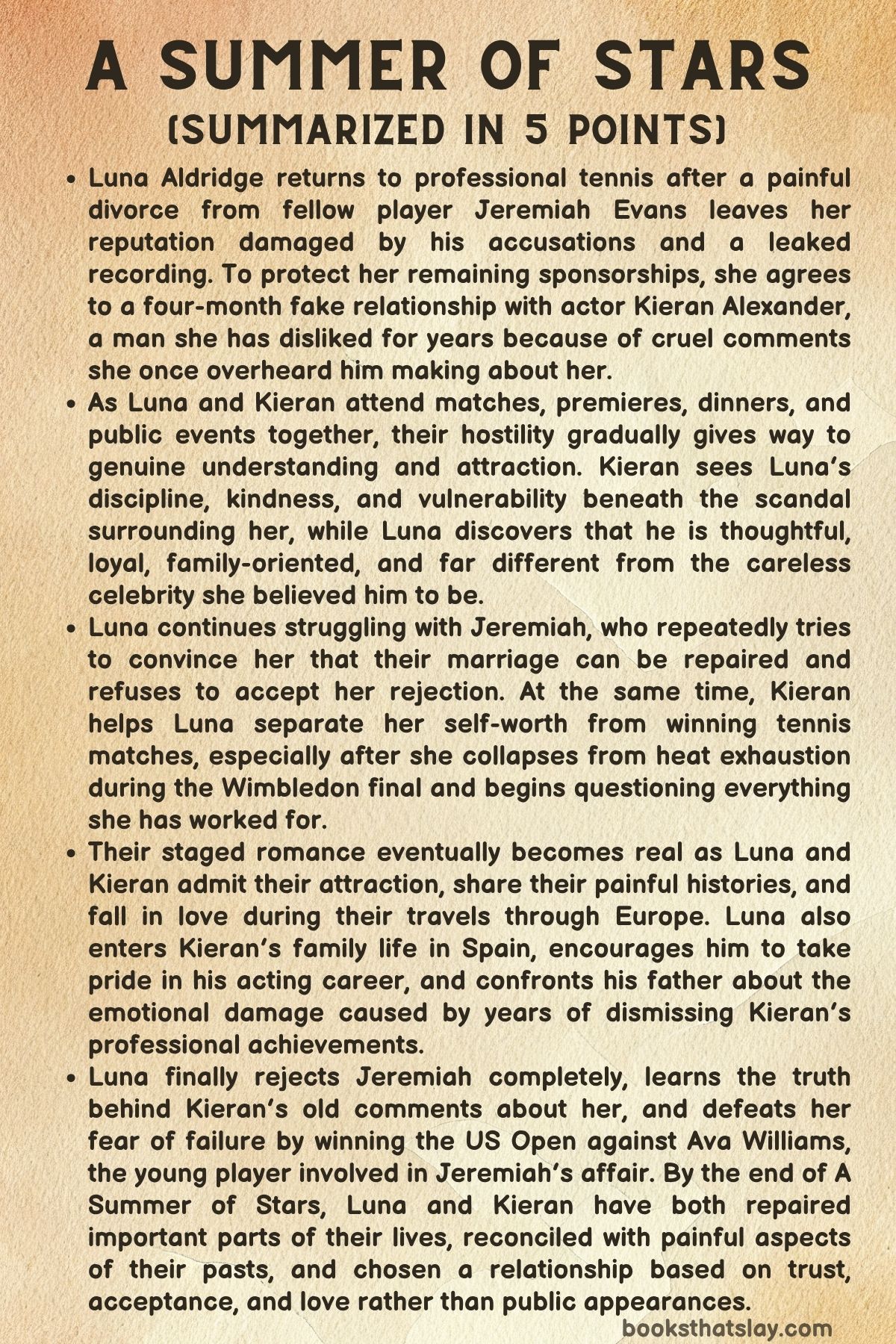
Characters
Luna Aldridge
Luna is the emotional and narrative center of A Summer of Stars, and much of her development concerns separating her actual identity from the version of herself created by Jeremiah, the media, sponsors, and her own perfectionism. At the beginning of the book, she believes regaining public approval is necessary before she can feel secure again, which explains why she accepts a relationship arrangement she personally dislikes.
Her greatest internal problem is not simply what Jeremiah did to her but how thoroughly she has absorbed the belief that failure makes her less worthy. Tennis has been connected to love, grief, family, and self-esteem since childhood, so losing a match often feels to Luna like losing part of herself.
Her relationship with Kieran gradually changes this perspective because he values her when she is sick, defeated, anxious, angry, or uncertain. By the time she wins the US Open, her achievement matters deeply, but it no longer serves as the sole proof that she deserves respect or affection.
Kieran Alexander / Kieran Alvarez
Kieran initially appears to embody the charming, emotionally unavailable celebrity persona associated with him publicly, but A Summer of Stars gradually reveals a man whose casual approach to relationships developed from betrayal and family rejection. Penelope’s infidelity convinced him that emotional commitment is unsafe, while his father’s rejection of acting taught him to minimize the importance of the career he loves.
His treatment of Luna exposes the difference between his public image and private nature. He is attentive when she is anxious, physically ill, grieving, or doubting herself, and he consistently offers care without making Luna feel indebted to him.
Kieran’s development also requires him to stop treating his own ambitions as less legitimate than Luna’s athletic career. His eventual reconciliation with his father allows him to accept acting as something worthy of pride, while his decision to love Luna openly shows that Penelope’s betrayal no longer determines what he believes relationships must become.
Jeremiah Evans
Jeremiah functions as the major human source of conflict in A Summer of Stars, not merely because he cheats on Luna but because he repeatedly attempts to control the interpretation of their marriage after it ends. He presents Luna’s sacrifices as choices that had nothing to do with him, reduces his affair to a mistake, and uses a private recording to construct a public image of himself as the injured partner.
His behavior repeatedly depends on assuming that Luna remains emotionally connected to him. He contacts her despite her requests that he stop, appears at events, challenges the legitimacy of her new relationship, grabs her wrist, and speaks as though reconciliation is something Luna should eventually provide.
Jeremiah becomes increasingly powerless as Luna stops engaging with the identity he created for her. Her eventual physical and verbal rejection of him is significant because she no longer seeks an explanation capable of making his behavior acceptable; she simply recognizes that she does not want him controlling her life.
Deidra
Deidra begins A Summer of Stars primarily as the professional strategist responsible for rebuilding Luna’s damaged reputation. Her fake-dating proposal is calculated and intrusive, but it comes from an understanding of the commercial realities threatening Luna’s career.
Her relationship with Luna is more complicated than a conventional manager-client arrangement because Deidra also cares about her personally. This creates tension after Wimbledon, when professional instincts and Luna’s emotional needs no longer align perfectly.
Deidra eventually becomes more willing to let Luna make choices that are not optimized for publicity or competition. Her development reflects the broader movement of the novel away from controlling appearances and toward allowing Luna greater ownership of her life.
Cecilia
Cecilia is one of Luna’s most dependable friends and provides an environment where Luna can complain, joke, and behave without constantly managing how she appears. Her loyalty reaches back to the night Luna first overheard Kieran’s apparent insults, when Cecilia immediately tried to comfort her.
She frequently balances humor with practical support and remains closely involved in Luna’s professional and personal life. Cecilia also becomes important in explaining Luna’s history to Kieran and helping both characters understand information that the other has withheld.
Her presence emphasizes how different genuine support is from the conditional approval Luna receives from sponsors or the public. Cecilia values Luna regardless of victories, scandals, or romantic status.
Walt Aldridge
Walt is Luna’s brother and one of the people most willing to question whether her determination is healthy. When Luna announces her return to tennis and the fake relationship arrangement, Walt worries that she may be agreeing to too much simply because she is desperate to reclaim control.
His concern is protective without becoming dominating. Unlike Jeremiah, Walt reminds Luna that she has the right to refuse situations she does not want, making him part of the family support system that respects her autonomy.
Walt also connects Luna to the childhood and family life that existed before celebrity, marriage, and scandal complicated everything. His presence helps keep her identity anchored beyond professional tennis.
Luna’s Father
Luna’s father is demanding, protective, and deeply involved in the history of her tennis career. He introduced Luna to the sport and helped create the competitive environment in which her talent could develop, but his intensity also contributes to the culture of achievement surrounding her.
He distrusts the fake relationship strategy and prefers a direct legal and public response to Jeremiah’s accusations. His instinct is to protect his daughter, even when Luna chooses a different approach.
His later conversation with Mr. Alvarez becomes particularly meaningful because he explains parenthood through the experience of watching a child become herself rather than through trophies alone. That insight helps another father recognize what his pride and rigidity have cost him.
Luna’s Mother
Although Luna’s mother died before the central events of the book, her influence remains present throughout Luna’s decisions, memories, and emotional development. She represented warmth and balance within a highly competitive family, reminding Luna that beauty, work, and success should not replace enjoyment or human connection.
Luna’s fear of forgetting her mother’s voice and touch shows how grief has remained unresolved beneath her professional discipline. The bracelet charms associated with family memories become physical symbols of Luna’s desire to preserve the past.
Her mother’s values increasingly guide Luna toward a healthier life. By learning to enjoy tennis, relationships, ordinary experiences, and imperfection again, Luna moves closer to the balance her mother once encouraged.
Nari
Nari manages Kieran’s public image and occupies a professional role similar to Deidra’s relationship with Luna. She understands that the success of Saving September depends partly on whether audiences accept Kieran as believable in a romantic role.
Although she helps create the fake relationship, Nari also recognizes changes in Kieran before he is ready to admit them. She notices how distracted he becomes whenever Luna is mentioned and understands that his professional arrangement is becoming personal.
Nari therefore functions partly as an observer of Kieran’s emotional growth. Her presence keeps the original business purpose of the romance visible even after that purpose becomes secondary to genuine feelings.
Abuela
Abuela brings warmth, humor, and emotional clarity to A Summer of Stars. While Kieran continually rationalizes his feelings for Luna, his grandmother studies photographs, observes his behavior, and openly tells him that the relationship appears real.
Her ideas about stars, love, and signs provide an emotional language Kieran initially treats playfully but later adopts for himself. She is also closely connected to the beginning of his acting dream because watching her joy while viewing a film inspired him to pursue a career capable of creating similar feelings in others.
At the Madrid final, Abuela’s enthusiastic support also becomes meaningful for Luna. Her encouragement represents the kind of love both protagonists need: expressive, generous, and unconcerned with maintaining emotional distance.
Mr. Alvarez
Kieran’s father represents the pressure created when parental expectations become tied to a narrow definition of success. He regards acting as inferior to the family business and makes Kieran separate his professional identity from the Alvarez name, creating a wound that remains active well into adulthood.
His resistance is not treated as permanent. Luna confronts him directly, and her father later offers another perspective that encourages him to examine Kieran’s work seriously rather than dismissing it.
After watching Kieran’s films and recognizing the preparation behind them, Mr. Alvarez admits his error and tells his son he is proud. His apology matters because it acknowledges both Kieran’s talent and the harm caused by withholding approval.
Kieran’s Mother
Kieran’s mother is less confrontational than her husband and is presented mainly through the warmth of the Alvarez household. Her presence helps Luna see that Kieran comes from a large family whose relationships are noisy, affectionate, and central to his sense of home.
She also participates in the family reunion at the New York premiere. Her inclusion reinforces the possibility that Kieran’s professional world and family identity no longer need to remain separate.
Ava Williams
Ava initially exists in Luna’s mind as the woman with whom Jeremiah cheated, making her inseparable from one of Luna’s most painful memories. This interpretation changes substantially when Luna is finally forced to meet her directly before the US Open final.
Luna recognizes the power imbalance involved when a twenty-year-old player becomes involved with an older and much more powerful athlete. Ava’s confession that Luna has always been her favorite player further complicates the image Luna has carried of her.
Their conversation gives both women a chance to stop allowing Jeremiah’s choices to define their relationship. When Ava embraces Luna after the final, she has become a fellow athlete rather than a permanent symbol of betrayal.
Penelope Collins
Penelope’s betrayal shapes Kieran long before his relationship with Luna begins. Kieran believes they have built a meaningful partnership, only to discover that Penelope does not share his understanding of the relationship and has already become involved with someone else.
Her statement that she could never love someone like him becomes especially damaging because it reinforces his fear that commitment exposes him to rejection. Afterward, he begins treating romance casually rather than risk feeling similarly vulnerable.
Penelope never controls Kieran directly during the central story, but the beliefs created by their breakup continue affecting him. His love for Luna becomes meaningful partly because he chooses emotional commitment despite having once concluded that serious relationships were unsafe.
Franny
Franny is Kieran’s brother and offers practical companionship during important moments, including Luna’s tennis match in Charleston. His willingness to research tennis so they can understand what is happening shows the supportive quality of Kieran’s sibling relationships.
He also helps connect Kieran’s professional life to his family world. Unlike their father, Franny does not require Kieran to justify his choices before offering support.
Mila
Mila, Kieran’s sister, becomes part of Luna’s introduction to the Alvarez family in Spain. Her presence contributes to Luna’s realization that Kieran’s private life is far more grounded in family relationships than his bachelor reputation suggests.
Through Mila and the rest of the household, Luna sees Kieran as a brother and member of a community rather than simply as a famous actor. That perspective strengthens her understanding of the person beneath his publicity image.
Anica
Anica is Mila’s girlfriend and appears within the lively Alvarez household Luna encounters in Spain. Although the book gives her a limited individual role, her inclusion contributes to the sense that Kieran’s home life contains established relationships and a wider circle of acceptance.
She also belongs to the family environment Luna voluntarily enters after Kieran receives news about Abuela. That decision marks how far Luna has moved beyond simply performing the role of Kieran’s girlfriend.
Coach Felix
Coach Felix represents Luna’s professional discipline and the technical side of her return to tennis. He monitors her training and helps restore the competitive form she needs after months away from the tour.
Unlike the media and sponsors, Felix’s focus is on what Luna does on court rather than on the scandal surrounding her. His presence provides continuity between the athlete Luna was before Jeremiah and the stronger, more self-aware competitor she becomes later.
Mary
Mary belongs to Luna’s trusted social circle and becomes unexpectedly important when she reveals that Kieran contacted her early in the fake relationship to learn Luna’s favorite flower. The information forces Luna to reconsider the assumption that Kieran’s thoughtful behavior only began after they became attracted to each other.
Mary therefore contributes to Luna’s growing recognition that Kieran’s kindness was present even when both were still maintaining their hostility. Her accidental revelation exposes a private gesture that publicity cannot explain.
Emma
Emma, Deidra’s daughter, is part of the intimate dinner environment Luna creates for people close to her. Her presence helps establish the difference between Luna’s carefully controlled public life and the informal home life where professional relationships have become personal ones.
Although she has little independent influence over events, Emma belongs to the community that gives Luna ordinary companionship. That ordinary social world becomes increasingly important as Luna learns that her life cannot be reduced to tennis and reputation management.
Gabriel
Gabriel is one of the fashion professionals preparing Luna for major public events. His enthusiasm about Kieran’s likely reaction to Luna’s clothes becomes another way the people around her recognize her growing attraction before she fully accepts it herself.
He also represents the machinery surrounding celebrity appearances, where clothing, photographs, and public perception are carefully planned. Luna’s interactions with him show how little of her public presentation is truly accidental.
Kelsey
Kelsey works alongside Gabriel as Luna’s stylist and helps prepare the wardrobe used during the highly visible European portion of the publicity campaign. Her work emphasizes the extent to which Luna’s image is managed after Jeremiah’s accusations.
Kelsey therefore contributes to the contrast between constructed public appearances and private emotional truth. The more carefully Luna is styled to look like Kieran’s romantic partner, the less artificial the relationship itself becomes.
Taylor
Taylor is the young tennis fan Luna recognizes on the red carpet. Luna stops to speak with her despite instructions to move quickly through the event, revealing a generosity that contradicts the selfish public identity created around her.
Taylor’s brief appearance matters because Kieran witnesses the exchange. Seeing Luna give genuine attention to a young admirer becomes one of the moments that forces him to reconsider his old assumptions about her personality.
Abigail
Abigail is a nervous young journalist who interviews Kieran during a press day. Instead of treating her anxiety as an inconvenience, Kieran deliberately helps her relax, displaying patience that challenges the careless celebrity persona associated with him.
Her scene provides evidence of Kieran’s ability to notice another person’s discomfort and respond kindly. That quality later becomes central to his relationship with Luna.
Eliza
Eliza is Kieran’s attractive co-star and becomes significant mainly through Luna’s reaction to seeing them photographed together. Luna’s jealousy provides another sign that her feelings for Kieran have moved beyond the terms of their arrangement.
Eliza does not function as a genuine romantic rival. Instead, her presence exposes emotions Luna has been trying to explain away.
Jonathan
Jonathan is Kieran’s male co-star in the independent film shown at Cannes. Luna’s reaction to their convincing romantic scene demonstrates both her admiration for Kieran’s talent and her insecurity about whether his intimacy with her might also be performance.
Jonathan therefore indirectly contributes to one of Luna’s central doubts. She must learn that Kieran’s professional ability to portray desire does not invalidate what he genuinely feels outside the screen.
Amir
Amir delivers the news that Ava has reached the US Open final. His announcement destroys the emotional separation Luna has maintained between her current tennis campaign and the painful circumstances of her divorce.
Although his role is brief, the information he brings forces Luna to face an unresolved part of her past immediately before the most important match of her career. The resulting confrontation becomes essential to her final emotional growth.
Daria Wren
Daria Wren wins Wimbledon after Luna is forced to retire because of heat exhaustion. She represents the competitive reality that another player’s success continues even when Luna’s personal hopes collapse.
Daria’s victory is important because Luna must eventually understand that losing to another athlete does not reduce her own value. Wimbledon becomes a painful but necessary stage in changing how Luna interprets defeat.
Themes
Identity Beyond Public Reputation
Public identity repeatedly threatens to replace private truth in A Summer of Stars. Luna becomes known through Jeremiah’s accusations and a single recording rather than through the complete history of her marriage, while Kieran is reduced to the image of a carefree playboy even though his private behavior is far more loyal, serious, and family-centered.
Both protagonists initially respond by accepting further image management. Their fake relationship is created because sponsors, studios, journalists, and audiences are assumed to care more about a convincing romantic narrative than about the complicated people behind it.
The irony is that pretending eventually creates opportunities for them to discover each other’s authentic selves. Kieran witnesses Luna’s generosity with fans, determination on court, grief for her mother, fear of failure, and vulnerability after defeat, while Luna sees Kieran cooking, caring for Abuela, protecting nervous people, loving his siblings, and struggling with his father’s rejection.
Their growth depends on reducing the authority they give to public interpretation. Luna eventually understands that a hostile headline cannot determine whether she is a good person, while Kieran learns that being described as unserious does not make his acting career or capacity for commitment less meaningful.
The novel therefore treats reputation as unstable and incomplete. Real identity emerges through repeated choices made when there is no useful photograph to capture them and no audience whose approval can provide an immediate reward.
Perfection, Failure, and Self-Worth
Luna’s relationship with competition is shaped by the belief that winning provides evidence of personal value. Because tennis became central to her identity after childhood and her mother’s death, professional disappointment often becomes emotionally much larger than the actual result of a match.
Wimbledon demonstrates the danger of this mindset most clearly. Luna keeps pushing herself despite severe physical distress because withdrawing feels psychologically equivalent to admitting that she has failed, and even the accidental breaking of her mother’s bracelet charm becomes proof, in her exhausted state, that everything is falling apart.
Kieran challenges the assumption that achievement must determine worth. He sees Luna when she loses, becomes ill, refuses interviews, and doubts herself, yet none of those moments reduces his respect for her.
That shift allows Luna to approach later tournaments differently. She still wants to win intensely, but she begins playing because she loves tennis rather than because every point must defend her reputation or justify her sacrifices.
The US Open victory is therefore significant for reasons beyond completing a career goal. Luna succeeds only after learning that defeat would not erase her identity, allowing ambition to remain important without turning achievement into the condition on which self-respect depends.
Love After Betrayal
Both Luna and Kieran enter their relationship carrying evidence that love can become dangerous. Jeremiah’s infidelity and public manipulation leave Luna questioning whether her devotion was foolish, while Penelope’s betrayal convinces Kieran that serious attachment creates vulnerability without guaranteeing loyalty.
Their fake relationship initially protects both characters from emotional risk. Every touch, outing, photograph, and flirtatious gesture can be explained as work, allowing them to experience closeness while maintaining the comforting claim that nothing truly personal is happening.
The relationship changes because their trust develops through actions rather than declarations. Kieran cares for Luna when she is ill, attends matches because he wants to support her, listens when she discusses her mother, and defends her without demanding control over her choices.
Luna responds by entering Kieran’s family life, defending his career to his father, celebrating his work, and helping create the reconciliation he has wanted for years. Each gradually discovers that being vulnerable with another person does not automatically reproduce the betrayals of the past.
Their declarations of love matter because neither enters them innocently. They understand that affection creates the possibility of loss, but they choose commitment anyway, making trust a deliberate decision rather than an assumption that nothing painful can happen.
Family, Grief, and Emotional Inheritance
Family relationships shape nearly every important decision in A Summer of Stars. Luna’s memories of her mother influence her understanding of beauty, ambition, grief, and enjoyment, while Kieran’s relationship with his father determines how confidently he can value his own career.
Luna and Kieran each carry unfinished conversations with family members. Luna regrets that her last interaction with her mother involved conflict about her career, while Kieran lives with the continuing pain of knowing his father considers acting a disappointment.
These experiences affect the advice they give each other. Kieran encourages Luna to speak about her mother rather than suppress memories to protect other family members, and Luna warns Mr. Alvarez that withholding pride may leave his son carrying unanswered questions forever.
Abuela represents a contrasting model of family affection because she communicates love openly and enthusiastically. Her encouragement toward Kieran and Luna demonstrates how emotional generosity can strengthen people without controlling them.
The eventual meeting of both families at the Saving September premiere therefore completes more than a romantic storyline. Luna’s father helps Kieran’s father understand his son, Luna helps Kieran reconnect different parts of his identity, and Kieran helps Luna carry her mother’s memory without allowing grief to dictate every choice.
By the end, family is no longer represented primarily through expectation or loss. It becomes a source of recognition, forgiveness, continuity, and the freedom to become a person whose life does not have to follow someone else’s definition of success.