Hello Stranger by Katherine Center Summary, Characters and Themes
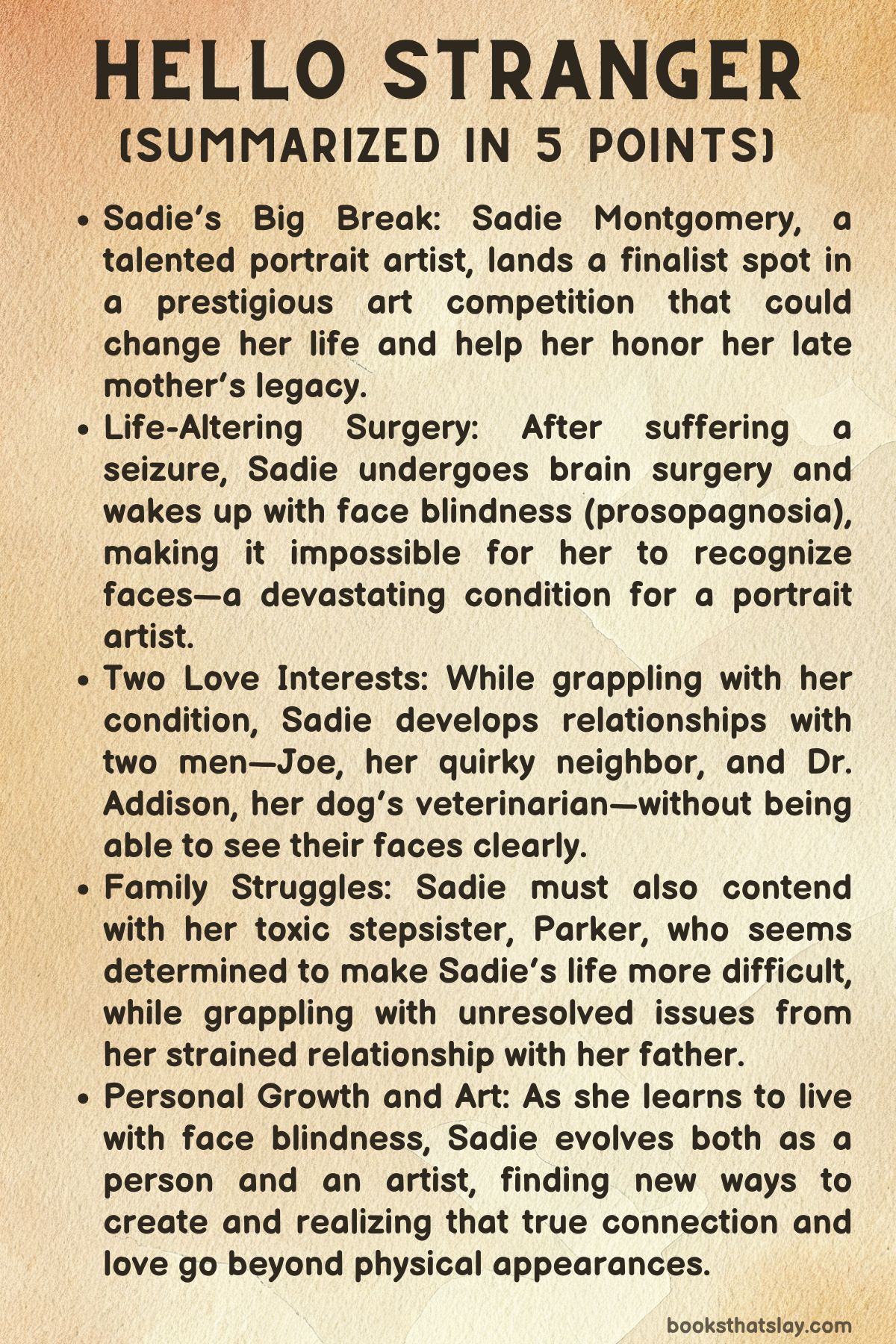
Hello Stranger by Katherine Center is a contemporary romance and women’s fiction novel that blends art, medical challenges, and second chances. It follows Sadie Montgomery, a struggling portrait artist who finally gains recognition by becoming a finalist in a prestigious art competition.
Just as her career begins to look promising, a sudden medical crisis leaves her with face blindness after brain surgery—an unimaginable challenge for someone whose entire life depends on painting faces. With her dog Peanut, complicated family relationships, and unexpected love interests shaping her journey, Sadie must redefine her art, her relationships, and her sense of self while discovering resilience, forgiveness, and the unexpected ways love can appear.
Summary
Sadie Montgomery, a portrait artist with financial struggles, feels a surge of hope when she becomes a finalist in the North American Portrait Society competition. She shares the news with her best friend Sue but receives only a dismissive response from her estranged father, a prominent doctor who disapproves of her career choice.
While buying supplies for a small celebration, she encounters a charming stranger who pays for her forgotten groceries. Moments later, she collapses from a seizure and narrowly avoids being hit by a car thanks to an anonymous rescuer.
At the hospital, doctors discover that Sadie has a cavernoma, a malformed blood vessel in her brain, which caused the seizure. Surgery is recommended.
Though initially reluctant, she learns her mother died of the same condition and reluctantly agrees to the operation. The surgery is successful, but Sadie wakes to find she can no longer recognize faces, including her own reflection.
This condition, prosopagnosia or face blindness, devastates her, since her identity and career as an artist rely on her ability to capture faces.
Returning home, Sadie attempts to navigate life with her condition while also dealing with her domineering stepmother Lucinda and manipulative stepsister Parker. Though frightened, she finds comfort in reuniting with her beloved dog, Peanut, whom she can still recognize.
During a visit to the vet, she meets Dr. Oliver Addison, whose quiet confidence attracts her immediately. Despite her condition, she begins to imagine a future with him.
However, Parker’s reappearance in her life threatens her fragile progress, as Parker constantly belittles her and resurrects old wounds from their shared past.
Sadie’s struggles intensify when she learns she must complete a live portrait for the competition within three weeks. Unable to perceive faces accurately, her early attempts are disastrous.
Desperate, she obsesses over painting exercises, but nothing works. Meanwhile, Peanut becomes gravely ill, requiring Dr. Addison’s constant medical care.
Amid these visits, Sadie and the vet grow closer, and he eventually asks her on a date. Torn between her artistic crisis and personal turmoil, she agrees, leaving the timing flexible.
As if the pressure weren’t enough, Sue announces she is eloping and cannot model for the competition as planned. Distraught, Sadie reluctantly accepts when Joe, a neighbor she once dismissed as unpleasant, offers to sit for her portrait.
Despite initial misgivings, they begin spending time together. Through trial and error, Sadie develops unconventional methods—grids, descriptions, and even tactile exploration—to attempt capturing Joe’s likeness.
Their connection deepens, culminating in unexpected intimacy. Sadie begins to see Joe not as an annoyance but as someone who understands her vulnerabilities.
However, misunderstandings and sabotage by Parker fuel conflict. Sadie mistakenly believes Joe is involved with Parker and spirals into despair.
Her art seems doomed, her relationship prospects muddled, and her health uncertain. Yet inspiration strikes when Sue sends her an article about an artist with face blindness who uses touch to create portraits.
Sadie experiments with this method, finding new meaning and direction in her work. Through this, her bond with Joe strengthens as he becomes her supporter and muse, and she learns he is not the shallow neighbor she once assumed.
At the portrait show, Sadie’s work does not win, but the experience brings clarity. Her father finally apologizes for blaming her after her mother’s death, admitting his grief had clouded his judgment.
Though it cannot undo the past, it allows for healing between them. She also confronts Parker, offering her a chance to change despite Parker’s refusal to accept responsibility.
The reconciliation with her father and the support of her building managers, the Kims, help her regain confidence.
Sadie leaves a heartfelt voicemail for Joe, confessing her condition and her feelings for him, though she believes he won’t hear it. To her surprise, at Sue’s elopement celebration, Joe appears, and she finally recognizes his face clearly.
In a startling revelation, Joe is also Dr. Oliver Addison, the veterinarian she admired, his dual identity hidden from her by her face blindness. The confusion that had plagued their relationship is lifted, and they reconcile with newfound honesty and understanding.
Joe reveals he was also the mysterious rescuer who saved her earlier, making his presence in her life even more significant.
One year later, Sadie and Joe are engaged. She has grown closer to her father, continued painting with recognition from a gallery, and built a more secure, love-filled life.
Peanut remains by her side, and even Parker, now abroad, lingers in her thoughts as someone who might one day change. Sadie has learned to accept imperfection, seek support, and see the world differently—not just with her eyes but with her heart.
The challenges that once threatened to end her career and happiness ultimately lead her to deeper love, forgiveness, and a new way of living fully.
Characters
Sadie Montgomery
Sadie Montgomery, the protagonist of Hello Stranger, is a young portrait artist whose life spirals from long-awaited triumph into sudden crisis. Ambitious yet insecure, Sadie is fueled by her passion for art, clinging to it as a lifeline in the wake of her mother’s death and her father’s disapproval.
Her narrative is marked by resilience, vulnerability, and the constant tension between her need for independence and her yearning for acceptance. When a cavernoma and subsequent surgery leave her with face blindness, her identity as an artist and her ability to connect with others are profoundly threatened.
Sadie’s struggle becomes both literal and symbolic: she must learn to “see” in new ways—through touch, trust, and empathy. Despite her setbacks, she grows from a defensive, isolated woman into someone who can forgive, reconcile with her past, and embrace love.
Joe (Dr. Oliver Addison)
Joe, initially introduced under different guises—as the mysterious “Grocery Store Guy,” the “Weasel” from a past one-night stand, a neighbor, and finally as Dr. Oliver Addison—embodies the novel’s theme of misperception. To Sadie, who suffers from prosopagnosia, he is both stranger and savior, a man she alternately distrusts and desires.
Joe is compassionate, steady, and quietly devoted, always appearing at her lowest points with support and kindness. His hidden identity as both her veterinarian and her Good Samaritan highlights how Sadie’s literal blindness parallels her emotional blindness to love and trust.
Beneath his calm demeanor lies pain from betrayal and loss, which makes him cautious yet deeply empathetic toward Sadie’s struggles. Their love story is as much about unveiling truth as it is about building trust.
Sue
Sue, Sadie’s extroverted best friend, is her emotional anchor and greatest cheerleader. She provides the unwavering support that Sadie’s family fails to give, insisting on celebrating her victories and urging her forward through setbacks.
Sue represents joy, spontaneity, and the kind of unconditional love that allows Sadie to feel seen even when she cannot see others. Her elopement disrupts Sadie’s plans for the art competition, but her absence becomes an inadvertent gift, pushing Sadie toward self-reliance and creative reinvention.
Sue’s friendship demonstrates the novel’s theme that chosen family can often provide the truest sense of belonging.
Peanut
Peanut, Sadie’s beloved dog, is more than a pet—he symbolizes constancy, comfort, and recognition in a world suddenly stripped of faces. His illness introduces another layer of emotional crisis, but also becomes the channel through which Sadie bonds with Joe, deepening their relationship.
Peanut’s presence grounds Sadie, reminding her of unconditional love and the simplicity of connection that transcends appearance. In many ways, Peanut anchors Sadie’s resilience, reinforcing the idea that love and recognition come in forms beyond the visual.
Lucinda
Lucinda, Sadie’s stepmother, initially appears overbearing and intrusive, inserting herself into Sadie’s life at the hospital and beyond. She represents the tension between unwanted control and genuine, if clumsy, concern.
While her attempts at “helping” often undermine Sadie’s independence, her actions reveal a complicated mix of guilt, obligation, and a desire to belong within the fractured family. Lucinda’s dynamic with Sadie underscores the book’s exploration of boundaries, forgiveness, and the difficulty of reconciling strained relationships.
Parker
Parker, Sadie’s stepsister, is a manipulative and antagonistic force who thrives on Sadie’s vulnerability. From framing her in high school to undermining her as an adult, Parker embodies cruelty born from insecurity.
Yet, by the novel’s end, she is portrayed with nuance—a figure whose malice is revealed as a shield for her own pain. While Parker never fully redeems herself, her lurking presence serves as both a challenge and a catalyst for Sadie to reclaim her agency.
The possibility of change that Sadie extends to her reflects the novel’s broader theme of forgiveness and compassion.
Sadie’s Father
Sadie’s father is a figure of authority, grief, and regret. A successful doctor, he disapproves of Sadie’s artistic path and fails her emotionally after her mother’s death, even marrying Lucinda quickly as a way to cope.
His estrangement from Sadie stems from misplaced blame and an inability to confront his grief. However, his eventual apology and confession of past failings create one of the book’s most poignant moments of reconciliation.
His gesture of leaving marigolds, her mother’s favorite flower, symbolizes his rediscovered love and his attempt to bridge years of distance.
Dr. Nicole
Dr. Nicole, the Trinidadian neuropsychologist, is a steadying presence during Sadie’s most frightening ordeal. She balances medical professionalism with empathy, guiding Sadie not only through the realities of face blindness but also through the emotional labyrinth of loss and identity.
By encouraging Sadie to embrace vulnerability and honesty, Dr. Nicole acts as both healer and mentor. Her presence underscores the importance of compassion in medicine and highlights the book’s emphasis on emotional resilience.
Mr. and Mrs. Kim
The Kims, Sadie’s building managers, represent quiet, steadfast community support. Though not family by blood, they act as parental figures, providing comfort, practical help, and even validation of her art by purchasing and proudly displaying her portrait.
Their role reinforces the idea that love and family can be found in unexpected places, and their kindness provides a stark contrast to the neglect and manipulation Sadie endures from her own relatives.
Themes
Identity and Self-Perception
In Hello Stranger, the question of identity is constantly challenged, reshaped, and tested through Sadie’s journey. Her sense of self is deeply tied to her role as an artist, specifically one who paints portraits, where the recognition and reproduction of faces is central.
When she develops prosopagnosia, her very foundation as both an artist and individual is destabilized. She is forced to confront a reality where the thing she values most—her ability to capture human likeness—is suddenly stripped away.
This loss pushes her to reimagine her definition of self beyond technical skill, eventually leading her to develop new artistic methods that rely less on visual memory and more on emotional truth and tactile exploration. Beyond her art, Sadie’s relationships with family, particularly her father and stepmother, influence how she sees herself.
Years of estrangement and disapproval cause her to internalize rejection, questioning her worth. Yet, her eventual reconciliation with her father, who acknowledges his own failings, allows her to reclaim a fuller, more compassionate understanding of who she is.
Identity in the novel thus becomes less about external validation and more about resilience, adaptation, and authenticity. Sadie learns that her worth as an artist and individual is not contingent on perfection or recognition but on her ability to remain honest to her experiences, no matter how flawed or unconventional they may be.
Family, Estrangement, and Forgiveness
Family conflict is a central thread in Hello Stranger, marked by Sadie’s strained relationships with her father, stepmother, and stepsister. Her father’s rejection of her artistic aspirations and his misplaced blame after her mother’s death shape much of Sadie’s pain and sense of inadequacy.
Lucinda and Parker add layers of hostility and manipulation, representing the antagonistic forces within her domestic sphere. However, Katherine Center does not leave family as a mere source of cruelty; instead, the narrative demonstrates how reconciliation, however imperfect, can become a form of healing.
The moment Sadie’s father admits his grief-driven failings is a turning point, granting her validation she had been denied for years. It underscores the way unresolved pain can distort family bonds but also how vulnerability can restore them.
Even with Parker, Sadie’s refusal to mirror cruelty back at her and her offer of forgiveness highlight the power of choosing compassion in the face of bitterness. Forgiveness does not erase betrayal or undo years of hurt, but it provides a release that allows Sadie to step forward with less burden.
Through these relationships, the book suggests that family, despite its fractures, remains a complicated but potentially restorative part of human identity.
Illness, Vulnerability, and Resilience
The theme of illness is not only physical but psychological, shaping how Sadie views her future and her capacity to endure. Her cavernoma and subsequent brain surgery introduce a terrifying uncertainty, threatening her career and independence.
Face blindness becomes a metaphor for the limitations we encounter in life that cannot be controlled or reasoned away. Instead of succumbing to despair, Sadie gradually learns to confront her condition by embracing new ways of working and relating to others.
Her friendship with Dr. Nicole emphasizes the importance of acknowledging vulnerability instead of masking it, and through this, Sadie begins to accept that resilience is not about invincibility but adaptation. Even Peanut’s illness mirrors her own fragility, deepening the novel’s exploration of the shared struggles between human and animal, and the ways love anchors resilience in moments of despair.
Illness, therefore, is portrayed not only as a challenge but also as a catalyst for growth, compelling Sadie to find strength in unexpected places, whether in her art, her relationships, or her willingness to accept imperfection.
Love, Misunderstanding, and Connection
Romantic love in Hello Stranger is fraught with miscommunication, uncertainty, and the profound limitations of Sadie’s face blindness. The relationship between Sadie and Joe/Dr. Addison underscores how appearances can obscure deeper truths, as Sadie literally cannot recognize the man she loves because of her neurological condition.
The dramatic reveal that Joe and Dr. Addison are the same person highlights how love is not merely about surface recognition but about emotional resonance, patience, and trust. Misunderstandings drive much of their tension, reflecting the fragility of human connection when assumptions replace communication.
Yet, their eventual reconciliation emphasizes the triumph of genuine connection over superficial confusion. Beyond romance, Sadie’s relationships with Sue and the Kims illustrate love in its many forms: friendship, mentorship, and chosen family.
These bonds reveal that connection sustains people through hardship, and that even in isolation, finding others who see us clearly can restore hope. Love in the novel is portrayed not as perfect or seamless but as enduring, forgiving, and rooted in the willingness to truly see one another beyond mistakes.
Art, Creativity, and Transformation
Art is not merely Sadie’s profession in Hello Stranger but the lens through which she understands herself and the world. The book explores how creativity is often born out of constraint, and how artistic expression can flourish even under the weight of disability and doubt.
Sadie’s face blindness, while devastating at first, forces her to innovate, breaking away from traditional representation toward a more expressive and personal style. This shift demonstrates how creativity thrives when artists are willing to embrace imperfection and confront vulnerability.
The failure to win the competition becomes less important than the discovery of a new, authentic artistic voice. Moreover, art serves as a bridge between generations—Sadie’s late mother’s unfinished portrait becomes a symbol of continuity, resilience, and love, reinforcing the idea that creativity carries memory and emotion across time.
Art here is not about external accolades but about transformation, healing, and the courage to translate lived experiences into form, however unconventional.