Hopeless by Elsie Silver Summary, Characters and Themes
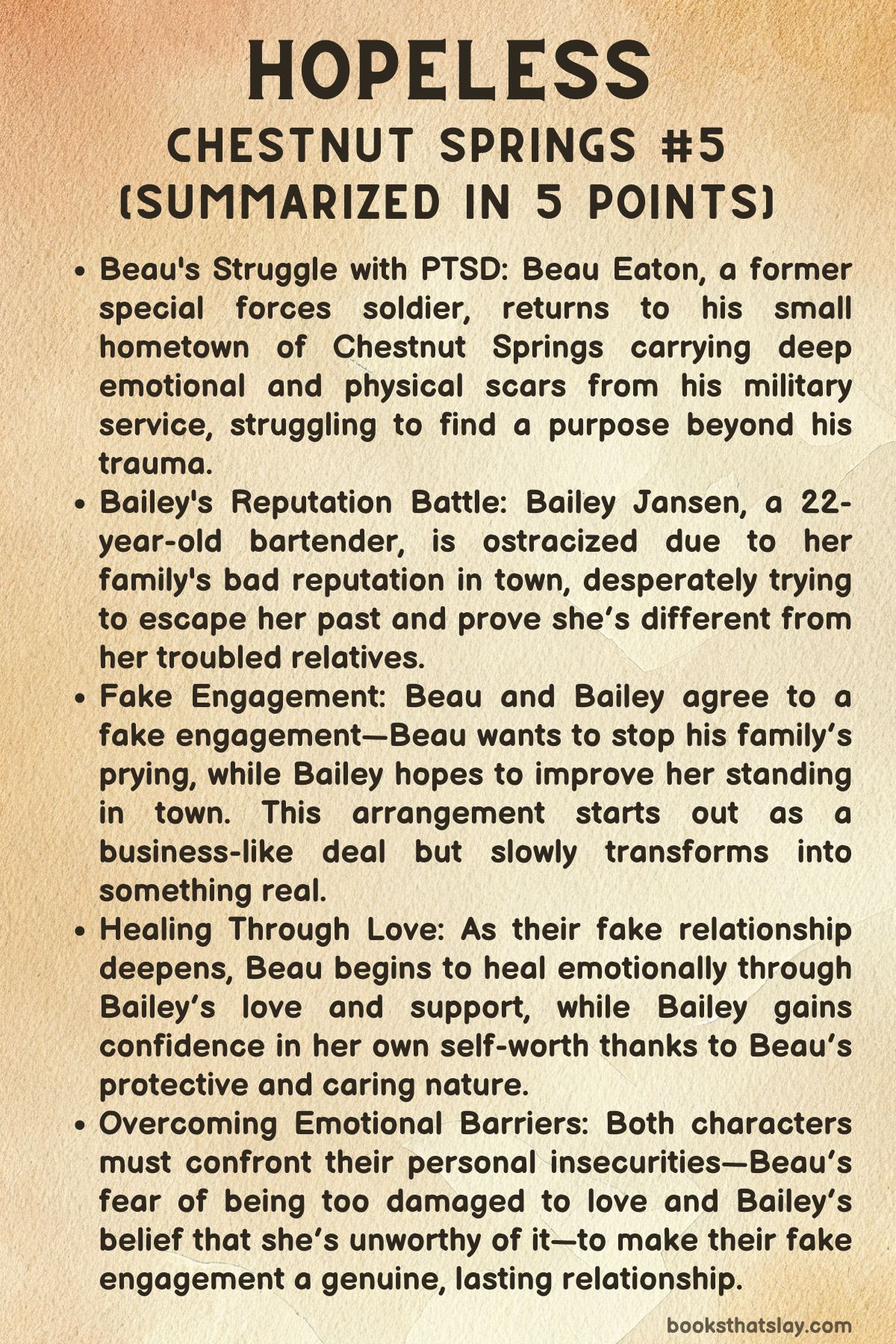
Hopeless by Elsie Silver continues her beloved Chestnut Springs series, blending romance, small-town drama, and emotional healing. This installment follows Beau Eaton, a decorated but broken Canadian special forces veteran, and Bailey Jansen, a resilient young woman burdened by her family’s tarnished reputation.
Both characters are outsiders in their own ways—Beau haunted by trauma and struggling to reclaim a sense of purpose, Bailey fighting for respect and independence in a town that refuses to see her apart from her surname. Their story unfolds through an unexpected bond that transforms into a relationship where love, trust, and belonging offer redemption for them both. It is the fifth and final book in Elsie Silver’s popular Chestnut Springs series, wrapping up the saga with a heartwarming yet intense story.
Summary
Beau Eaton returns to his hometown of Chestnut Springs after a harrowing mission abroad leaves him scarred inside and out. Though his family welcomes him, he feels disconnected from both the ranch and his own life.
His restless search for distraction takes him to The Railspur, a bar run by Bailey Jansen. Bailey, unlike most in town, refuses to treat Beau as either a fallen hero or a broken man.
She demands respect in her space and confronts him when his anger or drinking threatens it. Their exchanges are blunt and sometimes volatile, but Beau finds himself drawn to her straightforwardness and unshaken presence.
Their bond begins quietly, with late nights at the bar turning into a routine. Bailey offers Beau chamomile tea instead of alcohol and allows him to sit in silence while she closes up.
He, in turn, makes a habit of walking her to her car. This small companionship grows into something deeper.
When Beau lashes out violently one night at a customer who taunts him about his military past, Bailey sets boundaries. She reminds him that her bar is the only place where she feels safe in town and demands he not ruin it.
He admits he drinks to fight insomnia, revealing just how much his trauma still dominates his life. From then on, he channels his restlessness into showing up for Bailey, quietly guarding her when she works alone.
Beau’s protective instincts intensify after an incident with Bailey’s brothers and their friend, Seth, who assaults her in the bar. Beau throws them out with brutal force, making it clear he will not tolerate anyone hurting her.
Later, when Bailey sneaks onto Eaton land to swim in the river, Beau finds her and they share a tense yet intimate conversation. She confides her dream of leaving town and escaping the Jansen legacy.
Beau challenges her, believing she shouldn’t have to run. Their conversation drifts into flirtation, culminating in his surprising proposal: a fake engagement.
In his mind, it offers her the Eaton name and a measure of respect, while shielding him from his family’s concern. Bailey is skeptical, but she doesn’t dismiss the idea.
After a night of internal debate, Bailey agrees to Beau’s plan. They set rules: no sex, limited affection in public, and an eventual breakup that leaves her reputation intact.
But rules quickly blur. Their staged engagement, announced with a bold display at the bar, includes Beau presenting Bailey with an extravagant ring.
The town is skeptical, but he revels in claiming her publicly. When Bailey’s brothers threaten her, Beau moves her trailer onto his land, insisting it’s safer and logical for an engaged couple.
Though resistant, she stays, and the intimacy of living so close shifts their connection further.
Introducing Bailey to the Eaton family is nerve-wracking for her, but they accept her warmly despite her worries. This newfound sense of belonging softens Bailey’s defenses, while Beau’s steady reassurance steadies her.
Their private moments grow increasingly personal. She is unashamedly curious and direct about intimacy, while he battles guilt over crossing boundaries in their “fake” arrangement.
Their relationship deepens in layers—humor, tenderness, protectiveness, and physical closeness—until the line between pretense and reality all but vanishes.
As their bond grows, Beau defends Bailey fiercely against the town’s gossip, most notably at the fair when whispers about her family erupt. His public protectiveness embarrasses Bailey but also shows her a kind of unwavering loyalty she has never known.
Their connection becomes physical, culminating in deeply intimate encounters where Beau insists she deserves respect and care. For Bailey, who has always been dismissed or judged, his reverence is transformative.
For Beau, who has long felt numb, she awakens desire, laughter, and hope.
Conflict arises when Bailey discovers Beau secretly owns The Railspur, the bar she believed she had built independently. He reveals he purchased it years earlier to protect her from being fired, but Bailey feels betrayed, interpreting it as control rather than love.
Hurt and furious, she leaves him, declaring that his actions made her feel like a project instead of a partner. Beau refuses to give up, bringing her breakfast, returning her tips, and standing by her even when she demands space.
Bailey, meanwhile, begins to glimpse a future for herself beyond Chestnut Springs. After a painful rejection from a salon job, she finds support from Summer Eaton, who offers her a position at her gym.
Bailey confides her dream of studying kinesiology and chiropractic care. Slowly, she allows herself to imagine leaving town, though it clashes with Beau’s rootedness.
Their turning point comes when they travel to the city together. Bailey explores campuses and apartments, envisioning a future where she might finally belong.
Beau secretly interviews for the fire department, determined to shape his life around hers. When he reveals he got the job, Bailey sees his willingness to change for her.
She breaks down, realizing how deeply their lives have entwined. They reconcile with honesty, promising not to keep secrets from each other again.
The story concludes with Beau and Bailey building a life together in the city. They move into a vintage home, host family dinners, and embrace their future as a couple.
For Bailey, it’s the first time she feels truly included and loved without conditions. For Beau, it’s the first time since his trauma that he feels alive, with purpose and joy.
In the epilogue, at Cade and Willa’s wedding, Bailey reflects on how far they’ve come. No longer an outsider, she stands proudly at Beau’s side, ready for their own vows by the river where their love first began.
Characters
Beau Eaton
Beau Eaton is portrayed as a deeply complex man, haunted by his past as a Canadian special forces soldier. His return to Chestnut Springs marks not only a physical homecoming but also an internal struggle with trauma, scars, and an overwhelming sense of displacement.
Beneath his stoic exterior lies a man grappling with sleepless nights, simmering anger, and a hollowed-out sense of purpose. Yet, Beau is not merely defined by his pain—his protectiveness and loyalty stand out just as strongly.
From taking Bailey’s keys to prevent her from driving drunk, to defending her against her predatory brothers and the cruel whispers of townsfolk, Beau reveals a steady moral compass rooted in care and protection. His relationship with Bailey awakens parts of himself he thought were gone—tenderness, humor, and even vulnerability.
In moments where she tends to his scars without judgment, Beau sheds layers of shame and begins to rebuild himself not as a broken soldier, but as a man learning how to love again. His journey throughout Hopeless is one of reclaiming agency, rediscovering purpose, and ultimately finding solace in intimacy and belonging.
Bailey Jansen
Bailey Jansen emerges as one of the most resilient and striking characters in the novel. As the youngest member of the Jansen family, whose reputation is marred by crime and violence, she shoulders the weight of prejudice and exclusion.
Unlike her brothers, she has fought to carve out an independent life, anchoring herself in The Railspur, where she not only earns a living but also finds a sliver of respect from those willing to see her beyond her last name. Bailey is courageous and unflinching—she does not cower before Beau’s rage, nor does she shrink from the town’s cruelty.
Instead, she meets every challenge with grit and wit, even wielding humor as both armor and defiance. Despite her toughness, Bailey carries a deep yearning: to escape her family’s shadow, to pursue education, and to live free from the constant shame of her surname.
Her relationship with Beau becomes transformative, not because she depends on him for strength, but because he sees her in her entirety—her vulnerabilities, her dreams, and her fire. With him, she begins to allow herself moments of tenderness, intimacy, and trust.
Bailey’s evolution is a testament to her determination to build a life defined by her own choices, rather than the sins of her family.
The Eaton Family
The Eaton family functions as a crucial backdrop to Beau’s story, embodying warmth, chaos, and resilience. While Beau often feels like the outsider in their lively dynamic, their acceptance of Bailey shows their ability to expand love and loyalty beyond bloodlines.
Harvey Eaton, with his humor and grounded presence, anchors the family’s acceptance of unconventional choices. Rhett, Cade, Summer, and the others each contribute to the chaotic, teasing energy that contrasts sharply with Beau’s solemnity, and this energy gradually draws him out of his shell.
For Bailey, the Eatons represent what she has long been denied—a family who embraces flaws with laughter and love rather than using them as weapons. Their presence not only softens Beau but also integrates Bailey into a larger narrative of belonging, giving her a space to heal from her family’s neglect.
The Jansen Family
The Jansen family, in stark contrast to the Eatons, represents everything Bailey seeks to escape. Her brothers embody the violence, intimidation, and corruption that define their name in Chestnut Springs.
Their constant interference—whether through groping friends, vandalizing her property, or attempting to intimidate her—symbolizes the oppressive hold of a toxic family legacy. They function less as individual characters and more as a collective force of antagonism, embodying the prejudice Bailey must endure and resist.
Bailey’s father, though less directly portrayed, adds to the generational cycle of dysfunction. Against their menace, Bailey’s determination to define herself is even more powerful, highlighting her strength and courage in carving out a different path.
Gary
Though a secondary character, Gary plays an important role in Bailey’s world. As an older drunk who often inhabits The Railspur, his character oscillates between comic relief and provocation.
His insensitive questions about Beau’s captivity spark one of Beau’s public breakdowns, but beyond his flaws, Gary symbolizes the bar’s dual nature—as both a haven and a place of constant tension. His skepticism of Beau and Bailey’s engagement underscores his protective stance toward Bailey, revealing that he, in his own rough-edged way, has looked out for her.
He stands as a reminder of the fragile respect Bailey has managed to build in town.
Willa, Summer, and Sloane
Willa, Summer, and Sloane act as pivotal supporting figures for Bailey, offering her the female camaraderie she has long lacked. Willa, with her boldness, publicly defends Bailey against humiliation in the café, providing her with a rare and empowering moment of solidarity.
Summer extends a genuine job opportunity at her gym, countering Bailey’s fear of pity with sincere belief in her capabilities. Sloane adds to the sense of inclusion, inviting Bailey into the fold of women who see her worth beyond her family name.
Collectively, these women provide Bailey with friendship, encouragement, and acceptance, helping her dismantle the isolation that has shaped much of her life.
Themes
Trauma and Healing
In Hopeless, the lingering effects of trauma dominate Beau Eaton’s life, shaping his actions, choices, and relationships. His return to Chestnut Springs after military service is shadowed by both physical scars and an invisible weight of emotional pain.
The sleepless nights, sudden bursts of anger, and dependence on alcohol illustrate how trauma becomes cyclical, reinforcing feelings of alienation. Yet, what stands out in Beau’s arc is the depiction of healing as nonlinear—progress comes not from sudden breakthroughs but through small acts of connection and trust.
Bailey’s unflinching honesty offers Beau an anchor, not by erasing his pain, but by showing him that he is more than his scars. Their companionship gradually disrupts his destructive patterns, substituting alcohol with tea, violence with conversation, and isolation with intimacy.
Healing is shown as a shared process; while Beau struggles with his past, Bailey faces her own kind of trauma through constant rejection and prejudice in town. Their journeys parallel each other, demonstrating that healing often requires both self-acceptance and the willingness to let someone else in.
Trauma here is not romanticized—it is messy, frightening, and at times explosive—but the narrative insists that even the deepest wounds can be soothed when met with patience, respect, and genuine care.
Identity and Reputation
The novel carefully explores how identity is often dictated by external labels, and how reputation can cage individuals into roles they never chose. Bailey, born into the notorious Jansen family, lives under the shadow of her last name, which dictates how the community perceives her regardless of her actions.
She works tirelessly at The Railspur to build independence, but her efforts are constantly undermined by assumptions tied to her bloodline. Beau, though carrying the respected Eaton name, faces a similar yet inverted struggle—his reputation as a war hero masks his brokenness, leaving him suffocated by admiration he cannot live up to.
The fake engagement they construct becomes more than a shield; it is a commentary on how names can either elevate or condemn someone in small-town hierarchies. By pretending to unite their surnames, they challenge those rigid boundaries and test whether reputation truly defines worth.
Ultimately, the story suggests that identity is fluid, shaped less by the expectations of others and more by the choices an individual makes to claim their own future. For both Beau and Bailey, defying the weight of imposed identities becomes a radical act of self-liberation.
Love as Redemption
At the core of Hopeless lies a portrayal of love not as a sudden, sweeping force, but as a slow and redemptive process. Beau’s initial numbness and Bailey’s hardened independence seem incompatible with intimacy, yet their relationship unfolds through moments of tenderness that redefine both of them.
Love in this story does not erase flaws; instead, it acknowledges them and creates a space where vulnerability feels safe. Beau’s protective instincts, while sometimes overbearing, evolve into acts of deep care, such as defending Bailey against her brothers or mending her childhood toy.
Bailey, in turn, accepts his scars without judgment, offering reassurance in ways that cut through his shame. Their intimacy—physical and emotional—is depicted as healing rather than performative, with acts of closeness reinforcing trust more than passion alone.
Redemption emerges through this connection, not in the sense of saving each other but in proving that love can restore faith in oneself. Through Bailey, Beau begins to see a future beyond his trauma, while Bailey learns that she is worthy of devotion despite her family’s reputation.
Together, they transform love into a force of resilience and hope.
Power, Control, and Autonomy
The novel repeatedly raises questions about control—over one’s body, choices, and destiny. Beau’s instinct to protect Bailey borders on dominance, especially when he moves her trailer without asking or hides his ownership of the bar.
These actions, though rooted in love, reveal his struggle to balance protection with respect for autonomy. Bailey’s furious reaction underscores how much her independence matters, particularly because she has lived most of her life under the control of her family’s reputation and the town’s judgment.
Her insistence on standing on her own, even in the face of Beau’s devotion, highlights the tension between safety and freedom. Similarly, Beau’s battle with his own body—his scars, phantom pains, and insomnia—demonstrates how loss of control can erode identity.
Yet, through their evolving relationship, both characters learn that real intimacy requires surrendering control without erasing autonomy. Beau ultimately respects Bailey’s dreams of education and relocation, even at the cost of his comfort, while Bailey learns to accept help without seeing it as weakness.
The theme suggests that love thrives not in possession, but in balance—when individuals feel safe enough to trust, but free enough to choose.
Belonging and Community
The small-town setting of Hopeless magnifies the tension between exclusion and acceptance. Bailey’s life has been one of constant rejection, where her last name defines her before she has a chance to prove herself.
Her loneliness is palpable, and The Railspur becomes more than a bar—it is her sanctuary, the one place where she feels some measure of control. Beau’s re-entry into the community is similarly fraught, as the town sees him as a symbol rather than a man.
Their partnership challenges the town’s prejudices, gradually shifting how others perceive Bailey and how Beau reconnects with his roots. The warmth of the Eaton family stands in sharp contrast to Bailey’s cold home life, offering her a glimpse of the belonging she has always craved.
Community here is not static; it can wound as easily as it can heal, depending on whose voices are amplified. By the end, Bailey not only gains Beau’s love but also finds a place within his family and, slowly, the broader town.
The novel underscores that true belonging is not given by reputation but earned through trust, loyalty, and chosen family.