A Neighbour’s Guide to Murder Summary, Characters and Themes
A Neighbour’s Guide to Murder by Louise Candlish is a psychological crime novel about housing insecurity, sexual exploitation, moral certainty, public accusation, and the dangerous consequences of believing that good intentions justify every action.
At its center is Gwen Healy, an older London resident who becomes fiercely protective of Pixie Gray, a young woman living with their neighbour Alec Pedley under disturbing circumstances. What begins as concern for a vulnerable tenant gradually expands into police involvement, media exposure, legal threats, family conflict, and an increasingly personal battle between Gwen and Alec. The novel continually challenges the reader to reconsider who is victim, protector, manipulator, and offender.
Summary
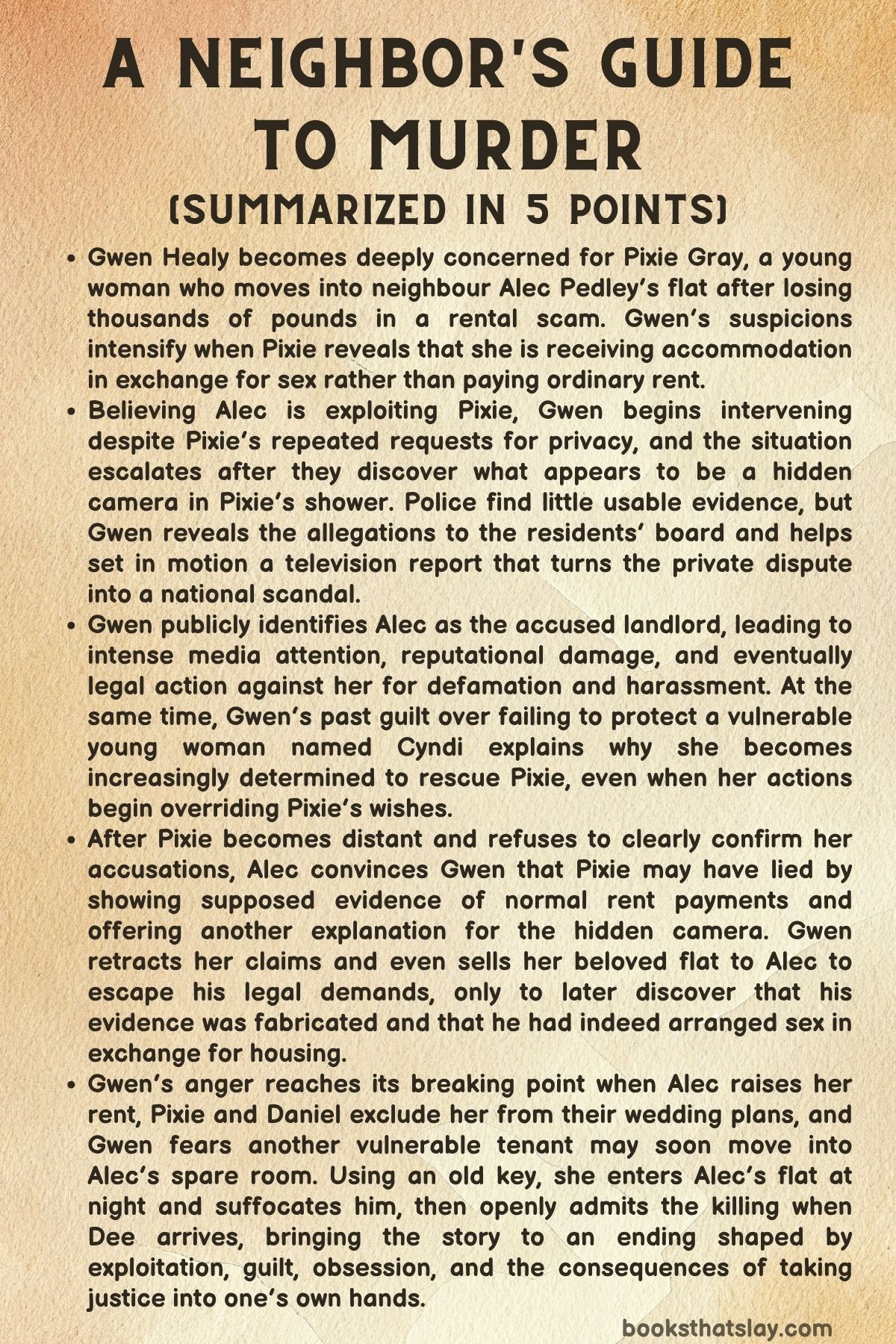
Gwen Healy lives in Columbia Mansions, an old and prestigious London apartment building that has become the most important symbol of independence in her life. After the collapse of her marriage and the financial scandal caused by her ex-husband Brian, owning her flat gave Gwen a sense of stability that she had fought hard to recover.
Her attention is soon captured by Pixie Gray, a young woman who had originally viewed a room being rented by Gwen’s neighbour Alec Pedley. Pixie had already secured another property, but the supposed landlord turned out to be a fraudster who disappeared with almost £7,000 supplied largely by her father.
Suddenly homeless and financially desperate, Pixie accepts an unexpected offer from Alec and moves into his spare room. Gwen is immediately puzzled because Alec charges £1,500 a month, an amount Pixie had previously said she could not afford, yet she appears to have found some unexplained way of living there.
Alec is a former musician who once enjoyed brief fame as a member of the band Empty Cloud. To most residents he is amusing, sociable, occasionally crude, and somewhat irritable, but not obviously threatening; Gwen nevertheless becomes increasingly suspicious of him after hearing arguments through the wall and learning that he imposes restrictions on Pixie that he did not impose on an earlier tenant.
Gwen quickly forms a close attachment to Pixie. She helps her find work at a local café, invites her into her social circle, worries about her finances, and begins treating her welfare as a personal responsibility.
Her concern intensifies when she realizes that Pixie and Alec are having sex. Initially, Gwen considers the possibility that their relationship is consensual, although the age difference and Alec’s position as landlord make her uneasy.
The truth proves more disturbing. Pixie eventually explains that she is not paying Alec normal rent at all: after losing her money in the rental scam, she accepted his proposal to provide accommodation in exchange for sexual access. She technically believes she can refuse him, but refusing could endanger the arrangement that keeps her housed, making any claim of genuine freedom difficult to sustain.
Gwen regards the arrangement as exploitation and breaks Pixie’s confidence by confronting Alec. He denies being abusive, argues that Pixie has misrepresented a consensual situation, and suggests that Gwen is allowing her own history to influence her judgment.
That history becomes increasingly important. Years earlier, Gwen and Brian ran a charity together until Brian was exposed for financial misconduct, ruining both the organization and their family finances. During the investigation, a vulnerable young employee named Cyndi told Gwen that Brian had coerced her sexually, but Brian threatened to implicate Gwen in his financial crimes if she supported Cyndi’s complaint.
Gwen chose self-protection. Although she told Cyndi that she believed her, she discouraged her from going to the police, and Cyndi subsequently lost her job, her accommodation, and much of the support she desperately needed.
Years later Gwen learned that Cyndi had died young after a difficult period of instability and illness. Her guilt never disappeared, and protecting Pixie becomes a way of trying to make a different moral choice when another vulnerable young woman asks for her trust.
Gwen’s anxiety about Alec becomes more extreme after she reads about landlords secretly recording tenants. She convinces Pixie to search Alec’s flat while he is away, and they discover what appears to be a tiny concealed camera positioned in Pixie’s shower.
Alec unexpectedly returns during the search. Pixie immediately leaves his flat and moves temporarily into Gwen’s home, while Gwen reports the camera to the police.
The police investigation produces little. Alec has removed the suspected device, Gwen’s photograph of it is blurred, and there is insufficient evidence to seize his computers or telephone.
Unable to accept the lack of official action, Gwen raises the allegation before Columbia Mansions’ management board. When the camera evidence fails to convince everyone, she reveals Pixie’s sex-for-rent arrangement despite having promised to keep it confidential.
Dee, the socially powerful chair of the residents’ board, believes Pixie and suggests involving her daughter Stella, a successful journalist. Stella sees the story as an important example of housing exploitation and arranges for Pixie to give an anonymous interview on a television current-affairs programme.
Although Pixie’s face and voice are concealed, the programme shows Columbia Mansions clearly enough for viewers to identify the building. Residents, journalists, online commentators, and amateur investigators rapidly connect the allegations to Alec.
During the growing media frenzy, Gwen makes the situation far worse by publicly naming Alec as the accused man and calling him a sex offender. The accusation spreads immediately, destroying the anonymity that had previously protected both parties from direct identification.
Alec leaves London temporarily as reporters pursue him. The residents largely assume his guilt, graffiti appears near the building, and Stella’s professional profile rises through her coverage of the scandal.
Pixie meanwhile grows closer to Gwen’s son Daniel, who has been living with Gwen after the collapse of his marriage. Daniel finds work at Pixie’s café, becomes more energetic around her, and eventually begins a relationship with her.
Gwen helps Pixie leave the situation permanently by lending her £5,000 toward another rental. Pixie departs, but Alec soon retaliates against Gwen through legal channels.
His solicitors accuse her of defamation for publicly identifying him and describing him as a sexual offender without having evidence strong enough to prove the allegation. He also reports her for harassment, using her confrontations, pursuit of him through the neighbourhood, entry into his flat, hostile messages, and aggressive behaviour outside his door to construct a very different account of events.
Gwen’s solicitor, Frances Voss, explains that moral conviction is not the same as legal proof. Pixie has never made a formal complaint alleging sexual coercion, the camera was never recovered, and Gwen’s own conduct can easily be presented as obsessive harassment.
Her position deteriorates further when Pixie begins avoiding her. After Pixie secretly travels to New Zealand with Daniel and Gwen’s family, Gwen becomes resentful and feels betrayed by the young woman she had sacrificed so much to protect.
When Gwen finally meets Pixie again, she directly asks whether the allegation against Alec was true. Pixie refuses to give her the clear reassurance she expects and instead suggests that Gwen has become obsessed with deciding what everyone else’s experiences mean.
The uncertainty devastates Gwen. She begins considering whether Alec may have been falsely accused and whether her desire to rescue Pixie caused her to interpret an uncomfortable consensual relationship as abuse.
Alec encourages those doubts when he shows Gwen apparent evidence that Pixie’s father paid ordinary rent. He also claims that the shower camera belonged to former tenant Yasmin, who supposedly used it while producing adult material, and insists that Pixie consensually slept with him before reinventing herself as a victim.
His explanation seems coherent enough that Gwen accepts it. Believing she has ruined an innocent man’s reputation, she agrees to withdraw her accusations and accepts that she may have to pay enormous damages.
Alec then offers her a brutal alternative. He will abandon his legal and criminal complaints if Gwen sells him her beloved flat at market value, after which she can remain there temporarily as his tenant.
With few options, Gwen agrees. Alec becomes the owner of the home that represented her independence, while she becomes financially dependent on the neighbour she once accused of exploiting a tenant.
Several months later, however, Pixie unexpectedly contacts Gwen and insists once again that no normal rent was ever paid. Gwen also discovers that Pixie has publicly joined a campaign against sex-for-rent arrangements, continuing to describe herself as someone who genuinely experienced such exploitation.
This causes Gwen to investigate Alec’s evidence properly. She discovers that the £4,200 payment he presented as Pixie’s rent was actually money paid to Alec for professional work, while Yasmin firmly denies installing any camera or producing the shower footage Alec claimed belonged to her.
When Gwen confronts Alec, he finally admits that he did propose the sex-for-rent arrangement. He continues insisting that Pixie agreed voluntarily, and he claims that she knew about the camera, but the larger deception is now undeniable.
Gwen realizes that Alec manipulated her uncertainty as effectively as she had once manipulated public certainty against him. She had first assumed everything Pixie said must be true, then assumed everything Alec showed her must be true, repeatedly acting before fully verifying either version.
Another secret also emerges. Years before Pixie arrived, Gwen and Alec had drunkenly slept together after a party, and Gwen had hoped the encounter might mean something. Alec left the following morning with obvious discomfort and no interest in pursuing her, leaving Gwen humiliated.
That buried rejection complicates Gwen’s motives. Her anger toward Alec may have been rooted partly in genuine concern for Pixie and partly in old resentment that she had never honestly admitted to herself.
Her emotional stability collapses further when Daniel announces that he and Pixie intend to marry but that Gwen will not be invited. Soon afterwards Alec informs Gwen that he intends to raise her rent to £3,200 a month, effectively forcing her from the flat that used to belong to her.
Drunk, furious, excluded from her family, and convinced Alec intends to exploit another young tenant, Gwen discovers that she still possesses Pixie’s old key to his apartment. At two in the morning she uses it to enter.
Alec is sleeping alone. Gwen sees the spare room prepared for another tenant and imagines another desperate young woman becoming trapped in the same situation Pixie experienced.
She enters Alec’s bedroom, restrains him beneath the bedding, presses a pillow over his head, and holds him down until he stops moving. Her actions are calm and sustained despite her later insistence that the murder was not planned.
The following morning Gwen confirms that Alec is dead and summons Dee. She openly admits that she killed him, showing no desire to construct an excuse or escape responsibility.
Dee calls emergency services and explains that her neighbour has been murdered by his tenant. The description contains the final irony: because Alec had purchased Gwen’s flat and allowed her to remain there, Gwen herself is now his tenant.
As police take Gwen away, several young women arrive to view Alec’s newly available room. They know nothing about what has happened and are simply desperate to secure affordable accommodation in an expensive part of London.
One woman protests when told the viewing is cancelled and remarks that the opportunity had seemed too good to be true. Gwen agrees, bringing the story back to the housing desperation that allowed Alec’s original arrangement with Pixie to exist and completing the novel’s cycle of vulnerability, exploitation, certainty, and violence.
Characters
Gwen Healy
Gwen is the narrator, moral center, unreliable interpreter, and eventual murderer at the heart of A Neighbour’s Guide to Murder. She possesses genuine compassion and a strong instinct to notice unfairness, particularly when vulnerable women appear to be exploited by people with greater financial or social power.
What makes Gwen difficult to judge is that compassion gradually becomes indistinguishable from control. She does not merely want Pixie to be safe; she increasingly decides what safety should mean, which people should be trusted, what information should remain private, and when Pixie’s wishes can be ignored for what Gwen considers the greater good.
Her history with Cyndi explains much of this behaviour. Gwen once failed a vulnerable young woman because supporting her would have endangered Gwen’s marriage, finances, and legal position, and Cyndi’s eventual death leaves her with a need to prove that she is no longer the person who remains silent.
Yet guilt does not automatically produce wisdom. Gwen repeatedly assumes that moral conviction gives her authority to act, and the book demonstrates how easily a desire to protect somebody can become another form of denying that person control over her own life.
Her reliability is further complicated by her earlier sexual encounter with Alec. She initially conceals how deeply his rejection hurt her, meaning that her hostility toward him contains an emotional history she does not fully acknowledge while presenting herself as an objective defender of Pixie.
Gwen nevertheless cannot simply be reduced to a jealous or obsessive woman. Alec really does lie, really does manipulate evidence, and really did establish the exploitative arrangement that Gwen feared, which makes her tragedy more complicated: she is frequently correct about the underlying wrong while being reckless, invasive, and destructive in the methods she uses to confront it.
Her murder of Alec represents the final collapse of any boundary between justice and personal vengeance. By the end, Gwen is no longer simply trying to stop an exploitative man; she appoints herself judge and executioner, convinced that preventing a future victim justifies taking a life.
Pixie Gray
Pixie is one of the most deliberately ambiguous characters in A Neighbour’s Guide to Murder because nearly everything the reader knows about her passes through other people’s expectations. She can appear vulnerable, impulsive, dishonest, imaginative, irresponsible, perceptive, manipulative, frightened, and sincere without any one description fully explaining her.
Her housing crisis makes her vulnerable before Alec ever enters her life. Losing thousands of pounds in a rental scam removes ordinary choices, and the arrangement with Alec exists precisely because she lacks the financial security that would allow her to reject his terms without consequences.
Pixie’s repeated insistence that she agreed to the arrangement complicates the question of consent rather than resolving it. She recognizes that she technically had the ability to refuse sex, yet she also knows that her accommodation depends on continuing an arrangement she would never have chosen if she possessed enough money.
Her behaviour after the scandal can look inconsistent. She seeks anonymity but agrees to television exposure, accepts Gwen’s assistance but resents Gwen’s interference, borrows money but uses her life in ways Gwen does not approve of, and refuses to provide Gwen with the reassurance she constantly demands.
Those contradictions are central to her characterization. Pixie wants help without surrendering ownership of her choices, whereas Gwen increasingly treats assistance as creating a right to explanations, gratitude, financial accountability, and emotional loyalty.
Her later involvement with Women Against Sex for Rent is especially significant because it continues after public attention has faded. It suggests that whatever ambiguities surrounded the details of her relationship with Alec, Pixie herself ultimately understands the experience as exploitative.
Her relationship with Daniel also allows her to move beyond the identity of victim that others construct around her. Their eventual decision to marry shows Pixie building a future on her own terms, even if her exclusion of Gwen becomes another source of emotional damage.
Alec Pedley
Alec is effective because he is never presented as a simple theatrical villain. He is funny, socially functional, involved with his community, capable of generosity, and able to behave with impressive calm even when neighbours treat him with open hostility.
Those qualities make his exploitative behaviour more believable rather than less disturbing. Alec does not need to behave violently or openly threaten Pixie in order to benefit from a severe imbalance of power; he merely needs to recognize that housing desperation gives him access to something she would otherwise refuse.
His central moral defence is consent. Pixie agreed, he argues, so her desperation should not transform their transaction into coercion after the fact.
The weakness in that defence lies in the circumstances he deliberately exploits. Alec has housing, money, age, experience, and control of the property, while Pixie has just been defrauded and urgently needs somewhere to live.
His later manipulation of Gwen reveals another side of his intelligence. Alec understands that Gwen has begun doubting herself and produces exactly the kind of evidence that will satisfy her need for a coherent alternative story.
The false rent payment and invented explanation involving Yasmin demonstrate his capacity to manufacture credibility without telling direct, easily disproved lies until Gwen is already persuaded. He knows that a document, an anonymous video, and a plausible explanation can be more powerful than an angry denial.
His purchase of Gwen’s flat is also psychologically calculated. He does not merely seek legal vindication; he places Gwen in the same dependent landlord-tenant position that made her so angry on Pixie’s behalf.
Alec remains morally disturbing even when the story temporarily invites sympathy for him. The fact that public judgment against him becomes reckless does not erase his conduct toward Pixie, and his ability to exploit weaknesses in both women becomes one of the story’s clearest demonstrations that a person can be unfairly treated in one context while still behaving badly in another.
Daniel Healy
Daniel initially appears passive, depressed, and stalled. His marriage has broken down, his work life has become uncertain, and his return to Gwen’s home reinforces her view that her adult son has never fully learned to manage his own life.
Nella’s description of him as negative and emotionally unproductive supports some of Gwen’s frustrations. Yet Daniel gradually becomes one of the people most capable of challenging his mother’s tendency to interpret dependence as permission to interfere.
His connection with Pixie changes him. He becomes more socially engaged, finds work, appears happier, and eventually develops a committed relationship that leads toward marriage.
Daniel’s concern for Alec during the height of the public scandal is particularly revealing. Even while knowing what Pixie has alleged, he wonders whether the humiliation and mob judgment might place Alec in danger, demonstrating an ability to hold competing moral concerns that Gwen increasingly loses.
His later criticism of Gwen is therefore not simple ingratitude. Daniel recognizes that Gwen repeatedly betrayed Pixie’s confidence while convincing herself that she was entitled to do so because her intentions were protective.
Their conflict also exposes Gwen’s difficulty accepting that her children possess emotional lives independent of her. Daniel’s move away from her home and his decision to build a future with Pixie threaten Gwen because they remove two people she has become accustomed to advising and managing.
Dee
Dee is socially powerful, polished, wealthy, and exceptionally comfortable exercising influence. As chair of the residents’ board, she occupies a position from which personal relationships and building politics regularly overlap.
Gwen both admires and competes with her. Their friendship contains affection, but Gwen is alert to Dee’s status, money, family success, and ability to dominate communal situations without appearing controlling.
Dee’s response to Pixie illustrates the ambiguous relationship between assistance and self-interest that runs throughout the story. She believes Pixie, supports action against Alec, and offers access to Stella, but the resulting media exposure also advances her daughter’s career.
Gwen eventually suspects that Dee enjoys being close to the center of a public scandal. Whether that judgment is entirely fair remains uncertain, but Dee clearly understands reputation, presentation, and institutional influence better than Gwen does.
Her importance also lies in contrast. Gwen acts impulsively and emotionally, while Dee usually protects herself through careful language, indirect action, and social management.
When Alec is finally murdered, Dee becomes the person who calls the police. Her description of Gwen as Alec’s tenant completes the reversal of power that neither woman could have imagined when the conflict began.
Stella
Stella is a successful journalist whose ambitions intersect directly with Pixie’s vulnerability. She immediately recognizes that sex for rent is a strong public-interest subject capable of generating attention beyond Columbia Mansions.
She is not presented as someone who invents Pixie’s claims. Rather, her weakness lies in moving rapidly from believing an allegation to building a major media story around it without ensuring that every element has been adequately tested.
The supposedly anonymous television report becomes the catalyst for public identification because the building itself is visually recognizable. Even if Stella does not personally control every production decision, her involvement places Pixie inside a media process whose appetite for dramatic detail is far greater than Pixie understands.
Stella’s career benefits enormously once the story becomes national news. That success creates an uncomfortable question about whether advocacy journalism can remain purely protective when the journalist also receives status, attention, and professional advancement from the suffering being reported.
Her later public support for Pixie’s anti-sex-for-rent campaign suggests that she continues believing the fundamental allegation. Stella therefore represents neither pure exploitation nor pure advocacy, but the difficulty of separating public-interest reporting from the incentives of media attention.
Maya Healy
Maya initially appears through Gwen’s memories as a politically engaged activist who repeatedly challenged institutions and historical injustice. By the time of the main events, however, she has reinvented herself as a social-media personality celebrating domesticity, traditional gender roles, and luxurious dependence on her wealthy partner Jason.
The transformation frustrates and fascinates Gwen. Maya’s willingness to change identities also echoes the novel’s broader interest in self-presentation and the stories people construct about themselves.
Maya is especially effective when confronting Gwen’s belief that she must serve as everyone’s moral guide. Her observation that Gwen imagines herself as a kind of organizing force in other people’s lives identifies the central problem in her mother’s behaviour.
Unlike Gwen, Maya does not necessarily interpret dependence as exploitation. Her own lifestyle involves financial dependence on Jason, but she understands herself as choosing it freely, providing a useful contrast with Pixie’s far more constrained arrangement with Alec.
Her relationship with Gwen also demonstrates how parental control changes once children become adults. Maya can love her mother while refusing to accept Gwen’s preferred interpretation of her life.
Brian Healy
Brian is the character whose actions shape Gwen long before the main conflict begins. His financial dishonesty destroys their charity, damages their family finances, costs Gwen her home, and leaves Daniel and Maya carrying the social consequences of their father’s disgrace.
His treatment of Cyndi is even more consequential. When she accuses him of sexual coercion, Brian denies wrongdoing and then uses the threat of implicating Gwen in his financial crimes to pressure her into discouraging Cyndi from reporting him.
Brian therefore teaches Gwen one of the most damaging lessons of her life: powerful people can exploit another person’s fear of financial ruin to secure silence. Her later reaction to Alec is inseparable from remembering what happened when she allowed that pressure to work.
He also represents the lasting injustice Gwen cannot accept. Brian avoids prison, moves abroad, rebuilds his life, and eventually remains welcome to members of the family whose lives his actions helped disrupt.
The comparison between Brian and Alec is never exact, but Gwen repeatedly responds to Alec with emotional force created by what Brian once escaped. Her desire to see one exploitative man punished becomes partly a delayed response to another.
Cyndi
Cyndi never dominates the present-day action, yet she is one of the most important people in understanding Gwen. A capable young woman who entered the charity through a programme supporting disadvantaged adults, she trusted Gwen professionally and later trusted her with an allegation against Brian.
Her financial vulnerability is central. She needs her wages and accommodation, which means pursuing justice is never simply a question of deciding whether to report an assault; it is connected to whether she can continue supporting herself.
Gwen believes Cyndi but advises silence. That failure leaves Cyndi without the institutional support she reasonably expected from a mentor who had presented herself as someone committed to helping vulnerable people.
Her later death transforms Gwen’s regret into something far more consuming. Gwen comes to believe that stronger support might have changed Cyndi’s path, even though she can never know exactly what would have happened.
Pixie consequently becomes connected to Cyndi in Gwen’s mind. The danger is that Gwen stops responding only to the young woman standing in front of her and begins responding to the woman she previously failed, placing the emotional burden of one relationship onto another.
Frances Voss
Frances Voss provides the strongest legal counterweight to Gwen’s moral reasoning. She does not necessarily decide whether Alec is innocent or guilty; her concern is what can actually be proved and how Gwen’s conduct will appear when examined without her preferred interpretation.
Through Frances, Gwen is forced to confront the difference between believing something and possessing defensible evidence. A blurred photograph, second-hand allegations, hostile messages, unauthorized entry, and public accusations may feel justified from Gwen’s perspective, but collectively they can form a persuasive case against her.
Frances repeatedly gives practical advice that Gwen ignores, especially the instruction to stop contacting Alec directly. Her presence therefore emphasizes that Gwen’s legal problems are not caused solely by injustice but also by her refusal to accept boundaries once she believes she is morally right.
She is one of the few characters who consistently separates emotion from evidence, which makes Gwen’s later failure to verify Alec’s supposedly exonerating material especially ironic.
Nella
Nella, Daniel’s estranged wife, provides an important outside assessment of Daniel before Pixie changes his life. She describes a marriage weakened by his passivity, suspicion, pessimism, and unwillingness to contribute fully to a shared future.
Her criticism hurts Gwen because Gwen knows much of it is accurate. Nella therefore prevents the reader from interpreting Daniel merely as an unfortunate man abandoned by his wife.
She also represents a person willing to establish a boundary that Gwen struggles to accept. Rather than indefinitely trying to repair Daniel, motivate him, or reorganize his life, Nella decides that his emotional stagnation is no longer something she wishes to absorb.
Her decision helps explain why Gwen becomes so involved in Daniel’s life after the separation and why his eventual independence with Pixie has such emotional significance.
Ash
Ash functions as one of Pixie’s more stable friendships outside Columbia Mansions. He helps her move after the rental scam, reassures her that being deceived does not make her foolish, and later accompanies her when she meets Gwen under emotionally difficult circumstances.
His presence reminds the reader that Pixie has relationships that do not depend on Gwen. This becomes important because Gwen increasingly behaves as though she is Pixie’s primary protector and therefore deserves privileged access to her decisions.
Ash also provides Pixie with a degree of practical safety without demanding the same level of emotional ownership that Gwen gradually expects. His relative simplicity as a friend contrasts with the complicated obligations attached to Gwen’s assistance.
Yasmin
Yasmin is Alec’s previous tenant and becomes crucial only when Gwen finally investigates Alec’s supposed evidence. Alec claims that Yasmin installed the shower camera herself for adult-content production and uses an anonymous video to make the explanation appear credible.
When contacted, Yasmin firmly rejects the story. She also recalls that Alec made drunken advances toward her, although he stopped once her boyfriend became established in her life.
Her testimony exposes how Alec constructs persuasive lies by attaching unverifiable claims to real people. It also demonstrates Gwen’s earlier mistake: after criticizing others for insufficient fact-checking, she accepts Alec’s story about Yasmin without simply asking Yasmin whether it is true.
Cara
Cara initially appears as another applicant for Alec’s room and later becomes evidence that his selection of Pixie involved deliberate deception. Alec first offers Cara the accommodation and then withdraws it by claiming that a niece suddenly needs the room.
Because Pixie is not his niece, Cara’s account suggests that Alec developed another reason for preferring Pixie after learning about her circumstances. That detail becomes particularly troubling once the sex-for-rent arrangement is revealed.
During the later media scandal, Cara describes herself as having had a fortunate escape. Her role shows how easily individuals on the edge of a scandal become incorporated into the public narrative once journalists begin searching for additional witnesses and angles.
Colin Gray
Colin Gray, Pixie’s father, remains physically distant from most of the story but is repeatedly used by other people to explain Pixie’s finances. His imprisonment for burglary complicates Gwen’s understanding of Pixie because it reveals that Pixie concealed an important part of her family background.
Gwen temporarily treats that concealment as evidence that Pixie may be generally unreliable. Yet hiding an imprisoned parent does not prove that her claims about Alec are false, and Gwen’s readiness to connect the two demonstrates how quickly judgments about character can replace examination of specific evidence.
Colin is also central to Alec’s fabricated rent story. By claiming that a payment came from Pixie’s father, Alec exploits both Colin’s absence and Pixie’s secrecy, creating a claim that Gwen initially has little ability to verify.
Noel
Noel is one of the residents involved in the management of Columbia Mansions and largely represents the institutional perspective of the building. His responses tend to be more cautious than Gwen’s, particularly when accusations against Alec move from private concern into formal board business.
His presence helps show that collective judgment develops gradually. The residents do not begin as a unified group convinced of Alec’s guilt; certainty grows as allegations, media coverage, and social pressure reinforce one another.
Noel therefore functions as part of the communal environment against which Gwen’s increasing extremity becomes visible.
Hester
Hester is part of Gwen and Dee’s wider social community within Columbia Mansions. Her involvement in gatherings and later building affairs helps establish the close social environment in which private disputes can quickly become communal knowledge.
She eventually takes a greater role in the residents’ management after Gwen and Alec leave the board. That change symbolizes the building’s attempt to return to ordinary administration after a period in which personal conflict overwhelmed collective life.
Liz
Liz appears as part of the women surrounding Gwen, Dee, and Pixie during the early period of their friendship. Her presence contributes to the social world into which Gwen attempts to welcome Pixie.
Although she does not drive the central conflict, characters such as Liz matter because Columbia Mansions operates almost like a small social ecosystem. Gossip, loyalty, suspicion, and reputation all gain power because the residents know one another and repeatedly share private information.
Sadie
Sadie also belongs to the residents’ social circle and helps establish the communal setting in which Pixie is introduced to older women who possess greater stability than she does. That contrast emphasizes Pixie’s insecure financial position.
Like several minor residents, Sadie becomes part of the background against which private allegations gradually become public community opinion. Her limited individual role reinforces the idea that collective judgment can be produced by many people who possess only fragments of the original information.
Steve
Steve, the building’s gardener, is associated with Alec’s ordinary neighbourhood life and helps establish why Alec was not initially regarded as dangerous. Alec assists him and participates in communal activities, contributing to an image of a useful, socially involved resident.
That normality is important because the novel refuses the idea that exploitative people must advertise themselves through obviously threatening behaviour. Steve’s connection with Alec helps establish the everyday version of the man whom Gwen later comes to view as a predator.
Bear
Bear is one of Pixie’s friends and appears during a conversation in which Pixie refers to something she considers deeply shameful. His response is significant because he tells her that she has done nothing wrong rather than questioning or judging her.
This provides another contrast with Gwen. Bear offers reassurance without immediately trying to investigate, expose, or reorganize Pixie’s circumstances.
His brief role helps establish that Pixie’s sense of shame exists before the media scandal and that she selectively reveals different parts of herself to different people.
Jason
Jason is Maya’s wealthy partner and the financial foundation of the lifestyle she presents online. Through him, Maya can embrace domestic dependence without experiencing the insecurity that defines Pixie’s arrangement with Alec.
His role therefore creates a useful comparison between different forms of economic dependence. Dependence itself is not automatically exploitation; the crucial questions concern genuine choice, security, power, and whether one person can withdraw consent without losing access to basic needs.
Jason remains less psychologically developed than the central characters because his main narrative function is to clarify the privilege surrounding Maya’s choices.
Cam
Cam is Stella’s partner and belongs to the socially confident world surrounding Dee and her successful daughter. His presence during communal events reinforces the contrast between Pixie’s insecurity and the relative stability of those around her.
He is not given a major independent conflict, but his inclusion contributes to the network of relationships through which Gwen constantly compares status, success, age, money, and belonging.
Karishma
Karishma becomes involved in the management of Columbia Mansions after the scandal has largely subsided. Her arrival in that role, alongside Hester, signals the building’s effort to continue after Gwen and Alec have both withdrawn from formal responsibility.
She belongs mainly to the later restoration of ordinary communal life. That apparent return to normality is deliberately deceptive because the unresolved conflict between Gwen and Alec continues privately even after the residents prefer to regard the scandal as finished.
Draco
Draco, the small dog Pixie temporarily looks after, plays a surprisingly useful role in exposing the tensions inside Alec’s flat. Alec’s anger over the building’s no-pets rule leads to Pixie spending the night with Gwen, strengthening their relationship and giving Daniel and Pixie more time together.
The incident also reveals how differently Gwen and Alec respond to rules. Alec treats the rule as something to enforce immediately, while Gwen sees circumstances as justification for flexibility.
Draco therefore becomes a minor catalyst whose presence shifts important relationships even though the animal itself has no larger role in the conflict.
Themes
Housing, Economic Power, and Exploitation
Housing insecurity determines how much freedom several characters genuinely possess. In A Neighbour’s Guide to Murder, a room is never simply a place to sleep; it can represent independence, bargaining power, humiliation, safety, social position, or control over another person.
Pixie’s relationship with Alec begins only after a rental scam removes her savings and leaves her urgently needing somewhere to live. Her ability to say no to Alec therefore exists in theory more comfortably than it does in practice, because rejecting his terms may also mean losing her accommodation.
The story repeatedly asks whether consent can be considered fully voluntary when access to a basic necessity depends upon it. Alec focuses on the fact that Pixie agreed, while Gwen focuses on the circumstances that made agreement attractive despite Pixie saying she would never have chosen the arrangement if she possessed ordinary financial alternatives.
Gwen’s later position makes this concern painfully personal. After selling her flat to Alec, she becomes his tenant and discovers how vulnerable a person can feel when someone else controls the continuation and price of her home.
The ending returns to the same economic pressure through the young women arriving to view Alec’s spare room. Even immediately after his death, another desperate applicant is ready to compete for the opportunity because London housing remains scarce enough to make suspiciously favourable offers difficult to refuse.
Protection, Control, and the Limits of Good Intentions
Gwen’s desire to protect Pixie begins with recognizable compassion but steadily acquires a sense of ownership. She believes that because she understands the danger better than Pixie does, she is entitled to override Pixie’s requests whenever those requests conflict with what Gwen considers morally necessary.
That reasoning leads her to confront Alec after promising confidentiality, expose the sex-for-rent arrangement to the residents’ board, involve increasingly powerful outsiders, and eventually participate in a chain of events that makes Pixie’s private experience part of a national scandal.
The central problem is not that helping another person is inherently controlling. The problem appears when assistance begins creating an assumed debt: Gwen expects honesty, gratitude, access, influence, and eventually explanations about Pixie’s relationships and use of borrowed money.
Pixie repeatedly resists that expectation. She accepts practical help but refuses to let Gwen permanently define her identity as a rescued victim or determine what choices she should make afterward.
Maya’s criticism of Gwen identifies the broader pattern. Gwen often behaves as though other people’s lives require her guidance, and her failure with Cyndi has intensified this tendency by convincing her that hesitation itself is morally dangerous.
The novel therefore separates care from authority. Someone can correctly identify injustice and still behave wrongly when responding to it, especially when protecting another person becomes a way of satisfying guilt, pride, or the need to feel indispensable.
Truth, Evidence, and Public Judgment
Nearly every major disaster develops from the distance between what people believe and what they can prove. Gwen initially believes Pixie because the account fits the behaviour she has already observed, but belief soon becomes certainty, and certainty becomes public accusation before the underlying facts have been properly established.
The media accelerates this process. Pixie’s testimony is transformed from a private disclosure into a television story, after which viewers, residents, journalists, activists, and online commentators collectively identify Alec and behave as though investigation has already reached a final verdict.
Later the direction of certainty reverses. Alec produces a bank payment, a video, and an explanation involving Yasmin, and Gwen accepts these materials because she has become emotionally ready to believe that she made a catastrophic mistake.
She eventually discovers that she committed precisely the failure she accused Stella and others of making: she accepted a persuasive account without checking its foundations. The payment was not rent, Yasmin did not install the camera, and Alec had constructed an alternative narrative powerful enough to change Gwen’s behaviour.
Truth in the story is therefore not portrayed as unknowable. Facts exist, but reaching them requires patience, verification, and resistance to emotionally satisfying explanations.
Public judgment rarely possesses that patience. Once a narrative provides recognizable roles of victim and offender, people begin defending the story itself, often treating uncertainty as disloyalty rather than as a necessary part of determining what actually happened.
Guilt, Shame, and the Search for Moral Redemption
Cyndi’s memory transforms Gwen’s response to Pixie from ordinary concern into an attempt at personal redemption. Gwen once chose security over supporting a vulnerable young woman, and the knowledge of Cyndi’s later suffering leaves her desperate to believe that she will behave differently if life presents her with the same moral test again.
That desire is understandable, but it creates a serious distortion. Pixie becomes more than herself in Gwen’s mind; she becomes an opportunity to correct the past, which means Gwen approaches each decision carrying emotional obligations that Pixie never asked to represent.
Shame operates just as strongly as guilt. Pixie feels shame about the sexual arrangement, Gwen carries shame over Cyndi and her encounter with Alec, Daniel and Maya have lived with the public disgrace of their father, and Pixie conceals Colin’s imprisonment because family wrongdoing can alter how others evaluate an individual.
Alec understands shame well enough to use it strategically. His rejection wounded Gwen years earlier, while his later legal and financial victories force her to experience humiliation as a tenant in the home she once owned.
The murder is finally produced by several unresolved humiliations arriving together: exclusion from Daniel’s wedding, fear of losing her home, anger at Alec, memories of Pixie, and Gwen’s old conviction that failing to act allowed Cyndi to suffer.
Her final act offers no genuine redemption. By killing Alec, Gwen does not repair Cyndi’s life or restore Pixie’s autonomy; she simply converts private moral certainty into irreversible violence.