A Single Captive Spark Summary, Characters and Themes
A Single Captive Spark by Emberly Ash is a fantasy novel built around political oppression, forbidden magic, rebellion, and an unexpected relationship between two people raised to regard each other as enemies.
Fionna, a human servant whose life has been shaped by survival and responsibility for her younger sister, is accidentally kidnapped by Síofran Rebels who mistake her for a princess. Her captivity gradually exposes lies behind Irska’s social order, while her connection with Rebel commander Helio challenges both of their loyalties. Through hidden magic, political violence, personal trauma, and competing ideas of justice, the book asks whether inherited hatred must determine the future. It’s the 1st book of the Rise of the Firebird series.
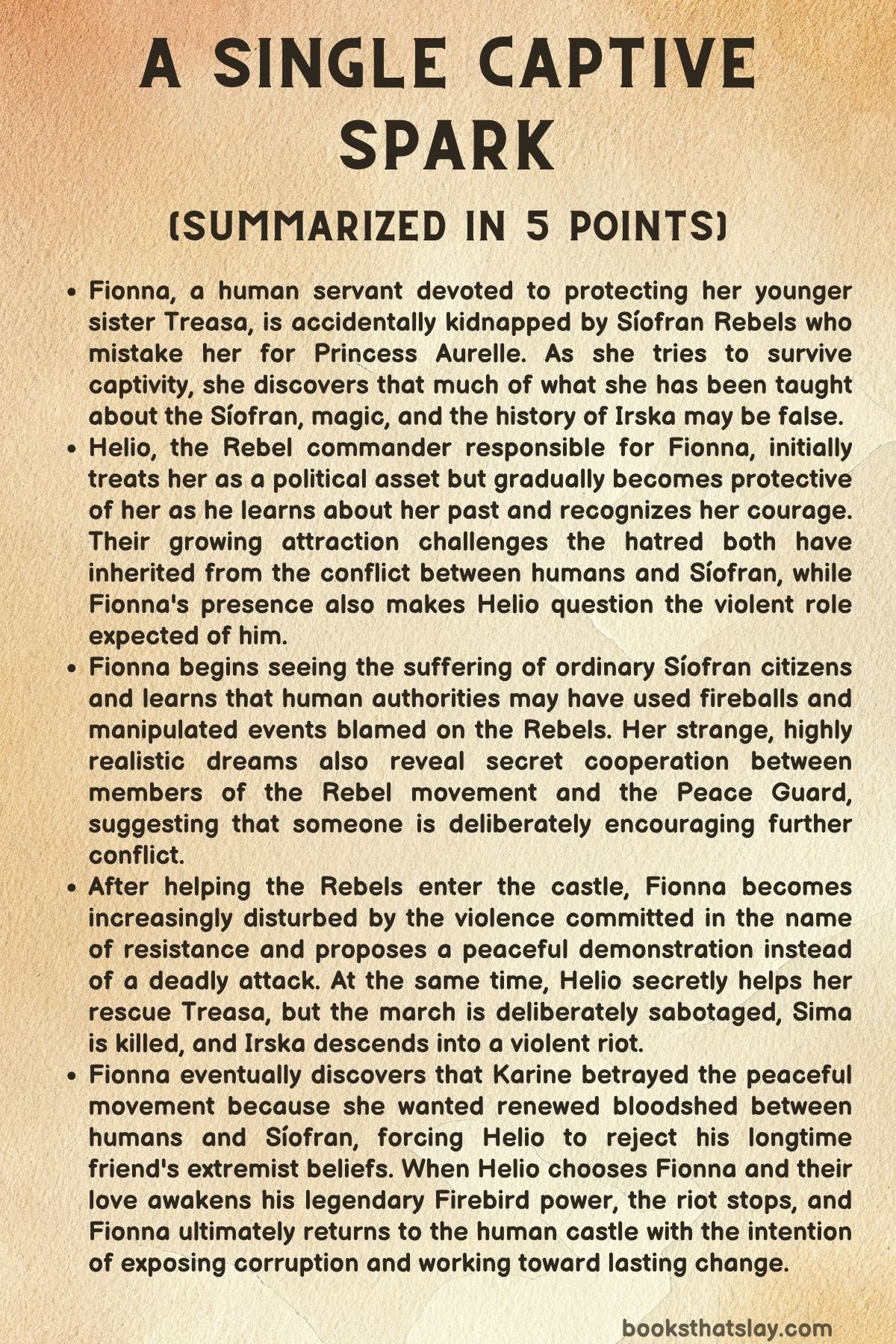
Summary
Fionna has spent ten years serving Princess Aurelle in the castle of Irska after losing her parents in a fireball attack. Although others describe her as fortunate for being chosen as the princess’s companion instead of being sent to an orphanage, Fionna understands that her position has always required caution, obedience, and constant calculation, especially because she is determined to protect her younger sister, Treasa.
When Aurelle demands one of the king’s golden apples, Fionna secretly enters the heavily protected royal orchard before dawn. The apples are dangerous and valuable because eating one can temporarily grant elemental magic, and while hiding in the orchard Fionna overhears members of the royal family discussing previous thefts before surviving a dangerous fall and escaping with an apple.
Her return to the castle becomes increasingly difficult when she begins suffering the effects of poisonous widowsbloom hidden among the orchard roses. Already exhausted and injured, she becomes disoriented, collapses, and is seized by strangers before she can find help.
Those strangers are Síofran Rebels led by Helio, and they believe they have successfully kidnapped Princess Aurelle. Because the royal children have been kept secluded from public view, Fionna’s appearance, clothing, and location in Aurelle’s rooms are enough to convince the Rebels that they have captured an important royal hostage.
Fionna awakens tied to a chair in a cellar and quickly realizes that her captors belong to the population she has been taught to fear. Her terror becomes even greater when she sees Karine use genuine fire magic, contradicting the human claim that nearly all magic disappeared centuries earlier.
Helio initially refuses to believe Fionna when she tells him that she is merely Aurelle’s servant. His attitude begins changing when he recognizes the depth of her fear and learns that Prince Vainar has abused her, but even after accepting her identity he cannot simply release her because the Rebel leadership may kill an ordinary servant who has seen too much.
Fionna saves herself by pointing out that ten years beside Aurelle have given her detailed knowledge of the castle. Helio hides the truth of her identity temporarily and argues that she may have greater strategic value as an intelligence source than she ever had as a mistaken royal hostage.
While confined, Fionna begins experiencing unusually vivid dreams that appear to show real events and places. In one, she witnesses Síofran citizens using magic for ordinary acts of cooperation, forcing her to reconsider the human teaching that Síofran magic is inherently violent or monstrous.
The Rebels eventually move her through the poorer Síofran areas of Irska. For the first time since childhood, Fionna sees how badly these communities live compared with the protected life surrounding the royal castle, and her assumptions become even less stable when she discovers Sima, a former human castle worker believed to be dead, actively helping the rebellion.
During the transfer, two human Defenders discover Síofran children innocently using magic and immediately threaten them. Fionna receives a perfect chance to escape her captors, yet instead of running to the humans she uses her iron restraints to strike one of the Defenders and protect a child.
Her decision deeply affects Helio because it does not fit his belief that humans naturally choose their own people over Síofran lives. He removes her manacles after she promises not to attack a Síofran, and the growing attraction between them finally results in a kiss that mysteriously strengthens the dormant Firebird magic inside him.
At the Rebel council, Helio fights to keep Fionna alive, arguing that her knowledge of servant corridors, royal routines, private rooms, and castle operations could give the Rebels access they have never possessed. He also hides Treasa’s existence from the council for as long as possible, showing that his concern for Fionna is beginning to compete with his responsibilities as a commander.
Fionna, meanwhile, continues struggling with anxiety and compulsive rituals that have long helped her create an illusion of control. Helio notices these behaviors, teaches her practical self-defense, and later obtains frostbloom tea for her, but their trust suffers when Fionna discovers that he has investigated her life and knows about Treasa.
Sima then gives Fionna one of the most disturbing pieces of information she has encountered. Sima explains that human forces also possess fireballs and that Peace Guards may have been involved in the attack that destroyed her own family, meaning Fionna can no longer be certain that Síofran attackers were responsible for killing her parents.
At Pearl House, a Rebel refuge maintained by Turi and Nieve, Fionna encounters Síofran family life without the constant presence of violence. Surrounded by children, shared meals, domestic magic, and ordinary affection, she begins seeing the Síofran not as a political category but as people living under conditions created by the human regime.
Fionna eventually offers the Rebels a bargain: if they rescue Treasa and help the sisters leave Irska, she will provide everything she knows about the castle. Her offer changes her position from helpless captive to active negotiator and gives her a possible route toward the freedom she has spent years trying to secure.
Helio is also changing. Fionna’s questions force him to consider whether being raised as the future bearer of the Firebird power has allowed him to choose his own identity at all, while his growing attachment to her makes it increasingly difficult to accept the Rebel belief that individual lives can simply be sacrificed for the cause.
Another of Fionna’s strange dreams reveals a secret exchange involving Peace Guards, information, money, and a fireball. She becomes convinced that someone within the rebellion is cooperating with human authorities and intentionally helping create further violence.
The Rebel council eventually approves another operation inside the castle, with Fionna serving as their guide. She leads Helio and his companions through passages and corridors known only to someone who has lived within the fortress, allowing them to reach imprisoned Síofran captives.
During the mission, Fionna suffers a severe panic attack, and Helio helps ground her rather than treating her fear as weakness. Soon afterward, however, Peace Guards attack, and Fionna witnesses Helio kill several of them with frightening efficiency, leaving her unable to reconcile the protective man she has begun trusting with the commander capable of such violence.
The experience pushes Fionna into direct opposition to the Rebel council when she hears plans for a violent equinox operation involving explosions and mass casualties. She argues that ordinary humans and Síofran have already suffered enough for the ambitions of armed factions and proposes a peaceful public demonstration instead.
Helio supports her idea despite resistance from more militant Rebels. Their disagreement about violence remains unresolved, but both begin accepting that their feelings for each other are no longer simply the result of physical attraction or forced proximity.
As the equinox approaches, the Rebels organize Fionna’s proposed march while she quietly prepares her own plan for reaching Treasa. Helio ultimately chooses to help her, arranging for Sima and Heath to escort her into the castle while the demonstration draws most of the Peace Guards into the city.
Before they separate, Fionna and Helio come close to openly admitting that they love each other. Helio has already arranged an escape route for Fionna and Treasa using his own resources, revealing that Fionna’s freedom now matters to him even when it provides no advantage to the rebellion.
The peaceful march initially appears capable of succeeding. Helio repeatedly prevents confrontations from becoming violent and begins to believe that the city may genuinely be capable of change, but he soon notices suspicious behavior among the Peace Guards and realizes that someone appears determined to provoke the crowd.
Fionna, Sima, and Heath enter the castle using legitimate passes supplied through a new human sympathizer inspired by the peaceful protest. Fionna and Heath locate Treasa and escape with her, but just as the rescue seems successful, a young Peace Guard kills Sima during a confrontation outside the castle.
At the same time, barriers trap the Síofran demonstrators in a confined street while Peace Guards remain strategically positioned nearby. Stones begin flying, no one can determine exactly who initiated the confrontation, and the peaceful gathering collapses into a riot that spreads through Irska.
Heath takes Fionna and Treasa to the safety of Pearl House, apparently completing Fionna’s decade-long mission to protect her sister. Yet Fionna cannot accept leaving Helio inside the violence, so she entrusts Treasa to Heath and returns to the streets to find him.
When Fionna reaches Helio, she finally recognizes the traitor revealed in her dreams. Karine has been working with members of the Peace Guard and deliberately helped sabotage the peaceful march because she wants renewed bloodshed to eliminate the possibility of reconciliation and push the Rebels toward total war against humans.
Karine admits what she has done, placing Helio in a final conflict between the ideology that shaped his entire life and the future Fionna represents. Helio rejects Karine’s fanaticism and takes Fionna’s hand, and their mutual love releases the ancestral power that has remained trapped inside him.
Golden fire surrounds Helio as he transforms fully into the legendary Firebird, the first complete awakening of the creature in three hundred years. The sight stops the riot because both humans and Síofran recognize the Firebird as an ancient symbol of peace and hope rather than a weapon belonging exclusively to one people.
The transformation also reveals that an old prophecy has been misunderstood. Magic is freed when two hearts beat as one, and the bond between a human woman and a Síofran man proves that the return of magic depends on unity rather than ethnic purity.
After Helio returns to human form, Fionna is unexpectedly found by Garen, who still believes she has been an unwilling Rebel captive. Instead of openly returning to Helio or escaping the country with Treasa, Fionna allows Garen to take her back toward the castle.
Her choice is no longer based on fear or submission. With Treasa safe and the Firebird restored, Fionna realizes she can use her position inside human society to identify Karine’s Peace Guard collaborators and challenge the political machinery sustaining Síofran oppression.
The woman who once survived by calculating every danger therefore ends the story making a decision that calculation alone could never justify. Fionna chooses to remain in the center of the conflict because she now believes both love and political change are worth the risk, while Helio’s transformation gives Irska a visible sign that the old division between humans and Síofran does not have to determine what comes next.
Characters
Fionna
In A Single Captive Spark, Fionna develops from a woman whose entire existence is organized around survival into someone willing to make moral choices even when they place that survival at risk. Her intelligence is practical rather than abstract: she studies people, remembers routes, anticipates danger, hides weakness, and constantly calculates how one decision might affect Treasa.
Her devotion to her sister initially defines nearly every choice she makes. Treasa represents both family and purpose, and Fionna has spent years accepting humiliation, exhausting work, and dependence on the royal household because she believes doing so will eventually create a safer future for them both.
Her anxiety and compulsive rituals are equally important to understanding her. Counting, tapping, washing, and repeating actions offer temporary control in circumstances where she has almost none, and the book treats these behaviors as part of her daily struggle rather than reducing them to a decorative personality trait.
Fionna’s greatest development occurs in her moral understanding. She begins with categories inherited from human society, but direct experience repeatedly forces her to judge people according to what they actually do rather than whether they are human or Síofran.
Her decision to protect a Síofran child instead of using the opportunity to escape is one of the clearest expressions of her character. She acts before she can calculate the political consequences because the immediate injustice matters more than inherited loyalty.
Her relationship with Helio intensifies this transformation without replacing it. She is attracted to him, frightened by him, protected by him, horrified by his violence, and eventually in love with him, yet she continues challenging his beliefs instead of simply adopting them.
By returning for Helio after Treasa has reached safety, Fionna finally does something for herself rather than treating her own desires as less important than her responsibilities. Her final decision to re-enter the human world also proves that love has not removed her political agency; instead, she chooses a more dangerous role because she now understands the system she once merely endured.
Helio
Within A Single Captive Spark, Helio begins as a man who has trained himself to treat emotional detachment as a form of discipline. As a Rebel commander and bearer of the Firebird bloodline, he has been taught that personal desires must remain secondary to the survival and liberation of the Síofran.
His early treatment of Fionna reflects this conditioning. He thinks of the supposed princess primarily as a political weapon and deliberately suppresses every reaction that might encourage him to see his captive as an individual.
Yet Helio’s behavior repeatedly contradicts the ruthless identity he claims. He prevents Heath from striking Fionna, reacts with genuine fury when he learns about Vainar’s abuse, conceals Treasa from the council, brings Fionna the tea she needs, teaches her to defend herself, and gradually assumes personal responsibility for her safety.
Fionna also recognizes something Helio has rarely been encouraged to consider: he may never have chosen the life everyone expects him to live. His Firebird ancestry has made him valuable to the rebellion since childhood, leaving him with the burden of being treated simultaneously as a person, leader, symbol, and future weapon.
His relationship with violence remains one of his most difficult contradictions. He can kill efficiently and defend those deaths as necessary, but Fionna forces him to consider whether protecting his people requires accepting every method carried out in their name.
The peaceful march becomes a major test because Helio chooses restraint even when violence would be easier and more familiar. Karine’s betrayal then forces him to separate loyalty to the Síofran from loyalty to extremist methods supposedly undertaken for their benefit.
His Firebird transformation completes this internal change. The power emerges not when he embraces hatred but when he chooses love across the very division that shaped his identity, turning him from a weapon expected to continue an old conflict into a symbol capable of challenging it.
Treasa
Treasa is Fionna’s younger sister and initially functions as the central reason behind Fionna’s determination to survive. Fionna carefully manages Treasa’s work as a firestoker so that the girl can continue receiving lessons and eventually have opportunities beyond the castle.
Although Treasa appears less frequently than Fionna or Helio, her importance is enormous because nearly every bargain Fionna makes is measured against Treasa’s safety. The possibility that the Rebels might discover and exploit her is one of Fionna’s greatest fears.
Treasa also represents the future Fionna has spent years trying to create. Protecting her means more than keeping her alive; Fionna wants her to grow into a person whose choices are not controlled by poverty, political violence, or dependence on the royal household.
Once Treasa is rescued, Fionna faces a significant emotional test. She has finally achieved the goal around which her identity has been organized, yet rather than ending her involvement in Irska’s conflict, Treasa’s safety allows Fionna to recognize that she has desires and responsibilities beyond being her sister’s protector.
Karine
Karine initially appears to be one of Helio’s most dependable companions. She has known Helio and Link since childhood, shares the history of being raised through the Rebel network, acts as Helio’s second, and possesses enough magical skill to manufacture extremely dangerous fireballs.
Her closeness to Helio gives her emotional influence that extends beyond ordinary military loyalty. She understands the expectations surrounding his Firebird bloodline and appears committed to protecting both him and the Síofran cause.
That loyalty, however, has become corrupted by ideological extremism. Karine no longer wants liberation that leaves room for reconciliation; she wants conditions severe enough to make coexistence impossible and drive the rebellion toward the destruction of its human enemies.
Her secret cooperation with Peace Guards is therefore not simple betrayal for personal gain. She betrays her own comrades because she believes renewed suffering will ultimately strengthen the cause, showing how fanaticism can persuade a person that manipulating and sacrificing members of their own community is justified.
Karine also serves as Helio’s ideological opposite near the end. Both have suffered under human rule, but where Helio slowly accepts the possibility of another future, Karine interprets every attempt at peace as weakness and actively destroys the demonstration to prove that her own violent assumptions are correct.
Sima
Sima is one of the most important figures in Fionna’s changing understanding of Irska because she is human yet willingly works with the Síofran Rebels. Fionna remembers her as a castle kitchen worker who was believed to have died, making her unexpected appearance among the Rebels immediately challenge Fionna’s certainty about what she knows.
Her personal history provides even stronger evidence against the official human account of the conflict. After her family was killed, Sima saw human Peace Guards behaving suspiciously while Síofran neighbors attempted to help, leading her to question the assumption that Síofran violence was automatically responsible.
Sima’s revelation that humans can also possess fireballs has a particularly powerful effect on Fionna because it destabilizes the story Fionna has believed about her own parents’ deaths. Through Sima, suspicion becomes personal rather than theoretical.
Her eventual death is cruelly appropriate to the political world she has tried to expose. After helping Fionna reach Treasa, Sima is killed by a young Peace Guard, demonstrating how quickly individual lives can be destroyed once fear, weapons, and factional assumptions control an encounter.
Heath
Heath first appears as one of the least sympathetic Rebels because he attempts to strike Fionna during her captivity. His aggression confirms many of her fears about the Síofran, and Helio’s repeated insistence that Heath must not harm her establishes an early conflict between the two men.
Later interactions make Heath less simple. Fionna learns fragments of his family background and Old Irskan heritage, allowing her to see experiences and losses that exist beyond the hostility he directs toward her.
His role in the rescue of Treasa further changes his position. Heath enters the castle beside Fionna, helps protect Treasa during the escape, and later promises to remain with the girl at Pearl House when Fionna decides to return for Helio.
He does not suddenly become affectionate toward Fionna, which makes his development more convincing. Instead, he demonstrates that cooperation does not require people to erase every resentment first, and his willingness to protect Treasa shows that moral responsibility can develop even between individuals who continue to distrust one another.
Link
Link is part of Helio’s closest personal circle and shares a childhood history with him and Karine. The three were orphaned and raised through the Rebel network, making Link part of the substitute family created around Helio long before Fionna enters his life.
His detention by the Peace Guard demonstrates the constant danger faced by Rebel operatives. The rebellion cannot treat capture as an isolated personal tragedy because one arrested member can potentially expose an entire network.
During the equinox march, Link remains beside Helio and helps investigate signs that the demonstration is being deliberately manipulated. His presence reinforces the contrast between loyal comradeship and Karine’s concealed agenda, because not every old bond becomes corrupted by ideological obsession.
Link is not developed as extensively as Helio or Karine, but he represents continuity within Helio’s life. He connects the commander to the childhood and community that shaped him while also showing that Helio’s rejection of Karine’s methods does not require him to reject every relationship formed within the rebellion.
Garen
Garen is Fionna’s former lover and a member of the Peace Guard. His position makes him an important link between Fionna’s former personal life and the human political structure she increasingly learns to question.
His presence also prevents the human side from becoming entirely abstract. Fionna has known and cared about an individual who serves within the same institution whose actions increasingly trouble her, reinforcing her refusal to declare that everyone belonging to one group must share the same moral character.
At the end, Garen finds Fionna and assumes she has remained a Rebel captive who needs rescue. His interpretation is understandable according to everything human society believes, but the reader knows how dramatically Fionna’s understanding has changed.
When Fionna allows him to take her back toward the castle, Garen unintentionally becomes part of her new strategy. What appears to him as the restoration of the old order is actually Fionna choosing to enter that order with knowledge and intentions she never possessed before her disappearance.
Princess Aurelle
Aurelle is the royal princess whom the Rebels originally intend to abduct and the person Fionna has served for approximately a decade. Her privileged position contrasts sharply with Fionna’s, even though the two have spent much of their lives in close proximity.
The golden apple incident illustrates this imbalance clearly. Aurelle wants something forbidden and dangerous, while Fionna accepts the physical risk of obtaining it and then receives additional demands rather than concern when she returns injured and exhausted.
Aurelle therefore represents a form of privilege that does not necessarily require deliberate political cruelty to cause harm. She is accustomed to having needs satisfied by people whose labor and danger remain largely invisible to her.
Her importance also comes from her absence. The Rebels build an entire operation around their imagined understanding of a secluded princess they have never actually seen, and that lack of knowledge causes Fionna’s abduction, showing how political conflict can turn individuals into symbols long before anyone knows who they really are.
Prince Vainar
Vainar represents the personal brutality protected by royal privilege. Fionna’s terror of him is based on a history of sexual violence and cruelty, giving the political corruption of the monarchy an immediate human consequence.
His importance is not limited to what he has done to Fionna. Her instinctive fear of physical aggression has been shaped partly by experiences such as his abuse, and Helio notices that fear before fully understanding its source.
Helio’s reaction to learning Vainar’s name is significant because it creates one of the first moments when his anger is directed toward protecting a human rather than opposing humans collectively. Vainar therefore unintentionally contributes to Helio’s growing inability to divide the world neatly by ancestry.
For Fionna, Vainar also represents the danger hidden beneath the security of castle life. The royal household may appear civilized compared with Rebel safe houses and poor Síofran districts, yet her memories reveal that proximity to power has never guaranteed her safety.
Turi
Turi helps maintain Pearl House and introduces Fionna to a side of Síofran society that neither propaganda nor captivity has prepared her to understand. His home offers meals, children, conversation, domestic routines, and a degree of warmth that sharply contrasts with the political labels surrounding the conflict.
He is not sentimental when Fionna proposes exchanging castle information for Treasa’s rescue. Turi directly asks why the Rebels should not simply take Treasa and force Fionna’s cooperation, testing whether Fionna understands how little conventional leverage she possesses.
That challenge makes his eventual willingness to bring the proposal to the council more meaningful. Turi recognizes Fionna’s determination without pretending that the rebellion operates according to uncomplicated kindness.
Through Pearl House and his interactions with Fionna, Turi helps transform the Síofran from an enemy population into a community containing homes, parents, children, disagreements, and individual choices.
Nieve
Nieve shares responsibility for Pearl House with Turi and contributes to one of the most important changes in Fionna’s perception of Síofran life. Her household demonstrates that magic can exist alongside ordinary domestic routines rather than appearing only in conflict or rebellion.
The atmosphere she helps create gives Fionna something close to a family environment, which carries special emotional weight because Fionna has lived without her parents for many years. Eating together, sewing, listening to children, and witnessing small uses of magic allow Fionna to experience the people she once feared in circumstances untouched by battle.
Nieve therefore contributes to the story primarily through normality. Political propaganda depends upon reducing opponents to dangerous abstractions, and Pearl House quietly destroys that abstraction by allowing Fionna to observe Síofran people simply living.
Mendara
Mendara belongs to Helio’s Rebel group and participates in operations surrounding Fionna’s captivity and the later castle mission. Although given less individual attention than several other Rebels, Mendara’s presence helps establish the collective structure within which Helio operates.
During the attempt to extract Síofran prisoners from the castle, Mendara is seriously wounded when Peace Guards confront the group. The injury demonstrates that Rebel missions carry immediate personal costs and helps explain why Helio responds to threats with lethal force.
Mendara’s suffering also complicates Fionna’s response to the fight. She is horrified by the deaths of the human guards, yet the Rebels are not attacking in a situation without danger; members of their own group are being injured while trying to free imprisoned Síofran.
The character therefore contributes to the moral difficulty of the violence rather than offering a simple judgment about it.
Yelena
Yelena is a member of the Rebel council who represents the faction more willing to accept severe violence as a necessary response to human oppression. Her willingness to consider attacks with enormous consequences places her in direct conflict with Fionna’s developing belief that the methods of liberation matter as much as the goal.
When Fionna challenges plans for the equinox attack, Yelena embodies the frustration of people who have endured oppression long enough to distrust proposals for peaceful change. This gives her position political logic even when Fionna finds its consequences unacceptable.
Her confrontation with Fionna also exposes Helio’s changing loyalties. When Yelena threatens Fionna, Helio’s magic reacts powerfully, revealing how difficult it has become for him to behave as though Fionna is merely a useful human captive.
Yelena therefore provides resistance against the emerging possibility of peace and prevents Fionna’s ideas from being accepted without serious opposition.
Val
Val is a Rebel councillor whose unusual eyes and composed behavior attract Helio’s attention. The information provided about her remains limited, which gives her a somewhat mysterious position within the political structure of the rebellion.
Helio’s interest suggests that he senses qualities or knowledge in Val that are not immediately explained. Her presence therefore hints that the history of Síofran magic and leadership may contain uncertainties extending beyond Helio’s own Firebird lineage.
Unlike Karine or Yelena, Val does not become a central ideological opponent during the events described. Her importance lies more in the questions surrounding her and in the suggestion that Helio does not fully understand every person or power operating within the movement he is expected to lead.
Prince Trinar
Trinar appears as one of the princes Fionna overhears while secretly entering the golden-apple orchard. His conversation with his brothers helps establish that valuable apples have already been disappearing and that tensions exist around the security of the royal family’s magical resources.
Although he receives little individual development, his presence contributes to the atmosphere of secrecy surrounding the monarchy. The royal family possesses access to controlled magic while ordinary citizens are punished for magical practices, creating an important contradiction in Irska’s political order.
Trinar therefore functions primarily as part of the protected royal structure rather than as a deeply individualized participant in Fionna’s journey.
Prince Odinar
Odinar also appears during Fionna’s dangerous visit to the royal orchard and participates in the discussion concerning stolen golden apples. Like Trinar, he occupies a privileged world almost completely separated from the conditions under which servants and Síofran citizens live.
His limited role nevertheless helps establish the secrecy and anxiety surrounding the royal family’s control of magical objects. The concern over missing apples suggests that even the monarchy’s apparently secure possession of power is becoming unstable.
Odinar consequently contributes more to the political setting than to the emotional center of the story. His presence helps show that uncertainty already exists inside the royal sphere before Fionna’s kidnapping begins exposing the larger weaknesses of the established order.
Moccus and Sucellus
Moccus and Sucellus are Peace Guards who appear in one of Fionna’s unusually vivid dreams. Rather than encountering a Síofran operative as an obvious enemy, they participate in a secret exchange involving information, payment, and a fireball.
Their involvement becomes evidence that official loyalties cannot be trusted at face value. Peace Guards publicly represent human authority and the enforcement of laws against Síofran magic, yet individuals within that institution are willing to engage in covert arrangements connected to the very forces they claim to oppose.
The encounter also gives Fionna information she could not logically have known through ordinary means, strengthening the possibility that her dreams are connected to an emerging form of magic. Moccus and Sucellus therefore matter less as fully developed personalities than as evidence of hidden cooperation and corruption within Irska’s conflict.
The King of Irska
The king remains largely distant from the immediate action, yet the political system surrounding him affects almost every major character. The heavily protected golden-apple orchard, the segregation of Síofran communities, the Peace Guard, restrictions on magic, and the castle’s concentration of privilege all exist within the royal order.
His authority is especially visible during the equinox, when citizens are ordered into the streets while political tension is already severe. The monarchy therefore represents institutional power more than individual personality.
This distance is significant because Fionna’s struggle increasingly moves beyond identifying a few cruel people. Vainar can be personally abusive and corrupt guards can manipulate events, but Fionna eventually understands that lasting change requires confronting the wider structure that permits inequality and violence to continue.
Her final return toward the castle signals that her conflict is ultimately with that system rather than with every human living under it.
Themes
Inherited Prejudice and the Destruction of Simple Enemies
Fionna has been raised inside a society where humans and Síofran are presented as natural opponents, and A Single Captive Spark repeatedly tests that belief by placing her in situations where inherited categories fail. The people she has been taught to fear feed her, protect children, maintain families, use magic for ordinary tasks, and sometimes display greater compassion than representatives of the human government.
The change is gradual because prejudice in the story is not merely an opinion that can disappear after one conversation. Fionna’s understanding is connected to childhood trauma, the presumed Síofran fireball that killed her parents, years of royal propaganda, and genuine acts of Rebel violence, so questioning the official story also means questioning the foundation on which she has built her identity.
Helio faces the same problem from the opposite direction. His experiences give him strong reasons to hate human institutions, yet Fionna repeatedly behaves in ways his assumptions cannot explain, beginning with her decision to protect a Síofran child when escaping would have been easier.
The story ultimately separates ancestry from moral responsibility. Humans can protect Síofran, Síofran can betray their own people, Peace Guards can cooperate with Rebels, and individuals on either side can choose cruelty or mercy.
The Firebird’s return gives this idea a symbolic conclusion because the legendary power is awakened through a bond crossing the division everyone has treated as permanent. Peace therefore becomes possible only when people stop assuming that identity automatically determines character, loyalty, or moral worth.
Survival, Control, and the Freedom to Choose
Fionna’s early life is governed by calculation because uncertainty has repeatedly punished her. After losing her parents and becoming responsible for Treasa, she learns to survive by anticipating other people’s demands, concealing pain, maintaining routines, and thinking several steps ahead.
Her compulsive rituals extend this need for control into her private life. Tapping, counting, washing, and repeating actions cannot actually determine Treasa’s safety, yet they provide Fionna with patterns when the surrounding world feels impossible to control.
Captivity initially seems to remove even the limited independence she has built. She is physically restrained, moved between hidden locations, threatened with death, and forced to prove her usefulness, but those conditions unexpectedly begin the process through which she becomes more capable of choosing rather than merely enduring.
Her bargain with the Rebels is a major change because she stops waiting for others to determine her value. Later, proposing the peaceful march moves her still further beyond private survival and toward influencing the political choices of people around her.
Rescuing Treasa should logically allow Fionna to leave, because protecting her sister has guided her for ten years. Instead, she returns for Helio and later chooses to re-enter the castle, showing that freedom is not simply physical escape.
True freedom for Fionna becomes the ability to choose according to love, conscience, and purpose even when those choices contain risk. She does not become free because danger disappears; she becomes freer because fear no longer makes every decision for her.
Violence, Resistance, and the Moral Cost of Justice
The conflict in Irska refuses to make violence morally simple. The Síofran face poverty, imprisonment, restrictions on magic, and institutional persecution, giving the rebellion understandable reasons to resist, yet the book repeatedly asks whether legitimate anger automatically justifies every method used in response.
Helio embodies this conflict because he has learned to treat lethal force as a practical requirement of survival. When Peace Guards threaten his people, he kills quickly and considers those deaths necessary, but Fionna sees individuals where he sees members of an oppressive force.
Her reaction after the dungeon fight creates an important disagreement rather than an easy moral lesson. Helio is protecting Fionna and freeing abused prisoners, yet the human guards he kills are still human beings, some of them young enough to make Fionna question whether every death can be dismissed as an unavoidable consequence of war.
The proposed equinox attack enlarges that problem. Fionna rejects a strategy that could kill large numbers of Peace Guards because civilian Síofran and humans would also suffer, and her peaceful march becomes an attempt to separate resistance from indiscriminate destruction.
Karine provides the darkest answer to this debate. She deliberately sabotages peace because continued bloodshed strengthens the ideological future she wants, making violence no longer a reluctant means but something actively manufactured to eliminate alternatives.
The story therefore treats justice as inseparable from method. A cause can begin with genuine oppression and still lose moral direction when victory becomes more important than the lives supposedly being defended.
Love as Recognition Rather Than Escape
The relationship between Fionna and Helio develops under circumstances that constantly make affection difficult to trust. He begins as her captor, she begins as a human he intends to use against the monarchy, and both belong to communities that have taught them to interpret the other as dangerous.
Their connection becomes meaningful because neither person remains a comforting fantasy for the other. Fionna sees Helio’s protectiveness and tenderness but also witnesses his capacity for lethal violence, while Helio admires Fionna’s courage yet repeatedly encounters her refusal to support the rebellion simply because she has recognized Síofran oppression.
Love therefore requires recognition rather than idealization. Fionna does not love a version of Helio stripped of anger and brutality, and Helio does not love Fionna only after she becomes politically useful or adopts his worldview.
Their bond also changes their relationship with choice. Helio begins questioning a role assigned to him since childhood, while Fionna begins imagining a life in which her own desires deserve space beside her obligation to protect Treasa.
The Firebird transformation turns this personal connection into a political symbol without making the romance merely symbolic. The old prophecy has been misunderstood because people assumed magic depended upon two Síofran hearts, while its real meaning concerns two hearts acting in unity.
The distinction matters because the restored magic rejects the logic of separation itself. Love becomes powerful not because it erases difference, but because two people remain different, confront each other’s contradictions, and still choose a shared future.