Flickerstate Summary, Characters and Themes
Flickerstate by F. A. Davidson is a science-fiction novel centered on probability, free will, responsibility, and the moral limits of power. Its world is shaped by navigators who can enter flickerstate and manipulate possible futures, but every alteration carries risks made physical through terrifying flickerbeasts and possibility wounds.
At its center is Norah Sullivan, an exceptionally talented teenager who enters the Academy of Navigation with a private mission: discover whether legendary navigator Victoria Highwall found a cure for the wounds slowly killing both Norah and her father. Her search turns an elite academic competition into an investigation of secrecy, exploitation, friendship, and the difference between controlling people and trusting them.
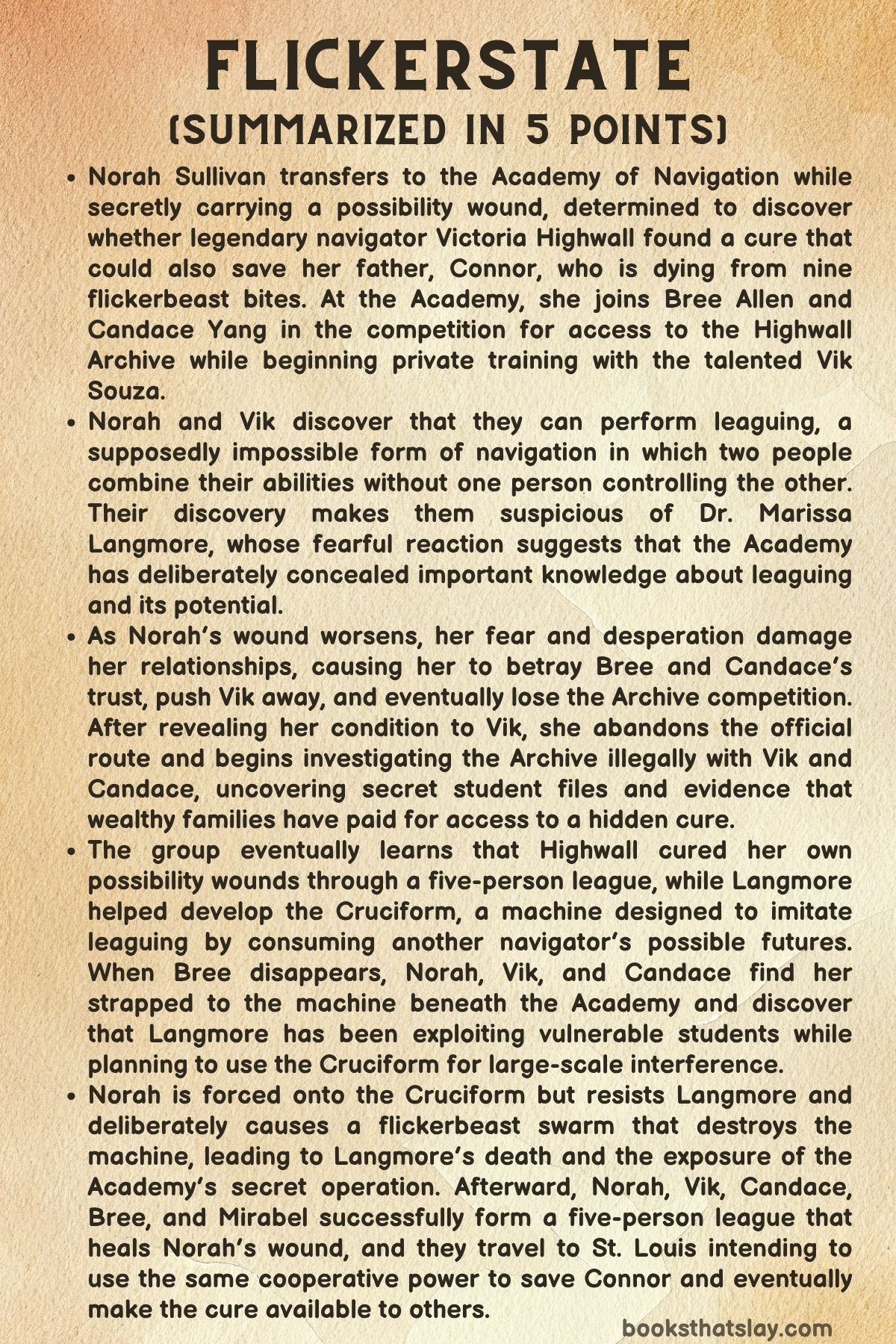
Summary
Eight months before an ominous future in which Norah Sullivan expects to be sacrificed to a machine, she arrives at the Academy of Navigation for a senior-transfer interview. Her desire to attend goes far beyond academics because her father Connor is dying from nine possibility wounds caused by flickerbeasts, while Norah secretly carries a bite of her own.
During her evaluation, Norah demonstrates remarkable natural navigation talent by entering flickerstate, manipulating probabilities, and hiding her possible futures through occlusion. Her impulsive attempt to protect her mother from a manifesting flickerbeast angers Dr. Marissa Langmore, however, and Norah leaves believing she has lost her chance at admission.
Thirteen days later, Langmore unexpectedly informs her that a place has opened. Norah accepts immediately because she believes Victoria Highwall may have discovered a secret method for curing possibility wounds, and gaining access to Highwall’s restricted Archive becomes the central purpose behind her decision to attend.
At the Academy, Norah meets her new blockmates Bree Allen and Candace Yang. Candace shocks her by revealing scars from possibility wounds that somehow healed, giving Norah the first living evidence that the condition may not be universally fatal.
Norah also reunites with Vikram “Vik” Souza, the talented student she briefly saw during her interview. She learns that access to the Highwall Archive is awarded through a demanding series of team trials, and she becomes determined to win despite being an inexperienced transfer.
Norah, Candace, and Bree eventually form Team Eight after Griffin Minter, Candace’s stepbrother, joins Vik and Mirabel Delgado instead. Their team begins at a disadvantage because all three girls are transfers, but Norah’s desperation makes her work relentlessly at siphoning, channeling, occlusion, and other advanced techniques.
At the same time, Norah makes a private arrangement with Vik. She agrees to help him investigate the theoretical technique of leaguing if he tutors her in conventional navigation, beginning a relationship founded on intellectual curiosity, mutual challenge, and gradually increasing trust.
Their training reveals that ordinary channeling requires one person to give navigation while another receives it, something Norah finds extremely difficult. Her instinct is always to seize control rather than surrender it, reflecting both her personality and the enormous burden she feels as the oldest daughter in a family facing disaster.
As Norah and Vik become more open with each other, their navigation improves. Vik explains his loneliness and his guilt over his former blockmate Jake, while Norah admits that she has spent much of her life trying to protect everyone around her and fears becoming dangerous to the very people she wants to help.
The first Archive trial exposes the destructive side of Norah’s need for control. When her team’s channeling is disrupted, she forcibly siphons power from Bree and Candace without their consent, using it to win the challenge but badly damaging their trust.
Immediately afterward, several flickerbeasts manifest. Norah and Vik instinctively try to channel power to one another at the same moment, but instead of one dominating the other, their navigation joins completely and gives them access to a vastly expanded view of possible futures.
Together they banish all three beasts, accidentally proving that leaguing is real. Langmore’s fearful reaction convinces them that the Academy already knows far more about the technique than it admits, and her questioning makes secrecy surrounding navigation itself increasingly suspicious.
Norah and Vik begin researching Jake’s old books and discover that successful leaguing may require a shared understanding of each other’s flickerstate manifestations and genuine unity of purpose. Meanwhile, Norah’s possibility wound worsens, producing increasingly frequent bite-dreams that show different versions of her death.
During the second trial, Norah makes a deliberate effort to trust Candace as the team’s lead navigator. She successfully gives power instead of taking it, helping Team Eight defeat its opponents and advance to the final.
Before the trial, Norah and Vik also successfully league on purpose for the first time. Their emotional closeness turns romantic when Norah kisses him, and after some uncertainty they begin a relationship.
Yet Norah’s terror soon overwhelms that happiness. When a falling branch nearly strikes Vik in a way that resembles one of her death dreams, she becomes convinced that proximity to her wound may endanger him and abruptly breaks off their relationship.
Her growing isolation also damages her friendships with Bree and Candace. Team Eight enters the final Archive trial emotionally divided, and Griffin chooses individual siphoning duels rather than a cooperative team challenge.
Griffin defeats Candace, Norah and Vik fight to a stalemate, and Mirabel defeats Bree, giving Vik, Griffin, and Mirabel the Archive positions. For Norah, the defeat feels catastrophic because she believes she has failed both herself and her dying father.
After cruelly lashing out at Bree, Norah receives a call from Jo informing her that Connor’s condition has grown worse. Jo’s simple question about finding another way into the Archive forces Norah to recognize that losing the official competition does not mean she must abandon her goal.
Norah finally tells Vik the truth about her wound and Connor’s condition. Instead of withdrawing, Vik immediately agrees to help, but they soon discover that his Archive access does not include Highwall’s papers because those materials are assigned to Griffin.
Norah and Vik therefore plan to break into the restricted collection. Their suspicions deepen when they overhear Mr. Davis reassuring a wealthy donor that something within the Archive “always works,” suggesting that its secrets may be available to people willing to pay.
Around the same time, another transfer student, Aria Zacconi, mysteriously disappears. The circumstances resemble Jake’s disappearance closely enough to convince Vik and Norah that vulnerable Academy students may be deliberately isolated before something happens to them.
Candace joins the investigation after Norah finally reveals both her wound and the reality of leaguing. Candace then explains that Griffin once promised their wealthy stepfather could somehow save her, and she was mysteriously cured shortly after Terry Minter donated five million dollars to the Academy.
The implication becomes unavoidable: powerful families may have been paying for access to a secret method of curing possibility wounds. Norah agrees to attend the Winter Formal with Griffin so she can keep him occupied while Vik and Candace enter the Highwall Collection.
The break-in reveals something even darker. Secret files classify students according to navigation ability, wealth, social support, and willingness to cooperate, with poor, isolated, highly talented students such as Jake and Aria considered ideal “candidates.”
The group also finds diagrams suggesting that leaguing is possible between more than two people and uncovers records connecting Victoria Highwall, Daisuke Miura, Kay Lucasson, Laura De Soto, and a mysterious figure identified only as “MO.” A concealed door inside the collection suggests that the Academy’s hidden operation is physical as well as intellectual.
Research into stolen Highwall notebooks finally provides the history Norah has been seeking. Highwall herself suffered possibility wounds and was cured when five navigators successfully formed a league, proving that shared navigation can eliminate the condition.
After the original group’s unity collapsed, Lucasson designed the Cruciform, a machine intended to imitate the extraordinary power of leaguing by consuming a navigator’s possible futures. The machine could temporarily create immense navigation power, but its operation placed the person attached to it in severe danger.
The identity of “MO” proves decisive. Marissa Olson, an engineering researcher involved with Highwall’s work, later became Marissa Langmore, meaning the Academy’s respected instructor was involved in the technology from the beginning.
When the friends realize Bree has disappeared, Norah, Vik, and Candace form a three-person league and use their expanded perception to enter the hidden area beneath the Archive. There they discover the Cruciform and find Langmore, Davis, and Griffin preparing an unconscious Bree for the machine.
Langmore claims that Bree volunteered and argues that the Cruciform allows her to fund the Academy, cure selected people, and eventually guide society through large-scale interference. She intends to manipulate government officials and sees control over other people’s decisions as justified when she believes the results will be beneficial.
Norah refuses Langmore’s offer to use Bree’s power to cure Connor. When Langmore attempts to interfere with her decision, Norah protects herself with occlusion and begins freeing Bree, only to be knocked unconscious.
She awakens strapped to the Cruciform in Bree’s place. Langmore activates the machine and tries to control Norah’s enormous field of possible futures, but Norah resists by exploiting the symbolic relationship between their flickerstate forms.
Mirabel unexpectedly enters the underground chamber and becomes another target. Searching desperately for a future in which her friends survive and the Cruciform is destroyed, Norah chooses a terrifying possibility and intentionally causes a swarm of flickerbeasts to manifest.
The beasts attack the Cruciform and force the people in the chamber to abandon their conflict. Griffin rescues Bree, Vik releases Norah, and Candace and Mirabel help protect the escaping students while Langmore refuses to leave the machine she has dedicated herself to preserving.
Langmore is ultimately attacked and later dies after receiving dozens of bites. Federal authorities seize the ruined Cruciform and the Highwall Archive, while Griffin faces investigation for his role and claims that Langmore interfered with his decisions.
In the aftermath, Bree explains how Langmore gradually studied her family problems and financial vulnerability before drawing her into the Archive. Norah finally tells her friends everything she had hidden, and she and Bree repair the friendship damaged by fear, secrecy, and Norah’s earlier cruelty.
Bree, Candace, Vik, Mirabel, and Norah then attempt what Highwall’s generation once accomplished. After ten exhausting hours, the five successfully league, and Norah’s possibility wound disappears, leaving only thirteen white scars.
Norah immediately turns toward the person she has been trying to save from the beginning. The group travels with her to St. Louis, where Connor is gravely ill, and Norah prepares to use their five-person league to cure him.
The ending of Flickerstate therefore changes the meaning of Norah’s struggle. She begins believing survival depends on personally forcing the correct future into existence, but she ends surrounded by people whose freely given trust creates a power greater than any one navigator can command.
She no longer faces the future only as an enemy to conquer. By joining hands with her friends and entering flickerstate beside her father, Norah accepts that the best possibilities may come from cooperation rather than control, with the cure now carrying the promise of eventually being shared with others.
Characters
Norah Sullivan
Norah Sullivan is the central character of Flickerstate, and nearly every major conflict grows from her belief that she must personally protect the people she loves. Her father’s nine possibility wounds and her own hidden bite create an overwhelming sense of urgency, but the deeper force behind her choices is guilt because Connor was injured while protecting her during the first uncontrolled manifestation of her navigation.
Her strongest quality is determination, yet the book repeatedly shows how that strength can become dangerous when combined with fear. Norah excels at siphoning because taking control comes naturally to her, while giving power through channeling initially terrifies her because surrender feels too similar to helplessness.
Her treatment of Bree and Candace during the first trial demonstrates this flaw clearly. Faced with possible failure, she forcibly takes their power despite knowing that doing so will hurt them, placing the outcome she wants above their right to choose.
Norah’s development therefore depends less on becoming stronger than on learning what responsible strength actually requires. Her successful channeling with Candace, leaguing with Vik, reconciliation with Bree, and eventual participation in a five-person league all require trust rather than domination.
Her secrecy is another important part of her character. She conceals her wound because she fears becoming a burden and because Anna’s abandonment of her family taught her that vulnerability can cause people to leave.
That assumption gradually collapses as Vik, Candace, Bree, and Mirabel choose to remain with her after discovering the truth. Norah finally understands that denying other people the opportunity to support her is itself another attempt to control their choices.
By the conclusion, Norah has not lost her intensity or her desire to save others. Instead, she has learned to separate responsibility from absolute control, allowing her extraordinary power to operate within relationships based on consent and shared purpose.
Vikram “Vik” Souza
Vik is one of the most important emotional and philosophical counterweights to Norah in Flickerstate. Initially appearing distant and self-contained, he gradually reveals himself as patient, intellectually curious, deeply loyal, and far more insecure than his exceptional navigation abilities suggest.
His childhood between two frequently arguing parents taught him to withdraw rather than expect stability from other people. That history helps explain why he is comfortable working alone and why the nickname “Afterthought” affects him so deeply.
Vik expects abandonment even when evidence suggests he is valued. His reaction after Norah first kisses him reveals this clearly, because he assumes that competition will matter more to her than their connection and prepares himself to be discarded before she has actually rejected him.
Jake’s fate gives Vik’s interest in leaguing a moral dimension. His guilt over failing to protect Jake, combined with his suspicion that someone interfered with him on the night of Jake’s disappearance, makes him distrust systems that place one person’s will above another’s.
This is why leaguing appeals to him beyond its technical possibilities. It creates power through agreement rather than submission, offering a model of navigation that reflects the kind of relationships Vik increasingly wants to build.
His treatment of Norah also reveals unusual patience. When she fails at channeling, hides information, ends their relationship, and later returns asking for help, he does not reduce her to her worst decisions.
By the end, Vik becomes both a romantic partner and an ethical partner for Norah. His insistence that her bite never made him stop wanting a future with her directly challenges her assumption that she alone should decide what risks other people are allowed to take for her.
Candace Yang
Candace provides one of the clearest challenges to fear-based prejudice in Flickerstate. When Norah first meets her, other students avoid her because she once carried possibility wounds, making Candace a living example of how easily fear can turn suffering into social exclusion.
Her healed scars also make her central to Norah’s investigation. Candace initially knows almost nothing about how she survived, but the eventual discovery that her wealthy stepfather paid millions to the Academy forces her to confront the uncomfortable possibility that her life was preserved through another person’s exploitation.
Candace is perceptive, direct, and often quicker than Norah to recognize unhealthy emotional patterns. She identifies the coercive dynamic between Bree and Kayla, understands why Norah’s self-isolation resembles the prejudice once directed at her, and refuses to allow friendship to become an excuse for dishonesty.
Her relationship with Norah evolves considerably. At first they are strategic partners who both need Archive access, but Candace eventually becomes one of the people most willing to challenge Norah when fear begins controlling her behavior.
Her developing romance with Bree also adds another dimension to her character. Having experienced rejection after being bitten, Candace understands the vulnerability involved in allowing someone close and therefore treats Bree’s affection with both desire and caution.
Candace ends the novel carrying moral uncertainty about her own cure. She cannot undo the choices Griffin and Terry made, but she can participate in building a form of healing that does not depend on sacrificing vulnerable people.
Bree Allen
Bree initially appears to be the least competitive member of Team Eight, but her character gradually becomes essential to the story’s criticism of how ambition is defined. Unlike Norah, she does not automatically believe that success requires defeating everyone around her, and her reluctance to siphon aggressively causes others to label her weak.
That apparent softness hides considerable endurance. Bree is dealing with Kayla’s emotional pressure while trying to maintain demanding academic responsibilities, and her constant availability to her sister has conditioned her to treat personal boundaries as dangerous.
Her friendship with Candace and Norah gives her an opportunity to begin establishing those boundaries. Their practical solution to Kayla’s late-night calls is an early example of how mutual support can solve problems without one person taking control of another.
Bree’s conflict with Norah becomes especially important after the final trial. Norah attacks the very vulnerability Bree fears others see in her, calling her weak and questioning whether she tried hard enough, turning their friendship into collateral damage from Norah’s desperation.
Langmore later targets Bree for similar reasons. Her candidate file identifies the qualities the Academy’s hidden system values in potential victims: talent, limited resources, personal vulnerability, and conditions that make resistance or disappearance easier to manage.
Bree’s willingness to join the five-person league after everything she has endured reveals the difference between weakness and generosity. She does not become powerful by imitating Norah’s aggression; she proves powerful by freely offering trust after having every reason to withhold it.
Griffin Minter
Griffin is one of the most morally complicated characters in Flickerstate because his actions combine genuine love, avoidance, privilege, and manipulation by others. He is charismatic and socially successful, but his confidence hides uncertainty about whether his choices are truly his own.
His flickerstate perception captures that uncertainty. Because he sees himself only through the way other navigators perceive him, Griffin fears that he lacks a stable identity independent of other people’s expectations.
His devotion to Candace becomes the central source of his moral compromise. When she is bitten, Griffin turns to Langmore because he desperately wants her saved, and he accepts the promise of a solution without fully investigating the cost.
Griffin does not knowingly choose Jake’s death, but he allows himself not to ask questions when asking them might threaten Candace’s survival. His later conversation with Norah shows that he understands this difference, which leaves him responsible without reducing him to someone who consciously intended the harm.
His relationship with Langmore also illustrates how manipulation can operate through emotional dependence. She becomes a trusted mentor after he confides in her, giving her access to his fears and loyalties before drawing him deeper into her secret work.
Griffin’s rescue of Bree during the flickerbeast attack demonstrates that his moral instincts have not disappeared. When forced into a direct choice between preserving Langmore’s project and protecting a vulnerable person, he carries Bree to safety.
Dr. Marissa Langmore
Dr. Marissa Langmore is the principal antagonist of Flickerstate, but her danger comes from conviction rather than simple cruelty. She genuinely believes that intelligence, expertise, and superior knowledge justify controlling other people’s futures.
Her philosophy of “benevolent interference” transforms navigation from a means of exploring possibility into a political and personal instrument of domination. She views unwanted choices as errors that can be corrected by someone more capable of seeing desirable outcomes.
This belief explains both her secrecy and her hypocrisy. She dismisses leaguing publicly while understanding its history, partly because genuine leaguing depends on equality and shared purpose, principles incompatible with her preference for centralized control.
The Cruciform expresses her worldview in technological form. Rather than requiring several people to cooperate freely, the machine extracts enormous power from one navigator and allows another person to direct that power.
Langmore also demonstrates a sophisticated ability to identify vulnerability. Her attention to Bree’s finances, family problems, and ambitions appears supportive until it becomes clear that such information helps determine whether Bree can be used with minimal resistance.
Her downfall results from the same certainty that allowed her crimes to continue. Even when the Cruciform is being destroyed and flickerbeasts fill the chamber, she cannot abandon the machine because doing so would mean accepting that her vision of controlled progress was fundamentally wrong.
Mirabel Delgado
Mirabel begins as a confident senior who appears fully invested in the Academy’s competitive culture. Her success, leadership role, history with Griffin, and eventual Archive victory initially place her on the side of the institution Norah is trying to defeat.
She is also capable of jealousy and cruelty, particularly in her treatment of Norah around Griffin. Their hostility during the Winter Formal demonstrates how personal insecurity can survive beneath institutional prestige.
Mirabel’s importance changes dramatically once she discovers the Cruciform chamber. Unlike Langmore, she does not protect the system simply because she benefited from it, and the truth forces her to reconsider what she believed the Academy’s competitions represented.
Her later explanation is revealing: she thought the difficult system taught lessons about excellence and achievement, only to discover that Langmore had secretly rigged the environment. That betrayal turns Mirabel from competitor into ally.
Joining Norah’s five-person league therefore represents more than practical assistance. Mirabel chooses a cooperative form of power after learning that the competitive hierarchy she trusted concealed manipulation and exploitation.
Connor Sullivan
Connor is physically absent from much of the Academy action, but his condition determines many of Norah’s choices. He received nine possibility wounds while shielding his daughter when her navigation first manifested, making his suffering both an act of parental protection and the central source of Norah’s guilt.
Norah’s promise to cure him gradually becomes so important that she treats failure as morally unacceptable. Connor therefore functions as both a beloved father and, unintentionally, the emotional justification Norah uses when crossing boundaries.
His declining health also keeps the novel’s theoretical questions grounded in immediate human consequences. For Norah, debates about probability, leaguing, and interference are never merely academic because her father’s survival depends on whether those ideas can become practical.
The final scene returns the story to Connor and redefines Norah’s promise. She no longer arrives as a lone rescuer carrying a secret solution; she arrives with friends whose freely shared power may accomplish what individual determination could not.
Jo Sullivan
Jo, Norah’s younger sister, responds to the family crisis with anger, fear, and an understandable desire for certainty. She initially resents Norah for leaving while Connor is dying because the Academy looks like abandonment when viewed from home.
Norah’s promise that she will find a cure gives Jo something concrete to hold onto. That promise later becomes another source of pressure when Connor worsens and Jo asks when Norah will bring the cure home.
Yet Jo also provides one of the story’s simplest and most important challenges to Norah’s rigid thinking. After learning that Team Eight lost the Archive competition, she asks what other method Norah can use, immediately reframing defeat as a problem that still has alternatives.
That question helps Norah move beyond the belief that one lost route means total failure. Jo therefore influences the plot not through navigation ability but through her refusal to accept Norah’s narrow definition of what is possible.
Norah’s Mother
Norah’s mother represents a perspective Norah initially interprets as surrender. Exhausted by Connor’s decline and the family’s financial strain, she recognizes that there may be events no amount of determination can reverse.
Her warning that Highwall’s hidden cure could carry a terrible cost proves especially significant. Norah initially dismisses the caution because she believes saving Connor automatically justifies pursuing whatever solution exists.
As the truth about the Cruciform emerges, her mother’s concern becomes morally important rather than pessimistic. A cure does exist, but the Academy’s technological version of that cure has been built around exploitation.
Their Thanksgiving conversation begins repairing the emotional distance created by Norah’s secrecy. By the time Norah returns home with healed scars, she can show her mother that hope and caution did not have to be opposites because the cure itself was not evil; the method used by Langmore was.
Jake
Jake never appears alive in the present action, yet his absence shapes Vik, Griffin, and the entire investigation. He was talented, poor, socially isolated, and bullied, precisely the combination later shown to make students attractive candidates for Langmore’s hidden program.
His unexplained disappearance and later death become the pattern against which Aria’s disappearance is recognized. The erased belongings, strange behavior around the event, and suspicions of interference suggest that the Academy actively controlled the story told about him.
Jake’s old books become a form of resistance that survives him. Through the materials he left behind, Norah and Vik discover theoretical information about leaguing and begin questioning the official limits imposed on navigation.
His role also exposes differences between Vik and Griffin. Vik carries guilt for not protecting him, while Griffin eventually admits that he ignored signs that something was wrong because confronting those signs could have threatened the solution offered for Candace.
Mr. Davis
Mr. Davis acts as the institutional accomplice who helps Langmore maintain the hidden operation. His role demonstrates that the Cruciform conspiracy requires more than one visionary leader; it depends on ordinary people willing to cooperate for personal reasons.
Investigators later learn that Langmore had been helping pay the gambling debts of Davis’s adult son. His participation therefore reflects a smaller-scale version of the same vulnerability-based manipulation used against Academy students.
His behavior during the flickerbeast attack exposes his priorities clearly. Unlike the students who protect one another, Davis abandons the chamber and attempts to escape, after which federal authorities arrest him.
Terry Minter
Terry Minter’s wealth gives the story one of its clearest examples of unequal access to survival. His enormous donation to the Academy occurs around the time Candace’s possibility wounds are cured, strongly connecting money to Langmore’s secret use of the Cruciform.
His actions are driven by a desire to save his stepdaughter, which complicates the ethical picture. Like several other characters, he participates in a harmful system because the person he loves is facing death.
What separates his position from Norah’s is the power his money gives him. Terry can purchase access to a hidden solution while poorer students are classified as suitable sources of the power required to make that solution possible.
Anna
Anna appears mainly through Norah’s memory, but her abandonment of the Sullivan family after Connor was bitten has lasting consequences. Norah turns that experience into a general belief that people will withdraw when confronted with frightening vulnerability.
That belief explains why she hides her wound even from people who have repeatedly demonstrated loyalty. Anna therefore functions less as an active participant in the present plot than as the origin of one of Norah’s most damaging assumptions about friendship.
Norah’s relationships with Vik, Candace, and Bree eventually disprove the lesson she took from Anna’s departure. Their choice to stay does not erase the earlier betrayal, but it prevents that betrayal from defining every future relationship.
Aria Zacconi
Aria is another transfer student whose disappearance helps transform individual suspicion into evidence of a pattern. Rumors that she was bitten while practicing alone and immediately removed from campus resemble the misleading stories surrounding Jake.
Her absence becomes especially alarming once the secret candidate files are discovered. Aria’s classification as a desirable candidate suggests that her disappearance was connected to the same system that targeted other talented but vulnerable students.
Although the book provides less direct information about her personality, her role is significant because she proves that Jake’s case was not merely an isolated tragedy. She represents the possibility that the Academy’s exploitation continued for years beneath ordinary school routines.
Victoria Highwall
Victoria Highwall exists largely through records, research, and the institution built around her legacy. Her importance changes as Norah learns that Highwall herself suffered possibility wounds and successfully cured them through a five-person league.
This discovery overturns the assumption that the cure required something inherently monstrous. Highwall’s experience proves that cooperation can achieve the same extraordinary result later pursued through the Cruciform.
Her later agreement to dismantle the machine after its dangers became clear also separates her legacy from Langmore’s actions. The Academy preserves Highwall’s name while ultimately violating the cooperative principle behind her greatest discovery.
Daisuke Miura, Kay Lucasson, and Laura De Soto
Miura, Lucasson, and De Soto were members of the original group that leagued with Highwall and Marissa Olson. Their success proves that navigation becomes dramatically more powerful when multiple people reach genuine unity of purpose.
Lucasson later contributes to the darker development of that discovery by proposing the Cruciform as a technological substitute for leaguing. Miura’s death after the machine’s prototype is tested becomes one of the clearest indications that technological power without genuine cooperation carries severe consequences.
Their historical presence gives the modern students a model they can recover and improve upon. Norah’s group does not invent collective navigation from nothing; they rediscover a possibility that institutional secrecy had buried.
Agent Fletcher
Agent Fletcher appears after the underground confrontation as the representative of the federal investigation. His questioning allows the wider consequences of Langmore’s actions to become visible beyond the Academy.
Through Fletcher, Norah learns about Davis’s arrest, Langmore’s death, Griffin’s legal situation, and the government’s seizure of the Cruciform and Highwall Archive. His presence signals that the Academy’s secrets can no longer remain protected within its own institutional hierarchy.
Antoine and Jacqueline
Antoine and Jacqueline occupy smaller roles among the Academy’s senior students, helping establish the social and competitive world surrounding Norah. Antoine’s high ranking in siphoning shows that Vik and Norah are not the only formidable navigators at the school.
Their presence at social events also helps reveal how Norah’s experience of the Academy gradually broadens beyond her single-minded mission. They remain secondary figures, but they contribute to the sense that the school is a functioning community rather than merely the setting for the central conspiracy.
Themes
Control, Consent, and Free Will
The conflict between controlling outcomes and respecting individual choice governs nearly every major relationship in Flickerstate. Navigation itself creates the temptation to treat reality as something that should be corrected whenever a sufficiently skilled person disagrees with the future that others would otherwise create.
Norah initially falls into this logic on a personal scale. During the first trial, she siphons Bree and Candace without permission because she decides that winning is important enough to override their autonomy.
Langmore takes the same reasoning to its most dangerous conclusion. Her idea of benevolent interference assumes that superior knowledge grants moral permission to redirect people’s decisions, whether the target is an individual student or a government official.
The Cruciform becomes the physical expression of that philosophy because it transforms one person’s possible futures into power for someone else. It creates results without requiring equal participation, making exploitation part of its basic design.
Leaguing offers the opposite model. It cannot succeed through simple force because the participants must align their intentions and accept a shared purpose, meaning its extraordinary power depends on cooperation.
Norah’s growth is therefore measured by how her relationship to control changes. Her greatest achievements eventually occur not when she dominates probability alone but when she accepts that other people must be free to decide whether they will stand beside her.
Guilt, Responsibility, and the Limits of Self-Blame
Norah’s guilt begins with the moment Connor protects her from the flickerbeasts attracted by her first uncontrolled navigation. Because he receives nine wounds while shielding her, she treats his suffering as a debt that only she can repay.
That belief converts love into an exhausting sense of responsibility. Saving Connor stops being merely something Norah desperately wants and becomes something she believes she is morally required to accomplish regardless of the cost to herself.
The same pattern appears after her own bite. Norah becomes convinced that her dangerous probability could harm Vik or other people nearby, so she isolates herself and ends their relationship without allowing Vik to decide whether he accepts the risk.
Her behavior shows how excessive responsibility can become another form of control. By assuming that every harmful possibility is hers to prevent, she also assumes that other people cannot make informed decisions about their own involvement.
Griffin provides a different version of guilt. He did not knowingly choose Jake’s death, but his desire to save Candace made it easier for him to ignore suspicions about Langmore, leaving him responsible for avoidance without making him identical to Langmore.
The novel ultimately presents responsibility as something that must be precise rather than limitless. Norah can acknowledge the consequences of her mistakes, apologize to Bree, and change her behavior without accepting the impossible burden of personally guaranteeing everyone’s safety.
Cooperation Versus Hierarchy
The Academy is organized around rankings, competition, elimination trials, exclusive access, and the belief that exceptional individuals deserve advancement. Flickerstate repeatedly questions whether such a structure actually identifies meaningful strength or merely trains students to reproduce a hierarchy.
Norah initially accepts the Academy’s assumptions because winning appears to be the only route to saving Connor. She judges Bree’s lack of aggression as weakness and measures progress largely through whether Team Eight can defeat more experienced students.
Yet the most powerful form of navigation discovered in the story does not belong to a single superior navigator. Leaguing becomes stronger as people cooperate, with three-person and five-person leagues providing capacities far beyond what ordinary individual navigation can achieve.
The contrast becomes especially clear in Langmore’s Cruciform. Rather than accept the difficulty of creating trust among equal participants, she supports a machine that concentrates power by consuming another person’s possibilities.
Mirabel’s development reinforces this criticism of hierarchy. She once believes the Academy’s competition teaches valuable lessons about excellence, but the discovery that vulnerable students were secretly classified and exploited forces her to reconsider what achievement means inside a rigged institution.
By the end, the group that develops the cure includes people who previously competed against, distrusted, hurt, or misunderstood one another. Their strength comes not from eliminating weaker participants but from reaching a form of shared purpose in which each person’s contribution remains necessary.
Fear, Vulnerability, and Human Connection
Possibility wounds create physical danger, but much of their social power comes from fear. Candace’s classmates avoid her even after her wounds heal, treating survival itself as something unsettling and turning a person who suffered into someone others consider threatening.
Norah condemns that behavior but eventually repeats its logic against herself. Once she believes her wound might endanger Vik, she decides that isolation is the responsible response and begins withdrawing from everyone who cares about her.
Her secrecy increases the damage because it prevents the people around her from understanding what is happening. Bree and Candace interpret her exhaustion, anger, and distance as rejection because Norah refuses to let them see the fear underneath those behaviors.
Bree’s family situation presents vulnerability in another form. Her fear that Kayla will harm herself if boundaries are imposed allows emotional pressure to control Bree’s time until her friends help her recognize that care does not require complete surrender.
Langmore exploits precisely these kinds of vulnerabilities. The candidate files reveal a system designed to identify talented students who lack money, social support, or strong protection, showing how institutions can turn private weakness into an opportunity for abuse.
The eventual five-person league reverses that pattern. Norah’s wound disappears only after she stops hiding, Bree chooses to forgive and participate, Mirabel rejects the institution she once trusted, Candace confronts the troubling origin of her own cure, and Vik remains despite knowing the risks.
Their connection does not remove vulnerability before cooperation becomes possible. Instead, vulnerability becomes something they can openly carry together, allowing trust to produce a future that secrecy and individual strength could never create.