Find Me by Holly Craig Summary, Characters and Themes
Find Me by Holly Craig is a psychological wilderness thriller about grief, family estrangement, guilt, and the dangerous stories people construct around unexplained events. Set around the remote Mount Mercy in Tasmania, the novel follows sisters Hallie and Gertie as they return to investigate the disappearance of their brother Pete three years earlier.
What begins as a search for an isolated commune gradually exposes a history involving missing hikers, a crashed aircraft, escaped prisoners, violence, and a supposedly supernatural figure haunting the mountain. At its emotional center, however, the novel is about two sisters confronting the damage they have caused each other and deciding whether reconciliation is still possible.
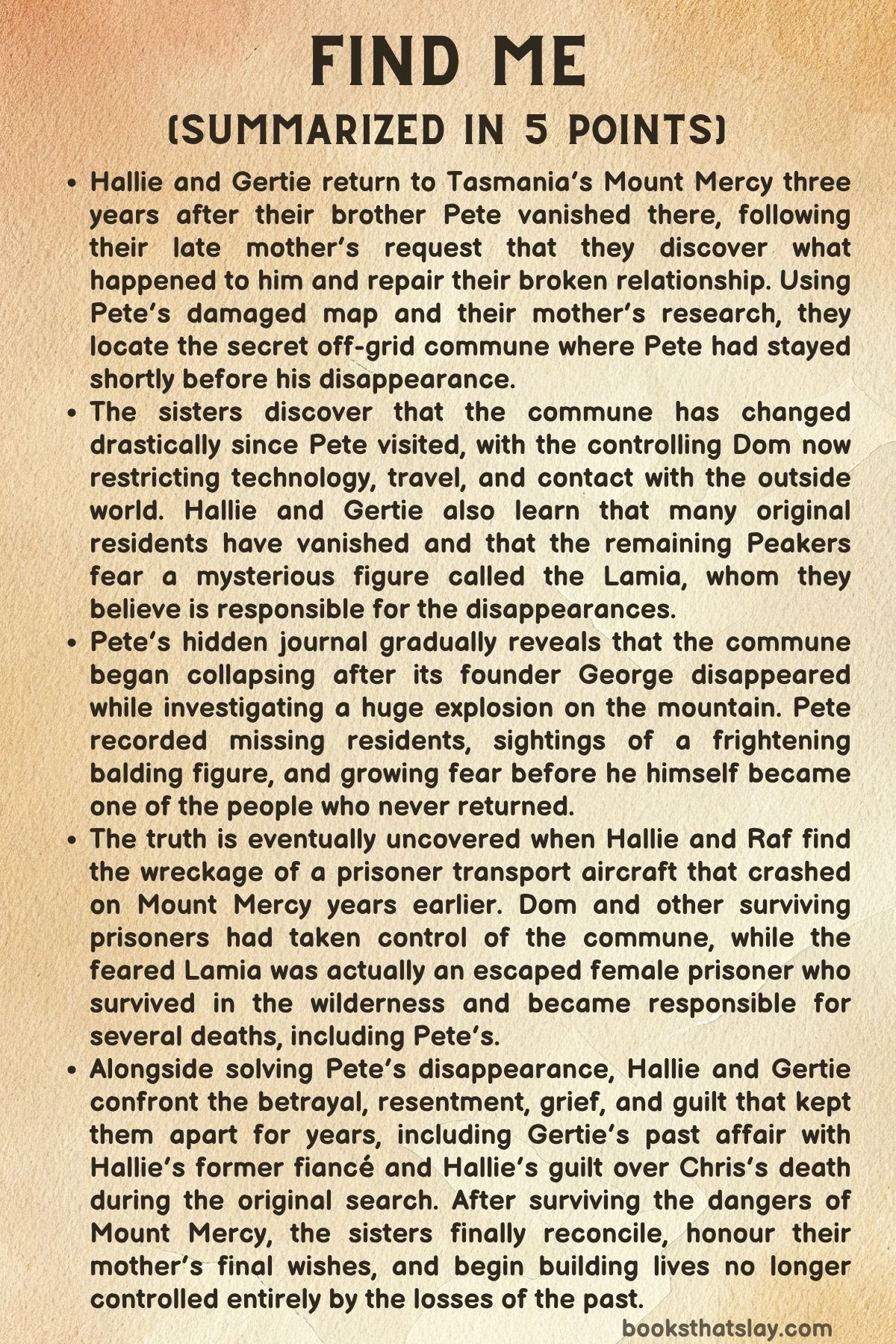
Summary
Three years after Peter “Pete” Hillberry disappears on Mount Mercy, his sisters Hallie and Gertie return to Pine Peak following their mother’s death. Their mother spent her final years refusing to accept the official assumption that Pete simply became another reckless hiker lost in Tasmania’s wilderness, and one of her last wishes was for her daughters to return together, investigate what happened, and repair their broken relationship.
Hallie approaches the mission with the same determination that once defined her work as an emergency-service volunteer. Gertie is far less willing, particularly because she and Hallie have barely spoken for five years and because Hallie has concealed the true difficulty of their journey.
Pete had travelled to Mount Mercy intending to write about an isolated off-grid community known locally as the Peakers before exploring the mountain’s cave systems. His emails show that he successfully reached the settlement, became friendly with several residents, and initially considered the place peaceful despite unsettling local stories about men disappearing from the mountain.
In Pine Peak, the sisters discover that Pete was not the last person to disappear. Locals speak of missing climbers and strange phenomena, while the police continue to emphasize ordinary wilderness dangers such as cliffs, caves, storms, and isolation.
Hallie and Gertie hear repeatedly that Mount Mercy “takes” people. Hallie dismisses such claims, but Gertie is more open to the possibility that the mountain carries an unusual or threatening energy.
Using Pete’s damaged map and research completed by their mother, Hallie finds a hidden route into the wilderness. After a difficult hike marked by arguments, wrong turns, and disturbing arrangements of animal bones hanging from trees, the sisters finally locate the commune that search teams failed to find three years earlier.
The settlement contains cabins, gardens, livestock, a communal hall, and a watchtower, but it is far less peaceful than Pete described. Dom, the aggressive man now controlling the community, initially orders the sisters away until Hallie pays him to let them remain temporarily.
Hallie immediately notices that something is wrong. Dom prohibits technology, restricts travel, and exercises unusual authority over the residents, while armed men such as Sparky reinforce his control.
Raf, one of the original residents, seems uncomfortable with Dom’s leadership. June secretly helps Hallie conceal her satellite phone, while an elderly resident called Maud warns Gertie that only seven members of the original settlement remain.
The sisters investigate separately while their old hostility continues causing conflict. Gertie briefly abandons Hallie and spends a frightening night in their vehicle, where she hears what sounds like a young girl giggling outside; after discovering that a tyre has been badly damaged, she returns to the commune rather than leaving her sister alone.
Hallie gradually reveals why she is so obsessed with Pete’s disappearance. During the original search three years earlier, she led her fiancé Chris and fellow rescuers Anna and Kieran deep into Mount Mercy despite deteriorating conditions and Kieran’s injured ankle.
The searchers discovered Pete’s backpack, his engraved pen, his damaged map, and possible bloodstains. Hallie became convinced they were approaching him and refused to abandon the search even as Chris questioned whether desperation was overwhelming their professional judgment.
Their expedition ended catastrophically when Kieran slipped near a cliff and grabbed Chris while falling. Both men went over the edge, Kieran dying immediately and Chris dying despite Hallie’s desperate attempts to revive him.
Hallie has blamed herself ever since. Her return to Mount Mercy is therefore not simply an attempt to find Pete but also a form of self-punishment, because she believes her refusal to stop searching caused Chris’s death.
Meanwhile, Hallie and Gertie uncover evidence that the commune dramatically changed around the time Pete vanished. Its founder, George Barton, disappeared after investigating a huge explosive sound on the mountain, families began leaving, and Dom later emerged as the settlement’s authoritarian leader.
Pete’s surviving journal describes this transformation from inside the commune. He records George’s disappearance, increasing fear among residents, the disappearance of Darla, Greg, Callum and others, and sightings of a balding humanoid figure moving through the forest.
The Peakers call this figure the Lamia. Raf believes it has been taking men for years, and the residents maintain boundary fires, keep a rifle in the watchtower, and eventually sacrifice livestock to prevent it from approaching humans.
Gertie becomes increasingly convinced the Lamia is real after seeing a strange figure near Dom’s cabin and sensing someone watching her at the outdoor shower. Hallie remains sceptical until she discovers that a sacrificed pig has actually been dragged into the forest.
Human danger remains equally serious. Gertie becomes sexually involved with Dom while intoxicated and accidentally mentions Pete, prompting Dom to reveal that he recognizes the name.
Hallie learns from Raf that Pete definitely stayed in the commune. She and Gertie search abandoned cabins and find evidence that many families once lived there, confirming that a substantial number of people disappeared or fled.
Their investigation also forces their personal history into the open. Years earlier, Gertie slept with Hallie’s then-fiancé Hugh while intoxicated during Hallie’s engagement celebration, and Hallie never forgave her.
Gertie has spent years hiding behind substances, casual relationships, sarcasm, and defensiveness, while Hallie has treated responsibility and control as proof of moral superiority. Their resentment explodes when Hallie physically grabs Gertie during an argument and Gertie runs into the forest alone.
Lost in the darkness, Gertie finally confronts her own responsibility for the collapse of their relationship. She admits privately that Hallie had genuine reasons to be hurt and decides that, if she survives, she will apologize without blaming alcohol, drugs, jealousy, or circumstances.
Hallie quickly regrets the fight and searches for her. She obtains Pete’s hidden journal from Maud and discovers that Pete himself eventually believed something dangerous was hunting people around Mount Mercy.
At the same time, Hallie learns that their vehicle has been deliberately sabotaged. Sparky then accompanies Hallie and Raf into the wilderness with a rifle before effectively taking them prisoner, confirming that the threat surrounding the commune is not limited to the mysterious figure.
Hallie and Raf escape Sparky, only to discover that the battery has been removed from Hallie’s hidden satellite phone. A note reading “No Tech” shows that Dom deliberately ensured they could not contact outsiders.
Raf finally tells Hallie what happened after George disappeared. Dom and several armed men suddenly arrived and seized control of the weakened commune, while Raf submitted because he believed cooperation was the only way to protect June, Maud, and the other survivors.
Pete became particularly dangerous to the newcomers because he was a writer documenting the community. Once they learned what he was doing, they confined him, and Raf never saw him again.
Pete’s final journal entries confirm that he understood he was unlikely to survive. He entrusted the journal to Maud in the hope that it would someday reach his family and reveal that both the new arrivals and the strange figure on the mountain were connected to the disappearances.
Hallie and Raf continue higher onto Mount Mercy and discover pieces of metal resembling debris Hallie remembers seeing during the original search. They eventually find the wreckage of a small aircraft hidden among the trees.
The discovery explains the explosive noise Pete recorded and transforms the entire mystery. The supposed supernatural story surrounding Mount Mercy has grown from a concealed human disaster.
Near the wreckage they encounter the feared Lamia. She is actually an escaped female prisoner who survived the crash and has spent three years living almost ferally in the wilderness after a childhood of severe abuse and later incarceration.
Her transport plane had been hijacked by male prisoners, including Dom and his associates, with assistance from corrupt insiders. Their plan failed when the aircraft crashed on Mount Mercy, killing guards and crew members while releasing the surviving prisoners into an environment where they could disappear from authorities.
The male prisoners eventually reached the isolated commune and took control of it. The escaped woman, whom they had intended to leave restrained because even they feared her, began hunting the men involved in the escape.
Dom exploited the Peakers’ existing folklore by allowing the residents to believe the Lamia was a supernatural creature. He used livestock sacrifices to keep her away while his group maintained control over the settlement and discouraged all outside contact.
The woman is genuinely dangerous and responsible for numerous deaths. Among her victims is Pete, meaning that his fate emerged from the collision of two dangers: criminals who imprisoned and controlled people at the commune, and an escaped prisoner whose brutal survival on the mountain turned her into the figure behind the legend.
Another astonishing revelation follows when Hallie and Raf discover George Barton alive. George survived by hiding from the armed prisoners and has spent years living alone near the wreckage, psychologically damaged by isolation and everything he witnessed.
Once the Lamia is restrained, Hallie’s focus returns entirely to Gertie. Hallie, Raf, and George head toward the highway because the vehicle and satellite phone are useless.
They eventually reach the road, where Hallie hears Gertie calling her name. Gertie emerges exhausted, injured, and filthy but alive after becoming lost, knocking herself unconscious, using the Southern Cross to move downhill, and finally remembering Hallie’s survival advice about stopping somewhere visible rather than wandering endlessly.
The sisters embrace without their usual defensiveness. Hallie praises Gertie for keeping herself alive, while Gertie finally experiences Hallie’s protectiveness as love rather than judgment.
Authorities subsequently uncover the crashed criminal transport plane and the takeover of the commune. Surviving prisoners are arrested, investigators connect the escaped woman to numerous deaths, and Pete is formally identified among her victims, although not every missing person’s remains can be recovered.
Two months later, Hallie and Gertie meet at Lake St Clair to scatter their mother’s ashes. Gertie finally apologizes directly for sleeping with Hugh, accepting responsibility rather than offering excuses, and Hallie takes her hand and accepts the sincerity of what she is saying.
Their mother’s final request is therefore fulfilled in two ways: the sisters learn what happened to Pete, and they recover the relationship they had allowed pain and resentment to destroy. The answer to Pete’s disappearance cannot restore him, Chris, or their mother, but it ends the uncertainty that controlled both women.
Six months later, Hallie visits Raf, who has created a new home near a river with June nearby. Their relationship has become romantic, and Hallie finally understands that loving someone after Chris does not diminish what Chris meant to her.
Raf suggests that they buy a new tent and go camping somewhere peaceful. Hallie can now accept the idea because the belongings, wilderness memories, and guilt attached to Chris no longer determine every decision she makes; she carries the dead with her while allowing herself to continue living.
Characters
Hallie Hillberry
Hallie is the central emotional force of Find Me, a woman whose instinct to rescue other people gradually becomes inseparable from her need to control situations she cannot actually control. Her background in emergency services makes her practical, disciplined, courageous, and highly capable, but those strengths become dangerous when grief convinces her that persistence is always morally superior to retreat.
Pete’s disappearance transforms her determination into obsession, and Chris’s death leaves her convinced that her decisions destroyed the person she loved most. She therefore returns to Mount Mercy partly to fulfil her mother’s wish and partly because suffering feels like something she owes the dead.
Hallie’s relationship with Gertie exposes her greatest weakness. She genuinely loves and protects her sister, yet she often expresses that love through criticism, planning, judgment, and commands, making Gertie feel permanently inferior.
Her development depends upon accepting that responsibility is not the same as total control. Leaving Chris’s old tent behind, trusting Raf, searching desperately for Gertie after their fight, and eventually embracing a future all show Hallie learning that remembering people does not require punishing herself forever.
Gertie Hillberry
Gertie provides the emotional counterweight to Hallie in Find Me, appearing impulsive, rebellious, sarcastic, and unreliable while carrying considerable shame beneath those qualities. She has spent years defining herself against Hallie, whose competence makes Gertie feel judged even when Hallie is trying to care for her.
Her betrayal involving Hugh is the deepest source of their estrangement. Rather than fully confronting what she did, Gertie initially hides behind alcohol, drugs, relationships, jokes, spirituality, and the argument that Hallie will never forgive her anyway.
Mount Mercy forces her to become more self-aware. She survives isolation in the forest not because she suddenly becomes Hallie, but because she remembers practical lessons from her sister while also using her own intuition and emotional instincts.
The discovery that Hallie packed gluten-free meals specifically for her becomes especially important because it proves that Hallie’s love survived beneath years of anger. Gertie’s eventual apology has power because she finally removes every excuse and accepts responsibility for hurting her sister.
Pete Hillberry
Pete’s physical absence drives almost every major event in Find Me, yet his emails and journal entries create a clear portrait of an adventurous, curious, experienced traveller rather than the reckless amateur described by public reports. His fascination with off-grid communities and cave systems brings him to Mount Mercy, where his openness initially allows him to form genuine bonds with the Peakers.
Pete is rational at first and dismisses local supernatural beliefs. As people begin disappearing and he sees the strange woman himself, his confidence changes into fear without completely destroying his instinct to document what is happening.
His role as a writer becomes crucial because knowledge makes him dangerous to Dom and the escaped criminals. Even when Pete realizes he may die, he protects the record of events by giving his journal to Maud, turning his writing into an act of resistance.
Pete also reveals different aspects of his sisters. Hallie’s refusal to stop searching for him exposes her compulsive need to rescue, while Gertie’s guilt over failing to help during the original crisis becomes part of her larger struggle with responsibility.
Raf
Raf initially appears mysterious because he clearly knows more than he tells Hallie. His silence can resemble complicity, but the truth reveals a man who has spent years making humiliating compromises to keep other original residents alive.
He is practical, resourceful, and deeply connected to the commune’s original ideals. Dom’s takeover leaves him trapped between resistance and survival, and his promise of obedience is motivated primarily by concern for June, Maud, and others who would otherwise be vulnerable.
Raf’s attraction to Hallie develops alongside trust rather than replacing the investigation. He helps her repair the vehicle, explains the Lamia legend, challenges Sparky, escapes with her, and eventually reveals the truth about Pete and Dom.
His relationship with Hallie is significant because he represents possibility rather than rescue. By the end, both characters are survivors building lives after prolonged grief, and neither needs the other to erase the people or places lost in the past.
Dom
Dom functions as the principal human antagonist in Find Me, using intimidation, secrecy, isolation, and misinformation to control the commune. He presents himself as its natural leader even though he arrived only after the transport plane crashed and the original community had already been destabilized by George’s disappearance.
His prohibition on technology is an instrument of control rather than an ideological preference. Destroying access to vehicles, preventing trips into Pine Peak, sabotaging Hallie’s satellite phone, and maintaining armed authority ensure that residents cannot easily contact help.
Dom is particularly effective because he turns existing fear into political power within the settlement. Rather than inventing the Lamia completely, he takes a genuine danger and encourages supernatural interpretations that distract people from the crimes committed by him and his fellow prisoners.
His treatment of Gertie also shows his manipulative nature on an intimate level. He encourages her intoxication and rebelliousness because those vulnerabilities make her easier to influence and separate from Hallie.
The Lamia / Escaped Female Prisoner
The woman called the Lamia is the most unsettling figure in Find Me because she occupies the boundary between monster and human being. Years of sightings, disappearances, animal remains, giggling sounds, and predatory movement transform her into a supernatural legend before her identity is revealed.
Her history complicates that image without excusing her violence. Abducted by her father as a small child and raised through deprivation, cruelty, animalistic survival training, and physical abuse, she learns to interpret fear, pain, and domination differently from ordinary social experience.
Later confinement continues the pattern of other people controlling her body and freedom. When the male prisoners hijack the transport but intend to leave her restrained, the crash becomes her opportunity to escape and take revenge.
She is therefore both victim and killer. Her brutal past explains how she became capable of surviving alone and hunting people across Mount Mercy, but Pete and numerous others still die because of her actions.
Chris
Chris represents the stable future Hallie believed she had finally created before Pete disappeared. As her fiancé and fellow emergency-service volunteer, he understands both her strengths and her tendency to push herself beyond reasonable limits.
During the search for Pete, Chris remains supportive far longer than Hallie later allows herself to remember. He gives up ordinary responsibilities, enters dangerous terrain, reassures her when she loses confidence, and repeatedly tries to balance hope with safety.
His death is accidental, but Hallie transforms it into a moral judgment against herself. Because she insisted on continuing the search when conditions were deteriorating, she convinces herself that Chris died because she failed him.
Chris consequently remains psychologically present throughout the novel. Hallie’s eventual willingness to love Raf does not replace him; instead, it demonstrates that Chris can remain meaningful without becoming the reason she refuses every future source of happiness.
George Barton
George is the founder of the original commune and represents what the Peakers were before violence corrupted their community. Pete describes him as thoughtful and adventurous, someone who abandoned conventional expectations to create a simpler collective life.
His disappearance becomes one of the key events that destabilizes the settlement. After investigating the mysterious blast caused by the transport crash, he encounters circumstances dangerous enough that returning openly becomes impossible.
When Hallie and Raf eventually find him, years of isolation have profoundly affected him. His improvised companions and strange wilderness existence show the psychological cost of surviving alone while believing armed criminals control the people he once led.
George’s survival also helps separate myth from fact. He provides a living connection between the original commune, the aircraft crash, the criminal takeover, and the false assumptions that developed afterward.
June
June initially appears distant and obedient, but small acts reveal quiet resistance. Her most important early action is refusing to expose Hallie’s hidden satellite phone after discovering it during Dom’s ordered search.
That decision immediately signals that June does not fully accept Dom’s authority. She understands the danger of openly opposing him, so resistance takes the form of selective silence, indirect warnings, and small opportunities given to outsiders.
June also demonstrates how coercive systems can produce misleading appearances. Someone observing the commune briefly might assume she chooses its rules, yet her guarded behaviour reflects adaptation to years of danger.
Her eventual life near Raf after the commune is freed carries symbolic importance. She survives long enough to experience a life in which daily existence is no longer organized around Dom’s commands and the fear surrounding Mount Mercy.
Maud / Granny
Maud appears strange and secretive, making it easy for other residents to dismiss her as unstable. Dom’s group benefits from that reputation because anything she says can be treated as the confused speech of an elderly woman.
In reality, Maud is one of the most important guardians of the truth. She warns Gertie that only a handful of original Peakers remain and protects Pete’s journal after he realizes he may not survive.
Her loyalty to Pete ensures that his final testimony is not destroyed. Through that decision, a woman treated as marginal becomes responsible for preserving evidence that eventually helps Hallie understand her brother’s final days.
Sparky
Sparky represents the direct physical violence supporting Dom’s control. From Hallie’s first encounters with him, his attention feels threatening, and his possession of the rifle later confirms that intimidation within the commune is backed by lethal force.
His behaviour during the search for Gertie removes any remaining doubt about his role. By forcing Hallie and Raf to travel at gunpoint and attempting to control where they search, he shows that preventing discovery matters more to him than finding a missing woman.
Sparky is also important because he prevents the story from treating the Lamia as the only source of terror. Even before the complete mystery is solved, his actions prove that ordinary human cruelty can be as dangerous as anything hidden in the wilderness.
Juice
Juice is less developed personally than Dom, Raf, or Sparky, but his participation in the settlement’s disturbing practices helps establish how normalized fear has become. His handling of the terrified pig before the sacrifice shows the brutal routine created around keeping the Lamia away.
He belongs to the group whose behaviour makes Hallie and Gertie increasingly uncomfortable. Through characters such as Juice, the novel shows how prolonged exposure to violence and superstition can turn extraordinary actions into accepted daily procedure.
Anna
Anna is one of Hallie and Chris’s emergency-service friends who joins the original search for Pete. She demonstrates loyalty by entering difficult terrain and continuing even as the expedition becomes increasingly dangerous.
She also functions as part of the professional standard Hallie gradually stops following. Anna recognizes the worsening conditions, Kieran’s injury, and the risks surrounding the cave search, yet the emotional momentum of the mission keeps the entire group moving.
After Kieran and Chris fall, Anna’s presence emphasizes how sudden catastrophe destroys the assumptions of experienced rescuers. Training can reduce danger, but it cannot make people invulnerable to unstable terrain, weather, exhaustion, and chance.
Kieran
Kieran is another member of the original search team and becomes central to Hallie’s guilt because his accidental fall causes Chris’s death. His ankle is injured earlier in the expedition, creating repeated discussions about whether continuing is responsible.
Kieran himself minimizes his condition and attempts to remain useful. His behaviour illustrates how group loyalty can become dangerous when nobody wants to admit that an operation should stop.
His conversations with Hallie about Gertie also expose the absolute nature of Hallie’s resentment at the time. When Hallie claims she would not search for Gertie if her sister went missing, the statement gains painful irony once Hallie later risks everything to find her.
Hugh
Hugh is Hallie’s former fiancé and the man at the center of the betrayal that destroys the sisters’ relationship. Hallie had already begun recognizing that her relationship with him was unsuitable, but Gertie sleeping with him turns dissatisfaction into a profound personal wound.
His importance therefore lies less in his personality than in what the incident represents. For Hallie, Gertie’s actions prove that her sister cannot be trusted; for Gertie, the incident grows from envy, intoxication, insecurity, and a destructive desire to possess something associated with Hallie’s seemingly superior life.
Hugh becomes a symbol of an injury both sisters keep alive for years. Only when Gertie apologizes without using him, alcohol, or jealousy as an excuse can that history begin losing its control over them.
Georgie Hillberry
Pete, Hallie, and Gertie’s mother refuses to accept the dismissive public explanation of Pete’s disappearance. Her persistence keeps the investigation alive even when institutions and local residents appear prepared to treat him as another person who misjudged Mount Mercy.
She spends years studying Pete’s damaged map and comparing his markings with geographic information until she reconstructs a possible route to the hidden commune. Her final wishes then force Hallie and Gertie into the same journey.
Although she is dead during the main events, her influence shapes nearly every decision the sisters make. She wants the truth about Pete, but she also understands that her daughters’ estrangement is another family tragedy that needs attention.
Darla
Darla is one of the original Peakers who treats Pete warmly during his early days at the commune. Her presence in his emails and journal helps establish that the settlement he originally encountered was welcoming rather than inherently threatening.
Her later disappearance is therefore one of the first signs that something has fundamentally changed. When Hallie finds evidence connecting Darla and Greg to abandoned cabins, Pete’s private observations finally align with physical evidence in the present.
Greg
Greg is another original commune resident whose disappearance becomes part of the broader pattern surrounding Mount Mercy. His photograph with Darla gives Hallie and Gertie tangible proof that former residents existed even though the current settlement rarely explains where they went.
Like Darla, Greg represents the people erased when fear, criminal control, and violence replace the commune’s earlier way of life. His absence helps turn Maud’s vague warning into something concrete.
Callum
Callum appears primarily through Pete’s later journal entries as one of the people who disappears during the commune’s collapse. His disappearance adds to the evidence that the problem is not a single isolated missing person.
Through Callum and the other vanished residents, Pete realizes that the danger is systematic. What begins as uneasiness about George’s absence becomes recognition that people around him are being removed one after another.
Candy
Candy runs the Pine Peak cafe and serves as one of Gertie’s first important sources of local information. She knows about other missing hikers and privately admits that she believes the mountain takes people, even though such beliefs are not openly promoted to tourists.
Her role establishes how deeply the Mount Mercy legend has entered local culture. Candy is not presented as foolish; rather, she represents people who have seen enough disappearances to distrust simple official explanations even when they cannot provide evidence for anything supernatural.
Gary
Gary is the local gossip whom police suggest Hallie question. His warnings about Mount Mercy contribute to the sisters’ growing awareness that many Pine Peak residents speak about the mountain almost as if it possesses intention.
Hallie initially finds his language frustrating because she wants facts rather than folklore. Nevertheless, the fear behind Gary’s warnings later proves to have grown around genuine deaths and unexplained activity, even if the supernatural interpretation is incorrect.
Constables Graves and Simpson
Graves and Simpson represent the official, rational perspective surrounding the disappearances. They acknowledge that multiple people have vanished from Mount Mercy but emphasize environmental hazards rather than local supernatural explanations.
They also take Hallie’s plans seriously enough to record where the sisters intend to go. Their perspective is not portrayed as entirely wrong, because Mount Mercy truly is physically dangerous, but their limited knowledge of the hidden commune prevents them from seeing the criminal situation developing beyond ordinary police awareness.
Themes
Grief, Guilt, and the Difference Between Remembering and Punishing Oneself
Hallie’s grief becomes destructive because she converts loss into personal responsibility. In Find Me, Pete’s disappearance begins that process, but Chris’s death turns it into a fixed belief that Hallie deserves to suffer because she continued the search when conditions had become unsafe.
Her guilt gives her an illusion of control. If Chris died entirely because of her decision, then the tragedy has a clear cause; accepting that Kieran slipped, conditions were dangerous, multiple people made choices, and accidents can occur would require Hallie to face a much more frightening reality in which terrible events cannot always be prevented.
Objects become part of this punishment. The blue tent once represented love, travel, intimacy, and a future with Chris, but afterward Hallie treats it almost like a memorial she is morally forbidden to abandon.
Leaving the tent behind while escaping Sparky therefore carries greater significance than simply abandoning equipment. Hallie chooses immediate life over an object associated with the dead, beginning to understand that survival is not betrayal.
Her relationship with Raf completes that change. Loving another person does not erase Chris, and imagining another camping trip does not invalidate the past.
The novel ultimately distinguishes memory from self-imposed suffering. Hallie can continue carrying Pete, Chris, and her mother emotionally without arranging her entire future around guilt.
Sisterhood, Betrayal, and Forgiveness
Hallie and Gertie spend much of the story interpreting every present disagreement through wounds created years earlier. Hallie sees Gertie as selfish, unreliable, and prone to abandoning people, while Gertie sees Hallie as controlling, morally superior, and incapable of allowing anyone to change.
Both interpretations contain some truth, which makes reconciliation difficult. Gertie genuinely betrayed Hallie by sleeping with Hugh, avoided much of the family responsibility surrounding Pete’s disappearance, and spent years protecting herself with substances, humour, and defensiveness.
Hallie, however, turns justified anger into a permanent identity for her sister. Even acts of protection are delivered through commands and criticism, making Gertie feel that nothing she does can alter Hallie’s judgment.
Their journey gradually exposes the love beneath those habits. Hallie remembers Gertie’s dietary needs and prepares food for her, Gertie returns to the commune rather than leave Hallie alone, and both eventually risk themselves when the other is endangered.
The reconciliation becomes convincing because it does not require pretending the betrayal never happened. Gertie finally admits what she did without excuses, while Hallie allows an apology to matter without denying the seriousness of the original injury.
Forgiveness therefore becomes neither instant absolution nor forgetting. It is the decision to stop treating an old wrong as the only possible definition of another person.
Folklore, Fear, and the Creation of Monsters
Mount Mercy accumulates stories because people repeatedly disappear without satisfactory explanations. Screams, abandoned belongings, strange figures, hanging bones, isolated caves, violent weather, and unreliable navigation create an environment in which supernatural explanations can flourish.
The Lamia legend demonstrates how fragments of truth can become mythology. A frightening human figure really does move through the wilderness, animals really are taken, men really do disappear, and the commune genuinely maintains defences against something dangerous.
What people misunderstand is the origin of those events. The feared creature is an escaped prisoner shaped by horrific abuse and extreme isolation, while many other mysteries are connected to a crashed transport aircraft and the criminals who seize the commune afterward.
Dom deliberately benefits from uncertainty. By encouraging belief in a monstrous presence, he directs attention away from his own arrival, the armed takeover, restricted communication, and the disappearance of original residents.
The theme therefore does not simply argue that folklore is foolish. Stories often form around real experiences that people lack enough information to explain.
The danger comes when fear replaces investigation or when powerful individuals manipulate those stories. The truth of Mount Mercy is ultimately more complicated than either complete scepticism or complete supernatural belief.
Control, Isolation, and Survival
Physical isolation gives nearly every form of power in Find Me greater force. The commune’s distance from Pine Peak originally allows its residents to build an alternative community, but the same remoteness later enables Dom and the escaped prisoners to dominate it without immediate interference from authorities.
Dom understands that control depends upon limiting information and movement. He bans technology, stops trips into town, removes transportation, sabotages Hallie’s satellite phone, maintains armed supporters, and encourages fear of the wilderness outside the settlement.
The survivors respond through different forms of adaptation. Raf cooperates because open resistance could endanger June and others, June hides small acts of defiance beneath obedience, and Maud preserves Pete’s journal while accepting that people may dismiss her as unstable.
Hallie initially interprets survival mainly through competence and action. Gertie’s experience in the forest challenges that assumption because survival sometimes requires stopping, admitting vulnerability, remembering instructions, and refusing to panic rather than forcing forward movement.
The escaped woman represents the darkest version of survival. Childhood abuse teaches her extraordinary endurance but also reduces human relationships to domination, hunger, fear, and violence.
By the end, survival means more than remaining alive. Hallie, Gertie, Raf, June, and George must decide what to do after danger ends, and the novel suggests that genuine recovery begins when survival is no longer the only purpose governing a person’s life.