Fallin’ Tides Summary, Characters and Themes
Fallin’ Tides by Tori Ford is a contemporary romance about two people whose lives have been shaped by abandonment, expectation, loneliness, and the search for a place that truly feels like home.
Alice Sinclair has spent years suppressing her creative ambitions beneath the weight of family expectations, while Colt Mitchell returns to Holly River carrying childhood wounds and traumatic memories from military service. Their reunion brings old affection into an adult relationship while Alice fights to open a bookstore and Colt learns to imagine a permanent future. The novel connects personal recovery with community, creativity, friendship, and the courage required to choose a life rather than simply accept one. It’s the 1st book of the Holly River series.
Summary
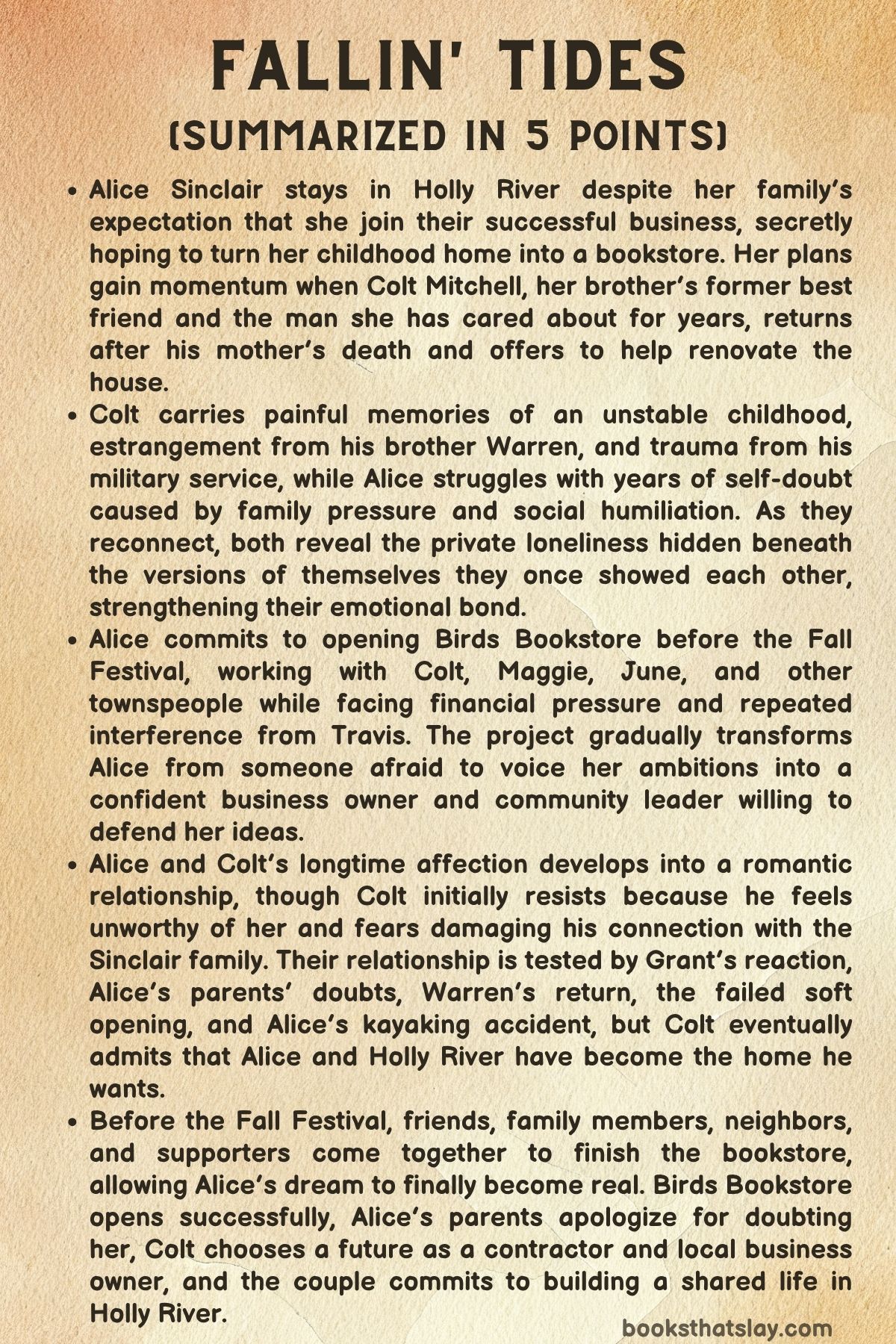
Alice Sinclair has remained in Holly River after graduating from Texas A&M, despite the expectation that she will move to Louisiana and join her family’s successful industrial HVAC company. She secretly dreams of converting her childhood home into a bookstore, but years of being taught to prioritize practical achievements have left her afraid that pursuing something creative will end in failure.
Her familiar life is disrupted when Colt Mitchell unexpectedly returns to Holly River. Colt was once her brother Grant’s closest friend and became almost another member of the Sinclair household after his troubled home life drove him to spend much of his adolescence with them.
Alice has carried feelings for Colt for years and continued writing letters to him after he joined the Marines. Colt answered for a time but eventually stopped, even though he privately kept Alice’s letters and reread them throughout his deployments.
Colt has returned because his mother, Eleanor, has died and left him the neglected property where he grew up. His childhood memories are painful because Eleanor struggled with alcoholism, his father abandoned the family, and his older brother Warren eventually left as well.
When Alice sees Colt at Holly Hall, years of separation disappear for a moment and she throws herself into his arms. Colt is startled by the adult woman Alice has become, while Alice is immediately embarrassed by how strongly she reacted to seeing him again.
Their renewed friendship quickly exposes the emotional history between them. Alice learns that Colt continues to carry anger, grief, and confusion regarding his mother, while Colt begins realizing that Alice’s cheerful letters never revealed how lonely she often felt during the years he was gone.
Flashbacks reveal how their bond began during childhood. Alice initially resented Colt because her parents praised his discipline and welcomed him so naturally into their household, but her attitude changed after witnessing Eleanor drunkenly mistreat him.
Unable to find the right words to comfort him, young Alice gave Colt a small figurine from a school project she treasured. Colt kept it for years, turning the object into a lasting symbol of the first time Alice recognized the pain he was hiding.
As they spend more time together in the present, Colt continues recognizing Alice’s tendency to find possibilities in difficult circumstances. She, in turn, sees that his guarded behavior comes from years of believing that he must protect others while expecting little emotional safety for himself.
Alice finally attempts to secure financing for her bookstore but is rejected by the bank. Instead of abandoning the project, she begins tearing into the house herself, determined to make progress even without certainty that she can finish.
Colt arrives during a storm and finds her beginning demolition alone. Rather than allowing her financial setback to end the project, he offers his carpentry skills and labor for free, giving Alice both practical assistance and the confidence to confront her parents with a serious proposal.
Her parents reluctantly agree to let her attempt the bookstore but impose a strict condition. Alice must have the business functioning successfully by Holly River’s Fall Festival or accept that the plan has failed, sell the house, and move toward the secure career her family originally intended for her.
The deadline creates enormous pressure, but it also forces Alice to stop treating the bookstore as an imaginary future. With Colt handling much of the construction and Alice developing the shop’s creative identity, the house gradually begins changing into a real commercial space.
Alice’s friends Maggie and June become essential partners in the effort. Maggie promotes the renovation online while June prepares ways for her bakery to collaborate with the bookstore, helping Alice recognize that her business can succeed by supporting the wider community rather than operating in isolation.
The project also creates conflict with Travis, a man connected to local real estate and municipal inspections. Travis repeatedly uses his position to delay the renovations, raising questionable objections and creating obstacles that become increasingly difficult to dismiss as ordinary bureaucracy.
His interference is particularly painful because Alice already has a traumatic history with him. During high school, Travis publicly humiliated her by reading aloud from an explicit romance novel she owned, contributing to a period when classmates mocked her and she became increasingly isolated.
Alice eventually tells Colt about those years and explains that the happiness he saw in her letters was something she deliberately searched for rather than evidence that her life was easy. Her optimism developed as a method of surviving loneliness, rejection, and disappointment without surrendering her ability to notice good things.
Colt also opens up about his military experiences. He explains how birds became signs of safety during deployments and finally discusses the friendly-fire incident that killed members of his gun team, leaving him with guilt and contributing to his decision to leave the Marines.
Their emotional intimacy makes their physical attraction increasingly difficult to suppress. Colt repeatedly pulls away because he feels indebted to the Sinclair family and worries that becoming romantically involved with Alice violates the place he once occupied within their household.
He also believes his traumatic experiences have made him unsuitable for someone whose hopefulness he admires. Alice refuses to accept that reasoning because she sees Colt’s pain without viewing it as evidence that he is less deserving of love.
Their restraint eventually fails after an evening at Holly Hall, and Colt kisses Alice while walking her home. The relationship remains uncertain, however, especially after Grant unexpectedly arrives and unknowingly becomes an obstacle to the privacy they need to discuss what has happened.
As renovation continues, Alice begins behaving more confidently in other areas of her life. At a Fall Festival planning meeting, she refuses to accept the possibility that the event should be canceled after a competing festival secures several attractions Holly River had expected to use.
Alice proposes redesigning the festival around the river and unexpectedly volunteers to lead the effort. The choice reveals that her personal transformation is expanding beyond the bookstore, because she is beginning to trust that her creative ideas can have public value rather than keeping them hidden to avoid criticism.
Meanwhile, she and Colt begin seeing each other secretly. Their growing relationship becomes increasingly serious, although both understand that romance could affect Colt’s relationship with the Sinclair family if things go badly.
Colt also begins questioning his assumption that he must sell his mother’s property and leave Holly River. Working on the bookstore has shown him that his practical abilities could become the basis of a different career, while his relationship with Alice gives him a reason to imagine staying.
Their bond becomes fully intimate shortly before the bookstore’s planned soft opening. What they try to dismiss as temporary comfort instead confirms that neither can realistically treat the relationship as casual.
Alice continues claiming more control over her life. She returns to tennis and discovers that the sport itself was never what she hated; what she hated was the constant criticism and pressure surrounding it.
She also confronts Travis about his past behavior, including an earlier incident in which he tried to force her into a bathroom before someone intervened. When Travis insults her, Alice walks away without allowing his judgment to determine how she sees herself.
Travis escalates his attempts to stop the bookstore, eventually demanding that Alice break open a wall based on questionable moisture readings. Alice takes the sledgehammer herself and destroys the section he identifies, declaring that she will repair every problem he finds rather than allow him to force her into giving up.
At the same time, Colt’s estranged brother Warren unexpectedly returns after being invited by Alice. Colt remains furious that Warren left him behind during their unstable childhood, but conversations between the brothers gradually reveal that Warren was also a frightened young person trying to escape circumstances he did not know how to survive.
The Halloween soft opening becomes disastrous. Alice’s parents arrive while the bookstore remains visibly unfinished, Warren appears intoxicated, and the Sinclair family discovers that Alice and Colt are romantically involved.
Alice’s father reacts by questioning whether anything inappropriate could have happened when Colt lived with the family while Alice was younger. The accusation devastates Colt because the Sinclairs were once the people who made him feel that he belonged somewhere.
Warren angrily defends Colt, Grant becomes involved, and multiple confrontations erupt. Colt ultimately leaves, while Alice’s parents interpret the unfinished bookstore as further evidence that she cannot successfully turn ambitious ideas into reality.
Alice is emotionally exhausted after the collapse of the opening. Colt eventually returns and promises to finish the bookstore, but he also reveals that he has received an offer for his mother’s property, suggesting that the practical reason keeping him in town may soon disappear.
Seeking relief from everything threatening her future, Alice goes kayaking with Colt. She explains why Holly River matters so much to her, arguing that books, traditions, festivals, and beautiful communal spaces can give people moments of comfort even when their private lives are difficult.
Colt finally understands that Alice’s optimism is not naïve. It is a conscious response to suffering, built by someone who repeatedly chose to look for reasons to continue rather than allowing loneliness to determine her entire view of life.
The outing turns dangerous when Alice chooses a more difficult section of the river and her kayak overturns. She strikes her head and loses consciousness, forcing Colt to rescue her and rush her to the hospital.
Although Alice survives with a concussion, the accident changes Colt profoundly. The possibility of losing her makes him realize that he cannot continue rejecting happiness because he believes he is unworthy of it.
Alice temporarily loses some of her usual emotional energy as well. Her recovery acknowledges that hope cannot erase exhaustion, fear, or disappointment and that sometimes she must allow other people to care for her instead of immediately turning every difficulty into reassurance.
Colt throws himself into completing Birds Bookstore while Alice recovers. He also begins repairing his relationship with Warren, recognizing that his brother’s departure cannot be understood only through the perspective of the abandoned child Colt once was.
Shortly before the Fall Festival, Alice finally tells Colt that she is terrified he will leave after everything they have built together. Colt tells her that he cannot leave because she has become his home, transforming their relationship from something temporary and uncertain into a clear commitment.
Fifteen hours before the bookstore is scheduled to open, completing everything still appears impossible. Then Maggie arrives with townspeople, friends, and social-media followers who have come voluntarily to help.
June, Dalton, Grant, Frank, Roxanne, Harold, Mrs. Devonshire, Warren, and many others work together to finish shelving books, installing fixtures, organizing systems, and completing the remaining construction. The community response forces Colt to reconsider his belief that people are primarily selfish and unreliable.
Everyone who helped signs the back of the permanent Birds Bookstore sign before it is installed above the entrance. For Alice, the finished shop proves that her imagination can become something concrete when she stops treating fear as a reason to remain inactive.
On Fall Festival morning, customers fill the bookstore, and Alice’s collaborative approach sends additional business toward Maggie and June as well. Her parents return and apologize for doubting her abilities and for how they treated Colt, finally recognizing that Alice’s unconventional thinking is one of her greatest strengths.
Colt has also created a future for himself. He plans to become a contractor, using the skills he discovered during the renovation, and he has purchased the electric picnic boats Alice originally wanted for her festival attraction so that he can build another local business around them.
He also designs a way for himself and Alice to live above the bookstore. Instead of following the futures other people once imagined for them, the two decide to create a shared life based on the work, community, and relationships they have consciously chosen.
As they float beneath the festival lights, Colt tells Alice that he loves her, and she returns the declaration. Their story ends with both characters remaining in Holly River, no longer treating the past as a current that must determine the direction of everything that comes next.
Characters
Alice Sinclair
Alice is the emotional center of Fallin’ Tides, a woman whose brightness initially appears effortless but is gradually revealed to be something she has consciously built in response to loneliness and pressure. Her childhood was dominated by expectations surrounding tennis, academic achievement, and eventually the assumption that she would join the family business, leaving her creative interests in books, drawing, and imaginative projects treated as less valuable.
Her greatest internal conflict is therefore not a lack of ambition but a lack of confidence in whether her own desires deserve to guide her life. The bookstore represents much more than a career choice because creating it requires Alice to stop waiting for parental approval before deciding what constitutes a meaningful future.
Alice’s optimism is one of her defining characteristics, yet the novel carefully separates optimism from innocence. She has been humiliated by classmates, neglected during periods when her parents focused on Grant, disappointed by Colt’s unanswered letters, and repeatedly made to question whether her interests are practical enough to matter.
She nevertheless trains herself to notice beauty and possibility because doing so gives her emotional control over experiences she cannot otherwise change. That quality explains why she can look at Eleanor’s troubled life and suggest that her attempt to stop drinking may represent an effort to change, even though Eleanor caused Colt considerable harm.
Alice also develops significantly as a leader. She begins the story frightened even to describe her bookstore dream, but eventually she is willing to confront banks, her parents, municipal obstacles, Travis, skeptical townspeople, and an overwhelming Fall Festival project.
Her confrontation with Travis is particularly important because she no longer protects him from accountability simply to avoid conflict. By naming what he did to her and refusing his romantic attention, Alice rejects the idea that other people get to define the meaning of her past.
Her relationship with Colt also demonstrates growing emotional courage. Instead of accepting his claim that he is too damaged for her, she insists that she is capable of deciding whom she wants, transforming herself from someone waiting to be chosen into someone actively choosing.
By the ending, Alice has not stopped being imaginative or hopeful; she has stopped apologizing for those qualities. Her bookstore, community leadership, friendships, renewed enjoyment of tennis, and commitment to Colt all show that she has finally built a life reflecting her own values.
Colt Mitchell
Colt is the other central figure in Fallin’ Tides, and much of his development concerns the difference between surviving and actually permitting himself to have a future. Childhood abandonment taught him that security could disappear quickly, while military trauma reinforced his belief that the world is dangerous and that attachment creates opportunities for devastating loss.
His relationship with Eleanor is intentionally complicated. Colt was harmed by her alcoholism and instability, yet her death leaves him grieving someone he cannot comfortably idealize or completely condemn.
This emotional contradiction explains why Alice’s compassionate interpretation affects him so strongly. She does not erase Eleanor’s failures but offers Colt a way to acknowledge that a damaged person may still contain efforts, regrets, and moments that resist a simple judgment.
Colt’s military history intensifies his self-punishing tendencies. The friendly-fire incident involving his gun team leaves him burdened by guilt, and he interprets what he has witnessed as evidence that Alice’s optimism should be protected from the darker parts of himself.
That belief is also why he stopped answering her letters. What he imagined as an act of protection was actually a withdrawal that left Alice giving emotional support without receiving similar honesty in return.
His return to Holly River forces him to confront that mistake. As he learns about Alice’s isolation during the years he was away, he recognizes that he misunderstood her optimism and treated her as someone untouched by pain rather than as another person carrying private wounds.
Construction becomes an important form of recovery for him because physical work produces visible evidence that damaged things can be repaired. Building shelves, repairing walls, organizing trades, and eventually planning a contracting career teach him that his abilities do not exist only for military service or emergency protection.
His romantic development requires a similar shift. Colt initially believes that loving Alice is selfish because of his debt to the Sinclair family and because he sees himself as too psychologically damaged to deserve her.
Eventually he understands that constantly leaving is not the same as protecting people. His decision to remain with Alice, reconcile partially with Warren, build a career, and participate in Holly River reflects a new willingness to belong somewhere without believing that belonging must first be earned through suffering.
Grant Sinclair
Grant occupies a complicated position in Fallin’ Tides because he functions simultaneously as Alice’s brother, Colt’s longtime best friend, and an example of how family attention can become uneven without deliberate cruelty. Throughout Alice’s childhood, much of the Sinclair household’s energy revolves around Grant’s football career, leaving Alice feeling that her interests matter less.
Grant does not initially understand the full consequences of this imbalance. His teasing about Alice’s books, his skepticism toward the bookstore, and his assumptions about Colt all reflect someone who has benefited from the family structure without always recognizing what it cost his sister emotionally.
His friendship with Colt is nevertheless genuine. Grant helped bring Colt into the Sinclair household and treated him as family, which makes Alice and Colt’s romantic relationship difficult for him to process because it changes a relationship structure he assumed was fixed.
The disastrous soft opening forces Grant into that conflict directly. His involvement in the confrontation with Warren shows how quickly loyalty can become defensive aggression when old assumptions are challenged.
Grant eventually adjusts. By joining the final effort to complete the bookstore and offering Colt awkward acceptance as Alice’s partner, he begins respecting Alice as an adult whose choices do not require his supervision.
His arc is quieter than those of Alice and Colt, but it remains significant because he learns that loving his sister means recognizing her independence rather than assuming that familiarity gives him authority over her future.
Warren Mitchell
Warren is one of the most emotionally complicated supporting figures in Fallin’ Tides because Colt understands him primarily through the memory of being abandoned. When Warren left home at eighteen, Colt experienced his departure as another confirmation that the people he depended on would eventually choose escape over him.
Warren’s return forces that childhood interpretation to confront an adult reality. Their conversations reveal that Warren was also a young person surviving hunger, neglect, instability, and an alcoholic parent, meaning his decision to leave cannot be understood only as a deliberate rejection of Colt.
His aggressive behavior creates additional conflict rather than immediately repairing anything. He arrives intoxicated at the bookstore opening, provokes arguments, fights with Grant, and eventually exchanges blows with Colt himself.
Yet Warren also displays fierce loyalty toward his brother. When Alice’s father questions Colt’s past behavior around Alice, Warren immediately defends him, recognizing how deeply the accusation attacks Colt’s sense of himself.
His participation in confronting Travis creates the first practical cooperation between the brothers in years. More importantly, his later arrival to help finish the bookstore allows reconciliation to occur through shared action rather than a sudden emotional resolution.
Warren therefore represents the possibility of repairing family bonds without pretending that abandonment never happened. Colt does not instantly forgive him, but he begins seeing Warren as a damaged participant in the same childhood rather than merely the person who left.
Maggie
Maggie plays an essential role in Fallin’ Tides because she consistently sees Alice’s abilities before Alice is prepared to trust them herself. As the owner of Pardon My Garden, Maggie understands the pressures facing Holly River’s small businesses and recognizes that Alice’s bookstore could become part of a larger effort to strengthen the town.
Her most important contribution is emotional honesty. She challenges Alice about Colt, questions what Alice intends to do with her future, and refuses to let her hide her ambitions behind vague excuses.
Maggie’s description of Alice as someone who sees wildflowers where others see weeds captures the quality that defines Alice throughout the novel. Instead of treating that perspective as impractical, Maggie frames it as a genuine ability that can be used in business and community leadership.
She also becomes crucial to the bookstore’s marketing. By documenting the renovation online, Maggie turns Alice’s private construction project into a story that develops an audience and ultimately contributes to the crowd of volunteers who appear before the final opening.
Maggie is equally willing to challenge Colt. She confronts him about ignoring Alice’s letters and later tells him that destroying himself through exhaustion will not help Alice recover, demonstrating that her loyalty includes saying what people may not want to hear.
Through Maggie, friendship becomes an active force rather than simple companionship. She helps Alice convert ideas into action while providing the kind of steady emotional support that Alice often lacked earlier in life.
June
June, the owner of Humble Pie, forms the other central part of Alice’s close friendship circle. Her presence contributes humor, warmth, business experience, and practical assistance throughout Alice’s attempt to establish the bookstore.
Alice’s partnership with June also demonstrates her developing entrepreneurial intelligence. Offering June’s baked goods through the bookstore allows both businesses to benefit, turning what could have been separate local ventures into complementary parts of a shared customer experience.
June participates in planning, decorating, emotional support, and the final effort to complete the store. She helps create the sense that Alice’s achievement is not purely individual but rooted in relationships with people willing to contribute their skills.
Her accidental revelation concerning Travis and Alice also triggers one of Colt’s most aggressive protective reactions. Although June is not responsible for the conflict that follows, the moment shows how thoroughly Alice’s friends have become part of the network surrounding both central characters.
Travis
Travis functions as the principal human antagonist of the story. His importance comes not only from the obstacles he creates in the present but from the way he represents the humiliation, entitlement, and powerlessness Alice experienced during adolescence.
His public reading of Alice’s romance novel helped turn something she loved into a source of social shame. The later revelation that he once tried to force her into a bathroom gives his past behavior an even more disturbing dimension and explains why Alice’s eventual confrontation with him carries such significance.
In adulthood, Travis has acquired institutional authority through his municipal role and connections to local real estate. He repeatedly uses inspections, delays, and questionable regulations in ways that appear designed to pressure Alice and interfere with her property.
His romantic interest in Alice makes that behavior especially troubling because he seems unable to understand why obstruction and entitlement would make her distrust him. When he later asks her out, he behaves as though his own desire should matter more than the history between them.
Alice’s refusal ultimately deprives Travis of the psychological power he once held over her. She no longer needs him to admit wrongdoing before she can identify what happened, and she no longer changes herself to avoid becoming the target of his judgment.
Eleanor Mitchell
Eleanor is absent from the present-day action because she has already died, yet she remains enormously important to Colt’s emotional life. Her alcoholism created a childhood environment marked by neglect, unpredictability, humiliation, and fear.
The novel refuses to reduce her entirely to those failures. Her apparent attempt to stop drinking before her death raises the possibility that she recognized what addiction had done and was trying, however unsuccessfully, to change.
Alice’s interpretation gives Colt room to grieve without pretending that Eleanor was a good parent. That distinction matters because Colt has difficulty understanding why he should mourn someone who caused him so much pain.
Eleanor therefore represents the emotional complexity of loving a person who has also harmed you. Colt’s recovery depends partly on accepting that grief does not require him to rewrite his childhood or excuse what happened.
Mr. Sinclair
Alice’s father is both a source of security and a source of pressure. He provides opportunities for his children, welcomes Colt into the family, and reassures the teenage Colt that he never needed to prove his worth in order to deserve the Sinclairs’ care.
His relationship with Alice is more difficult because he tends to measure success through practical achievement. The family business offers a safe and prosperous path, so Alice’s desire to build a bookstore initially appears unnecessarily risky from his perspective.
His reaction to Alice and Colt’s relationship becomes one of his most serious mistakes. By questioning whether Colt could have behaved inappropriately when Alice was younger, he attacks the integrity of someone he once treated like family and fails to respect Alice’s ability to describe her own history.
His later apology is therefore important. By recognizing Alice as a visionary and accepting Colt as someone they would be fortunate to have in her life, he begins replacing paternal control with respect for the adult person his daughter has become.
Mrs. Sinclair
Alice’s mother is strongly associated with the performance pressure Alice experiences from childhood onward. Even after Alice performs well in tennis, her mother immediately focuses on errors and areas for improvement, teaching Alice to experience achievement as something that can always be judged insufficient.
This pattern contributes heavily to Alice’s fear of creative failure. A bookstore cannot offer the measurable security of the family company, making it the kind of project Alice has learned to expect others to criticize before she has even tried.
Her mother is not presented as someone who wants Alice to suffer. Instead, she appears convinced that discipline, stability, and conventional success are forms of protection.
The problem is that this approach leaves little room for Alice to discover what she wants independently. Her eventual support and apology therefore matter because they signal growing recognition that protecting Alice cannot mean designing her life for her.
Dalton
Dalton is one of the familiar faces who reconnects Colt with Holly River after his return. As Colt’s former football teammate and the owner of Holly Hall, he helps draw Colt back into a community Colt initially expects to leave as quickly as possible.
His establishment becomes an important social space where Alice, Colt, Maggie, June, and others repeatedly gather. Several major stages of Alice and Colt’s relationship develop there, including jealousy, dancing, emotional conversations, and their eventual first kiss afterward.
Dalton also participates in the final effort to complete the bookstore. His presence reinforces the idea that Colt’s return has restored connections he previously assumed belonged only to his past.
Frank
Frank, the eccentric owner of The Buttermilk Cafe, provides comic relief while also representing Holly River’s familiarity and continuity. He remembers Colt immediately and asks blunt questions that make it difficult for Colt to remain emotionally anonymous after returning.
Frank’s affection for Alice is evident through the environment in which she works. The cafe functions as another place where Alice is recognized and valued for who she already is rather than primarily for what she might achieve.
His participation in the final bookstore effort further establishes him as part of the informal community that supports Alice. Although he does not undergo a major personal arc, his presence contributes to the sense that Holly River is held together through accumulated everyday relationships.
Harold
Harold plays a small but important role during the permitting conflict. When Travis attempts to impose questionable requirements on Alice’s bookstore renovation, Harold challenges the reasoning and helps prevent municipal authority from becoming an unchecked tool of obstruction.
His intervention demonstrates that institutions are not automatically hostile simply because one person within them abuses influence. Individuals still have the capacity to question unfair behavior and insist on reasonable treatment.
Harold later joins the group completing Birds Bookstore before the Fall Festival. That continuity turns his earlier bureaucratic assistance into a more personal expression of community support.
Mrs. Devonshire
Mrs. Devonshire represents the customers and townspeople who understand the social value of Alice’s bookstore before its financial success has been proven. Her enthusiasm, particularly for access to romance novels, validates the very kind of reading that once became a source of humiliation for Alice.
That detail creates an important contrast with Alice’s adolescence. Something Travis once used to shame her becomes part of the identity of a public space where readers can enjoy their interests openly.
Mrs. Devonshire’s participation in the final completion effort further confirms that the bookstore has already become meaningful to people before its official opening.
Roxanne
Roxanne is associated primarily with the organization of the Fall Festival and therefore with Alice’s emergence as a civic leader. When expected attractions are lost to a competing event, Roxanne considers canceling rather than delivering a disappointing festival.
Her uncertainty creates the opportunity for Alice to step forward. Alice proposes rebuilding the event around the river and volunteers to take responsibility, transforming herself from a hesitant meeting participant into one of the people shaping Holly River’s future.
Roxanne later joins the community effort at Birds Bookstore, showing that Alice’s willingness to support the town inspires reciprocal support when Alice herself needs help.
Themes
Choosing Your Own Life
For much of the novel, Alice lives inside a future that other people have already designed for her. Her education, family business, tennis career, and expectations surrounding practical achievement all suggest that success means fulfilling established plans rather than asking what kind of life she actually wants.
Opening the bookstore therefore becomes an act of personal authority rather than merely an entrepreneurial project. Alice must decide that wanting something is sufficient reason to attempt it even when success is uncertain and even when people she loves believe another path would be safer.
This idea also appears in Colt’s development. His identity has long been shaped by circumstances that demanded reaction: surviving his mother’s alcoholism, coping with abandonment, joining the Marines, enduring combat, and returning home to settle an estate after Eleanor’s death.
He initially assumes that leaving Holly River is simply the next step because departure has become his default response whenever attachment becomes dangerous. Building the bookstore introduces another possibility because creation requires him to remain present long enough to imagine what comes after survival.
By the conclusion of Fallin’ Tides, both characters reject lives chosen primarily through fear. Alice refuses the secure career others prefer for her, while Colt decides that remaining with Alice, becoming a contractor, creating a river business, and living above the bookstore are choices he is allowed to make.
Their shared future matters because neither person simply joins the other’s predetermined life. They create something new together, demonstrating that adulthood sometimes requires distinguishing gratitude toward family and history from permanent obedience to the paths those forces once established.
Optimism as an Act of Resistance
Alice’s optimism initially seems like a natural personality trait because she consistently searches for hopeful interpretations of difficult situations. As more of her history emerges, however, it becomes clear that her positivity developed through conscious effort rather than protection from suffering.
She experienced social humiliation, parental absence, pressure to perform, loneliness, and years of uncertainty regarding Colt. Instead of proving that she has never understood darkness, her optimistic habits reveal how actively she has resisted allowing painful experiences to dictate her complete perception of the world.
Colt initially misunderstands this quality. During his deployments, he reads Alice’s upbeat letters and concludes that she possesses an innocence he must protect from the things he has witnessed, which partly motivates him to stop responding.
Learning about Alice’s actual experiences forces him to reconsider that assumption. Her hope exists alongside knowledge of cruelty and disappointment, making it a form of psychological endurance rather than ignorance.
The river metaphor strengthens this idea. Alice’s interest in tidal forces capable of temporarily reversing a river’s current reflects her belief that powerful directions are not always permanent, even when they appear impossible to resist.
Her philosophy is eventually tested after the failed opening, conflict with her parents, and kayaking accident leave her unable to manufacture reassurance immediately. The story does not treat this temporary collapse as failure; instead, it acknowledges that optimism remains healthiest when it allows room for exhaustion, grief, anger, and assistance from others.
Home, Family, and Belonging
Home is repeatedly presented as something more complicated than a building or biological relationship. Colt grows up in a house that provides little emotional safety, while the Sinclair household becomes the place where he eats, spends holidays, plays sports, and experiences the ordinary stability missing from his own family.
Alice’s childhood photo album labeled “Family” captures this idea directly. By including Colt in those memories, she recognizes him as belonging long before he is emotionally capable of accepting that he deserves a place within the Sinclair family.
Yet belonging becomes fragile when Alice’s father questions Colt’s past intentions after discovering the romantic relationship. The accusation is so devastating because it threatens not only Colt’s romance with Alice but also his interpretation of years he had come to regard as evidence that the Sinclairs truly considered him one of their own.
Warren complicates the same theme from another direction. Colt has defined his brother through abandonment, yet their adult confrontations gradually reveal that Warren was also a child formed by the same unstable home and was trying to escape circumstances that exceeded his ability to manage them.
The bookstore eventually becomes a new model of home because it is built through chosen relationships. Friends, relatives, neighbors, and strangers physically participate in finishing the space, while Colt and Alice later plan to live above it.
Home therefore becomes less about receiving unconditional security from a perfect family and more about creating mutual belonging among imperfect people. Forgiveness does not erase what happened, but renewed relationships become possible when people stop assuming that the worst thing someone did must permanently define every connection.
Community, Creativity, and Rebuilding
The renovation of Birds Bookstore provides the clearest physical expression of transformation in Fallin’ Tides. Alice begins with a private sketchbook full of plans she is afraid to show anyone, and the completed shop ultimately becomes a public place created through cooperation among nearly everyone important to her.
The construction process reflects both Alice and Colt’s internal changes. Walls must be opened, structural problems discovered, repairs made, shelves built, permits secured, and unfinished work exposed before the building can become functional.
Alice goes through a similar process by confronting old insecurities instead of disguising them, while Colt begins examining beliefs formed by childhood abandonment and military trauma rather than continuing to escape whenever those beliefs are challenged.
Creativity also becomes a practical economic force. Alice’s bookstore collaborates with Maggie’s flower shop and June’s bakery, while her river-centered Fall Festival strategy transforms imagination into a community plan capable of attracting visitors and supporting local businesses.
The final night before opening makes the communal dimension unmistakable. Alice and Colt cannot finish everything alone, and the project succeeds only when friends, family members, townspeople, and online supporters contribute their labor.
That moment challenges both protagonists in different ways. Alice learns that accepting help does not make her achievement less legitimate, while Colt receives direct evidence against his belief that people are fundamentally selfish or unreliable.
The finished bookstore therefore represents more than personal success. It shows how individual dreams can become communal structures when people allow creativity, labor, generosity, and mutual dependence to work together, turning an abandoned possibility into something capable of sustaining both private lives and an entire town.