A Tangled Magic Summary, Characters and Themes
A Tangled Magic by Andrea Eames is a fantasy novel about Persinette “Netta” Edevane, a young woman raised in isolation by a mother who has shaped nearly every belief she holds about magic, history, and herself.
When violence destroys the security of Netta’s secluded life, she enters a wider world filled with forbidden abilities, political schemes, religious authority, and competing versions of the past. Her search for her missing mother gradually becomes a search for the truth about her own origin. At its center, the book examines personal choice, institutional control, inherited beliefs, and the difference between possessing power and deciding how that power should be used.
Summary
Persinette “Netta” Edevane has spent almost her entire life inside an isolated Tower with her mother, Margotte. Margotte is a brilliant and obsessive magical researcher who has devoted years to producing an enormous pale spellbook, while Netta has grown up believing that proper magic must be written into books and controlled through carefully regulated forms of sacrifice.
Netta cannot read because written letters refuse to remain stable in her mind, something Margotte has treated as evidence that her daughter is slow or inadequate. Yet Netta possesses an extraordinary memory for spoken words, remarkable skill in bookmaking and embroidery, magically active Hair, and an unusual connection with animals, especially a raven named Baldbeak whom she can understand telepathically.
Netta’s sheltered existence ends when two men invade the Tower. Her Hair kills one attacker while the other escapes, and Netta discovers that Margotte has disappeared along with the great spellbook that had dominated her mother’s life; with only a few clues, including the word “Quell,” Margotte’s correspondence, and three strands of her hair, Netta leaves home for the first time.
On the journey, Netta quickly learns how little she understands ordinary society. She meets Patrick, a clever traveler who initially presents himself as a wandering magician, and although he helps her after a ferryman takes advantage of her, his casual attitude toward magic immediately challenges the strict ideas Margotte taught her.
Patrick directs Netta toward Mieka in Quell and suggests that she travel with a group of wandering religious Followers. Through them, Netta learns that the official history of Virelith may be incomplete: bone magic was once powerful and costly, the Temple gained enormous authority after the ancient Plague, and practices now described as unquestionably dangerous may have been deliberately simplified or distorted.
In Quell, Netta examines an important embroidered historical display maintained by the Temple and notices that its stitches have been altered. The discovery suggests that history itself has been physically rewritten, strengthening Netta’s suspicion that the society Margotte described to her rests upon controlled information rather than unquestionable truth.
Mieka introduces Netta to a hidden world of smugglers, forbidden practitioners, and people whose magical affinities exist outside Temple approval. Netta’s embroidery begins revealing itself as a form of magic, and when a priest threatens Baldbeak, Netta instinctively uses another terrifying power that allows her to harm a person’s body without touching him.
Seeking information about Margotte, Netta finds the mysterious Book Man, whose secret shop is concealed inside an abandoned crematorium. He treats Netta’s inability to read with considerably more respect than Margotte did and recognizes her practical intelligence, while his own affinity for books proves that forbidden magical talents are neither imaginary nor automatically corrupt.
The Book Man eventually explains that he once participated in attempts to resist the Temple’s control over magic. He also reveals that an ambitious former apprentice became interested in bone magic, and when Netta instinctively changes a spell by altering its physical stitching, he realizes that her embroidery can function as a magical language capable of rewriting spellcraft itself.
Netta’s growing independence is complicated by Patrick’s return. During Quell’s Plaguenight celebration, she discovers that he is actually Patrick Ladran Foley, a wealthy and powerful nobleman with a genuine shadow affinity and close political connections; he has known far more about Margotte, the Tower, and the struggle over magic than he admitted.
Soon afterward, the Book Man’s shop burns, and Netta believes he has been killed. Sybil Edevane then appears, revealing herself as Margotte’s younger sister and taking Netta to the wealthy Edevane family estate, where Netta initially hopes that she has finally found the family and security denied to her during childhood.
That hope disappears quickly. Sybil becomes fascinated by Netta’s memory and magical potential, restricts her movements, demonstrates her abilities before politically important guests, and begins treating her as a valuable family asset rather than a niece.
Sybil intends Netta to marry Ban Morin, a powerful lord whose magic allows him to connect himself to another practitioner and draw upon that person’s power. Morin subjects Netta to painful magical experiments, while Sybil uses physical punishment to enforce obedience, making it clear that both see Netta’s body, bloodline, memory, and magic as resources they have a right to control.
Mieka, secretly placed inside the house with Patrick’s assistance, helps Netta investigate the Edevane family’s hidden library. There they discover extensive research into bone magic, confirming that the family has been involved in forbidden practices far more deeply than Sybil has admitted.
Netta eventually escapes by invoking the sanctuary traditionally offered by the Followers, but Morin’s men pursue them and attack their camp. During the violence Baldbeak is struck down, and Netta, overwhelmed by grief and fury, uses her mysterious power to break the bones of the men pursuing her.
Then something even more extraordinary happens. Refusing to accept Baldbeak’s death, Netta instinctively senses the structure of his body as if she were repairing embroidery, restores his broken bones and damaged flesh, and brings him back to life.
Patrick helps Netta escape again, and when he removes a magically connected engagement ring that tears her finger open, Netta heals herself by mentally stitching the wound together. These acts confirm that her abilities belong to the forbidden realm of bone magic, although they do not resemble the monstrous form of it described by official history.
Netta and Patrick travel to Spire searching for information about Margotte’s work. Their investigation reveals experiments involving bones, blood, skin, animals, and human remains, but it also produces a disturbing discovery: Margotte had been corresponding with dangerous practitioners herself, and the completed spellbook appears to have been intended for the Pontiff.
As Ban Morin’s forces continue hunting her, Netta travels through buried portions of the ancient Corpse Roads. The bones within them respond directly to her, confirming that she does not require normal spellscript, spoken formulas, or conventional magical sacrifices to reach the power growing inside her.
At Mirthwater, Patrick takes Netta to the royal court and introduces her to the seriously ill King Colin. Believing that the king’s death could produce political disaster, Patrick proposes that Netta marry Colin and perhaps use her healing abilities to save him; if Colin dies, the marriage might also give Netta a claim capable of stabilizing the kingdom.
Netta is furious because Patrick’s proposal repeats the same pattern she has already experienced with Sybil and Morin. However noble his political intentions may be, he has still decided that her body, abilities, and future should be arranged according to what he considers useful, so she rejects his plan and approaches the Pontiff independently.
The Pontiff reveals that Margotte was not simply kidnapped by Temple agents. She had made an agreement with them and offered access to powerful bone magic, while the Temple itself intends to release a controlled form of Plague and then defeat it publicly so that fear will restore its weakened authority.
Netta is imprisoned but discovers that the Book Man is alive in a nearby cell. He explains that Margotte was once his apprentice, became obsessed with possessing bone magic, and stole forbidden research after he attempted to abandon it; with Baldbeak’s help, Netta reshapes a small bone into a key, escapes, and descends toward the catacombs where Margotte’s spellbook is being kept.
There Netta watches the Pontiff, Sybil, and Ban Morin attempt to activate the great volume. The spellbook begins constructing a body from bones, blood, muscle, skin, and hair until Margotte herself emerges from it, still connected to the magical object she spent years creating.
The sight restores Netta’s missing memories. Margotte had expected the men who came to the Tower and had begun the final stage of her experiment before their arrival; Netta was not simply intended to help produce the spellbook but had been raised as part of its magical design and was meant to participate in its sacrifice.
Netta had resisted. During the struggle she tore three hairs from Margotte, disrupted the ritual, and accidentally caused her mother to become trapped inside the book, after which the trauma erased her memory of what had actually happened.
Margotte finally admits that Netta’s entire upbringing served her research. Even Netta’s creation involved deliberately drawing bone magic into her, meaning that Margotte had designed her daughter to become a vessel rather than simply raising a child who happened to develop unusual powers.
Margotte attempts to take control of bone magic for herself, but Netta understands something her mother never did. Magic has repeatedly been imprisoned, exploited, categorized, and treated as property, so instead of demanding obedience from it, Netta offers it the freedom to choose.
Bone magic chooses Netta. Margotte’s constructed body collapses as the power leaves her, and Netta uses her new connection not to create an army or dominate others but to build an enormous Bone Bird that carries her, Patrick, and Baldbeak away from the collapsing catacombs.
Back at the palace, Netta begins confronting the consequences of what she has become. Mieka reminds her that Margotte’s intentions do not define her identity, while King Colin treats her choices with greater respect than the people who previously attempted to arrange her life.
Netta also confronts Patrick, who reveals that he kept the embroidery Baldbeak once carried from the Tower and that Netta’s own magical desire to be found had helped guide him toward her. Their feelings remain unresolved but genuine, and although they share another kiss, Netta refuses to make romance the foundation of her newly independent life.
Instead, Netta decides to return to the Tower with the Book Man and examine Margotte’s research for herself. She leaves with Baldbeak aboard the Bone Bird understanding that she may carry immense and dangerous power, but for the first time the direction of her life belongs to her.
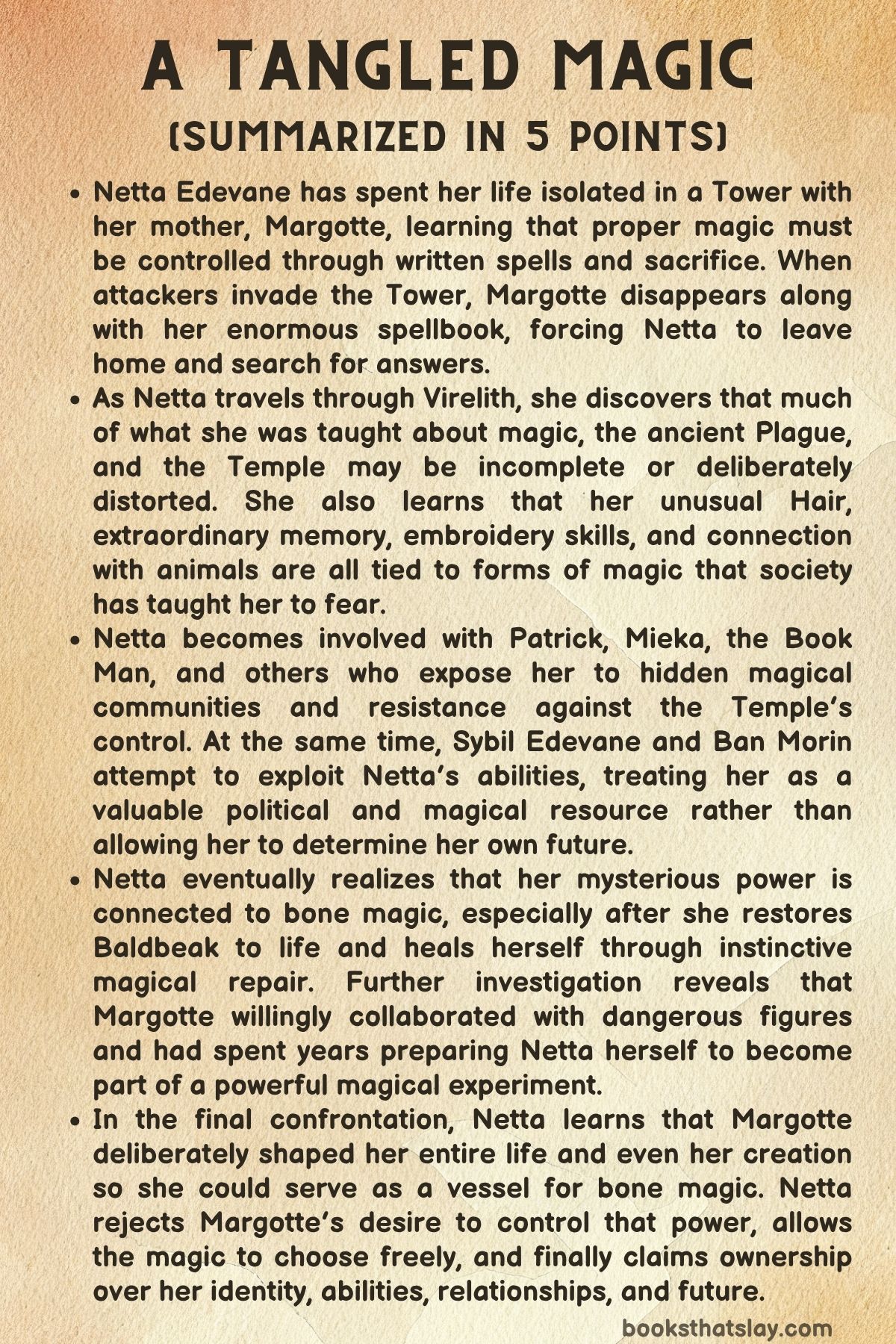
Characters
Persinette “Netta” Edevane
Netta is the emotional and moral center of A Tangled Magic, and her development is built around the gradual separation of her identity from the definitions imposed on her by other people. At the beginning, she has absorbed Margotte’s judgment so thoroughly that she interprets her inability to read as proof of intellectual failure, even though she possesses exceptional memory, artistic skill, practical knowledge, magical intuition, and tremendous emotional sensitivity.
Her journey repeatedly forces her to discover that qualities dismissed as weaknesses are actually forms of intelligence. Embroidery becomes a language through which she can understand and alter magic, her memory allows her to reproduce complicated spells without reading them, and her compassion toward animals becomes especially significant through her connection with Baldbeak.
Netta’s deepest conflict is not simply whether she will become powerful but whether she will remain the owner of her own life after becoming useful to powerful people. Margotte, Sybil, Ban Morin, Patrick, and the Pontiff all differ in morality and intention, yet each at some point views Netta partly according to what her abilities can accomplish.
Her final transformation therefore depends on choice rather than strength. By rejecting Margotte’s attempt to treat magic as property and offering bone magic a partnership instead, Netta proves that the defining quality of her character is her refusal to reproduce the systems that harmed her.
Margotte Edevane
Margotte is both Netta’s mother and the central source of the psychological damage Netta must overcome. She is intellectually brilliant, disciplined, ambitious, and capable of extraordinary magical research, but those qualities become destructive because knowledge and achievement matter more to her than the independent humanity of the people around her.
Her treatment of Netta reveals a particularly disturbing form of control because it is disguised for years as education and parental purpose. She tells Netta that their work is sacred, criticizes the traits she cannot use, isolates her from ordinary relationships, and shapes her daughter’s entire understanding of reality so that obedience appears natural.
The revelation that Netta was deliberately created and raised as part of Margotte’s magical project changes the meaning of their relationship. Within A Tangled Magic, Margotte represents the extreme consequence of treating another person as the means to an intellectual or ideological goal, even when the controller believes that goal is historically important.
Her final failure also exposes the weakness in her understanding of magic. Margotte assumes that greater knowledge gives her the right to possess power, while Netta succeeds by recognizing that power capable of choice cannot ethically be reduced to ownership.
Patrick Ladran Foley
Patrick is one of the book’s most complicated figures because he combines genuine care with a persistent belief that manipulation can be justified by desirable outcomes. He first appears as an entertaining and resourceful traveler, but his later identity as a wealthy nobleman, shadow mage, and political operator reveals that nearly every early interaction with Netta contained information he deliberately withheld.
His attraction to Netta is real, and so is his desire to protect her. He repeatedly places himself in danger to help her, arranges Mieka’s presence inside Edevane House, assists her escape from Morin’s forces, and remains beside her even after she directly rejects his political reasoning.
Yet Patrick’s greatest weakness is his habit of deciding what other people should do before asking what they actually want. His proposal that Netta marry King Colin is motivated by fear of political collapse rather than personal greed, but Netta correctly recognizes that good intentions do not erase the fact that Patrick has once again converted her future into a strategic calculation.
His development becomes meaningful because he eventually has to face the limits of his own authority. The growing possibility of a relationship between him and Netta depends not on his rescuing her but on his learning that affection cannot substitute for consent.
Baldbeak
Baldbeak begins as Netta’s secret companion but becomes one of the clearest symbols of the life she chooses for herself. Their friendship is not arranged by Margotte, the Temple, the Edevanes, or any political faction; it begins because Netta sends part of herself into the world hoping to be found, and the raven responds.
His importance is emotional as well as practical. Baldbeak gives Netta companionship during her isolation, scouts dangerous situations, carries objects and messages, helps her escape imprisonment, and repeatedly places himself in danger for her.
His death and restoration mark one of the most important moments in Netta’s understanding of her abilities. She does not revive him because she wants to prove her power or perform an experiment but because she cannot accept the destruction of a being she loves.
The fact that Baldbeak returns as himself also challenges the assumption that bone magic must automatically create monstrosity. Through him, the story demonstrates that the moral nature of magic may depend greatly on intention, relationship, and choice.
Mieka
Mieka represents one of Netta’s first experiences of friendship outside the controlled environment of the Tower. Practical, socially confident, and familiar with Quell’s illegal magical world, she gives Netta access to people and ideas Margotte taught her to fear.
What makes Mieka especially important is that her loyalty survives Netta’s suspicion. Once Netta discovers Patrick’s hidden identity, she worries that Mieka’s friendship may also have been arranged, but Mieka insists that whatever role Patrick played in bringing them together, her affection and concern have become genuinely her own.
Her actions support that claim. She infiltrates Edevane House, witnesses the effects of Morin’s experiments, helps Netta enter the hidden library, warns her about the danger she faces, and repeatedly offers assistance without demanding ownership over Netta’s decisions.
Mieka also provides an ideological alternative to shame. She believes people should be able to acknowledge magical affinities openly, making her friendship essential to Netta’s gradual rejection of the fear Margotte built into her understanding of herself.
The Book Man
The Book Man functions as mentor, historian, survivor, and living connection to Margotte’s past. His hidden bookshop initially appears strange and dangerous, but for Netta it becomes one of the first places where her knowledge is recognized without being measured against her inability to read.
He respects craftsmanship, understands the magical character of books, and recognizes that Netta’s way of thinking has value. This makes his mentorship notably different from Margotte’s because he responds to what Netta can actually do rather than continually defining her by what she cannot.
At the same time, the Book Man is not free from responsibility for the dangerous history surrounding bone magic. He once participated in resistance to the Temple and researched forbidden power before becoming frightened by its consequences, meaning that his later caution comes from personal involvement rather than detached wisdom.
His survival after the burning of his shop allows him to give Netta crucial information about Margotte. By the end, his willingness to return to the Tower with Netta suggests a relationship based on shared investigation rather than control.
Sybil Edevane
Sybil initially presents herself as the respectable relative capable of rescuing Netta from the chaos created by Margotte’s disappearance. Her elegance, wealth, family connection, and apparently generous hospitality give Netta a temporary hope that belonging to the Edevane family might offer the security she has always lacked.
That appearance collapses once Sybil realizes the extent of Netta’s abilities. She restricts Netta’s movements, turns her magical memory into a public demonstration, attempts to arrange her marriage to Ban Morin, and ultimately uses pain as a method of correction.
Sybil is especially disturbing because her control is socially polished. Unlike an obvious attacker, she uses family obligation, clothing, servants, marriage arrangements, etiquette, and magical instruction to convert imprisonment into something that can initially resemble protection.
Her character shows how exploitation can operate through respectable institutions as effectively as through open violence. She does not need to deny Netta’s value because her purpose is to define that value entirely according to family and political usefulness.
Ban Morin
Ban Morin embodies possession in its most direct and physically destructive form. His magical ability allows him to attach himself to another practitioner and draw upon that person’s power, making his supernatural talent a direct reflection of his attitude toward human relationships.
He does not treat Netta’s suffering as morally significant. During his experiments, pain becomes information, exhaustion becomes evidence, and resistance becomes proof that her abilities are developing.
His proposed marriage to Netta would give social and religious legitimacy to the same process. Rather than seeing marriage as companionship, Morin regards it as a structure through which he can secure long-term access to a uniquely powerful magical resource.
His pursuit of Netta even after she claims sanctuary with the Followers shows how little meaning he gives to limits that obstruct his desires. Morin therefore becomes one of the clearest examples of power without respect.
King Colin
King Colin spends much of the story less as an active political force than as the vulnerable center of a succession crisis. His serious illness creates uncertainty throughout Virelith because nobles, the Temple, and Patrick all understand that his death could radically alter the balance of power.
Netta initially encounters him through other people’s plans. Patrick’s proposal that she marry Colin reduces both of them, in different ways, to pieces in a political solution: Netta becomes a source of healing and legitimacy, while Colin becomes a throne whose survival must be secured.
Yet Colin himself appears more respectful of Netta’s independence than many of the supposedly healthier and more powerful people around her. By the end, even the possibility of marriage is presented as something that would have meaning only if Netta eventually chose it.
His character therefore helps distinguish political necessity from personal consent. A crisis may explain why other people want a particular outcome, but it cannot automatically create the right to demand that outcome from someone else.
The Pontiff
The Pontiff represents institutional power stripped of its moral justification. As the leader of the Temple, he stands at the center of an organization that publicly claims to protect society from uncontrolled magic while privately considering the deliberate creation of magical danger.
His plan to release a limited version of the Plague and then defeat it reveals the logic of rule through fear. If people can be convinced that catastrophe is always near and that only the Temple can save them, dependence on the institution can be restored.
This makes the Pontiff particularly important to the story’s treatment of history. The Temple does not merely misunderstand the past; its leaders are willing to manufacture events in the present to produce the political interpretation they need.
His dealings with Margotte also show that supposedly absolute moral prohibitions become negotiable when forbidden power is useful to those already in authority. The Pontiff condemns uncontrolled magic publicly while seeking to control its most feared form privately.
Zlata
Zlata is closely associated with Mieka’s life in Quell and offers a more cautious response to political resistance. While Mieka believes people need to challenge the shame surrounding affinities and unsanctioned magic, Zlata worries that involvement with organized opposition will get Mieka killed.
Her fear is not presented as simple cowardice. The violence that later surrounds Netta, the Temple, Ban Morin, and those who resist them demonstrates that challenging powerful institutions carries genuine physical consequences.
Zlata therefore contributes an important practical perspective to the story’s politics. Resistance may be morally necessary, but the danger paid by ordinary participants is real and cannot be dismissed merely because the cause is just.
Priest Herlind
Priest Herlind introduces Netta to a religious tradition that exists outside the Temple’s dominant account of history. His willingness to welcome her among the Followers gives Netta both physical protection and exposure to beliefs about death, magic, and the Corpse Roads that differ from those she learned at the Tower.
His role is significant because he does not simply replace one absolute doctrine with another. Instead, the knowledge Netta receives from the Followers encourages her to recognize that official narratives can be questioned and that beliefs pushed to the margins may preserve information powerful institutions have suppressed.
Through Herlind and the wider Follower tradition, travel itself becomes educational for Netta. Leaving the Tower means encountering people whose existence proves that Margotte’s explanations were never the only possible way of understanding the world.
Dwale
Dwale is one of Patrick’s associates and helps expose the scale of Patrick’s hidden social position. His teasing makes it increasingly difficult for Netta to maintain the image of Patrick as a wandering magician without wealth or influence.
He also accompanies the group during a period when Netta is moving closer to the political center of Virelith. Although he does not dominate the plot, his presence helps show that Patrick operates through a broader network of relationships and resources than Netta initially understood.
Dwale therefore contributes to one of Netta’s recurring lessons: people can appear radically different depending on how much information they choose to reveal. His familiarity with Patrick provides a view of the nobleman that Netta could never obtain from Patrick’s carefully constructed first impression.
Tamara
Tamara preserves dangerous knowledge beneath Spire, making her an important representative of information that survives outside official institutions. Her hidden workshop contains evidence about experiments involving bones, blood, skin, animals, human remains, and unusually powerful magical books.
Through her material, Netta and Patrick discover stronger connections between Margotte and forbidden research. The evidence also shows that Margotte’s work was not an isolated private obsession but part of a wider history involving practitioners, institutions, smugglers, and secret exchanges of knowledge.
Tamara’s role emphasizes the uncertain moral character of hidden information. Suppressed knowledge can expose lies and challenge unjust authority, but it can also preserve methods capable of terrible exploitation.
Tarrow
Tarrow is one of the men involved in the attack on the Tower and becomes the first person Netta kills. His death occurs when her Hair hurls him from the window during her attempt to defend herself, making the moment frightening precisely because Netta does not fully understand either the situation or the strength of her own magic.
Although Tarrow has limited personal development, his death has lasting consequences. A relative later confronts Netta seeking revenge, connecting the violence at the Tower to the wider pursuit surrounding her.
Tarrow’s role also contributes to the gradual reversal of Netta’s understanding of the opening attack. What initially appears to be a straightforward assault is later revealed as the chaotic result of Margotte’s prior arrangements and failed ritual.
Cambrick
Cambrick survives the events at the Tower and becomes an important source of information for those pursuing Netta. Because he can identify her and describe what happened, the violence of the opening continues to follow her even after she leaves the Tower.
Like Tarrow, Cambrick is more important to the plot’s chain of consequences than to its emotional center. His survival ensures that Netta cannot simply leave the first confrontation behind and begin again anonymously.
His existence also reminds the reader that Netta’s limited knowledge shapes the earliest interpretation of events. She initially understands the intruders only as mysterious attackers, while later revelations show that the situation surrounding their arrival was far more complicated than she knew.
Themes
Autonomy and the Right to Choose
Netta repeatedly encounters people who believe that recognizing her value gives them some claim over her future. Margotte wants to use her as part of a magical experiment, Sybil sees her as an Edevane asset, Ban Morin wants permanent access to her power, Patrick proposes a politically useful marriage, and the Pontiff imagines incorporating her abilities into the Temple’s plans.
The central conflict of A Tangled Magic therefore concerns the difference between being needed and being free. Several characters can give persuasive reasons for wanting Netta to act in particular ways, but the story continually separates the usefulness of an outcome from the moral right to force someone into producing it.
Netta’s development depends on learning to distrust arrangements in which other people decide first and ask for her consent afterward. This is why Patrick’s proposal hurts her even though his motives are far less cruel than Morin’s: from Netta’s position, both men have looked at her abilities and designed a future around them.
Her final relationship with bone magic provides the strongest answer to this pattern. Instead of forcing the power to obey her, Netta gives it the freedom to choose, and that choice creates the partnership Margotte could never achieve through control.
Control of History and Knowledge
History in the story is not merely a record of what happened; it is one of the principal ways institutions decide what people are permitted to believe. Netta grows up with a clear explanation of the Plague, bone magic, the Temple, legitimate spellcraft, and magical sacrifice, only to discover that nearly every part of that explanation contains omissions or distortions.
Her ability to detect alterations in the Temple’s embroidered historical display makes this idea literal. Someone has physically changed the representation of the past, showing that public memory can be revised carefully enough that later generations mistake alteration for truth.
The Temple benefits enormously from this control because fear of the Plague supports its authority over magic. The Pontiff’s later willingness to manufacture a new magical crisis proves that controlling history and controlling present events are related strategies: both allow an institution to create the explanation that best preserves its position.
Hidden libraries, illegal bookshops, smugglers, forbidden workshops, and the Followers all become important because they preserve competing forms of memory. Yet the story does not suggest that secret knowledge is automatically virtuous, since Margotte’s research proves that information freed from official control can still be abused.
Magic, Ownership, and Exploitation
Much of the conflict arises from the assumption that magic exists primarily to be possessed, regulated, extracted, or directed. The Temple confines it within approved systems, Margotte tries to master bone magic through research, Ban Morin literally draws power from other practitioners, and Sybil evaluates Netta according to the magical usefulness of her body and bloodline.
Even conventional spellcasting is connected to bodily sacrifice through hair, teeth, fingernails, and other physical costs. The repeated emphasis on what must be taken from a body creates a world in which magical power and exploitation are never far apart.
Netta gradually discovers another possibility. Her embroidery responds to creativity and intention, her connection with Baldbeak grows from companionship, her healing ability restores rather than consumes, and the Corpse Roads react to her without requiring the structures she has been taught are essential.
The final confrontation with Margotte develops this distinction fully. Margotte approaches bone magic as something that superior knowledge should allow her to command, while Netta recognizes it as something capable of responding and choosing.
The difference changes the meaning of power itself. Ethical strength does not come from possessing the greatest force but from refusing to make domination the condition of using it.
Identity Beyond Inheritance and Design
Netta begins life inside an identity almost entirely constructed by Margotte. She is told that she is slow because she cannot read, that certain forms of magic are shameful, that their work should determine her purpose, and that the boundaries of the Tower are effectively the boundaries of the meaningful world.
The later revelation that Margotte deliberately shaped even Netta’s origin makes the problem more severe. Netta is forced to confront the possibility that her Hair, magical abilities, education, isolation, and connection to bone magic were not accidental parts of childhood but elements of a design created before she could make choices for herself.
The story refuses to treat origin as destiny. Mieka’s reassurance after the catacombs is important because it identifies the distinction Netta has spent the entire book learning: what someone was created for does not determine what that person must become.
Netta cannot erase Margotte’s influence or remove the power placed within her, but she can decide what those inheritances mean. Returning to the Tower is therefore not a retreat into childhood but an act of ownership over her past.
By choosing what knowledge to preserve, what power to carry, whom to trust, and whether any future relationship will be accepted on her own terms, Netta turns identity from something assigned to her into something she continually creates through decision.