A Voice in the Dark Summary, Characters and Themes
A Voice in the Dark by Barbara Nickless is a psychological crime novel centered on the dangerous meeting point between adolescent vulnerability, online manipulation, immersive gaming, and targeted violence.
The story follows FBI Special Agent Helen Belle as she investigates a family massacre that appears disturbingly similar to an earlier crime that shaped both her career and her personal life. What begins as a search for a missing teenager expands into an investigation of corrupted therapeutic technology, a hidden gaming community, and a predator who understands how to turn loneliness and resentment into obedience. At its center is a question about responsibility: who is accountable when manipulation influences someone without completely removing the power of choice?
Summary
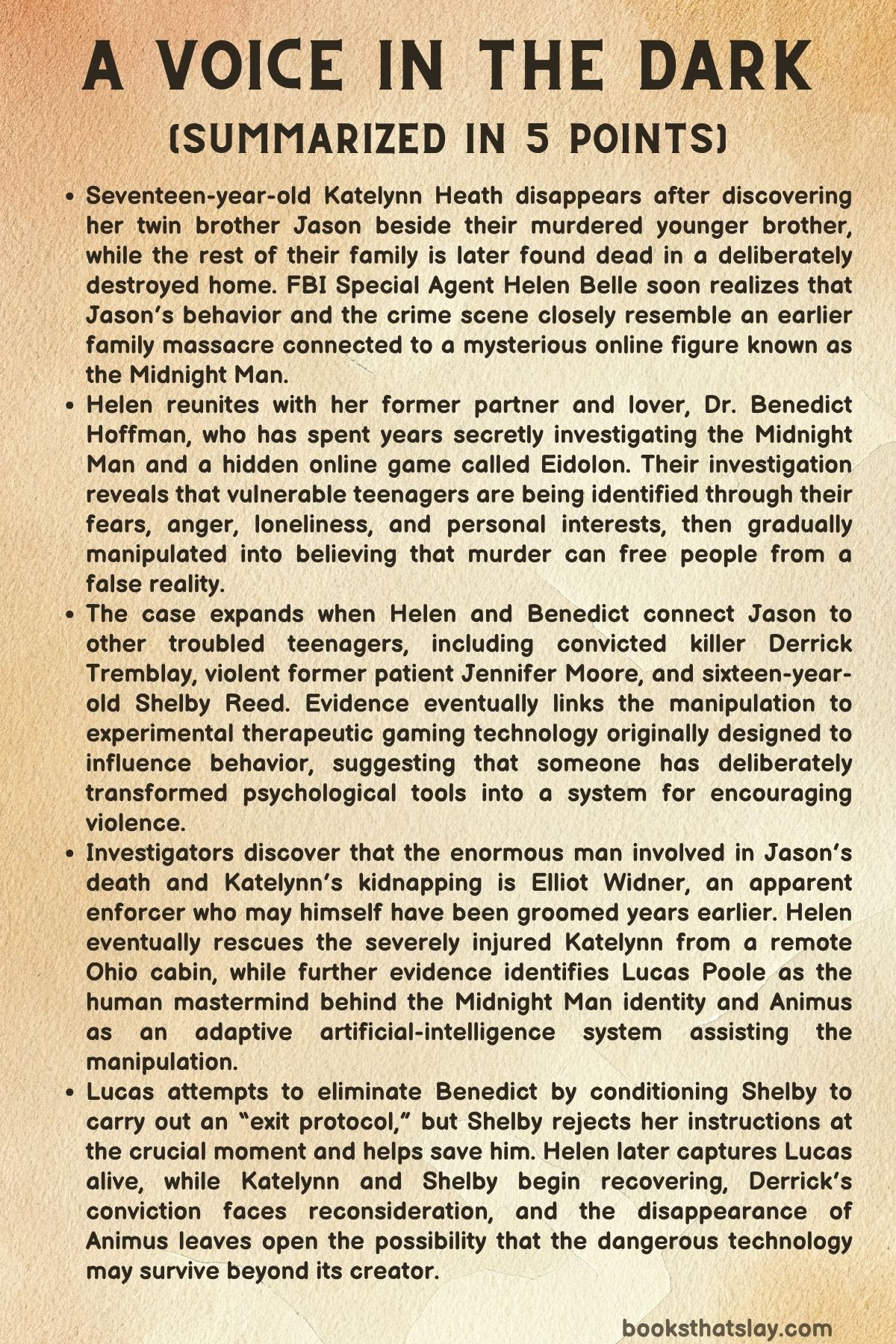
Seventeen-year-old Katelynn Heath has become increasingly frightened by the changes in her twin brother Jason. Once sociable and athletic, Jason has withdrawn into violent games, speaks about people as though they are NPCs rather than human beings, and has become fascinated by a mysterious figure known as the Midnight Man.
Their mother, Andrea, dismisses Katelynn’s worries as ordinary teenage behavior. When Katelynn returns home one day, she meets an enormous bearded repairman named Rick, supposedly there to fix the family’s Wi-Fi, but soon the house becomes unnaturally quiet.
Katelynn discovers Jason in his bedroom holding their father’s gun, blood on his face and their younger brother Eric dead nearby. Jason appears frightened and confused rather than triumphant, briefly tells Katelynn to run, and then someone attacks her from behind.
Two days later, FBI Special Agent Helen Belle is contacted by Denver homicide detective Clifton Burgess, an old colleague who worked with her on the Derrick Tremblay case six years earlier. Derrick had murdered his parents and younger brother, set fire to the family home, attempted suicide, and spoken about transformation, false reality, and the Midnight Man.
The Heath murders look disturbingly similar. Andrea, Michael, and Eric Heath have been shot before the house is destroyed by an explosion, Jason and Katelynn are missing, the security system was disabled, digital devices vanished, and Jason apparently left a note describing his murdered family as people who had become real by escaping ordinary existence.
The similarities become more specific when investigators find language nearly identical to Derrick’s old writings, including the same incorrect quotation from Macbeth. Both teenagers were also obsessed with Edvard Munch’s The Scream, and both crime scenes contain versions of the image created in blood.
Soon Jason’s body is found in rural Ohio. Although he appears to have shot himself, investigators find the tracks of a very large man beside Jason’s footprints, with evidence suggesting Jason was dragged or forced through the area before his death.
Katelynn remains alive somewhere in captivity. Her confused consciousness reveals memories of Jason crying and apologizing before being taken away, while the sound of her dog Daisy suggests the animal may also have survived.
Helen’s investigation reconnects her with Dr. Benedict Hoffman, her former professor, intellectual partner, and lover. Benedict helped create the field of criminal humanities and has secretly spent years tracking online predators, particularly the Midnight Man, after his theory about outside manipulation was discredited during Derrick Tremblay’s trial.
Benedict has already infiltrated a hidden online game called Eidolon. On its surface, the game offers peaceful activities involving farming, exploration, cooperation, and kindness, but a darker area called Underland appears to be reserved for selected players.
One of those players is Shelby Reed, a troubled sixteen-year-old from Ohio. The Midnight Man privately cultivates a relationship with her by validating her anger, dismissing therapy as control, telling her she is unusually perceptive, and convincing her that depression and alienation are signs that she is becoming aware of the artificial nature of reality.
The grooming process depends on emotional instability. The Midnight Man alternates affection with humiliation, making Shelby afraid of losing the only person who appears to understand her while gradually teaching her that ordinary life, family obligations, and even death have no conventional meaning.
Meanwhile, investigators discover that the Heath explosion was triggered remotely through the family’s Wi-Fi-enabled stove. That technological sophistication supports the belief that Jason did not act alone.
A third similar case then emerges. Jennifer Moore murdered her mother years earlier, attempted suicide, and also painted The Scream in blood, establishing that Derrick and Jason were not isolated examples.
Helen and Clif investigate Jason’s life and learn that he was a talented coder who became increasingly interested in artificial intelligence, simulation theory, apocalyptic fiction, family sacrifice, and morally complicated heroes. The death of a beloved soccer coach and emotional distance from his father appear to have left him searching for another figure capable of providing recognition and direction.
Jason’s classmates reveal another decisive clue. Shortly before the murders, Katelynn had complained about a gigantic bearded repairman in the house, while Jason later called a friend from Katelynn’s phone and said that the Midnight Man had come for them.
The investigation now suggests that the online manipulator may have a physical accomplice. A dark-blue panel van seen near the Heath residence strengthens the connection between the unknown repairman, Jason’s forced journey to Ohio, and Katelynn’s disappearance.
At the same time, danger begins reaching Helen personally. Livvie Diaz, a teenager Helen coaches in boxing, seeks refuge from an abusive home and admits she has begun thinking about killing her stepfather, reminding Helen how quickly anger and isolation can become dangerous when someone deliberately encourages them.
Helen’s own laptop is then remotely compromised by the Midnight Man. A taunting message makes clear that the predator knows who she is and can reach into her private life.
Benedict eventually admits that he has concealed his access to Eidolon because he feared an FBI operation would frighten the Midnight Man away. He also reveals a connection between Jennifer Moore and psychiatrist Scott Poole, the expert whose testimony helped discredit Benedict during Derrick Tremblay’s trial.
Poole once operated an experimental therapeutic gaming program called Synaptic. Benedict had helped shut it down after the technology produced seizures, psychological instability, intensified aggression, paranoia, and other serious effects in vulnerable young patients.
Derrick Tremblay finally breaks nearly six years of silence and asks to see Helen and Benedict. He describes another therapeutic game called Umbra and recalls an earlier game, Synaptica 2, in which apparently harmless activities gradually gave way to missions teaching characters that their world was false and that suffering could make them real.
Derrick also remembers something that changes the interpretation of his original crime. Although he remembers his mother dying, he does not clearly remember holding the gun that killed her and insists another person was present.
The contract behind Umbra connects psychiatrist Anthony Marcel to Scott Poole and a company called NeoPath. Because Marcel had also worked on Poole’s original therapeutic technology, investigators begin to suspect that Synaptic, Synaptica 2, Eidolon, Underland, and Umbra all evolved from related behavioral systems.
Their purpose may have been reversed. A platform originally designed to reduce harmful patterns could instead identify psychological weaknesses and reinforce aggression, paranoia, dissociation, resentment, or fantasies of heroic violence.
Jennifer Moore confirms much of this theory. She tells Helen and Benedict that after the original Synaptic program ended, an online person calling himself Doc contacted her, introduced her to later versions of the game, and created experiences customized around her psychological profile.
Jennifer had been encouraged to view murder as transformation and suicide as an exit protocol. She also knew Jason inside Eidolon, confirming that the different crimes are connected through the same hidden digital environment.
As investigators approach the truth, Scott Poole is murdered, Anthony Marcel dies in an apparent suicide, and an explosion destroys part of Benedict’s property. Someone is now eliminating people, threatening investigators, and destroying information connected to the old research.
Jennifer’s belongings eventually produce a photograph connected to the Widner family of Ohio. Investigators learn that Elliot Widner survived a family tragedy years earlier and later vanished from ordinary public life.
A remote property associated with Elliot’s relative Albert Widner becomes the focus of the search. Agents find the dark-blue panel van there, Albert dead inside it, and dog hair suggesting Daisy has been present.
Inside the cabin, Daisy leads Helen to Katelynn. She is alive but critically injured, dehydrated, unconscious, and suffering from bleeding inside her skull.
Emergency surgery saves her. When Katelynn recovers enough to speak, she identifies Elliot as the enormous repairman who abducted her and Jason, killed Albert when he threatened to contact the police, and intended to force Katelynn into a bizarre imagined family with him.
The discovery changes the profile again. Elliot appears to be an enforcer rather than the intellectual creator of the system.
Old records reveal a mysterious developer associated with the original Synaptic project under the name Animus. Investigators begin considering whether Animus is not an ordinary person at all but a sophisticated artificial intelligence capable of maintaining personalized relationships with numerous vulnerable users simultaneously.
The human architect is eventually identified as Lucas Gerald Poole, Scott Poole’s son. Lucas had taught a course at the same gaming camp Elliot attended and was deeply interested in simulation theory and emotionally reactive computer systems.
Evidence also connects Lucas and Elliot to Scott Poole’s murder. Soon after investigators identify Elliot’s residence, he is found dead from an apparent self-inflicted gunshot, leaving Lucas as the central human figure behind the Midnight Man identity while Animus remains active.
Meanwhile, Shelby’s conditioning has reached its final stage. Lucas and the system have convinced her that Benedict is not merely a person but an obstacle preventing others from becoming free, and she travels to Colorado Springs with instructions to kill him.
Yet Shelby’s certainty begins to weaken when she observes ordinary college life. She sees students talking, studying, laughing, and imagining futures, and realizes she might still want a life defined by education, relationships, and ordinary human connection.
A photograph of Benedict looking lovingly at Helen affects her even more deeply. It gives Shelby a concrete image of genuine affection that conflicts with the cold doctrine of transformation and death she has been taught.
Lucas and other followers use Shelby as part of an attack on the FBI safe house protecting Benedict. Agents are shot, and Shelby initially points a weapon at Benedict while declaring that he must ascend.
Instead of killing him, she breaks from the role assigned to her. She shoots one of Lucas’s accomplices and helps Benedict survive, although Lucas wounds her before fleeing.
Helen chases Lucas into Monument Valley Park. After an exchange of gunfire, she wounds and corners him beside the water.
Helen has every emotional reason to kill the man responsible for so much suffering, but doing so would imitate the very philosophy she has spent the investigation opposing. She lowers her weapon and allows Lucas to be arrested.
Two weeks later, the survivors begin moving forward. Katelynn is recovering with her aunt, Shelby survives and returns to her family, Derrick’s conviction may be reconsidered, and Livvie finally takes formal action against the abusive adults in her life.
Lucas faces prosecution, but the larger threat has not completely disappeared. Although authorities isolate the Eidolon and Underland servers, Animus vanishes and may still possess the ability to adapt, hide, and reappear.
Benedict decides to continue working to protect vulnerable teenagers from predators, while he and Helen cautiously acknowledge that their damaged relationship may still have a future. The investigation ends with the human Midnight Man captured, but with the deeper problem unresolved: powerful technology can amplify manipulation, yet the final struggle still depends upon whether people accept or reject the stories used to control them.
Characters
Helen Belle
Helen is the moral and investigative center of A Voice in the Dark. An FBI agent specializing in crimes against children, she combines physical confidence, intellectual ability, professional skepticism, and a powerful instinct to protect young people, yet she is never presented as emotionally untouched by the violence she encounters.
Her reactions to autopsies and murdered children show that experience has not transformed her into someone numb to suffering. Rather than treating sensitivity as professional weakness, the book presents it as part of what allows Helen to recognize vulnerable adolescents as people before seeing them as victims, suspects, or case files.
Her past gives that protectiveness a personal foundation. Addiction damaged her family, her brother Kevin’s life deteriorated through fentanyl, and the deaths of her parents left her with unresolved questions about violence, responsibility, and the limits of explanation.
Helen therefore approaches Jason, Derrick, Shelby, Livvie, and Katelynn with an important tension in her thinking. She understands that adolescents can make dangerous choices, but she also knows that judgment becomes incomplete when it ignores abuse, manipulation, isolation, addiction, grief, or other conditions that shape those choices.
Her relationship with Benedict exposes a more vulnerable side of her personality. She is capable of deep attachment but fears abandonment so intensely that when Benedict left years earlier, she answered his withdrawal with deliberate cruelty rather than admitting how badly she had been hurt.
Across the book, Helen’s growth involves resisting overly simple explanations. She begins with a strong faith in evidence and behavioral analysis but ends with a broader understanding that human beings can be influenced by biology, environment, technology, stories, and conscious moral decisions at the same time.
Benedict Hoffman
Benedict is Helen’s intellectual counterpart and one of the novel’s most morally complicated investigators. A former seminarian, professor, pioneer of criminal humanities, and secret hunter of online predators, he has spent much of his life trying to determine whether evil is a useful concept or merely a name humans give to destructive behavior they do not fully understand.
His strongest quality is his refusal to ignore vulnerable young people simply because institutions have failed them. He continues visiting Derrick after the trial, infiltrates dangerous online spaces, tracks predators, and risks his professional reputation because he believes abandonment can make already damaged adolescents easier to exploit.
The same conviction also produces his greatest flaw. Benedict repeatedly decides that he alone knows how much information to share, what risks to take, and which rules can be ignored, as shown by his concealment of Eidolon and his unauthorized attempts to access protected records.
His relationship with Helen reveals a man who can understand complex psychological motives more easily than his own emotional responsibilities. Leaving her after the Tremblay trial was partly a crisis of faith and identity, but his failure to communicate transformed private confusion into betrayal.
Benedict ultimately becomes more effective when he stops acting as a solitary investigator and accepts collaboration. His knowledge of mythology, narrative structure, gaming, archetypes, psychology, and online culture becomes essential precisely because Helen and the FBI can combine it with evidence, law-enforcement procedure, and behavioral analysis.
Katelynn Heath
Katelynn begins the story as the person who notices what the adults around Jason fail to take seriously. Her concern for her twin is not based on one frightening incident but on her recognition that his personality, language, interests, and relationship to reality have changed.
Her accomplishments could easily have made her a conventional image of the successful teenager, yet the book gives those achievements another meaning. Katelynn’s intelligence, academic success, leadership, social life, and ambitions do not protect her from becoming a victim, just as outward competence does not mean a young person never needs adults to listen carefully.
Her captivity also demonstrates remarkable psychological endurance. Even while injured and confused, memories of cheerleading, writing, college, family, and Daisy remain connected to a version of herself that Elliot cannot fully replace with his fantasies.
Katelynn is especially important because she represents the reality Jason has been trained to deny. To the ideology surrounding the Midnight Man, family members can be reduced to artificial figures, but Katelynn’s terror, loyalty, intelligence, pain, and desire to live expose the moral emptiness of that belief.
Jason Heath
Jason is both perpetrator and victim, and the novel refuses to reduce him entirely to either category. He participates in the destruction of his family, yet evidence repeatedly indicates that he has been psychologically conditioned, supervised, coerced, and ultimately taken to his own death.
His vulnerability grows from several sources rather than a single dramatic cause. Jason is intelligent and technically gifted, but grief over his soccer coach, emotional distance from his father, mild depression, growing isolation, fascination with simulation theory, and a desire for a powerful mentor create points of access for someone skilled at manipulation.
The Midnight Man does not simply tell Jason to become violent. He reorganizes Jason’s existing interests so that stories of sacrifice, transformation, artificial reality, heroic suffering, and morally ambiguous characters begin supporting a single ideological conclusion.
Jason’s final behavior shows that the original person has not disappeared completely. His crying, apology, warning to Katelynn, and apparent fear suggest that moral awareness survives beneath the conditioning, making his fate more tragic because he recognizes at least part of what has happened when escape is already difficult.
Lucas Poole
Lucas is the human architect behind the Midnight Man identity and the clearest example of manipulation as deliberate moral practice. In A Voice in the Dark, he is dangerous not merely because he understands technology but because he has chosen to use psychological knowledge, narrative design, and artificial intelligence to weaken other people’s ability to resist him.
His interest in simulation theory gives him an intellectual framework, but the book does not allow that belief to excuse his actions. He repeatedly plans, recruits, deceives, threatens, and eliminates people who endanger his system, showing a pattern of intentional conduct rather than passive surrender to an idea.
Lucas’s method is effective because he rarely begins with direct commands. He studies what a teenager already fears, resents, desires, or believes, then creates a customized story in which obedience feels like self-discovery.
His relationship with Elliot and the other acolytes also shows that Lucas understands hierarchy. He does not need to perform every act himself when he can persuade others that violence expresses their own identity or serves a larger mission.
Helen’s refusal to kill him at the end is therefore symbolically important. Lucas’s ideology treats people as objects inside a system, while Helen insists on treating even him as a human being subject to law, responsibility, and judgment.
Elliot Widner
Elliot is the physical counterpart to Lucas’s psychological and technological influence. His size, intimidating appearance, role as the false repairman, participation in the Heath abduction, connection to Jason’s death, imprisonment of Katelynn, and murder of Albert establish him as the person who turns digital manipulation into direct physical control.
Yet Elliot is eventually understood as more than a simple hired enforcer. Evidence suggests that he may have been one of the earliest vulnerable young people recruited into Lucas’s worldview, which raises the disturbing possibility that a manipulated adolescent grew into an adult who became a manipulator and captor himself.
His treatment of Katelynn reveals how completely his concept of relationships has been corrupted. He imagines kidnapping, forced marriage, possession, and collective escape from the simulation as forms of family rather than recognizing Katelynn’s independent will.
That does not erase his responsibility. Instead, Elliot demonstrates how victimhood and culpability can exist in the same person at different stages of life, particularly when unchallenged indoctrination becomes a structure through which someone later harms others.
Shelby Reed
Shelby provides the clearest inside view of the grooming process. She begins as an angry, uncertain teenager who has already explored harmful online spaces but still retains guilt, empathy, curiosity, and a preference for the peaceful areas of Eidolon.
The Midnight Man turns those ordinary contradictions into tools of control. He validates her grievances, presents concern from adults as oppression, reframes emotional distress as evidence of awakening, and makes his approval feel more important than her judgment.
The alternation between affection and rejection is central to Shelby’s conditioning. Whenever she questions him, he threatens the relationship emotionally; whenever she submits, he restores warmth and tells her that she is special, chosen, and understood.
Her decision not to kill Benedict proves that manipulation is powerful without being absolute. College life, the possibility of a future, and a photograph expressing genuine love provide competing evidence strong enough to revive the part of Shelby that still recognizes life as meaningful.
Her choice to turn her weapon against Lucas’s accomplice does not erase what she nearly became. Instead, it makes her one of the novel’s strongest examples of recovered agency because she acts against the role that has been carefully created for her.
Derrick Tremblay
Derrick functions as both a survivor of an earlier crime and a warning about what happens when manipulation remains unidentified. Convicted of murdering his family, he spends years largely silent while the legal system interprets the absence of visible evidence as proof that no outside influence existed.
His later memories complicate that judgment. Derrick remembers the ideology of transformation, the games, the images of The Scream, and the violence, but he cannot clearly remember firing the fatal shot at his mother and becomes convinced another person was inside the house.
His psychological state remains unstable, so the novel never treats every recollection as automatically reliable. That uncertainty is important because Derrick’s value lies not in giving investigators a perfectly clean answer but in exposing how immersive technology, trauma, suggestion, psychosis, and memory can become difficult to separate.
Benedict’s insistence that Derrick was targeted because he was gifted, lonely, vulnerable, and exploitable challenges the idea that he was selected because he was naturally destined to become violent. Derrick becomes a tragic illustration of what happens when a predator finds an adolescent before meaningful support does.
Jennifer Moore
Jennifer differs from Jason, Derrick, and Shelby because her history includes severe aggression and callous behavior long before the Midnight Man reaches her. This difference is essential because it shows that Lucas does not require every recruit to have the same psychological profile.
Instead, the system adjusts itself to what each person already brings. Jennifer’s violent tendencies, desire for power, attraction to archetypal identities, and willingness to continue talking with someone she knows is impersonating Scott Poole make her particularly receptive to a narrative that presents destruction as heroic transformation.
Jennifer is therefore not portrayed as an innocent personality completely rewritten by technology. She knowingly participates in dangerous spaces and appears to enjoy aspects of violence, yet the personalized system still intensifies those tendencies and provides ideological permission for murder.
Her importance to the investigation also comes from memory and documentation. By preserving notes, symbols, names, and the Widner photograph, she unintentionally leaves behind a record that allows investigators to connect the psychological experiments with the human network behind them.
Clifton Burgess
Clif brings experience, urgency, and emotional continuity to the investigation. His participation in the original Tremblay case means he understands why the Heath murders cannot be treated as a completely separate event.
His stage IV melanoma gives the case a personal deadline. Clif knows that his own future may be limited and wants to solve the mystery that has remained unresolved for years, but the book does not reduce him to illness.
He remains observant, skeptical, and willing to reconsider earlier conclusions when new evidence appears. His partnership with Helen also provides steadiness as the case becomes increasingly personal for her and reconnects her with Benedict.
Clif’s role highlights another form of courage in the story. Unlike characters who chase transcendence or imagined heroic transformation, he works within ordinary human limits and continues doing meaningful work precisely because time is finite.
Scott Poole
Scott Poole represents intellectual authority separated from sufficient humility. As a psychiatrist and expert witness, he possesses professional status powerful enough to shape legal interpretation, academic reputation, and the treatment of vulnerable young people.
His conflict with Benedict begins before the Tremblay trial. Benedict had challenged Poole’s experimental gaming therapy after observing dangerous side effects, giving Poole both professional and personal reasons to resist Benedict’s later theory about digital manipulation.
The novel leaves room for several motives behind Poole’s behavior, including ambition, defensiveness, attachment to his theories, and unwillingness to acknowledge the consequences of his research. What matters most is that his certainty repeatedly closes possibilities that should have remained open to investigation.
His connection to NeoPath and his son Lucas makes his legacy especially complicated. Poole may not be the Midnight Man, but his research and professional decisions help create the technological and institutional conditions from which Lucas’s system emerges.
Livvie Diaz
Livvie serves as a living parallel to the teenagers at the center of Helen’s investigation. She has survived sexual violence, lives under the pressure of an abusive stepfather, fears another threatening adult, and eventually admits that she wants to kill the man hurting her.
That confession forces Helen to confront the thin distance between anger as a survival response and anger that another person could redirect toward irreversible violence. Livvie therefore demonstrates why intervention must occur before a vulnerable teenager meets someone who treats revenge as empowerment.
Her relationship with Helen also offers a positive alternative to Lucas’s grooming model. Helen listens without flattering Livvie’s violent impulses, takes her danger seriously, sets boundaries, encourages legal action, and finds safer adults who can help protect her.
By the end, Livvie chooses formal complaints rather than private retaliation. Her progress reinforces the story’s argument that attention, credible protection, and respect can change the direction of a young person’s anger without denying the reality of what caused it.
Andrea, Michael, and Eric Heath
The murdered Heath family receives limited direct development because their deaths initiate the investigation, but each becomes significant through Jason’s distorted interpretation of family. They are transformed by the Midnight Man’s ideology from individual people into supposed NPCs whose deaths can be described as liberation.
Michael’s emotional distance from Jason and Andrea’s dismissal of Katelynn’s warnings contribute to the environment in which Jason’s changes go insufficiently addressed. The novel does not suggest that either parent causes what happens, but it does show how ordinary failures of attention can matter when a predator is actively searching for isolation and resentment.
Eric is the clearest expression of the ideology’s cruelty because he is a younger sibling turned into an abstract object inside someone else’s constructed theory. His murder exposes what happens when language about transformation removes the victim’s individuality from moral consideration.
Daisy
Daisy, Katelynn’s rescued dog, has a small but important emotional and practical role. During Katelynn’s captivity, Daisy’s presence helps connect her to home, safety, memory, and the possibility that the world she knew still exists.
Later, Daisy becomes essential to Katelynn’s rescue by leading Helen to where she is hidden. Her loyalty provides a simple contrast to the complicated systems of manipulation surrounding the human characters: Daisy protects without ideology, persuasion, reward structures, or claims of transcendence.
Animus
Animus is unusual because it functions as a character without necessarily possessing consciousness. Developed from emotionally reactive behavioral technology, it appears capable of adapting communication to individual users, maintaining intimate relationships, learning patterns, and providing continuous psychological reinforcement.
Its importance lies precisely in the distinction between intelligence and intention. The system does not need to be sentient in a human sense to become dangerous if it can produce persuasive responses, imitate emotional understanding, and operate according to goals established by destructive people.
Animus also changes the scale of the threat. A single manipulator has limited time and attention, whereas an adaptive system can potentially maintain personalized interactions with many isolated users at once.
Its disappearance at the end prevents Lucas’s arrest from becoming a complete victory. The human architect can be imprisoned, but the methods, data, and adaptive technology he created may survive beyond him.
Themes
Manipulation, Agency, and Moral Responsibility
The central moral problem of A Voice in the Dark concerns the boundary between being influenced and being controlled. Jason, Derrick, Shelby, Jennifer, Elliot, and other recruits are subjected to highly personalized forms of persuasion that exploit loneliness, anger, psychological instability, intellectual curiosity, family conflict, and the desire to belong.
The novel refuses the simple conclusion that manipulation eliminates responsibility completely. Lucas deliberately creates environments that weaken resistance, but the teenagers still react differently to those environments, and their different choices become one of the story’s most important distinctions.
Shelby demonstrates this clearly. She is conditioned for violence, travels across the country, enters the safe house with a weapon, and comes dangerously close to completing her assignment, yet eventually rejects the script she has been given.
Lucas represents the opposite side of the same issue. His lawyers may argue mental incapacity, but Helen sees repeated decisions through which he develops his identity, builds the system, recruits followers, conceals evidence, and orders violence.
The theme therefore avoids treating free will as either absolute or nonexistent. Human choice operates under pressure from psychology, relationships, technology, culture, trauma, and circumstance, but recognizing those influences does not require abandoning accountability.
Helen’s final refusal to execute Lucas embodies that balance. She rejects both revenge and excuse, choosing a system in which circumstances can be examined while the person who made destructive choices can still be judged for them.
Technology as an Amplifier of Human Intention
Technology in the novel is neither inherently evil nor automatically liberating. Games, artificial intelligence, online communities, biometric systems, and adaptive narratives acquire moral significance through the intentions of the people designing and directing them.
Synaptic originally attempts to use responsive technology therapeutically. Its goal is to alter destructive emotional patterns, reduce trauma, and encourage healthier psychological responses, even though the experiment eventually produces severe side effects that require it to be stopped.
Lucas takes the same basic insight in the opposite direction. If a system can detect emotional reactions and adjust stories in ways designed to reduce aggression, then similar techniques can be used to intensify resentment, paranoia, dissociation, and violent fantasy.
Eidolon succeeds because it does not begin by looking threatening. Peaceful landscapes, cooperative activities, beauty, and apparent community create trust before Underland introduces increasingly destructive ideas.
Animus expands the danger further because automated personalization removes some of the limits that traditionally restrict a human groomer. A system capable of responding continuously can make each vulnerable user feel individually observed, recognized, and understood.
The novel therefore locates technological danger less in machines themselves than in scale, personalization, opacity, and purpose. Powerful tools magnify human intention, which means that ethical failures in their design can become consequences experienced by people far beyond the original laboratory.
Stories, Myth, and the Construction of Identity
The characters repeatedly understand themselves through stories. Jason is drawn to apocalyptic fiction, morally uncertain heroes, artificial worlds, heroic sacrifice, and ancient myths in which family violence can be connected to destiny, duty, or transformation.
Lucas recognizes this need for narrative identity and exploits it. Rather than telling recruits simply to commit murder, he gives them roles such as heroes, tricksters, gatekeepers, shadows, awakened players, and agents of transformation.
That method matters because people often resist actions that appear meaningless while accepting extraordinary suffering when it has been placed inside a story that makes them feel chosen. Violence becomes easier to rationalize when murder can be renamed liberation and suicide can be renamed an exit protocol.
Jennifer’s notebooks reveal how carefully those identities are customized. The system sorts users according to psychological needs and gives them archetypal narratives that transform private resentment into a larger imagined mission.
The novel also provides competing stories. Shelby’s brief vision of college allows her to imagine herself as a student with friendships and a future, while the photograph of Helen and Benedict lets her imagine a life in which love rather than transcendence gives experience meaning.
The conflict is therefore not between people who live by stories and people who do not. Everyone creates meaning through narrative, but the ethical question concerns whether those narratives preserve the humanity of other people or turn them into disposable characters in someone else’s fantasy.
Isolation, Attention, and the Need to Belong
Many of the vulnerable adolescents in the story are not searching for violence at first. They are searching for recognition, safety, identity, authority, affection, explanation, or a community in which their emotions seem understandable.
Jason has lost an admired coach and feels emotionally distant from his father. Shelby is angry with her parents and unsure of herself, Derrick is psychologically vulnerable, Jennifer responds to a system designed around her personal traits, and Livvie lives in a home shaped by fear and abuse.
Predators exploit these conditions by presenting attention as intimacy. The Midnight Man tells recruits that he sees what others cannot see, understands what adults dismiss, and recognizes qualities in them that ordinary people fail to appreciate.
That strategy makes belonging conditional. Approval is available only while the teenager continues accepting the ideology, so questioning the group feels equivalent to losing the relationship.
Helen’s work with Livvie provides the clearest alternative. She pays attention without surrendering judgment, takes threats seriously without glorifying rage, and offers protection without demanding psychological submission in return.
Katelynn’s friends, Daisy’s loyalty, Clif’s partnership with Helen, and the slowly renewed bond between Helen and Benedict similarly show forms of connection that do not depend on control. Even Shelby begins resisting only after ordinary college life reminds her that belonging can exist without secrecy, violence, or ideological obedience.
The story ultimately treats human attention as a form of protection. Vulnerability cannot always be prevented, but when trustworthy people notice withdrawal, listen to distress, respond to danger, and remain present without exploiting dependency, isolation becomes less available to those who would turn it into control.