The Found Object Society Summary, Characters and Themes
The Found Object Society by Michelle Maryk is a dark speculative mystery about grief, addiction, guilt, and the dangerous wish to touch death without surrendering to it. The story follows Greta Davenport, a rich Connecticut socialite whose life is shaped by the car crash that killed her parents when she was young.
On the twentieth anniversary of that loss, Greta is invited into a secret organization that lets members experience the final moments of dead people through objects connected to their deaths. What begins as curiosity becomes obsession, and Greta soon wonders whether these voyages can do more than show the past.
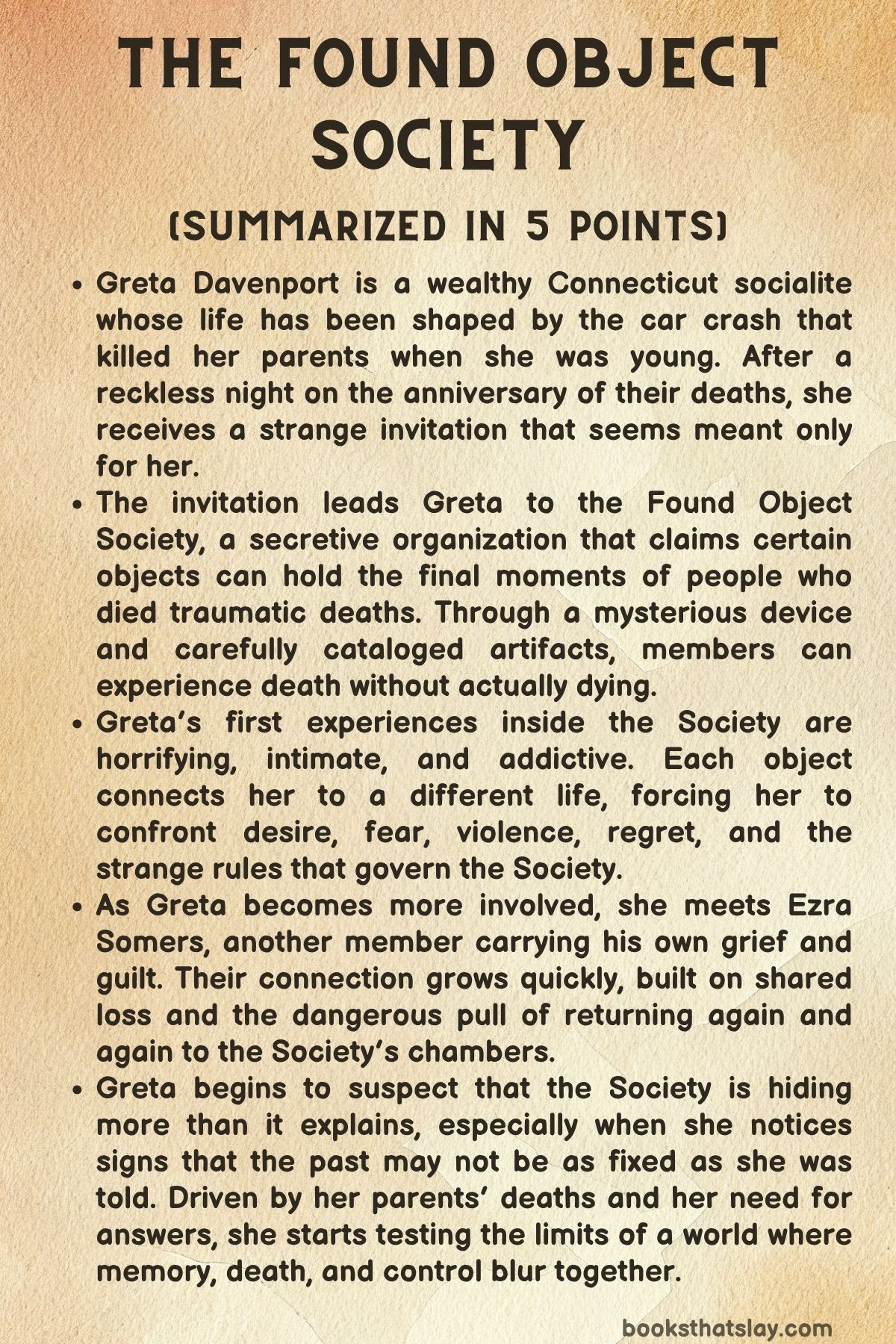
Summary
Greta Davenport is a thirty-seven-year-old socialite living with wealth, status, and an old wound she has never truly faced. The twentieth anniversary of her parents’ fatal car crash pushes her into a public breakdown at a wildlife-preservation gala.
Drunk, furious, and ashamed, she leaves in her vintage Mercedes and drives recklessly through the dark Connecticut roads. When a possum darts into her path, she swerves and nearly crashes between two maple trees.
She survives without a scratch, but the near accident shakes something loose in her. Greta has long believed that her survival as a child left her in a strange bargain with death, and this new brush with disaster makes that feeling impossible to ignore.
At home, she receives a blank white card through her mail slot. At first it seems empty, but later a hidden QR code appears.
When she scans it, she hears a strange artificial voice that invites her to a preliminary interview with the Found Object Society. The voice gives her a Manhattan address and warns her not to tell anyone.
Greta searches for the organization online, but there is no trace of it. Curiosity, loneliness, and her old fascination with death draw her in.
At the address, Greta finds a cold, unreal office and meets a woman named Eileen. The meeting quickly becomes personal and unsettling.
Eileen gives Greta a childhood taffy flavor tied to memories of her parents, proving the society knows far more about her than it should. She explains that the society offers a rare experience: death without dying.
Certain objects, Eileen says, hold the energy of traumatic deaths. By using these objects, members can experience the final moments of the dead from inside their bodies.
Greta undergoes a test with the Obitus Mold, a liquid-metal device that wraps around her arm. The experience overwhelms her with sensations and images that feel too intense to dismiss as illusion.
Instead of frightening her away, it leaves her craving more. When she tries to show the card to her best friend Lisbeth, Lis cannot see anything unusual.
Greta’s phone then displays a warning reminding her that she was told not to tell anyone. Afraid that Lis might be harmed, Greta retreats into secrecy.
Soon after, a black card arrives, formally inviting her to join. The membership fee is five hundred thousand dollars, and Greta pays it.
The real society is hidden beneath 273 Water Street in Manhattan’s South Street Seaport. There, Greta meets a huge cockney attendant she privately nicknames Big Daniel Craig, along with Miranda, an elegant woman who guides her through the society’s rules.
The space beneath the city is vast, luxurious, and strange, filled with shelves of objects arranged by place and time. Each object is linked to a death.
Members choose an object and take a “voyage,” becoming a passenger inside the dying person connected to it. They are told they can witness but not interfere.
For her first voyage, Greta selects a jeweled perfume bottle from nineteenth-century France. She enters the life of Zephyrine, a sixteen-year-old servant at Château de Barbitière.
Zephyrine arrives with her brother Gilbert to work in a wealthy household. She becomes the lady’s maid to Mistress Claudette, and their relationship turns sexual.
Zephyrine believes Claudette’s attention means love and devotion, but the household’s corruption slowly reveals another truth. Claudette has used other girls before her, and Zephyrine is not special in the way she hoped.
Heartbroken and angry, Zephyrine confronts Claudette on a bridge. She declares her love and asks for a future together.
Claudette rejects her. In despair, Zephyrine attacks, but Claudette stabs her in the neck with a letter opener and pushes her into the pond.
As Zephyrine drowns, Greta sees a dark, inhuman figure retrieve the perfume bottle from the water. The sight plants the first hint that the society’s power may involve something far stranger than advanced technology.
Greta returns from the voyage violently ill, shaken, and disoriented, but she is also hooked. Outside the society, she meets Ezra Somers, another member who recognizes her condition.
The two walk through the city and speak with the raw honesty of people who have been altered by the same secret. They become close quickly, drawn together by grief, guilt, and the shared need to return to the society.
Ezra hints that he is haunted by a death involving his son. Greta, meanwhile, lies to Lisbeth about where she has been and says only that she has met someone.
After the required waiting period, Greta returns for another voyage. This time she chooses a more recent object: novelty Elton John sunglasses with tiny windshield wipers.
The object carries her into the life of Lassiter Evans, a twenty-eight-year-old salesman in 1970s Fresno. Lassiter lives with his sick, cruel mother, Yvonne, in an unfinished Central California subdivision.
He is lonely, resentful, and obsessed with infamous killers, especially Ted Bundy. He has built a shed behind the house that he imagines as the place where he will begin his own murderous legend.
The shed is arranged to look romantic, but hidden inside are rope, a gag, a hammer, condoms, and Bundy clippings.
Lassiter goes to Club Alonso intending to lure a woman home. He meets Janine, but she surprises him by being kind, funny, and genuinely interested.
They dance, drink, laugh, and share the ridiculous sunglasses. For the first time, Lassiter’s fantasy of becoming a killer begins to weaken.
Janine agrees to go home with him, though she grows uneasy when she sees his empty-looking neighborhood and learns that his mother is inside the house. Lassiter explains that Yvonne is sick and that he cares for her.
Instead of mocking him, Janine is touched.
In the shed, the two begin having sex. Lassiter is so caught in the moment that he forgets the contents of the nightstand.
When Janine reaches for a condom, she discovers the rope, gag, hammer, and killer clippings. Terrified, she screams and tries to flee.
Lassiter insists he can explain, but the evidence speaks louder than he can. She hits him with the hammer and runs outside.
He tackles her, still trying to stop everything from collapsing, but fire ants from a nearby mound swarm him. Their bites trigger anaphylactic shock.
Janine escapes while Lassiter staggers into the house, swelling and dying. His mother tumbles down the stairs trying to reach him, and as his vision fades, the same dark figure appears and takes the sunglasses from his hand.
When Greta awakens, Miranda collects the glasses, but Greta realizes something unusual has happened. She has brought back a trace of the voyage: an ant, which quickly vanishes.
More importantly, Greta remembers becoming briefly lucid inside Lassiter’s body and moving his arm. This means she may not be only a passenger.
She may be capable of interfering with the dying person she inhabits. She also connects the dark figure from Lassiter’s death with the one she saw in Zephyrine’s final moments.
She begins to think of it as the Collector, an entity that gathers objects at the moment of death.
Greta and Ezra compare suspicions. Big Daniel Craig has warned Greta to be careful because “they can see everything,” suggesting that the society’s leaders know more than they admit.
Greta and Ezra wonder whether the Found Object Society is controlled by supernatural beings, and whether Greta’s strange ability could allow her to change what happens inside a voyage. Ezra then tells Greta more about his own loss.
His son Jake vanished from a sailboat during an overnight trip, and his body was never recovered. Ezra has lived ever since with guilt, grief, and unanswered questions.
Greta’s obsession sharpens into purpose. If she can become lucid inside a vessel and move that person’s body, perhaps she can alter a death.
If she can alter one death, perhaps she can reach the crash that killed her parents. She begins researching lucid dreaming and training herself with a mantra, hoping to carry awareness into her next voyage.
When she returns to the society, Big Daniel Craig again warns her not to interfere, while Miranda watches with quiet suspicion.
For her next choice, Greta selects an art deco cigarette lighter from 1930s Chicago. She enters the life of Colleen Davies, a fading silent-film star who has just shot her husband, studio head Harold Stark.
As Colleen panics with her young lover Tyrone, Greta prepares to test the limits of the society’s rules, the Collector’s power, and her own desperate belief that the past may not be as fixed as it seems.
Characters
Greta Davenport
Greta Davenport is the central character of The Found Object Society, and she is built around the tension between privilege, grief, recklessness, and a dangerous hunger for transcendence. At thirty-seven, Greta has wealth, social access, and the polished surface of a Connecticut socialite, but emotionally she remains frozen at the moment of her parents’ deaths.
The gala meltdown exposes how little control she truly has over the wound she tries to disguise. Her drunken drive after the event is not simply careless behavior; it reveals her deeper pattern of courting danger as if survival itself must constantly be tested.
Greta’s near-crash with the possum reawakens the belief that she has been challenging death since childhood, and this makes her uniquely vulnerable to the Society’s offer.
Greta’s fascination with the Found Object Society grows from more than curiosity. She is addicted to the possibility of touching death without surrendering to it.
The Obitus Mold awakens something in her that is both spiritual and compulsive, and after her first experience she behaves less like a woman investigating a mystery and more like someone who has discovered a forbidden drug. Her wealth allows her to join, but money is not her real ticket into the Society.
Her real qualification is psychological: she is desperate, traumatized, and willing to mistake danger for meaning. This makes her both powerful and easy to manipulate.
What makes Greta especially compelling is that she does not remain a passive observer. During Lassiter’s voyage, she realizes she can briefly become lucid and influence the vessel’s body.
This changes her role in the book from participant to potential disruptor. Her grief begins to evolve into ambition, because if she can interfere with someone else’s death, she may be able to alter the death that defines her own life.
This makes her morally unstable in an interesting way. Her desire to save her parents is understandable, but it also threatens to make her reckless with other people’s lives, histories, and deaths.
Greta is also defined by loneliness. Her relationship with Lisbeth shows she has access to affection and friendship, but she cannot be fully honest without endangering others or exposing the depths of her obsession.
Her relationship with Ezra, by contrast, is built on shared damage. He understands the hunger the Society creates, and that intimacy pulls Greta further into the underworld she should probably escape.
By the time she prepares for the Colleen Davies voyage, Greta has become a woman trying to turn trauma into control. Her tragedy is that she wants liberation from death, but each voyage binds her more tightly to it.
Lisbeth
Lisbeth, or Lis, serves as Greta’s closest link to ordinary human life. She is not part of the Society, and that distance makes her important.
In a story filled with secret rooms, impossible offices, supernatural objects, and death experiences, Lis represents the world of friendship, concern, and emotional accountability. Greta’s attempt to show her the mysterious card reveals the divide between Greta’s experience and everyone else’s reality.
Lis sees nothing, which confirms that the Society operates by rules that isolate its chosen members from the rest of the world.
Lis’s main function in the book is not simply to be the loyal best friend. She reveals what Greta is losing.
When Greta lies to her, withdraws, and hides the truth, the reader sees the cost of Greta’s obsession in personal terms. Lis is someone Greta could turn to, but the Society’s warning makes that impossible.
This creates a painful irony: Greta is surrounded by people and privilege, yet the one experience that matters most to her cannot be shared with the person who might care about her most honestly.
Lis also helps expose Greta’s moral fear. Greta does not back away from telling Lis only because she wants privacy; she does it because she is terrified Lis may be harmed.
This suggests that Greta is not purely selfish, even as she becomes increasingly consumed by the Society. Lis therefore functions as a moral anchor.
She reminds the reader that Greta still has something to lose outside the Society, even if Greta herself is becoming too addicted to recognize it clearly.
Eileen
Eileen is the first human face of the Society, and her calmness makes her unsettling. She conducts Greta’s preliminary interview in a sterile, impossible office space, which immediately places her between the ordinary and the supernatural.
Eileen does not behave like a villain in a conventional sense. She is composed, professional, and almost therapeutic, but this surface politeness hides something predatory.
She knows exactly how to reach Greta through memory, sensation, and grief.
The childhood taffy flavor Eileen gives Greta is especially revealing. It shows that the Society does not merely collect objects connected to death; it understands how to locate the private emotional doors inside a person.
Eileen’s use of Greta’s memories makes the recruitment feel intimate, but also invasive. She offers comfort and wonder, yet she is also testing Greta’s susceptibility.
In that sense, Eileen is less a guide than a gatekeeper who knows how to make danger feel like destiny.
Eileen’s explanation of the Society’s purpose is seductive because she frames death as an experience that can be accessed without consequence. This is exactly the illusion Greta wants to believe in.
Eileen’s role is to introduce the central temptation of the novel: the idea that death can be consumed, studied, or temporarily inhabited without being transformed by it. Her controlled manner contrasts sharply with the chaos Greta later experiences, suggesting that the Society’s calm exterior is a mask over something far darker.
Miranda
Miranda is one of the most elegant and unnerving figures in the book. She appears at the Society’s true location beneath 273 Water Street and embodies its luxurious, ritualistic, and dangerous nature.
Unlike Eileen, who functions as an interviewer, Miranda feels like a custodian of the deeper mysteries. She explains the chambers, the shelves of found objects, and the mechanics of the voyage with an almost aristocratic poise.
Her elegance makes the Society feel refined, but that refinement only makes its brutality more disturbing.
Miranda’s relationship with Greta is marked by watchfulness. She presents the rules, collects the objects, and monitors Greta’s condition after each voyage.
Her composure suggests long familiarity with death, trauma, and the addictive behavior of members. She does not appear shocked by Greta’s violent reactions, which implies that such suffering is routine within the Society.
This makes Miranda seem both knowledgeable and morally detached. She may understand the human cost of the voyages, but she continues to facilitate them.
Her suspicion of Greta becomes especially important once Greta begins to wonder whether she can interfere with a vessel. Miranda’s watchfulness suggests that the Society has boundaries members are not supposed to cross.
If Eileen is the recruiter, Miranda is the guardian of the system. She represents the Society’s authority, beauty, and threat.
Her refinement is not softness; it is control.
Big Daniel Craig
The attendant Greta nicknames Big Daniel Craig is one of the book’s most intriguing secondary figures because he seems both comic and ominous. His huge physical presence and cockney manner make him memorable, and Greta’s nickname for him reflects her tendency to process danger through wit and social observation.
Yet beneath the nickname is a figure who clearly knows more than he can say. His warnings to Greta suggest that he may be sympathetic, trapped, frightened, or some combination of all three.
His warning that “they can see everything” changes the reader’s understanding of the Society. Until then, the organization seems secretive and powerful, but his words imply surveillance, hierarchy, and possibly nonhuman control.
He becomes a crack in the Society’s polished surface. Unlike Miranda, who protects the institution’s mystique, Big Daniel Craig hints at its menace.
He may not be openly rebellious, but his warnings indicate that he recognizes Greta as someone likely to cross a dangerous line.
He also serves as a threshold figure. Greta encounters him when entering the Society’s deeper world, and his presence reinforces the idea that the Society is not simply a club but a guarded realm with rules and consequences.
His concern for Greta complicates him. He may be an employee, servant, guardian, or captive of the Society, but his humanity comes through in the fact that he tries, however cautiously, to warn her.
Ezra Somers
Ezra Somers is Greta’s mirror and temptation. Like Greta, he is drawn to the Society because he is damaged by grief and guilt.
His connection to his missing son Jake gives him a sorrow that is unresolved in the cruelest possible way. Because Jake’s body was never found, Ezra is trapped between mourning and uncertainty.
This makes him emotionally hollowed out, and the Society offers him the same dangerous promise it offers Greta: contact with death as a way to make pain meaningful.
Ezra’s intimacy with Greta develops quickly because they recognize in each other a hunger that ordinary people would not understand. Their relationship is romantic, but it is also addictive and mutually enabling.
He does not pull Greta away from the Society; he helps normalize her craving to return. Their bond is built less on healing than on shared obsession.
This makes their relationship emotionally powerful but unstable, because both of them are using the Society to approach wounds that may not be survivable.
Ezra’s guilt over Jake also gives him a tragic restraint. Unlike Greta, whose grief begins transforming into a desire to interfere with the past, Ezra seems more defined by absence and helplessness.
He is haunted by what he could not prevent or recover. His story deepens the book’s exploration of death by adding ambiguity: Greta knows what happened to her parents, while Ezra lives with the horror of not knowing exactly what happened to his son.
Together, they represent two forms of grief, one fixed by memory and one suspended in uncertainty.
Jake Somers
Jake Somers is absent from the main action, but his absence shapes Ezra profoundly. His disappearance from the sailboat is not merely backstory; it is the emotional center of Ezra’s character.
Because Jake’s body was never found, he becomes a ghostly presence rather than a concluded tragedy. He exists in the book as a wound that cannot close.
Jake’s importance lies in the uncertainty surrounding him. A confirmed death allows grief to begin, however painfully, but a disappearance traps the living in endless speculation.
For Ezra, Jake represents failure, guilt, and unfinished fatherhood. The fact that Ezra is drawn to a Society that lets people experience death suggests that he may be searching not only for sensation, but for proximity to the unknowable place where Jake may have gone.
Jake’s absence therefore gives emotional weight to Ezra’s addiction and makes his connection with Greta more understandable.
Greta’s Parents
Greta’s parents are dead before the main action begins, but they are among the most important presences in the story. Their deaths in the car crash form the original trauma that shapes Greta’s entire adult life.
The twentieth anniversary of the accident does not simply remind Greta of loss; it reveals that she has never truly moved beyond it. Her wealth, social rituals, and adult identity all rest on an unresolved childhood catastrophe.
They function less as fully developed living characters and more as emotional forces. Greta’s memories of them are powerful enough for the Society to exploit through something as small and sensory as a childhood taffy flavor.
This detail suggests that Greta’s bond with them is preserved through fragments: taste, memory, guilt, and longing. The Society understands that such fragments can be more powerful than direct explanations.
Their deaths also motivate Greta’s dangerous turn toward interference. Once she realizes she may be able to influence a vessel, the possibility of revisiting or changing her parents’ accident becomes irresistible.
In that sense, her parents are not only the source of her grief but the reason she may become a threat to the Society’s rules. Their absence drives the plot forward because Greta’s deepest desire is not merely to understand death, but to undo the one death that made her who she is.
Zephyrine
Zephyrine is one of the most tragic characters in the novel because her death is rooted in emotional exploitation. As a sixteen-year-old servant at Château de Barbitière, she enters a world of wealth, power, and moral corruption without the experience needed to protect herself.
Her relationship with Mistress Claudette becomes the center of her emotional life, but Zephyrine mistakes desire, attention, and patronage for love. This mistake is devastating because it grows from innocence rather than foolishness.
Zephyrine’s tragedy lies in the imbalance between what she feels and what Claudette offers. To Zephyrine, the relationship appears transformative and intimate.
To Claudette, she is one of many girls used and discarded. The difference between these perspectives destroys Zephyrine’s sense of reality.
When she confronts Claudette on the bridge and pleads for a shared future, she is really asking for her own humanity to be recognized. Claudette’s dismissal is therefore not just romantic rejection; it is a brutal confirmation that Zephyrine has been treated as disposable.
Her violent reaction shows how humiliation, betrayal, and powerlessness can erupt into desperation. Zephyrine attacks Claudette, but she is not a villain in a simple sense.
She is a young woman pushed past the limits of grief and shame. Her drowning, accompanied by the appearance of the dark figure retrieving the perfume bottle, makes her death feel both personal and cosmically harvested.
Through Zephyrine, the book shows how the Society’s objects are born from moments where human pain reaches its final intensity.
Gilbert
Gilbert, Zephyrine’s brother, represents family, survival, and the vulnerability of the servant class. He arrives with Zephyrine to serve a wealthy household, and his presence reminds the reader that Zephyrine does not enter that world alone.
The siblings are part of a lower social order dependent on the whims, appetites, and abuses of the powerful. Gilbert’s role may be smaller than Zephyrine’s, but he helps frame her life within a broader social reality.
As Zephyrine’s brother, Gilbert also emphasizes what she risks losing as she becomes emotionally entangled with Claudette. The household pulls Zephyrine away from ordinary bonds and into a secretive, unequal intimacy that isolates her.
Gilbert’s presence makes her vulnerability more painful because she has a family connection nearby, yet it cannot save her from the psychological trap Claudette creates. He stands for the life Zephyrine might have continued had she not been consumed by desire, illusion, and betrayal.
Mistress Claudette
Mistress Claudette is a predatory figure whose cruelty is wrapped in elegance and privilege. She seduces Zephyrine not only sexually but emotionally, allowing the young servant to believe she is special.
Claudette’s power comes from her class position, her maturity, and her ability to turn attention into control. She does not need to use open violence at first because the structure of the household already gives her dominance over Zephyrine.
Her most disturbing quality is emotional carelessness. Claudette may feel desire, amusement, or affection in passing, but she does not treat Zephyrine’s love as real.
To her, Zephyrine is replaceable. This makes Claudette morally chilling because she understands the game better than Zephyrine does and still allows the girl to be consumed by it.
Her dismissal on the bridge reveals the emptiness beneath her charm.
When Claudette stabs Zephyrine and pushes her into the pond, her violence becomes literal. The act exposes what was always present beneath the relationship: power without responsibility.
Claudette is not simply a lover who rejects someone; she is an aristocratic abuser who destroys the person she has used once that person becomes inconvenient. Her character gives Zephyrine’s voyage its sharp social and emotional cruelty.
Lassiter Evans
Lassiter Evans is one of the most morally disturbing and psychologically complex figures in the book. He is a lonely twenty-eight-year-old salesman living in an empty Central California subdivision with his invalid mother, and his life is defined by resentment, humiliation, and fantasies of significance.
His obsession with Ted Bundy reveals his desire to transform himself from an ignored man into a figure of fear and legend. The persona “Classy Lassie” is grotesque because it shows how childish and theatrical his evil fantasy really is.
Yet Lassiter is not written as a flat monster. The night with Janine complicates him because he begins to experience genuine warmth, attraction, and possibility.
At Club Alonso, when Janine responds to him with kindness and playfulness, the fantasy of becoming a killer starts to weaken. This does not erase the horror of what he planned, especially the staged shed and the drawer full of tools, but it does show that his identity is unstable.
He wants to be a predator because he feels powerless, but when offered real human connection, part of him wants to abandon the performance.
His death by fire-ant-induced anaphylactic shock is both grotesque and darkly ironic. Lassiter imagines himself as a mastermind of violence, but he dies helplessly, undone by nature, panic, and his own failure to control events.
Janine survives not because Lassiter chooses redemption clearly, but because the situation collapses before he can become the legend he imagined. The final image of his mother with the Dorito in her bra adds absurdity to horror, reducing his grand fantasy to something pathetic and bodily.
Lassiter’s character shows how the craving to be important can curdle into violence when mixed with entitlement, isolation, and shame.
Yvonne Evans
Yvonne Evans, Lassiter’s mother, is a figure of dependency, bitterness, and tragic helplessness. As an invalid mother living with her resentful adult son, she contributes to the claustrophobic atmosphere of Lassiter’s life.
Their home feels emotionally airless, and their arguments reveal a bond poisoned by need and contempt. Yvonne depends on Lassiter, but her insults and helplessness deepen his resentment.
She is both a burden to him and one of the few human ties he has.
Yvonne’s role is important because she helps explain Lassiter’s emotional environment without excusing him. His fantasies of murder do not come from nowhere; they grow in a world where he feels trapped, belittled, and invisible.
But Yvonne is also vulnerable. She is not responsible for the monstrous fantasy he builds in the shed.
Her own body and circumstances make her dependent on a son who secretly dreams of becoming powerful through violence.
Her attempt to save Lassiter as he dies is one of the bleakest details in his storyline. Despite their bitterness, she still tries to reach him, tumbling down the stairs in the process.
This moment gives her a tragic dignity. She may be harsh, needy, and humiliating, but she is also a mother watching her son die.
The absurd final detail of the Dorito in her bra does not make her meaningless; rather, it captures the book’s ability to mix horror, pity, and grotesque comedy in a single image.
Janine
Janine is the intended victim who unexpectedly disrupts Lassiter’s fantasy by treating him like a person. At Club Alonso, she is warm, playful, and attracted to him, which creates the one thing Lassiter’s murder fantasy cannot survive easily: genuine connection.
Her kindness is not weakness. In fact, it becomes the force that briefly destabilizes his plan.
She gives him a chance to be ordinary, desired, and human, and for a time he seems to want that more than the violent legend he has imagined.
Janine’s shift from trust to terror is crucial. When she sees the subdivision, learns about his mother, and enters the shed, she senses unease but continues to respond with empathy.
Once she discovers the rope, gag, hammer, and Bundy clippings, her perception changes instantly and correctly. Her fear is not hysteria; it is recognition.
She understands the danger before Lassiter can explain it away, and her survival depends on trusting that fear.
Her escape makes her one of the few characters in the voyages who resists becoming only a victim. She fights back, hits Lassiter with the hammer, runs, screams, and survives.
In a book preoccupied with death, Janine represents the possibility of interruption. Her survival also becomes important for Greta, because Greta realizes she may have influenced the vessel.
Janine is therefore not only Lassiter’s intended victim but part of the moment that reveals Greta’s dangerous potential.
The Collector
The Collector is the book’s most mysterious and inhuman presence. Appearing at the moments of death to retrieve charged objects, the Collector suggests that the Society is connected to forces far older and stranger than a secret club.
The figure’s silence and timing make it terrifying. It does not comfort the dying or judge the living.
It harvests. That single function gives the character an almost mythic quality.
The Collector changes the meaning of the found objects. They are not merely historical artifacts touched by dying people; they are trophies, conduits, or containers deliberately taken at the threshold between life and death.
This implies intention behind the Society’s collection. Someone or something chooses what is preserved, and the Collector appears to be the agent of that choice.
Its presence at both Zephyrine’s and Lassiter’s deaths suggests a pattern Greta is only beginning to understand.
For Greta, the Collector becomes a clue to the Society’s true nature. If she can see it during voyages, then the voyages are not just recordings of death.
They may be active encounters with an entity that exists within or around death itself. The Collector embodies the book’s central horror: death is not empty, and the objects left behind may be claimed by something that has been watching all along.
Colleen Davies
Colleen Davies enters the story as Greta’s next vessel, and even from the limited glimpse provided, she appears to be a woman cornered by glamour, fear, and violence. As a fading silent-film star in 1930s Chicago, Colleen represents another kind of trapped identity.
Her fame belongs to an earlier era, and the word “fading” suggests a woman whose public value is disappearing. This makes her panic after shooting her husband feel connected not only to crime, but to desperation.
Colleen’s situation immediately places Greta inside a death-bound crisis already in motion. Unlike Zephyrine, whose emotional downfall unfolds through seduction and betrayal, or Lassiter, whose murderous fantasy collapses into panic, Colleen begins with the aftermath of violence.
She has shot Harold Stark, a studio head and her husband, and is with her young lover Tyrone. This positions her at the intersection of marriage, power, celebrity, and scandal.
As a vessel, Colleen is especially dangerous for Greta because her story begins with agency. She has already acted violently before Greta arrives fully into the experience.
This may tempt Greta to interfere even more directly, because Colleen’s panic and instability could provide openings for control. Colleen’s character expands the book’s pattern of vessels: each death is not only a spectacle, but a morally charged life with its own pressures, desires, and consequences.
Harold Stark
Harold Stark, though seen through the crisis of his shooting, represents power in the old Hollywood world surrounding Colleen. As a studio head and husband, he likely holds both professional and personal control over her.
His role places Colleen within a system where marriage, career, and reputation are tightly bound. Even before the full details of their relationship are known, Harold’s position suggests that he is not merely a private husband but a man whose authority shapes Colleen’s life.
His shooting makes him a catalyst. Whether he is victim, abuser, tyrant, or something more complicated, his death or near-death creates the conditions for Colleen’s voyage.
In the structure of the story, Harold functions as the powerful man whose fall exposes the desperation of those around him. His importance lies in what his body represents: the collapse of a glamorous but coercive world.
Tyrone
Tyrone, Colleen’s young lover, represents desire, escape, and danger. His youth matters because it contrasts with Colleen’s fading stardom and her marriage to Harold Stark.
To Colleen, Tyrone may symbolize renewal, passion, or a way out of a life controlled by her husband and the studio system. Yet his presence after the shooting also turns romance into liability.
He is not merely a lover; he is a witness and possible accomplice.
Tyrone’s panic alongside Colleen suggests that their relationship may not be strong enough to withstand the consequences of violence. Affairs can feel liberating in secrecy, but the shooting forces their private desire into the open world of crime and consequence.
His character is important because he helps define Colleen’s emotional state at the moment Greta enters her. Colleen is not alone, but she may still be profoundly unsupported.
The Society Members
The other members of the Society, including those Greta observes indirectly through its rituals and chambers, represent a hidden class of people who have turned death into an elite experience. Their presence expands the moral scope of the book.
The Society is not operating only for Greta; it serves people wealthy, desperate, or damaged enough to pay for access to someone else’s final moments. This makes the organization feel both supernatural and socially corrupt.
The members’ addiction to voyages suggests that the Society feeds on a human weakness: the desire to transform death into knowledge, entertainment, therapy, or power. Their participation raises uncomfortable questions.
Are they grieving people seeking contact with mortality, or are they voyeurs consuming the suffering of the dead? The answer may be both.
Greta’s own addiction shows how easily the search for meaning can become exploitation.
As a collective, the members also normalize the abnormal. Their existence makes Greta feel less alone, but that belonging is dangerous.
The Society offers community, but it is a community built around repeated exposure to death. In this way, the members form a shadow version of high society: exclusive, expensive, ritualized, and morally empty beneath its elegance.
The Possum
The possum is a small but symbolically important presence in the story. Greta swerves to avoid it on the dark Connecticut road, and that moment nearly recreates the fatal conditions of her childhood trauma.
The animal is not a character in the human sense, but it functions as a trigger and threshold. By surviving the near-crash, Greta is pushed back into the old question that haunts her: why did she live when her parents did not?
The possum also complicates Greta’s recklessness. She is drunk and driving dangerously, yet the immediate cause of the swerve is an attempt to avoid killing a vulnerable creature.
This mixture of care and self-destruction captures Greta’s contradictions. She is not careless because she lacks feeling; she is careless because her feelings are unmanaged and dangerous.
The possum becomes the small living thing that sends her back toward death, memory, and eventually the Society.
Themes
Death as Addiction Rather Than Release
Greta’s attraction to the Found Object Society grows from grief, but it quickly becomes something more compulsive and dangerous. She is not simply curious about death; she wants to feel its edge without losing her own life.
Her reckless drive after the gala shows that she has already been testing mortality long before the Society appears. The voyages give that urge structure, luxury, and permission.
Each object becomes a controlled overdose of terror, pain, memory, and escape. Greta’s sickness after returning does not stop her because the emotional intensity gives her a sense of purpose that ordinary life lacks.
In The Found Object Society, death is treated less like an ending and more like a substance that can be consumed. The horror lies in how easily pain becomes entertainment when it is separated from consequence.
Greta survives each experience, but the deaths she inhabits are real, and her craving gradually makes her less able to respect the boundary between witnessing and using another person’s final moments.
Grief, Guilt, and the Need to Revisit the Past
Greta and Ezra are both trapped by deaths they survived emotionally but never truly escaped. Greta’s parents died in the crash that defined her life, leaving her wealthy, damaged, and obsessed with the question of why she lived.
Ezra’s grief over Jake’s disappearance carries a different kind of torment because uncertainty has denied him even the finality of a body. The Society offers both of them a cruel illusion: that entering death might eventually lead to understanding, repair, or control.
Greta’s interest in altering a vessel’s actions grows from the belief that if death can be replayed, perhaps it can also be revised. Her plan to train herself for lucidity reveals how grief turns into strategy when mourning becomes unbearable.
The objects promise access to the past, but they also exploit the mourner’s deepest weakness: the fantasy that one more look, one more second, or one different movement could change everything.
Objects as Containers of Trauma and Memory
The found objects are not simple antiques or souvenirs; they are physical anchors for violent emotional history. A perfume bottle, novelty sunglasses, and a cigarette lighter become gateways into lives marked by longing, shame, fear, and sudden death.
The Society’s shelves turn private suffering into a catalog, suggesting that objects outlast bodies while carrying traces of what happened around them. This gives ordinary things a disturbing power.
Zephyrine’s perfume bottle holds the collapse of romantic illusion and class exploitation. Lassiter’s glasses preserve both his pathetic fantasy of importance and the absurdity of his final moments.
The objects reduce entire lives to touchpoints, yet they also prove that no death is cleanly erased. In The Found Object Society, memory is material, and trauma clings to the world through what the dead leave behind.
The Collector’s presence makes this even darker, implying that these items are not merely preserved but harvested.
Control, Consent, and the Ethics of Witnessing
Greta is repeatedly told that she is only a passenger inside the dying, but her growing ability to move a vessel’s body threatens the Society’s central rule. This raises an unsettling moral question: is it worse to passively experience someone’s death for pleasure, or to interfere with it for personal reasons?
The Society presents itself as controlled and refined, yet its entire system depends on using the final terror of strangers as an exclusive experience for the wealthy. The dead cannot consent, and the living members are encouraged to treat their suffering as a rare privilege.
Greta’s possible interference complicates the ethics further. Her desire to change outcomes may seem noble when directed toward her parents or Ezra’s son, but it also risks turning other lives into experiments.
The warning that “they can see everything” suggests that the Society’s rules are not about morality alone. They are about power, ownership, and maintaining control over death itself.