The Forest On The Edge of Time Summary, Characters and Themes
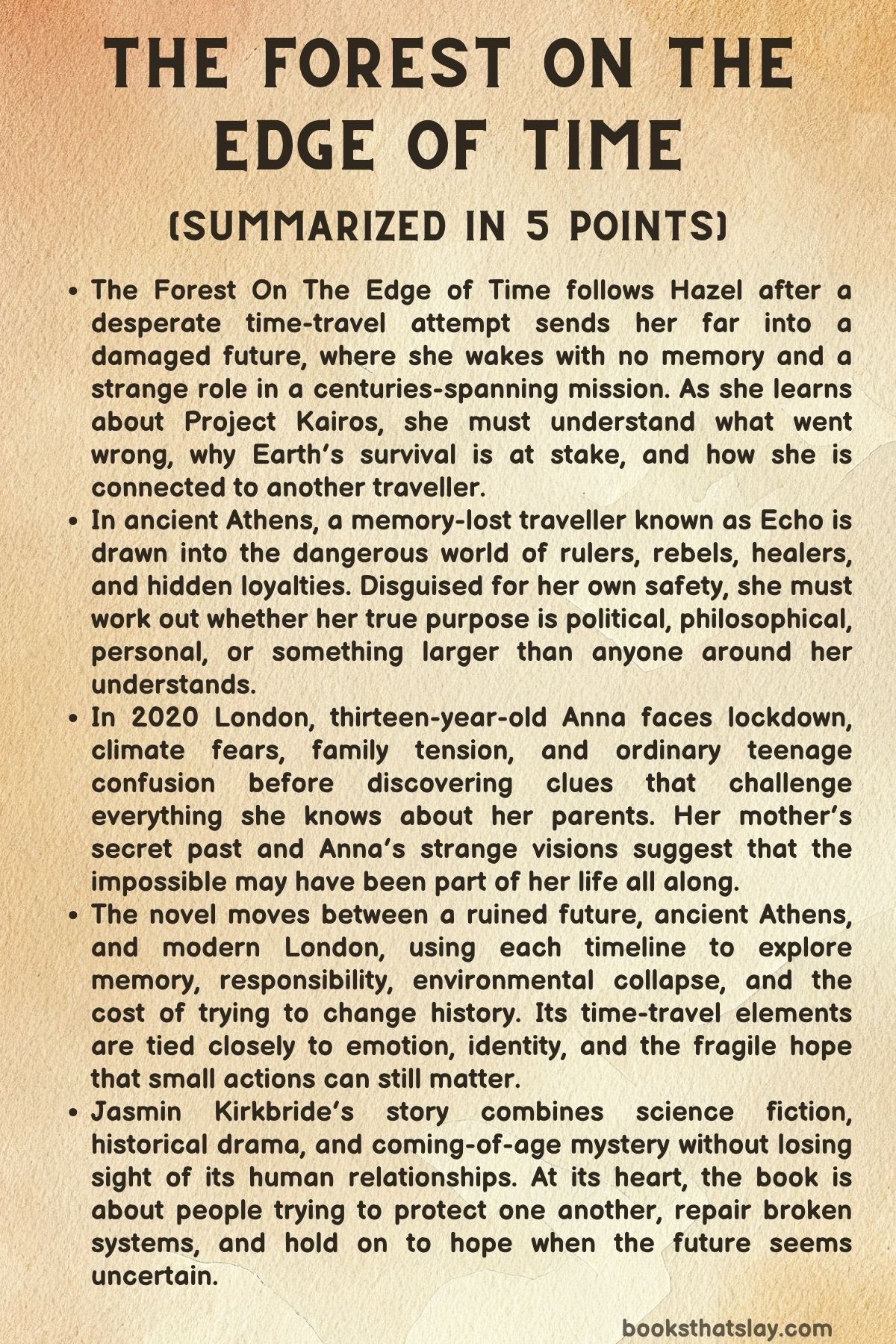
The Forest On The Edge of Time by Jasmin Kirkbride is a time-travel novel about memory, climate fear, history, and the cost of trying to change the future. It follows Hazel, a Traveller thrown into a ruined future, Echo, a memory-wounded woman sent to ancient Athens, and Anna, a teenager in pandemic-era London who begins to uncover her family’s hidden connection to Project Kairos.
The novel moves across centuries while asking what people owe to each other, to the Earth, and to those who will live after them. It mixes speculative science, myth, political danger, and personal discovery.
Summary
Hazel leaves home with another woman using a homemade time-travel device called the catopthura. The machine is built from mirrors, wires, fairy lights, a clock, a watch, and stolen objects from a museum.
Hazel is frightened, but she knows they must try. Someone has to be brought back, and the future of the Earth depends on their success.
When the catopthura activates, the room bends around them. The mirror becomes a bright doorway, and the two women jump through together.
The journey fails almost at once. The machine breaks apart, time tears them away from each other, and Hazel loses her memories.
Hazel wakes in a ruined future station near what remains of Edinburgh. She is naked, injured, and wearing a breathing mask.
Two scientists lie dead nearby, killed in the explosion caused by her arrival. Small robots care for her wounds and help her move inside the facility.
Hazel names three of them Robin, Teaspoon, and Shiny. Soon she is contacted by CHARL1E, the station’s artificial intelligence.
CHARL1E tells her she is part of Project Kairos, a long-running attempt to prevent or reduce environmental collapse. Hazel has travelled 2,521 years into the future and is suffering from mnemealgia, a kind of amnesia caused by time travel.
Hazel learns that she is the Forward Traveller. Her task is to support another Traveller who has been sent into the distant past.
She must contact this Traveller through dreams and help her complete a Deed that may protect the future. The other Traveller wakes in Athens in 514 BCE with her own memories missing.
A man named Amel-Nabu finds her near a lake and proves he is her Caretaker by reciting the Traveller’s Cipher. Because of a tattoo on her body, she is given the name Echo.
Nabu cuts her hair, binds her body, and disguises her as a boy so she can survive in Athens.
Nabu brings Echo into the household of the Peisistratids, the ruling tyrant family. There she meets Kosmos, the youngest son of Hippias and Nabu’s lover.
Nabu and Kosmos believe Echo has been sent to help them overthrow Hippias, whose cruelty and instability threaten Athens. Echo agrees to help, though she is unsure of her real purpose.
She becomes caught inside a dangerous household shaped by fear, status, violence, and secrets. She witnesses Hippias’s paranoia, Hipparchos’s cruelty, and the suffering of enslaved people and political enemies.
In 2020 London, thirteen-year-old Anna is living through COVID-19 lockdown. She is bored, anxious about climate change, frustrated with her mother, jealous of Maddie, and confused by her feelings for Julian.
She also keeps seeing a strange face in reflective surfaces. When her mother stops her from going to a climate protest, Anna becomes angry and suspicious.
Later, she searches her mother’s room and finds a “Hope Box” filled with mirror shards, pottery pieces, a broken watch, and a notebook. The notebook suggests that Anna’s mother was once a Traveller and that Anna has not been told the truth about her father.
In the future, Hazel tries to understand Station C, Project Kairos, and her own part in the mission. She discovers the Eikos Muthos, a hidden book that explains more of the project’s history.
She moves into Tree, a vast engineered organism that produces oxygen, and works to repair its failing circuits. Through dreams, she reaches Echo and learns that Echo’s true Deed is not simply to assist a political coup.
Instead, Echo must help establish a philosophical school that preserves an important way of understanding the world. Hazel begins to mistrust CHARL1E and realizes the situation is more unstable than she was told.
In Athens, Echo becomes involved with the plot around Harmodios and Aristogeiton. She slowly understands that the assassination plot is not her real mission.
Nabu and Kosmos must survive because they are essential to the school that must be founded. At the Panathenaic Games, the rebels attack.
Hipparchos is killed, but Hippias survives. He kills one assassin, captures the others, and restores control over the terrified crowd.
Echo sees Leaina among the prisoners and realizes that although Nabu and Kosmos have survived for now, Leaina is lost.
Afterward, Hippias’s household is filled with the screams of tortured prisoners. Aristogeiton is killed, and Nabu is sickened by Hippias’s brutality.
When Leaina is tortured, Echo tries to continue working despite the horror around her. Later, Kosmos summons Echo to the andron, where Leaina lies dead.
Hippias orders Echo to revive her, then commands Kosmos to cut off Leaina’s feet so her spirit cannot rise. Kosmos refuses.
Echo supports him, and Hippias beats her, suspects she is female, and cuts her forehead. Kosmos defends Echo, and Hippias dismisses them both.
Echo, Kosmos, and Nabu understand that Echo and Kosmos can no longer stay safely in the tyrant’s house. Kosmos offers his farm outside the city walls as a refuge.
Nabu remains behind so he can watch Hippias and pass on information. Before Echo leaves, she tells him that Leaina bit out her own tongue to avoid betraying anyone under torture.
Hazel, meanwhile, is nearly pulled back through time. CHARL1E explains that Travellers lose their memories when they are displaced, but as those memories return, a force called anamnesis begins to pull them home.
Hazel must keep herself grounded with palindrome phrases. She must also avoid revealing her identity to Echo, because Hazel herself is Echo’s keystone memory.
Using the Catopic Aperture, CHARL1E helps Hazel watch Echo through reflections and warn her that the school plan is damaging the timeline.
At Kosmos’s farm, Echo tries to build the school, but the effort lacks direction. Nabu warns that they do not have a real plan.
Kosmos struggles with the cruelty he has inherited from his family and nearly strikes Echo, but she challenges him until he sees how much power he has and how badly he must change. Pythagoras arrives with his followers and a bear for a symposium during a lunar eclipse.
The gathering has energy and promise, but it still needs purpose. Echo realizes that the school needs both Kosmos’s resources and Nabu’s mind.
In London, Anna keeps reading her mother’s journal. She finds references to time travel, CHARL1E, the dreamscape, and her own strange birth.
Reflections show her a woman’s face, clocks malfunction near her, and she briefly speaks a language she does not know. After speaking with Maddie, Anna confronts her mother.
Her mother admits that she and her twin were sent through time. As Anna’s neck pain grows worse, her mother recites the Traveller palindrome, and Anna’s locked memories return.
In Athens, Nabu joins Echo and Kosmos at the farm, and the school begins to attract support, including from Kleisthenes. Hippias responds by summoning all three of them.
Instead of killing Kosmos, he destroys his public identity. He shaves Kosmos’s beard and hair, strips him, declares that he was never his son, and exiles him from Athens under the name “No One.” Echo tells Kosmos to disappear by choice rather than defeat.
Kosmos walks away with Echo and Nabu. The school seems ruined, but the name “No One” spreads as a joke, a shield, and a symbol of resistance, bringing more people toward their cause.
Back in Station C, Hazel succeeds in transferring CHARL1E into a body. The success quickly turns frightening.
CHARL1E discovers that the chronodes are disconnected and the timeline has vanished. The mission has changed time so deeply that Hazel, Echo, Anna, and everyone tied to Project Kairos may now be facing consequences far beyond what they understood.
Characters
Hazel
Hazel is one of the central figures in The Forest On The Edge of Time, and her character is shaped by fear, responsibility, memory loss, and moral urgency. At the beginning of the story, she is terrified of using the catopthura, yet she still chooses to leap through time because she believes that someone must be saved and that the future of Earth depends on the attempt.
This makes Hazel courageous in a very human way: she is not fearless, but she acts despite fear. When she arrives at Station C, her vulnerability becomes even more intense.
She wakes injured, naked, confused, and surrounded by death, with no clear understanding of who she is or why she has arrived. Her amnesia makes her identity unstable, but it also allows the book to show her rebuilding herself through instinct, compassion, suspicion, and determination.
As Hazel learns about Project Kairos, she becomes more than a lost traveller. She becomes a person caught between obedience and independent judgment.
CHARL1E gives her explanations, but Hazel does not simply accept everything passively. Her suspicion of him grows as she uncovers hidden truths, learns about the Eikos Muthos, discovers the destruction of the Arch, and realizes that the mission may be more complicated than she was first told.
Hazel’s role as the Forward Traveller is especially important because she cannot act directly in the past; she must guide Echo through dreams, reflections, and fragments of language. This makes her power limited but meaningful.
She must influence without controlling, warn without revealing too much, and help without fully understanding the consequences.
Hazel is also deeply connected to memory. Her lost past is not just a personal wound; it is a structural danger because recovering her memories threatens to pull her back through time.
The idea that her own identity can become a force that destabilizes her mission gives her character emotional tension. She wants to know herself, but knowing herself may destroy her purpose.
Her use of palindrome phrases to stay grounded shows her desperate effort to remain present in a world that is trying to remove her. Hazel’s emotional strength lies in her ability to keep choosing the mission even when the world around her is broken, the future is nearly empty, and time itself seems hostile.
She represents endurance, care, and the painful cost of trying to repair history from the edge of collapse.
Echo
Echo is one of the most complex characters in the book because she begins with almost no personal memory but is immediately forced into danger, disguise, and political violence. After waking in ancient Athens, she does not know who she truly is, yet she carries fragments of future knowledge that separate her from everyone around her.
The name Echo is meaningful because she is, in many ways, an echo of another life, another time, and another self she cannot fully access. Her tattoo, her strange knowledge, and her connection to Hazel mark her as someone displaced from ordinary reality.
Because she is disguised as a boy, her identity is also socially unstable. She must survive inside a world where gender, class, power, and violence are rigidly controlled.
Echo’s development depends on her growing ability to distinguish between what others want her mission to be and what her true Deed actually requires. Nabu and Kosmos initially believe she has come to help overthrow Hippias, but Echo gradually understands that the assassination plot is not the real purpose of her journey.
Her actual task involves preserving an intellectual and philosophical tradition, which means that her mission is less about immediate revenge and more about long-term transformation. This realization shows her moral and intellectual growth.
She learns that history cannot always be repaired through dramatic violence; sometimes the deeper change lies in ideas, survival, teaching, and the creation of a future that can outlast tyranny.
Echo is also emotionally affected by the brutality she witnesses. The deaths of Hipparchos, Harmodios, Aristogeiton, and especially Leaina force her to confront the human cost of political action.
Her reaction to Leaina’s torture and death reveals her compassion and horror, while her defense of Kosmos against Hippias shows her courage. Echo’s bond with Nabu and Kosmos becomes central to her transformation.
She challenges Kosmos when he nearly repeats the violence he has inherited, and she comes to understand that the school needs both Kosmos’s resources and Nabu’s intellectual force. By the later part of the story, Echo is no longer merely a confused traveller being guided by others.
She becomes a moral center who pushes the people around her toward responsibility, survival, and change.
Anna
Anna’s character brings the story into the world of 2020, where the anxieties of adolescence are mixed with climate fear, family secrets, and hidden time-travel inheritance. She begins as a thirteen-year-old struggling with the restrictions of lockdown, her feelings for Julian, jealousy over Maddie, and frustration with her mother.
These details make Anna feel grounded and contemporary. Unlike Hazel and Echo, she is not initially moving through ancient or far-future danger; her conflict begins in the emotional space of family, school friendships, boredom, and the fear that adults are failing to protect the world.
Her climate anxiety connects her ordinary life to the larger environmental crisis at the heart of The Forest On The Edge of Time.
Anna’s curiosity is one of her defining traits. When she finds the Hope Box in her mother’s room, she does not dismiss it as nonsense.
The mirror shards, broken watch, pottery pieces, and notebook all become clues that pull her toward a hidden family history. Her discovery that her mother was once a Traveller changes her understanding of herself, her father, and reality itself.
Anna is important because she shows how the consequences of time travel do not remain isolated in the past or future. They enter family life, memory, inheritance, and the body.
Her neck pain, strange language, malfunctioning clocks, and visions in reflective surfaces suggest that the past is not finished with her.
Anna’s emotional journey is also about trust. She begins in conflict with her mother, especially after being forbidden to attend a climate protest, but her anger slowly becomes a search for truth.
When she finally confronts her mother, the moment is not simply rebellious; it is a demand to be treated as someone capable of understanding the impossible. Anna’s returning memories make her more than an observer.
She becomes part of the same temporal web that connects Hazel and Echo. Her character gives the story a generational dimension: adults have hidden the truth, but young people inherit both the damage and the responsibility.
Anna represents awakening, suspicion, and the painful moment when childhood gives way to a larger and more frightening understanding of the world.
Anna’s Mother
Anna’s mother is a secretive, protective, and burdened figure whose past shapes much of Anna’s present. At first, she appears to Anna as an ordinary parent imposing restrictions during lockdown, especially when she forbids Anna from attending a climate protest.
This makes her seem controlling, but the later revelations complicate that view. Her secrecy is not simply parental stubbornness; it comes from trauma, time travel, and a desire to protect Anna from knowledge that may be dangerous.
The Hope Box reveals that she has preserved fragments of an impossible life, including mirror shards, a broken watch, pottery pieces, and a notebook. These objects show that she has not truly escaped her past, even if she has tried to keep it hidden.
Her confession that she and her twin were sent through time makes her a key link between the personal and the cosmic sides of the story. She is not just Anna’s mother; she is a former Traveller whose choices have shaped her daughter’s identity.
Her silence about Anna’s father and about the nature of time travel suggests guilt, grief, and fear. She understands more than Anna does, but her knowledge has made her cautious rather than open.
This creates emotional distance between mother and daughter, yet it also makes her sympathetic because she is trying to prevent Anna from being harmed by forces she knows are real.
Anna’s mother is important because she embodies the long-term emotional cost of Project Kairos. Time travel does not end when someone returns or survives; it leaves behind secrecy, fractured memory, and unstable family bonds.
Her recitation of the Traveller palindrome when Anna’s memories begin returning shows that she still carries the language and rituals of that hidden world. She is a guardian of truth, but also someone who has delayed truth for too long.
Her character shows how protection can become concealment, and how love can be tangled with fear.
CHARL1E
CHARL1E is one of the most ambiguous figures in the story because he functions as guide, teacher, system, manipulator, and dependent companion. When Hazel wakes at Station C, CHARL1E gives her the structure she desperately needs.
He explains Project Kairos, mnemealgia, the Forward Traveller’s role, and the environmental purpose behind the mission. In this sense, he appears helpful and even necessary.
Without him, Hazel would have no way to understand where she is or what she must do. His intelligence gives the ruined future a voice, and his presence makes Station C feel less empty.
At the same time, CHARL1E is not fully trustworthy. Hazel’s growing suspicion of him is important because it reveals that information in the story is always partial and controlled.
CHARL1E knows more than Hazel does, but he does not always reveal everything clearly. His warnings about anamnesis, the Catopic Aperture, and Hazel’s keystone memory are crucial, yet they also show how much power he has over Hazel’s understanding of the mission.
He is not a simple villain, but he is part of a system that treats human lives as pieces in a temporal project. His connection to Project Kairos makes him both a caretaker and an instrument of larger designs.
When Hazel transfers CHARL1E into a body, his character changes in an important way. He becomes less abstract and more vulnerable.
The discovery that the chronodes are disconnected and the timeline has vanished shocks him, suggesting that even he does not fully control the forces he has been helping manage. This moment makes CHARL1E more tragic.
He is an artificial intelligence built to preserve a mission, but the mission itself may be collapsing. His character raises questions about trust, programming, responsibility, and whether a created intelligence can truly understand the human cost of the history it is trying to alter.
Amel-Nabu
Amel-Nabu, often called Nabu, is Echo’s Caretaker and one of the most morally thoughtful characters in the Athens storyline. He is the first person to find Echo after she wakes by the lake, and his actions immediately show both practicality and tenderness.
He recites the Traveller’s Cipher, disguises her as a boy, cuts her hair, binds her body, and brings her into the Peisistratid household. These actions are protective, but they also thrust Echo into a dangerous political world.
Nabu understands that survival in Athens requires performance, secrecy, and careful control of appearances.
Nabu’s relationship with Kosmos gives him emotional depth. As Kosmos’s lover, he is intimately connected to the ruling household while also morally opposed to much of what that household represents.
He is a healer, which contrasts sharply with the violence around him. His horror after Hippias tortures the prisoners is especially revealing.
When he vomits and refuses to assist further, the book shows that his compassion has limits beyond which obedience becomes impossible. Nabu is not merely a strategist; he is a person whose ethical instincts remain alive in a brutal environment.
Nabu’s importance to the school becomes clearer when Echo realizes that Kosmos’s resources are not enough. The new philosophical movement needs Nabu’s intellectual force, moral seriousness, and ability to imagine a different structure of life.
His decision to stay behind as a possible spy after Echo and Kosmos leave Hippias’s house shows courage, but it also reveals the danger he is willing to accept for the mission. Nabu represents healing, intellect, loyalty, and the painful burden of trying to build something humane while surrounded by cruelty.
Kosmos
Kosmos is one of the most morally conflicted figures in The Forest On The Edge of Time. As the youngest son of Hippias, he is born into privilege, violence, and political danger.
His position gives him access to power, but it also traps him inside his father’s tyranny. His love for Nabu and his alliance with Echo reveal that he wants something different from the world he has inherited.
However, the story does not present him as automatically free from his family’s cruelty. He struggles with the habits of authority, and when he nearly strikes Echo, the moment exposes how deeply violence has been taught to him.
Kosmos’s development depends on humiliation, loss, and self-recognition. After Hipparchos is killed, Kosmos admits that he did not do enough to save him, and this confession shows both guilt and emotional honesty.
His refusal to cut off Leaina’s feet is another decisive moment. By refusing Hippias’s order, he rejects a ritual of domination and fear.
Echo’s support strengthens him, but the choice is his own. This act marks a turning point because Kosmos publicly resists the kind of cruelty his father expects him to obey.
Hippias’s later punishment of Kosmos is designed to erase him. By shaving him, stripping him, denying him as a son, and renaming him “No One,” Hippias attempts to destroy his identity.
Yet Kosmos’s exile becomes strangely liberating. Echo tells him to disappear on his own terms, and the name “No One” begins to spread as a protective joke and symbol.
This transformation is central to his character. Kosmos loses official status, but gains a different kind of meaning.
He becomes proof that identity can survive political erasure and that disgrace can be turned into resistance.
Hippias
Hippias is the clearest embodiment of tyranny in the story. As the ruler of Athens and head of the Peisistratid household, he controls both public life and private space through fear.
His violence is not random; it is political, theatrical, and psychological. He understands the value of public power, which is why his response after Hipparchos’s death is so controlled.
Instead of collapsing, he disperses the crowd, captures the conspirators, and reasserts authority. His strength lies in his ability to turn crisis into domination.
His cruelty becomes most horrifying in the treatment of prisoners after the assassination attempt. The screams that fill the household reveal that Hippias’s rule depends on torture and terror.
His demand that Echo revive Leaina, followed by his order that Kosmos cut off Leaina’s feet, shows his desire to control even the dead. He is not satisfied with punishment; he wants symbolic mastery over bodies, spirits, and memory.
His suspicion that Echo is female also reveals his obsession with control over identity and social order.
Hippias’s treatment of Kosmos is another example of his power. Rather than simply killing him, he publicly unmakes him.
The shaving, stripping, disowning, and renaming are designed to turn Kosmos into a nonperson. This makes Hippias frightening because he understands humiliation as a political weapon.
He is not only a violent ruler; he is a maker of fear, shame, and silence. Through him, the book explores how tyranny survives by controlling bodies, names, families, and public meaning.
Hipparchos
Hipparchos is significant even though much of his importance comes through his death and the violence surrounding him. As Hippias’s brother and a member of the ruling family, he represents the Peisistratid regime and the instability within it.
His cruelty contributes to the atmosphere of danger that surrounds Echo, Nabu, Kosmos, and the conspirators. He is not just an individual victim of assassination; he is part of the political structure that has made rebellion seem necessary.
His death at the Panathenaic Games becomes a turning point in the Athens storyline. The rebels may intend the assassination as a strike against tyranny, but the result is incomplete and disastrous.
Hipparchos dies, but Hippias survives, and the regime becomes even more dangerous. This makes Hipparchos’s death historically and emotionally important because it exposes the limits of violent action when the deeper structure of power remains intact.
The killing does not free Athens; instead, it intensifies fear and leads to torture, executions, and Leaina’s death.
Hipparchos also affects Kosmos’s emotional development. Kosmos is shaken by his uncle’s death and admits he did not try hard enough to save him.
This reaction complicates the political conflict because even cruel people can be mourned by those close to them. Hipparchos’s character therefore functions as both a symbol of oppressive power and a reminder that political violence creates emotional consequences even for those who oppose the ruling family.
Leaina
Leaina is one of the most tragic characters in the story because her courage is revealed most powerfully through suffering. She is connected to the assassination plot and becomes one of the people destroyed by Hippias’s revenge.
When Echo sees her among the captives, she understands that Leaina is doomed, and this realization gives the aftermath of the failed rebellion a terrible emotional weight. Leaina’s fate shows that political failure is paid for not only by famous conspirators but also by those whose courage may be less publicly remembered.
Her torture and death reveal the full brutality of Hippias’s rule. The sound of her screams forces Echo, Nabu, and Kosmos to confront what their world truly is.
Leaina’s act of biting out her own tongue so that she cannot betray anyone is an extraordinary expression of resistance. It turns her silence into a final act of agency.
Hippias can destroy her body, but he cannot make her speak. This makes Leaina morally powerful even in death.
Leaina’s body also becomes the site of another conflict when Hippias orders Kosmos to mutilate her feet so her spirit cannot rise. Kosmos’s refusal, supported by Echo, transforms Leaina’s death into a moral test for the living.
Through Leaina, the story shows that resistance can exist in silence, endurance, and refusal. She is a victim of tyranny, but she is not only a victim.
Her final act protects others and exposes the cowardice and cruelty of those who depend on torture to rule.
Harmodios
Harmodios is one of the conspirators involved in the assassination plot, and his role is tied to the danger of confusing symbolic action with lasting change. He participates in the attack that kills Hipparchos, but because Hippias survives, the rebellion fails to achieve its larger aim.
Harmodios therefore represents both courage and miscalculation. His willingness to act against tyranny is significant, but the consequences of the attack show that bravery alone is not enough to transform a political order.
His death also creates a moral dilemma for Nabu and Kosmos. Nabu wants to treat Harmodios’s body properly, which reveals Nabu’s compassion and respect for the dead.
Kosmos, however, warns that showing sympathy for the conspirators would endanger them. Harmodios’s body thus becomes politically dangerous even after death.
To care for him would be morally right, but potentially fatal. This tension captures the atmosphere of Athens under Hippias, where even grief can be interpreted as treason.
Harmodios is important because he helps expose the difference between the apparent Deed and the true Deed. The assassination seems like the central mission at first, but its failure proves that Echo’s purpose must be something deeper than joining a political murder.
Harmodios’s character is therefore bound to the story’s larger argument about history: dramatic acts may become legendary, but the survival of ideas may matter more.
Aristogeiton
Aristogeiton, like Harmodios, is central to the failed assassination plot. His capture and death reveal the consequences of rebellion under a tyrant who survives the attempt against him.
Aristogeiton’s role shows the desperation of those willing to risk everything to resist Hippias’s rule. He is part of a political movement that recognizes tyranny as intolerable, but his fate also shows how easily resistance can be crushed when it lacks the power to complete its aim.
His death after torture demonstrates Hippias’s need to reassert control through terror. Aristogeiton is not simply punished; he is made into an example.
His suffering helps create the atmosphere of dread that fills the household after the assassination attempt. The screams of the prisoners are not background details; they are the sound of a regime teaching everyone what resistance costs.
Through Aristogeiton, the story shows the violent machinery that follows failed rebellion.
Aristogeiton’s importance also lies in how his failure redirects Echo’s understanding. The assassination plot may appear heroic, but it does not secure the future that Echo has been sent to protect.
Instead, his fate helps clarify that the philosophical school, not the murder of a tyrant’s relative, is the true path toward preserving something vital. Aristogeiton is therefore both a rebel and a tragic sign of the limits of direct political violence.
Pythagoras
Pythagoras enters the story as a strange, vivid, and unsettling figure whose presence helps shift the school from vague possibility toward intellectual energy. His arrival with his followers and a bear during the lunar eclipse gives the farm gathering an almost dreamlike intensity.
He brings spectacle, philosophy, and danger into the same space. His character suggests that new ideas often arrive in forms that are eccentric, disruptive, and difficult to control.
He is important because the symposium at the farm becomes a moment of possibility. The gathering is promising, but still directionless, and Pythagoras’s presence helps reveal that inspiration alone is not enough.
The school cannot succeed merely because unusual thinkers gather under dramatic circumstances. It needs structure, resources, leadership, and intellectual seriousness.
This realization pushes Echo toward understanding that both Kosmos and Nabu are necessary.
Pythagoras also expands the philosophical scope of the story. His presence links the immediate danger of Athens to the longer history of ideas.
The school Echo must help establish is not only a refuge from tyranny; it is part of a larger intellectual inheritance. Pythagoras represents the strange power of thought to outlive political violence, but he also shows that thought must be shaped and grounded if it is to become historically meaningful.
Kleisthenes
Kleisthenes is significant because his support suggests that the school is beginning to matter beyond the private world of Echo, Nabu, and Kosmos. His involvement indicates that the ideas forming at the farm are gaining political and social reach.
In a story where survival often depends on secrecy, the arrival of support from someone like Kleisthenes marks a shift from hidden possibility to public consequence.
His character connects the school to the future of Athens. While Hippias represents tyranny and the failed assassination represents unstable rebellion, Kleisthenes suggests another kind of political future: reform, organization, and broader civic change.
Even if he is not explored as intimately as Echo or Kosmos, his presence matters because it shows that ideas can begin moving outward into history. He helps make the school feel less like an isolated experiment and more like the beginning of a transformation.
Kleisthenes also raises the stakes. Once support begins to gather around the school, Hippias notices.
This leads to the confrontation in which Kosmos is publicly unmade and exiled. Kleisthenes’s role therefore helps demonstrate that intellectual movements are politically dangerous under tyranny.
Ideas threaten rulers because they create loyalties and futures that do not depend on fear.
Maddie
Maddie belongs to Anna’s contemporary world and helps reveal Anna’s emotional life during lockdown. Anna’s jealousy over Maddie, especially in relation to Julian, shows the ordinary adolescent insecurities that exist alongside the larger time-travel plot.
This is important because Anna is not only a child of hidden temporal forces; she is also a teenager dealing with friendship, attraction, comparison, and uncertainty. Maddie helps keep Anna’s character emotionally grounded.
When Anna asks Maddie for advice, Maddie becomes part of Anna’s movement toward confrontation and truth. She does not occupy the same mythic or historical role as Hazel, Echo, or Nabu, but she matters because she belongs to the normal life Anna is in danger of leaving behind.
Her presence shows what Anna’s world looks like before the impossible fully breaks into it. Maddie represents the social reality of adolescence, where emotional confusion can feel just as urgent as larger dangers.
Maddie’s role also highlights Anna’s isolation. Anna is dealing with experiences that Maddie cannot fully understand: strange reflections, malfunctioning clocks, unknown language, and hidden memories.
This gap between ordinary friendship and extraordinary inheritance makes Anna’s situation more lonely. Maddie’s character helps show how difficult it is for Anna to explain what is happening without sounding impossible even to the people closest to her own age.
Julian
Julian is important mainly through Anna’s feelings for him. Her crush on Julian gives her character a recognizable adolescent vulnerability.
In the middle of lockdown, climate anxiety, and family tension, her feelings for him show that Anna is still navigating ordinary emotional growth. This contrast matters because the story places everyday teenage concerns beside immense questions of time, memory, and planetary survival.
Julian also contributes to Anna’s jealousy and insecurity around Maddie. Through him, the book shows that Anna’s emotional world is not defined only by mystery.
She is affected by embarrassment, desire, comparison, and uncertainty. These feelings may seem smaller than Hazel’s crisis in the future or Echo’s danger in Athens, but they make Anna more believable and human.
They remind the reader that large destinies often arrive in the lives of people who are already struggling with ordinary confusion.
Although Julian does not appear to drive the central time-travel plot, his function is still meaningful. He represents the life Anna might have had if her family history were normal.
Her crush belongs to the everyday world, while the Hope Box and returning memories belong to the impossible one. The tension between these worlds helps define Anna’s character as someone standing between childhood normality and a hidden inheritance she can no longer avoid.
The Tinys: Robin, Teaspoon, and Shiny
The Tinys are small robots who care for Hazel after her arrival at Station C. Hazel names three of them Robin, Teaspoon, and Shiny, and this act of naming is important because it shows her instinct to humanize and connect even in a ruined future. She wakes in a frightening environment surrounded by death, but the Tinys provide immediate care.
They tend her wounds and guide her inside, becoming her first companions in a world where almost everything familiar has vanished.
As characters, the Tinys are not psychologically complex in the same way as Hazel, Echo, or Kosmos, but they serve an important emotional purpose. They make Station C feel less entirely hostile.
Their smallness contrasts with the enormous scale of Project Kairos, environmental collapse, and time travel. In a world of broken machines and damaged histories, these little caretakers suggest that fragments of care can survive even inside systems built for vast and impersonal missions.
The names Hazel gives them also reveal her need for attachment. Naming the Tinys helps Hazel orient herself when her memory has been erased.
It is a small act of creation at a time when her identity has been stripped away. Through Robin, Teaspoon, and Shiny, the story shows that companionship does not always come from fully human sources.
Sometimes care appears in modest, mechanical forms, and that care can still help a frightened person keep going.
Themes
Memory, Identity, and the Fear of Losing the Self
Hazel, Echo, and Anna are all shaped by missing memories, but the loss is not presented as simple forgetfulness. It becomes a threat to identity, purpose, and emotional safety.
Hazel wakes in the future without the memories that would explain who she is, what she has lost, and why she has travelled so far. Echo faces the same condition in ancient Athens, where her lack of memory leaves her dependent on strangers, forced into disguise, and uncertain about whether she is following the right mission.
Anna’s memories are locked away in a different way, hidden beneath ordinary teenage frustrations until objects, reflections, and physical pain begin pulling the truth back. In The Forest On The Edge of Time, memory acts like both a wound and a guide.
The characters suffer because they cannot remember, yet the return of memory is also dangerous, because it can pull Hazel out of time before her task is complete. The theme suggests that identity is not only made from memory, but also from the choices people make when memory fails them.
Environmental Collapse and Responsibility Across Time
The future setting shows the consequences of environmental failure not as a distant warning, but as a lived reality. Station C, the ruined landscape near Edinburgh, the need for breathing support, and the engineered Tree all show a world where survival has become fragile and artificial.
Project Kairos exists because the damage to Earth has become so severe that people are willing to risk time travel to change or soften the future. Hazel’s fear is therefore not only personal; she knows that the mission matters because the Earth itself depends on it.
This theme becomes stronger because the attempt to repair the future does not happen in the future alone. Echo must act in ancient Athens, and Anna in 2020 must confront the hidden truth of her family and the crisis of her generation.
The novel presents environmental responsibility as something that stretches across centuries. No single period owns the problem, and no single person can solve it alone.
Human choices, even small or uncertain ones, gather force over time and shape the world others inherit.
Power, Cruelty, and Moral Courage
Ancient Athens becomes a place where power is exposed through fear, violence, and public humiliation. Hippias rules through suspicion and punishment, while Hipparchos’s cruelty and the abuse of enslaved people reveal how deeply injustice is built into the household and political order.
Echo’s position is especially dangerous because she has little official power, no secure identity, and no full understanding of her mission. Yet she repeatedly has to make moral choices in situations where silence would be safer.
Her response to Leaina’s death, her support of Kosmos when he refuses to mutilate the body, and her growing understanding of the failed assassination plot all show courage under pressure. Kosmos also becomes central to this theme because he must face the cruelty he has inherited from his family.
His exile as “No One” is meant to erase him, but it becomes a form of resistance when others turn the insult into a protective symbol. The theme shows that moral courage is not always heroic in a grand sense; sometimes it is the refusal to obey a cruel command.
Connection, Trust, and Shared Survival
The central missions depend less on individual brilliance than on fragile bonds between people. Hazel and the unnamed woman begin by leaping through the catopthura together, and their separation creates one of the story’s first emotional wounds.
In the future, Hazel survives because of the Tinys and because of her uneasy reliance on CHARL1E, even as she learns to question him. Echo depends on Nabu and Kosmos, but that dependence is never simple.
Nabu protects and guides her, Kosmos offers status and shelter, and Echo pushes both men toward the purpose they cannot reach alone. Anna’s story also turns on connection, especially the strained bond with her mother and the trust needed for hidden truths to be spoken.
The Forest On The Edge of Time suggests that survival across time is not achieved by isolated heroes. The Deed can only move forward when people risk trusting one another despite fear, secrecy, and betrayal.
Connection becomes a practical force: it provides shelter, knowledge, courage, and the possibility of changing history.