Make It Out Alive Summary, Characters and Themes
Make It Out Alive by Allison Brennan, the 7th book in the Quinn & Costa series is a fast-moving crime thriller that follows an FBI Mobile Response Team racing to stop a honeymoon-killer before more couples disappear. When investigators arrest resort maintenance worker Garrett Reid during an apparent abduction attempt, the case looks promising—until the evidence comes up thin and two agents vanish without a trace.
What begins as a straightforward takedown turns into a high-stakes hunt across state lines, with shifting suspects, a hidden “secondary site,” and a clever accomplice who treats kidnapping like sport. The story balances procedural legwork with a relentless fight to survive.
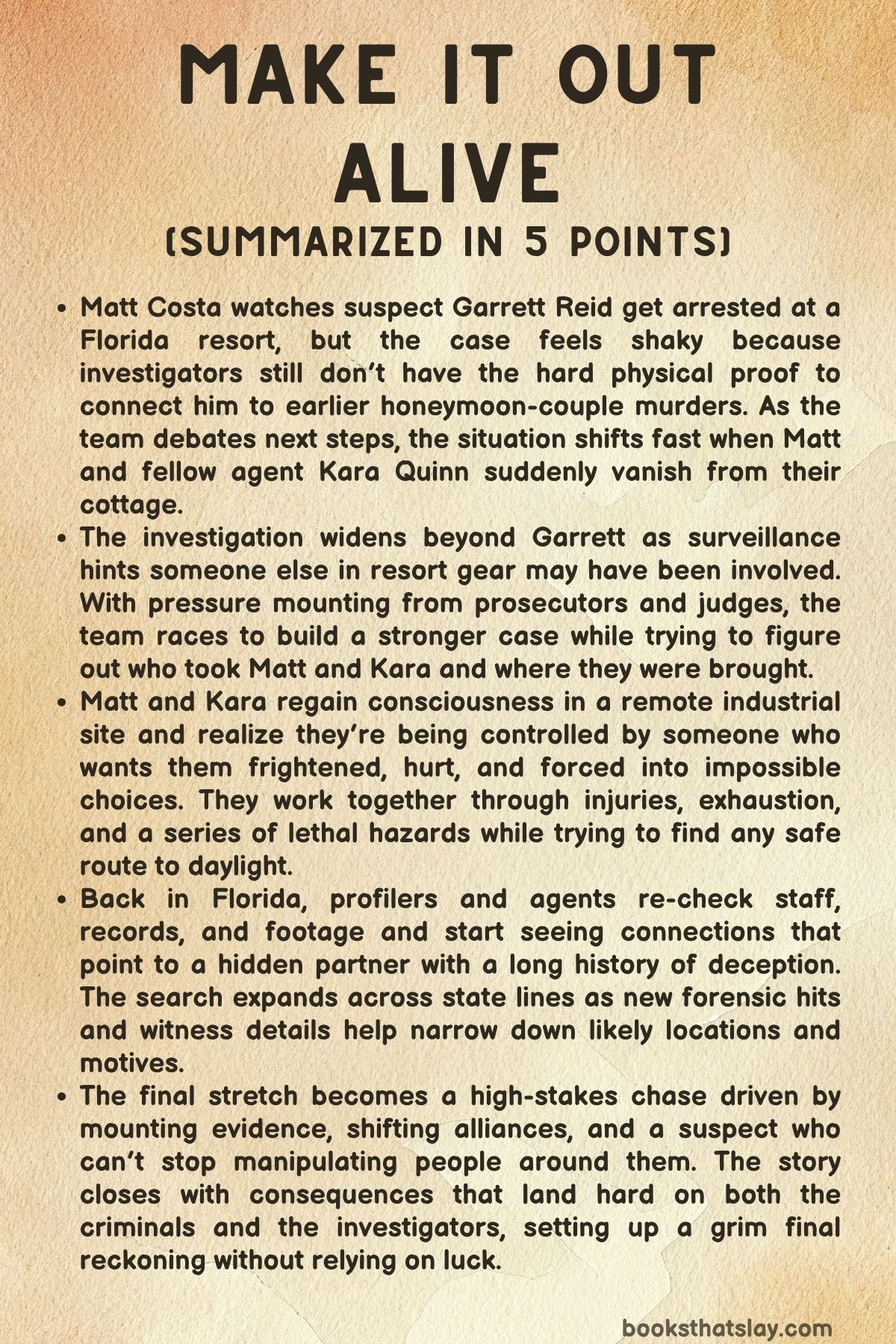
Summary
At the Sapphire Shoals Resort in Florida, FBI Agent Kara Quinn and agent Matt Costa watch Garrett Reid get questioned after he’s arrested for trying to abduct undercover agents posing as newlyweds. The arrest seems like a breakthrough: three honeymooning couples have already been found dead, drugged and held for days before being dumped at sea, and Reid fits the profile investigators built.
District Attorney John Anson believes they finally have their man, but Matt can’t shake the feeling that the capture was too smooth. Saltwater ruined most forensic traces from the earlier murders, and without solid physical proof, the case could crumble.
During the interview, Detective Bianca Fuentes and FBI Agent Michael Harris press Reid about suspicious activity near Kara and Matt’s cottage—room service delivery, a laundry cart, and a beachside entrance. Reid offers tidy explanations: he says he was asked to carry a breakfast tray, claims he found the couple unconscious and tried to help, and insists he doesn’t remember guests.
When the questioning tightens, he becomes wary and asks for a lawyer. Investigators search his apartment and truck, expecting to find drugs, restraints, trophies, or something linking him to the dead couples.
Instead, they find almost nothing. The apartment is clean to the point of sterility, the truck yields no clear clues, and neighbors describe him as quiet and courteous.
Kara notices loose fence boards on his patio that could allow secret movement toward a canal, but it’s still not enough to tie him to murder.
Back at Quantico, the team realizes something is wrong: Kara and Matt never boarded their flight home and have gone silent. Resort security enters their cottage and finds their phones charging, weapons and badges left behind, and luggage untouched—signs of a sudden removal rather than a planned exit.
Security footage captures a person in a maintenance uniform pushing a laundry bin near their cottage, then slipping out of camera coverage. The team scrambles back to Florida, and leadership warns they may be facing more than one offender.
Kara and Matt wake up in darkness inside an abandoned industrial facility. Matt is bruised and dehydrated, remembering only a tranquilizer sting and Kara collapsing during a quiet brunch.
He hears Kara scream and finds her trapped in a malfunctioning freight elevator. When the elevator drops unexpectedly, it nearly kills her; she escapes with Matt’s help, and the elevator later crashes down the shaft, convincing them they’re in a place built to hurt them.
They attempt to follow an exit sign but discover doors without handles, unstable stairwells, and corridors filled with debris. Matt cuts his leg when a corroded step gives way.
In a filthy restroom, Kara finds a Bible verse scratched into a mirror. Paperwork in the building suggests they’ve been transported across state lines to a shuttered cannery in Georgia.
The implication is terrifying: someone moved them while Garrett Reid sat in custody.
As they search for daylight, the building itself turns hostile. A boarded window area collapses when they disturb the wrong pile, sending beams and glass down where Matt had stood seconds earlier.
They begin to treat every doorway and hallway like a trap. In a raised control-room area overlooking a flooded factory floor, they spot working surveillance monitors and realize the site has power.
A cheerful woman’s voice comes over a speaker system, mocking them as if they’re contestants in a private game. The doors slam shut from the outside, confirming an unseen handler is watching and controlling their routes.
Meanwhile, back in Florida, prosecutors admit their problem: there’s still no hard evidence connecting Reid to the murders, and his phone and financial records appear clean. With Kara and Matt missing, the attempted-abduction case is also weaker than it should be.
Reid’s attorney, Franklin Graves, arrives and blocks further questioning. At a court hearing, the judge refuses to hold Reid without stronger charges and sets bail, giving prosecutors a short window before the case risks dismissal.
The team shifts strategy: if they can’t hold Reid on the murders yet, they’ll follow him and watch who he contacts.
The reason Reid has such strong legal support soon becomes clear—Graves is being forced to comply. His wife Lily and stepson Nathan have been kidnapped by a woman calling herself Audrey.
She threatens to kill them if Graves doesn’t protect Reid. Audrey meets Reid and reveals she is his partner and lover.
She boasts that she tranquilized Kara and Matt and moved them to the cannery, keeping them alive for her entertainment. Reid worries about exposure and insists the agents must die.
Audrey agrees, but she’s also juggling her cover identity and her next move.
Investigators dig into resort staff and uncover the second offender hiding in plain sight. Surveillance suggests the laundry-bin pusher may be a woman.
Attention turns to Hope Davidson, a gym employee whose timeline doesn’t add up. A lifeguard reports Hope disappeared from her work area at key moments, and camera angles show gaps where someone could move from locker rooms to the beach unseen.
When agents review her employment history, they discover she omitted past jobs that overlap with Reid’s prior workplaces. Hope vanishes before she can be questioned again, confirming she’s more than a witness.
Inside the cannery, Kara and Matt force themselves to think like engineers as much as agents. After a catwalk collapse sends Kara into dark water and nearly drowns Matt, they decide the obvious exits are designed to kill them.
Kara’s leg is badly cut, and Matt makes a tourniquet from his shirt, worried about infection from the filthy water. They test doors without touching them directly, using a long metal basin as a wedge.
Their caution pays off: a rigged pile drops on the far side, meant to crush anyone who walks through normally. They spot another trap—an overhead net loaded with bowling balls—and avoid it by breaking a window and climbing out instead.
They finally reach sunlight and identify the site as the Sweetwater Cannery in Clinch County, Georgia.
Exhausted and limping, they follow a gravel road toward help. Matt tries to sabotage the generator to slow their captor’s tracking, while Kara fights dizziness and blood loss.
Their escape intersects with Graves’s family’s nightmare: Lily and Nathan are being held in a decaying farmhouse that begins to collapse and then erupts in an explosion. Kara and Matt manage to pull Lily free and get Nathan out as the structure burns.
Sirens and a helicopter arrive, and Michael Harris confirms Kara is alive, while paramedics rush Lily to surgery and assess Matt’s injuries.
With Kara safe, the investigation sharpens. The team identifies Hope Davidson as Clara Dolan, a woman with multiple aliases, fake IDs, and access to money through a trust and shell companies.
Evidence found at her home and in her documents links her to the cannery property. The team also uncovers an older missing-person case: Becca McCarthy, a young woman from Reid’s past who resembles Kara.
Kara confronts Reid directly, using Becca as leverage and pressing him with Clara’s real identity and crimes. Reid denies direct involvement but cracks under the pressure, providing contact information and later calling Kara with a chilling shift in attitude—he now believes Clara took Becca from him, and he hints he may seek revenge outside the law.
Authorities narrow Clara’s likely hideout by focusing on her pattern: she needs coastal access to dispose of bodies and escape quickly. Two trust-linked properties fit—one near Savannah and one on Kiawah Island.
The team chooses Kiawah and raids the property with backup, only to encounter more traps. Clara attempts to flee through hedges while triggering hazards, injuring an officer.
She also tries to distract the team by remotely starting a boat motor. Michael chases her to the dock; she dives into the water, but he follows, captures her underwater, and hauls her back to shore.
Clara demands a lawyer and tries to perform innocence, but the evidence is now overwhelming.
As prosecutors secure jurisdiction, more proof stacks up: digital recordings, blood traces tied to boats, and documentation of extortion and fraud through her business fronts. Lily survives surgery and begins recovering.
Reid disappears after a boat explosion and is presumed dead, though investigators later locate remains connected to Becca’s case, suggesting a grim resolution.
Months later, the story takes a final, violent turn. Reid is alive, disguised and moving unseen.
He contacts Kara, claims he’s ready to surrender, then approaches a courthouse transport van and shoots Clara three times, including a fatal head shot. He drops the weapon, turns himself in, and announces that, to him, the game is finished.
Characters
Matt Costa
Matt is one of the steadier heroes in Make It Out Alive: observant, methodical, and instinctively distrustful of “easy” wins. His early suspicion that Garrett Reid’s arrest is too neat becomes a defining trait—Matt keeps returning to what’s missing, such as physical evidence, a secondary site, and a clean chain of proof, rather than what feels satisfying.
Once he’s abducted, his competence shifts from investigative to survivalist: he problem-solves under exhaustion, reads environments like puzzles, and repeatedly chooses restraint over impulse, whether he is testing doors indirectly, hunting tools, or thinking about booby traps. Matt’s psychology is built on responsibility—he carries guilt when Kara is hurt, and his decisions consistently prioritize keeping her alive, even when his own injuries worsen.
By the end, he represents the human cost of the case: a professional trained for danger who still gets blindsided, bruised, terrified, and forced into a game designed to humiliate and break him.
Kara Quinn
Kara is the narrative’s sharp edge—direct, impatient with half-measures, and unwilling to let procedure become an excuse for paralysis. Early on, she’s frustrated the team moved too fast on Reid, not because she doubts he’s dangerous, but because she understands how thin suspicion looks in court and how quickly predators exploit that gap.
When she becomes a captive, Kara’s defining quality is refusal: refusal to panic, refusal to accept obvious exits, refusal to be psychologically “managed” by the voice over the speakers. She’s practical about injury and contamination risk, yet she keeps a strong moral spine—she protects Nathan, demands protective custody for Lily, and re-enters the investigation while still bleeding.
Kara also becomes an emotional lever against Garrett: her resemblance to Becca McCarthy makes her both a target and a tool, allowing her to destabilize his self-image and pry open cracks in his loyalty to Clara. In the end, Kara embodies resilience with judgment—courage that isn’t reckless, and empathy that doesn’t dilute her aggression toward the guilty.
Garrett Reid
Garrett is written as the charming, plausible offender—socially smooth, employable, and outwardly ordinary—whose menace is initially more about what he could do than what can be proven. His central function is ambiguity: he fits the FBI profile, is caught with restraints, and yet the case against him collapses repeatedly because he understands cleanliness, deniability, and legal leverage.
The call with his father reframes him as a long-practiced predator of a different kind: a manipulator who exploits trust, money, and sexuality, then discards people without remorse. That background clarifies why he survives scrutiny early—he’s trained himself to look like the reasonable man in the room.
His later arc turns him into a volatile collision of ego, grievance, and possessiveness: he’s less the architect of sadism than the one who wants control and credit, and when Clara’s games endanger his freedom, his “love” becomes a justification for violence. His final act—executing Clara and surrendering with theatrical satisfaction—shows a man who cannot stop performing dominance, even when claiming repentance; he doesn’t end the game because he’s healed, he ends it because he wants the last move.
Clara Dolan
Clara is the true engine of cruelty: inventive, theatrical, and obsessed with control as entertainment. Her many names—Audrey, Hope Davidson, Amber, Audrey Reid, Audrey Dolan—aren’t just disguises; they’re proof she experiences identity as a costume rack, chosen for access, leverage, and storycraft.
Clara doesn’t simply kill; she curates fear, builds traps, rigs spaces, and speaks through speakers like a director addressing actors. That voice—cheerful while threatening—signals a specific psychology: she needs emotional dominance more than physical proximity, and she treats victims as props in a performance that validates her superiority.
The trust fund and LLCs deepen her menace by removing common constraints; money gives her logistics, mobility, and the confidence to take risks. Her manipulation of Franklin Graves and the hostage-taking of Lily and Nathan show how she weaponizes ordinary people’s love and responsibility, turning decency into a weakness she can exploit.
Even in detention, Clara’s refusal to confess and her attempts to redirect blame show she views truth as negotiable and morality as a game board—she doesn’t feel guilt, she feels irritation when she can’t rewrite the narrative.
Dr. Catherine Jones
Catherine functions as the mind of the investigation, but she’s also a study in professional fallibility. She begins confident in her profile, then has to confront the humiliation of being wrong when the case changes shape—her early belief in a lone killer becomes a liability the defense and prosecutors can point to.
What makes her compelling is that she adapts rather than defends her ego: she pivots to the partner theory, digs into Reid’s family history, and uses behavioral interpretation to identify why Graves’s involvement looks off. Catherine’s leadership style is strategic pressure—she knows when to push a witness, when to create fear in a suspect, and when to use the weight of consequences to crack someone’s self-interest.
Her empathy is present but contained; she is more protective through action than comfort, trying to keep agents safe, anticipating future victims, and refusing to let the case become a bureaucratic stalemate. By the end, Catherine is the one who can stare down Clara’s performative manipulation and treat it like what it is—another tactic—showing her growth from profiler-as-authority to profiler-as-adjusting instrument.
FBI Agent Michael Harris
Michael is competence with heat: a former operator who carries impatience for delay and a blunt sense of what danger looks like in real time. He’s often the counterweight to Catherine—where she theorizes, he tests; where she reframes, he demands results.
His work with surveillance, staff interviews, and scene updates shows a methodical investigative side, but his defining moments are physical and protective: raising security protocols, insisting people not move alone, and ultimately pursuing Clara into water and refusing to be tricked by her feigned helplessness. Michael’s emotional center emerges most when Kara is found alive—his relief is immediate and human—and that matters because it contrasts with the cold machinery of the case.
He’s also one of the few characters who embodies consequence management: he recognizes that one mistake in a booby-trapped environment or one underestimated suspect can kill a teammate. Michael’s arc makes him the bridge between analysis and action, demonstrating that survival against a predator like Clara requires both.
Detective Bianca Fuentes
Bianca is the local anchor—experienced, procedural, and tuned to how interviews and courts actually work on the ground. In interrogation, she’s sharp enough to catch Reid’s pivots and alarm responses, and her slip about arraignment becomes a revealing mistake: it shows how easily a suspect can seize a procedural opening to shut down questioning.
Bianca’s value increases as the case turns messy; she supplies legal reality checks, supports the push to broaden warrants, and collaborates with Catherine on the “why does he have that lawyer” question that becomes a major break. She also carries the emotional fatigue of working a case contaminated by seawater and circumstance—every lead feels smeared—and yet she remains steady rather than cynical.
Bianca represents the story’s realism: evidence, timing, and courtroom constraints matter, even when the danger is urgent.
District Attorney John Anson
Anson is the embodiment of prosecutorial gravity: he wants the right suspect, but he wants a case that survives. He frustrates the team because he refuses to confuse “caught with suspicious items” with “provable beyond a reasonable doubt,” and that tension is the point—predators exploit the gap between certainty and proof.
Anson’s insistence on murder evidence and his warnings about the weakness of attempted abduction charges without testimony are not villainy; they’re the legal system pressing back against the investigators’ desire to move fast. At the same time, he’s not passive—he argues bail, pushes for timelines, and supports surveillance strategies once he understands the direction of the threat.
Anson’s role sharpens the stakes: the danger isn’t only the killer, it’s also the possibility that the killer walks because the system is doing what it must.
Ryder Kim
Ryder is urgency with discipline: the one who notices the flight no-show, triggers the rapid verification cycle, and keeps moving when others are still assuming normal explanations. His contribution is partly technical—tracking, contacting security, pushing footage and stills for enhancement—but mostly it’s about attention and follow-through.
Ryder’s suspicion that the laundry-bin figure could be a woman shows a willingness to trust subtle cues without overstating certainty, which is critical in a case full of misleading surfaces. He also becomes a key partner to Catherine as she shifts theories, reinforcing that good investigative work is often less “big reveal” and more relentless checking of what everyone else overlooks.
Tony Greer
Tony is command presence—the one who makes the hard organizational call to get everyone back to Florida and to treat the situation as broader than a single suspect. He’s less about emotional texture and more about institutional muscle: keeping Reid in custody as long as possible, entertaining the partner theory early, and pushing operational urgency.
Tony’s role highlights how serial cases require not just talent but coordination, speed, and risk management across jurisdictions and teams.
Sloane Wagner
Sloane is the quiet scalpel: patient, detail-focused, and essential in the “paperwork” phase that often breaks cases. Her attention to Hope Davidson’s employment history and the omission on the résumé is classic investigative leverage—small dishonesty that signals larger deception.
Sloane also becomes a protective presence for Nathan, which reframes her competence as caretaking as well as analysis; she understands that safeguarding witnesses and victims is part of solving the case, not an afterthought. She represents the investigative truth that major predators are often caught not by genius alone, but by someone who reads the file closely and asks why one line doesn’t fit.
Jim
Jim is forensic momentum—arriving with ketamine confirmation, identifying the tranquilizer dart, and pushing retesting for additional narcotics. He’s also a symbol of vulnerability inside competence: once the case recognizes a predatory partner and potential stalking of investigators, Jim becomes someone who must be protected, reminding the team that specialized knowledge can also make you a target.
His findings matter because they convert suspicion into mechanism—how victims are subdued, how abductors move unseen, how the crime’s signature connects across scenes.
Brian Valdez
As Sapphire Shoals security chief, Valdez sits at the intersection of hospitality optics and real threat. He’s decisive when it counts—entering the cottage, confirming disappearance indicators, and providing access to surveillance systems—yet he also reveals the limitations of private security infrastructure: camera blind spots, uniform access through suppliers, and procedural routines that can be exploited.
Valdez isn’t incompetent; he’s facing a predator who planned around the resort’s systems. His role underscores a key theme: modern environments feel monitored, but that illusion can be weaponized.
Franklin Graves
Graves begins as an obstacle—a skilled defense attorney who can slow the investigation—and then becomes a hostage-shaped tragedy. His coercion shows the cruelty of Clara’s strategy: she doesn’t just fight law enforcement; she turns law itself into a tool by forcing the lawyer to act against his will.
Graves’s internal conflict—terror for his family, shame at compliance, and eventual willingness to cooperate—makes him more than a plot device. He represents how predators collapse ethical systems by applying pressure where people are most human: love, fear, and responsibility.
When he agrees to help Catherine confront Garrett, it isn’t heroism in the action-movie sense; it’s a frightened man choosing a smaller evil to prevent a larger one.
Lily Graves
Lily is mostly seen through the consequences done to her, which is itself meaningful: she’s a civilian pulled into a nightmare specifically to control someone else. Her injuries and rescue become a moral pivot—once Lily and Nathan are involved, the case is no longer only about catching killers, it’s about saving innocents who never chose this battlefield.
Lily’s survival also becomes proof that Clara’s “game” is not limited to FBI agents; it expands to whoever can be leveraged, underscoring Clara’s predatory breadth.
Nathan Graves
Nathan functions as the story’s most vulnerable stake: a child trapped in adult cruelty. His fear, clinging, and need for protection intensify the urgency and strip away any romanticization of the chase.
Nathan’s presence forces the investigators and Kara in particular to shift from tactical survival to protective caregiving, and it frames Clara’s violence as not just murderous but fundamentally exploitative—she uses a child as a bargaining chip without hesitation.
Harold Reid
Harold’s phone call is a character-defining reveal for Garrett, but Harold himself matters because of what he refuses and what he admits. His estrangement conveys years of betrayal and exhaustion, and his willingness to describe Garrett as charming, ruthless, and capable of extreme harm gives the investigation something rare: a family member who won’t soften the truth.
Harold represents the long tail of damage caused by a narcissistic con artist—relationships burned, trust destroyed, and a father who chooses distance over denial.
Becca McCarthy
Becca is the absent presence that haunts Make It Out Alive. Her disappearance is both Garrett’s emotional origin story and Clara’s likely first major “claim,” creating a triangle where love, obsession, and ownership blur into violence.
Becca’s resemblance to Kara turns her into a psychological key: Kara becomes a living reminder of what Garrett lost and what he believes Clara stole, which makes Becca’s memory a weapon the investigators can use. The recovery of her remains provides a grim anchor of truth—proof that behind manipulation and games, there is a dead girl whose life mattered beyond how others used her.
Hope Davidson
Hope is the perfect camouflage: a gym employee in a resort setting, positioned to observe guests, track routines, and disappear into staff-only flows without triggering alarms. Her evasiveness, unexplained absences, and scrubbed résumé expose how predators exploit “ordinary” roles that grant proximity and plausible deniability.
Hope’s characterization also shows the value of workplace history as behavioral fingerprinting—she repeats patterns across locations, attaching herself to environments with transient populations and predictable blind spots.
Piper Dolan
Piper appears briefly, but she deepens Clara’s portrait by implying a cold, enabling, or emotionally detached origin environment. Her refusal to meaningfully help, her careful phrasing around Clara’s identity, and her mention of past sabotage suggest a family dynamic where harm is minimized, normalized, or treated as someone else’s problem.
Piper functions as a chilling reminder that monsters sometimes come from households where accountability is absent, and where reputation or distance matters more than truth.
Detective Carlos Rodriguez
Carlos, the resort maintenance chief, is a practical witness who provides crucial operational context: uniforms are easy to obtain, and the person in footage is not recognized as staff. His quick labeling of the suspect as a “girl” also adds texture to the team’s evolving theory that the partner is female.
Carlos represents the ground-level manager who knows how systems really work—and therefore how easily they can be spoofed by someone determined.
Alena Porter
Alena embodies institutional fear: the resort manager worried about reputation, liability, and the business impact of scandal. Her frazzled demeanor and insistence on limited knowledge read as either genuine panic or calculated deflection, which is why investigators flag her alibi.
Her later poisoning/unconsciousness becomes an indicator of Clara’s tactical mindset: remove an administrative chokepoint, buy time, disrupt coordination. Alena illustrates how predators attack not only people but systems—management, documentation, and response processes.
Ginger
Ginger’s small role is strategically important: she unintentionally provides Garrett Reid a partial alibi by confirming she asked him to deliver the tray. In a case starved for clean proof, her testimony demonstrates how ordinary workplace actions can become legal shields for criminals.
Ginger also highlights how predators benefit from routine—one casual request can create doubt that lasts weeks.
Alyssa Prescott
Alyssa, the bartender, offers a social read on Garrett that cuts through superficial charm by naming him “calculating.” Her perspective matters because service workers often see patterns others miss: who watches too carefully, who asks the wrong questions, who seems interested in control rather than connection. She contributes to the story’s theme that predators can be socially functional while still radiating something subtly predatory to attentive observers.
Will Kirk
Will’s importance lies in time and absence. His report about Hope vanishing during specific windows provides the kind of mundane, timestamped fact that transforms “hunch” into investigative direction.
He’s a reminder that cases often hinge on a witness who simply noticed something inconvenient to the predator—an unexplained gap, a missed routine, a strange detour.
Zack
Zack appears as an analytical problem-solver who converts Kara’s theory into actionable geography by identifying trust properties with docks. His role reinforces a theme of the latter half: once Clara is identified, the case becomes logistics—routes, access points, property holdings—because Clara’s advantage is infrastructure.
Zack helps take that advantage away by turning money trails into locations.
Deputy Aberdeen
Aberdeen’s brief presence underscores operational discipline. The warning not to enter the cannery because of traps highlights how easily law enforcement can become victims if they rush, and it shows the investigators’ growth: they now treat the environment itself as weaponized.
Aberdeen represents the many responders who arrive after the story’s “main” agents, and who must be protected from unseen hazards designed for anyone, not just the intended targets.
Emily Masters
Emily is a shadow reference that hints at Clara’s longer history of sabotage and interpersonal destruction. Even without extensive detail, her mention expands Clara’s pattern beyond this case, implying Clara has rehearsed harm before, likely in social or romantic arenas that later escalated into lethal “games.” Emily functions as a breadcrumb: Clara’s violence is not spontaneous; it’s an evolution of earlier cruelty.
Themes
The machinery of control and how it spreads beyond the victim
In Make It Out Alive, control operates less like a single act of violence and more like a system that grows stronger the more people try to contain it. The investigation begins with the appearance of an easy win—Garrett Reid caught in an attempted abduction—but the story quickly shows how an arrest can create a false sense of resolution.
The lack of physical evidence becomes a crack that the offenders exploit, not just legally but psychologically, because uncertainty forces law enforcement to chase shadows instead of locking down outcomes. Control becomes contagious: the killers don’t only dominate their captives, they also shape the behavior of people who are not supposed to be controllable—lawyers, managers, coworkers, even institutional procedures.
Franklin Graves is turned into an extension of the offenders’ will, demonstrating how coercion can weaponize social roles that are meant to protect rights and due process. The police and FBI are pushed into reactive positions, always arriving after the offenders have adjusted the board, and that reversal matters because it reframes power: authority doesn’t disappear, but it becomes slow, bound by rules and proof, while predation becomes flexible and opportunistic.
The captivity sequences make the theme tangible by presenting control as engineered environment. The cannery isn’t simply a place to hold people; it’s a set of decisions designed to remove safe options and punish initiative—doors that trigger crushing debris, tripwires that turn basic movement into risk, and collapsing structures that make the captives doubt their senses.
Even when Kara and Matt act intelligently, they have to assume that normal escape logic is being used against them. That constant second-guessing is itself a form of control because it drains time, energy, and confidence.
The most unsettling part is how control extends into “ordinary” spaces like a resort workplace. The maintenance uniform, the gaps in camera coverage, the ease of moving through service corridors—these are everyday systems that the offenders learn to exploit.
The theme ultimately argues that domination isn’t only about strength; it’s about anticipating how institutions, habits, and assumptions will behave, and then turning those predictable patterns into leverage.
Identity as performance, and the danger of believing the mask
The story treats identity not as a stable biography but as a practiced performance that can be swapped, polished, and sold. Garrett Reid succeeds for so long because he fits into what people expect a “safe” person to look like: helpful, quiet, competent, a maintenance worker who blends into the background.
His neighbors describe him in ways that discourage suspicion, and the absence of trophies or mess in his apartment reinforces the idea that criminality should leave an obvious signature. The investigation struggles partly because it is forced to interpret a person who understands how to appear ordinary while remaining strategically unreadable.
The interrogation highlights this: he offers a plausible narrative of trying to help, then shuts down when a misstep threatens his position. That shift shows how identity can be used like a legal tool—talk when it benefits you, become a blank wall when it doesn’t.
Clara Dolan escalates the theme by turning identity into a multi-layered weapon. Her aliases are not just paperwork tricks; they allow her to reset social history, appear unconnected to patterns, and move through different communities without accumulating accountability.
The story also suggests that identity performance is gendered in the way it is perceived: Ryder’s uncertainty about whether the person on camera might be a woman reflects how even trained observers can be guided by small cues and stereotypes, especially when footage is partial. Clara uses that uncertainty to stay mobile.
Her performance is also emotional: she can sound cheerful while threatening murder, and she can switch from playful taunting to operational planning without friction. That ability matters because it shows identity as something constructed for effect, not a mirror of inner truth.
The theme is sharpened by the contrast between “official” identity and lived reality. Records say Garrett’s finances and phone history look clean, so the system treats him as a weaker suspect.
Yet family testimony paints him as charming and ruthless, someone who has already practiced exploitation in socially acceptable forms—loans, affairs, manipulation—long before violence becomes visible. The story implies that society often treats nonviolent harm as separate from violent harm, when in fact the same skills—persuasion, lack of empathy, strategic lying—can scale upward when circumstances allow.
In the end, identity is shown as a mask that doesn’t slip by accident; it slips when pressure is applied from multiple angles: evidence, witness history, and the offender’s own need to protect their self-image. The plot’s tension comes from how long the mask holds and how many people pay the price for trusting it.
Survival as discipline, not heroics
The escape narrative insists that survival is not a single brave decision but a sequence of disciplined choices made under exhaustion, pain, and fear. Kara and Matt don’t survive because they are lucky or because the story grants them sudden strength; they survive because they keep making practical decisions while their bodies are failing.
They assess threats, conserve movement, test doors without touching them, and treat the environment as hostile even when it offers something that looks like a straightforward exit. That mindset becomes the core of survival: refusing to accept “obvious” solutions when the situation has taught them that obvious paths are designed to kill.
The cannery becomes a training ground for caution—every corridor, sign, and opening is treated as a possible setup. When Kara worries about electricity and standing water near an exit, it isn’t paranoia; it is learned logic based on repeated booby-trap patterns.
The story frames this kind of thinking as survival intelligence: the ability to delay gratification and endure uncertainty instead of rushing toward relief.
Physical injury is portrayed as a constant negotiation rather than a dramatic obstacle that disappears when motivation rises. Matt’s damaged ankle, Kara’s leg wound, dehydration, filthy water, and the risk of infection force them to adjust pace and tactics.
The tourniquet scene underlines that survival is also caretaking: one person’s stability depends on the other’s ability to stay focused and act methodically. Even the choice to eat blackberries is grounded in the small realities of energy and hydration rather than cinematic triumph.
Importantly, the story shows that survival does not end at escape. The farmhouse rescue adds another layer: saving Lily and protecting Nathan while structures collapse and explosions occur.
Survival expands from self-preservation into responsibility for others, which raises the stakes because it introduces moral pressure alongside physical danger.
The theme also highlights the psychological cost of staying alive when someone else frames your survival as entertainment. Clara treats the trapped factory as a “game,” monitoring them, adjusting, and planning the ending.
That framing is meant to reduce the captives to objects in her narrative. Kara and Matt resist that reduction by continuing to make choices that keep their personhood intact: protecting each other, refusing reckless moves, and maintaining a shared goal that is not defined by the captor’s rules.
The story suggests that the opposite of victimhood is not violence in return; it is agency maintained through discipline. By the time they reach help, survival has become proof that careful thinking and mutual commitment can outlast an opponent who relies on fear, surprise, and control of the setting.
Justice under pressure, and the uneasy gap between law and consequence
The investigation thread presents justice as something that must operate inside constraints that offenders can exploit. The case against Garrett initially feels strong because he is caught during an attempted abduction, but the narrative quickly shows how “caught” is not the same as “provable.” Without murder evidence tied to him, prosecutors face bail hearings, preliminary deadlines, and defense strategies that turn uncertainty into leverage.
The judge’s insistence on clarity and stronger charges is not portrayed as villainy; it is the system doing what it is built to do. But the theme emerges from the cost of that structure: the time required to meet legal standards becomes a resource for offenders.
Every hour without definitive proof is an hour in which someone can be moved across state lines, evidence can be avoided, and witnesses can be silenced. The story doesn’t argue against due process; it exposes the vulnerability that due process creates when opponents are willing to kill to stay ahead.
The coercion of Franklin Graves widens the theme by showing how justice can be bent without any courtroom corruption. Graves is not bribed; he is threatened.
That distinction matters because it suggests the legal system can be manipulated even when everyone is “doing their job.” Rights become tools for offenders when an attorney is forced to act as their shield. The theme becomes even sharper when investigators realize that profiling assumptions—such as believing in a lone killer—can shape resource allocation and strategy.
When the profile is wrong, the system wastes time chasing a simpler story, and that gap between expectation and reality becomes another advantage for the offenders. Justice is therefore not only about law; it is also about interpretation, and interpretation is fallible.
The ending turns the theme dark by showing a form of consequence that sits outside institutional justice. Garrett’s final act—killing Clara and then surrendering—functions as a statement that he can still decide the ending.
Even if the state denies bail, secures evidence, and prepares for conviction, a single person with a gun can override the courtroom’s timeline and replace a trial with execution. The story forces the reader to confront the discomfort of that moment: the satisfaction some characters might feel at a predator being stopped versus the moral and legal horror of vigilantism.
Garrett’s smile and “game over” line signal that he is claiming control and authorship, turning justice into a personal performance rather than a collective process. By closing on that contradiction, the story suggests that justice is not only about catching offenders; it is also about preventing anyone—offender, victim, or investigator—from deciding that rules no longer matter when emotions peak.