The Fourth Princess Summary, Characters and Themes
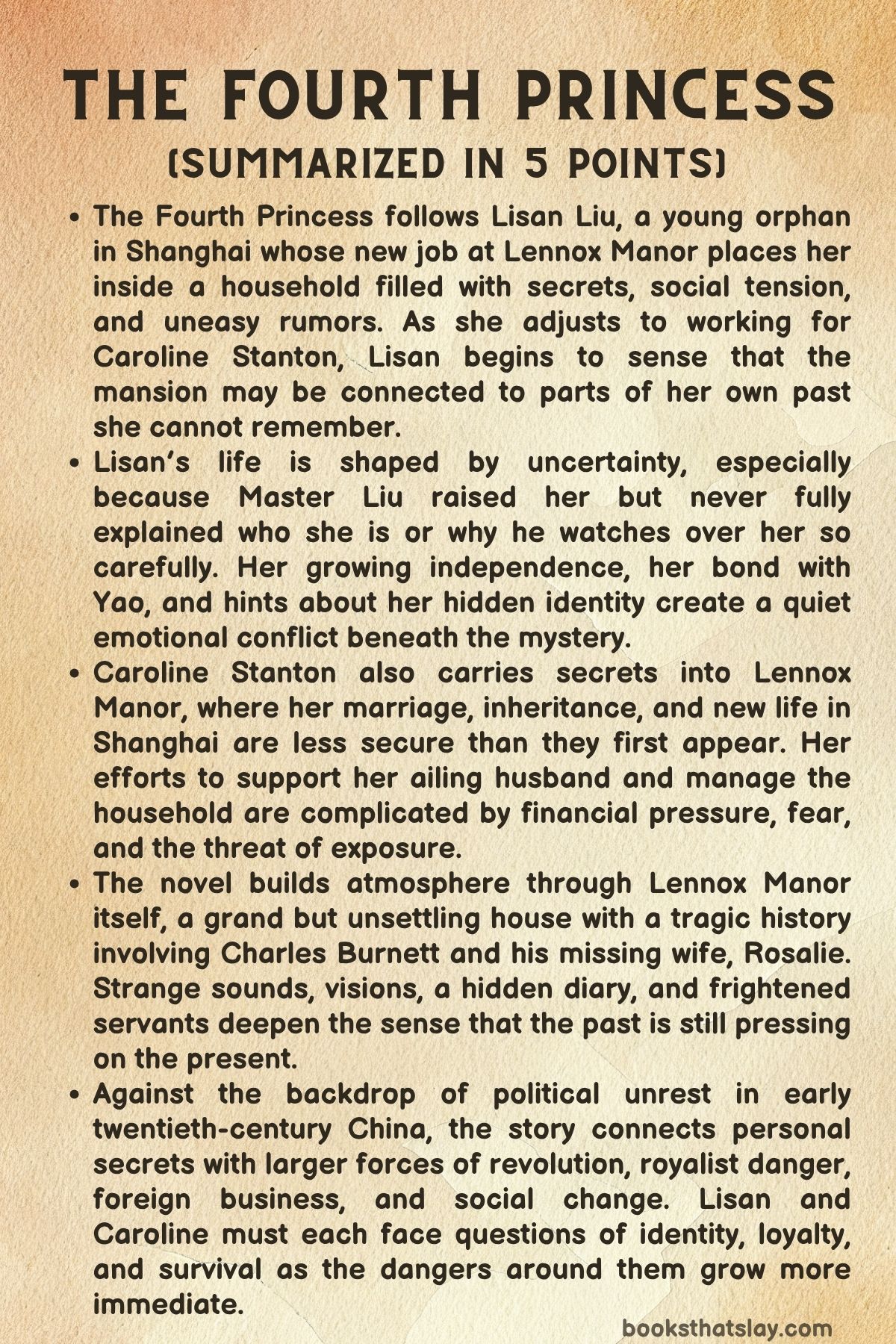
The Fourth Princess by Janie Chang is a historical novel set in early twentieth-century Shanghai, where private secrets unfold against the fall of the Qing dynasty and the rise of revolutionary China. The story follows Lisan Liu, a young woman raised in a wealthy household without knowing her true origins, and Caroline Stanton, an Englishwoman hiding a stolen identity.
Their lives meet inside Lennox Manor, a strange and troubled house marked by rumors, deaths, missing people, and ghostly signs. Through mystery, family history, political danger, and betrayal, The Fourth Princess explores identity, survival, and the cost of buried truth.
Summary
Lisan Liu is nineteen, orphaned, and living in Shanghai under the care of Master Liu, a wealthy and unusual man who rescued her as a child but never formally adopted her. Because of this, she has grown up in an uncertain place between family member and dependent.
She is educated and capable, yet she does not fully belong anywhere. Wanting some independence, she secretly travels through the rain to Lennox Manor for a job interview as secretary to Caroline Stanton, the wife of Thomas Stanton.
Lennox Manor unsettles Lisan from the start. The house is a strange mix of Chinese and Western design, grand yet uneasy, as if it carries memories no one wants to face.
It is leased by Mason Burnett, an American businessman, and occupied by his nephew Thomas and Thomas’s wife, Caroline. Caroline hires Lisan despite the objections of Mrs. Easton, who believes a Chinese woman is not suitable for such a position.
Lisan is pleased to have the work, but she fears Master Liu will refuse to let her keep the job.
When Lisan returns home, her worries deepen. Master Liu has recently become more watchful of her after an old imperial official noticed that she resembled someone.
He had already forced her to leave her school job, and now he reacts badly to the Lennox Manor position. Then Fourth Uncle reveals that he owns the manor and suggests that Lisan working there may serve their purposes.
Lisan overhears enough of their conversation to understand that secrets surround her. They speak of keeping “her” ignorant, waiting for news from Mr. Zheng, and placing someone out of sight.
The next morning Master Liu unexpectedly allows her to take the job, but only if she returns home on her days off. He also tells her that Yao, a gardener connected to the Liu household, has been hired there as well.
Caroline Stanton is also building a life on uncertain ground. She married Thomas after surviving a railway disaster in Wellington, where her aunt and uncle died and she lost her memory for a time.
Thomas rescued her, courted her, and brought her to Shanghai after Mason Burnett offered him a place in a railway business and the use of Lennox Manor. Yet Caroline quickly sees that Mason has misled them.
He is almost broke, the manor is not truly his to offer, and repairing it will cost far more than expected. Thomas also asks Caroline to lend him money from her inheritance for the railway scheme because Mason cannot contribute what he promised.
Caroline begins to distrust both the business and the men around it.
At Lennox Manor, Lisan learns that the house has a dark reputation. Mason’s son Charles once lived there with his wife Rosalie, a singer.
Charles went bankrupt, Rosalie disappeared, and Charles later hanged himself in the house. The servants believe his ghost remains.
Lisan soon has disturbing experiences of her own. She sees a woman in red near the lake, hears crying in the night, and has nightmares of being dragged up stairs during chaos, blindfolded, and told to jump.
These dreams seem tied to memories from her early childhood, which she cannot recall.
Lisan becomes closer to Caroline as she helps her manage the household and understand Chinese customs. She also reconnects with Yao, who tells her he came from Peking after the Boxer Rebellion and was later trained as a gardener by Master Liu.
Lisan feels an unexplained closeness to him and wonders if they knew each other before, but he denies it. Around them, China is changing.
Railway nationalization, foreign loans, and revolutionary politics threaten the old order and connect Thomas’s ambitions to wider unrest.
While working in her room, Lisan finds a hidden drawer in an old desk and discovers Rosalie Burnett’s diary, written in French. The diary reveals Rosalie’s life before Lennox Manor.
She had been Rosalie Roussel, a singer trying to build a career before she married Charles Burnett. Lisan translates the diary and becomes increasingly drawn to Rosalie’s fate.
At the same time, she and Caroline visit a dressmaker, meet Lisan’s fashionable friend Ju Ming, and hear gossip about Princess Masako Kyo, a scandalous and dangerous woman. As Caroline prepares for her first major party, Lisan senses that the manor, Rosalie’s disappearance, Mason’s secrets, and her own lost past are connected.
The truth about Lisan begins to emerge when Master Liu and Yao tell her who she really is. Her father is Prince Tsai, a former Qing royal who survived violence in Peking and now lives abroad under the name Mr. Zheng while working with Master Liu’s automobile import business.
Prince Tsai supports Sun Yat-sen and the Nationalists, which makes him dangerous to royalist enemies, especially Prince Duan. Lisan is stunned to learn that she is a Manchu princess and that this truth has been hidden from her for years.
Master Liu explains that her lost memory made secrecy both easier and safer.
Yao then reveals his part in her past. When he was fourteen, he carried Lisan away from Peking after her mother and sisters died.
He hid with her at a summer house and helped Prince Tsai escape with her to Shanghai. Prince Tsai later entrusted her to Master Liu and went overseas to raise money for the revolution.
Lisan is shaken by the knowledge that her life has been shaped by political danger and family loss she could not remember.
There is more bad news. Prince Tsai has gone missing in Mexico, though he had planned to reunite with Lisan and take her to Victoria, Canada.
Because Masako Kyo has recognized Lisan and may expose her royal identity, Master Liu arranges for her to leave China within a week aboard a Liu family ship. Yao will accompany her under forged papers.
Lisan is angry and hurt by the years of secrecy, but she returns to Lennox Manor to finish her work before she must leave.
Meanwhile, Thomas Stanton grows seriously ill. Dr. Ellis believes he has intestinal parasites and treats him with harsh medicines, including purgatives, laudanum, and morphine.
Thomas only becomes weaker. He suffers convulsions and begins losing hair.
Caroline nurses him day and night while trying to hide how frightened she is. Her own secret is then revealed: she is not the real Caroline Vessey.
She was once Caroline’s poor school friend and companion. After an avalanche killed the real Caroline and her relatives, the survivor was mistaken for Caroline because she was wearing Caroline’s fur coat and monogrammed nightgown.
She accepted the mistake and took Caroline’s identity, later marrying Thomas.
A man named Andrew Grey discovers Caroline’s secret and blackmails her. He demands fifteen thousand dollars and suggests he wants control over her in other ways too.
Caroline meets him and realizes he will never stop. Later, she goes near his hotel for another meeting, but finds a commotion after his body is discovered in an alley.
He has been stabbed to death. The next day Lisan reads that Grey was likely killed over gambling debts.
Caroline feels relief, but she knows danger has not ended.
Lisan continues to be haunted by Rosalie. The diary shows that Rosalie loved Charles, sang successfully, married him despite Mason’s anger, and later suffered as Charles fell into debt, opium addiction, violence, and ruin.
Lisan dreams of Rosalie in the garden and hears her ask to be found. She also dreams of Charles smashing a mantel and later confirms it was repaired, proving the dream reflects real events.
Afraid, she burns Rosalie’s diary and returns the portrait to the attic, though she keeps her translations.
The manor’s servants become more convinced that the house is cursed. Some leave after strange events in Caroline’s parlor.
Chin notices missing rat poison, and Lisan discovers a silver carving knife is missing from the attic. Thomas’s symptoms, the missing poison, and the missing knife suggest human danger rather than ghosts alone.
Lisan asks Madame Taddeo about Rosalie and learns that Rosalie vanished without contacting even her closest friend. Later, Chin admits he has stayed at Lennox Manor because he is waiting for his daughter to return.
Lisan realizes that Rosalie is Chin’s missing daughter.
As Dr. Ellis decides Thomas must be moved to a hospital, Masako Kyo arrives at Lennox Manor. Caroline expects her to be interested in Lisan, but Kyo says she has come for Caroline.
She reveals that Andrew Grey was her lover and business partner, and that he told her Caroline’s secret. Kyo now intends to continue the blackmail herself.
The novel’s tensions gather around the two women at the center of the story: Lisan, whose hidden royal birth places her in political danger, and Caroline, whose stolen identity makes her vulnerable to anyone who knows the truth. In The Fourth Princess, Lennox Manor becomes the place where false names, lost families, murder, illness, and old grief all press toward exposure.
Characters
Lisan Liu
Lisan Liu is the central figure of The Fourth Princess, and her character is built around hidden identity, emotional displacement, and the painful recovery of a past that others have tried to bury. At nineteen, she appears outwardly capable, intelligent, and eager for independence, especially when she seeks work at Lennox Manor despite Master Liu’s likely disapproval.
Her desire for the secretary position shows that she wants a defined place in the world, something she has never truly had in Master Liu’s household. She is not treated as a servant, but she is also not formally accepted as family, leaving her in a state of uncertainty that shapes much of her insecurity.
This uncertain social position makes her both grateful and restless: she knows Master Liu saved her, but she also senses that her life has been controlled by secrets she does not understand.
Lisan’s emotional journey deepens when she learns that she is the daughter of Prince Tsai and a surviving Manchu princess. This revelation does not simply give her status; it destabilizes everything she believed about herself.
Her royal identity is not romanticized as a simple blessing, because it comes with danger, loss, and political consequences. She has survived violence in Peking, the deaths of her mother and sisters, forced concealment, and years of ignorance about her origins.
Her recurring nightmares suggest that trauma lives inside her even when memory fails. The images of being pulled through chaos, blindfolded, and told to jump reveal a mind haunted by experiences she cannot consciously explain.
In this way, Lisan becomes a character whose identity is split between the life she remembers and the life that was hidden from her.
Her relationship with Lennox Manor also reveals her sensitivity to buried sorrow. She is not merely frightened by the ghostly signs surrounding Rosalie; she is drawn into them because she recognizes, on some instinctive level, what it means for a woman’s story to be concealed.
Her discovery of Rosalie’s diary makes her a witness to another woman’s silenced suffering, and her visions of Rosalie show that Lisan is connected to the house’s emotional history as well as to China’s political past. Even when she burns the diary out of fear, she preserves the translations, which suggests that she cannot fully destroy truth once she has encountered it.
Lisan’s strength lies not in certainty, but in her ability to keep moving through confusion, danger, and betrayal. She is young and vulnerable, but she is also observant, morally alert, and increasingly determined to understand the forces that have shaped her life.
Caroline Stanton
Caroline Stanton is one of the most morally complex figures in the book because she lives under an identity that is both stolen and desperately needed. On the surface, she appears to be a refined young wife beginning a new life in Shanghai with her husband Thomas.
She is practical, socially aware, and capable of managing a household that is unfamiliar to her. Her decision to hire Lisan despite Mrs. Easton’s prejudice shows that Caroline is more open-minded than many people around her, and her growing bond with Lisan reveals a capacity for warmth, trust, and emotional dependence.
Yet beneath this respectable exterior is a woman whose entire life rests on deception.
Her past explains, though does not fully excuse, her actions. She was once the impoverished companion of the real Caroline Vessey, and after the railway disaster caused a fatal confusion of identity, she chose to continue living as Caroline.
This decision reveals both opportunism and desperation. She seizes the chance to escape poverty and social invisibility, but the cost is constant fear.
Caroline’s false identity makes her vulnerable to Andrew Grey’s blackmail, and later to Masako Kyo’s threats. Her story explores how survival can become entangled with moral compromise.
She is not presented as purely wicked; rather, she is someone whose fear of returning to powerlessness drives her deeper into secrecy.
Caroline’s relationship with Thomas also complicates her character. She seems genuinely devoted to him as his illness worsens, and her care for him is marked by anxiety and tenderness.
At the same time, Thomas’s financial requests and the instability surrounding Mason’s railway promises make her wary. She has entered marriage partly through deception, but she is also being deceived by others.
Her life at Lennox Manor becomes a trap where every secret mirrors another: her false identity, Thomas’s illness, Mason’s lies, Rosalie’s disappearance, and the house’s hidden violence. Caroline is compelling because she is both victim and deceiver.
Her fear is real, her affection can be real, and her wrongdoing is also real.
Master Liu
Master Liu is a protective, secretive, and morally ambiguous guardian whose love for Lisan is expressed through control. He rescued her from the streets and raised her in comfort, but he never gave her the security of formal adoption or the truth of her identity.
This makes him a complicated father figure. He is not cruel in an obvious way, and his secrecy is partly motivated by the need to protect Lisan from royalist enemies.
However, his protection also denies her agency. By keeping her ignorant, removing her from her school job, watching her anxiously, and managing where she may go, he treats her less as an adult woman than as someone to be hidden and moved according to political necessity.
His connection to Prince Tsai and Sun Yat-sen’s cause places him within the political tensions of the story. Master Liu is not simply a wealthy eccentric; he is involved in networks of loyalty, revolution, and concealment.
His ownership of Lennox Manor adds another layer of calculation to his decisions. When he allows Lisan to work there, it is not only because she wants employment, but because the arrangement may serve a purpose.
This makes him a figure who often operates several steps ahead of others, though his motives remain partially concealed.
The emotional difficulty of Master Liu’s character lies in the gap between care and manipulation. He has preserved Lisan’s life, but he has also shaped that life through silence.
He believes secrecy is necessary, yet his choices leave Lisan feeling betrayed when the truth finally emerges. He represents an older generation’s belief that young people, especially young women, should be protected by withholding information.
In the novel, that protection becomes increasingly unstable because truth continues to surface through memory, gossip, politics, and ghosts.
Yao
Yao is a quiet but deeply significant character whose loyalty is rooted in shared trauma and long-hidden devotion. At Lennox Manor, he first appears as a gardener connected to the Liu household, but his importance grows when Lisan senses an intense familiarity with him.
His denial that they knew each other before reflects the larger pattern of concealment surrounding Lisan’s past. When the truth is revealed, Yao’s role becomes emotionally powerful: as a fourteen-year-old boy, he carried Lisan from Peking after the deaths of her mother and sisters, helped hide her, and aided Prince Tsai’s escape with her to Shanghai.
Yao’s character is shaped by duty, restraint, and memory. Unlike Lisan, he remembers the past, which means he has had to live with knowledge she was denied.
His silence may be protective, but it also creates emotional distance. He stands near Lisan without fully revealing what he has endured for her sake.
This gives their relationship a sense of unspoken history. Lisan’s instinctive recognition of him suggests that emotional memory can survive even when factual memory has been lost.
As a gardener, Yao is also symbolically connected to cultivation, patience, and hidden growth. He works quietly in the background, much as he has quietly guarded Lisan’s survival.
His planned departure with her under forged papers shows that his loyalty is not temporary or convenient. He is willing to uproot himself again for her safety.
Yao is not a flamboyant hero; his heroism lies in endurance, secrecy, and the willingness to protect someone across years of danger.
Thomas Stanton
Thomas Stanton is a character whose outward role as husband and aspiring businessman gradually gives way to weakness, illness, and suspicion. At first, Thomas seems tied to rescue and romance, because Caroline’s new life begins after he saves her following the railway disaster and later marries her.
He brings her to Shanghai with the promise of opportunity through Mason Burnett’s railway venture. Yet as the story progresses, Thomas appears less secure and less heroic than Caroline’s memory of him might suggest.
His financial dependence on Caroline’s inheritance reveals his vulnerability and perhaps his willingness to pressure her for money.
Thomas’s worsening illness turns him into a center of dread within Lennox Manor. Dr. Ellis believes he has intestinal parasites, but his symptoms become increasingly alarming: weakness, convulsions, and hair loss.
These details, especially when combined with the missing rat poison, suggest that his suffering may not be natural. As a result, Thomas becomes both a person in pain and a mystery around which other characters’ fears gather.
His body reflects the corruption and danger hidden inside the household.
His role is also important because Caroline’s feelings toward him reveal her complexity. She cares for him intensely, yet their marriage is founded on her false identity and his possible financial motives.
Thomas may be deceived by Caroline, but Caroline is also unsettled by the false promises surrounding his business prospects. He is therefore part of a web of mutual dependence and uncertainty.
In the book, Thomas functions less as a fully empowered romantic hero and more as a fragile figure whose decline exposes the instability of the life Caroline has tried to build.
Mason Burnett
Mason Burnett is a figure of decay, deception, and failed authority. He presents himself as a man who can offer Thomas and Caroline opportunity, status, and a grand home, but this image quickly proves hollow.
He is nearly insolvent, has exaggerated or misrepresented his ability to support the railway venture, and has no true right to offer Lennox Manor as if it were his own. His promises are built on illusion, and that illusion places others in financial and emotional danger.
Mason’s personal history adds to his tragic and corrupt presence. His son Charles once lived at Lennox Manor, fell into ruin, and died by suicide after being abandoned by Rosalie.
Mason’s anger at Charles’s marriage to Rosalie suggests pride, class prejudice, and a need to control family reputation. His drunken confusion when he mistakes Lisan for Rosalie shows that the past still haunts him.
He is not simply a dishonest businessman; he is a man surrounded by the consequences of his failures as a father and patriarch.
Mason’s weakness is important because he helps create the conditions in which the house becomes a place of danger. His financial recklessness, family bitterness, and evasions leave others to deal with the wreckage.
Lennox Manor itself reflects him: grand in appearance, damaged beneath the surface, and full of unresolved grief. Mason is a character whose authority has rotted away, leaving only debt, memory, and guilt.
Charles Burnett
Charles Burnett is a tragic figure whose life is known largely through memory, rumor, and Rosalie’s diary. He begins as a man capable of passion and rebellion, since he falls in love with Rosalie and marries her despite his father’s anger.
His love for her seems genuine at first, and their relationship carries the possibility of escape from rigid expectations. However, Charles’s character deteriorates as debt, addiction, and violence consume him.
His decline into opium use and financial ruin transforms him from romantic husband into a source of fear and suffering.
Charles’s importance lies in the damage he leaves behind. His suicide at Lennox Manor turns the house into a rumored site of haunting, but the deeper haunting is moral and emotional.
Rosalie’s disappearance, the broken and repaired mantel, and the servants’ fear all point toward a past in which domestic life became violent and unstable. Charles represents the destruction caused by weakness when it is mixed with entitlement.
He is ruined by his own failures, but he also ruins others.
Through Charles, the story explores how romantic defiance can collapse into dependency and abuse. His marriage to Rosalie begins as a challenge to his father’s prejudice, yet he cannot sustain love in the face of addiction, debt, and rage.
He becomes one of the ghosts of Lennox Manor even before his death, because his actions continue to shape the lives and fears of those who come after him.
Rosalie Roussel Burnett
Rosalie Roussel Burnett is one of the most haunting figures in the story, even though much of her character is reconstructed through her diary, portrait, memories, and supernatural presence. She begins as Rosalie Roussel, an aspiring singer struggling for work, ambition, and recognition.
Her desire to sing successfully onstage shows her hunger for artistic identity and independence. Her marriage to Charles Burnett offers love and possible security, but it also draws her into a family and household shaped by resentment, class prejudice, addiction, and violence.
Rosalie’s tragedy lies in the silencing of her story. She vanishes without contacting even Madame Taddeo, her closest friend, and her father Chin remains at Lennox Manor waiting for her return.
This disappearance gives her character an unresolved sorrow. She is not merely absent; she is actively calling to be found.
Lisan’s visions of Rosalie in the garden and the repeated words “Come find me” suggest that Rosalie’s fate has been buried but not erased. Her ghostly presence is therefore not only frightening; it is a demand for truth.
Rosalie also mirrors Lisan in important ways. Both women are connected to hidden histories, lost family ties, and identities obscured by others.
Both are young women whose lives are shaped by powerful men and dangerous houses. Rosalie’s diary gives Lisan access to a woman’s private voice, making Rosalie more than a rumor or scandal.
She becomes a person with ambition, love, fear, and suffering. Her character gives the novel much of its gothic emotional force, because she represents the cost of being forgotten by everyone except those who loved her most.
Prince Tsai
Prince Tsai is Lisan’s true father and a character defined by royal blood, political danger, and painful separation. As a former Qing royal who survives the violence in Peking, he belongs to a collapsing world of imperial power.
Yet he does not simply cling to the old order. His support for Sun Yat-sen and the Nationalists makes him a threat to royalist factions, especially Prince Duan.
This political position makes him unusual: he is a prince whose loyalties appear to move toward revolution rather than restoration.
As a father, Prince Tsai is both loving and absent. He helps save Lisan and entrusts her to Master Liu, but his need to flee and raise money overseas means that she grows up without knowing him.
His plan to reunite with her and take her to Victoria, Canada, suggests that he has not forgotten her and has imagined a future with her. However, his disappearance in Mexico turns that hope into uncertainty.
For Lisan, discovering him is immediately tied to the fear of losing him again.
Prince Tsai’s character gives Lisan’s private identity a wider historical meaning. She is not only an orphan with hidden memories; she is the daughter of a politically significant man whose survival matters to competing factions.
Through him, personal family secrets become connected to national upheaval. His absence is powerful because it drives much of the secrecy around Lisan’s life, while his ideals suggest that the future of China is being fought over not only by armies and politicians, but also by families living in exile and disguise.
Prince Duan
Prince Duan functions as a threatening political force more than an intimate household character. His importance comes from the danger he represents to Prince Tsai and, by extension, to Lisan.
As a royalist figure hostile to Prince Tsai’s support for the Nationalists, he embodies the old factional violence that continues to endanger survivors of the Qing world. Even when he is not physically present, his influence creates fear and urgency.
His role helps explain why Lisan’s identity has been hidden for so long. If she is recognized as Prince Tsai’s daughter, she becomes vulnerable to enemies who may use her against her father or punish her for her lineage.
Prince Duan therefore represents the political consequences of ancestry. In Lisan’s life, family heritage is not merely personal; it can become a death sentence.
Masako Kyo
Masako Kyo is a glamorous, dangerous, and socially perceptive antagonist whose power comes from knowledge. She is introduced through gossip as a scandalous princess, but her later actions show that she is far more than a fashionable figure of rumor.
She recognizes Lisan and may expose her hidden identity, which makes her a threat to Master Liu’s carefully constructed secrecy. Yet her arrival at Lennox Manor reveals another target: Caroline.
By declaring that she knows Caroline’s secret through Andrew Grey, Masako positions herself as a successor to his blackmail.
Masako’s character is compelling because she understands the value of secrets in a world governed by reputation, class, gender, and political danger. She does not need physical force to dominate a scene; she uses information.
Her connection to Grey as lover and business partner also suggests that her schemes are not impulsive. She is calculating, opportunistic, and willing to exploit weakness wherever she finds it.
At the same time, Masako’s presence exposes the fragility of both Lisan and Caroline. Lisan’s royal identity and Caroline’s stolen identity are very different kinds of secrets, yet Masako can threaten both.
She becomes a figure who links the political plot and the domestic plot. In The Fourth Princess, her danger lies in her ability to see what others have tried to hide.
Andrew Grey
Andrew Grey is a predatory blackmailer whose role is to turn Caroline’s hidden past into a weapon. Once he discovers that she is not the real Caroline Vessey, he demands money and implies that he expects sexual access as well.
This makes him not only greedy but deeply violating. He understands that Caroline’s social survival depends on secrecy, and he uses that knowledge to trap her.
Grey’s character reveals how vulnerable Caroline truly is. Her stolen identity may have given her wealth and status, but it has also made her permanently exploitable by anyone who uncovers the truth.
Grey’s threats are frightening because they promise endless control. Caroline quickly realizes that paying him will not free her, because his power lies in repetition: he can always return, always demand more, always threaten exposure again.
His death in an alley near Les Trois Lanternes removes one immediate danger but creates another atmosphere of suspicion. The report that gambling debts may have led to his murder gives a practical explanation, yet his connection to Masako Kyo ensures that his influence continues after death.
Grey is a relatively brief but crucial figure because he turns Caroline’s secret from a hidden sin into an active threat.
Mrs. Easton
Mrs. Easton represents colonial prejudice and rigid social hierarchy within the household. Her disapproval of Lisan’s appointment as secretary comes from the belief that a Chinese woman is unsuitable for such a role.
This reaction reveals how race, class, and gender shape domestic power at Lennox Manor. To Mrs. Easton, Lisan’s competence matters less than her place in the social order.
Her character helps establish the barriers Lisan faces even when she is qualified and intelligent. Lisan’s excitement about the job is shadowed by the knowledge that people like Mrs. Easton will question her presence.
Mrs. Easton is not the central villain of the story, but her attitude contributes to the atmosphere of exclusion. She stands for the everyday prejudice that makes Lisan’s independence harder to claim.
Dr. Ellis
Dr. Ellis is the physician responsible for treating Thomas Stanton, and his character carries the uncertainty of medical authority. He diagnoses Thomas with intestinal parasites and treats him with purgatives, laudanum, and morphine, yet Thomas only grows worse.
This does not necessarily make Dr. Ellis malicious, but it does make his confidence unsettling. His medical explanations cannot fully account for the disturbing pattern of symptoms.
His role is important because he represents rational interpretation in a story filled with ghosts, secrets, poison, and fear. While servants suspect a curse and Lisan senses supernatural disturbance, Dr. Ellis offers a clinical explanation.
However, the worsening illness, convulsions, hair loss, and missing rat poison undermine that explanation. Dr. Ellis therefore becomes part of the tension between ordinary diagnosis and hidden crime.
Chin
Chin is one of the most quietly tragic characters in the book. At first, he appears as part of the servant world at Lennox Manor, observant and connected to the practical life of the household.
His notice of the missing rat poison is significant because it links him to the mystery surrounding Thomas’s illness. Yet his deeper importance is revealed when he explains that he has stayed at Lennox Manor because he is waiting for his daughter to return.
The discovery that his daughter is Rosalie transforms Chin from a background servant into a grieving father. His long wait gives Rosalie’s disappearance emotional weight.
She is not merely a vanished singer, a portrait, or a ghostly figure; she is someone’s child. Chin’s patience is heartbreaking because it suggests hope prolonged beyond reason.
He remains near the place of her suffering because leaving would mean surrendering the possibility of her return.
Chin also helps connect the servant world to the central mysteries of the manor. The secrets of the house are not only the concerns of wealthy foreigners and political figures.
They have devastated ordinary people as well. Chin’s grief makes the haunting of Lennox Manor more human and more painful.
Fourth Uncle
Fourth Uncle is a practical and influential member of the Liu family whose role is tied to strategy and concealment. His revelation that he owns Lennox Manor changes the meaning of Lisan’s employment there.
What first appears to be a young woman’s independent step into work is revealed to be part of a larger arrangement controlled by the Liu family. Fourth Uncle’s suggestion that the position may be useful indicates that he thinks in terms of placement, protection, and advantage.
He is important because he helps expose the hidden machinery behind Lisan’s life. Like Master Liu, he knows more than he says, and he participates in decisions about where Lisan should be and what she should know.
He is not presented as emotionally central in the same way Master Liu is, but he strengthens the sense that Lisan’s world is managed by older men who believe secrecy is necessary. His ownership of Lennox Manor also ties the Liu household directly to the gothic and political mysteries of the story.
Ju Ming
Ju Ming is Lisan’s fashionable friend and serves as a contrast to Lisan’s uncertainty and guarded upbringing. Her presence during the visit to the dressmaker introduces a livelier social dimension to the story.
Through Ju Ming, Lisan is connected to a world of style, gossip, and young female companionship. This matters because so much of Lisan’s life is shaped by secrecy, duty, and danger; Ju Ming represents a more ordinary kind of youthful sociability.
Her discussion of Princess Masako Kyo also helps move the plot forward by bringing social gossip into contact with real threat. What may first sound like fashionable scandal later becomes dangerous knowledge.
Ju Ming’s role shows how information circulates among women through conversation, rumor, clothing appointments, and social visits. In a story full of official secrets, informal gossip becomes surprisingly powerful.
Madame Taddeo
Madame Taddeo is important as a keeper of memory. Through her, Lisan learns more about Rosalie’s past and the depth of Rosalie’s disappearance.
Madame Taddeo’s knowledge confirms that Rosalie did not simply leave behind a casual life; she vanished without contacting even someone close to her. This makes Rosalie’s fate more troubling and strengthens the sense that something terrible happened at Lennox Manor.
Madame Taddeo also gives Rosalie a social and emotional context beyond Charles. She helps the reader see Rosalie not only as a wife or ghost, but as a woman who once had friendships, ambitions, and a life before the manor consumed her.
Her role is brief but meaningful because she helps restore Rosalie’s humanity.
Themes
Hidden Identity and the Cost of Secrecy
Lisan’s life is shaped by a truth that has been hidden from her so completely that even her sense of self feels borrowed. She grows up protected by Master Liu, yet that protection also keeps her dependent, watched, and excluded from the facts of her own past.
Her discovery that she is a Manchu princess does not simply give her a noble identity; it forces her to question every relationship around her. The people who loved her also controlled what she knew, and this creates a painful conflict between gratitude and betrayal.
Caroline’s false identity deepens this theme by showing secrecy from another angle. Unlike Lisan, Caroline chooses deception as a means of survival after trauma and poverty leave her with few secure options.
In The Fourth Princess, identity becomes something unstable: it can be inherited, hidden, mistaken, performed, or stolen. The novel suggests that secrets may protect people for a time, but they also delay emotional truth and leave characters vulnerable to fear, blackmail, and self-doubt.
Power, Class, and Social Exclusion
The story repeatedly shows how social position decides who is trusted, protected, or dismissed. Lisan is educated and capable, yet Mrs. Easton judges her unsuitable because she is Chinese, revealing how colonial attitudes reduce talent to race and status.
In Master Liu’s household, Lisan occupies another uncertain position: she is not a servant, not an adopted daughter, and not fully free. This in-between status makes her dependent on the decisions of men who claim to act for her safety.
Caroline also understands class insecurity because her assumed identity gives her access to wealth and respectability that her original life denied her. Her fear of exposure is partly moral, but it is also social; losing the name Caroline means losing protection, marriage, and public standing.
The contrast between wealthy homes, servants’ quarters, foreign investors, fallen aristocrats, and ruined families shows a world where class is fragile but powerful. People are valued not only for who they are, but for the names, money, race, and connections attached to them.
Memory, Trauma, and the Return of the Past
Memory in the novel is not a calm record of events; it returns through nightmares, visions, physical fear, and sudden recognition. Lisan’s lost childhood does not disappear simply because she cannot consciously remember it.
Her dreams of chaos, being carried, blindfolded, and forced to jump suggest that trauma has remained alive inside her body and imagination. The past presses into the present through Rosalie’s diary, the portrait, the repaired mantel, the crying at night, and the figure near the lake.
These details make Lennox Manor feel less like a house than a place crowded with unfinished histories. Caroline’s past also returns through Andrew Grey and Masako Kyo, proving that buried truths can become weapons when others discover them.
The characters try to survive by forgetting, hiding, or rewriting what happened, but the story shows that suppressed truth often returns in distorted and frightening forms. Healing can begin only when the past is faced directly, even when that truth threatens safety, love, and identity.
Women’s Survival in a Dangerous World
The women in The Fourth Princess live in a world where survival often depends on secrecy, intelligence, adaptation, and uneasy compromise. Lisan must navigate political danger, racial prejudice, household suspicion, and the discovery of a royal identity that makes her a target.
Caroline survives disaster and poverty by accepting a mistaken identity, but that choice traps her in fear because her security depends on maintaining a lie. Rosalie’s story adds a darker example of how marriage and financial ruin can destroy a woman’s freedom, especially when addiction, violence, and male control enter domestic life.
Even Masako Kyo, though threatening, reflects a world where women use scandal, information, and manipulation as forms of power because respectable avenues may be closed to them. The novel does not present survival as simple virtue or villainy.
Instead, it shows women making difficult choices under pressure, sometimes morally compromised, sometimes brave, and often both at once. Their lives reveal how danger can force women to become strategic long before they are allowed to be truly free.