The Fox Hunt Summary, Characters and Themes
The Fox Hunt by Caitlin Breeze is a dark academic fantasy about class, secrecy, desire, and the cost of being accepted by powerful people. Set in an old University city changed by a strange flood, the book follows Emma Curran, a reserved law student whose scientific curiosity brings her into the world of the Colefax-Lee Foundation and the secretive Turnbull Society.
What begins as a chance at recognition soon becomes a dangerous encounter with ritual, privilege, and old bargains. The novel mixes student life, ecological unease, and folklore to show how easily admiration can turn into control.
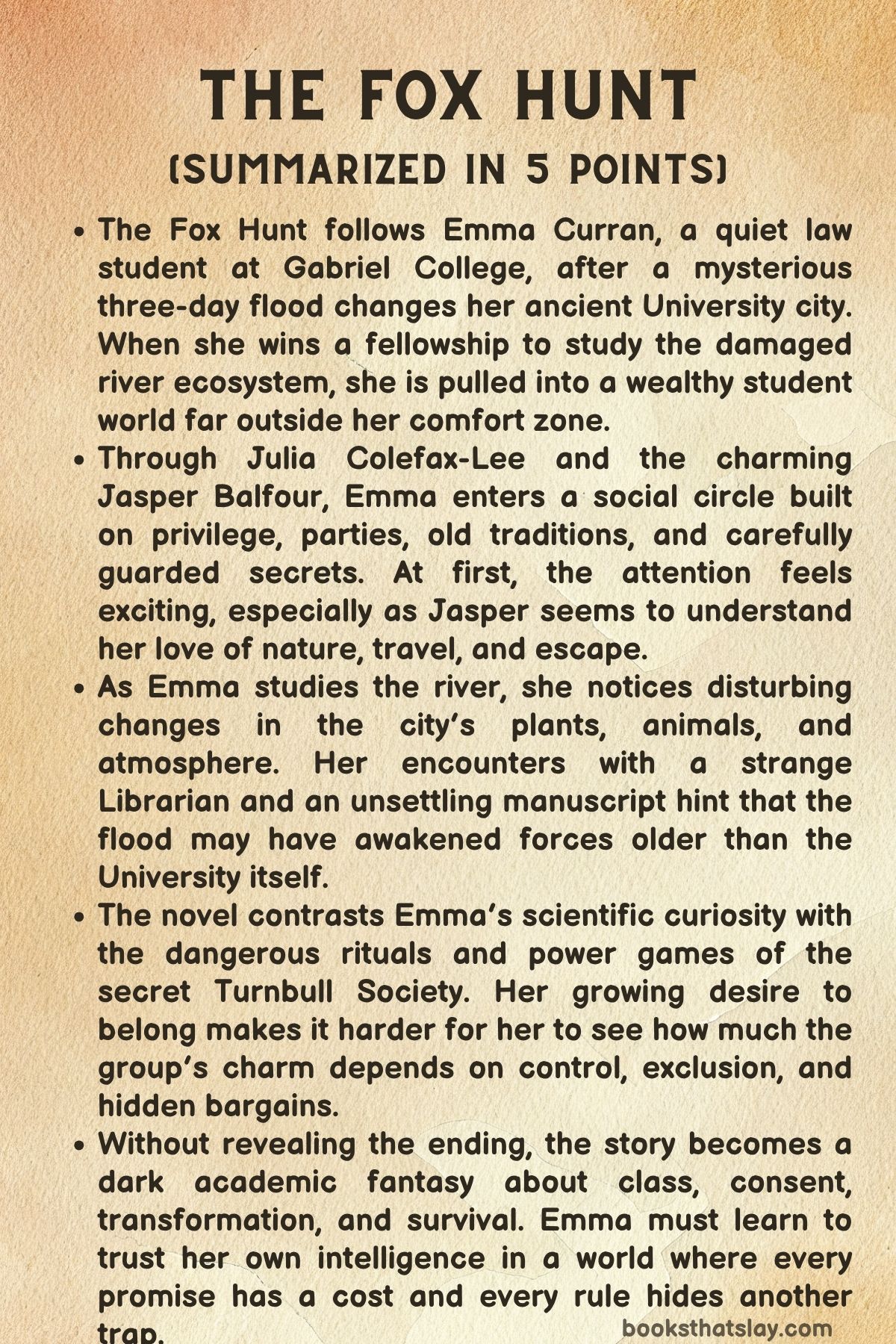
Summary
Emma Curran is a second-year law student at Gabriel College in an ancient University city built on learning, status, and hidden influence. She is quiet, serious, and more comfortable with research than with wealthy social circles.
When an extraordinary flood submerges the city for three days, Emma becomes fascinated by what the flood may have done to the river ecosystem. She prepares for an interview with the Colefax-Lee Foundation, hoping to win a fellowship that would allow her to study the river and its wildlife after the disaster.
Emma is nervous about the interview, especially because she does not feel polished or socially confident. Her best friend Nat, bold and theatrical, pushes her to believe in herself.
Her mother, Diana, a scientist, also supports her curiosity and ambition. Emma arrives at the interview in green waders, an awkward but practical choice after the flood.
Instead of being dismissed, she impresses Julia Colefax-Lee with the detail and originality of her proposal. Julia sees that Emma is not merely chasing prestige; she has a real question and a real method.
Emma wins the fellowship, and with it gains entry into a world that has always seemed distant from her own.
The foundation launch party introduces Emma to wealthy, polished students who move through the University with ease. Julia is charismatic and welcoming, and Emma begins to feel seen by someone from a world she once viewed from the outside.
The evening continues at St Dunstan’s College, where a party is being hosted by Jasper Balfour, a famous student connected to privilege, charm, and the secretive Turnbull Society. Emma accidentally enters a room filled with beautiful travel and nature photographs and assumes it belongs to Jasper’s quieter roommate, Richard.
She admires the photographs before discovering that Jasper is the photographer.
Emma is embarrassed when she realizes her mistake, but Jasper handles the moment with charm. They talk in the garden about Tasmania, photography, travel, nature, and the pressure of living according to other people’s expectations.
Jasper seems different from the careless aristocratic figure she imagined. He appears sensitive, trapped, and attentive to the natural world.
He asks for her number, and soon they begin spending time together on photography trips by the river. Emma is drawn to his confidence and to the idea that he understands her interest in the strange changes taking place around the city.
Those changes become harder to ignore. The flood has left behind more than mud and damage.
Frogs mate out of season and behave violently. Gardens rot and bloom at the same time.
Dead plants seem to revive. River footage becomes corrupted.
Animals act in ways that should not be possible. Emma studies these signs through her fellowship and speaks with Dr Asima Banerjee, trying to find a rational explanation.
Yet the evidence keeps moving beyond normal science. The city feels altered, as if something old has risen with the water.
Emma’s unease deepens when she visits the University Library. There she meets a strange old figure known as the Librarian, who warns her about darkness and gives her a manuscript scrap showing a monstrous toothed eye.
When Emma asks about him later, the receptionist denies that anyone like him works there. The encounter suggests that the University contains layers of knowledge that are not officially recorded, and that Emma has already been noticed by forces she does not understand.
Through Jasper, Emma is pulled further into the Turnbull Society’s orbit. The group is rich, male, secretive, and bound to rituals that appear at first like old student theatrics.
Jasper invites Emma to a midnight gathering in the Library, where she is tested socially by members of the society. She manages to pass, partly through intelligence and partly through her growing awareness of how this world works.
She becomes closer to Julia, attends more parties, and begins to enjoy the feeling of belonging. At the same time, her friendship with Nat suffers, as Emma spends more time with people Nat does not trust.
Jasper’s own life is shaped by expectation. His family wants him to become the perfect president of the Turnbulls, and his father’s approval weighs heavily on him.
Emma sees his resentment and insecurity, especially around Richard, who seems to be treated almost like the better son. These glimpses make Jasper seem vulnerable, and Emma becomes more invested in him.
Their relationship becomes physical after they climb onto a cathedral roof and sleep together. Emma believes the connection is meaningful.
Julia warns her that Jasper does not have a reputation for commitment, but Emma wants to believe she is different.
The Turnbulls’ annual dinner marks a shift. Emma is seated away from Jasper, drinks heavily from punch that seems stronger than expected, and watches increasingly disturbing ceremonial courses appear before the guests.
Bones, skulls, raw meat, and strange vessels turn the event from decadent entertainment into something ugly and threatening. During the midnight ritual, Emma breaks an ancient Turnbull bowl.
Jasper is furious, and the room’s atmosphere turns against her. Julia removes Emma from the scene, but Emma is left shaken by nightmares, whispers, and the sense that she has damaged something more serious than a piece of old tableware.
After the dinner, Jasper ignores Emma for weeks. She is hurt, confused, and ashamed.
When he finally sends another invitation, she accepts because she wants to repair what has gone wrong and regain the closeness she thought they shared. The event is the Turnbulls’ “opening meet,” styled as a fox hunt.
The women are dressed as foxes, while the male Turnbulls dress as hunters. Jasper gives Emma fox ears and a tail, turning her into part of the game before she fully understands what the game means.
The ritual begins with the repaired bowl, and the atmosphere quickly becomes menacing. Jasper corners Emma while drunk and kisses and grabs her despite her discomfort.
She asks him to stop, but he restrains her. When she scratches him to escape, he shouts “Fox,” calling the others after her.
The Turnbulls begin hunting Emma through the city. What was presented as play becomes pursuit.
Emma runs in terror, and as the hunt closes around her, the city’s old magic takes hold. She changes into a fox and vanishes.
For months, the human world believes Emma has disappeared. In truth, she has been living as a fox, surviving beyond ordinary memory and sight.
When she wakes human again in winter, she is found by the one-eyed Library receptionist, known as the Sister, and by the Librarian. They explain that Emma has crossed into the hidden order beneath the city.
She is now caught between the mortal University and the Night City, a realm governed by bargains, debts, exact wording, and ancient houses.
Emma learns that mortals can no longer properly see or remember her. Boar-headed hunters pursue her, and she is drawn through secret streets into the Night City.
A green-clad messenger appears helpful but tricks her into entering the City’s domain. Underground, Emma discovers that by becoming a fox she has entered the House of Foxes and now owes service.
She undergoes an ordeal and chooses the fox claw, gaining the power to become a fox by choice rather than only through fear.
With help from the Sister, the Librarian, Nancy, and Saskia, Emma prepares to face the Night City court. Before she can do so safely, she is seized by the Boars and brought before the Judge.
There she learns the truth of the Turnbull bargain: the society had promised her soul to the City. Because Emma is no longer fully mortal, the debt cannot be collected in the intended way.
Instead of surrendering, Emma uses the skills that define her as a law student. She reads the contract carefully, argues from its wording, and demands protection.
The Judge grants her a token that prevents the Boars from harming her. Yet the victory carries a terrible price.
The unpaid soul-debt is transferred to Emma herself. One mortal soul is valued at one thousand years of service to the Night City, and Emma must now pay what the Turnbulls tried to spend.
In the end, The Fox Hunt leaves Emma changed: no longer simply a student trying to belong, but a fox-marked survivor bound to a hidden world where every promise has teeth.
Characters
Emma Curran
Emma Curran is the central character of The Fox Hunt, and her journey gives the story its emotional and moral weight. At the beginning, she appears shy, anxious, and uncertain of her place in the elite University world around her.
She is a second-year law student at Gabriel College, but her real passion lies in ecology, the river, and the strange natural changes caused by the flood. This makes her both observant and vulnerable: she notices things others ignore, yet she doubts her own importance in social spaces dominated by wealth, confidence, and inherited power.
Her arrival at the Colefax-Lee interview in green waders captures her character well. She is awkward and out of place, but also sincere, intelligent, and deeply committed to her work.
Emma’s greatest weakness is her longing to belong. When Julia and Jasper bring her into their glittering circle, Emma is flattered and fascinated.
She wants to believe that she has been accepted for who she is, but she also becomes willing to overlook warning signs. Her friendship with Nat suffers because Emma is drawn toward the glamour and mystery of the Turnbulls.
Her relationship with Jasper is especially important because it reveals how easily affection, admiration, and desire can become tangled with power. Emma believes their connection is meaningful, while Jasper treats her as someone who can be used, tested, and discarded.
After the fox-hunt event, Emma’s transformation into a fox becomes the physical expression of what has already been happening to her socially and emotionally. She has been hunted, reduced, and turned into prey by people who once pretended to welcome her.
Yet this transformation also gives her a new kind of power. In the Night City, Emma learns to survive by reading carefully, thinking legally, and refusing to surrender her agency.
Her legal mind becomes as important as her courage. By the end, she is no longer simply an innocent outsider.
She is wounded, changed, and burdened, but also sharper, braver, and more capable of fighting systems built on exploitation.
Jasper Balfour
Jasper Balfour is one of the most charming and dangerous figures in the book. He is wealthy, handsome, socially powerful, and surrounded by admiration, but beneath this polished surface he is insecure, resentful, and morally weak.
He knows how to make Emma feel special. Their conversations about photography, travel, Tasmania, and feeling trapped allow him to appear sensitive and misunderstood.
This makes him attractive to Emma because he seems different from the arrogant world he belongs to. However, his charm gradually reveals itself as a tool rather than a sign of genuine emotional depth.
Jasper’s relationship with his family and the Turnbull Society explains some of his bitterness, but it does not excuse his cruelty. He feels pressured by his father to become the perfect Turnbull president, and he resents Richard for being treated like the better son.
These pressures make Jasper feel trapped, but instead of resisting the corrupt world around him, he protects his place inside it. He uses rebellion as a pose while still benefiting from privilege, secrecy, and male power.
His anger after Emma breaks the Turnbull bowl shows that his loyalty is not truly to her, but to the ritual order he claims to resent.
His behavior at the fox-hunt-themed event exposes his real nature most clearly. When Emma asks him to stop, he ignores her discomfort, restrains her, and then calls the others to hunt her.
This moment transforms him from a romantic interest into a figure of betrayal and violence. Jasper represents the danger of charisma without conscience.
He understands enough about pain and pressure to seem sympathetic, but when given a choice, he chooses dominance, cruelty, and self-preservation.
Julia Colefax-Lee
Julia Colefax-Lee is a complicated character because she is both Emma’s benefactor and one of the people who helps draw her into danger. She first appears as elegant, wealthy, impressive, and socially confident.
As the face of the Colefax-Lee Foundation, she recognizes Emma’s intelligence and offers her a fellowship, which changes Emma’s life. Julia is not shallow; she sees value in Emma’s research and seems genuinely interested in her.
This makes her more layered than a simple rich-girl figure. She has warmth, intelligence, and moments of real concern.
At the same time, Julia belongs to the world that harms Emma. She understands the rules of elite student society far better than Emma does, and she knows Jasper’s reputation.
Her warning that Jasper is not serious about relationships suggests that she is not blind to his faults. However, her warning is limited.
She does not fully protect Emma from the Turnbulls or explain the true danger of their rituals. Julia’s kindness is therefore compromised by her loyalty to her social circle and her familiarity with its cruelty.
Julia’s role in taking Emma home after the annual dinner shows that she is capable of care, but it also highlights her limits. She helps Emma when Emma is visibly distressed, yet she remains part of the larger structure that has placed Emma in danger.
In this way, Julia represents privileged sympathy: she may feel bad for Emma and even like her, but she does not fully break from the system that benefits her. Her friendship with Emma is real in some ways, but it is never free from imbalance.
Nat
Nat is Emma’s best friend and one of the most grounded human presences in the story. Dramatic, lively, and encouraging, Nat gives Emma confidence before the fellowship interview and helps her believe that she can face intimidating situations.
Nat’s importance lies in the fact that she belongs to Emma’s ordinary life, the life Emma starts to neglect once she is pulled into Julia and Jasper’s world. While the Turnbull circle offers glamour and status, Nat offers loyalty, honesty, and emotional safety.
Nat also helps reveal Emma’s vulnerability. Emma does not abandon Nat because she stops caring about her; rather, she becomes distracted by the seductive promise of acceptance.
This makes their friendship emotionally important. Nat represents the kind of connection that does not require Emma to perform or prove herself.
Unlike Jasper’s world, Nat’s friendship is not built on tests, rituals, or hidden costs. She accepts Emma before Emma becomes interesting to powerful people.
In the structure of the book, Nat serves as a contrast to the elite social world. Her presence reminds the reader what Emma is losing as she becomes more entangled with the Turnbulls.
Nat’s role may not be as supernatural or dramatic as that of the Night City characters, but she is essential because she represents ordinary affection, trust, and the life Emma might have held onto more firmly if she had not been drawn toward danger.
Diana Curran
Diana Curran, Emma’s mother, is a scientist and a steady source of encouragement. Her influence helps explain Emma’s intellectual curiosity and respect for evidence.
Emma’s interest in the river ecosystem, animal behavior, and environmental disruption feels connected to Diana’s scientific outlook. Diana’s presence gives Emma a background of rational thought, which becomes especially important in a story where magic, ritual, and impossible natural events begin to disturb reality.
Diana also represents a form of parental support that contrasts sharply with Jasper’s family pressure. While Jasper’s father pushes him toward status, tradition, and control, Diana encourages Emma’s abilities and ambitions.
She does not appear as a dominating force in Emma’s life. Instead, she gives Emma confidence and a sense that her ideas matter.
This makes her a positive parental figure, even if she cannot protect Emma from the hidden forces surrounding the University.
Her role also deepens the tragedy of Emma’s disappearance and transformation. Emma is not an isolated person with no ties; she has a mother, a friend, and a life.
The supernatural violence done to her therefore has emotional consequences beyond the magical plot. Diana reminds the reader that Emma’s life had love and promise before the Turnbull bargain tried to claim her.
Richard
Richard is Jasper’s quieter roommate and an important contrast to Jasper. Emma first mistakes Jasper for Richard after seeing Jasper’s room and admiring the travel photographs, and this mistaken identity creates an early sense of confusion around appearances.
Richard is not as flamboyant or socially dazzling as Jasper, but his presence reveals Jasper’s insecurity. Jasper resents Richard because Richard is treated almost like the better son by Jasper’s family, which exposes how deeply Jasper measures himself through approval, status, and comparison.
Richard’s main importance lies in what he reveals about Jasper. Jasper’s jealousy suggests that his confidence is partly theatrical.
He may seem like the natural center of attention, but he feels threatened by someone quieter and possibly more stable. Richard therefore functions as a mirror that shows Jasper’s immaturity and resentment.
He does not need to dominate the story to affect it; his existence is enough to unsettle Jasper.
Richard also belongs to the social world that Emma is trying to understand. Because he is quieter, he may seem less dangerous than Jasper, but the book’s elite environment is full of people whose silence can be as significant as action.
Richard’s role reminds the reader that power does not always appear loudly. Sometimes it sits in the background, shaping rivalries and expectations.
The Librarian
The Librarian is one of the most mysterious and significant figures in The Fox Hunt. He appears first as an eerie old man in the University Library, warning Emma about darkness and giving her a manuscript scrap showing a monstrous eye.
His strangeness immediately marks him as someone connected to deeper truths beneath the ordinary University world. The fact that no one else admits he works in the Library makes him feel almost impossible, as though he belongs partly to another reality.
The Librarian functions as a guide, but not in a simple or comforting way. He does not prevent Emma’s suffering, yet he gives her warnings and later helps her understand what has happened.
His connection to the Library is symbolically important because the story is filled with contracts, hidden histories, rules, and debts. The Library becomes more than a building of books; it is a threshold between knowledge and danger.
The Librarian understands that knowledge can protect, but only if one knows how to read the world correctly.
After Emma’s transformation, the Librarian becomes part of the small group that helps her survive. He stands in contrast to the Turnbulls because he understands hidden power but does not use it merely for domination.
His assistance is strange, limited, and bound by rules, yet it is real. He represents old knowledge, warning, and the possibility that even within a corrupt magical order, there are figures who can help the vulnerable navigate its laws.
The Sister
The Sister, the one-eyed Library receptionist, is one of the most quietly powerful helpers in the story. At first, she appears connected to the ordinary administration of the Library, especially when she denies that the strange Librarian works there.
Later, however, she is revealed to have a much deeper role. She finds Emma after Emma has lived as a fox and helps bring her back into understanding.
Her one eye gives her an uncanny quality, suggesting that she sees what ordinary people cannot.
The Sister is practical, knowledgeable, and protective, though not sentimental. She helps Emma prepare for Court and understand the rules of the Night City.
In a world where wording, debts, and bargains control survival, this kind of guidance is invaluable. She does not remove Emma’s burden, but she helps Emma face it with more awareness.
Her care is therefore active and useful rather than merely emotional.
She also serves as a contrast to Julia. Both women help Emma at different points, but the Sister’s help is more honest about danger.
She does not draw Emma into a glamorous trap or soften the truth to preserve social comfort. Instead, she prepares Emma for the harsh reality of the Night City.
Her role shows that protection in this story often comes from those who understand rules clearly and refuse illusion.
Nancy
Nancy is one of the figures who helps Emma after her transformation and before her confrontation with the Night City court. Although she is not as central as Emma, Jasper, or the Librarian, her role matters because she becomes part of the support network that Emma desperately needs.
After being betrayed and hunted, Emma can no longer rely on the ordinary world to recognize or protect her. Nancy’s help shows that there are still people willing to assist her within the strange new order she has entered.
Nancy represents practical solidarity. She is not presented as a grand savior; rather, she contributes to Emma’s preparation and survival.
This is important because Emma’s recovery is not immediate or simple. She needs information, shelter, guidance, and people who understand the laws of the Night City.
Nancy helps provide that structure.
Her presence also widens the world of the story. The Night City is not only made of judges, hunters, and cruel bargains.
It also contains helpers, witnesses, and people who know how to live under its rules. Through Nancy, the book suggests that survival often depends on small acts of assistance from those who understand danger.
Saskia
Saskia, like Nancy, helps prepare Emma for Court and belongs to the circle of people who support Emma after she becomes caught between the mortal city and the Night City. Her role may be quieter, but it is still meaningful.
She is part of the world that Emma must learn to navigate after her transformation, and her presence helps show that Emma is not entirely alone.
Saskia’s importance lies in her contribution to Emma’s transition from victim to advocate for herself. Emma cannot simply run from the Night City; she must understand its rules and argue within them.
Saskia helps make that possible. In a story where careless words can create binding consequences, preparation becomes a form of protection.
She also helps balance the book’s darker forces. Against the Turnbulls, the Boars, and the Judge, characters like Saskia show that the hidden world is not uniformly hostile.
It is dangerous, but it contains communities and alliances. Saskia’s role reinforces the idea that Emma’s survival depends not only on personal courage but also on receiving guidance from those who know the terrain.
The Judge
The Judge is a powerful embodiment of the Night City’s law. Unlike Jasper, whose cruelty is emotional and social, the Judge represents institutional power: formal, ancient, and bound to rules.
The Judge does not behave like a simple villain. Instead, the Judge listens to arguments, interprets debts, and delivers consequences according to the logic of the Night City.
This makes the character frightening in a different way. The Judge may be fair in a narrow legal sense, but that fairness exists inside a deeply exploitative system.
Emma’s confrontation with the Judge is one of the most important moments in the book because it allows her intelligence to become her defense. She reads the contract carefully and argues for herself, proving that she is not merely prey.
The Judge recognizes the technical problem in the Turnbulls’ bargain: Emma’s soul cannot be collected as planned because she is no longer fully mortal. This gives Emma protection from the Boars, but it also traps her in a terrible new obligation.
The Judge therefore represents the danger of systems that value procedure over mercy. Emma wins something real, but the victory is costly.
The Judge’s decision protects her body while binding her future to one thousand years of service. Through this character, the story explores how law can be both shield and trap, especially when the rules are written by powers older and stronger than the individual.
Dr Asima Banerjee
Dr Asima Banerjee is important because she connects Emma’s ecological research to the larger mystery of the flood. As someone Emma consults while studying the river and the strange natural changes, Dr Banerjee represents academic seriousness and scientific investigation.
Her role helps ground the story’s supernatural elements in careful observation. Before the Night City is fully revealed, the world is already behaving strangely, and Emma’s research gives those changes weight and structure.
Dr Banerjee also helps show that Emma is not imagining things. The flood is unprecedented, and the ecological disruptions are not ordinary.
By placing Emma’s observations in a research context, Dr Banerjee strengthens the sense that the city itself has been altered. This makes the supernatural plot feel connected to the environment rather than separate from it.
Although Dr Banerjee is not involved in the magical conflict directly, her presence matters because she belongs to the rational world Emma begins in. The contrast between scientific inquiry and magical law is one of the story’s tensions.
Emma moves from studying river systems to studying bargains and debts, but both require close reading, pattern recognition, and respect for hidden consequences.
Lady Alice
Lady Alice appears most strongly through Emma’s painful discovery that Jasper is kissing her after the Turnbull dinner. Her role is brief but emotionally significant.
To Emma, Lady Alice becomes a symbol of betrayal and of the social world to which Jasper truly belongs. Emma may have hoped that Jasper saw her as different and special, but seeing him with Lady Alice makes clear that she is not secure in his affections or in his society.
Lady Alice also represents the established aristocratic circle surrounding Jasper. Even without extensive development, she suggests the kind of woman who fits more naturally into Jasper’s world than Emma does.
This matters because Emma’s insecurity is not only romantic; it is social. She feels out of place among people whose wealth, titles, and traditions seem effortless.
Lady Alice’s presence sharpens Emma’s awareness of that exclusion.
Her character also helps expose Jasper’s carelessness. Whether he intends to hurt Emma or simply assumes he can behave as he likes, the effect is devastating.
Lady Alice’s role is therefore less about her own choices and more about what her presence reveals: Jasper’s lack of commitment, Emma’s vulnerability, and the cruelty of a world where intimacy can become another game of status.
Themes
Power, Privilege, and Social Belonging
Emma’s movement from ordinary student life into the wealthy student circle exposes how privilege works through charm, invitation, and quiet exclusion. At first, the fellowship seems like a reward for intelligence and effort, but it also becomes a doorway into a world where status decides who is protected, believed, and valued.
Julia’s circle offers Emma admiration, parties, beauty, and access, yet that access depends on Emma accepting rules she does not fully understand. Jasper’s confidence comes from generations of power behind him: family name, male society, inherited rituals, and the expectation that others will bend around his desires.
Emma’s desire to belong makes her overlook warnings, especially when acceptance feels like proof that she has escaped loneliness and insecurity. In The Fox Hunt, privilege is not only money or reputation; it is the ability to turn cruelty into tradition and make victims feel grateful for being included.
The theme becomes darker when Emma realizes that elite belonging can demand silence, obedience, and even sacrifice.
Consent, Control, and Betrayal
Emma’s relationship with Jasper shows how affection can be used to disguise control. Their early connection feels intimate because Jasper listens to her, shares his frustrations, and seems to understand her wish for freedom.
This makes his later behavior more painful, because the betrayal comes from someone Emma believed had chosen her sincerely. Jasper repeatedly controls the terms of their relationship: he appears, disappears, invites, ignores, charms, and punishes.
When Emma breaks the bowl, his anger reveals that his loyalty belongs more to the Turnbulls and their expectations than to her safety. The fox-hunt event turns emotional manipulation into physical danger.
Emma arrives hoping to repair the relationship, but the setting reduces her to prey, while Jasper and the other men take the role of hunters. His refusal to respect her discomfort changes the game into a violation of trust.
The theme shows that betrayal is not only a single act; it grows through unequal power, ignored boundaries, and the belief that someone else’s fear can be treated as entertainment.
Nature, Transformation, and Hidden Truth
The disturbed river, strange animal behavior, rotting flowers, impossible growth, and corrupted footage suggest that nature is reacting to something ancient and wrong beneath the city’s surface. Emma’s scientific attention to the ecosystem matters because she notices what others dismiss as odd or decorative.
Her research becomes a way of reading the city’s hidden condition. The flood does not simply damage the setting; it reveals that the familiar world has always stood beside something older, hungrier, and less human.
Emma’s transformation into a fox is therefore both punishment and revelation. She is hunted as an object, but becoming a fox also gives her a form that matches her fear, speed, instinct, and survival.
In The Fox Hunt, transformation is not treated as escape alone. It is painful, disorienting, and costly, yet it gives Emma access to truths that ordinary society refuses to see.
Nature becomes a witness to corruption, while Emma’s changed body becomes proof that hidden violence can no longer remain hidden.
Law, Bargains, and the Cost of Survival
Emma’s legal mind becomes crucial once she enters the Night City, where language, debt, and contracts shape reality. Earlier, the Turnbulls rely on inherited ritual and social authority, assuming that old bargains will protect them from consequences.
Emma, however, survives by doing what she has been trained to do: she reads carefully, questions terms, identifies weakness, and argues for herself. This theme connects the mortal university’s legal culture with the Night City’s harsher system of debts and service.
Both worlds respect power, but both also leave openings for someone who understands wording. Emma’s victory at Court is therefore complex.
She wins protection from the Boars and prevents the original debt from being collected as intended, but survival does not restore her old life. The unpaid soul-debt becomes her burden, measured in a thousand years of service.
The theme shows that law can be a shield, but not always a rescue. Justice may prevent immediate destruction while still leaving the victim to carry the cost.