Z For Zachariah Summary, Characters and Themes
Z For Zachariah by Robert C. O’Brien is a quiet, unsettling post-apocalyptic novel told through the journal of Ann Burden, a teenage girl who believes she may be the last person alive after a nuclear war. Living alone in a small valley somehow spared from contamination, Ann survives through routine, caution, and memory.
The story begins as a survival narrative but slowly becomes something more disturbing and psychologically intense when another survivor appears. What makes the novel memorable is not just its ruined world, but its close focus on loneliness, trust, power, and the cost of staying human when society has vanished.
Summary
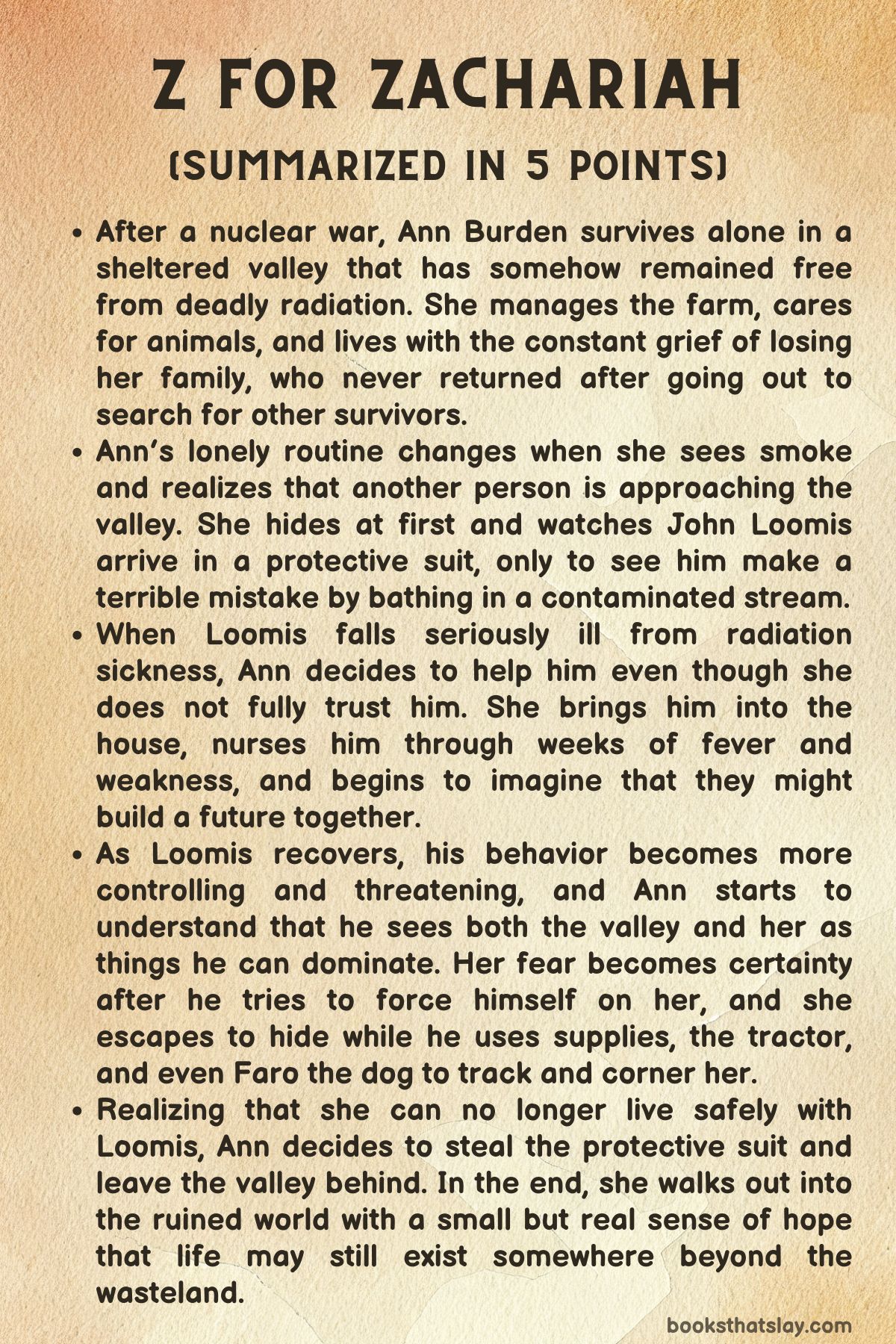
After a nuclear war destroys the outside world, Ann Burden lives alone in a small valley that has escaped radioactive contamination. The valley remains green and fertile while everything beyond it appears dead.
Ann’s family had once gone out to search for other survivors, but none of them returned. Since then, she has managed on her own, tending animals, growing food, gathering supplies from the local store, and writing in a notebook to keep herself company and preserve a sense of order.
One day, Ann notices smoke rising in the distance. Over several days it moves closer, and she realizes someone is approaching the valley.
Fearful and uncertain, she hides signs of her presence. She turns animals loose, covers her garden, and takes shelter in a cave from which she can watch without being seen.
She knows that meeting another person could mean rescue from loneliness, but it could also mean danger. Her long isolation has taught her to be careful.
Eventually the stranger enters the valley wearing a protective suit and pulling a wagon. He is cautious, checking radiation levels before removing the suit.
Ann watches him from hiding as he explores the house, store, church, and streams. He seems exhausted and unfamiliar with the valley’s hidden dangers.
Then he makes a critical mistake: he bathes in a stream that Ann knows is contaminated. Soon afterward he becomes violently ill.
Despite all her caution, Ann cannot let him die. She goes to him and begins caring for him.
He is delirious, feverish, and weak from radiation sickness. He tells her his name is John Loomis, a chemist who helped develop the protective suit he was wearing.
He has traveled a long way through the ruined country and had hoped to find a safe place. Ann moves him into the house, feeds him, brings him water, sterilizes what she can, and follows his instructions for reducing further risk of infection.
As Loomis slowly talks more, Ann learns about the world beyond the valley. He had worked with others in a military research setting, trying to create materials that could resist radiation.
By the time the war began, there was only one completed suit. He had used it to travel, hoping to survive where others could not.
During his periods of delirium, however, he keeps mentioning a man named Edward. At first Ann does not understand who Edward is, but the name returns again and again in Loomis’s fevered speech.
While Loomis remains bedridden, Ann continues working. She replants her garden, manages the animals, and starts imagining a future in which she and Loomis might build a life together.
Her thoughts are shaped by youth, loneliness, and hope. She dreams of companionship, marriage, children, and the possibility that the valley could become a new beginning for humanity.
At the same time, small moments unsettle her. Loomis can be sharp with her.
He sometimes speaks to her in a way that makes her feel foolish or lesser, even when he depends on her completely.
As his fever worsens, Ann spends days and nights caring for him, nearly without rest. In his delirium he reveals more about Edward.
Ann pieces together that Edward had wanted to use the protective suit to reach his own family, while Loomis insisted the suit must be preserved. From Loomis’s broken words and from damage she later finds in the suit, Ann realizes that Loomis shot Edward.
The truth remains morally complicated. Edward may have tried to take the suit, but Loomis also chose to kill him.
Even knowing this, Ann still wants Loomis to live. By then she has invested too much care, effort, and feeling in saving him.
Against the odds, Loomis recovers. As he regains strength, the balance between them changes.
While he was helpless, Ann had power through action, knowledge of the valley, and moral authority. Once he begins to walk again, his attitude grows more possessive.
He criticizes the choices she made while nursing him, especially her delay in planting certain crops. He becomes preoccupied with long-term control of the valley’s resources and speaks as if the future of the place is something he should direct.
He forbids Ann from touching the protective suit or going beyond the valley. What had once sounded like practical planning begins to feel like domination.
Ann’s discomfort deepens into fear. Loomis watches her constantly, especially while she works in the fields.
He asks personal questions but reveals little about himself. When she asks whether he had ever been married, he responds by grabbing her hand and pulling her against him.
The physical contact is aggressive, not affectionate, and Ann recognizes it as an attempt to exert control over her. After that, she becomes alert to the danger of being alone with him.
The threat becomes unmistakable one night when Loomis enters Ann’s bedroom while she is pretending to sleep. He touches her in a way that makes his intentions clear.
Ann fights him off and escapes into the night. She flees to the cave where she had once hidden from him before they met.
There she watches the house and tries to think of a way to survive. Her dog Faro, who had returned to the valley earlier, becomes a problem as well as a comfort, because Loomis can use him to track her.
From then on, Ann and Loomis live in a tense standoff. Ann comes out during the day to work and to keep the farm going, then returns to hiding at night.
Loomis trains Faro to follow her scent and gradually becomes more controlling of tools, supplies, and access to the store. He padlocks the store to deny her food and equipment.
He takes the tractor key and forces her to ask permission for things that once belonged to her family and had sustained her life. His goal becomes clear: to eliminate her independence until she has no option but to return to him on his terms.
The conflict turns openly violent. Loomis spies on her movements and tries to discover where she is hiding.
When she confronts him about the locked store, he shoots at her, grazing her leg. She realizes he does not want to kill her outright; he wants to wound and capture her.
Later he tracks her to the cave with Faro, burns her supplies, and destroys her refuge. Ann is horrified not only by his cruelty but also by what survival is doing to her own conscience.
At one point she considers killing Faro to stop Loomis from using him, and the thought leaves her shaken.
In the weeks that follow, Ann remains injured, hungry, and constantly on the move. Faro eventually dies after following her through the contaminated stream, another painful loss caused by Loomis’s pursuit.
During this time Ann reaches a final conclusion: there is no safe way to live with Loomis in the valley. He is unstable, dangerous, and determined to possess both the place and her future within it.
She decides that her only chance is to steal the protective suit and leave the valley altogether.
Ann sets a plan in motion. She lures Loomis away from the house with a note, then takes the wagon, the suit, and what supplies she can carry.
After dressing in the suit, she starts out toward the dead world beyond the valley. Even then she cannot leave without one last confrontation.
She waits for Loomis on Burden Hill and tells him why she must go. He comes armed and immediately tries to assert his claim over the suit, but when Ann mentions Edward, his confidence falters.
She tells him that staying means becoming his prisoner and likely dying in winter. He begs her not to leave him alone, but she refuses.
The bitterness between them is mixed with grief, disappointment, and the knowledge that things did not have to become this way.
Ann finally walks out into the wasteland. Loomis does not shoot her.
Instead, he calls out that he once saw birds flying in the west, suggesting there may be another place where life survives. That small piece of hope is enough.
Ann keeps going, carrying her journal, her gun, and the possibility that somewhere beyond the ruin there are other people, other children, and another future. The novel ends with uncertainty, but also with movement toward life rather than confinement.
Characters
In Z For Zachariah, character development is shaped by isolation, fear, memory, and changing power. Robert C. O’Brien keeps the cast small, but that smallness gives each figure unusual weight.
Ann Burden
Ann Burden stands at the center of the novel as both narrator and moral consciousness. Because the story is presented through her journal, readers experience events through the mind of a girl who is practical, observant, emotionally vulnerable, and far more resilient than she first seems.
She has survived alone for a long time before the arrival of another human being, and that survival has required intelligence, discipline, and a quiet courage. She knows how to farm, care for animals, store food, observe danger, and make difficult choices without guidance.
Her strength is not loud or dramatic. It comes through routine, endurance, and the ability to keep going when there is no reassurance that her effort means anything.
What makes Ann especially compelling is the tension between innocence and maturity in her character. She is still young enough to imagine companionship, marriage, and a future shaped by hope, yet she is also old enough to understand fear, death, and moral uncertainty.
She wants to trust, wants to believe in rebuilding life, and wants another person to share the valley with. At the same time, she senses danger before she can fully explain it.
Her instincts often protect her before her reasoning catches up. This gives her voice an honesty that feels deeply human.
She does not always interpret others correctly at first, but she pays attention, learns, and adjusts.
Ann also represents moral persistence in a ruined world. She cares for Loomis even after suspecting terrible things about him, and she continues to act with decency long after he stops deserving her trust.
Her kindness is not weakness. It is a choice, and one that costs her.
By the end, her growth is marked by a painful shift: she moves from hoping to build a future with someone else to understanding that survival may require separation, self-protection, and leaving behind the only home she has ever known. Her final decision is powerful because it shows that she has not given up on life; she has simply refused to surrender her freedom in order to keep it.
John Loomis
John Loomis is the most complex and disturbing figure in the novel because he enters the valley first as a possible answer to loneliness and later becomes its greatest threat. At the beginning, he appears as a sick, exhausted survivor whose knowledge and experience might help create a future.
He is educated, scientifically trained, and capable of understanding the larger catastrophe in ways Ann cannot. His arrival seems to offer companionship, adult guidance, and practical hope.
This first impression matters because it makes his later behavior more unsettling. He does not begin as an obvious monster.
He becomes frightening through a gradual exposure of his needs, his pride, and his hunger for control.
Loomis is deeply shaped by fear and guilt. His fevered speech about Edward reveals that he carries a violent past into the valley.
Even when he recovers physically, he does not recover morally or emotionally. He is possessive about the protective suit, rigid in his thinking, and unable to see Ann as an equal human being with her own will.
He treats survival as something tied to authority, ownership, and obedience. The valley becomes, in his mind, something to manage and dominate.
His plans for crops, tools, and the future are not wrong in themselves, but the spirit behind them is controlling rather than cooperative.
He is also a striking example of how intelligence can exist without wisdom. Loomis understands chemistry, radiation, and machinery, yet he lacks humility, emotional balance, and ethical clarity.
He cannot bear dependence, which is why his recovery changes him so sharply. While he is helpless, Ann’s care sustains him.
Once he regains strength, he seems unable to accept the debt he owes her. Gratitude would require vulnerability, and vulnerability is something he rejects.
His treatment of Ann reveals entitlement, resentment, and a desire to possess what he cannot earn. By the end, Loomis becomes less a companion than a warning about what fear, isolation, and unchecked power can do to a person who has already compromised his conscience.
Faro
Faro is more than a dog in the novel. He functions as a living connection to Ann’s past, to her family, and to a form of loyalty untouched by the corruptions that affect the human characters.
When he returns unexpectedly, he brings with him memory, comfort, and continuity. His presence reminds Ann that not everything from the old life has vanished.
He responds through instinct rather than strategy, and that makes him emotionally important in a story filled with mistrust and psychological tension.
At the same time, Faro becomes part of the power struggle between Ann and Loomis. Because he moves between them, he exposes how survival in the valley is no longer simply about food and shelter but about control.
Loomis uses Faro’s trust as a tool, especially when he trains him to follow Ann’s scent. This changes the meaning of Faro’s presence.
He remains innocent, but innocence itself becomes dangerous when exploited by someone more calculating. Ann’s horror at the thought of harming Faro is one of the clearest signs that she is still fighting to preserve her humanity.
She understands that killing him might protect her, yet the mere willingness to consider it frightens her.
Faro’s death is one of the saddest moments in the novel because it confirms how thoroughly violence has poisoned the valley. He does not die because of malice of his own, but because humans have turned loyalty into a weapon.
His end marks the loss of one of the last uncomplicated bonds in Ann’s world. After that, the valley feels even colder, because one of the few remaining creatures associated with affection and home is gone.
Edward
Edward never appears directly in the present action, yet he is one of the most important hidden characters in the novel. Everything readers learn about him comes through Loomis’s fevered memories, frightened outbursts, and Ann’s interpretation of clues.
This indirect method makes Edward less a fully visible person and more a moral presence hanging over the story. He represents the unresolved crime that Loomis carries with him.
Through Edward, the novel suggests that the valley does not begin the moral conflict; it only reveals what was already there.
Edward seems to have wanted the protective suit in order to reach his family. Whether or not that hope was realistic, it gives him a human motive grounded in love rather than possession.
Loomis frames him as a thief, but that accusation is unstable because the situation itself is morally desperate. In a dying world, ownership becomes hard to separate from selfishness.
Edward’s attempt to take the suit may have been reckless, but Loomis’s decision to shoot him shows a capacity for violence justified in the name of necessity. That matters because it prepares readers to understand Loomis’s later behavior toward Ann.
Edward is not just part of a backstory; he is evidence of what Loomis becomes when another person stands between him and what he thinks he must have.
Edward also serves as a contrast to Ann. Both Ann and Edward become obstacles to Loomis’s control, and in both cases Loomis responds with coercion or violence.
This pattern helps Ann understand the danger she is in. Edward’s unseen death is therefore central to the novel’s moral structure.
He is the absent figure who makes the truth about Loomis impossible to ignore.
Ann’s Family
Ann’s parents, brother, and extended family members remain mostly in memory, yet their influence is present throughout the novel. They give Ann emotional grounding, practical knowledge, and a standard by which she judges the world after disaster.
The valley is not simply land to her; it is family history, daily habit, and inherited responsibility. Her memories of work, worship, meals, seasons, and ordinary life make the setting feel lived in rather than merely abandoned.
Their disappearance also shapes Ann’s character in lasting ways. Because they left to search for survivors and never returned, Ann lives with both grief and uncertainty.
She has no final conversation, no confirmed farewell, and no proper closure. That unresolved absence deepens her loneliness and partly explains why the arrival of another human being affects her so strongly.
She has been carrying the silence of their loss for a long time. At the same time, what her family taught her is the reason she remains alive.
Their knowledge of farming, tools, food storage, and household labor has become the structure of her survival.
They also represent a lost moral and social order. Their absence is not only personal; it marks the disappearance of authority, protection, and community.
Ann must become her own guide because the people who once defined safety are gone. In that sense, her family remains active in the novel as a quiet measure of what has been lost and what Ann is trying to preserve.
Mr. Jacob and the Burden Legacy
Mr. Jacob, though mentioned only briefly, helps define the social history of the valley. He belongs to the older local world that existed before the war, the world of neighboring farms, shared labor, and practical familiarity.
Characters like him remind readers that the valley was once part of a living community, even if it was small and isolated. His absence reinforces the emptiness left by the catastrophe.
The Burden family legacy is equally significant. The church, the land, and the sense of rootedness attached to Ann’s name suggest continuity between generations.
This history gives Ann a deeper attachment to the valley than Loomis can ever understand. For him, it is a refuge and a resource.
For her, it is ancestry, memory, and belonging. That difference explains much of their conflict.
Loomis looks at the valley and sees survival planning. Ann looks at it and sees home.
The Burden legacy therefore matters not only as background but as a source of identity. It is part of why Ann resists being reduced to someone who merely occupies the place.
She belongs to it in a way that is emotional, historical, and spiritual.
Themes
Isolation and the Human Need for Companionship
Isolation in Z For Zachariah is not presented as a simple condition of being alone. It alters emotion, judgment, hope, and fear.
Ann has learned how to survive physically in solitude, but survival does not erase the need for human contact. Her journal itself shows this need, because writing becomes a substitute for conversation and companionship.
When Loomis arrives, Ann’s reaction is divided between caution and longing. She has spent so much time alone that the appearance of another person feels almost miraculous, yet that same loneliness makes her vulnerable to false hope.
She wants connection, and that desire shapes how she initially imagines a shared future.
The novel also shows that companionship is not automatically healing. Another person can end loneliness while creating a different kind of suffering.
That is what makes the theme so powerful. The story does not romanticize human presence; it examines the risks built into dependence.
Ann discovers that being alone can be painful, but being trapped with the wrong person can be worse. By the end, the theme shifts again.
Isolation is no longer only a burden forced on her by disaster. It becomes, for a time, a necessary condition of self-preservation.
The novel suggests that companionship has value only when it is joined to mutual respect, trust, and freedom.
Power, Control, and Possession
Control operates at every level of the novel, from physical survival to emotional pressure. The valley begins as a place where Ann quietly governs her own life through labor, knowledge, and routine.
After Loomis recovers, that balance changes. He starts to assert control over tools, land, information, mobility, and eventually over Ann herself.
What makes this progression so disturbing is that it does not begin with open violence. It begins with assumptions: that his plans should prevail, that his judgment matters more, that Ann should accept his authority, and that the future of the valley belongs in his hands.
Possession in the novel is never limited to objects. The protective suit is the clearest symbol of ownership, but the same logic extends to the farm, the tractor, the store, Faro, and finally Ann’s body and freedom.
Loomis acts as if control over resources naturally gives him the right to control another person. His behavior reveals how quickly practical dependence can become domination when one person sees others as subordinate.
Ann’s resistance is therefore not only a struggle to stay alive. It is a defense of autonomy.
Her refusal to remain in the valley under Loomis’s terms becomes the moral center of the story. The novel insists that survival without freedom is not enough, especially when survival is offered in exchange for submission.
Innocence, Experience, and Moral Awakening
Ann begins the novel with innocence that is not childish but untested. She is capable, hardworking, and thoughtful, yet she still believes that goodness, care, and effort may be enough to create trust.
Her experience with Loomis forces her into a painful moral awakening. She learns that someone can be educated, vulnerable, and dependent on kindness while still being dangerous.
She learns that gratitude does not always follow sacrifice and that violence can grow gradually out of resentment, fear, and entitlement.
This theme is also visible in how Ann’s understanding of herself changes. Early on, she imagines adult life in ideal terms: marriage, children, home, partnership.
Later, she is forced to separate those hopes from the reality of coercion. The difference between chosen closeness and imposed possession becomes one of the central truths she must face.
Her growth lies not in becoming harder for its own sake, but in seeing clearly. She does not lose the capacity for care, sorrow, or hope.
What changes is her willingness to ignore danger for the sake of emotional comfort.
The novel also complicates innocence by showing that survival can darken even the innocent. Ann contemplates actions she finds morally horrifying, including the possibility of killing Faro.
That moment matters because it reveals that corruption in the novel is not only something outside her. The pressure of fear can distort anyone.
Her moral awakening, then, is not just about recognizing evil in Loomis. It is also about recognizing what desperation can awaken in herself.
Hope and the Possibility of Renewal
Hope in the novel is fragile, often interrupted, and never sentimental. It appears first in practical forms: planting a garden, storing food, repairing tools, caring for animals, and imagining a future harvest.
These actions matter because they show hope as work rather than wishful thinking. Ann continues to plant, build, cook, and repair because she believes life must be sustained even when no larger future is visible.
Her labor becomes a declaration that living still matters.
As the story darkens, hope changes shape. It is no longer tied to the valley as a secure future with another person.
Instead, it moves outward, toward uncertainty. Ann’s recurring dream of children waiting for her gives hope a moral direction.
She does not simply want to survive for herself. She wants a life in which knowledge, care, and community can exist again.
That dream transforms escape into purpose. Leaving the valley is terrifying, but staying would mean surrendering both freedom and possibility.
The final image of movement westward carries this theme with quiet force. There is no guarantee that Ann will find other survivors, safety, or the children from her dream.
Yet the ending remains hopeful because she chooses motion over despair and uncertainty over captivity. Hope, in this novel, is not confidence that things will end well.
It is the decision to keep walking toward the chance that they might.