The Girls Before Summary, Characters and Themes
The Girls Before by Kate Alice Marshall is a mystery thriller about old secrets, missing girls, and the damage caused when powerful families are protected for too long. The story follows Audrey Dixon, a school counselor and search-and-rescue volunteer, as she becomes drawn into the disappearance of a student named Meghan Vale.
What first seems like a runaway case begins to connect with a local witch legend, a hidden bunker, and Audrey’s own unresolved childhood guilt. The book uses a tense small-town setting to explore fear, silence, loyalty, and the cost of looking away from the truth.
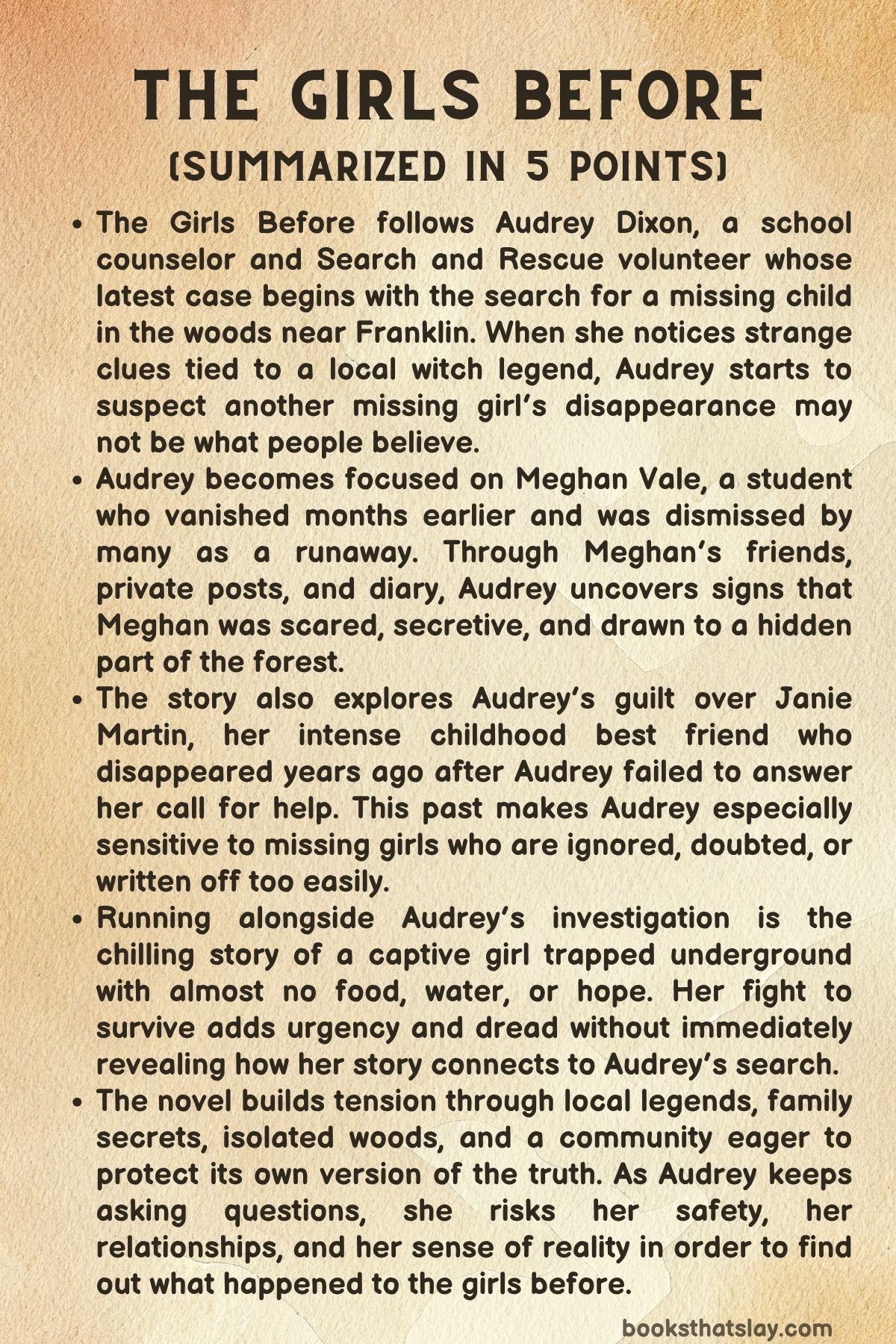
Summary
The Girls Before begins with a girl trapped in a dark underground room. She is chained by the ankle, starving, thirsty, and so weak that she begins to see the dead girls who were held there before her.
These imagined girls, whom she thinks of as ghostlike companions, left messages carved under the bed. The carvings tell her how to survive: save food, do not waste water, do not cry, and focus first on the chain.
Her captor has not returned for several days, and though that means she may die from neglect, it also gives her a chance. She begins taking apart the bed and then a chair, trying to create tools that might help her escape.
Aboveground, Audrey Dixon works as a counselor at Franklin High and volunteers with Search and Rescue. She joins the search for Bryson Lee, a four-year-old boy who wandered away from his family’s vacation home.
Audrey has a reputation among the team as “Lucky” because missing people are often found when she is part of the search. During the operation, she and another volunteer, Rick, cross onto private land after Audrey thinks she hears a child crying.
Instead of Bryson, they find a string of white beads hanging in the woods. The beads connect to the local story of Jenny Red-Hands, a witchlike figure said to haunt the area.
Their search is interrupted by Bill Butler, who threatens them with a rifle for trespassing. Emily Hill, the youngest member of the prominent Hill family, arrives and calms him down.
Soon afterward, Bryson is found alive in an old root cellar. The search ends well, but Audrey cannot stop thinking about the beads, the private land, and the strange feeling the woods gave her.
Audrey connects the beads to Meghan Vale, a Franklin High student who disappeared months earlier. Most people believe Meghan ran away, but Audrey begins to doubt that explanation.
At school, she looks into Meghan’s social media and talks to Meghan’s friend Chloe. Chloe says Meghan was unhappy and interested in witchcraft, but she also says Meghan would have said goodbye if she had truly planned to leave.
Chloe shows Audrey Meghan’s private Instagram account, where Audrey finds a photo of the same bead-covered tree taken shortly before Meghan vanished.
As Audrey investigates Meghan, memories of Janie Martin return. Janie was Audrey’s childhood best friend: intense, controlling, unpredictable, and impossible to forget.
Janie often vanished from Audrey’s life and then came back as if nothing had happened. Years earlier, Janie disappeared for good after calling Audrey and coming to her window on the last night Audrey ever heard from her.
Audrey ignored her, and she has carried guilt ever since. Janie had also helped shape the Jenny Red-Hands legend when they were teenagers, which makes Audrey’s present investigation feel connected to her past.
Audrey reconnects with Emily Hill, who takes her deeper into the woods. Together they find the bead tree and the root cellar where Bryson hid.
They also find a carved handprint marked with red paint, which suggests Meghan may have been in that place. Emily warns Audrey that she will not find the answer in the woods, but her warning only makes Audrey more suspicious.
At Emily’s house, Audrey learns more about Emily’s isolated childhood. Melinda Hill, Emily’s older sister, arrives and tells Audrey to be careful, saying Emily has problems and can seem frightening.
Audrey finds a podcast episode about Jenny Red-Hands and learns that Meghan had been interviewed for it. Meghan claimed she saw Jenny in the woods.
Audrey contacts Ethan, the podcast host, who says Meghan seemed genuinely scared. He also says another girl, Theresa Abbott, had been with Meghan.
When Audrey questions Theresa, Theresa denies that anything serious happened and says Meghan exaggerated things.
Audrey also visits Terry Butler in the hospital. Terry is hostile, but he admits he may have seen a girl on his land and yelled at her.
Audrey cannot decide whether Terry harmed Meghan or simply frightened her. At the same time, Audrey begins dating Dev Khanna, a teacher at Franklin High.
For a while, she tries to live normally, but Meghan’s disappearance continues to occupy her mind.
Audrey eventually visits Meghan’s home and speaks with Meghan’s father. His behavior makes her uneasy.
While inside the house, Audrey secretly takes Meghan’s purple diary. As she leaves, Mr. Vale grabs her arm and demands to know why she is really there.
Audrey escapes to her car shaken and wonders whether Meghan’s father may be involved in what happened to her.
In the underground room, the captive girl keeps fighting to survive. Weak and injured, she manages to remove one long bolt from a broken toilet, but another bolt snaps and becomes useless.
When her flashlight dies, she is left in total darkness. Still, she feels along the wall until she finds the rusted link where her chain is attached.
Using the bolt as leverage, she breaks the welded link and frees herself. She reaches the stairs, but the door above is locked, and the bunker has no electricity.
After coming so close to freedom, she is trapped again. In despair, she prepares to carve her real name among the names of the dead girls, but then she hears voices outside.
Audrey reads Meghan’s diary and learns that Meghan once saw a pale-haired woman in the woods with red hands. Meghan believed she had seen Jenny Red-Hands and became obsessed with the woods, the beads, and the marked tree.
Her later diary entries grow strange and sparse, including poems about being voiceless, faceless, forgotten, and calling herself “Stranger.” Audrey begins to think Meghan found something real and dangerous.
Audrey confronts Emily, who admits she met Meghan but says what Meghan told her was private. Emily shows Audrey her studio, including portraits of Liam, her brother, and Elizabeth, her dead mother.
Audrey realizes that Janie resembled both Elizabeth and Emily. Emily also reveals that after her mother died, her father became controlling and kept her isolated.
Audrey notices that Emily painted the marked tree and understands that Emily knew about the red hand symbol before Audrey showed it to her.
At a benefit dinner for Bryson, Audrey sees Andrew Hill and feels uneasy when he tries to bring up a drunken encounter they had years earlier. She also learns from Bill Butler that Andrew has been tending Terry Butler’s land, meaning the Hills had access to the woods.
Audrey tells Dev about Meghan and Emily. Dev suggests that a cadaver dog might still find remains if someone is buried there.
Audrey takes Barry, her former search-and-rescue dog, into the woods with Dev. Barry alerts first to a buried scent, then leads them to a metal door hidden in a hill.
Audrey breaks the padlock and enters the bunker. Inside, she and Dev find a concrete room covered with red handprints.
There are old chains, broken furniture, and boards carved with survival rules: do not swear, be polite, do not cry, save food, use the toilet as water, and never say your real name. They find names scratched by different hands: Amanda, Madison, and Stranger.
Barry reacts to the smell of death. Audrey realizes Meghan must have found the bunker and borrowed the name “Stranger” from the writing on the wall.
The truth begins to emerge through the story of the captive girl. When she first escaped her chain, the Hill siblings—Melinda, Andrew, Liam, and Emily—found her.
Their father, Mason Hill, had apparently kidnapped and abused her before he died, leaving her locked underground. Instead of calling the police immediately, the siblings hesitated.
Revealing what Mason had done would destroy the Hill family’s name, their careers, and everything built around their father’s public image. Emily brought the girl food and water, and the girl gave her name as Stranger.
But the siblings left her locked in the dark while they decided how to protect themselves.
Audrey and Dev report the bunker to Len, who brings them to Chief Wagner. Wagner refuses to take the evidence seriously.
He treats the bunker as trespassing, graffiti, and local legend rather than proof of crimes. Because the Hills are considered a respectable family, he does not want to investigate them.
Later, Andrew confronts Audrey and claims the bunker was harmless, warning her to stop searching.
Audrey does not stop. She looks into missing women whose names and appearances match the carvings in the bunker.
That night, she and Dev return to the woods illegally and dig where Barry had alerted. They uncover a buried skull just as Emily arrives in the clearing, confirming that the mystery around Meghan, the bunker, and the Hill family is far darker than the town has allowed itself to admit.
Characters
Audrey Dixon
Audrey Dixon is the central investigative force in The Girls Before, and her character is built around a tension between competence and unresolved guilt. On the surface, she is capable, observant, and useful to others: she works as a school counselor, volunteers in Search and Rescue, and has earned the nickname “Lucky” because missing people tend to be found when she is involved.
This nickname gives her an almost mythical role in the community, but the book gradually shows that Audrey’s “luck” is not magic; it comes from her sensitivity to danger, her willingness to notice small details, and her inability to let unanswered questions rest. Her discovery of the witch beads and her connection between the woods, Meghan Vale, and the legend of Jenny Red-Hands reveal how deeply she trusts instinct even when others dismiss her.
Audrey is also a character haunted by the past. Her memories of Janie Martin shape much of her emotional life, especially because Janie vanished after reaching out to Audrey and being ignored.
This guilt makes Audrey unusually responsive to missing girls and silenced victims. Meghan’s disappearance matters to her not only as a school counselor or search volunteer, but also because Meghan becomes another version of the girl Audrey failed to help.
This gives Audrey’s investigation moral urgency, but it also makes her vulnerable to obsession. She crosses boundaries, steals Meghan’s diary, trespasses, and risks her safety because she cannot accept the official explanation that Meghan simply ran away.
Audrey’s strength is that she keeps looking when everyone else wants to stop; her flaw is that her need to make things right can push her into reckless choices.
Meghan Vale
Meghan Vale is one of the most important absent presences in the book. Although she is missing for most of the story, her personality emerges through Chloe’s memories, her social media, her diary, her poetry, and the traces she leaves behind in the woods.
Meghan is portrayed as unhappy, secretive, imaginative, and increasingly frightened. Her interest in witchcraft and the legend of Jenny Red-Hands could easily be dismissed by adults as teenage drama, but the story makes clear that Meghan’s obsession grows out of something real.
She sees signs that others overlook, follows them into the woods, and becomes entangled in a mystery that is far older and darker than she first understands.
Meghan’s use of the name “Stranger” is especially revealing. It shows both her identification with the forgotten captive girls and her own fear of becoming faceless and erased.
Her poems about being voiceless, nameless, and forgotten suggest that she understands, at least emotionally, the danger of disappearing from the world without being believed. Meghan is not merely a victim; she is also a witness.
Her tragedy lies in the fact that she finds the truth but lacks the protection, power, and adult support needed to survive it. Through Meghan, the book explores how easily teenage girls can be dismissed when their fear is expressed through symbols, stories, art, or rebellion rather than through language adults consider credible.
Janie Martin
Janie Martin is Audrey’s childhood best friend and one of the most psychologically complicated figures in the story. She is intense, manipulative, magnetic, and unstable in her bond with Audrey.
Janie repeatedly disappears from Audrey’s life and then returns, creating a relationship defined by emotional control and uncertainty. She seems to need Audrey, but she also tests and punishes her, making their friendship feel less like a safe childhood bond and more like a formative wound.
Janie’s final disappearance becomes the central guilt Audrey carries into adulthood.
Janie also matters because she helped shape the legend of Jenny Red-Hands during their teenage years. This links her to the story’s larger pattern of girls creating myths to explain dangers adults refuse to name.
Janie’s resemblance to Elizabeth Hill and Emily Hill adds another layer of unease, suggesting that Audrey’s memories of Janie are not separate from the Hill family mystery but emotionally and visually connected to it. Janie is important not only because she vanished, but because she taught Audrey what it feels like to ignore a cry for help and never get a second chance.
Emily Hill
Emily Hill is one of the most morally ambiguous characters in the book. She first appears as someone helpful and unusual, stepping in when Bill Butler threatens Audrey and Rick with a rifle.
Her knowledge of the woods, her isolated upbringing, and her connection to the bead tree make her both guide and suspect. Emily understands far more than she initially admits, and her warnings to Audrey suggest that she is trapped between wanting the truth exposed and fearing what exposure will destroy.
Her character is shaped by secrecy, trauma, family loyalty, and fear.
Emily’s childhood under her controlling father, Mason Hill, explains much of her strangeness without excusing her choices. After her mother’s death, she was isolated and dominated, leaving her emotionally stunted in some ways and intensely observant in others.
Her art becomes a way of preserving what she cannot say directly, especially through portraits and images of the marked tree. Emily’s relationship with the captive girl known as Stranger is central to her moral failure.
She brings food and water, which shows compassion, but she still participates in leaving the girl locked away while the family decides how to protect itself. Emily is neither a simple villain nor a clear innocent.
She represents the damage caused when abuse, secrecy, and privilege teach a person that protecting the family name matters more than saving a victim.
Dev Khanna
Dev Khanna functions as Audrey’s emotional counterbalance and one of the few people willing to take her concerns seriously. As a teacher at Franklin High, he belongs to Audrey’s everyday world, and their developing relationship offers her a glimpse of normalcy amid obsession and fear.
However, Dev is not just a romantic interest. He listens, reasons with her, and helps her think through practical possibilities, such as using a cadaver dog to search for buried remains.
His presence helps move Audrey’s suspicions from instinct to action.
Dev’s importance lies in his trust. Many characters dismiss Audrey, minimize the evidence, or warn her away, but Dev chooses to accompany her into the woods and into danger.
This makes him a stabilizing figure, though he also becomes implicated in Audrey’s increasingly risky choices. By going with her to the hidden bunker and later returning to dig illegally, Dev shows loyalty that is both admirable and dangerous.
He represents the kind of support Audrey needs, but his involvement also shows how the search for truth can pull even sensible people across legal and moral lines.
Melinda Hill
Melinda Hill is a guardian of the Hill family’s public image and a character shaped by calculation, fear, and self-preservation. When she warns Audrey about Emily, she presents herself as practical and concerned, but the warning also serves to redirect suspicion away from the family as a whole and toward Emily as the unstable one.
Melinda understands the power of reputation and uses it to manage how others perceive the Hills. Her behavior suggests that she is skilled at turning family dysfunction into someone else’s personal problem.
Her role in the discovery of Stranger reveals her moral cowardice. Faced with evidence of Mason Hill’s crimes, Melinda and her siblings hesitate because telling the truth would destroy the family’s standing and their futures.
This hesitation is devastating because it shows that she can recognize horror and still choose delay, secrecy, and self-protection. Melinda is not necessarily driven by cruelty in the same way Mason is, but her willingness to preserve the family name at the expense of a captive girl makes her deeply culpable.
She represents the polished face of complicity.
Andrew Hill
Andrew Hill is unsettling because he combines charm, social power, and implied threat. His attempt to discuss a drunken encounter with Audrey from years earlier creates discomfort, especially because he behaves as though he has the right to reopen or control that memory.
His position within the Hill family gives him access, authority, and protection, while his behavior toward Audrey suggests a man accustomed to managing consequences rather than facing them.
Andrew’s connection to Terry Butler’s land is crucial because it gives the Hills practical access to the area around the bunker. When he later confronts Audrey and describes the bunker as harmless, his minimization becomes chilling.
He is not simply denying evidence; he is trying to redefine reality. Andrew’s character shows how privilege protects itself through confidence, intimidation, and plausible explanation.
He may not be the original source of the violence, but he helps maintain the silence that allows violence to remain hidden.
Liam Hill
Liam Hill is less fully foregrounded than Emily, Melinda, and Andrew, but his presence in the Hill sibling group is important. He is part of the collective decision that follows the discovery of Stranger, and that makes him morally involved in the family’s failure.
Even without being the most vocal sibling, he participates in the silence that keeps the captive girl trapped. His character shows that complicity does not always require leadership; sometimes it exists in passivity, hesitation, and obedience to family pressure.
Liam also appears through Emily’s art, which suggests that he has emotional significance within the family system. The portrait of Liam places him inside Emily’s private world of memory, grief, and unresolved feeling.
He becomes part of the book’s larger portrait of the Hill children as damaged descendants of Mason Hill. They are victims of his control in some ways, but they also become protectors of the system he created.
Liam’s importance lies in that uncomfortable middle ground between harmed child and responsible adult.
Mason Hill
Mason Hill is the hidden monster behind much of the story’s violence. Although he is dead when many of the central events unfold, his actions continue to shape the lives of his children, the fate of Stranger, and the secrets buried in the woods.
He is presented as controlling, abusive, and capable of kidnapping and imprisoning girls. His bunker is the physical expression of his character: secretive, brutal, rule-bound, and designed to strip victims of identity and hope.
Mason’s evil also survives through family silence. His death does not free the victims or cleanse the family; instead, it leaves his children with a choice.
Their decision to protect the Hill name allows Mason’s crimes to keep harming others even after he is gone. In this sense, Mason is not only an individual villain but the origin of a corrupted legacy.
He represents patriarchal control at its most extreme: a man who dominates his household, isolates his daughter, imprisons girls, and leaves behind a structure of fear that others continue to maintain.
Elizabeth Hill
Elizabeth Hill is important as an absence that shapes the Hill family’s emotional landscape. Her death marks a turning point in Emily’s life, after which Mason becomes more controlling and Emily more isolated.
Elizabeth’s image survives through Emily’s portraiture and through Audrey’s realization that Janie resembled Elizabeth and Emily. This resemblance creates a haunting link between Audrey’s past and the Hill family’s secrets.
Elizabeth functions less as an active character and more as a lost possibility. She suggests a version of the Hill household that may once have had warmth, beauty, or protection, though the book does not allow that possibility to become comforting.
Her absence leaves a vacuum that Mason fills with control. Through Elizabeth, the story shows how the dead can remain powerful, not by acting, but by shaping memory, resemblance, grief, and obsession.
Mr. Vale
Mr. Vale is Meghan’s father, and his role is defined by suspicion and unease. When Audrey visits Meghan’s house, his behavior makes her uncomfortable enough to wonder whether he may have harmed his daughter.
His grabbing of Audrey’s arm is especially disturbing because it turns a conversation about a missing girl into a moment of physical intimidation. He becomes one of the adults whose behavior raises the possibility that Meghan may not have been safe even at home.
At the same time, his character also contributes to the book’s atmosphere of uncertainty. Audrey does not immediately know whether his unsettling behavior comes from guilt, grief, fear, or anger.
This ambiguity is important because it reflects the broader problem in Meghan’s case: the adults around her are difficult to read, and many seem more invested in controlling the story than finding the truth. Mr. Vale represents the suspicion that can gather around families of missing girls, especially when grief and secrecy are hard to separate.
Chloe
Chloe is Meghan’s friend and one of the first people to help Audrey see that Meghan’s disappearance should not be dismissed as a runaway case. Chloe understands Meghan’s emotional state better than the adults around her do.
She knows Meghan was unhappy and interested in witchcraft, but she also insists that Meghan would have said goodbye if she had truly chosen to leave. This distinction is important because Chloe refuses to let Meghan be reduced to a stereotype of a troubled teenage girl.
Chloe’s access to Meghan’s private Instagram makes her a bridge between Meghan’s hidden world and Audrey’s investigation. Through Chloe, Audrey finds the image of the bead-covered tree, which becomes a major clue.
Chloe’s character shows the value of teenage friendship as testimony. Adults may dismiss adolescent interests as dramatic or unserious, but Chloe recognizes patterns in Meghan’s behavior that point toward real fear.
Her loyalty helps keep Meghan visible.
Theresa Abbott
Theresa Abbott is connected to Meghan through the Jenny Red-Hands podcast interview, but she responds to Audrey with denial and minimization. She claims Meghan exaggerated what happened, distancing herself from the mystery and from Meghan’s fear.
Theresa’s behavior makes her seem evasive, but it also suggests a person who may be frightened, ashamed, or determined not to be pulled into danger.
Her character adds realism to the book’s treatment of witnesses. Not everyone who knows something is brave enough to say it clearly.
Theresa may not be malicious, but her refusal to validate Meghan’s experience contributes to the larger pattern of disbelief surrounding missing and endangered girls. She shows how fear and self-protection can make the truth harder to uncover, even when the truth is already circulating among those who saw pieces of it.
Ethan
Ethan, the podcast host, represents the way local legends are collected, retold, and transformed into entertainment. His episode about Jenny Red-Hands helps preserve Meghan’s account, but it also places her fear inside a folklore framework that others can dismiss.
When Audrey contacts him, Ethan confirms that Meghan seemed serious and frightened, making him useful as a witness rather than merely a storyteller.
Ethan’s role raises an important question about true crime and legend-making: does telling the story help reveal the truth, or does it turn suffering into atmosphere? In his case, the answer is mixed.
The podcast may not save Meghan, but it preserves a version of her voice and points Audrey toward Theresa. Ethan is therefore part of the chain of evidence, even if he does not fully understand the danger behind the story he is recording.
Terry Butler
Terry Butler is hostile, suspicious, and connected to the land where key events unfold. His admission that he may have seen a girl and shouted at her makes him a plausible threat in Audrey’s mind.
Because he is unpleasant and aggressive, he becomes an easy suspect, especially in a community where the woods, trespassing, and private property all carry tension.
However, Terry’s role also shows how suspicion can attach itself to the wrong kind of person. His hostility may be real, but that does not automatically make him the central villain.
Audrey cannot tell whether he harmed Meghan, and that uncertainty matters. Terry complicates the investigation by embodying visible menace while the more protected and respectable Hill family remains harder to accuse.
He is a reminder that danger in the book does not always come from the person who looks most obviously threatening.
Bill Butler
Bill Butler first appears as a direct physical threat when he points a rifle at Audrey and Rick for trespassing. His reaction establishes the woods as a contested and dangerous space, where private property can become a barrier to truth.
Bill’s aggression heightens the sense that Audrey is crossing into territory guarded not only by trees and legends but also by men with weapons and secrets.
Later, Bill becomes useful because he tells Audrey that Andrew Hill has been tending Terry’s land. This information shifts suspicion toward the Hills and gives Audrey a practical connection between the family and the area near the bunker.
Bill is therefore both obstacle and source. He may be intimidating, but he is not merely decorative; his presence helps reveal how land, access, and family arrangements conceal the truth.
Rick
Rick is Audrey’s fellow search volunteer and part of the opening movement from ordinary rescue work into deeper mystery. When he crosses onto private property with Audrey after she thinks she hears crying, he participates in the moment that leads to the discovery of the witch beads.
His role is smaller than Audrey’s, but he helps establish the Search and Rescue world in which Audrey is respected and known as “Lucky.”
Rick also functions as a contrast to Audrey. He is involved in the search, but he does not appear to become consumed by the mystery in the same way she does.
This difference highlights Audrey’s particular sensitivity to missing people and hidden clues. Rick belongs to the organized, practical side of searching; Audrey crosses from that world into obsession, memory, and danger.
Bryson Lee
Bryson Lee is the four-year-old boy whose disappearance brings Audrey back into the woods and indirectly begins the central investigation. As a child who wanders away and is found alive in an old root cellar, Bryson represents the kind of rescue story the community wants to believe in: frightening, urgent, but ultimately safe.
His survival reinforces Audrey’s reputation as “Lucky” and gives the search team a public success.
Yet Bryson’s disappearance also opens the door to a much darker truth. The place where he is found and the clues surrounding the woods connect his rescue to Meghan’s disappearance and the hidden bunker.
Bryson is not psychologically developed in the same way as the adult and teenage characters, but his role is structurally important. His temporary disappearance exposes the landscape where other girls were not lucky enough to be found in time.
Chief Wagner
Chief Wagner represents institutional failure. When Audrey and Dev bring evidence of the bunker to Len and then to Wagner, he dismisses it as trespassing, graffiti, and local superstition.
His refusal to investigate is especially disturbing because the physical evidence is alarming: chains, carved rules, names, red handprints, and Barry’s alert to death. Wagner’s dismissal shows how authority can protect the powerful by deciding in advance whose story sounds believable.
His defense of the Hills as a “good family” reveals the social bias at the heart of his failure. Rather than follow the evidence, he trusts reputation.
This makes him one of the book’s most frustrating figures because he does not need to be the original criminal to become dangerous. By refusing to act, he helps keep victims hidden and gives the Hills more time to control the narrative.
Wagner embodies the danger of institutions that value respectability over truth.
Barry
Barry, Audrey’s former search-and-rescue dog, is not human, but he is one of the most important agents of truth in The Girls Before. Unlike many of the people around Audrey, Barry does not care about reputation, fear, family names, or local legends.
He responds to scent and death, leading Audrey and Dev first to a buried trace and then to the metal door hidden in the hill. His instincts cut through the human fog of denial.
Barry also reconnects Audrey to her identity as a searcher. With him, she is not merely a guilty woman chasing a theory; she is using the skills and partnerships that once made her effective.
His alerts give physical confirmation to Audrey’s suspicions and move the mystery from possibility to evidence. Barry represents loyalty, memory, and the body’s ability to reveal what people try to bury.
Jenny Red-Hands
Jenny Red-Hands is not a conventional character, but the legend functions like one throughout the book. She is a figure made of fear, rumor, teenage imagination, local history, and hidden violence.
To some, she is only a witch story. To Meghan, she becomes something seen and feared.
To Audrey, she becomes a symbolic thread connecting Janie, Meghan, the bead tree, the red handprints, and the buried crimes of the Hills.
The importance of Jenny Red-Hands lies in how the legend transforms real suffering into folklore. The red hands, the beads, and the woods all seem supernatural until the investigation reveals human cruelty beneath them.
In The Girls Before, the legend becomes a language for truths that victims and witnesses cannot safely speak directly. Jenny is the story people tell when they do not yet know, or do not want to know, the names of the girls who were harmed.
Themes
Guilt and the Burden of the Past
Audrey’s search for Meghan is driven not only by concern for a missing girl but also by the guilt she carries from Janie’s disappearance. Her memory of ignoring Janie’s final attempt to reach her keeps shaping the way she responds to danger in the present.
This guilt makes Audrey unusually sensitive to signs that others dismiss: the beads in the woods, Meghan’s online clues, the diary, and the bunker. In The Girls Before, the past does not stay buried; it returns through legends, memories, repeated disappearances, and physical evidence hidden in the woods.
Audrey’s guilt becomes painful, but it also gives her moral urgency. She refuses to treat Meghan as another runaway because she knows what it feels like to leave someone unheard.
The theme shows how guilt can trap a person emotionally, yet it can also push them toward truth. Audrey cannot save Janie, but by pursuing Meghan’s case, she tries to answer the call she once ignored.
Silence, Erasure, and the Fight to Be Remembered
The captive girls are not only physically imprisoned; they are stripped of identity, voice, and recognition. The rules carved under the bed reveal a system meant to reduce them to obedience and survival.
“Never say your real name” is especially cruel because it forces the girls to separate themselves from who they were before captivity. Meghan’s use of the name “Stranger” shows how deeply this erasure spreads, even beyond the bunker itself.
The missing girls are treated by others as rumors, runaways, or pieces of a local legend rather than real people with lives and families. The carvings, names, poems, and red handprints become acts of resistance because they insist that these girls existed.
The theme is powerful because it connects survival with memory. To be forgotten is another form of violence, and Audrey’s investigation becomes an effort to restore identity to those who were hidden, doubted, or dismissed.
Power, Reputation, and Institutional Failure
The Hill family’s social position protects them long after the truth should have been exposed. Their name, wealth, and public image influence how others respond to evidence, especially when Chief Wagner refuses to take Audrey seriously.
The bunker, the carvings, Barry’s alerts, and the link to missing women should demand action, yet authority figures choose comfort over truth. This theme shows how reputation can become a shield for harm.
The Hills are treated as a “good family,” and that label matters more to some people than the suffering of vulnerable girls. Even the siblings’ hesitation after finding Stranger reveals how power encourages moral compromise.
They know a crime has happened, but they weigh the victim’s life against their family’s future. In The Girls Before, danger does not come only from one predator; it also comes from the people and systems that protect the powerful, ignore uncomfortable evidence, and punish those who ask difficult questions.
Survival, Resistance, and Moral Courage
Survival in the novel is shown as both physical endurance and mental resistance. The trapped girl survives through discipline, memory, pain, and the practical wisdom left by those before her.
The carved instructions are grim, but they are also a form of care passed from one victim to the next. Even when she is weak, hallucinating, and nearly hopeless, she studies the chain, breaks furniture for tools, searches for weaknesses, and refuses to surrender completely.
Audrey’s courage works in a different but connected way. She risks her safety, job, relationships, and reputation because she believes Meghan’s disappearance deserves answers.
Both women resist being controlled by fear. The theme suggests that courage is not the absence of terror; it is action taken while terror is present.
Survival is also collective: one girl leaves instructions, another leaves a name, Audrey follows the clues, and the dead help guide the living toward justice.