Spoiled Milk Summary, Characters and Themes
Spoiled Milk by Avery Curran is a gothic school horror story set in 1928 at Briarley School, where the death of a student begins a chain of strange and deadly events. The novel follows Emily Locke, a girl who cannot accept the official version of her best friend Violet’s death.
As fear spreads through the school, séances, rot, possession, and ghostly warnings turn Briarley into a place cut off from safety and reason. The book uses the setting of an isolated girls’ school to explore grief, suspicion, loyalty, and the terror of being trapped with something no one fully understands.
Summary
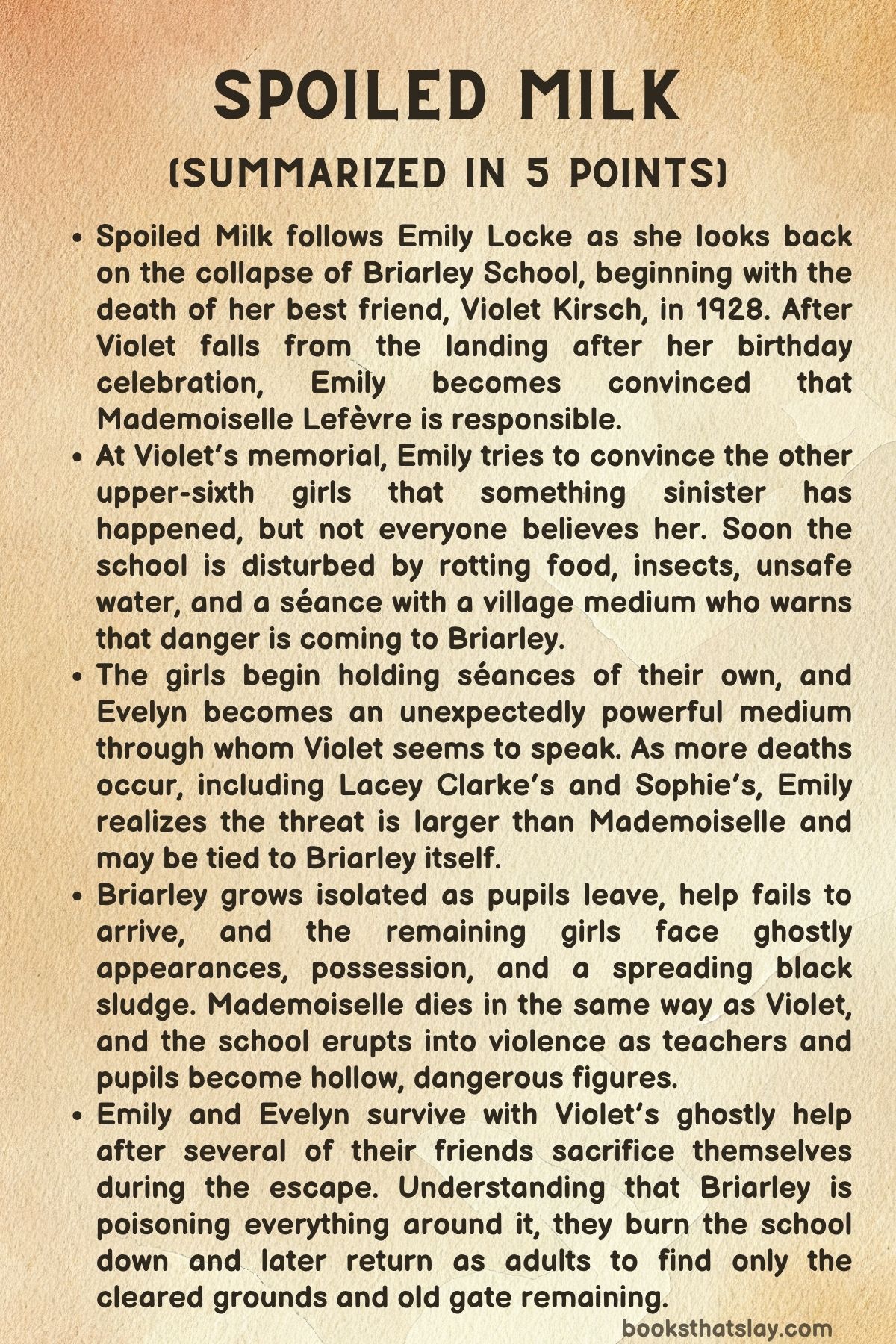
Spoiled Milk begins with Emily Locke looking back on the events that led to the collapse of Briarley School in 1928. For Emily, everything starts with Violet Kirsch, her closest friend.
Violet has just celebrated her eighteenth birthday, surrounded by the other upper-sixth girls. She receives several gifts, including gloves, sweets, perfume, and a book about spiritualism.
The celebration seems ordinary enough, but the evening ends in horror. After the party, Violet goes to say goodnight to Mademoiselle Lefèvre.
Soon after, she falls over the landing balustrade and dies from the drop.
Emily is the first to see Violet’s body. Shock and grief quickly turn into suspicion.
She becomes convinced that Mademoiselle is responsible for Violet’s death. To Emily, the timing is too strange, and Mademoiselle’s presence near Violet just before the fall feels impossible to ignore.
The adults do not treat the death as murder, but Emily refuses to accept that Violet simply fell by accident.
At Violet’s memorial, Emily tries to share her fears with the other girls in their group: Evelyn, Marion, Alice, Dorothy, and Sophie. Evelyn is the most open to believing her, while Alice and Marion are more doubtful.
The girls are shaken, but not all of them are ready to accuse a teacher without proof. Emily feels alone in her certainty, yet the school soon begins to change in ways no one can explain.
The first signs are small but disturbing. Apples that look fresh on the outside are rotten inside and crawling with maggots.
A beetle appears in a girl’s porridge. The food and water at Briarley begin to seem unsafe, as though decay is working its way into the school from within.
These events make the girls more frightened and more willing to believe that Violet’s death may be part of something larger.
Sophie’s book on spiritualism becomes important as the girls search for answers. They visit Mrs. Northcote, a medium in the village, hoping she can help them contact Violet.
During the séance, a spirit named Penelope appears to warn them that something is coming to Briarley. The warning is vague but alarming.
Instead of comfort, the séance gives the girls a deeper sense that the school is in danger.
After this, the girls begin holding séances on their own. Evelyn unexpectedly becomes the medium among them.
Through her, strange things happen. There are knocks, movements, and messages from unseen presences.
Eventually, Violet speaks through Evelyn. Emily desperately wants Violet to confirm that Mademoiselle killed her, but the answers she receives are not simple.
Violet’s presence seems real, yet it does not bring the clear explanation Emily wants.
Meanwhile, Mademoiselle falls ill and is taken to the infirmary. While there, she seems to speak with another presence and warns that Violet was only the beginning.
This warning soon proves true. A younger girl named Lacey Clarke dies during dinner, apparently poisoned or choked by the food.
Emily goes to San and finds Mademoiselle still bedridden. This means Mademoiselle could not have caused Lacey’s death.
Emily’s belief that one guilty person is behind everything begins to weaken. Something else is happening at Briarley, and it is not limited to Violet’s fall.
Fear spreads through the school. Many pupils are taken home by their families, but Emily and the other girls remain.
The building feels more dangerous each day. Evelyn’s mediumship also becomes stronger, but the power moving through her seems to harm her as much as it helps.
On Evelyn’s birthday, she levitates, and Violet speaks through her again. Violet warns them about the staircase and asks Emily for a kiss before leaving.
The moment is both frightening and painful for Emily, who still longs for her lost friend but cannot understand what Violet has become.
Sophie grows increasingly terrified. She decides to leave Briarley, hoping to escape whatever has taken hold of the school.
Yet the next morning, she is found dead in the fountain. It appears that she tried to leave but somehow returned, or was brought back.
Her death makes escape feel less possible. Later, something shaped like Sophie appears outside the school, suggesting that death at Briarley does not bring peace.
The remaining girls continue trying to reach Violet, but the adults begin to interfere. Miss Lewis catches them during a séance and starts imposing stricter control.
Instead of making the school safer, this only makes Briarley feel more like a prison. The school becomes increasingly cut off from the outside world.
Attempts to send for help fail. People who go beyond the gates do not return.
A postman stands frozen outside, visible but unreachable, as though the boundary of the school has become unnatural.
During another séance, Evelyn’s body is pushed beyond ordinary limits. Ectoplasm pours from her mouth as the girls try to bring Violet into fuller form.
The attempt shows how powerful the forces around them have become. Soon after, Mademoiselle dies in the same place and in the same manner as Violet, falling from the landing.
She is found clutching the handkerchief she once tried to give Emily. Her death confirms that she was never the simple villain Emily imagined.
She too was caught in the same pattern of violence.
On the final morning, Briarley breaks down completely. The gramophone begins playing “Rule, Britannia!” by itself, and a black, foul sludge pours from it.
The teachers and remaining pupils become violent, emptied-out figures. They no longer seem fully human.
The girls are forced to fight their way through the school as the corruption spreads.
Alice sacrifices herself to trap some of the attackers in the Long Gallery, giving the others a chance to continue. Violet then returns in a fuller ghostly form, bright and strange, and helps guide the survivors.
Dot dies after falling from the same landing where Violet and Mademoiselle died, making the staircase a repeated site of loss. Marion later stays behind to hold off the pursuing figures so Emily and Evelyn can keep going.
Each death reduces the group until only Emily and Evelyn remain.
Emily and Evelyn come to understand that the black substance is not confined to Briarley. It is spreading from the school and poisoning everything around it.
If they simply run, the evil may continue outward. They decide that the school must be destroyed.
Injured and exhausted, they gather kerosene and move through the sludge-filled building. They set Briarley alight, choosing fire as the only way to stop what has taken root there.
The manor burns with the dead and possessed still inside. Emily and Evelyn escape through the gates together, alive but permanently changed by what they have survived.
Their escape does not undo the deaths of Violet, Sophie, Alice, Dot, Marion, Mademoiselle, or the others, but it ends Briarley’s power.
Years later, Emily and Evelyn return as adults to the place where Briarley once stood. The school is gone.
Only grass, weeds, and the old gate remain. The return shows that the horror has ended physically, but memory remains.
For Emily, Briarley is not only a ruined school but the place where grief, fear, friendship, and survival became tied together forever.
Characters
Emily Locke
Emily Locke is the central character through whom the emotional collapse of Briarley School is most clearly understood. In Spoiled Milk, she begins as a grieving friend who cannot accept Violet Kirsch’s death as a simple accident.
Her grief quickly becomes suspicion, and that suspicion gives her a purpose when the school around her begins to turn strange and dangerous. Emily’s loyalty to Violet is one of her strongest qualities, but it also makes her vulnerable to obsession.
She wants Violet’s spirit to confirm what she already believes about Mademoiselle Lefèvre, and this shows that Emily is not only searching for truth but also trying to make sense of trauma in a way that gives her someone to blame.
Emily is brave, but her courage is complicated by fear, guilt, and emotional dependence on Violet. She repeatedly moves toward danger because she cannot bear uncertainty.
As the supernatural events grow worse, Emily becomes less focused on proving one person guilty and more aware that Briarley itself has become infected by something much larger and more terrible. This shift is important because it shows her growth from a frightened, grieving schoolgirl into someone capable of making a devastating moral decision.
By helping Evelyn burn the school, Emily accepts that survival sometimes requires destroying the place that shaped her. Her final return as an adult gives her character a sense of haunted endurance, showing that she survives the events physically but remains emotionally tied to the ruins of her past.
Violet Kirsch
Violet Kirsch is the character whose death begins the destruction of Briarley School, but her importance does not end with her fall from the landing. She remains emotionally present throughout the book as Emily’s lost friend, a possible victim, and later a ghostly guide.
Violet’s eighteenth birthday should represent maturity and celebration, yet it becomes the moment that leads directly into horror. The gifts she receives, especially the book on spiritualism, connect her to the supernatural world before her death, making her feel like both a girl caught in danger and a doorway through which darker forces enter the school.
Violet’s role is tragic because she is remembered more through absence than ordinary action. The other girls respond to her death in different ways, but Emily’s response is the most intense.
Violet becomes the center of Emily’s grief, suspicion, and longing. When Violet begins speaking through Evelyn, she is not simply a ghost giving answers.
She is mysterious, emotional, and sometimes unsettling. Her request for a kiss from Emily suggests intimacy, longing, and unfinished feeling, while her warnings suggest that she understands more about Briarley’s danger than the living characters do.
By the end, Violet’s return as a shining ghost makes her less a symbol of fear and more a figure of protection. She cannot undo what happened to her, but she helps guide the survivors through the horror her death first revealed.
Evelyn
Evelyn is one of the most important characters because she becomes the living bridge between the girls and the dead. At first, she is more willing than some of the others to believe Emily’s suspicion about Violet’s death.
This openness makes her emotionally receptive, but it also makes her vulnerable. When the girls begin holding séances, Evelyn unexpectedly becomes the medium, and her body becomes the place where the supernatural forces of the story reveal themselves.
Her mediumship gives the girls access to Violet, but it also places Evelyn in increasing physical and spiritual danger.
Evelyn’s character is defined by sensitivity, fear, and resilience. She is not simply a passive vessel for spirits; she suffers through what happens to her and continues forward despite the cost.
Her levitation, the voices speaking through her, and the ectoplasm pouring from her mouth show how deeply the haunting invades her body. Yet Evelyn also survives when many others do not.
Her connection with Emily becomes one of the emotional anchors of the book, especially as the school falls apart and the two girls are forced to rely on each other. By escaping with Emily and later returning to the site as an adult, Evelyn becomes a symbol of survival after violation.
She has been used by the supernatural, but she is not destroyed by it.
Mademoiselle Lefèvre
Mademoiselle Lefèvre is one of the most suspicious and tragic adult figures in the book. At first, Emily believes she killed Violet, largely because Violet dies immediately after going to say goodnight to her.
This makes Mademoiselle appear threatening, secretive, and possibly guilty. Her foreignness, emotional distance, and mysterious behavior make her easy for Emily to suspect, especially in a school environment where fear spreads quickly and authority figures are not fully trusted.
However, as the events continue, the idea that Mademoiselle is the single cause of the horror becomes less convincing.
Her illness in the infirmary changes the reader’s understanding of her. When Lacey Clarke dies while Mademoiselle is bedridden, it becomes clear that the danger at Briarley is larger than one person.
Mademoiselle’s strange warning that Violet was only the beginning suggests that she may know or sense more than she can explain. Her death, which mirrors Violet’s fall, makes her less like a villain and more like another victim of the same force.
The handkerchief she clutches connects her to earlier moments of emotional tension and regret. Mademoiselle’s character therefore works as a false suspect, but also as a reminder of how grief and fear can make people accuse the wrong person before they understand the true nature of evil.
Marion
Marion is one of the more resistant and practical girls in the group. When Emily first tries to convince the others that Mademoiselle killed Violet, Marion does not easily accept the accusation.
This makes her an important contrast to Emily and Evelyn, who are more emotionally open to suspicion and supernatural possibility. Marion’s skepticism does not make her uncaring; instead, it shows that she wants proof before surrendering to panic.
In a school increasingly ruled by fear, Marion represents a more grounded kind of intelligence.
As the horror grows undeniable, Marion’s strength becomes more active. She is not defined by dramatic mediumship or ghostly connection, but by courage under pressure.
Her final decision to hold off the pursuing figures so Emily and Evelyn can escape gives her character a powerful ending. Marion’s sacrifice is not impulsive or theatrical; it feels like the action of someone who has accepted the reality of danger and chooses to protect others.
Her character shows that bravery in the story does not always come from belief in spirits or emotional intensity. Sometimes it comes from discipline, loyalty, and the willingness to act when escape is no longer possible for everyone.
Alice
Alice is another character who initially resists Emily’s suspicions, and this makes her part of the rational opposition within the upper-sixth group. She does not immediately let grief become accusation, which gives her a measured and cautious presence.
Alice’s resistance helps show that the girls are not all simply swept along by Emily’s certainty. There is disagreement among them, and this disagreement makes the group feel more realistic.
Alice’s skepticism also increases the tension because the reader can see how difficult it is to decide what is true when ordinary explanations and supernatural signs are both present.
Alice’s most defining moment comes near the end, when she sacrifices herself to trap some of the attackers in the Long Gallery. This act transforms her from a cautious observer into one of the most heroic figures in the story.
Her sacrifice is especially meaningful because she is not the character most closely associated with the supernatural mystery. She is not the medium, the dead girl, or the main grieving friend.
Instead, she is someone who chooses courage when the situation becomes desperate. Alice’s death shows the human cost of Briarley’s collapse and proves that even characters who doubt or resist early explanations can still become deeply loyal and brave.
Dorothy
Dorothy, often called Dot, is part of the group of upper-sixth girls who remain inside Briarley as the school becomes increasingly dangerous. Her presence helps build the sense of a close but fragile community among the girls.
She is not as dominant as Emily, Evelyn, or Violet, but she belongs to the emotional circle that gives the story its force. Dot’s role is important because the horror does not affect only the most central characters.
It spreads through the group, making every girl vulnerable.
Dot’s death is especially painful because she falls from the same landing where Violet and Mademoiselle died. This repetition turns the staircase into one of the most cursed spaces in the book.
Dot’s fall suggests that Briarley’s violence is cyclical, as though the school keeps repeating the same pattern of death. Her ending also deepens the feeling that the characters are trapped inside a place where past deaths are not finished events but active forces.
Dot may not receive the same level of attention as Emily or Evelyn, but her death strengthens the story’s pattern of haunting and loss.
Sophie
Sophie is closely connected to the spiritualist elements of the story because her book on spiritualism leads the girls toward Mrs. Northcote and the séance. In this way, Sophie becomes one of the characters who helps open the door to the supernatural, even if she does not fully understand what she is helping to invite.
Her curiosity contributes to the girls’ search for answers, but as the haunting grows stronger, that curiosity turns into fear. Sophie’s character shows the danger of treating the spirit world as something that can be approached safely or experimentally.
Sophie’s decision to leave Briarley is a deeply human response to terror. Unlike some of the others, she reaches a point where she wants to escape rather than keep investigating.
This does not make her weak; it makes her realistic. Her death in the fountain after apparently trying to depart suggests that Briarley will not easily release those caught within it.
The later appearance of something shaped like Sophie outside the school makes her fate even more disturbing because it raises questions about what remains of a person after death in this corrupted place. Sophie’s character represents curiosity punished by forces beyond her control, and her death marks a turning point where escape begins to seem impossible.
Lacey Clarke
Lacey Clarke is a younger girl whose death proves that the horror at Briarley is not limited to Violet or the upper-sixth circle. Her death during dinner, apparently through poisoned or corrupted food, expands the threat from a personal mystery into a school-wide catastrophe.
Before Lacey dies, the food and water have already become suspicious through rotten apples, maggots, and insects. Her death confirms that the corruption is no longer symbolic or unsettling; it is lethal.
Lacey’s role is brief but important. Because she is younger, her death adds innocence to the tragedy.
She is not involved in the séances or the accusations against Mademoiselle, which makes her death feel especially unjust. Emily’s discovery that Mademoiselle was still bedridden when Lacey died also changes the direction of the mystery.
Lacey therefore becomes the character whose death disproves Emily’s original theory and forces a broader understanding of the evil at work. Her presence in the story shows that Briarley’s collapse consumes the innocent as well as the curious, the guilty, and the brave.
Mrs. Northcote
Mrs. Northcote is the village medium who introduces the girls to a more formal spiritualist experience. Her séance gives shape to the supernatural anxieties that are already gathering around Briarley.
Through her, the girls encounter Penelope, the spirit who warns them that something is coming. Mrs. Northcote’s role is important because she gives the girls a first glimpse of forces beyond their school, but she also cannot protect them from what follows.
Mrs. Northcote represents the dangerous appeal of hidden knowledge. She seems to offer access to answers, yet the answers she provides are incomplete and frightening.
Her presence suggests that the supernatural world is real, but not necessarily safe, clear, or obedient. The girls leave her séance with more fear than certainty.
As a character, she helps move the story from grief and suspicion into open haunting. She is not the source of the evil, but she helps confirm that the girls are dealing with something beyond ordinary explanation.
Penelope
Penelope is the spirit who speaks during the séance with Mrs. Northcote and warns that something is coming to Briarley. Though she is not a living character, her warning has great importance.
She functions as an early messenger of disaster, suggesting that the events at the school are part of a larger supernatural disturbance rather than only the result of Violet’s death. Penelope’s presence widens the spiritual world of the story and shows that Violet is not the only dead voice capable of reaching the living.
Penelope is mysterious because she gives warning without full explanation. This makes her both helpful and unsettling.
She does not solve the mystery for the girls; instead, she increases their dread. Her role reflects one of the book’s central ideas: communication with the dead may reveal truth, but it rarely reveals enough truth to make the living safe.
Penelope’s warning prepares the reader for the scale of Briarley’s collapse while preserving the uncertainty that makes the haunting so powerful.
Miss Lewis
Miss Lewis represents adult authority at Briarley, especially once she catches the girls attempting to contact Violet. Her response is to tighten control, which shows the failure of the school’s official order.
Rather than understanding the girls’ fear or recognizing the scale of the danger, she responds through discipline and restriction. This makes her part of the institution’s blindness.
She tries to restore normal rules in a situation where normal rules no longer have power.
Miss Lewis is important because she shows how authority can become useless, or even harmful, during a crisis it refuses to understand. Her control does not protect the girls; it helps deepen the feeling of imprisonment.
As Briarley becomes isolated and unreachable, adult supervision no longer feels comforting. It becomes another part of the trap.
Miss Lewis’s character therefore strengthens the criticism of the school as an institution that values obedience and appearances even while everything inside it is rotting.
Themes
Grief and the Need for Certainty
Emily’s response to Violet’s death shows how grief can turn into a need for a clear enemy. She cannot accept the death as a random fall or as something beyond ordinary explanation, so she fixes her suspicion on Mademoiselle.
This gives her pain a target and makes the chaos feel more manageable. Her search for proof is not only about justice; it is also about holding on to Violet.
Every séance becomes a way for Emily to ask the dead for answers, but the answers refuse to stay simple. As more deaths happen and Mademoiselle herself becomes a victim, Emily is forced to face the limits of her certainty.
The horror grows from this emotional confusion: love, guilt, suspicion, and fear all mix together until Emily can no longer separate truth from need. Spoiled Milk presents grief as something that does not remain private.
It spreads into friendships, decisions, and the whole atmosphere of the school.
Corruption Hidden Beneath Order
Briarley School appears to be a place of discipline, manners, education, and social training, but its polished surface quickly begins to rot. The perfect apples filled with maggots, the unsafe food, the poisoned water, and the black sludge all turn the school’s hidden decay into physical signs.
This corruption is not only supernatural; it also reflects the failure of the institution itself. Teachers try to control the girls, silence them, and preserve order, but they cannot protect anyone.
The school’s rules become useless once the danger begins growing from within. The setting suggests that respectable institutions can hide sickness behind ritual and routine.
Meals, lessons, birthdays, memorials, and punishments continue for a while, but each ordinary structure becomes contaminated. The horror works because the girls are trapped inside a place that was supposed to shape and shelter them.
As Briarley collapses, its appearance of authority is exposed as fragile and false.
Female Friendship as Survival
The girls’ relationships are tense, imperfect, and sometimes divided, yet their bonds become the only real source of protection. Emily’s suspicion is not accepted by everyone at first, and the group often struggles with fear, denial, and disagreement.
Still, the girls keep returning to one another when the adults fail them. Their séances begin as a search for Violet, but they also create a private space where the girls can speak, test danger, and share knowledge outside school authority.
As the threat becomes physical, friendship changes from emotional loyalty into active sacrifice. Alice, Dot, Marion, Evelyn, and Emily each face danger in ways that show how survival depends on trust rather than obedience.
The final escape is not the victory of one heroic figure but the result of several girls protecting one another, sometimes at the cost of their lives. The story treats friendship as both fragile and powerful, shaped by fear but strengthened by devotion.
Coming of Age Through Horror
The girls are at an age between childhood and adulthood, and the crisis at Briarley forces them to grow up through terror rather than guidance. Birthdays, school rituals, and upper-sixth status suggest that they are approaching adult life, but the world around them gives them no safe path into it.
Instead, they must learn that adults can be wrong, powerless, secretive, or dangerous. Emily and Evelyn’s final decision to burn the school marks a brutal form of maturity: they understand that escape alone is not enough if the corruption can spread beyond the gates.
This choice shows moral growth because they accept responsibility for ending what the adults could not face. The later return to the empty site adds a quieter layer to this theme.
Survival does not erase what happened, but it allows them to look back from adulthood and recognize both the horror they endured and the strength they gained from enduring it.