Souls in Ruin Summary, Characters and Themes
Souls in Ruin by Jacqueline White, the first book of the Soulbound series, is a dark fantasy romance about a rejected princess forced into a marriage that becomes far more dangerous than a political bargain. Mireille, the illegitimate daughter of King Aeldrin of Vareth, has spent her life unwanted, feared, and used by the royal court.
When she is offered to Valen, the feared Blood King of Nocthar, she enters a world of violence, ancient gods, blood magic, and betrayal. The story follows her fall from captive bride to something far greater, as she discovers that her suffering is tied to divine power, hidden truths, and a destiny no mortal kingdom can contain.
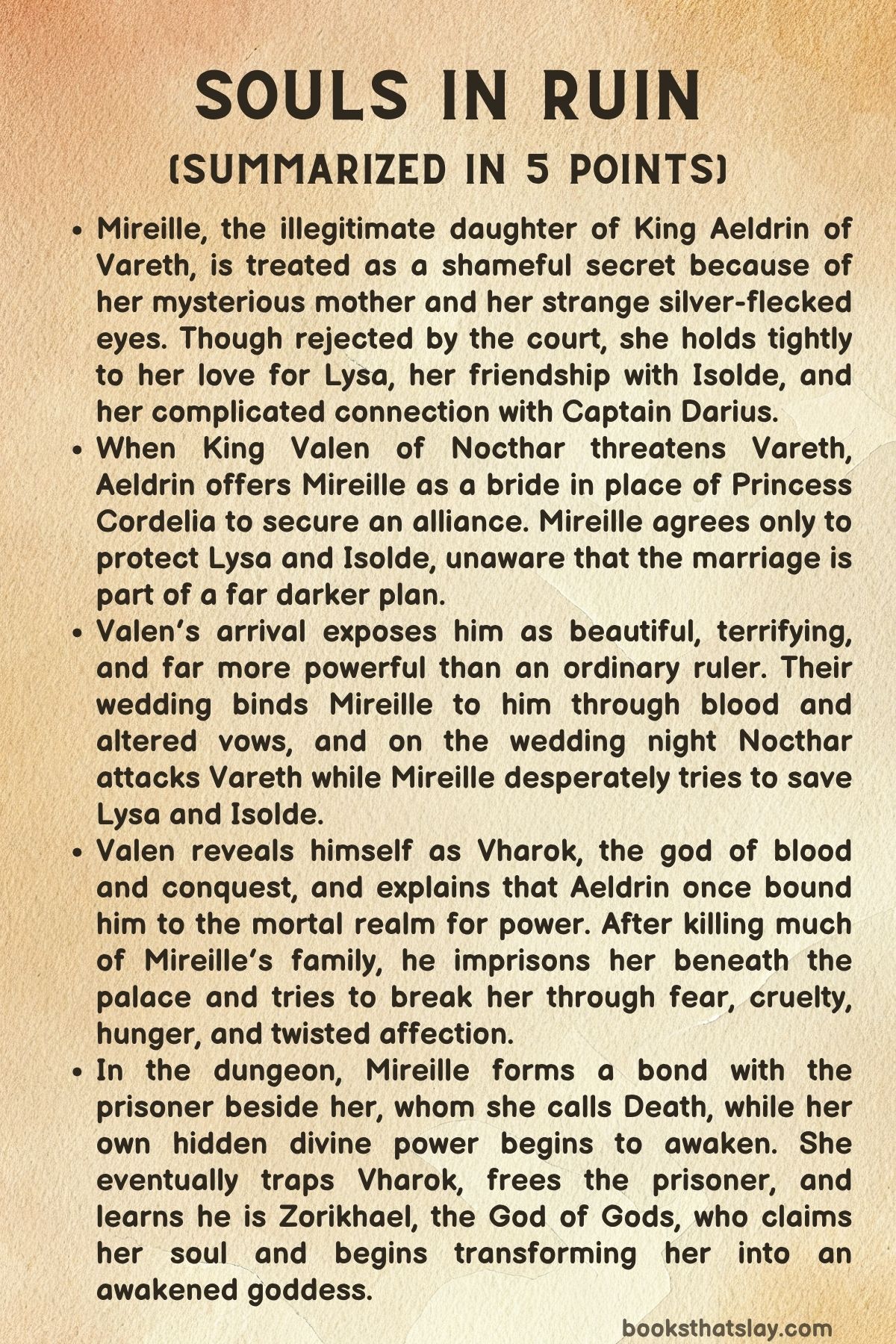
Summary
Mireille has never truly belonged in the court of Vareth. Though she is the daughter of King Aeldrin, her birth has always been treated as a shameful secret made visible.
She is illegitimate, born from the king’s affair with a mysterious woman who disappeared after giving birth to her. Her strange silver-flecked eyes mark her as different, and that difference makes the court wary of her.
She is tolerated rather than loved, kept alive by the king but never fully accepted as his child.
Queen Ira hates Mireille because she is proof of Aeldrin’s betrayal. Princess Cordelia mocks her and sees her as beneath the true royal children.
Aeldrin himself remains distant, offering protection without affection. Mireille grows up in a palace where nearly everyone sees her as a mistake, an inconvenience, or a threat.
Her few sources of comfort are her young half-sister Lysa, her loyal friend Isolde, and Captain Darius, a man with whom she shares a complicated past marked by physical closeness but not true security.
The fragile structure of Mireille’s life begins to collapse when King Valen of Nocthar turns his attention toward Vareth. Valen, known as the Blood King, has been conquering nearby lands with terrifying force.
To protect his kingdom from destruction, Aeldrin agrees to a marriage alliance. Valen originally asks for Cordelia, the legitimate princess, but Aeldrin offers Mireille in her place.
The choice makes it clear that Mireille is disposable to the court, a daughter useful only when she can be sacrificed.
Mireille accepts the arrangement not because she wants power or marriage, but because refusal could place Lysa and Isolde in danger. She understands that the people she loves may suffer if she resists.
Before the wedding, Aeldrin gives her a silver crown that belonged to her mother. He also reveals that he once loved her mother and had wanted to make her queen, but she vanished after Mireille’s birth.
This confession gives Mireille a painful glimpse of a past she never knew and a mother whose absence has shaped her entire life.
Valen’s arrival in Vareth changes the atmosphere of the court at once. He is beautiful, powerful, and threatening, with a presence that makes everyone uneasy.
In private, he warns Mireille that marriage to him will require her to cut herself off from her old life. He senses her past with Darius and threatens him, making it clear that he sees people not only as enemies or allies, but as possessions and obstacles.
Mireille fears him, but she is also drawn to the danger and power he carries.
The wedding is unlike any ordinary royal ceremony. Mireille wears her mother’s crown and a blood-red Nocthari gown.
The vows are altered, and the ceremony includes a blood exchange that feels less like tradition and more like a binding spell. Mireille senses that something deeper than politics is taking place, though she does not yet understand the full meaning of it.
By the time the ceremony ends, she is not simply Valen’s wife. She is bound to him in a way that touches blood, soul, and power.
On their wedding night, Valen confuses Mireille further. He is dangerous and controlling, yet at moments he is also attentive.
Mireille struggles with the attraction she feels toward him because it exists beside fear, anger, and hatred. But any illusion of intimacy is destroyed when screams erupt through the palace.
Nocthar’s forces attack Vareth during the night, proving that the marriage was never meant to save her kingdom.
Mireille escapes the bridal chamber and searches desperately for Lysa. She finds blood in the nursery but no body, which leaves her terrified and uncertain whether her sister is dead or alive.
Refusing to give up, she finds a way to help Lysa and Isolde escape through hidden passages beneath the palace. Even as Vareth falls, Mireille’s first instinct is not to save herself but to protect the two people who gave her love in a life otherwise filled with rejection.
Valen captures Mireille and takes her to the throne room. There, Aeldrin, Ira, Cordelia, and Mireille’s half-brothers are bound before him.
The truth he reveals shatters what remains of Mireille’s understanding of her family and her world. Aeldrin once sought Valen out and bound him to the mortal realm in pursuit of power.
Valen is not only a king. He is Vharok, the god of blood and conquest.
His marriage to Mireille is part of a revenge planned against Aeldrin and Vareth.
Valen kills much of Mireille’s family before her and leaves her powerless to stop him. The people who tormented her are still her blood, and their deaths become part of the horror surrounding her.
Aeldrin’s choices, Valen’s vengeance, and the secrets of the past collide in a single night of destruction. Vareth, the kingdom that never accepted Mireille, becomes a place of ruin, blood, and divine punishment.
After the massacre, Mireille is imprisoned beneath the palace. In the dungeon, she is subjected to isolation, hunger, fever, humiliation, and Valen’s continued attempts to break her will.
He wants to claim her fully, not only as a wife but as something bound to him in body, blood, and spirit. His treatment of her shifts between cruelty and disturbing tenderness, making his presence even harder for her to endure.
He is not a simple monster. He is a god with old wounds, terrible power, and a desire to possess what he believes is his.
Mireille clings to memories of Lysa, Isolde, and the life she has lost. These memories become her defense against madness.
In the darkness of the dungeon, she hears the voice of another prisoner in a neighboring cell. She calls him Death.
At first, he is only a voice in the dark, but his presence slowly becomes a source of steadiness. He comforts her, warns her, and helps her hold on to herself when Valen tries to strip away her strength.
As Mireille suffers, something inside her begins to change. During one encounter, she bites Valen and drinks his divine blood.
The act awakens a fierce, consuming madness in her. It also opens a door to powers she does not understand.
Later, Death gives her his own blood, creating a second connection that complicates the forces already moving through her. Mireille becomes tied to two ancient beings, both far beyond mortal understanding.
Her new awareness grows. She begins to see silver threads and hidden structures beneath the world around her.
The dungeon is no longer just stone, iron, and darkness. She sees runes, bindings, and threads of power that can be touched, understood, and changed.
She learns that divine beings shaped the world, that Valen is one of them, and that the prisoner beside her is far more powerful than he first seemed.
Mireille realizes that the chains around her are not absolute. They are made from systems of power, and systems can be altered.
Her fear turns into strategy. Instead of waiting to be rescued, she uses what she has learned to trick Valen.
She cuffs him in her place, reversing the prison he used to control her. For the first time, she turns his own methods against him.
With Valen trapped, Mireille frees the god imprisoned beside her. Death reveals his true name: Zorikhael, the First, the God of Gods and Keeper of Souls.
He is not merely another captive. He is an ancient power who has waited in darkness, and Mireille’s awakening is tied to his release.
Yet his rescue does not return her to ordinary life. Instead, it carries her further away from everything mortal.
Zorikhael claims Mireille’s soul and begins transforming her from dormant divinity into an awakened goddess. Her suffering, her strange eyes, her mother’s mystery, Valen’s obsession, and the blood bonds all point to the truth that Mireille was never merely an unwanted royal bastard.
She was something hidden, unfinished, and powerful. Her life in Vareth was only the beginning of a larger divine conflict.
Zorikhael carries Mireille into his realm while Valen screams in fury behind them. Vareth collapses into ruin, destroyed by the consequences of old bargains, royal betrayal, and divine revenge.
Mireille leaves behind the palace that rejected her, the family that used her, and the mortal identity that confined her. What remains is a woman broken by cruelty but not defeated, stepping into godhood with her soul claimed, her power awakened, and her old world burning behind her.
Characters
Mireille
Mireille is the central figure of Souls in Ruin, and her character is built around rejection, survival, awakening, and transformation. As the illegitimate daughter of King Aeldrin, she grows up inside the royal court but never truly belongs to it.
Her birth marks her as a living reminder of the king’s affair, and her silver-flecked eyes make her seem strange and unsettling to those around her. Because of this, Mireille learns early that blood relation does not guarantee love, safety, or acceptance.
She is treated as an embarrassment by the queen, mocked by Cordelia, emotionally neglected by her father, and viewed with suspicion by the court. This creates a deep emotional loneliness in her, but it also sharpens her instincts and teaches her to endure cruelty without fully surrendering to it.
What makes Mireille powerful as a character is that she is not fearless in a simple sense. She is often afraid, humiliated, wounded, and overwhelmed, yet she continues to make choices that protect the people she loves.
Her decision to marry Valen is not driven by ambition or romance, but by sacrifice. She accepts the marriage because Lysa and Isolde would suffer if she refused, showing that her love is active and costly.
Even after being trapped in a horrifying political and divine scheme, she does not become passive. She searches for Lysa, helps Lysa and Isolde escape, resists Valen’s attempts to possess her, and clings to memory as a way of preserving her identity.
Mireille’s journey also becomes a movement from unwanted princess to awakened goddess. At first, she believes her difference is a curse that isolates her from others, but over time, the signs around her begin to suggest that her strangeness has a deeper meaning.
Her ability to see silver threads, manipulate runes, and survive divine blood reveals that she is not merely a discarded royal child. She is a being whose true nature has been hidden or dormant.
Her transformation is painful because it comes through betrayal, imprisonment, hunger, violence, and psychological torment, but it also allows her to claim a power that no one in Vareth ever recognized. By the end of the story, Mireille is no longer only a victim of royal shame or divine revenge.
She becomes someone capable of outwitting a god, freeing another, and stepping into an identity far greater than the world allowed her to imagine.
King Valen / Vharok
King Valen, later revealed as Vharok, is one of the most dangerous and commanding figures in the book. At first, he appears to be the feared Blood King of Nocthar, a conqueror whose beauty, menace, and power unsettle everyone around him.
His presence immediately changes the atmosphere of Vareth because he represents a threat that is both political and personal. He is not simply a foreign ruler seeking alliance; he is a predator entering enemy territory with hidden intentions.
His interest in Mireille is deeply unsettling because it combines desire, strategy, revenge, and possession.
The revelation that Valen is actually Vharok, the god of blood and conquest, expands his character beyond that of a brutal king. His cruelty is not random.
It is tied to an old betrayal involving Aeldrin, who once bound him to the mortal realm for power. This history gives Vharok’s actions a motive, but it does not make them morally acceptable.
His marriage to Mireille is part of a calculated revenge, and his destruction of her family is meant to punish Aeldrin while also asserting his divine dominance. He uses ceremony, blood, intimacy, and violence as tools of control, turning the wedding into both a bond and a trap.
Vharok’s complexity comes from the contrast between his brutality and his disturbing tenderness. He is capable of violence, murder, imprisonment, and psychological torture, yet he also shows moments of attention and fascination toward Mireille.
This does not soften him; instead, it makes him more frightening because his tenderness is tied to ownership rather than care. He wants to break Mireille, claim her, and bind her to himself, but he also underestimates the strength growing inside her.
His downfall begins because he sees her as something to possess rather than someone capable of resistance. By the time Mireille tricks him and leaves him chained in her place, Vharok’s rage reveals the weakness beneath his dominance: he cannot tolerate losing control.
Zorikhael / Death
Zorikhael first appears as the mysterious prisoner in the neighboring cell, known to Mireille simply as Death. His introduction is quiet compared to Valen’s violent grandeur, but his presence becomes one of the most important emotional and mythological forces in the story.
In the darkness of the dungeon, he becomes a voice of comfort, warning, and steadiness. For Mireille, who is isolated, starved, feverish, and psychologically tormented, his presence helps her hold onto sanity.
He does not immediately rescue her, which makes his role more complicated. Instead, he guides her, observes her, strengthens her, and slowly forms a bond with her.
His true identity as Zorikhael, the First, the God of Gods and Keeper of Souls, changes the meaning of every interaction he has with Mireille. He is not merely another captive or a symbolic figure of death.
He is an ancient divine power whose imprisonment suggests a conflict much larger than Vareth, Nocthar, or royal politics. His title connects him to souls, fate, and divine order, which makes his relationship with Mireille feel both intimate and cosmic.
When he gives Mireille his blood, he creates a connection that is different from Vharok’s blood bond. Where Vharok’s connection is possessive and violent, Zorikhael’s is more transformative, though still dangerous in its own way.
Zorikhael is not a simple savior. His decision to claim Mireille’s soul and awaken her dormant divinity shows that he has his own power, authority, and agenda.
He helps her escape, but he also changes the course of her existence. This makes him a morally layered figure rather than a purely comforting one.
He represents refuge, death, knowledge, and rebirth all at once. His bond with Mireille is built in suffering, but it leads her toward a new identity.
By carrying her into his realm, he removes her from the ruins of her old life and begins the next stage of her transformation.
King Aeldrin
King Aeldrin is a deeply flawed father and ruler whose past choices shape the tragedy of the story. As Mireille’s father, he keeps her alive but fails to truly protect or love her in an open, consistent way.
His emotional distance leaves Mireille exposed to contempt from the queen, mockery from Cordelia, and suspicion from the court. He represents a form of weakness that hides behind royal authority.
Although he has power over Vareth, he does not use that power to give Mireille dignity or safety. His neglect becomes one of the emotional wounds that defines her early life.
Aeldrin’s character becomes more complicated when he reveals that he once loved Mireille’s mother and wanted to make her queen. This confession suggests that his relationship with Mireille is shaped not only by shame but also by grief, regret, and unresolved love.
The silver crown he gives Mireille is important because it is one of the few gestures that connects her to her mother and to a possible legacy beyond rejection. Yet even this late tenderness cannot erase years of emotional abandonment.
Aeldrin’s love, if it exists, is too hidden and too weak to protect Mireille from the consequences of his actions.
His greatest failure is tied to Vharok. The revelation that Aeldrin once sought out the god of blood and conquest and bound him to the mortal realm exposes him as more than a distant father.
He is a man who pursued power and created consequences that others would suffer for. His attempt to save Vareth through a marriage alliance is therefore deeply ironic, because the danger threatening his kingdom is connected to his own past bargain.
Aeldrin’s tragedy is that his secrets return with devastating force, destroying his family, his kingdom, and the daughter he never properly cherished.
Queen Ira
Queen Ira is one of the clearest sources of hostility in Mireille’s life at court. Her hatred of Mireille is rooted in humiliation, resentment, and the public reminder of Aeldrin’s betrayal.
Because Mireille is the king’s illegitimate daughter, Ira sees her not as an innocent child but as a symbol of the affair that wounded her pride and position. This makes Ira emotionally cruel, because she directs her anger toward someone who had no control over the circumstances of her birth.
Her treatment of Mireille helps establish Vareth as a place where appearances and legitimacy matter more than compassion.
Ira’s role in the story also shows how power can be used through coldness rather than open violence. As queen, she has status and influence, and her contempt gives the court permission to treat Mireille as lesser.
She does not need to personally destroy Mireille to damage her life; her rejection helps create the hostile environment in which Mireille grows up. Ira represents the cruelty of social judgment, especially toward women and children whose existence threatens royal respectability.
Although Ira is also a victim when Vharok destroys the royal family, her suffering does not erase the harm she caused. She is part of the world that made Mireille vulnerable long before Nocthar arrived.
Her character is important because she shows that cruelty inside a palace can be just as formative as cruelty from an invading enemy. Mireille’s imprisonment under Vharok is horrific, but her emotional imprisonment began much earlier in a court where Ira’s hatred helped make her feel unwanted.
Princess Cordelia
Princess Cordelia is Mireille’s half-sister and one of the people who reinforces Mireille’s outsider status. Unlike Lysa, who represents innocence and love, Cordelia represents privilege, cruelty, and the arrogance of legitimate birth.
She mocks Mireille and treats her as inferior, reflecting the values of the court around her. Cordelia’s behavior suggests that she has absorbed the hierarchy of Vareth completely.
She believes rank, legitimacy, and social approval make her superior.
Cordelia is also important because Valen originally wanted her for the marriage alliance, but Aeldrin offers Mireille instead. This substitution reveals the way the royal family values Mireille less than Cordelia.
Mireille becomes the disposable daughter, the one who can be handed over to a feared conqueror in order to protect the kingdom and preserve the more accepted princess. Cordelia’s position in the family therefore exposes the injustice at the heart of Vareth’s royal household.
She does not need to be the main decision-maker to benefit from Mireille’s sacrifice.
Her character also serves as a contrast to Mireille. Cordelia has legitimacy, status, and protection, while Mireille has resilience, emotional depth, and hidden power.
Cordelia’s cruelty is ordinary compared to Vharok’s divine violence, but it still matters because it shapes Mireille’s sense of self. She is part of the system that teaches Mireille she is unwanted, and that makes Mireille’s later transformation even more powerful.
The sister dismissed by the court becomes the one whose destiny reaches beyond the throne.
Lysa
Lysa is Mireille’s young half-sister and one of the few sources of genuine love in her life. Her importance is emotional rather than political.
In a court full of contempt, suspicion, and cruelty, Lysa gives Mireille a reason to remain tender. Mireille’s attachment to her shows that she has not been hardened completely by rejection.
Even after years of being treated as unwanted, Mireille is still capable of deep affection and selfless protection.
Lysa’s vulnerability drives some of Mireille’s most important choices. Mireille accepts the marriage to Valen largely because refusing would endanger Lysa and Isolde.
Later, when the attack on Vareth begins, Mireille’s first instinct is to search for Lysa rather than save herself. This reveals the strength of Mireille’s love and the way Lysa functions as an anchor to her humanity.
In a story filled with blood bonds, divine power, and conquest, Lysa represents a simpler and purer bond: the love of a sister who must be protected.
Lysa also symbolizes the innocent lives caught inside the ambitions and sins of powerful people. She has no control over Aeldrin’s past, Vharok’s revenge, or the politics of marriage alliances, yet she is placed in danger by all of them.
Mireille’s successful effort to help Lysa escape becomes one of her clearest acts of resistance. Even before she awakens divine power, Mireille proves her strength by protecting someone weaker than herself.
Isolde
Isolde is Mireille’s loyal friend and one of the rare people who treats her with care rather than judgment. In a court where Mireille is defined by scandal and difference, Isolde’s loyalty gives her a sense of belonging.
Isolde matters because she shows that Mireille is not unloved by everyone; there are people who see her as more than an illegitimate daughter or a political inconvenience. Her friendship helps humanize Mireille’s life before the marriage and gives emotional weight to what Mireille loses when Vareth falls.
Isolde’s role is also tied to Mireille’s sense of responsibility. Mireille accepts Valen’s proposal because Isolde, like Lysa, could be harmed if she refuses.
This shows that Isolde is not merely a companion in the background. She is someone Mireille values enough to sacrifice her own future for.
When Mireille helps Isolde escape through the hidden passages, it becomes another sign of Mireille’s courage and loyalty. Even during chaos, she thinks of others before herself.
As a character, Isolde represents friendship as a form of survival. She is part of the emotional world Mireille tries to preserve while everything else collapses.
In the dungeon, Mireille clings to memories of Lysa, Isolde, and her lost life, which shows that Isolde remains important even when physically absent. Her presence in Mireille’s memory helps keep Mireille connected to love, loyalty, and identity during imprisonment.
Captain Darius
Captain Darius is Mireille’s loyal friend and former physical partner, which makes his relationship with her emotionally complicated. He appears to be one of the few people in Vareth who has given Mireille attention and loyalty, but their history also creates tension because it exists in the shadow of power, secrecy, and vulnerability.
Mireille’s connection with Darius suggests that she has searched for intimacy and comfort in a world that rarely offers her either.
Darius is also important because Valen immediately senses the past intimacy between him and Mireille. This makes Darius a target of Valen’s jealousy and possessiveness.
Valen’s threat toward him reveals how quickly Mireille’s old ties become dangerous after the marriage arrangement. Darius therefore represents the life Mireille is being forced to leave behind: imperfect, complicated, but still human.
His existence reminds Valen that Mireille had desires, loyalties, and experiences before him, which Valen cannot tolerate.
Darius’s character also helps reveal Mireille’s emotional complexity. Her past with him is not presented as a perfect romance, but as part of a difficult life shaped by loneliness, need, and attachment.
Through Darius, the story shows that Mireille is not an untouched symbol or passive bride. She is a person with a past, with choices, and with relationships that matter.
This makes Valen’s demand that her old ties be severed feel especially violent because it is not only political control; it is an attempt to erase her personal history.
Themes
Rejection and the Hunger for Belonging
Mireille’s life is shaped by the pain of being unwanted in the place that should have protected her. Her birth marks her as a scandal, and her appearance makes her impossible for the court to ignore or accept.
The contempt she receives from Queen Ira, Cordelia, and the wider palace does not simply isolate her socially; it teaches her to measure her worth through the cruelty of others. Aeldrin’s distance is especially damaging because he keeps her alive without truly claiming her, leaving her trapped between royal blood and emotional exile.
This rejection makes her attachments to Lysa, Isolde, and even Darius deeply important, because they give her rare proof that she can be loved without being used. Her willingness to sacrifice herself for Lysa and Isolde shows how strongly she clings to the few bonds that make her feel human.
In Souls in Ruin, belonging is not shown as comfort alone, but as survival, identity, and the last defense against despair.
Power, Control, and Possession
Power is presented less as authority and more as the ability to define another person’s choices. Mireille is traded into marriage not because she is valued, but because her body and title are useful to men protecting kingdoms and settling old debts.
Aeldrin uses her as a political shield, while Valen uses the marriage as revenge and a means of domination. The wedding vows, blood exchange, threats, imprisonment, and repeated attempts to claim her all show how power becomes intimate and invasive.
Valen does not only want obedience; he wants Mireille’s fear, loyalty, body, and soul to bend toward him. Yet the story complicates control by showing that Mireille’s resistance begins internally before it becomes physical.
Even when imprisoned, starved, humiliated, and manipulated, she protects the parts of herself Valen cannot fully reach. Her eventual ability to read and alter the forces around her turns the structure of captivity against its creator, changing power from something done to her into something she learns to command.
Transformation Through Suffering
Mireille’s transformation is born from pain, but the story does not treat suffering as noble or beautiful. Her imprisonment strips away the identity forced on her by court life: unwanted daughter, political bride, royal embarrassment, powerless prisoner.
In the darkness, she is pushed beyond ordinary endurance, and each trial forces hidden parts of her nature closer to the surface. Hunger, fever, fear, and divine blood do not simply weaken her; they expose the truth that her life has always contained more than human inheritance.
Her bond with the prisoner she calls Death becomes central because he does not comfort her by pretending she is safe. Instead, he helps her endure long enough to understand what she is becoming.
Transformation here is frightening because it costs Mireille her former world, her innocence, and possibly even the limits of her humanity. By the time she escapes, she is not restored to who she was before.
She is remade into someone capable of surviving gods.
Revenge and the Ruin It Creates
Revenge drives the fall of Vareth and reveals how old sins can destroy people who never committed them. Valen’s hatred is rooted in Aeldrin’s past actions, especially the binding that trapped him in the mortal realm.
His violence is not random; it is punishment shaped by memory, humiliation, and divine rage. Yet the destruction he brings does not stay focused on the guilty.
Mireille, Lysa, Isolde, and others are pulled into the cost of a conflict they did not create. This makes revenge appear powerful but morally poisonous, because it turns justice into possession and punishment into spectacle.
Valen’s revenge also fails to give him true control. His cruelty awakens the very force that can oppose him, and his need to break Mireille becomes one reason she discovers her own divinity.
The ruin of the palace reflects the collapse of every false structure built on secrecy, fear, and domination. Revenge consumes its target, but it also weakens the one who depends on it.