Son of Nobody Summary, Characters and Themes
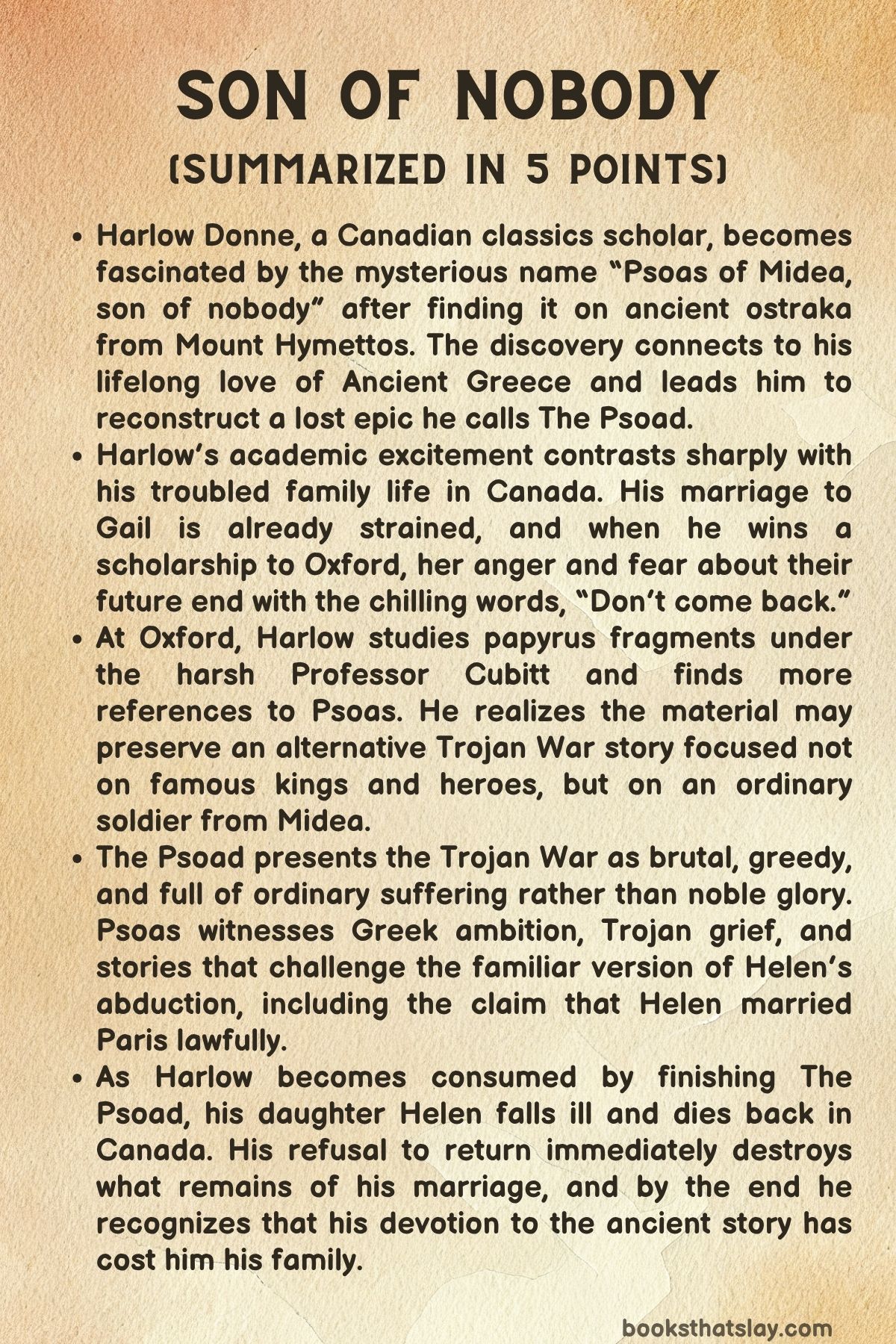
Son of Nobody by Yann Martel is a literary reimagining of the Trojan War through the life of an ordinary soldier rather than the famous kings and heroes of Greek legend. The book is framed through Harlow Donne, a Canadian classics scholar whose academic discovery becomes tied to his own private losses.
As Harlow studies fragments of a forgotten epic about Psoas of Midea, his research begins to mirror his troubled marriage, his failures as a father, and his inability to face grief. The novel questions heroism, memory, history, and the stories people choose to believe.
Summary
Son of Nobody begins with Harlow Donne, a Canadian scholar of classical literature, reflecting on the earliest forms of Greek writing. He explains the boustrophedon style, in which lines of writing move back and forth like an ox turning in a field.
This ancient habit of reading in alternating directions reminds him of his daughter, Helen, who struggled with reading and writing as a child. When her teacher, Mrs. Adamson, treated Helen’s unusual habits as a problem, Harlow defended his daughter by comparing her way of reading to ancient Greek practices.
This memory reveals Harlow as a man who sees the modern world through the lens of antiquity, but it also shows his deep attachment to Helen.
His scholarly life changes when he studies a group of ancient ostraka from Mount Hymettos at the Ashmolean Museum. These fragments contain a strange phrase: “Psoas of Midea, son of nobody.” The name arrests Harlow’s attention.
It seems too unusual to ignore, especially because it connects to a place that already holds great meaning for him. Years earlier, as a young man, Harlow visited the sanctuary on Mount Hymettos and felt an intense connection to the ancient world.
The discovery of Psoas gives him the sense that he has found a lost voice from history.
Harlow decides to tell the story directly to Helen. He explains that what follows is both his account of finding and reconstructing a lost epic and his version of the epic itself.
He calls the work The Psoad, a name that suggests a forgotten companion to the Iliad, but one centered not on kings, princes, and celebrated warriors, but on a common soldier from Midea. Harlow’s voice frames the whole narrative, and his personal life becomes inseparable from the ancient story he is trying to recover.
Before Oxford, Harlow lives in Canada with his wife, Gail, and their young daughter, Helen. His marriage is unhappy and marked by bitterness, arguments, and emotional distance.
Gail often seems practical and exhausted, while Harlow is absorbed in scholarship and ambition. One night, as Helen refuses to go to bed and asks him for a story, Harlow receives an email telling him that he has won a scholarship to Oxford.
He is overjoyed, seeing the opportunity as a major step in his academic life. Gail reacts with concern rather than celebration.
She worries about money, her work, their household, and Helen’s care. Their disagreement exposes the deep strain between them.
After argument and resentment, Gail finally agrees that Harlow should accept the scholarship and leave for England. Yet her support is not warm.
At the airport, her farewell is cold and wounded. She tells him not to come back.
The words hang over Harlow’s journey, though he continues toward Oxford, choosing scholarship over the brokenness waiting at home.
At Oxford, Harlow works under Professor Franklin Cubitt on the Oxyrhynchus Papyri. Cubitt is harsh, dismissive, and difficult to please.
Harlow, however, is thrilled to be near ancient texts and feels that the fragments may hold the kind of discovery he has always dreamed of making. While sorting papyrus fragments, he finds the name Psoas again.
This time, the name appears in connection with Midea and the Greek expedition to Troy. Harlow realizes that he may be looking at traces of a lost Trojan War tradition.
Cubitt dismisses the material as worthless pseudo-Homeric writing, but Harlow cannot let it go. To him, the fragments suggest something remarkable: an alternative account of the Trojan War that does not worship the great names of Greek legend.
Instead, it follows a man of no rank, no grand ancestry, and no heroic reputation. Psoas is called “son of nobody,” and that phrase becomes central to the meaning of the lost poem.
It suggests a story about men erased by history, men whose suffering and intelligence are hidden beneath the glory given to kings.
The reconstructed epic begins with the Greek fleet arriving at Troy. The Greeks expect triumph, wealth, and a swift victory.
They imagine Troy as a prize waiting to be taken. Instead, they face disaster before they even reach the shore.
The Trojans have dismantled their western harbor and filled the water with hidden stakes. Greek ships crash into the trap.
Many vessels are destroyed, and many men drown before they can fight. The landing, which should have marked the start of heroic conquest, becomes chaos, fear, and mass death.
In this crisis, Psoas, an ordinary soldier from Midea, notices a possible solution. He suggests that the ships be run along the shore to break the hidden stakes and clear the way.
His idea helps the Greeks survive the trap, but he receives no lasting credit. Odysseus, already known as clever and important, is given the honor instead.
This moment establishes one of the central concerns of The Psoad: history remembers the powerful, even when the powerless do the thinking, suffering, and dying.
Once the Greeks reach land, they see Troy itself. The city is wealthy, beautiful, carefully defended, and full of ordinary life.
The people inside are not monsters or abstractions. They have homes, families, trades, memories, and fears.
The Greeks attack anyway. Through Psoas’s eyes, the war becomes less a tale of noble revenge and more an act of invasion shaped by greed, pride, and false stories.
Psoas later encounters Prince Mestor of Troy, one of Priam’s sons. Mestor first insults him, treating him as a man of no worth.
Yet Mestor also reveals a troubling version of the war’s cause. According to him, the famous story of Helen’s abduction is false.
Helen was not stolen by Paris; she lawfully married him. The Greek kings, humiliated and hungry for wealth, created the abduction story to justify their attack on Troy.
This claim unsettles the familiar heroic tradition. It suggests that the war may have been built on lies told by men who needed a noble excuse for violence.
Another important encounter occurs when Psoas meets Elanthius, an old Trojan carpenter. Elanthius is not a prince or warrior.
He is a grieving man who has lost his wife and children. He speaks to Psoas about his dead family and offers him a precious family table, one of the last objects tying him to the life he has lost.
Then he asks Psoas to kill him. Psoas grants the request, but he cannot take the table away.
The scene shows the human cost of the war in small, domestic terms. The destruction of Troy is not only the fall of walls and armies; it is also the end of kitchens, tools, marriages, children, and household memories.
As Harlow reconstructs Psoas’s story, his own life begins to break apart. Back in Canada, Helen becomes seriously ill.
Gail calls him from the hospital in fear and desperation. Harlow is still in England, deep in his work on The Psoad.
Instead of returning immediately to his wife and daughter, he remains at Oxford, convinced that finishing the manuscript matters. His choice reveals the terrible imbalance in his life.
The ancient dead receive from him the attention and devotion he fails to give the living.
In the epic, Psoas’s path grows darker. He eventually kills Mestor with the help of Hades, the god of the underworld.
This killing is not presented as a simple heroic triumph. It carries the weight of death, vengeance, and moral confusion.
Afterward, Psoas finds Mestor’s home and sees that the prince’s wife and children have hanged themselves. The discovery destroys any clean division between Greek and Trojan, victor and enemy.
Psoas has killed a man whose family has already been ruined by the war. The suffering on both sides becomes unbearable and intimate.
Harlow’s personal tragedy reaches its final point when Helen dies. He does not return in time to be with her.
When he finally comes back to Canada, Gail takes him to see their daughter’s body. Harlow cannot respond as a grieving father should.
His emotional failure confirms what Gail already knows: he has abandoned them in the name of scholarship. Gail leaves him.
She throws his suitcases and manuscript outside, cutting him off from the family life he neglected.
In the end, Harlow walks home with the knowledge that he has failed both Gail and Helen. His reconstruction of The Psoad has given voice to a forgotten soldier, but it has also exposed his own blindness.
He understands ancient grief more easily than the grief in his own house. Son of Nobody closes as a story about lost texts, lost children, and lost chances.
It shows how stories can preserve the forgotten, but also how devotion to the past can become a way of avoiding responsibility in the present.
Characters
Harlow Donne
Harlow Donne is the central consciousness in Son of Nobody, and his character is defined by a painful tension between intellectual devotion and emotional failure. As a Canadian classics scholar, he is deeply sensitive to ancient language, lost texts, and the ways history preserves or erases human lives.
His fascination with early Greek writing and the strange name “Psoas of Midea, son of nobody” reveals his attraction to overlooked figures, especially those pushed aside by grand heroic traditions. Yet this scholarly sensitivity does not translate into emotional responsibility in his personal life.
Harlow can defend Helen’s unusual way of reading with tenderness and intelligence, but he cannot fully remain present for her when it matters most. His decision to stay at Oxford after Helen becomes gravely ill exposes the tragic flaw at the heart of his character: he values the recovery of a lost ancient voice more than the living voices of his wife and daughter.
By the end of the story, Harlow is not simply a scholar who has made a mistake; he is a man forced to recognize that his obsession has cost him his family, his moral certainty, and his sense of himself.
Helen Donne
Helen Donne is one of the most emotionally important characters in the book, even though much of her presence comes through Harlow’s memories and grief. As a child who struggles with reading and writing, she is connected to the opening discussion of ancient Greek writing and boustrophedon, making her more than just Harlow’s daughter; she becomes part of the book’s larger meditation on language, misunderstanding, and interpretation.
Helen’s unusual way of reading is not treated by Harlow as a weakness but as a different pattern of intelligence, and this reveals the tenderness he is capable of feeling. However, her illness and death also become the moral center of the story, because they reveal the devastating limits of Harlow’s love.
Helen represents innocence, vulnerability, and the immediate demands of family life, all of which Harlow fails to honor when he chooses scholarship over return. Her death turns the intellectual quest into something darker, forcing the reader to see that recovering an ancient lost story means little if one abandons the living people who need care.
Gail
Gail is a practical, wounded, and increasingly exhausted figure whose role is essential to understanding Harlow’s failure. She is not presented as merely an obstacle to his academic dreams; rather, she represents the real-world responsibilities that Harlow would rather escape or postpone.
Her concerns about money, work, childcare, and the family’s future are reasonable, especially because Harlow’s scholarship requires sacrifices from everyone, not just from him. The coldness of her airport goodbye and her words, “Don’t come back,” suggest that her resentment has been building for a long time.
When Helen becomes ill, Gail is terrified and alone, forced to carry the emotional burden that Harlow should have shared. Her final rejection of him after Helen’s death is not just anger; it is a judgment on his absence, his emotional numbness, and his inability to respond as a father and husband.
Gail’s character gives the domestic storyline its force, because through her the book shows how intellectual ambition can become selfishness when it ignores the people closest to home.
Psoas of Midea
Psoas of Midea is the central figure of the lost epic that Harlow reconstructs, and he stands as a deliberate contrast to the famous heroes of the Trojan War tradition. He is not a king, prince, or legendary warrior, but a common soldier whose name, “son of nobody,” immediately marks him as someone outside heroic genealogy.
This makes him one of the most significant figures in Son of Nobody, because his story challenges the usual way ancient war narratives glorify power, fame, and noble birth. Psoas observes the war from below, seeing not only strategy and glory but also fear, confusion, cruelty, and ordinary suffering.
His suggestion about running the ships along the shore shows intelligence and practical courage, yet Odysseus receives the credit, reinforcing the book’s interest in how history steals recognition from lesser-known people. Psoas becomes morally complex through his encounters with Trojans such as Mestor and Elanthius, because he is both victim and participant in violence.
His killing of Elanthius is especially disturbing because it is both an act of mercy and an act of war, leaving him burdened by compassion and brutality at the same time.
Professor Franklin Cubitt
Professor Franklin Cubitt is the severe Oxford scholar under whom Harlow works, and he functions as a representative of academic authority, hierarchy, and dismissal. Cubitt’s attitude toward the Psoas fragments is cold and condescending, especially when he judges them as worthless pseudo-Homeric material.
His skepticism is important because it shows how institutions can decide what counts as valuable history and what should be ignored. To Harlow, the fragments feel alive with possibility, but to Cubitt they are academically insignificant because they do not fit comfortably into established greatness.
This makes Cubitt a foil to Harlow: where Harlow becomes emotionally and intellectually obsessed, Cubitt remains detached, rigid, and dismissive. However, Cubitt’s presence also complicates the story, because his rejection indirectly fuels Harlow’s obsession.
The more Cubitt refuses to value Psoas, the more Harlow feels driven to prove the importance of the forgotten soldier’s story.
Mrs. Adamson
Mrs. Adamson appears through Harlow’s memory of Helen’s childhood struggles with reading and writing, and although she is a minor character, she plays an important symbolic role. As Helen’s teacher, she represents conventional education and the pressure to read and write in an accepted way.
Harlow’s defense of Helen against Mrs. Adamson’s concerns reveals his ability to see value in unusual patterns of thought. By comparing Helen’s reading to ancient Greek writing, he turns what might be seen as a problem into a sign of historical and intellectual richness.
Mrs. Adamson therefore helps reveal one of Harlow’s more sympathetic qualities: his instinct to protect his daughter’s difference from ordinary judgment. At the same time, this memory becomes painful in retrospect, because the same father who once defended Helen so tenderly later fails to come home when she is dying.
Prince Mestor
Prince Mestor of Troy is a proud and unsettling character who complicates the Greek version of the war. As a son of Priam, he belongs to the royal world that Psoas does not, and his initial insult toward Psoas emphasizes the gulf between aristocrats and common soldiers.
Yet Mestor is not merely arrogant; he also becomes a carrier of dangerous truth. His claim that Helen lawfully married Paris and that the Greek kings invented the abduction story changes the moral frame of the war.
Through him, the book suggests that heroic narratives may be built on lies, greed, wounded pride, and political convenience. Mestor’s later death at Psoas’s hands, with Hades’ help, adds a grim mythic weight to his role.
His home, where Psoas finds his wife and children dead by hanging, transforms him from an enemy prince into a figure surrounded by personal catastrophe. Mestor therefore embodies both Trojan nobility and Trojan suffering, forcing the reader to see the enemy not as an abstraction but as a man bound to a destroyed family.
Elanthius
Elanthius is one of the most tragic and humane figures in the story because he brings the Trojan War down to the level of ordinary domestic loss. As an old Trojan carpenter, he is not a warrior or a political leader, but a craftsman shaped by family, memory, and grief.
His precious family table represents the vanished life he once had with his wife and children, and his offer of it to Psoas is deeply moving because it is both a gift and a confession of despair. When he asks Psoas to kill him, the scene becomes morally unbearable.
Psoas’s act cannot be reduced to simple murder or simple mercy; it belongs to the brutal confusion of war, where compassion and violence can become almost indistinguishable. Elanthius’s table, which Psoas cannot carry away, becomes a powerful symbol of the emotional weight that survives after physical possessions are abandoned.
Through Elanthius, the book shows that the true cost of war is not only counted in armies and victories, but in homes, memories, and people who no longer wish to live.
Odysseus
Odysseus appears as a figure connected to reputation, cleverness, and the politics of heroic credit. In the episode involving the hidden stakes in the Trojan harbor, Psoas is the one who first suggests the practical solution, but Odysseus receives the recognition.
This detail is important because it sharply contrasts famous heroic identity with anonymous usefulness. Odysseus is not explored as deeply as Psoas, but his presence matters because he represents the kind of legendary figure history remembers easily.
The book uses him to show how fame often depends not only on intelligence or action, but also on status, storytelling, and the power to be named. In this way, Odysseus helps reveal the injustice behind heroic tradition: common men may save lives, solve problems, and shape events, yet the glory may still go to those already positioned to receive it.
Priam
Priam is important mainly through his connection to Troy, Mestor, and the royal family. As the king of Troy and father of Mestor and Paris, he represents the grandeur and vulnerability of the city under attack.
Although he is not described in great personal detail here, his presence stands behind the Trojan royal household and the city’s doomed dignity. Through Priam’s family, the war becomes more than a clash between armies; it becomes an assault on homes, generations, and inherited bonds.
His role also deepens the contrast between royal suffering and common suffering. Psoas is “son of nobody,” while Mestor is the son of a king, but both are trapped in the same machinery of war.
Priam’s importance therefore lies in how he helps frame Troy as a living society rather than merely a prize for Greek conquest.
Paris
Paris is a crucial background figure because the competing stories about him and Helen shape the moral justification for the war. In the Greek version, he is associated with abduction and dishonor, but Mestor’s account claims that Helen lawfully married him and that the Greek kings distorted the truth.
Paris therefore becomes less important as a directly present character and more important as a contested figure within storytelling itself. His role raises questions about who controls history, who benefits from a lie, and how private relationships can be transformed into public excuses for violence.
Through Paris, the story challenges the familiar moral simplicity of the Trojan War and suggests that what people call justice may sometimes hide greed, pride, and political ambition.
Helen of Troy
Helen of Troy functions as both a legendary figure and a disputed cause of war. Her story is especially significant because it is presented through conflicting narratives.
The familiar version makes her the abducted woman whose loss justifies a Greek invasion, but Mestor’s version suggests that she married Paris lawfully and that the Greek leaders used her as an excuse for conquest. This makes Helen of Troy a character whose identity is shaped by the stories men tell about her.
She becomes a symbol of how women in epic traditions can be turned into causes, prizes, or explanations without being given full control over their own meaning. Her presence also creates an echo with Harlow’s daughter Helen, linking ancient narrative to personal grief.
Both Helens are surrounded by male interpretation, but the emotional effect is different: one is used to justify war, while the other exposes the cost of a father’s absence.
Hades
Hades appears as a mythic force connected to death, violence, and the darker machinery of the epic world. His involvement in Mestor’s death gives the event a supernatural weight, suggesting that Psoas’s actions are not merely personal choices but part of a larger realm governed by death and fate.
Hades does not need to be a fully developed character to have power in the story; his presence changes the atmosphere around Psoas’s killing of Mestor. He represents the inescapable shadow beneath heroic warfare.
Where other traditions might emphasize glory, divine favor, or battlefield honor, the appearance of Hades reminds the reader that war ultimately belongs to death. His role strengthens the bleak moral vision of the reconstructed epic, in which victory and destruction are never cleanly separated.
The Greek Soldiers
The Greek soldiers are important as a collective character because the story repeatedly shifts attention away from kings and famous warriors toward ordinary men. At Troy, they expect wealth, victory, and perhaps heroic adventure, but they are immediately met with terror, drowning, confusion, and death.
Their ships crash into hidden stakes before they can even properly enter the war, undercutting any romantic idea of battle. Through them, the book presents war as a mass human experience rather than a stage only for great heroes.
The soldiers’ fear and vulnerability make Psoas’s perspective more meaningful, because he belongs to their world rather than to the world of commanders. They show that the cost of legendary wars is paid mostly by those whose names are least likely to survive.
The Trojans
The Trojans also function as a collective character, especially because the story insists on presenting Troy as a living city rather than merely an enemy stronghold. When the Greeks see Troy, it is wealthy, beautiful, fortified, and full of ordinary life.
This description matters because it makes the attack feel morally disturbing. The Trojans are not faceless opponents; they are families, craftsmen, rulers, children, and grieving survivors.
Characters like Mestor and Elanthius give individual form to this larger Trojan humanity. Through the Trojans, the story challenges the heroic tradition that treats conquest as achievement.
Their presence forces the reader to confront what invasion means for the people inside the walls, not just what victory means for the attackers.
Themes
Ordinary People and the Cost of War
Son of Nobody shifts attention away from famous rulers, celebrated warriors, and heroic legends, focusing instead on the ordinary people who are usually erased from grand war stories. Psoas is not a king, commander, or mythic champion; he is a common soldier whose intelligence, fear, exhaustion, and moral confusion matter as much as any heroic act.
Through him, war appears less like a field of glory and more like a violent system that consumes unknown lives. The attack on Troy is not presented only as a military achievement but as an assault on a living city filled with homes, families, work, memory, and grief.
Elanthius, the old carpenter, becomes especially important because he turns the enemy into a human being with a personal history. His table, connected to his dead family, represents the private world that war destroys.
By centering such figures, the narrative questions why history remembers leaders while forgetting those who suffered, obeyed, doubted, killed, and died without recognition.
Truth, Myth, and Historical Distortion
The story repeatedly questions how accepted versions of history are created and protected. Harlow discovers fragments that challenge the familiar heroic tradition of the Trojan War, suggesting that what survives from the past may not be the whole truth, but only the version preserved by authority, power, or chance.
The claim that Helen was not abducted but lawfully married to Paris directly challenges the moral justification of the Greek campaign. If the official cause of war is false, then the violence that follows becomes harder to defend.
This theme also appears in the academic world, where Professor Cubitt dismisses Harlow’s discovery because it does not fit established expectations. The fragments threaten a comfortable literary and historical order, so they are treated as unimportant.
Harlow’s reconstruction raises a larger question: who gets to decide what counts as truth? The narrative suggests that myth can hide greed, pride, and political convenience beneath noble language.
Obsession and Emotional Failure
Harlow’s scholarly passion gradually becomes a form of escape from responsibility. His interest in Psoas begins as intellectual excitement, but it grows into an obsession that separates him from his family at the very moment they need him most.
His marriage is already strained before Oxford, marked by resentment, practical anxiety, and emotional distance. Once he leaves, the physical distance becomes a moral distance as well.
When Helen becomes ill, Harlow’s failure is not simply that he is away; it is that he continues to place the manuscript above the living child to whom he is emotionally bound. His grief is blocked by his need to finish the work, as though completing the lost epic might give order to a life that is falling apart.
This makes his scholarship tragic rather than noble. The narrative shows how devotion to art, history, or knowledge can become destructive when it replaces love, presence, and human duty.
Fathers, Children, and the Pain of Absence
The relationship between parents and children gives the narrative its deepest emotional weight. Harlow tells the story to Helen, and this direct address makes the act of narration feel like an attempt to speak across loss.
Early memories of her reading struggles show him as a protective and attentive father, someone able to recognize meaning in what others misunderstand. Yet this tenderness makes his later absence more painful.
He understands ancient signs, damaged fragments, and lost voices, but he fails to respond properly to the immediate suffering of his own child. The phrase “son of nobody” also carries emotional force because it points to broken identity, missing lineage, and the fear of being unclaimed.
Psoas and Harlow are both connected to forms of abandonment: one through name and status, the other through his failure as a father. By the end, Harlow’s return does not repair what has been lost.
His knowledge cannot undo absence.