Stakeouts and Strollers Summary, Characters and Themes
Stakeouts and Strollers by Rob Phillips is a mystery novel that mixes private investigation, family strain, and organized crime. The story follows Charlie Shaw, a former crime reporter trying to prove himself as a private investigator while also learning how to survive life as a new father.
What begins as a routine adultery case soon pulls him into a much larger criminal web involving missing people, old mob ties, corrupt police, and a frightened teenage girl searching for her father. The book balances domestic stress, detective work, and escalating danger as Charlie tries to protect his family, help Friday Finley, and expose the truth.
Summary
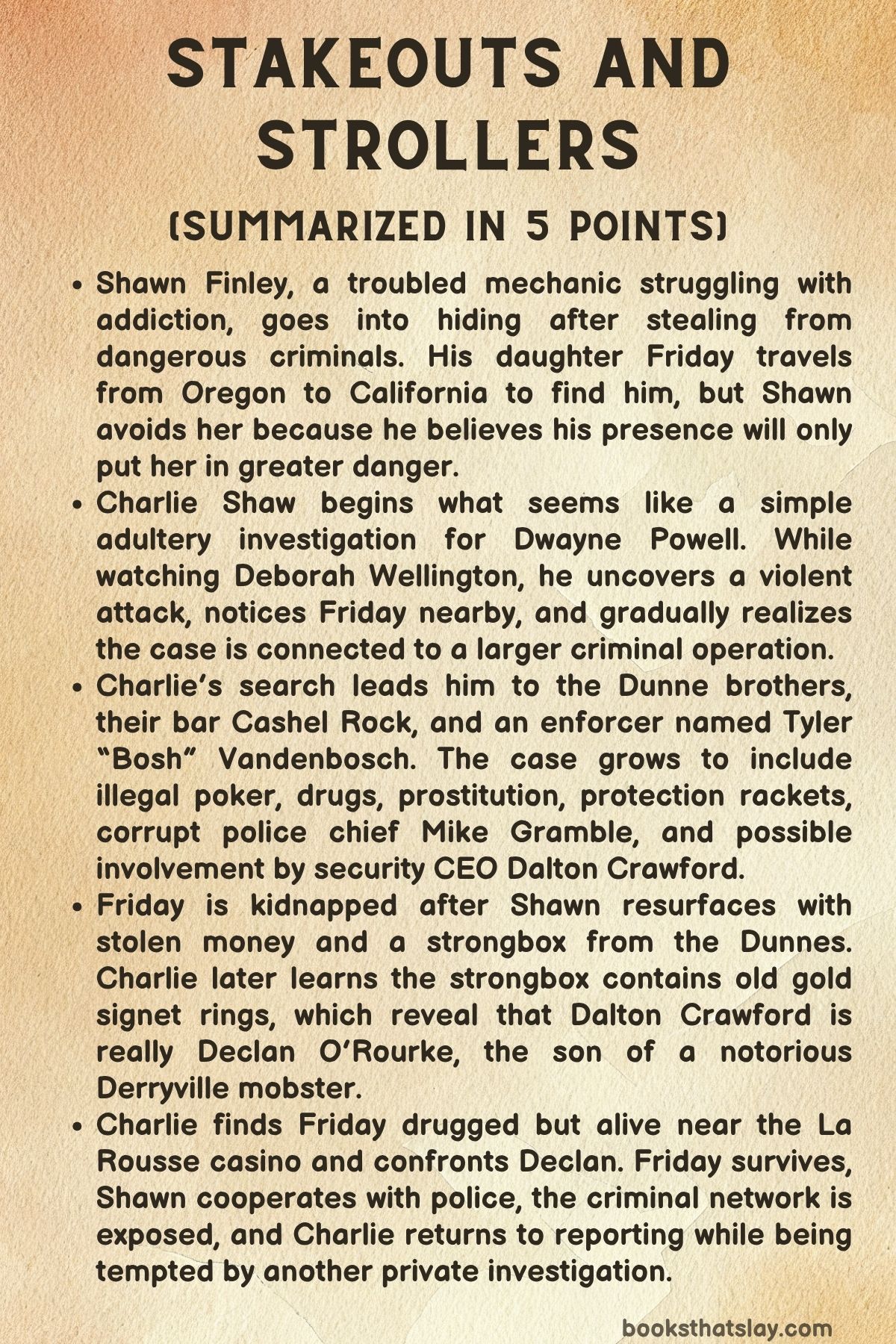
Stakeouts and Strollers begins with Shawn Finley hiding in a dirty motel room, broken down by alcohol, drugs, fear, and guilt. He has stolen from people who are not likely to forgive him, and he knows they may be coming for him.
His sixteen-year-old daughter, Friday Finley, keeps sending him desperate messages, but he ignores them. Shawn tells himself that staying away from her is the safest thing he can do.
He believes his life is too dangerous and damaged for her to be near it. Before he can decide whether to return for her, a huge man with a snake tattoo finds him and attacks him.
At the same time, Charlie Shaw is trying to start over professionally. Once a crime reporter, he is now attempting to build a career as a private investigator.
His first case comes through Dwayne Powell, who hires him to prove that Deborah Wellington, the wife of wealthy Arthur Wellington, is having an affair. Charlie’s home life is already stretched thin.
He and his wife, Ryan, are exhausted from caring for their baby daughter, Callie. They have hired Grace Chen as a night nurse, hoping she can help them survive the strain of new parenthood.
Charlie’s early work on the Wellington case does not inspire confidence. He follows Deborah but mishandles the surveillance when his phone dies before he can save the evidence he needs.
Determined to recover from the mistake, he continues watching her. During another stakeout, he follows Deborah to a houseboat in Sausalito, where he photographs her kissing a man named Scottie Coburn.
What should have been the key evidence in a simple cheating case quickly turns into something far more serious. Charlie sees the snake-tattooed man brutally beat Scottie and warn him to stay away from Deborah.
Charlie also notices a teenage girl watching the attack from a silver Oregon 4Runner. With help from Inspector “Tex” Whitmore, a police contact from his reporting days, Charlie traces the vehicle to Friday Finley.
Friday has recently lost her mother, Patricia Jiang, and has driven from Oregon to California in search of her father, Shawn. She knows he once worked at an Irish bar called Cashel Rock in Derryville, and she hopes that finding him will give her some kind of answer or stability.
Instead, her car breaks down, her money nearly runs out, and she ends up stranded.
Charlie brings Friday into his home, though Ryan is deeply uncomfortable with the decision. Their family is already under pressure, and adding a troubled teenager connected to a dangerous case only increases the tension.
Grace, however, becomes a steady source of support. She helps care for Friday and gives the girl a measure of safety while Charlie continues digging into Shawn’s disappearance and the violence he witnessed.
Charlie visits Cashel Rock and meets Colin and Ross Dunne, the brothers who own the bar. They avoid giving clear answers about Shawn and seem to know more than they admit.
Charlie soon learns that the Dunnes are connected to Tyler “Bosh” Vandenbosch, the same snake-tattooed enforcer who attacked Scottie and Shawn. What began as a domestic surveillance job now points toward a larger criminal network in Derryville.
As Charlie investigates, he uncovers illegal poker games, drugs, prostitution, protection schemes, and police corruption. Derryville police chief Mike Gramble appears to be protecting the Dunnes instead of enforcing the law.
Charlie also grows suspicious of Dalton Crawford, the CEO of Rivet Security and Scottie Coburn’s boss. Dalton plays cards with the Dunnes and appears to be tied to them in ways he tries to hide.
His polished public image does not match the company he keeps.
Shawn eventually resurfaces, and Charlie and Powell find him. Shawn has stolen money and a strongbox from the Dunnes, which explains why they are after him.
Rather than trust Charlie, Shawn attacks him, knocks him unconscious, and disappears again with the loot. His actions deepen the danger for everyone, especially Friday, who is desperate to help her father and make sense of his choices.
Friday decides to act on her own. Believing the stolen money might help resolve the situation, she gets involved directly and is kidnapped by the Dunnes.
Ross contacts Charlie and demands Shawn and the strongbox in exchange for Friday. Charlie joins forces with Shawn, Powell, and Tex to arrange a risky exchange near an abandoned building.
The plan leads to the capture of Ross, Colin, and Chief Gramble, but Friday is not found there. The apparent rescue fails, and Charlie realizes that the case is still missing its most important piece.
The strongbox becomes the key. Charlie discovers that its true value is not only the cash inside but a set of old gold signet rings.
The rings point to a buried history connected to Derryville’s criminal past. Following the clue, Charlie begins investigating Dalton Crawford more closely.
A church contact leads him to Nevada, where he uncovers Dalton’s real identity. Dalton Crawford is actually Declan O’Rourke, the son of Jimmy O’Rourke, a notorious Derryville mobster.
Declan has spent years remaking himself. He created the respectable identity of Dalton Crawford, built Rivet Security, and brought his sick father back under an alias.
Behind the polished surface, he has been helping the Dunne brothers rebuild organized crime in Derryville. The poker games, blackmail, criminal money, and protection rackets all serve a larger purpose: restoring the power and legacy of the O’Rourke family.
Charlie finds another matching ring hidden among Declan’s childhood belongings, confirming the connection.
Back at home, Charlie’s life as a father unexpectedly helps him think through the case. Callie’s baby behavior gives him the idea that Jimmy O’Rourke may be hidden in a senior living facility near the La Rousse casino.
Charlie goes there and finds Friday alive but drugged in Jimmy’s apartment. Before he can get her out safely, Declan catches him at gunpoint.
Declan explains how he used the Dunnes, secret poker games, criminal cash, and blackmail to bring back the old O’Rourke influence. His respectability was only a mask.
Rivet Security gave him access, power, and cover, while the Dunnes handled the dirtier work. Friday became a hostage because Shawn had taken something that threatened to expose the truth.
Charlie manages to trick Declan and fight back. He escapes with Friday, but Declan pursues them.
Powell arrives at a crucial moment and crashes into Declan’s car, stopping him and saving Charlie and Friday from further harm. The case finally breaks open.
Friday is taken to the hospital, where she begins recovering from the drugs and trauma. Shawn reunites with her in an emotional scene, though he still has to face the legal consequences of his crimes.
He cooperates with police, offering information that helps strengthen the case against the others.
The Dunne brothers, Chief Gramble, Declan, and Jimmy O’Rourke are exposed. Their operation collapses, and the truth about Derryville’s revived criminal network comes to light.
Friday does not return to the unstable life she came from. Instead, she moves in with Grace and Grace’s husband so she can finish school in San Francisco.
It gives her a real chance at safety, structure, and a future beyond her father’s mistakes.
Charlie, meanwhile, returns to reporting, suggesting that his identity as a journalist still matters to him. Yet the pull of detective work remains.
The story ends with Deborah Wellington offering to hire him to investigate whether Arthur is also being unfaithful. After everything he has survived, Charlie is tempted back toward private investigation, leaving his future open and suggesting that his work as a detective may not be finished.
Characters
Charlie Shaw
Charlie Shaw is the central investigative figure in Stakeouts and Strollers, and his character is shaped by the tension between domestic responsibility and professional curiosity. As a former crime reporter trying to become a private investigator, Charlie begins the story with uncertainty and inexperience.
His early mistakes, especially his failure to preserve evidence during the adultery case, show that he is not yet polished in his new role. However, his greatest strength is his instinct.
He notices details that others might ignore, such as Friday watching from the silver Oregon 4Runner, the importance of the strongbox, and the hidden meaning of the gold signet rings. Charlie is also deeply humane.
He takes Friday into his home even when doing so creates conflict with Ryan, because he cannot abandon a vulnerable teenager who has already lost her mother and is searching for her father. His character develops from a struggling novice investigator into someone capable of exposing a large criminal network.
At the same time, he remains flawed, overwhelmed, and emotionally pulled between fatherhood, marriage, danger, and justice. This makes him feel less like a perfect detective and more like an ordinary man forced to grow into courage.
Friday Finley
Friday Finley is one of the most emotionally important characters in the book. At only sixteen, she carries the grief of losing her mother, the pain of being abandoned by her father, and the fear of being alone in a dangerous world.
Her journey from Oregon to California shows her bravery, but it also reveals her desperation. Friday is not simply a helpless victim; she is observant, determined, and willing to take risks.
Her decision to watch the attack on Scottie and later try to solve the problem herself shows that she has courage, but her youth makes her vulnerable to manipulation and danger. Friday’s relationship with Shawn is central to her emotional arc.
She wants him to be better than he is, and even after his failures, she still longs for him as her father. Her kidnapping and rescue deepen the emotional stakes of the story, while her later move into Grace’s home suggests hope, healing, and the possibility of a safer future.
Friday represents innocence damaged by adult corruption, but she also represents resilience.
Shawn Finley
Shawn Finley is a tragic and morally complicated figure in the story. He is introduced as an alcoholic and drug-dependent mechanic hiding in a filthy motel after stealing from dangerous criminals.
His addiction, fear, and poor choices have made him unreliable, especially as a father. He ignores Friday’s desperate messages because he believes staying away from her will protect her, but this decision also reflects his weakness and inability to face responsibility.
Shawn’s theft of the money and strongbox drives much of the conflict, placing both himself and Friday in danger. Yet he is not portrayed as completely heartless.
His reunion with Friday in the hospital shows that he still loves her, even though love alone has not made him dependable. Shawn’s character is powerful because he is both a cause of Friday’s suffering and someone who genuinely wants to reconnect with her.
His cooperation with the police near the end suggests a small possibility of redemption, though the book does not erase the harm he has caused.
Ryan Shaw
Ryan Shaw is Charlie’s wife, and her character brings realism and emotional pressure into Charlie’s life. She is exhausted from caring for their baby, Callie, and her frustration with Charlie is understandable because his investigation repeatedly pulls him into danger and away from home.
Ryan’s objections to taking Friday in do not make her uncaring; instead, they show that she is trying to protect her own family during an already overwhelming period. Her perspective balances Charlie’s impulsive compassion.
While Charlie sees Friday as someone who needs immediate help, Ryan sees the risks involved in bringing a troubled stranger into their home. Through Ryan, the story explores the strain that investigative work places on marriage and parenthood.
She represents the ordinary responsibilities that Charlie cannot simply ignore, and her presence keeps his character grounded.
Callie Shaw
Callie Shaw, Charlie and Ryan’s baby daughter, may not actively participate in the investigation, but she has symbolic and practical importance in the novel. Her presence shows the new stage of Charlie’s life: he is no longer only a reporter or investigator, but also a father.
Callie’s needs create exhaustion, tension, and urgency within the Shaw household. She also indirectly helps Charlie make a crucial mental connection when her baby behavior leads him to think about Jimmy O’Rourke’s possible location in a senior living facility.
This detail is important because it shows how Charlie’s domestic life and detective work are intertwined. Callie represents vulnerability, family, and the fragile normal life Charlie is trying to protect while he is pulled deeper into danger.
Grace Chen
Grace Chen is one of the most compassionate and stabilizing characters in the book. Initially hired as a night nurse to help care for Callie, she becomes much more than a household employee.
Grace brings calm, warmth, and practical support into a home strained by sleeplessness, conflict, and fear. Her kindness toward Friday is especially meaningful because Friday needs an adult who can offer safety without judgment.
Grace’s eventual decision to take Friday in with her husband gives Friday the secure future that Shawn cannot provide at that moment. Grace’s character represents chosen family, quiet strength, and healing.
She does not solve the criminal mystery, but she plays a vital role in repairing the emotional damage left behind by it.
Dwayne Powell
Dwayne Powell is Charlie’s employer and investigative partner, and he adds both professional structure and action to the story. He hires Charlie for the Wellington case, which begins as a simple adultery investigation but grows into something far more dangerous.
Powell is more experienced than Charlie in private investigation, yet he is not distant or cold. He becomes involved in the effort to find Shawn and rescue Friday, showing loyalty and courage.
His arrival during the final confrontation with Declan is especially important because he physically helps stop the villain and save Charlie and Friday. Powell’s character also functions as a bridge between Charlie’s uncertain new career and the world of real investigative danger.
He helps Charlie move from amateur mistakes toward more serious detective work.
Inspector “Tex” Whitmore
Inspector “Tex” Whitmore is Charlie’s police contact and one of the few official figures Charlie can trust. His role is important because the story includes corruption within law enforcement, especially through Chief Gramble.
Tex provides access, information, and credibility when Charlie’s investigation moves beyond private suspicion into criminal conspiracy. He helps trace Friday’s vehicle and later participates in the dangerous exchange involving Shawn, Powell, and the Dunnes.
Tex represents legitimate justice in contrast to Gramble’s corruption. He is practical, reliable, and willing to act when the situation becomes serious.
His presence also shows that Charlie cannot solve everything alone; he needs trustworthy allies inside the system.
Deborah Wellington
Deborah Wellington begins as the target of Charlie’s first private investigation case because she is suspected of cheating on her wealthy husband, Arthur. At first, she seems to belong to a straightforward domestic scandal, but her connection to Scottie Coburn and the attack by Bosh pull her into the larger criminal plot.
Deborah is important because she links the surface mystery of infidelity to the deeper world of intimidation, blackmail, and organized crime. Her relationship with Scottie makes her more than a simple unfaithful spouse; she becomes part of the web that exposes the danger surrounding the Dunnes and Declan.
Her appearance at the end, when she offers Charlie another possible case involving Arthur, brings the story back to the private-investigator world where it began and suggests that Charlie may not be finished with this line of work.
Arthur Wellington
Arthur Wellington is wealthy, powerful, and mostly present through the investigation surrounding his marriage. He hires Dwayne Powell to prove Deborah’s infidelity, which sets Charlie’s entire journey in motion.
Arthur’s importance lies less in his emotional depth and more in his function as the spark that starts the plot. His marriage becomes the entry point into a much larger criminal conspiracy.
By the end, Deborah’s suggestion that Arthur himself may be unfaithful complicates the original case and adds irony. Arthur represents the world of money, suspicion, and private secrets that Charlie enters as an investigator.
Scottie Coburn
Scottie Coburn is Deborah Wellington’s lover and Dalton Crawford’s employee, making him a key connecting figure between the adultery case and the criminal conspiracy. His beating by Bosh is one of the first clear signs that the case is much more dangerous than simple marital betrayal.
Scottie’s fear after being threatened shows the power that the criminal network holds over people connected to it. He is not presented as a major mastermind, but his position near Deborah and Dalton makes him important to the plot’s movement.
Through Scottie, Charlie sees the violence behind the polished surfaces of wealth and business.
Tyler “Bosh” Vandenbosch
Tyler “Bosh” Vandenbosch is the physical face of intimidation in the story. The snake tattoo makes him visually memorable, and his violence against Shawn and Scottie establishes him as a dangerous enforcer.
Bosh does not need to be intellectually complex to be frightening; his role is to show how the criminals maintain control through fear. He is connected to the Dunnes and their operations, and his presence signals that the conspiracy is not merely financial or political but brutally physical.
Bosh represents the direct violence that supports organized crime. Whenever he appears, the danger becomes immediate and personal.
Colin Dunne
Colin Dunne, one of the owners of Cashel Rock, is part of the criminal structure hiding behind the appearance of a local Irish bar. He is evasive when Charlie asks about Shawn, which immediately suggests that he knows more than he admits.
Colin’s involvement in illegal poker, drugs, prostitution, protection rackets, and the larger Derryville network makes him one of the story’s central criminal figures. He is not just a bar owner caught near crime; he is part of a system that uses businesses, police corruption, and violence to maintain power.
Colin’s character helps show how organized crime can disguise itself behind ordinary community spaces.
Ross Dunne
Ross Dunne is more openly threatening than Colin in several ways, especially when he calls Charlie and demands Shawn and the strongbox in exchange for Friday. His role in Friday’s kidnapping makes him one of the most directly cruel characters in the story.
Ross is practical, ruthless, and willing to use a teenager as leverage. He reflects the Dunnes’ willingness to turn criminal business into personal terror.
While Colin helps represent the hidden, evasive side of the operation, Ross represents its aggressive and coercive side. His capture is one of the key moments in the collapse of the Derryville criminal network.
Mike Gramble
Mike Gramble, the corrupt Derryville police chief, is one of the most disturbing figures in the book because he represents the betrayal of public trust. As a police chief, he should protect people from criminals like the Dunnes, but instead he is connected to their operation.
His corruption makes the criminal conspiracy more dangerous because it means victims cannot easily rely on the law. Gramble’s involvement also raises the stakes for Charlie, Friday, and Shawn, because the system that should help them has been compromised.
His exposure is important not only because it punishes one corrupt man, but because it reveals how deeply crime has infected Derryville’s institutions.
Dalton Crawford / Declan O’Rourke
Dalton Crawford, later revealed to be Declan O’Rourke, is the central hidden villain of the story. At first, he appears to be a successful CEO connected to Rivet Security and the world of respectable business.
His true identity as the son of mobster Jimmy O’Rourke changes the meaning of the entire investigation. Declan is dangerous because he combines intelligence, patience, money, and inherited criminal ambition.
Unlike Bosh, who represents physical violence, Declan represents calculated power. He reinvents himself, builds a legitimate-looking company, brings his father back under an alias, and uses the Dunnes, poker games, blackmail, and criminal money to revive the family legacy.
His obsession with the past, especially the signet rings and his father’s reputation, makes him more than a greedy criminal. He is trying to restore an identity and dynasty that should have died out.
His confrontation with Charlie reveals arrogance, control, and deep loyalty to a corrupt inheritance.
Jimmy O’Rourke
Jimmy O’Rourke is the shadow of the past hanging over the story. Though ailing and hidden under an alias, he remains symbolically powerful because his legacy motivates Declan’s actions.
As a notorious Derryville mobster, Jimmy represents the old criminal order that Declan wants to revive. His connection to the gold signet rings gives the mystery historical weight and turns the strongbox into something more meaningful than stolen cash.
Jimmy’s presence in the senior living facility is especially unsettling because it places old criminal power in a quiet, vulnerable-looking setting. He may not be the active force he once was, but his influence continues through Declan.
Jimmy represents how crime, family loyalty, and inherited identity can survive even when the original criminal leader has weakened.
Patricia Jiang
Patricia Jiang, Friday’s deceased mother, does not appear directly in the action, but her absence shapes Friday’s entire emotional journey. Her death leaves Friday isolated and pushes the teenager to search for Shawn.
Patricia’s importance lies in the emotional space she leaves behind. Without her, Friday has no stable parent to rely on, which makes Shawn’s failure even more painful.
Patricia also represents the life Friday has lost before the events of the story begin. Her absence helps explain Friday’s desperation, grief, and need for belonging.
Themes
Parenthood, Responsibility, and Emotional Strain
The pressure of caring for others shapes many of the central choices in Stakeouts and Strollers. Charlie is pulled between the demands of a new baby, an exhausted marriage, and a dangerous investigation that grows far beyond his original assignment.
His struggle is not only about solving a case but about learning what responsibility means when every decision affects someone vulnerable. Friday’s situation deepens this theme because she has been forced to act like an adult while still needing protection, stability, and emotional care.
Shawn’s failure as a father shows the damage caused when responsibility is avoided, yet his later attempts to help suggest that guilt can still push a person toward change. Grace also becomes important because she represents steady, practical care in a world where many adults have failed the young.
Through these relationships, the story shows parenthood not as a simple role but as a constant test of sacrifice, patience, fear, and moral courage.
Addiction, Guilt, and the Possibility of Redemption
Shawn’s addiction drives much of the emotional conflict because his dependence on alcohol and drugs has damaged his judgment, his relationships, and his ability to protect Friday. His decision to hide from danger while ignoring her desperate messages reveals how addiction can distort love into avoidance.
He believes distance may keep her safe, but his absence leaves her even more exposed. At the same time, the story does not treat him as a one-dimensional failure.
His guilt remains alive beneath his fear, and that guilt becomes important when Friday is placed in direct danger. His actions cannot erase the harm he has caused, especially after years of absence and reckless choices, but they open the possibility of accountability.
Redemption here is not presented as instant forgiveness. It is tied to cooperation, consequence, and the painful work of facing what he has done.
Shawn’s arc suggests that broken people may still choose responsibility, but only after confronting the damage they helped create.
Corruption Beneath Respectability
The criminal world in the story is powerful because it hides behind ordinary institutions, polished careers, and public respect. What begins as a simple investigation into marital betrayal slowly exposes a wider system built on illegal gambling, drugs, prostitution, protection money, and police corruption.
The most disturbing part of this network is that it is not limited to obvious criminals. Wealth, business success, law enforcement authority, and social status all become masks for exploitation.
Dalton’s reinvention is central to this theme because he constructs a respectable identity while quietly reviving a violent family legacy. The Dunnes and Gramble show how local power can protect crime when personal gain matters more than justice.
This theme also changes Charlie’s role. He begins by watching people from a distance, but he is forced to see how private wrongdoing connects to public harm.
The story suggests that corruption survives best when it looks normal, professional, and untouchable.
Family Legacy, Identity, and Reinvention
Identity in the story is shaped by the past, even when characters try to escape or rewrite it. Friday searches for Shawn because she wants answers about where she comes from, but her search brings her into contact with secrets and violence that began long before her arrival.
Dalton’s hidden past shows the darker side of reinvention. He changes his name, builds a successful company, and creates the image of a legitimate businessman, yet his choices remain tied to his father’s criminal history.
The gold signet rings become powerful symbols of inheritance, loyalty, and buried truth. They prove that identity is not only what a person claims in public but also what they preserve in private.
Shawn, Friday, and Dalton all face different versions of family legacy: one tries to repair it, one tries to understand it, and one tries to restore it through crime. The story uses these contrasts to show how the past can guide, haunt, or corrupt the present.