This Weekend Doesn’t End Well for Anyone Summary, Characters and Themes
This Weekend Doesn’t End Well for Anyone by Catherine Mack is a comic murder mystery about crime writers, old grudges, literary jealousy, and real bodies appearing where fictional ones are supposed to stay.
The novel follows bestselling mystery author Eleanor Dash as she attends a writers’ conference in Nassau, only to discover that the event has been arranged around secrets from her past. What begins as professional obligation turns into a dangerous investigation involving her sister, her fiancé-to-be, her ex, rival authors, and a famous mystery legend. The book uses humor, publishing-world satire, and classic whodunit structure to turn a tropical conference into a deadly puzzle. It’s the 3rd book of the Vacation Mysteries series.
Summary
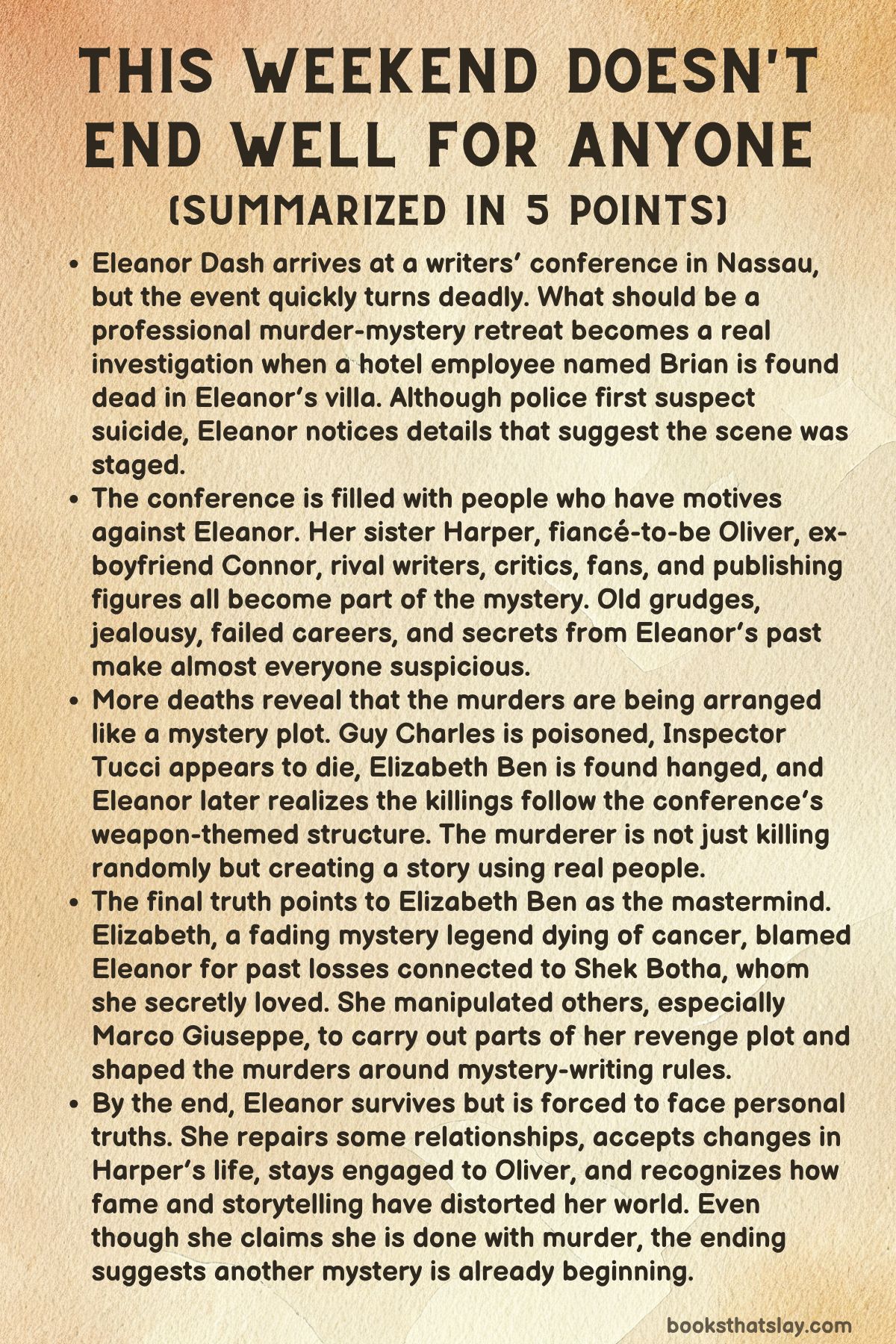
Eleanor Dash arrives in Nassau as a bestselling mystery author whose life has become far too close to the books she writes. She is known for the Vacation Mysteries series, but she is also known, at least to herself and those close to her, as someone who has already survived real murder plots.
She comes to the resort for a murder-writing conference with her sister and assistant Harper, her boyfriend and co-writer Oliver, and her ex, Connor Smith. Connor is not just an old romantic complication; he is also the real-life inspiration for Eleanor’s famous fictional hero, which makes his presence professionally useful and personally exhausting.
The conference begins badly almost at once. Connor creates delays with his luggage, the resort looks worse than advertised, and the group’s villa contains something no guest wants to find: a dead man in a staff uniform lying in blood, with a gun nearby.
The dead man’s name tag says Brian. The police initially treat the death as suicide, but Eleanor immediately distrusts that conclusion because the setup feels too staged.
Officer Rolle and hotel manager Mark Knowles try to calm everyone, while the resort works to avoid panic during the conference. Eleanor learns that Brian had been fired after being accused of stealing from guest rooms, and that another person had previously died at the resort.
Then Guy Charles appears as head of security. Guy is Connor’s former business partner and someone connected to earlier danger in Eleanor’s life, so his presence confirms that the conference cannot be treated as an ordinary professional event.
Eleanor, Harper, and Oliver debate leaving, but leaving is difficult. Flights are disrupted, contractual duties bind Eleanor to the conference, and others seem strangely invested in keeping her at the resort.
More suspicious figures arrive. Vicki, Eleanor’s editor, reveals that she helped organize the event. Inspector Tucci, an Italian officer from Eleanor’s previous murder case, appears as the conference’s police expert, claiming that his attendance was arranged through official channels.
At the welcome lunch, Eleanor sees the whole field of suspects gathering. Sandrine, her former best friend and fellow mystery writer, is there despite their broken friendship and unresolved accusation that Eleanor stole a book idea.
Ravi Botha is present as well. He is the brother of Shek Botha, a writer who died during Eleanor’s previous Italy case, and he blames Eleanor for the tragedy.
Elizabeth Ben, a legendary mystery author, welcomes everyone and organizes participants into groups named after murder weapons. Eleanor finds a threatening card under her plate saying that no one is getting out alive, making the conference look less like a professional retreat and more like a designed trap.
Eleanor teaches her first small-group session, but even the craft discussion seems to echo real danger. Her class includes Sandrine, Stefano Dimitrov, a hostile BookToker who has criticized her work, and other participants with their own resentments.
The conversation about how murder mysteries begin makes Eleanor think about Brian’s death as the “first body” in a larger design. She starts to suspect that the conference itself has been arranged according to mystery rules, with her as the central target.
The danger soon becomes physical. During a mandatory water polo match, someone grabs Eleanor’s ankle underwater and pulls her down. Connor rescues her, not Oliver, which adds emotional discomfort to the fear.
Eleanor accuses Sandrine, but Sandrine insists it was only rough play. The ambiguity is unsettling because the incident could be either a competitive accident or a murder attempt.
At a cocktail party, Eleanor learns from Vicki that Elizabeth Ben’s career is in trouble. Her sales have declined, her manuscript is weak, and Vicki may have to end her series.
Elizabeth herself seems fragile and melancholy. She asks Eleanor about Shek’s death in a way that hints at a deeper personal connection to him.
Ravi later warns Eleanor to watch her back. When Eleanor confronts him, he accuses her of destroying his brother’s life and reveals that his new book portrays a thinly disguised version of Eleanor as a murderer.
Inspector Tucci gives Eleanor more reason to worry. He suggests Brian may have been gathering information about her, not merely stealing objects from rooms.
Officer Rolle then confirms that Brian’s death was murder. The wound angle and Brian’s handedness do not support suicide, and photos of Brian’s room show a wall of material about Eleanor.
Brian had come from New York and started working at the resort only six weeks earlier, around the same time as Guy. The timing makes Eleanor believe Brian had been placed at the resort for a reason.
At dinner, Elizabeth gives a talk about hidden enemies and danger within familiar circles. During a dramatic lights-out moment, Eleanor senses someone behind her and fears she is about to be attacked.
When the lights return, Guy is choking and turning blue. He dies in front of the group, and Eleanor realizes Brian’s murder was only the beginning.
The police initially consider natural causes, but Eleanor believes Guy was poisoned. Her suspicion is confirmed when Rolle reveals that Guy was killed by a fast-acting poison delivered through a hidden needle device.
The method is disturbing because a similar device was used in the Italy case that killed Shek. Eleanor also knows that the same kind of device appears in her upcoming book, which means anyone with an advance copy could have copied it.
Eleanor and Oliver search Guy’s security office and find a personnel file belonging to Karl Johnson, Guy’s predecessor, along with a USB drive hidden in a hollowed-out book. Connor catches them and forces his way into the investigation.
Connor reveals that Guy contacted him months earlier, claiming he had found Marta Giuseppe, a fugitive tied to the Italian Mafia family involved in the earlier plot against Eleanor and Connor. Connor helped arrange the conference at the resort because Guy said Marta was hiding there.
The conference was meant to trap Marta, but Eleanor now sees that she and the others were used as bait. Oliver is furious, while Connor insists that Guy drove the plan.
The USB contains a password-protected file called “Novel.” Eleanor guesses the password is “Giuseppe,” and the group opens it, though the manuscript is long, dull, and unclear.
As Eleanor questions the other attendees, motives multiply. Sandrine still resents Eleanor over their broken friendship and the alleged stolen idea. Ravi blames Eleanor for Shek’s death and professional humiliation. Stefano resents her because she had his review access cut off and because he believes authors steal from others.
Cathy, Eleanor’s obsessive fan, also becomes more disturbing. She has researched Eleanor’s private trauma, including John Hart, the drunk driver who killed Eleanor and Harper’s parents.
Eleanor finally tells Cathy that her obsession has gone too far. Cathy reacts with anger, turning another odd admirer into a possible threat.
Meanwhile, Harper’s own secrets surface. She has been trying to separate herself from Eleanor, has attended John Hart’s parole hearing without telling her sister, and has worked with Connor more closely than Eleanor realized.
Eleanor suspects Harper may be ghostwriting Connor’s surprisingly good romance novels. Harper denies more than editing at first, but the truth later becomes important.
Eleanor and Oliver’s relationship also reaches a turning point. Oliver had planned to propose, but the murder investigation keeps delaying the moment. Eleanor, tired of uncertainty, asks him to marry her first, and he says yes.
The engagement is quickly interrupted by another shock. Officer Rolle announces that Inspector Tucci is dead and points to Mark Knowles, who runs.
Mark is exposed as Marco Giuseppe, Marta’s brother. Connor and Oliver help stop him, but Marco denies killing anyone, even as he accuses Eleanor and Connor of destroying his family.
When Eleanor realizes Vicki is missing, the group checks her room and finds signs that someone with staff access could open guest balconies. Eleanor remembers that a maid who brought towels may actually have been Marta.
Then Tucci’s body disappears from under guard, making his supposed death even stranger. Soon afterward, Marta is found hiding in the laundry room and agrees to talk.
Marta claims Guy found her and Marco and blackmailed them into hosting the conference. According to her, Guy planned to bring Eleanor and Connor to the resort so they could be killed.
Marta also says Guy was involved in the Italy murder plot and may have killed Brian after Brian snooped in his room. Eleanor begins to suspect that the obvious solution, blaming only the Giuseppes, is too simple.
Harper reads Guy’s manuscript and confirms that Guy planned to exploit the Giuseppes and profit from the resulting story. But Brian’s death does not fit neatly into Guy’s plan.
Eleanor gathers the suspects in the library and pretends that Harper’s journal contains Guy’s notes. The confrontation reveals more secrets.
Sandrine admits Guy wanted her to ghostwrite his book. Ravi admits Guy was blackmailing him with compromising information about Shek. Harper is forced closer to admitting that she has been ghostwriting, though she resists saying for whom.
Eleanor realizes Elizabeth is missing from the gathering. The group rushes to Elizabeth’s suite and finds her dead, apparently hanged.
Back in the library, Eleanor tries to match the deaths to the conference’s murder-weapon pattern: Brian with a gun, Guy with poison, Elizabeth with rope, Marco’s knife, and a heavy object still waiting.
Then Inspector Tucci walks in alive. He explains that he faked his death with medication because he believed Marta and Marco intended to kill him. He had been hiding in a staff uniform.
Tucci says Marta was his source and that he saved Vicki, who had been about to confront the Giuseppes’ accomplice. He names Elizabeth as that accomplice, claiming he saw her speaking with Marta and giving orders.
Eleanor and Oliver return to their room, where Oliver properly proposes with Eleanor’s mother’s ring. The moment is tender but brief, because Harper’s journal raises new fears.
The dark writing inside makes Eleanor and Oliver consider whether Harper could be involved. Harper is hurt when she overhears them, but she finally admits that she has been ghostwriting Connor’s novels.
A hidden mechanism then drops the heavy ceiling fan onto the bed where Eleanor and Oliver had been sleeping. They narrowly survive the “heavy object” part of the murder pattern.
The trap reveals that Brian’s body was planted in their original room to force the resort to move them into the rigged suite. The killer had planned several steps ahead.
Eleanor and Oliver search Brian’s room and study the wall of Eleanor materials. At first it looks like Brian was obsessed with her, but Eleanor notices older material, including a photo from a past conference showing Eleanor, Sandrine, Elizabeth, and Shek.
In the photo, Shek and Elizabeth are secretly holding hands. Eleanor realizes Elizabeth and Shek were romantically involved, and that Elizabeth may have resented Eleanor long before the present conference.
Vicki confirms the final pieces. She had rejected Elizabeth’s latest manuscript, which involved a dying mystery writer killing a younger rival. Brian had been hired to help Elizabeth fix the book.
Elizabeth, dying of cancer and obsessed with Shek, blamed Eleanor for Shek’s death and for his emotional rejection. She manipulated Guy, Marco, Brian, and the conference structure, using Eleanor’s own books and murder-writing rules as a model.
Marco killed Brian and Guy under Elizabeth’s direction, while the rigged suite was meant to kill Eleanor and Oliver. Tucci’s fake death disrupted the plan, and Elizabeth, losing control, hanged herself so she could become part of her own final design.
Afterward, Marco and Marta are taken into custody. Eleanor apologizes to Sandrine, though their friendship cannot truly return to what it was.
Harper begins building a separate life, including plans for a true-crime podcast about John Hart. Oliver moves in with Eleanor, and their engagement remains intact.
Elizabeth’s crimes make her books sell again, while Eleanor’s new release is overshadowed. Eleanor claims she is done with murder, both writing it and solving it.
That resolution lasts only until a death-sites bus tour in Los Angeles, where another author is found dead. Eleanor’s attempt to leave murder behind ends before it can really begin.
Characters
Eleanor Dash
Eleanor Dash is the center of This Weekend Doesn’t End Well for Anyone, and the book presents her as both a successful mystery author and a woman whose real life has become almost absurdly similar to her fiction. She is funny, anxious, self-aware, and often reckless, especially when danger gives her a puzzle she cannot resist.
Her strongest trait is her need to impose narrative logic on chaos. When Brian’s body is discovered, she does not accept the easy suicide explanation because she understands how murder stories work and because her past has taught her that coincidences usually hide intention.
Eleanor’s intelligence is real, but it is tangled with ego and insecurity. She sees patterns quickly, but she also sometimes assumes that every hostility is about her, which makes her both perceptive and unreliable.
Her relationships expose her emotional immaturity. With Oliver, she wants safety but keeps getting pulled back into old rhythms with Connor. With Harper, she wants control while claiming she wants independence for her sister.
Her journey is not about becoming fearless; she is afraid often and admits it. What changes is her willingness to face uncomfortable truths about herself, especially her self-absorption, her dependence on Harper, and her habit of treating danger as something she can solve through cleverness alone.
Harper
Harper is Eleanor’s sister, assistant, emotional support system, and hidden rival for independence. She has lived in Eleanor’s shadow for years, handling practical matters while suppressing her own ambitions and anger.
The book shows Harper as deeply loyal but also resentful. She loves Eleanor, yet she is tired of being treated as an extension of Eleanor’s career and life.
Her involvement with Connor’s writing career reveals her secret talent and her desire to prove that she can create something valuable outside Eleanor’s name. Her work as a ghostwriter also complicates her moral position because she has been hiding a major part of herself from the person closest to her.
Harper’s interest in John Hart, the man who killed their parents, shows that she processes grief differently from Eleanor. While Eleanor avoids the pain by turning life into narrative, Harper tries to confront the source of the wound directly.
Her dark journal writing makes her briefly look suspicious, but it mainly reveals how much anger she has had to bury. By the end, Harper’s movement toward a podcast, a separate home, and a life outside Eleanor’s immediate control gives her one of the clearest arcs in the story.
Oliver
Oliver is Eleanor’s boyfriend, co-writer, and eventual fiancé. He functions as her emotional anchor, but the book avoids making him passive or bland.
He is patient with Eleanor’s chaos, yet he also has limits. His anger at Connor is not simple jealousy; it comes from seeing how often Connor endangers Eleanor while still claiming a place in her life.
Oliver is practical, clever, and more capable than he first appears. His lock-picking tools, his willingness to search Guy’s office, and his ability to keep pace with Eleanor’s reasoning show that he is not just the supportive partner waiting outside the investigation.
His relationship with Eleanor is tested by the fact that murder brings out parts of her that he cannot fully control or understand. He wants a real future with her, not a relationship constantly shaped by Connor, danger, and unfinished business.
His proposal with Eleanor’s mother’s ring gives him emotional weight in the novel. He represents the possibility that Eleanor’s life can contain commitment and tenderness without losing her sharpness or wit.
Connor Smith
Connor Smith is Eleanor’s ex, the inspiration for her fictional hero, and one of the most morally slippery figures in the story. He is charming, useful, secretive, and almost always more involved than he first admits.
His history with Guy and the Giuseppes makes him central to the danger at the resort. Connor helped arrange the conference as part of a trap to draw out Marta, yet he failed to fully consider how much danger he was creating for Eleanor and the others.
Connor’s appeal lies in his competence and his ability to think like a criminal. He understands deception, hidden motives, and practical danger in ways that help the investigation.
At the same time, those same traits make him hard to trust. He has used people before, and Eleanor gradually understands that even his past relationship with her contained calculation.
Connor is not portrayed as purely villainous. He does care about Eleanor, and he often acts quickly when danger appears. Still, the book makes clear that affection does not erase manipulation, and Connor remains a person whose help usually comes with damage.
Sandrine
Sandrine is Eleanor’s former best friend and one of the book’s most emotionally grounded sources of conflict. Her resentment is not just professional jealousy; it comes from feeling abandoned by someone who once knew her deeply.
She believes Eleanor stole a book idea, but the deeper injury is that Eleanor became successful while Sandrine struggled. Their broken friendship is built from envy, misunderstanding, pride, and Eleanor’s failure to notice how much Sandrine was hurting.
Sandrine’s sharpness makes her look suspicious, especially when she needles Eleanor in class and during the water polo incident. Yet her anger is ultimately more human than murderous.
Her confession about feeling overshadowed gives the story emotional depth because it forces Eleanor to see herself through someone else’s pain. Sandrine is not simply bitter; she is wounded by the unequal balance their friendship became.
By the end, Eleanor apologizes, but the book does not offer an easy restoration. Sandrine unblocks her, yet the relationship cannot return to its old shape, which makes their arc feel honest.
Elizabeth Ben
Elizabeth Ben is the legendary mystery author whose public grace hides bitterness, illness, and obsession. She begins as a respected figure in the genre, someone Eleanor admires and feels guilty about disappointing.
Her declining career and rejected manuscript create the professional pressure behind her final choices. She is facing the loss of her series, her status, her health, and her control over the image she built.
The revelation of her relationship with Shek changes the meaning of her behavior. Her grief over him becomes fused with jealousy and blame, and she directs that blame toward Eleanor.
Elizabeth’s crime is especially disturbing because she uses the logic of mystery writing as a weapon. She turns the conference, the weapon groups, Eleanor’s own books, and the resentments of others into tools for a final act of revenge.
Her suicide is not an act of surrender alone. It is also a last attempt to control the story, casting herself as both author and victim in the murder pattern she created.
Guy Charles
Guy Charles is a dangerous connector between the present conference and the criminal past. As Connor’s former partner, he brings with him the world of schemes, hidden identities, Mafia ties, and morally compromised plans.
At first, Guy appears suspicious because he is evasive and because his arrival at the resort is no accident. He knows too much about Connor, Sandrine, and the Giuseppes to be treated as a normal head of security.
His manuscript and later revelations show that he planned to exploit the situation for personal profit. He wanted to use the Giuseppes, Eleanor, Connor, and the conference to create a sensational story that could benefit him.
Yet Guy also becomes a victim of a plan larger than his own. He tries to manipulate dangerous people and is killed when Elizabeth and Marco take control of the game.
Guy’s role is important because he shows how greed and storytelling can overlap. He treats real people as material, only to be turned into material himself.
Ravi Botha
Ravi Botha is shaped by grief, resentment, and the burden of inheriting his brother Shek’s literary legacy. His anger toward Eleanor comes from believing she played a role in Shek’s death and benefited from the attention around it.
Ravi’s writing turns his pain into accusation. By creating a thinly disguised version of Eleanor as a murderer, he uses fiction as revenge, mirroring the book’s broader interest in how writers transform real injuries into stories.
He is suspicious because his motive is visible and intense. He openly blames Eleanor, and Guy’s blackmail over Shek’s connection to the earlier conspiracy makes Ravi’s position even more complicated.
Still, Ravi is not the mastermind. His grief makes him harsh and unfair, but it also makes him vulnerable to manipulation by people who understand how to use resentment.
Ravi’s character adds moral pressure to Eleanor’s past. He reminds her that surviving a murder plot does not mean escaping its consequences for everyone else.
Stefano Dimitrov
Stefano Dimitrov is a BookToker whose antagonism toward Eleanor reflects the uneasy relationship between authors, reviewers, social media, and publicity. He is rude, performative, and eager to turn real deaths into content.
His presence makes Eleanor feel watched and judged. He has criticized her work, resents losing NetGalley access, and sees the conference murders as material for his platform.
Stefano is not only comic relief. He represents the way public attention can distort tragedy, especially when murder becomes entertainment before the victims are even understood.
His better-than-expected writing also complicates Eleanor’s assumptions. She dislikes him, but he is not talentless, and that forces her to separate personal irritation from literary judgment.
Stefano’s role in the book is to keep pressure on the boundary between storytelling and exploitation. He may not be the killer, but he is quick to package death for an audience.
Cathy
Cathy, often treated as Eleanor’s obsessive fan, begins as an eccentric and unsettling presence but becomes more troubling as the story continues. Her devotion crosses boundaries from admiration into surveillance.
She knows details about Eleanor’s life that she should not know, including private family trauma connected to John Hart. This makes her frightening not because she is powerful, but because she feels entitled to Eleanor’s pain.
Cathy’s manuscript pages, written from a killer’s perspective, increase suspicion around her. Her anger when Eleanor finally rejects her intrusion shows how quickly devotion can become hostility.
Yet Cathy’s function is not only to serve as a suspect. She reflects the darker side of fame, where readers may feel ownership over an author’s life, grief, and private history.
Through Cathy, the novel examines how admiration can become invasive when boundaries are ignored. Eleanor’s confrontation with her is one of the clearest moments where Eleanor demands control over her own personal story.
Vicki
Vicki is Eleanor’s editor and one of the people most tied to the publishing-world pressures behind the plot. She is practical, professionally strained, and burdened by knowledge she does not fully process until it is almost too late.
Her connection to the conference makes Eleanor suspicious at first, but Vicki is less a planner than a witness to the industry forces shaping the crime. She knows Elizabeth’s career is failing, her manuscript is weak, and the publisher may end her series.
Vicki’s painful conversation with Elizabeth helps push the older author closer to desperation. That does not make Vicki guilty of the murders, but it shows how professional rejection can become personally explosive when mixed with illness, envy, and obsession.
Her recognition of Brian as the young writer hired to help Elizabeth becomes crucial to solving the case. She provides the final context that links Elizabeth’s manuscript, Brian’s involvement, and the real murders.
Vicki is also a reminder that publishing is not a peaceful background in the story. Careers, reputations, contracts, and sales numbers all carry emotional consequences.
Inspector Tucci
Inspector Tucci is a link to Eleanor’s earlier case and a figure of both authority and theatrical secrecy. His unexpected presence at the resort makes Eleanor immediately suspicious because it suggests the conference has been arranged by forces larger than ordinary scheduling.
Tucci is observant and often ahead of the local investigation, especially when he points out details about Brian, the gun, and Guy’s possible criminal connections. He understands the larger Giuseppe background and recognizes that the murders may be tied to Italy.
His decision to fake his death is morally questionable but strategically effective. It allows him to hide, gather information, and avoid becoming a real victim.
Tucci’s return from supposed death also disrupts Eleanor’s understanding of the murder pattern. It proves that not every apparent body in the story means the same thing.
He functions as a professional investigator who nevertheless operates like a character inside a mystery novel. His choices are dramatic, risky, and shaped by the same rules of performance that govern the conference.
Marco Giuseppe
Marco Giuseppe hides under the identity of Mark Knowles, the resort manager, which makes him one of the story’s key concealed threats. His false identity places him close to every guest, every room, and every logistical detail.
As Marta’s brother and a member of the Giuseppe family, Marco carries the anger of a family damaged by Eleanor and Connor’s earlier actions. His resentment is direct, personal, and dangerous.
Marco does not design the entire scheme, but he acts as one of Elizabeth’s instruments. He kills Brian and Guy under her direction, turning his family revenge into part of her larger plan.
His staff access explains several practical aspects of the murders, including movement through the resort and access to rooms. He is not only motivated; he is positioned to make the crimes possible.
Marco’s character shows how revenge can be redirected by someone more calculating. His hatred is real, but Elizabeth uses it for purposes that go beyond his own family grievance.
Marta Giuseppe
Marta Giuseppe is the hidden figure everyone is trying to find, but her role is more complex than the early theories suggest. She is a fugitive tied to the previous Italy case, and her presence at the resort makes the conference look like a trap.
Marta is not innocent in a simple sense, but she is also not the main architect. She claims Guy found and blackmailed her and Marco, forcing them into the conference setup.
Her conversation with Eleanor complicates the investigation because she warns that if she and Marco are not responsible for everything, someone else is still free. That warning turns out to be crucial.
Marta’s role as Tucci’s source also shifts her from hidden villain to uneasy informant. She is trying to survive, bargain, and manage the danger around her.
In the book, Marta represents the danger of assuming the most obvious criminal must also be the mastermind. Her family history makes her suspicious, but suspicion alone does not explain the whole design.
Brian
Brian is the first victim and the body that turns the conference from awkward to deadly. Although he is dead before Eleanor can know him properly, his role is central to the structure of the mystery.
At first, Brian appears to be a fired hotel employee who may have killed himself after being accused of stealing. That explanation quickly falls apart when evidence reveals murder, staging, and a room full of Eleanor-related materials.
His wall of clippings makes him seem obsessed with Eleanor, but later details suggest that his involvement was tied to Elizabeth. He had been hired to help her with her manuscript, making him vulnerable to her manipulation.
Brian’s death also serves a practical purpose in the killer’s plan. By placing his body in Eleanor’s assigned villa, the murderer forces Eleanor and Oliver into the suite rigged with the ceiling fan trap.
Brian is important because he is not just a disposable opening corpse. His death contains the first clues to the entire scheme, including Elizabeth’s planning, staff access, and the false appearance of obsession.
Themes
Storytelling as Control
Characters in This Weekend Doesn’t End Well for Anyone repeatedly use stories to control how others see them, how guilt is assigned, and how violence is explained. Eleanor understands murder through plot structure, which helps her solve the case but also limits her at times because she expects life to obey fictional patterns.
Elizabeth takes this idea to its darkest point. She does not merely write mysteries; she arranges real deaths according to the logic of a mystery manuscript. The conference groups, the weapon pattern, Brian’s staged death, and her own suicide all show her desire to author reality itself.
Guy also treats life as material. His manuscript reveals that he planned to profit from danger by turning the Giuseppe trap into a sensational book. Stefano does something similar on a smaller scale by turning murder into online content before the truth is known.
The theme matters because the novel keeps asking who gets to tell the story and who gets reduced to a character inside someone else’s version. Eleanor’s growth depends on recognizing that real people are not plot devices, even when her own life keeps imitating fiction.
Fame, Jealousy, and Literary Rivalry
The publishing world in the novel is full of admiration, resentment, insecurity, and quiet humiliation. Writers compare sales, reviews, blurbs, reputations, and career trajectories, and those pressures become dangerous when personal wounds are left untreated.
Sandrine’s anger toward Eleanor comes from years of feeling unseen and overshadowed. Her accusation about a stolen idea is important, but the deeper pain is that Eleanor succeeded while Sandrine struggled, and Eleanor did not fully notice the emotional cost of that imbalance.
Ravi’s resentment is tied to Shek’s career and death. He believes Eleanor benefited from attention that should have belonged elsewhere, and he channels that grief into fiction that paints her as a villain.
Elizabeth’s jealousy is the most destructive because it combines professional decline, romantic obsession, illness, and wounded pride. She sees Eleanor not just as a younger writer but as someone who took Shek’s attention, survived the story Elizabeth wanted to control, and continued to rise while Elizabeth faded.
The book treats literary rivalry as both absurd and serious. A bad review, a missed blurb, a failed manuscript, or a fading series may seem small beside murder, but the story shows how fragile identity can become when a career is built on public praise.
Sisters, Dependence, and the Need for Separation
Eleanor and Harper’s relationship is loving but unhealthy. Harper has spent years managing Eleanor’s life, career, crises, and emotions, while Eleanor has grown used to that support without fully seeing what it costs her sister.
Their bond is rooted in shared grief after their parents’ deaths, but they respond to trauma differently. Eleanor turns chaos into mystery and performance, while Harper seeks private answers, including attending John Hart’s parole hearing and considering a true-crime podcast about him.
Harper’s hidden ghostwriting shows how much of herself she has kept outside Eleanor’s view. She is not only an assistant or younger sister; she is a writer with her own voice, ambitions, anger, and secrets.
Eleanor’s plan to fire Harper sounds cruel at first, but it is also connected to a real need for separation. Harper cannot grow while living entirely inside Eleanor’s orbit, and Eleanor cannot mature while depending on Harper to hold everything together.
Their conflict is painful because neither sister is simply wrong. They love each other, but love alone does not make their arrangement healthy. By the end, Harper’s move toward her own home and project suggests that distance may be necessary for the relationship to survive.
Revenge and the False Promise of Justice
Many characters believe they are owed repayment for past harm. Ravi wants Eleanor to answer for Shek’s death. Marco and Marta carry the Giuseppe family’s anger. Sandrine wants acknowledgment for old wounds. Elizabeth wants revenge for Shek, for her fading career, and for the life she feels Eleanor helped take from her.
The novel shows that revenge often disguises itself as justice. Elizabeth frames her actions as meaningful and almost artistic, but her plan depends on manipulation, murder, and the use of other people’s pain for her own final statement.
Marco’s violence also shows how easily revenge can be recruited by someone else. His anger is real, but Elizabeth directs it into a structure that serves her own obsession more than his family’s grievance.
Eleanor is not innocent of every emotional harm in the story, and the book does not pretend that apologies erase damage. She did neglect Sandrine, misread Harper, and benefit from public narratives around earlier tragedies.
Still, the story separates accountability from revenge. Accountability requires truth, recognition, and change, while revenge only creates new victims. By the end, the surviving characters are left not with perfect closure but with the harder task of living beyond the stories of injury that almost destroyed them.