Anita de Monte Laughs Last Summary, Characters and Themes
Anita de Monte Laughs Last by Xóchitl González is a novel about art, power, memory, and who gets written into history. It moves between the life and afterlife of Anita de Monte, a Cuban American artist erased by the art world after her violent death, and Raquel, a Latina art history student at Brown in the late 1990s who begins to uncover Anita’s story.
The book examines racism, class privilege, misogyny, abusive relationships, and the way institutions protect powerful men while dismissing women of color. At its center is a sharp question: who controls an artist’s legacy after they are gone?
Summary
Anita de Monte Laughs Last begins in New York’s art world in 1985, where Anita de Monte is moving through a party hosted by Tilly Barber, her husband Jack Martin’s influential gallerist. The room is full of artists, critics, patrons, and people eager to be seen near power.
Anita knows this world well: it is glamorous, judgmental, racist, and hungry for spectacle. She is Cuban American, talented, bold, and often reduced by others to the stereotypes they expect from her.
Jack, a celebrated artist, enters the party with the practiced confidence of a man used to being admired. His presence shifts the room, and Anita can feel how easily he takes up space that others deny her.
Anita’s marriage to Jack has been unequal for years. He is older, famous, and protected by the institutions around him.
She is gifted, but he often treats her as an accessory to his life rather than as an artist in her own right. He resents her successes, questions her work, mocks the role that Cuban identity plays in her art, and becomes angry whenever she receives opportunities that take her away from him.
He wants her near enough to serve his needs but not strong enough to challenge his position. Anita, however, understands her own talent.
She knows that her work matters, and she knows that Jack’s attempts to diminish her come from insecurity as much as cruelty.
The novel also follows Raquel, a Brown University student in 1998. Raquel is studying art history and has just won a summer fellowship at the Rhode Island School of Design.
She loves art, but she is frustrated by the narrowness of what she has been taught. Her courses focus heavily on white male artists, and she is aware that the art world rewards inherited money, whiteness, and connections.
Unlike many of the privileged girls in her department, Raquel does not come from wealth. Her mother once worked in the cafeteria at the Metropolitan Museum of Art, and Raquel’s own relationship with art grew partly from that proximity to museum spaces that were never built with people like her in mind.
Raquel plans to write her thesis on Jack Martin. Her professor, John Temple, admires Jack and treats his art as a major intellectual subject.
Temple believes that an artist’s identity should not determine how one reads their work, a position that Raquel increasingly questions. At the same time, Raquel starts dating Nick Fitzsimmons, a wealthy white art student whose family has strong ties to the art world.
Nick is charming at first, and Raquel is drawn to the confidence and access he represents. Through him, she enters spaces that have often felt closed to her.
Yet Nick’s world quickly begins to shape her in uncomfortable ways. His friends and social circle treat her as both exotic and suspect.
Some accuse her of using Nick for his connections, while others make racist comments disguised as liberal concern. Nick himself often fails to understand Raquel’s experience as a Latina student among wealthy white peers.
He buys her expensive clothing, praises her when she loses weight, orders food for her, and gradually pushes her toward a version of herself that fits his taste. Raquel tells herself that he is helping her navigate the art world, but his care often looks like control.
Anita’s past reveals how she and Jack first came together. They met in the late 1970s, when Jack appeared at an event connected to Anita’s work.
His fame brought attention, but it also pulled focus away from her art. Anita’s work was deeply tied to her Cuban identity, memory, nature, the body, and spiritual presence.
Jack, who rejected identity-based readings of art, did not truly understand what she was making. Still, they began a relationship, and Anita repeatedly sacrificed opportunities for him.
She turned down fellowships and residencies because he did not want her to leave New York, even though she found it difficult to create there.
Her return to Cuba changes her sense of herself. In Cuba, Anita feels connected to the land, the sea, the people, and the orishas, especially Yemayá.
The trip renews her work and gives her a clearer understanding of who she is as a woman and an artist. Jack cannot share this understanding.
To him, identity is either irrelevant or useful only when it makes Anita more interesting to his circle. To Anita, identity is inseparable from creation.
This difference becomes one of the many fractures in their marriage.
By 1985, Anita has decided to leave Jack. She has gathered evidence of his affairs and consulted a divorce lawyer.
She plans to take what she is owed and free herself from his belittling, infidelity, and control. When she confronts him, he reacts with rage.
He beats her, and as she tries to escape, he throws her from their apartment window. Anita dies, but her consciousness does not disappear.
She awakens on a beach in Cuba, tied to the world she loved and to the art that remains behind.
After Anita’s death, Jack tries to protect himself. His lawyers and supporters craft a defense that paints Anita as unstable, exotic, and irrational.
Tilly Barber helps him, using her power in the art world to shield him. Jack attends Anita’s memorial, where many people clearly believe he killed her.
Still, the system bends in his favor. His attorney advises him to avoid a jury and seek judgment from a male judge, believing that women would be far less likely to accept his innocence.
Jack is eventually found not guilty.
Death gives Anita new forms of power but also new limits. Her spirit can travel while people remember her and look at her work.
She appears as a bat, haunts Jack, disturbs his life, and interferes with his art. She watches as Jack and Tilly try to control her estate and block exhibitions of her work.
A retrospective briefly strengthens her, but as Tilly and Jack succeed in suppressing her reputation, Anita begins to fade. Her ability to affect the living depends on whether her art remains visible.
As the art world forgets her, her spirit weakens.
Years later, Raquel discovers the truth about Anita through Belinda Kim, the professor supervising her RISD fellowship. Belinda is shocked that Raquel has been studying Jack Martin without knowing that his wife was Anita de Monte, a major artist whom he killed and then helped erase.
This discovery changes everything for Raquel. She begins reading about Anita’s death and looking at her art.
What she finds moves her deeply. Anita’s work is vivid, original, and alive in a way that Jack’s work no longer seems to be.
Raquel starts to see how art history has trained her to value the work of men like Jack while overlooking women like Anita.
Raquel’s relationship with Nick worsens as her understanding grows. When her mother and sister visit, Nick’s discomfort around them is obvious.
He sees their warmth, volume, and closeness as something foreign and excessive. Raquel’s family sees through him quickly and warns her that he is not good for her.
Still, Raquel struggles to let go. Nick represents access, approval, and a kind of art-world legitimacy she has been taught to want.
But his control becomes harder to ignore. In one especially painful moment, he cuts off far more of her long hair than she permits, leaving her devastated.
Raquel understands that he has taken something personal from her while pretending it was an act of taste.
After leaving Nick, Raquel returns to herself. Her friends Marcus and Betsaida support her without demanding explanations.
She reconnects with music, friendship, family, and her own instincts. A cleansing ritual helps her feel lighter, and she begins to rebuild the parts of herself that Nick had narrowed.
Her breakup also clarifies her academic work. She no longer wants to write a conventional thesis celebrating Jack Martin.
Instead, she decides to study Anita’s influence on Jack’s art after her death.
Anita’s spirit grows stronger as Raquel and Belinda study her. Raquel notices that Jack’s post-1985 work contains traces that seem connected to Anita’s forms, materials, and visual language.
What Raquel cannot know is that Anita has literally altered some of Jack’s pieces from beyond death, shifting his rigid forms and softening his work in ways that critics admire. Jack hates that the art world praises the pieces Anita touched.
Even after killing her, he cannot escape her influence.
Raquel confronts Professor Temple and explains that she wants to change the direction of her thesis. Temple argues that Jack’s personal life should not affect how his art is judged, but Raquel rejects that separation.
She believes that identity, power, violence, and artistic production cannot be separated so neatly. She asks to work with Belinda instead, and Temple agrees.
Raquel’s thesis becomes a major success. It is praised, accepted for publication, and begins to reshape conversations around Jack Martin and Anita de Monte.
By 2000, Raquel’s work has helped restore Anita to public attention. Anita’s spirit becomes powerful again because people are looking, thinking, and speaking about her art.
She attends a party where Jack is present and causes chaos one last time, using music and her bat form to disturb the polished world that once protected him. But she no longer wants to spend eternity bound to revenge.
She releases some of her anger and turns her attention toward Raquel and her family.
The novel ends with Anita no longer fully erased. Raquel’s scholarship gives her work a second life and challenges the story that men like Jack and institutions like Tilly’s gallery tried to preserve.
Anita de Monte Laughs Last becomes a story about recovery: of art, history, selfhood, and voice. Anita cannot return to life, but she can be seen again.
Raquel cannot undo the harm done to Anita or to herself, but she can refuse the version of the art world that asks her to stay silent. The book closes on the idea that remembrance is a form of justice, and that the women pushed aside by power may still find a way to answer back.
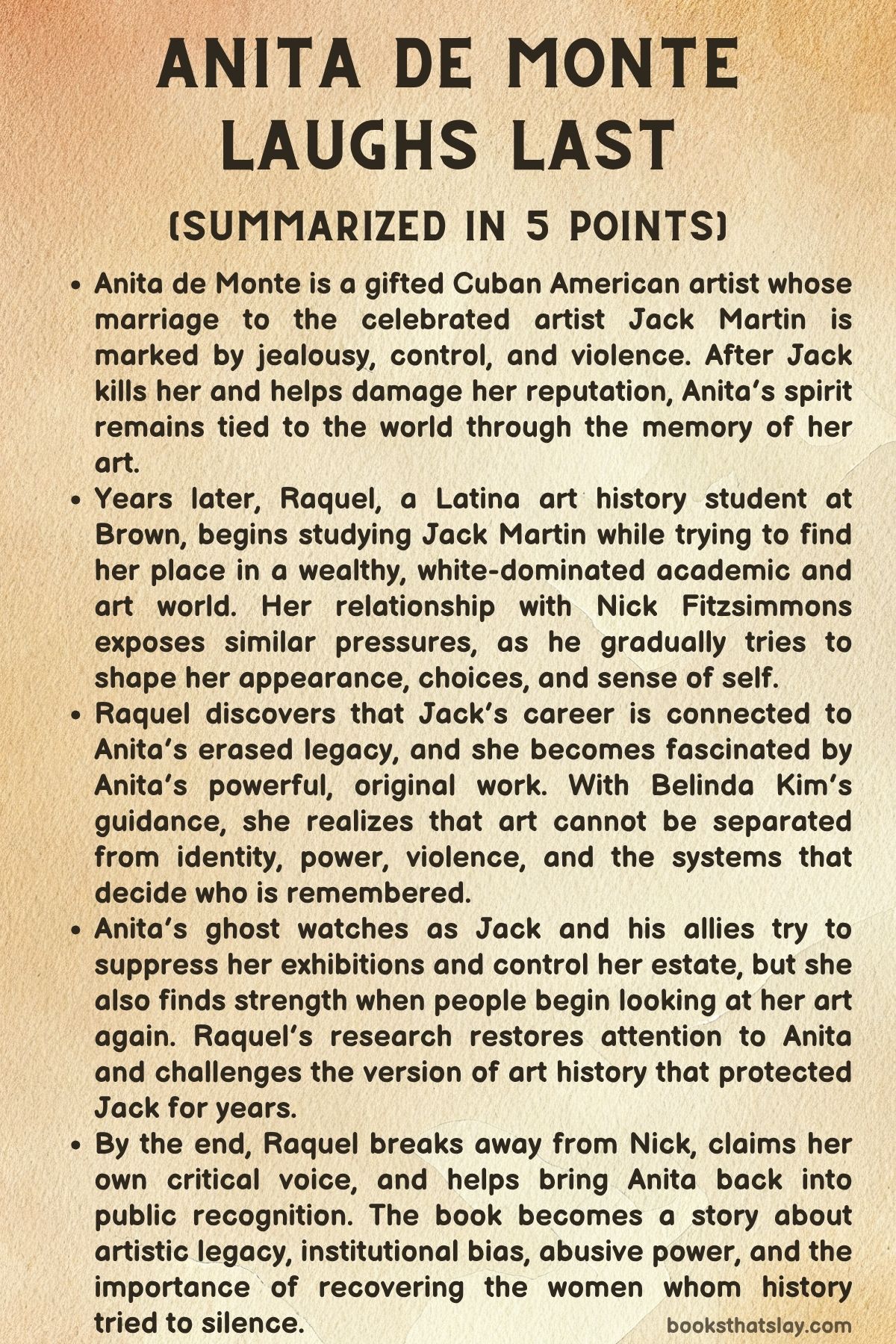
Characters
Anita de Monte
Anita de Monte is the emotional and artistic center of Anita de Monte Laughs Last, even though much of the book is shaped by the art world’s attempt to erase her. She is Cuban American, fiercely intelligent, sensual, funny, angry, and deeply aware of her own talent.
Anita’s art comes from memory, identity, nature, the body, and her connection to Cuba, especially the sea and spiritual traditions associated with Yemayá. She refuses the idea that identity is separate from art because, for her, creation is rooted in lived experience.
Her marriage to Jack Martin becomes one of the book’s clearest examples of how a powerful man can try to shrink a woman who threatens his ego. Jack wants Anita to be colorful enough to make him interesting, but not strong enough to rival him.
Even after her death, Anita remains restless because Jack and his allies try to control her legacy. Her ghostly presence gives the novel its sharpest sense of justice: she may have been killed, but she is not passive, silent, or defeated.
Anita’s anger is not presented as a flaw; it is a response to theft, violence, and erasure. By the end of the story, her power lies not only in haunting Jack but in being seen again through Raquel’s work.
Raquel Toro
Raquel is one of the most important figures in the book because she becomes the person who reopens Anita’s story and challenges the version of art history she has inherited. She is a Latina student at Brown, ambitious and intellectually serious, but also insecure about where she fits in a world shaped by wealth, whiteness, and social connections.
Raquel loves art, yet she knows that the institutions around her often treat people like her as outsiders. Her relationship with Nick exposes her vulnerability to approval from that world.
She starts to change her body, her clothes, her hair, and even her behavior because she thinks these changes might help her belong. At the same time, Raquel is not weak; she is observant, critical, and capable of growth.
Her discovery of Anita gives her a language for things she has already sensed: that art is never separate from power, and that the stories surrounding artists often protect men while dismissing women of color. Raquel’s journey is both academic and personal.
By choosing Anita over Jack as the true subject of her work, she also chooses herself over the version of herself Nick and the art world want her to become.
Jack Martin
Jack Martin is a portrait of artistic ego corrupted by entitlement. He is famous, physically imposing, and used to being treated as a genius.
His public identity depends on control: control over his image, his career, his wife, and the story others tell about him. Jack claims to believe that art should be judged apart from identity, but this belief benefits him because his own identity as a powerful white male artist is treated as neutral.
He dismisses Anita’s Cuban identity as secondary or decorative, while quietly fearing the force and originality of her work. His violence toward Anita grows out of a larger pattern of domination.
He resents her fellowships, her independence, her confidence, and her refusal to be reduced to his wife. After killing her, he continues trying to possess her by interfering with her estate and suppressing her exhibitions.
Jack’s cowardice is especially clear in the way he accepts help from lawyers, patrons, and gallerists who twist Anita’s image to protect him. Even when Anita’s ghost alters his art and critics praise the results, Jack cannot admit that her influence improves his work.
He is not simply a villain in the private sense; he represents an entire system that confuses reputation with greatness.
Nick Fitzsimmons
Nick is important because he mirrors Jack on a smaller and younger scale. He is not shown as openly monstrous in the beginning, which makes his role more unsettling.
He can be charming, attractive, and seemingly supportive, but his affection is tied to possession. He likes Raquel most when she becomes easier for him to display within his world.
He buys her clothes, comments on her body, orders food for her, and eventually cuts her hair in a way that shows how little he understands or respects her sense of self. Nick’s control often comes disguised as taste, care, or refinement.
He believes he is helping Raquel fit into elite spaces, but he is actually teaching her to doubt herself. His family background gives him confidence that he has not earned, and his artistic ambitions are supported by networks that are unavailable to Raquel.
Nick’s need for Raquel’s emotional labor becomes especially clear when he tells her he needs her support without showing equal concern for her inner life. His character shows how privilege can make selfishness look natural.
He is not Jack yet, but the book suggests that men like Jack are formed through years of small permissions, excuses, and unchecked entitlement.
Tilly Barber
Tilly Barber represents the institutional machinery that protects powerful men and decides whose art will be remembered. As Jack’s gallerist, she understands reputation, money, and influence.
She knows how to shape public perception, and she uses that knowledge to protect Jack after Anita’s death. Tilly’s parties are social spaces where art, wealth, gossip, and power circulate together.
She may present herself as a sophisticated figure in the art world, but her actions reveal a deep investment in preserving the hierarchy that benefits her. She treats Anita less as a major artist than as an inconvenience to Jack’s legacy.
Her efforts to stop Anita’s retrospective show that erasure does not happen by accident. It is often carried out through phone calls, favors, omissions, and quiet professional pressure.
Tilly’s racism and misogyny are not always loud, but they are effective. She understands that Anita’s memory threatens Jack’s market value and her own position, so she helps bury it.
In that sense, Tilly is one of the book’s most dangerous characters because she turns cultural authority into a weapon.
Professor John Temple
Professor Temple is a more subtle example of gatekeeping in Anita de Monte Laughs Last. He is not violent like Jack, but his worldview helps sustain the same system.
As Raquel’s professor, he teaches Jack Martin as an important artist while failing to give Raquel the full context of Jack’s life and crimes. His belief that an artist’s identity and personal actions should be separated from the art sounds intellectual, but the book exposes how convenient that position can be.
It allows men like Jack to remain central while women like Anita become footnotes. Temple also reveals the blurred power lines within academia when he shows inappropriate interest in Raquel.
His attraction to her carries the discomfort of a professor seeking emotional or romantic validation from a student. Still, he is not portrayed as entirely rigid.
When Raquel challenges him and asks to work with Belinda instead, he eventually allows the change. This does not erase his failures, but it makes him more realistic.
He represents a type of educated liberal authority that may see itself as fair-minded while still reproducing exclusion.
Belinda Kim
Belinda Kim serves as a necessary counterforce to Temple and the male-dominated art history Raquel has been taught. She understands that art is shaped by identity, history, race, gender, and power.
Her response to Raquel’s ignorance about Anita is one of shock because she knows how significant Anita’s story is and how disturbing it is that Raquel has been guided toward Jack without being told the truth. Belinda gives Raquel intellectual permission to ask better questions.
She does not treat Anita as a side note to Jack’s career, but as an artist whose work deserves direct attention. Her mentorship matters because she helps Raquel move from admiration of established reputation toward independent judgment.
Belinda also represents the importance of teachers who can see students fully. She recognizes Raquel’s intelligence and helps her develop an argument that challenges the art world’s accepted narrative.
Through Belinda, the book shows that scholarship can either preserve old hierarchies or expose them.
Marcus
Marcus is Raquel’s friend, musical partner, and one of the few people who sees her clearly while she is becoming absorbed into Nick’s world. He is not part of the art history elite, and that distance gives him a sharper view of Raquel’s relationship.
His teasing about Nick may sound casual, but it comes from real concern. He notices Raquel’s weight loss, her increasing absence from the radio station, and the way Nick’s life begins to reorganize her priorities.
Marcus represents friendship that is not based on social climbing or performance. With him, Raquel has access to a version of herself that is relaxed, funny, culturally rooted, and not constantly trying to prove she belongs.
The radio station becomes an important space of freedom because it is separate from Nick’s wealthy world and from the coded judgments of the art department. Marcus’s role is not to rescue Raquel but to remind her, through loyalty and honesty, that she had a self before Nick and can return to that self afterward.
Mavette
Mavette occupies an uneasy position between Raquel and the privileged Art History Girls. She is not white, and this makes her somewhat closer to Raquel than Claire and Margot, but her background is very different.
She grew up abroad, moves through elite spaces with more ease, and does not fully share Raquel’s understanding of race in America. Her failure to defend Raquel during the cruel dinner scene is important because it shows how silence can wound as much as direct insult.
Mavette is not presented as malicious in the same way as some of the others, but she is socially cautious. She wants connection, yet she also wants to preserve her place within a privileged circle.
Her later apology suggests that she recognizes her failure, though the damage has already been done. Mavette’s character reflects the complicated politics of belonging among students of color in elite institutions, where shared difference does not always produce solidarity.
Claire and Margot
Claire and Margot are part of the privileged social world that Raquel observes with both fascination and distrust. They represent the kind of wealthy, well-connected students who can treat art history as a natural inheritance rather than a difficult path to access.
Their cruelty toward Raquel is wrapped in the language of social awareness, which makes it especially revealing. They accuse her of racism and opportunism while showing little understanding of their own privilege.
Their comments about minorities “playing victim” expose the resentment that can sit beneath polished liberal manners. Later, their own romantic relationship and their families’ response to it add another layer to their portrayal.
Even their rebellion is absorbed into wealth and family strategy. Claire and Margot are not deeply individualized in the same way as Raquel or Anita, but they are important as a social force.
They show how elite spaces can punish outsiders while congratulating themselves on being progressive.
Raquel’s Mother
Raquel’s mother is one of the warmest moral presences in the book. She has worked close to great art without receiving the respect or access granted to wealthy patrons and scholars, yet she possesses intelligence, taste, and emotional wisdom.
Her visit to Raquel makes clear how much Raquel has changed under Nick’s influence. She notices the weight loss, the hairstyle, the new presentation, and the emotional distance forming between them.
Her concern is not controlling; it comes from love and from a deep knowledge of her daughter. When she meets Nick, she quickly senses what Raquel is not yet ready to admit.
She understands that kindness, respect, and character matter more than status. Her presence also challenges class assumptions in the art world.
She may not belong to Nick’s elite circles, but she can speak thoughtfully about art and see people with far more clarity than many of the so-called experts. Through her, the book honors forms of knowledge that institutions often ignore.
Toni
Toni, Raquel’s sister, plays a smaller but meaningful role as someone who speaks uncomfortable truths. She notices Raquel’s transformation and connects it to Nick more directly than Raquel wants to hear.
Toni’s comments can feel blunt, but they come from sisterly concern. She understands the pressure Raquel is under, and she sees how easily a relationship with a wealthy white man can become a demand for self-erasure.
Toni’s presence reminds Raquel of family, history, and the body she had before Nick’s gaze began reshaping it. Alongside their mother, Toni helps expose the contrast between Raquel’s loving home life and Nick’s colder, more status-driven family.
She is important because she refuses to be impressed by Nick’s money or art-world access. Her judgment is simple but accurate: Nick is not good for Raquel.
Betsaida
Betsaida is part of Raquel’s support system and helps bring her back to herself after the damage caused by Nick. Her role becomes especially important when she takes Raquel to a limpia, a cleansing ritual that helps Raquel feel lighter and more grounded.
Betsaida represents cultural and spiritual knowledge that exists outside elite academic frameworks but still carries real power. The ritual also connects Raquel’s healing to the broader spiritual atmosphere of the novel, especially Anita’s connection to Cuban belief and the afterlife.
Betsaida does not need to give long speeches to matter. Her care is practical, present, and rooted in understanding.
She helps Raquel recover without judgment, showing the importance of community when someone is leaving a harmful relationship.
Leslie
Leslie is significant because she is connected to Anita’s early artistic career and to the feminist art spaces that claim to support women and artists of color. She runs the Venus Collective and helps bring Jack to an event for Anita, hoping his fame will attract attention.
Yet this choice also reveals one of the book’s central tensions: even spaces meant to uplift marginalized artists can end up centering powerful men. Leslie’s intentions seem supportive, but Jack’s presence overshadows Anita.
Through Leslie, the book shows that allyship can be complicated. A person may sincerely want to help while still relying on the very structures that diminish the artist they mean to promote.
Leslie is not an antagonist like Tilly, but her role shows how easily women artists can be displaced even within feminist cultural spaces.
Ingrid
Ingrid is Jack’s lover and later caretaker, and her presence reveals Jack’s entitlement in intimate relationships. He brings her to Anita’s memorial, an act of astonishing disrespect that shows how little shame he feels and how protected he believes himself to be.
Ingrid’s relationship with Jack also becomes one of the places where Anita’s ghost expresses rage, especially because Ingrid is tied to Jack’s betrayal. Later, Ingrid helps care for Jack, managing his pills and trying to control his drinking.
Her role is not explored as deeply as Anita’s or Raquel’s, but she shows the pattern of women orbiting Jack’s needs. Whether as lover or caretaker, she exists in relation to his comfort, his body, and his decline.
Astrid Fitzsimmons
Astrid is Nick’s sister and Raquel’s friend through the RISD internship world. She is described by her family as difficult, and that label says as much about the Fitzsimmons family as it does about Astrid.
Her struggles, including the frightening drug incident, suggest that wealth does not create emotional safety. Nick’s parents treat her as a problem while admiring Raquel as someone who might make better use of opportunity.
This comparison is cruel to both young women. Astrid exposes the coldness inside Nick’s family, where affection seems tied to performance and usefulness.
Her presence also helps Raquel see that the Fitzsimmons household is not the ideal world she once imagined. It may have money, taste, and influence, but it lacks warmth.
Linda Fitzsimmons
Linda Fitzsimmons, Nick’s mother, represents the polished prejudice of elite patronage. She is socially graceful and capable of appearing generous, but her comments reveal a worldview shaped by class and racial assumptions.
She likes Raquel in a limited way, seeing her as impressive because of her “position,” but this approval depends on Raquel being grateful, exceptional, and nonthreatening. Linda’s admiration for Jack and dismissal of Anita expose her loyalty to the art world’s established hierarchy.
She owns or controls access to pieces connected to Anita, and her choices affect what can be seen and remembered. Linda’s character shows that collectors and patrons are not neutral supporters of art.
They shape history by deciding what remains visible, what stays hidden, and whose reputation is worth protecting.
Ron
Ron, Jack’s attorney, is a practical operator within the legal system. His role is not to discover truth but to secure Jack’s acquittal.
He understands gender bias well enough to use it, advising Jack to avoid a jury because women are unlikely to believe his innocence. This makes him an important figure in the book’s criticism of institutional power.
Ron does not need to believe Jack is morally innocent; he only needs to build a strategy that will work. His legal advice shows how violence against women can be reframed, softened, or excused when the accused man has money and status.
Ron’s character is not emotionally central, but he is structurally important because he helps translate Jack’s privilege into legal protection.
Anita’s Sister
Anita’s sister appears mainly through the conflict over Anita’s estate, but her role matters because she stands as a rightful guardian of Anita’s legacy. Jack’s attempt to seize control from her proves that his desire to possess Anita does not end with her death.
He wants access not only to Anita’s memory but also to the material future of her art. Anita’s sister represents family, inheritance, and the possibility that Anita’s work might be protected by someone who values her as a person rather than as a threat to Jack’s reputation.
Although she is not developed at length, the struggle around her position reveals how estates, archives, and legal control can become battlegrounds over an artist’s meaning.
Yemayá
Yemayá is not a conventional human character, but her presence is important to Anita’s identity and the spiritual structure of the novel. Associated with motherhood and the sea, Yemayá helps shape Anita’s sense of belonging, memory, and artistic power.
Anita’s connection to Cuba and to the ocean is not decorative; it is central to how she understands herself. Yemayá’s presence gives Anita’s art and afterlife a sacred dimension that Jack cannot understand or control.
In a book so concerned with who gets to define meaning, Yemayá represents a source of meaning beyond museums, critics, husbands, and gallerists. This spiritual presence helps make Anita’s survival after death feel connected to culture rather than merely fantasy.
Themes
Erasure and the Recovery of Women Artists
The art world in Anita de Monte Laughs Last does not simply forget Anita by accident; it forgets her through active choices made by people with influence. Jack wants her work controlled because her talent threatens his reputation, and Tilly helps suppress exhibitions because Anita’s visibility would damage the story that protects Jack.
Collectors and institutions also become part of this erasure when they hide, ignore, or misread her work. The book shows that cultural memory is not neutral.
It is shaped by galleries, museums, critics, scholars, patrons, and money. Anita’s disappearance from public conversation reveals how easily women, especially women of color, can be removed from art history when their presence makes powerful people uncomfortable.
Raquel’s research reverses that process. By looking carefully at Anita’s work and refusing to treat her as a footnote to Jack, Raquel restores her significance.
This theme is powerful because recovery is not presented as simple praise. It requires evidence, courage, interpretation, and a willingness to challenge the stories institutions have repeated for years.
Art, Identity, and Power
The conflict over whether identity matters in art runs throughout the story. Jack and Professor Temple prefer the idea that art can be separated from the artist’s race, gender, history, and personal life.
On the surface, this may sound objective, but the book shows how often that kind of objectivity protects those already treated as universal. Jack’s whiteness and masculinity are allowed to fade into the background, while Anita’s Cuban identity is treated as excessive, political, or limiting.
Anita’s art proves the opposite. Her work gains its force from memory, body, place, spirit, and cultural inheritance.
Raquel’s intellectual growth depends on recognizing that identity does not weaken art; it can be the source of its originality. The theme also exposes how power decides which identities are considered relevant.
When white male artists make work from their experience, it is often called serious or universal. When women of color do the same, it is often categorized, reduced, or exoticized.
The story rejects that double standard and argues for a fuller way of seeing art.
Control in Romantic Relationships
The relationships between Anita and Jack, and Raquel and Nick, reveal how control can operate through intimacy. Jack’s abuse is ultimately violent and fatal, but the book also pays attention to the earlier patterns that make his domination clear: jealousy of Anita’s success, resentment of her independence, belittling of her art, and anger when she chooses opportunities beyond him.
Nick’s behavior is less extreme, but it follows a similar emotional logic. He wants Raquel to support him, admire him, and fit his world.
He influences what she wears, what she eats, how she presents herself, and finally even how her hair looks. These acts may appear smaller than Jack’s violence, but the book treats them as warning signs of possession.
Both relationships show men who are drawn to talented women but cannot tolerate their full personhood. The women are expected to give admiration, labor, beauty, and loyalty while receiving control in return.
Raquel’s escape from Nick becomes meaningful because it shows her recognizing the pattern before it consumes her. Anita’s fate gives that recognition urgency.
Class, Race, and Belonging in Elite Spaces
Raquel’s experience at Brown and in the art world shows how elite spaces often invite diversity without giving up their hierarchies. She is allowed into classrooms, parties, internships, and wealthy homes, but she is constantly made aware that she is being evaluated.
The Art History Girls treat her as suspicious, Nick’s family sees her through classed and racial assumptions, and even academic mentorship is shaped by power. Raquel’s desire to belong is understandable because access matters in the career she wants.
Yet belonging comes with pressure to change herself. She loses weight, accepts clothes chosen for her, moderates personal details, and tries to appear more acceptable to people who will never fully see her.
Her family’s visit exposes the emotional cost of this performance. Their warmth and directness contrast with the cold politeness of Nick’s world.
The theme is not only about exclusion; it is about the hidden price of conditional inclusion. Raquel’s growth comes when she stops treating elite approval as proof of worth and begins trusting her own judgment, community, and cultural knowledge.