An Inside Job by Daniel Silva Summary, Characters and Themes
An Inside Job by Daniel Silva is a crime thriller centered on Gabriel Allon, an art restorer whose quiet life in Venice is interrupted by a murder, a missing masterpiece, and corruption at the highest levels of the Vatican. The book blends art history, organized crime, political intrigue, and family life into a fast-moving investigation.
At its center is the possible discovery of a lost Leonardo da Vinci painting, a treasure so valuable that people are willing to steal, lie, and kill for it. Gabriel’s search for the truth leads from Venice to Rome, Switzerland, France, and back to the Vatican.
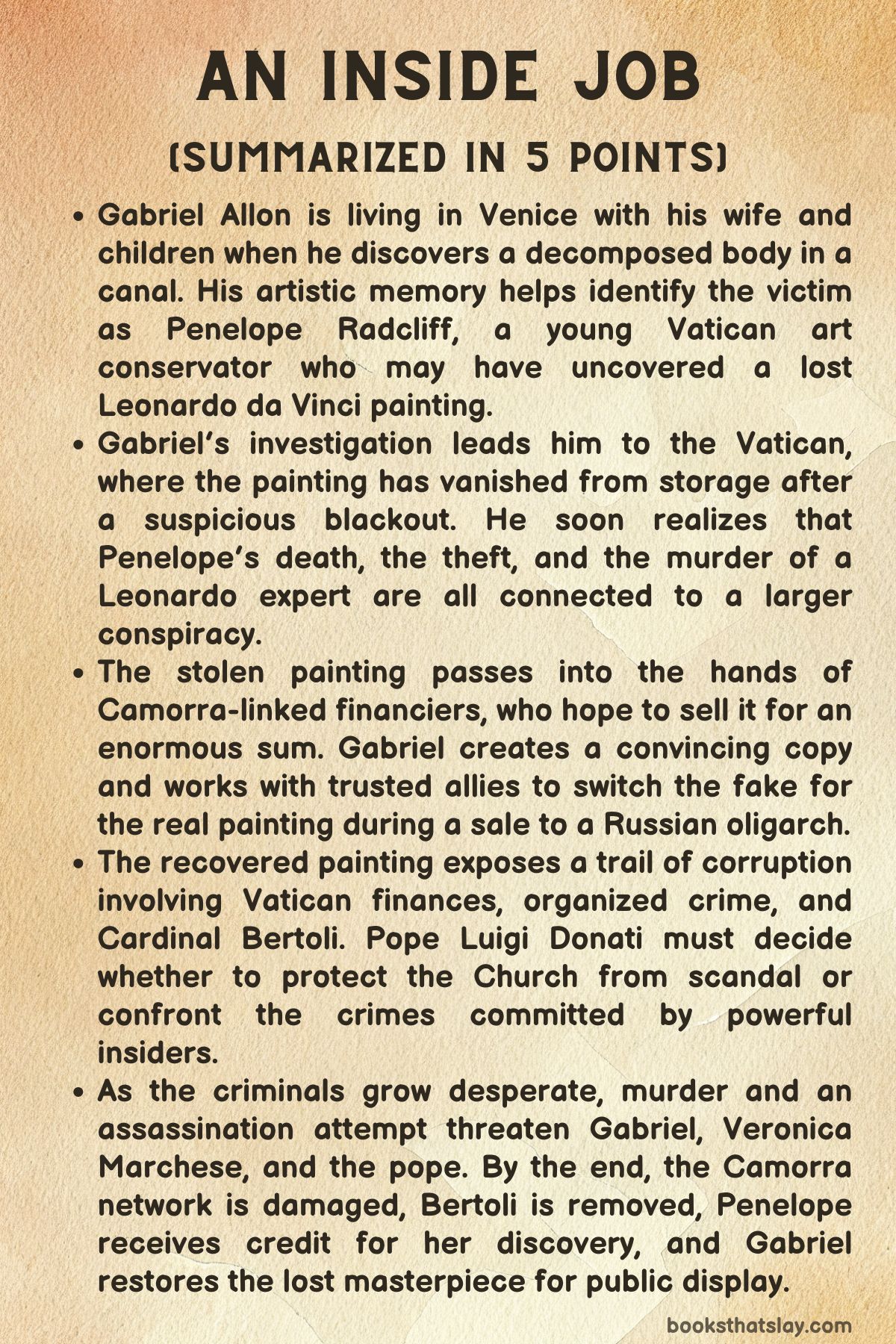
Summary
Gabriel Allon is living in Venice with his wife, Chiara, and their twins, Raphael and Irene. He is now known mainly as a master art restorer, while Chiara manages the Tiepolo Restoration Company.
Their domestic routine is lively but peaceful. Irene has organized a student protest over government inaction on climate change, which draws Gabriel and Chiara into a meeting with the school principal.
Gabriel helps turn the conflict into a compromise: the students will march on a weekend rather than miss school, and he will host them for lessons on art restoration.
Soon after, Gabriel is working on a Titian painting in a Venetian basilica when he notices something floating in the canal. He hires a water taxi to get closer and discovers that it is a badly decomposed body.
He contacts Captain Luca Rossetti, a trusted friend in the Art Squad. Because the body is difficult to identify, Gabriel is asked to use his visual memory and artistic skill to reconstruct the victim’s face.
As he works, Gabriel realizes he has seen the woman before. She had been at a café in Venice only weeks earlier, wearing the same pendant found on the corpse.
He and Chiara return to the café, where a waiter helps them review security footage. The footage also shows Amelia March, an English art journalist, waiting for the woman.
Gabriel travels to London to question Amelia, who explains that the victim had wanted to give her an exclusive story involving a painting and possible crime. The dead woman is identified as Penelope Radcliff, a gifted young art conservator who had been working at the Vatican.
Gabriel alerts Pope Luigi Donati, an old friend and reform-minded pontiff. Luigi is trying to clean up the Church without tearing apart an institution filled with entrenched interests.
Gabriel learns that Penelope had been assigned to restore a minor painting at the Vatican. During the restoration, she became convinced that a much more important work lay beneath the surface: possibly a lost painting by Leonardo da Vinci.
Her supervisor, Antonio Calvesi, had shown evidence of the discovery to Giorgio Montefiore, a respected Leonardo expert, who dismissed the claim. Penelope was taken off the project.
When Gabriel and Calvesi go to inspect the painting, they find that it has vanished from storage. The theft appears to have happened during a power blackout, with help from someone inside the Vatican.
Gabriel questions a security guard named Ottavio Pozzi, who admits he removed the painting after criminals threatened his imprisoned brother. Ottavio says he handed it to a priestlike figure who carried it out of the Vatican.
Gabriel sketches the man, and Pope Luigi recognizes him as Father Spada, a visiting cleric connected to a charity in Mali.
Gabriel then turns to Giorgio Montefiore, but when he and museum director Veronica Marchese visit the expert’s villa, they find him shot dead. Gabriel concludes that Montefiore had secretly confirmed the painting’s authenticity and was killed once he was no longer useful.
The conspiracy now includes Penelope’s murder, the theft of the Leonardo, and Montefiore’s execution. Rather than simply call in every police force available, Gabriel wants the thieves to reveal themselves by trying to sell the painting.
Back in Venice, Gabriel creates an exact copy of the lost Leonardo. Meanwhile, his old friend Julian Isherwood, a London art dealer, receives an invitation from an Amsterdam dealer to view a rare artwork.
Gabriel suspects this is the missing painting. Julian agrees to go, while Gabriel and Sarah Bancroft monitor him.
Julian is flown to a private viewing, where he sees the painting and realizes it is almost certainly the lost Leonardo. The seller refuses to let him take it for testing, so Julian offers $250 million.
Sarah traces the plane to Lugano, Switzerland, and a bank called SBL PrivatBank.
Gabriel consults Martin Landesmann, a wealthy financier with a dubious past. Martin identifies the bank as Camorra-controlled and names Franco Tedeschi as the man managing the criminal organization’s financial assets.
Gabriel needs more information, so he recruits Ingrid Johansen, a former thief and cyberhacker. Ingrid breaks into the bank’s systems and discovers that the Leonardo had been handed over to the bank after a failed real estate deal.
The bank has insured the painting for half a billion dollars, but the policy will only pay if the painting is stolen from its vault. This means the criminals have both a sale motive and an insurance motive.
Gabriel builds a plan to steal back the real painting and leave his copy in its place. Ingrid tracks the painting as it is shown to possible buyers.
Gabriel’s copy must be flawless enough to fool dealers, criminals, and private experts. His son Raphael secretly shows artistic talent by sketching the Leonardo, though he resists joining Gabriel’s art class.
The bidding rises quickly, driven by wealthy collectors and Gabriel’s own manipulation of the market. Sarah leaks rumors to the art press, and Julian’s associates pose as serious buyers to push up the price.
The final buyer is Alexander Prokhorov, a Russian oligarch with frozen assets and a villa in Antibes. Gabriel and his team decide not only to recover the painting but also to redirect the oligarch’s payment.
Sarah suggests sending the money to Ukraine, turning a criminal sale into a costly humiliation for both the Camorra and the oligarch.
The exchange takes place in France. Ingrid is placed on the Camorra’s private jet as a substitute flight attendant.
At the Nice airport, French art-crime officer Jacques Ménard uses an inspection as cover to carry the painting into a secure room. Gabriel waits there with the copy.
The real Leonardo is swapped for the fake, and the fake is returned to the plane. The Dutch dealer cannot detect the switch.
Gabriel takes the original across the Italian border under police escort.
The Camorra continues to Antibes, where Prokhorov’s expert authenticates the fake and authorizes the $500 million payment. After the transaction, Ingrid transfers the funds out of the Camorra bank, and Christopher Keller helps route the money to Ukraine.
The criminals believe they have completed a profitable sale, while Gabriel has recovered the original Leonardo.
The case, however, is far from over. Bank records reveal links to Nico Ambrosi, a Vatican financial adviser, and to Piedmont Global Capital, the failed London real estate deal that created the financial pressure behind the theft.
Pope Luigi explains that Vatican investments are controlled through Cardinal Matteo Bertoli, his chief of staff. Gabriel compares hacked bank data with Vatican records and sees that Bertoli has hidden massive losses.
Bertoli has entrusted Church money to Ambrosi and Tedeschi, who have enriched themselves through loans, fees, and fraud.
Gabriel and Luigi decide to trap Bertoli. The pope places the recovered Leonardo in plain sight during a meeting with the cardinal, then feeds him false information about the investigation.
Bertoli quickly contacts Ambrosi, and Gabriel monitors his communications. At a restaurant, Bertoli meets Ambrosi and Tedeschi.
Tedeschi realizes that the oligarch now has a fake painting and demands $400 million from Bertoli. Bertoli warns that exposing him will damage the Church and destroy their laundering operation.
Soon after, Luigi confronts Bertoli with evidence of fraud and the theft. Bertoli asks for time to fix the damage, but Luigi refuses.
Desperate and cornered, Bertoli considers murder. Ottavio, the security guard who helped remove the painting, is killed, and his brother is attacked in prison.
Gabriel believes Father Spada is the killer and that he also murdered Penelope and Montefiore. Gabriel grows concerned that Luigi himself may be targeted.
The threat becomes real during a public appearance in St. Peter’s Square. As the pope appears before the crowd, shots ring out.
Luigi is hit in the chest, and Veronica is also shot while trying to stop the assassin. Rossetti shoots the attacker before he can kill Gabriel.
At the hospital, Gabriel fears Luigi is dead, but discovers that the pope survived because he was wearing a bulletproof vest. Veronica survives after surgery.
Luigi believes Bertoli encouraged the Camorra to eliminate both him and Gabriel.
In the aftermath, Italian authorities arrest more than 200 Camorra operatives. Nico Ambrosi and Franco Tedeschi are captured.
Luigi orders an outside audit of Vatican finances, which confirms major fraud. Bertoli is removed from office and sent away to an isolated abbey.
The public does not immediately learn how all the crimes connect to Penelope, Montefiore, Ottavio, the painting, and the Vatican’s financial corruption.
Months later, Gabriel restores the lost Leonardo in Venice. Experts confirm its authenticity, and the Vatican prepares to display it.
Gabriel’s team also cleans up loose ends, including recovering the fake painting from the oligarch’s home. When the full story is finally published, Penelope Radcliff receives credit for discovering the masterpiece.
The Camorra’s role in the theft and murders is revealed, and public excitement around the painting grows.
The restored Leonardo is unveiled at a major Vatican event attended by Gabriel, his family, and friends. His work is praised by the art world.
In a quieter personal ending, Raphael finally decides to join Gabriel’s art class. Gabriel wonders whether Chiara influenced the boy’s change of heart, and the title An Inside Job takes on one final, playful meaning: not every hidden influence is criminal.
Characters
Gabriel Allon
Gabriel Allon is the central figure of An Inside Job, and the book presents him as a man whose quiet retirement is never fully separate from danger, intelligence work, and moral responsibility. At the beginning, he appears settled into a domestic life in Venice, restoring great works of art and raising his children with Chiara.
Yet the discovery of Penelope Radcliff’s body immediately draws out the older Gabriel: observant, disciplined, suspicious, and incapable of ignoring a crime that touches both art and human life. His gift as a restorer is not just technical; it is also investigative.
He sees details others miss, remembers faces with near-perfect clarity, and understands how hidden truths can lie beneath a damaged surface. This makes him especially suited to a mystery involving a concealed Leonardo, a murdered conservator, and corruption masked by religious authority.
Gabriel’s moral code is one of action rather than comfort. He does not simply want the painting returned; he wants Penelope’s discovery honored, the killers exposed, and the corrupt financial network behind the theft damaged.
His methods are often deceptive, especially when he creates the fake painting, manipulates the bidding war, and helps redirect the oligarch’s money to Ukraine. Yet the story frames these actions as part of a larger justice.
Gabriel is willing to operate in gray areas because the criminals he faces use legal, religious, and financial systems as shields. His character is defined by his ability to outthink them without becoming like them.
He remains loyal to friends, protective of family, and deeply respectful of art as a human inheritance.
His family life also gives the book a softer emotional base. With Chiara, he is not the lone operative but a husband who listens, argues, worries, and returns home.
With Irene and Raphael, he is both father and teacher, sometimes unsure how to reach them. Raphael’s hidden artistic ability mirrors Gabriel’s own talent and suggests that legacy is not only political or professional but personal.
By the end, Gabriel has restored the Leonardo, helped expose corruption, and preserved the pope’s life, but his final satisfaction also comes from Raphael joining his class. That quiet moment shows that beneath the thriller structure, Gabriel is a man trying to protect what is valuable: art, truth, faith, friendship, and family.
Chiara Zolli
Chiara Zolli is Gabriel’s wife and the manager of the Tiepolo Restoration Company, and her role in the book is far more than domestic support. She provides emotional steadiness, practical judgment, and a strong connection to everyday life.
While Gabriel is drawn into murder, theft, and Vatican corruption, Chiara keeps their family grounded. She handles the logistics of their household, supports their children, and remains involved in Gabriel’s work without trying to control him.
Her intelligence shows in the way she thinks through problems with him, such as when she helps him return to the café where he believes he saw Penelope. She trusts Gabriel’s instincts, but she also challenges him when necessary.
Chiara’s presence gives the story a sense of consequence. Gabriel’s work is dangerous because he has something real to lose.
His home in Venice is not a decorative background; it is the life he has chosen after years of violence and espionage. Chiara understands that Gabriel cannot ignore injustice, yet she also knows the cost of his involvement.
Her patience is not weakness. It comes from knowing who Gabriel is and accepting that his sense of duty will always pull him toward risk.
At the same time, she protects the ordinary rhythms of family life: school meetings, meals, children’s concerns, and the emotional needs of Raphael and Irene.
Chiara also represents a kind of quiet influence. The final suggestion that Raphael may have joined Gabriel’s art class because of her adds a gentle echo of the title.
While criminals conduct hidden operations for greed, Chiara’s “inside job” is one of care, persuasion, and family wisdom. She does not need to dominate the action to shape its emotional outcome.
Pope Luigi Donati
Pope Luigi Donati is one of the most morally significant characters in the novel. As a reformer, he occupies a position of immense spiritual authority but also deep vulnerability.
He wants to change the Church from within, but he understands that reform can provoke powerful enemies. His friendship with Gabriel is built on trust, shared history, and a mutual understanding of danger.
When Gabriel brings him the possibility that a murdered conservator and a stolen painting are connected to the Vatican, Luigi does not dismiss the threat. He allows Gabriel to investigate because he knows the institution he leads may contain corruption at its highest levels.
Luigi’s conflict is both political and spiritual. He wants transparency, but he also fears the damage scandal could do to the Church.
His struggle is not about protecting his own image; it is about whether exposing corruption will weaken the faithful or cleanse the institution. This tension makes him a compelling figure.
He is not naïve about power. He knows that cardinals, financiers, and traditionalists resent him.
Still, he refuses to protect wrongdoing once the truth becomes clear. His confrontation with Bertoli shows his courage.
He rejects the cardinal’s argument that scandal must be avoided at any cost and chooses accountability over concealment.
Luigi’s public speeches also reveal his moral priorities. His remarks on migrants, wealth, oppression, and cruelty show a pope who sees faith as an obligation to defend the vulnerable.
These beliefs make him dangerous to corrupt insiders because he threatens both their money and their worldview. The assassination attempt against him proves how far his enemies are willing to go.
His survival, aided by the bulletproof vest, allows him to continue his mission, but it also shows that reform requires both faith and strategy. Luigi is a man of conscience who learns that holiness alone cannot defeat corruption; it must be joined with courage, evidence, and decisive action.
Penelope Radcliff
Penelope Radcliff, often called Penny, is dead before Gabriel fully enters the mystery, yet her presence drives the entire book. She is a gifted young art conservator whose eye and discipline allow her to recognize what others miss: the possibility that a lost Leonardo lies beneath the surface of an obscure painting.
Her discovery should have brought her honor, professional recognition, and a place in art history. Instead, it makes her a threat to people who see the painting only as a financial instrument.
Her murder gives the plot its emotional and moral charge.
Penny represents the purity of scholarly and artistic dedication. She does not discover the painting through greed or ambition in the corrupt sense.
She sees value where others see routine work, and she tries to bring the truth into the open by contacting a journalist. That decision shows both courage and vulnerability.
She understands that something is wrong, but she underestimates the reach and brutality of the people involved. Her death exposes the cruelty of a world where knowledge can be dangerous when it interferes with money.
Although Penny does not act directly in much of the story, Gabriel’s commitment to recovering the painting is inseparable from his desire to restore her name. The final public credit she receives matters because it gives her back the achievement that murder tried to erase.
In that sense, the restoration of the Leonardo is also a restoration of Penny’s legacy. She becomes a symbol of truth hidden under layers of deception, waiting for someone honorable enough to reveal it.
Luca Rossetti
Captain Luca Rossetti is Gabriel’s close friend and a member of the Art Squad, and he provides both official support and personal loyalty throughout the investigation. He is practical, brave, and familiar with the strange borderland where art crime meets organized crime.
His friendship with Gabriel is built on mutual trust. Rossetti knows Gabriel’s talents and instincts, and he is willing to follow leads that might appear strange to a more conventional investigator.
At the same time, he gives Gabriel access to police authority, forensic information, and institutional reach.
Rossetti’s importance grows as the case expands from a body in a canal to an international conspiracy involving the Camorra, Vatican finance, and murder. He helps question Ottavio, studies the evidence from the bank, and participates in surveillance when Bertoli meets his criminal partners.
He is not merely a sidekick; he is a capable officer who understands the stakes and remains steady under pressure. His response during the assassination attempt is especially important.
By shooting the attacker before Gabriel can be killed, Rossetti saves his friend and helps prevent further bloodshed.
Rossetti also has a human warmth that balances the darker parts of the story. His possible romantic interest in Veronica suggests a future beyond violence and scandal.
Like Gabriel, he is a protector of cultural heritage, but he is also a protector of people. His character shows that justice in the book depends not only on brilliance but on loyalty, courage, and the willingness of good people inside institutions to act.
Veronica Marchese
Veronica Marchese is intelligent, cultured, direct, and emotionally complex. As the director of the National Etruscan Museum, she belongs naturally to the world of art and history, but her role extends far beyond expertise.
She quickly understands the implications of a stolen Leonardo and the likelihood that the theft required help from within the Vatican. Her sharp mind makes her a valuable ally to Gabriel, and her personal connection to Luigi gives her a deeper emotional place in the story.
Veronica’s past romance with Luigi adds restraint and sadness to her character. Their love remains real, but it is shaped by choices that cannot easily be undone.
Luigi has become pope, and Veronica has built an independent life. Their bond gives several scenes a private emotional weight, especially when Luigi keeps vigil at her hospital bedside after she is shot.
Veronica is not defined by this romance, however. She acts with courage in her own right.
During the assassination attempt, she tries to stop the shooter and is wounded because of it. That act shows instinctive bravery rather than calculated heroism.
Her partnership with Gabriel is based on respect. She helps him study financial records, accompanies him to investigate Montefiore, and takes part in surveillance.
She is perceptive enough to see how greed, vanity, and institutional secrecy have created the conditions for murder. By the end, her recovery suggests resilience, and Gabriel’s encouragement that she consider a future with Rossetti points toward renewal.
Veronica is a character marked by intelligence, old love, sacrifice, and the possibility of beginning again.
Cardinal Matteo Bertoli
Cardinal Matteo Bertoli is the main embodiment of corruption inside the Vatican. He is not a villain who begins with open violence; his evil grows out of ambition, greed, vanity, and entitlement.
He has used his position to gain access to money, influence, and comfort, treating the Church less as a spiritual institution than as a structure that can protect him. His resentment toward Luigi comes from fear.
A reforming pope threatens the hidden arrangements that have allowed Bertoli to enrich himself and conceal failure.
Bertoli’s crimes begin with financial wrongdoing but expand into theft and murder by association. When Vatican investments collapse through corrupt dealings with Nico Ambrosi and Franco Tedeschi, the lost Leonardo becomes a solution to his problems.
He helps set in motion the theft of the painting and uses others to do the dirtiest work. His willingness to let Penelope’s discovery be stolen shows his moral emptiness.
He does not see the painting as a sacred cultural object or a young scholar’s achievement; he sees it as a way to cover losses and preserve power.
What makes Bertoli especially dangerous is his ability to speak the language of institutional protection. When confronted, he argues that exposing him will damage the Church.
This is the logic of corrupt authority: the institution must be protected by hiding the crimes committed in its name. Luigi’s rejection of that logic is one of the book’s clearest moral moments.
Bertoli’s final turn toward assassination reveals that his priestly identity is only a shell. At his core, he is a man willing to sacrifice anyone to save himself.
Franco Tedeschi
Franco Tedeschi is a polished criminal financier whose power comes from money rather than street violence. As the man managing Camorra assets through SBL PrivatBank, he represents organized crime’s modern face: banking, insurance, private jets, shell transactions, and art dealing.
He is dangerous because he can move comfortably among businessmen, dealers, and criminals. His elegance hides the brutality of the organization he serves.
Tedeschi treats the Leonardo as an asset to be exploited. Whether through sale, insurance fraud, or leverage, the painting is valuable only as a tool for profit.
His confrontation with Ingrid shows his suspicious and controlling nature. He senses that something is wrong even when he cannot prove it, and his questions reveal a man used to command and intimidation.
Yet he is also vulnerable to Gabriel’s superior planning. By the time Tedeschi realizes he has been deceived, the money and the real painting are gone.
His relationship with Bertoli and Nico shows how organized crime thrives through partnerships with respectable figures. Tedeschi does not need to invade the Vatican with force; he needs insiders willing to cooperate.
His character exposes the connection between criminal violence and elite finance. He may not personally commit every murder, but his world makes those murders useful and likely.
In An Inside Job, he stands for the conversion of beauty, faith, and trust into money.
Nico Ambrosi
Nico Ambrosi is the Vatican financial adviser whose role reveals how corruption often hides behind professional expertise. He is not presented as a dramatic killer or public villain; instead, he works through advice, transactions, loans, and fees.
His danger lies in his access to decision-makers and his ability to make reckless or corrupt arrangements look legitimate. Through him, Church money flows into deals that benefit himself and his partners while weakening the institution he is supposed to serve.
Nico’s relationship with Bertoli is based on manipulation and mutual advantage. Bertoli wants wealth and financial success without scrutiny, while Nico provides the mechanisms that allow losses to be hidden and money to be siphoned away.
His partnership with Tedeschi links the Vatican’s internal corruption to the Camorra’s banking network. This makes him a bridge between clerical ambition and organized crime.
As a character, Nico helps show that not every villain needs to carry a weapon. Some destroy through spreadsheets, false assurances, and carefully arranged deals.
His crimes create the pressure that leads to the theft of the Leonardo and the deaths surrounding it. Without people like Nico, Bertoli’s greed might remain smaller and less destructive.
Nico turns corruption into a system.
Ingrid Johansen
Ingrid Johansen is one of the book’s most useful and memorable allies. A former thief and cyberhacker, she brings skills that Gabriel cannot easily replace.
Her past gives her a complicated moral position. She has lived outside the law, but she now seeks a form of atonement by helping recover the Leonardo.
This makes her different from the criminals she opposes. She knows deception, theft, and infiltration, but she chooses to use those abilities in service of restoration rather than greed.
Ingrid’s hacking of the Camorra bank is crucial because it changes the investigation from suspicion to knowledge. She uncovers the financial structure behind the crime and gives Gabriel the information needed to plan the recovery.
Her role as the substitute flight attendant is even riskier. She places herself physically close to dangerous criminals and maintains composure when Tedeschi becomes suspicious.
Her courage is quiet, controlled, and professional.
Her connection with Gabriel’s family also softens her characterization. Raphael and Irene respond warmly to her, suggesting that she is not merely a technical operator but a person capable of affection and trust.
Ingrid’s arc is one of redemption through action. She cannot erase her past, but she can decide what her talents are for now.
In a book filled with hidden motives, hers becomes clear: she wants to help set something right.
Julian Isherwood
Julian Isherwood is Gabriel’s old friend and a London art dealer whose knowledge of the art market makes him essential to the operation. He is charming, experienced, and deeply connected to the world of collectors, galleries, and private sales.
Julian is not an action hero, but he has courage of a different kind. By agreeing to view the suspected Leonardo, he knowingly places himself in the path of dangerous criminals.
Julian’s value lies in credibility. The sellers believe he is a plausible buyer or broker, and his judgment carries weight.
When he sees the painting, his recognition helps confirm Gabriel’s theory. Later, his network helps create the artificial bidding pressure that drives the price higher.
He understands the vanity and competitiveness of the ultra-rich art world, and Gabriel uses that knowledge to manipulate the criminals.
Julian also provides a link to Gabriel’s past and to a more civilized world of connoisseurship. He loves art, but unlike the Camorra and the oligarch, he does not reduce it to money.
His willingness to help reflects friendship and reverence for the work itself. Through Julian, the book shows that the art market can be vulnerable to greed, but it also contains people who respect beauty and truth.
Sarah Bancroft
Sarah Bancroft is a former CIA officer and Julian’s business partner, and she brings intelligence discipline, operational awareness, and strategic imagination to Gabriel’s team. She is especially important in tracking the plane used by the sellers and identifying the movement of the painting to Switzerland.
Her skills help transform a vague lead into actionable intelligence. She is calm under pressure and comfortable operating in spaces where art dealing, espionage, and finance overlap.
Sarah’s suggestion to send the oligarch’s money to Ukraine reveals her sharp moral and political instincts. She understands that recovering the painting is not enough.
The criminals can also be punished financially, and the oligarch’s wealth can be turned toward a cause opposite to his interests. This idea gives the operation a broader meaning.
It becomes not only an art recovery mission but also an act of symbolic justice.
Sarah is also part of Gabriel’s trusted circle, someone who understands both legality and necessity. She does not act recklessly, but she is not trapped by conventional thinking.
Her presence shows how Gabriel succeeds because he gathers people with different forms of expertise. Sarah contributes intelligence, courage, and the ability to see opportunity inside risk.
Christopher Keller
Christopher Keller, Sarah’s husband, works with British intelligence and adds another layer of professional capability to Gabriel’s operation. His role is quieter than Sarah’s, but it is important.
He helps think through the consequences of redirecting the oligarch’s payment and assists in moving the funds to Ukraine. His approval of the plan gives it operational seriousness rather than making it seem like a casual act of revenge.
Christopher represents disciplined statecraft in the background of the story. He is connected to official intelligence channels, but he is also willing to support an unconventional operation when the moral stakes justify it.
His presence reinforces the idea that Gabriel’s team exists between formal authority and covert action. They are not ordinary police, but they are not criminals in spirit.
Christopher helps give the mission structure, contacts, and credibility.
As a character, he also strengthens Sarah’s role. Their partnership suggests mutual respect and shared competence.
Together, they represent a modern intelligence couple who can move through elite spaces while understanding the darker networks beneath them.
Martin Landesmann
Martin Landesmann is a billionaire financier with a questionable past, and his value to Gabriel comes from his intimate knowledge of corrupt banking systems. He is not morally pure, and the book does not pretend otherwise.
His expertise exists because he has moved in circles where money laundering, hidden assets, and dubious institutions are familiar. Yet Gabriel uses that knowledge for a just purpose.
Martin quickly identifies the Camorra-controlled bank and Franco Tedeschi’s role within it. He understands how the financial side of the crime works and helps interpret the data Ingrid uncovers.
His cooperation shows that morally compromised people can still be useful in exposing greater corruption. He does not become a saint, but he helps Gabriel understand the machinery behind the theft.
Martin’s character adds realism to the financial plot. Organized crime does not operate only through violence; it needs bankers, advisers, investors, and wealthy intermediaries.
Martin knows that world from the inside. His presence also highlights Gabriel’s pragmatic side.
Gabriel does not require every ally to be innocent. He requires them to be effective and, in the moment that matters, willing to help.
Antonio Calvesi
Antonio Calvesi, the head of the Vatican’s art conservation lab, is important because he stands at the point where Penelope’s discovery first enters institutional awareness. He recognizes her talent but fails to protect her work from more powerful forces.
His decision to consult Montefiore is reasonable on the surface, but it also allows the conspiracy to begin moving. Once Montefiore falsely dismisses the painting, Calvesi accepts the judgment and removes Penny from the project.
Calvesi is not corrupt in the way Bertoli is. His weakness is institutional trust.
He believes in expertise, hierarchy, and proper procedure, which makes him vulnerable to deception. When Gabriel tells him Penny is dead and the painting is missing, Calvesi begins to grasp the seriousness of what has happened.
He then becomes a source of information that helps confirm Bertoli’s knowledge of the painting.
His character shows how wrongdoing can succeed when honest people defer too easily to authority. Calvesi does not intend harm, but his inability to challenge Montefiore’s dismissal contributes to Penny’s isolation.
In the larger moral structure of An Inside Job, he represents professional decency limited by caution.
Giorgio Montefiore
Giorgio Montefiore is the Leonardo expert whose ambition makes him vulnerable to corruption. Publicly, he is a respected authority.
Privately, he recognizes the lost painting and chooses deception. Instead of confirming Penny’s discovery, he lies to Calvesi, allowing the conspirators to steal the work.
His betrayal is especially severe because expertise carries ethical responsibility. He has the power to validate truth, and he uses that power to hide it.
Montefiore’s death is both punishment and evidence of the criminal world he entered. Once he confirms the painting’s authenticity, he becomes disposable.
His murder shows the foolishness of believing that cultural prestige can protect someone from organized crime. He wanted the glory or profit associated with finding a lost Leonardo, but the people he served valued him only as a tool.
As a character, Montefiore reflects the corruption of intellectual vanity. He is not driven merely by money; he is also tied to the dream of being connected to a historic discovery.
Yet because he chooses secrecy over truth, he loses both honor and life. His fate stands in contrast to Penelope’s.
She discovers the painting honestly; he recognizes it dishonestly. The book ultimately restores her name, not his.
Ottavio Pozzi
Ottavio Pozzi is a Vatican security guard whose participation in the theft comes from fear rather than greed. Criminals threaten his imprisoned brother, forcing him to remove the painting during the blackout.
His actions are wrong, but the book presents him as a compromised man rather than a mastermind. He is trapped between loyalty to his brother and duty to the institution he serves.
Ottavio’s confession helps Gabriel understand how the painting left the Vatican and points toward the priestlike figure involved in the theft. His cooperation makes him dangerous to the conspirators.
Once Bertoli and the Camorra fear exposure, Ottavio is murdered, and his brother is attacked. His death shows the brutality of the organization and the tragic cost paid by weaker people caught in powerful schemes.
Ottavio’s character adds moral complexity to the crime. Not every participant is equally guilty.
Some are greedy, some ambitious, and some coerced. Ottavio belongs to the last category.
His fate reminds the reader that organized crime often works by exploiting love, fear, and vulnerability.
Father Spada
Father Spada is the false or corrupted clerical figure who physically helps move the stolen painting and later appears connected to multiple killings. His priestly identity makes him especially disturbing because he uses religious appearance as a cover for crime.
He passes through Vatican spaces because people are conditioned to trust the clothing, role, and access of a cleric.
Spada functions as the violent arm of the conspiracy. Where Bertoli schemes and Tedeschi finances, Spada acts.
Gabriel suspects him in the murders of Penelope, Montefiore, and Ottavio, making him one of the darkest figures in the story. His ability to move between sacred surroundings and criminal violence captures the book’s concern with hidden rot inside respected institutions.
He is less psychologically developed than Gabriel, Luigi, or Bertoli, but his symbolic role is clear. He represents the way evil can disguise itself in holy language and religious costume.
His presence turns the phrase “inside job” into something literal and frightening: the danger comes not from outside enemies alone, but from those already admitted through the gates.
Amelia March
Amelia March, the art journalist from ARTnews, is a secondary but important figure because she represents the public truth that Penelope tried to reach. Penny contacts Amelia because she believes the journalist can expose the story of the painting and possible crime.
Although Amelia cannot save her, her testimony gives Gabriel the lead he needs to identify the victim and connect her death to the Vatican.
Amelia’s later role in spreading rumors about the major artwork on the market shows the power of journalism in another form. Information shapes behavior.
Her report helps drive the bidding war and forces the real buyers to act more aggressively. Gabriel uses the art press as part of his strategy, knowing that wealthy collectors respond to reputation, scarcity, and fear of missing out.
Amelia’s character shows that truth can be dangerous before it becomes public, but powerful once released. She is not part of Gabriel’s inner operational team, yet her profession matters to the outcome.
Through her, the book recognizes journalism as both a target of secrecy and a tool against it.
Irene Allon
Irene Allon, Gabriel and Chiara’s daughter, brings youthful conviction and moral energy into the book. Her climate protest at the beginning may seem separate from the central mystery, but it establishes an important idea: the next generation is watching the failures of authority.
Irene is willing to challenge institutions when she believes they are inactive or irresponsible. This mirrors, on a smaller scale, the larger conflicts involving the Vatican, corrupt finance, and public accountability.
Irene’s role also humanizes Gabriel. He is not only an art restorer and former intelligence officer; he is a father negotiating school discipline and supporting his daughter’s activism.
His compromise with the principal shows his respect for Irene’s conscience while guiding her toward responsibility. She is spirited, principled, and socially aware.
Although Irene is not central to the thriller plot, she helps define the values Gabriel is protecting. The fight against corruption is not abstract.
It concerns the kind of world his children will inherit. Irene’s confidence and activism suggest that moral courage is not limited to adults in powerful positions.
Raphael Allon
Raphael Allon is Gabriel and Chiara’s son, and his quiet arc gives the book one of its gentlest emotional threads. He has artistic talent but initially resists joining Gabriel’s art class.
This reluctance suggests shyness, independence, or the complicated pressure of having a gifted father. Gabriel notices Raphael’s ability when the boy sketches the Leonardo, and the moment reveals a possible inheritance of vision and craft.
Raphael’s character matters because he represents legacy without force. Gabriel cannot simply pass his gifts to his son by command.
Raphael must come to art in his own time. His eventual decision to join the class feels meaningful because it is voluntary.
It suggests trust, curiosity, and perhaps Chiara’s quiet influence.
In a story filled with theft, murder, and institutional betrayal, Raphael’s development offers a small but hopeful counterpoint. Art is not only something criminals steal or experts authenticate.
It is also something a child can learn to love. Through Raphael, the book closes on renewal rather than danger.
Alexander Prokhorov
Alexander Prokhorov is the Russian oligarch who becomes the final buyer of the fake Leonardo. He represents extreme wealth detached from moral responsibility.
His desire for the painting is tied to possession, status, and the private satisfaction of owning something almost no one else can have. He does not discover, restore, or protect art; he consumes it as a symbol of power.
Gabriel’s plan turns Alexander’s wealth against him. The oligarch believes he is buying a masterpiece, but he receives a fake, while his money is redirected to Ukraine.
This outcome gives his character a function beyond that of a buyer. He becomes the target of poetic justice.
His wealth, likely protected through privilege and political convenience, is transformed into aid for those harmed by the forces associated with his world.
Alexander is not explored as intimately as Bertoli or Gabriel, but he is important as a type: the collector whose money distorts the art market and attracts criminal schemes. His presence helps show why a painting can become so dangerous.
When beauty carries a half-billion-dollar price tag, it draws predators.
Themes
Art, Truth, and Restoration
Art in An Inside Job is never treated as decoration or luxury alone. It is a form of truth, memory, and inheritance.
The lost Leonardo lies hidden beneath another painting, and that physical condition reflects the broader moral structure of the story. Truth exists, but it has been covered by layers of neglect, greed, secrecy, and fear.
Penelope Radcliff’s discovery is significant because she sees past the surface. Gabriel’s restoration work carries the same symbolic force.
He does not simply repair damaged objects; he reveals what time and human interference have obscured.
The novel contrasts genuine care for art with the corruption of those who see it only as money. For Gabriel, Penelope, Calvesi, and Julian, the painting has cultural and spiritual value.
For Bertoli, Tedeschi, the Camorra, and the oligarch, it is a financial instrument, a bargaining chip, or a status object. This conflict gives the book much of its moral force.
A masterpiece can inspire wonder, but it can also attract criminals precisely because its value is so immense. Gabriel’s final restoration of the painting repairs more than wood and pigment.
It restores Penelope’s honor, exposes hidden crimes, and returns a stolen work to public view. The theme suggests that truth, like art, can survive concealment, but it needs skilled and courageous hands to bring it back into the light.
Corruption Inside Sacred Institutions
The Vatican setting allows the book to examine how corruption becomes most dangerous when it hides inside respected institutions. Cardinal Bertoli’s crimes are not committed from outside the Church; they are made possible by his position within it.
He has access to money, records, authority, and trust. His clerical status gives him protection, and he uses concern for the Church’s reputation as a weapon against accountability.
When he argues that exposing his fraud will damage the institution, he reveals one of the central habits of corrupt power: it confuses self-preservation with loyalty.
Pope Luigi represents the opposite vision of leadership. He understands that scandal is painful, but he also knows that concealment allows rot to spread.
His conflict with Bertoli is not simply personal. It is a struggle over what it means to protect a sacred institution.
Bertoli believes protection means hiding the truth. Luigi believes it means confronting sin, even when the cost is severe.
The theme becomes sharper because the crimes involve not only money but murder and the theft of a work of profound cultural value. The book suggests that institutions do not remain honorable because of their age, beauty, or sacred language.
They remain honorable only when people inside them choose truth over comfort and accountability over reputation.
Greed, Money, and the Price of Beauty
The lost Leonardo becomes deadly because its beauty is attached to a staggering financial value. The painting should belong to the realm of art, history, and public wonder, but the market turns it into a prize worth killing for.
The book repeatedly shows how money changes the behavior of individuals and institutions. Bertoli steals to cover financial ruin.
Nico and Tedeschi exploit Vatican investments for fees and criminal gain. The Camorra treats the painting as collateral, merchandise, and insurance bait.
Alexander Prokhorov wants it as a private trophy. In each case, art’s meaning is reduced to price.
This theme is especially effective because the criminals are not crude outsiders alone. They include bankers, advisers, clerics, dealers, and collectors.
Their world is elegant, discreet, and expensive, but beneath that surface lies violence. The painting’s value creates a chain of corruption that stretches from Vatican offices to Swiss banking systems and private jets.
Gabriel’s counterplot uses the criminals’ greed against them. By raising the price and redirecting the final payment to Ukraine, he transforms their appetite for profit into their punishment.
The book does not deny that art has monetary value, but it warns against a world in which price becomes the only value. When beauty is treated only as an asset, it becomes vulnerable to theft, secrecy, and bloodshed.
Justice Beyond the Law
Justice in the story does not always follow ordinary legal procedure. Gabriel often acts outside strict boundaries, using deception, hacking, forgery, surveillance, and financial misdirection.
Yet the book presents these actions within a moral conflict where the official systems are either too slow, compromised, or vulnerable to manipulation. The Camorra hides behind banks.
Bertoli hides behind the Vatican. The oligarch hides behind wealth and citizenship.
If Gabriel waited for every institution to function perfectly, the painting might vanish, witnesses might die, and the truth might be buried.
This theme raises a complicated question: when powerful criminals abuse lawful structures, what forms of resistance become justified? Gabriel’s answer is practical and morally charged.
He does not act for personal gain. He creates a fake painting to recover the real one, manipulates buyers to expose criminals, and redirects stolen wealth toward a cause linked to defense and survival.
His justice is not clean in a legalistic sense, but it is directed toward repair. At the same time, the book does not present him as careless.
He works with police, intelligence contacts, and art-crime officials whenever possible. The final arrests and audit show that formal justice still matters.
Gabriel’s covert actions create the conditions for public accountability. The theme suggests that justice sometimes requires courage before paperwork, but it must ultimately return truth to the public record.