An Infinite Love Story Summary, Characters and Themes
An Infinite Love Story by Chanel Cleeton is a historical romance with a speculative science-fiction element, set against the American Space Race of the 1960s.
At its center are journalist Vivian Mitchell and astronaut Joe Mitchell, a couple whose marriage is shaped by ambition, sacrifice, grief, and the constant possibility of separation. When Joe’s spacecraft mysteriously disappears during a lunar mission, Vivian refuses to accept the certainty of his death, especially after impossible messages begin reaching her. The novel combines an intimate marriage story with questions about time, alternate possibilities, scientific discovery, and whether love can remain a connection even when ordinary ideas of distance and reality no longer apply.
Summary
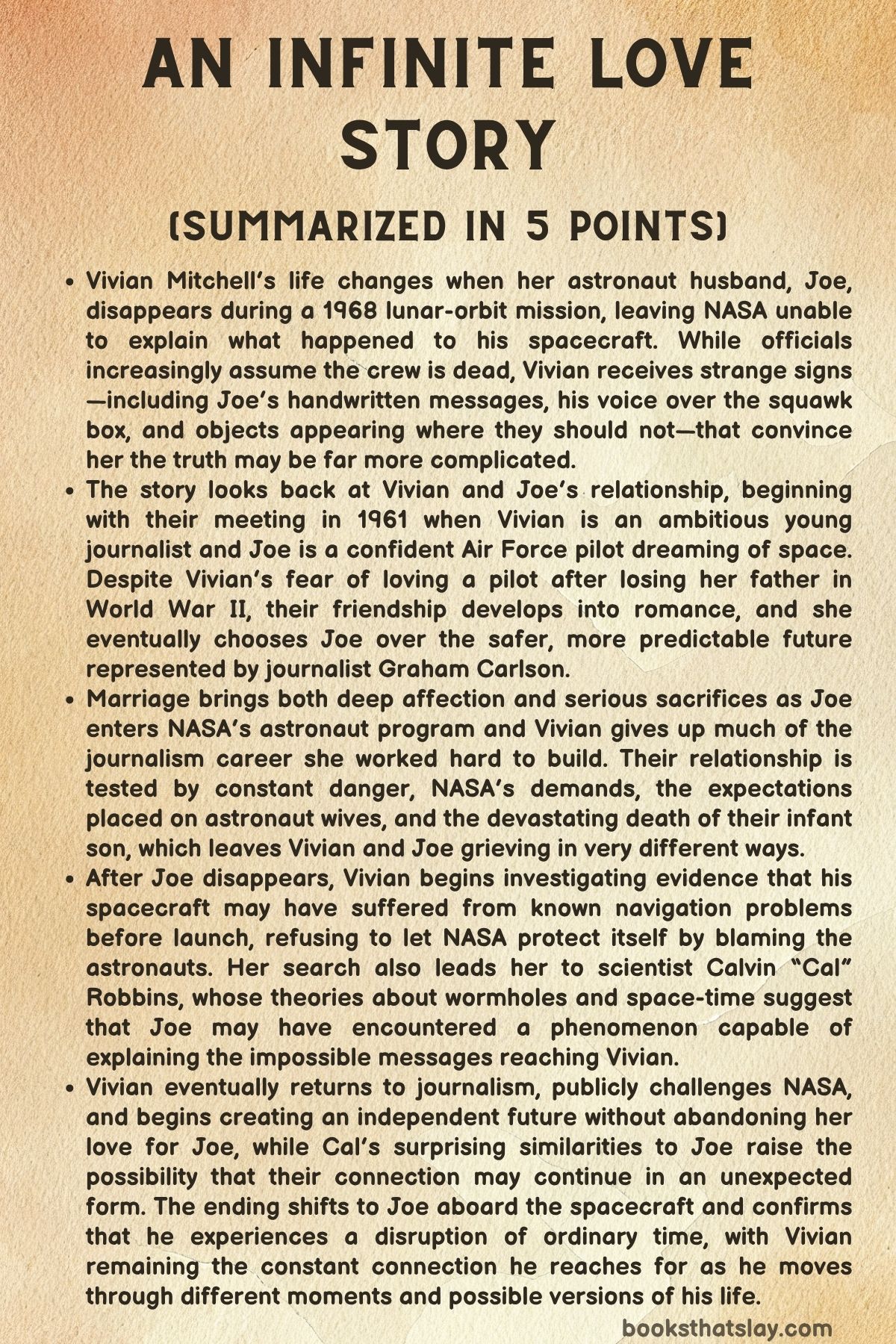
In 1968, astronaut Joe Mitchell disappears during a lunar-orbit mission when his spacecraft abruptly loses communication and telemetry with Mission Control. His wife, Vivian, watches the crisis unfold from their Cocoa Beach home while NASA officials, astronaut families, reporters, and concerned friends gather around her.
Frank Abbott, Joe’s closest friend and the mission’s flight director, eventually admits that NASA cannot locate the spacecraft and has received no reliable indication that Joe or his crewmates, Michael Drayer and Paul Robin, have survived. Vivian nevertheless refuses to accept that Joe is dead, partly because he always promised that he would return to her.
Her conviction becomes harder to dismiss when she discovers a crumpled piece of paper in her dress pocket. It contains mathematical calculations that Frank recognizes as his own and a message in Joe’s handwriting telling Vivian to wait for him, even though Frank insists he gave the paper to Joe shortly before launch.
The story then returns to 1961, when Vivian is a twenty-three-year-old journalist trying to establish herself in a Washington television newsroom dominated by men. Her roommate and closest friend, Polly, persuades her to join a double date with two Air Force pilots, Frank Abbott and the confident, charismatic Joe Mitchell.
Vivian initially dislikes Joe’s swagger and objects to the risks, expense, and political motives surrounding the Space Race. Their conversation changes her impression because Joe reveals himself as an idealist who believes exploration can advance science, inspire people, strengthen national security, and perhaps answer questions about space and time.
Joe also recognizes Vivian’s own idealism beneath her skepticism. When he learns that television once provided comfort during her lonely childhood, he understands that journalism is more than a career to her: it is a way of connecting people and making the world feel less distant.
Their attraction is complicated by Vivian’s fear of pilots. Her father, a fighter pilot, died during World War II when she was six, leaving her with an enduring association between aviation and abandonment, while her emotionally unstable mother made the security Vivian desired even harder to find.
Joe carries childhood loss of his own because his parents and sister were killed in a car accident when he was also six. Their shared history creates an unusual intimacy, yet Vivian refuses to pursue him because she does not want to build her future around someone whose profession may repeatedly place his life in danger.
Instead, Vivian begins dating respected journalist Graham Carlson, the kind of stable and professionally compatible man she believes she should want. Graham is intelligent, generous, successful, and serious about her, but Vivian cannot produce the depth of feeling that comes naturally whenever Joe enters her thoughts.
Joe is transferred to Italy, yet postcards and letters keep their connection alive across the Atlantic. When he sends Vivian an image of Venice and describes the places he imagines showing her, she realizes that her imagined future contains Joe far more readily than Graham.
After several months, Joe returns unexpectedly for Polly and Frank’s engagement celebration. Vivian’s reaction to seeing him forces her to admit that although she respects Graham and cares about him, she does not love him, and she ends the relationship rather than continue accepting affection she cannot honestly return.
Vivian and Joe meet again in Houston in 1962 while she is covering President John F. Kennedy’s call for America to reach the Moon. Joe has another opportunity to pursue NASA, and Vivian, instead of reacting with fear, finds herself genuinely excited for him.
Their attraction finally becomes impossible to deny. After Vivian admits that she ended her relationship with Graham and Joe confirms that there is no other woman in his life, they kiss, begin a relationship, and eventually spend the night together.
Vivian later travels to Italy to visit Joe, experiencing the adventurous romantic life she once feared choosing. Joe shows her Infinity, a science-fiction novel from his childhood that helped inspire his fascination with space, and tells her that she is his tether, the person who keeps his ambitions connected to something real.
Their time together is interrupted by the Cuban Missile Crisis, during which Joe is suddenly called to military duty. The threat of catastrophe causes both of them to confront how deeply they have fallen in love, and after the crisis eases, Joe proposes despite acknowledging that life with him will involve danger, absences, moves, and uncertainty.
Vivian accepts, knowing that marrying him also means risking the career and independence she fought to establish. They marry in Las Vegas, and Vivian eventually leaves journalism to follow Joe as he pursues astronaut training.
Joe succeeds in joining NASA, but his dream places new pressures on their marriage. Vivian struggles with the expectation that astronaut wives should appear cheerful, glamorous, loyal, and endlessly supportive while keeping their fear and frustration out of public view.
The strain becomes more serious as NASA’s dangers become impossible to ignore. A command-module fire kills three astronauts, and Joe begins questioning whether reaching the Moon is worth the human cost, particularly because Vivian is pregnant and he has begun imagining a different kind of future.
Vivian and Joe have a son, but their happiness lasts only nine months and twenty-one hours. The baby has a serious heart condition that doctors cannot overcome, and his death leaves both parents devastated.
Their grief also creates a deep fracture in the marriage because NASA calls Joe away while Vivian is still recovering from a cesarean section and mourning their child. Vivian experiences his departure as confirmation that the space program will always claim him when she most desperately needs him.
They move to Cocoa Beach, but a new home does little to ease their pain. When Joe is offered the lunar-orbit mission he once dreamed of, Vivian begs him to stop, while Joe admits that work is the only place where he does not feel completely powerless after failing to save their son or repair Vivian’s suffering.
The couple remains emotionally distant during the months before launch, although Vivian begins thinking seriously about rebuilding an independent life through education or work. Shortly before Joe leaves, however, he secretly finds her on the beach, and they apologize to each other without pretending their grief has disappeared.
When Joe asks whether Vivian will wait for him, she promises she will. On launch day she watches the Saturn V rise and, for a brief moment, understands the wonder Joe has always found in spaceflight even as she fears what it may cost them.
After the spacecraft disappears, the strange events around Vivian continue. She hears Joe calling her name through the NASA squawk box even though Mission Control receives nothing, a Venice postcard connected to their courtship inexplicably appears, and Joe’s flight boots move to the familiar place where he used to leave them.
At the same time, Vivian learns that the spacecraft may have had known navigation concerns before launch. An unidentified man gives her an internal memorandum describing potential problems, leading her to suspect that institutional pressure to keep the Moon program moving may have encouraged dangerous compromises.
NASA eventually declares the astronauts lost, and Vivian attends a memorial at Arlington National Cemetery without a body to bury. She refuses to allow the agency to control the story, giving the leaked memorandum to Graham and asking him to investigate whether negligence contributed to the disappearance.
Her determination grows when another mysterious object appears in her home: a scientific book called The Mystery of Time. Inside it is another message in Joe’s handwriting telling her to wait, and the torn paper fits perfectly with the earlier note, completing Frank’s original calculations.
The book leads Vivian to Dr. Calvin “Cal” Robbins, a scientist at NASA’s Langley Research Center who studies unusual theories involving time and space. Cal initially dismisses Vivian’s experiences as possible manifestations of grief, but her insistence that conventional science has already failed to explain the spacecraft’s disappearance eventually persuades him to reconsider.
Cal explains that wormholes could theoretically connect distant points in space and perhaps time. Although he cannot prove that Joe encountered one, he admits that an unusual space-time event could potentially explain why objects or fragments of information appear to reach Vivian even when Joe himself does not.
The possibility changes Vivian’s understanding of waiting. She can believe that Joe tried to reach her without allowing that belief to prevent her from living, and she begins reclaiming the professional identity she abandoned when she married him.
Vivian agrees to a televised interview with Graham, publicly challenging NASA over possible safety failures and refusing to let officials blame Joe through vague suggestions of pilot error. She also criticizes the culture surrounding astronauts, arguing that spouses and children have been expected to absorb enormous emotional costs while receiving little recognition.
The interview helps Vivian return to journalism, and veteran reporter Kerry Krieger again encourages her ambition. NASA also begins considering changes to how astronaut families are treated, allowing Vivian to transform some of her anger into work that may protect others.
Her friends are changing as well. Polly decides that she can no longer tolerate years of placing Frank’s NASA career above their marriage, while Frank eventually realizes how much he has sacrificed to the program and decides that preserving his family may matter more than remaining at NASA.
Cal later returns to Vivian’s life carrying his childhood copy of Infinity, the same science-fiction novel that shaped Joe’s imagination. Vivian learns that Cal also once wanted to become a pilot and astronaut but was prevented by poor eyesight, and his romantic approach to science reminds her strongly of Joe.
Before Vivian leaves Cocoa Beach for a new home and career, Frank gives her a videotaped message Joe recorded before launch. Joe apologizes for the pain his ambitions caused, tells her that she gave his life its greatest meaning, and asks her to live fully rather than allow his absence to end her own life.
Joe also tells Vivian that he believes he will somehow find her again, whether in this life or another. Almost jokingly, he suggests that if he returned in a different form, perhaps he could finally have the safer occupation she once wished for him and come back as a scientist.
The remark transforms Vivian’s understanding of Cal, whose life contains several striking parallels with Joe’s. The novel does not explicitly identify Cal as Joe, but the possibility of another path through time or reality remains open when Vivian agrees to have coffee with him.
The final perspective belongs to Joe aboard the vanished spacecraft. As its navigation systems fail, space appears to distort, and Joe begins experiencing childhood, adulthood, memories, and possible futures outside their ordinary sequence.
He sees versions of himself at different ages, including an older self wearing glasses and surrounded by grandchildren. Through the confusion, one person remains constant across every possibility: Vivian.
Joe reaches toward that connection, treating her as the tether capable of guiding him through the disorder of space and time. The ending confirms that the impossible events surrounding Vivian were connected to a genuine space-time disruption while leaving the precise nature of Joe’s return unresolved.
Characters
Vivian Mitchell
Vivian is the emotional and intellectual center of An Infinite Love Story, and much of her development comes from the conflict between her desire for security and the repeated uncertainty that defines her adult life. Childhood loss taught her that the people she loves can disappear without warning, so her early distrust of pilots is less prejudice than a defensive response created by grief.
Her ambition as a journalist is equally important to understanding her. Vivian wants work that gives her a public voice, but sexism pushes her toward domestic and supporting roles even before marriage, while becoming an astronaut’s wife later threatens to reduce her identity almost completely to Joe’s career.
Her relationship with Joe forces her to question whether safety should be the governing principle of her life. She chooses him despite knowing the dangers surrounding him, yet the novel does not treat that choice as an uncomplicated surrender to romance because Vivian repeatedly demands recognition for her own ambitions, fears, anger, and sacrifices.
The death of her son brings her deepest fear into reality and temporarily damages her ability to understand Joe. What appears to her as his preference for NASA over their child is eventually revealed as his own desperate method of surviving a grief he cannot control.
After Joe disappears, Vivian’s refusal to accept easy explanations demonstrates both the strength and danger of her loyalty. She pursues evidence rather than simply insisting on faith, which allows her eventual acceptance to become something more mature than passive waiting.
By returning to journalism, confronting NASA publicly, and choosing to build an independent future, Vivian reaches a form of strength that does not require her to stop loving Joe. Her development is therefore not about replacing love with independence, but about learning that she can carry love without allowing another person’s absence to erase her own identity.
Joe Mitchell
Joe is both the romantic hero of An Infinite Love Story and the personification of the ambition that repeatedly threatens the life he shares with Vivian. His confidence can initially appear theatrical, but underneath it lies genuine intellectual curiosity, idealism, and an almost spiritual fascination with humanity’s ability to move beyond familiar limits.
His childhood losses help explain the intensity with which he pursues purpose. Having lost his parents and sister at a young age, Joe is drawn toward science fiction, aviation, and space partly because they offer a universe larger than personal tragedy and suggest that reality may contain possibilities beyond what people immediately understand.
Joe loves Vivian sincerely, yet loving her does not erase his need to fly. This creates the central contradiction in his character: he repeatedly promises to return home while continuing to choose a profession in which returning can never be guaranteed.
The death of his son exposes the limits of Joe’s confidence. He cannot repair the child’s heart, cannot remove Vivian’s grief, and cannot make their marriage normal again, so NASA becomes the place where effort still seems capable of producing an identifiable result.
His decision to accept the lunar mission therefore contains both ambition and escape. He still wants the Moon, but he also wants relief from the helplessness he experiences at home, making his choice understandable without removing its emotional consequences for Vivian.
Joe’s final recorded message reveals that he has come to recognize the cost of his choices. He understands that Vivian, rather than professional achievement, gave his life its deepest meaning, yet the ending also confirms that exploration remains an inseparable part of who he is.
His experience aboard the disappearing spacecraft completes his symbolic role. Faced with the collapse of ordinary time, Joe discovers that technical skill alone cannot orient him, and Vivian becomes the constant by which he recognizes himself across different possibilities.
Polly Abbott
Polly initially appears as Vivian’s energetic, sociable friend, but her importance grows as the book exposes the private cost of life inside the astronaut community. She understands Vivian instinctively and often gives her permission to express anger or doubt when the surrounding culture expects silent loyalty.
Her marriage to Frank provides a parallel to Vivian and Joe’s relationship. Polly spends years caring for their daughters while Frank gives increasing amounts of his time and attention to NASA, creating a family structure in which his public responsibility repeatedly outranks her private needs.
Her decision to seek a divorce is therefore not sudden selfishness but the result of accumulated neglect. Polly recognizes that supporting a spouse does not require surrendering every part of one’s own life, and her refusal to continue doing so becomes one of the story’s strongest challenges to the idealized image of astronaut families.
Polly also functions as Vivian’s emotional reality check. She supports Vivian’s search for answers while remaining worried that impossible signs from Joe could trap her in permanent waiting, showing that friendship sometimes requires protecting another person from hope as well as despair.
Frank Abbott
Frank occupies an uncomfortable position between friendship, marriage, and institutional duty. As Joe’s closest friend and the flight director responsible for the mission, he experiences the disappearance both as a personal loss and as a professional catastrophe.
His early interactions with Vivian show how deeply NASA culture has shaped him. Even while Joe is missing, Frank worries about public statements, institutional confidence, and the future of the program, which makes him appear emotionally detached despite the grief he is privately carrying.
Frank is also central to Polly’s unhappiness. He has spent so long believing that the mission must come first that he fails to recognize how thoroughly that principle has damaged his home life.
His development begins when Vivian forces him to see the consequences of that worldview. By the end of the story, he is willing to reconsider his relationship with NASA and even contemplate leaving if that is necessary to save his marriage.
Frank also helps validate Vivian’s mysterious evidence because he recognizes the calculations on Joe’s notes as his own. This gives the strange events a material connection to the mission that Vivian cannot easily dismiss as imagination.
Graham Carlson
Graham represents the life Vivian could reasonably have chosen. He offers professional compatibility, maturity, stability, respect, and the absence of the physical danger that surrounds Joe.
His weakness as Vivian’s romantic partner is not a moral flaw. Graham treats her well and genuinely loves her, but their relationship demonstrates that suitability and love are not necessarily identical.
Vivian’s inability to return his feelings hurts him, yet he does not become vindictive. Years later, he is capable of discussing their past with maturity and even acknowledges the possibility that their relationship might have succeeded if Joe had never entered her life.
His greater importance ultimately lies in journalism. When Vivian needs someone capable of investigating the spacecraft’s possible safety problems, Graham uses his professional position to challenge the official version rather than protecting his own access or reputation.
He also helps Vivian return to the career she abandoned. Their later relationship therefore becomes more meaningful after romance has ended because Graham helps Vivian recover a part of herself that existed before marriage and widowhood.
Dr. Calvin “Cal” Robbins
Cal enters the story as a scientist whom Vivian hopes will provide a rational explanation for events that seem impossible. His first reaction is skepticism, making him a useful contrast to Vivian because he refuses to treat emotional conviction as scientific evidence.
His skepticism is not simple narrow-mindedness. Cal’s research into unconventional ideas about time and space has already damaged his professional credibility, so he understands the personal cost of entertaining possibilities that other scientists consider implausible.
His willingness to return to Vivian after initially dismissing her demonstrates intellectual humility. Cal cannot prove that Joe has crossed time or entered another reality, but he eventually recognizes that the absence of a conventional explanation means that uncertainty must be taken seriously.
The similarities between Cal and Joe deliberately complicate his role. Both were inspired by Infinity, both dreamed about aviation and space, and both approach the universe with a mixture of scientific curiosity and romantic imagination.
Cal’s poor eyesight prevented him from becoming the pilot and astronaut he once imagined, directing him instead toward scientific work. Joe’s recorded joke that he might return as a scientist consequently gives Cal an ambiguous significance that the book refuses to settle conclusively.
Cal can therefore be read as a possible alternate version of Joe, a person linked to him through some unexplained structure of time, or simply a new man whose similarities allow Vivian to recognize that life can continue in unexpected forms. The uncertainty is essential because Cal represents possibility rather than a solved mystery.
Kerry Krieger
Kerry serves as Vivian’s professional mentor and as evidence of what a woman can achieve in journalism despite an environment designed to limit her. She recognizes Vivian’s abilities before Vivian has fully developed the confidence to insist on using them.
Her disappointment when Vivian leaves journalism to marry Joe is significant because Kerry understands what Vivian is surrendering. She does not dismiss marriage or love, but she sees clearly that Vivian is giving up opportunities that women already struggle disproportionately to obtain.
When Vivian later returns to television, Kerry again becomes associated with professional possibility. Her presence reminds Vivian that the ambitious young reporter she once was has not disappeared merely because marriage, motherhood, grief, and the astronaut program have occupied the intervening years.
Kerry consequently represents continuity in Vivian’s identity. She connects the woman Vivian was before Joe to the woman capable of rebuilding a career after his disappearance.
Bridget Drayer
Bridget reveals one of the darkest private realities hidden behind the polished image of astronaut marriages. Her husband Michael’s repeated infidelity has left her angry, lonely, and emotionally exhausted long before the spacecraft disappears.
Her conversation with Vivian destroys the assumption that all astronaut wives experience the same kind of marriage. While Vivian’s relationship with Joe contains genuine love despite its serious problems, Bridget has been expected to publicly support a husband who repeatedly betrayed her in private.
Her breakdown also demonstrates the damage caused by a culture obsessed with appearances. The families are expected to represent national confidence and domestic perfection, leaving women such as Bridget little space to admit how badly their marriages are failing.
Michael Drayer
Michael is largely absent physically because he disappears aboard the spacecraft with Joe, but the information provided by Bridget changes how he is understood. Publicly, he belongs to the heroic image of the astronaut corps, while privately his repeated affairs have severely harmed his wife.
His character therefore emphasizes the gap between public reputation and domestic reality. The astronaut program can present disciplined heroes to the nation while spouses experience completely different versions of the same men.
Michael also serves as a contrast to Joe. Both men participate in a culture that demands sacrifice from their wives, but Joe’s relationship with Vivian retains emotional loyalty even when ambition damages the marriage, whereas Michael has violated the marriage more directly through infidelity.
Paul Robin
Paul Robin is the least individually developed member of the missing crew, yet his presence is important because the disappearance is not solely Joe’s personal tragedy. Three astronauts vanish, turning what Vivian experiences as the possible loss of her husband into a national disaster involving several families.
His limited characterization also reflects the perspective of the story. Vivian’s emotional attention naturally remains fixed on Joe, which means Michael and Paul are seen primarily through their relationship to the mission rather than through independent personal histories.
Paul consequently helps preserve the scale of the event. Joe may be the emotional center of Vivian’s experience, but he is not the only person placed at risk by technical failure, institutional ambition, and the unknown conditions of space.
Rick Adams
Rick Adams represents NASA’s public-relations machinery more clearly than most individual characters. His interactions with Vivian show how quickly institutional support can become institutional control when an astronaut’s family threatens to disrupt the preferred public narrative.
Rather than focusing only on Vivian’s emotional needs, Rick is concerned with what she says, how she appears, and whether her behavior protects confidence in the space program. His conduct reflects a wider system in which astronaut wives are treated partly as extensions of NASA’s public image.
Rick is therefore less important as an independent personality than as an expression of institutional priorities. Through him, the story shows how powerful organizations can pressure grieving individuals to perform reassurance for the public before those individuals have even understood their own loss.
Vivian and Joe’s Son
Vivian and Joe’s unnamed son has a brief life but an enormous effect on both parents. His arrival seems to offer the stable family future they have repeatedly imagined, particularly at a moment when Joe has begun questioning whether professional achievement justifies continued danger.
His death destroys that possibility almost immediately. Vivian experiences the loss through physical recovery, maternal grief, and Joe’s sudden absence when NASA calls him away, while Joe responds by returning to work because purposeful action is the only defense he can find against helplessness.
The child therefore changes the meaning of the conflict between home and mission. Before his death, NASA’s demands produce frustration and fear; afterward, those demands become inseparable from the most painful moment in Vivian and Joe’s marriage.
His absence also explains much of the emotional distance surrounding Joe’s final mission. Neither parent has learned how to mourn with the other, so the lunar assignment becomes both a professional opportunity and a test of whether their marriage can survive grief.
Themes
Love as a Connection Beyond Ordinary Time
Love in An Infinite Love Story is presented not simply as emotional devotion but as a possible form of orientation when familiar ideas about time and distance cease to function. Vivian and Joe repeatedly describe their relationship through the idea of a tether, something that allows Joe to pursue extraordinary ambitions without completely losing his connection to home.
That metaphor becomes literal in significance after the spacecraft disappears. The notes, the voice through the squawk box, the postcard, the moved boots, and the mysterious scientific book all suggest that Joe’s connection with Vivian survives conditions that should make ordinary communication impossible.
The ending strengthens this idea when Joe experiences different periods and possible versions of his life simultaneously. Memories, future possibilities, youth, age, and uncertainty lose their normal sequence, yet his awareness of Vivian remains constant.
Importantly, the novel does not argue that love magically eliminates loss. Vivian still attends a memorial, experiences loneliness, rebuilds her career, and confronts the possibility that Joe may never physically return in the form she remembers.
Love instead becomes something that can coexist with absence. Vivian can continue choosing life without declaring her bond with Joe meaningless, while Joe can remain oriented toward her even when the physical universe around him no longer behaves according to familiar rules.
Ambition and the Price of Achievement
The Space Race creates extraordinary opportunities, but nearly every major achievement in the story carries a private cost. Joe’s dream of becoming an astronaut gives his life direction and allows him to participate in an effort capable of inspiring millions, yet the same dream repeatedly demands sacrifices from the people closest to him.
Vivian gives up professional momentum, geographic stability, and a measure of independence when she follows Joe. Polly raises children while Frank devotes himself to NASA, Bridget maintains a respectable public image despite Michael’s infidelity, and astronaut families learn that private emergencies rarely outrank the mission.
The novel avoids reducing ambition to selfishness because Joe’s attraction to space is genuine and intellectually serious. He believes exploration can expand scientific understanding and unite people around something larger than themselves, and Vivian eventually understands why such a goal can be worth taking risks for.
The criticism instead falls on systems that treat sacrifice as limitless. NASA’s culture expects spouses to absorb loneliness, fear, interrupted careers, damaged marriages, and public scrutiny while behaving as though these costs are insignificant compared with national achievement.
Vivian’s eventual public challenge therefore seeks accountability rather than the destruction of exploration. Progress remains valuable, but the story insists that achievement becomes morally incomplete when institutions celebrate the visible hero while ignoring everyone required to carry the consequences.
Grief, Survival, and Different Ways of Mourning
Grief shapes Vivian and Joe long before their marriage begins. Both lose important family members as children, and those experiences influence the adults they become: Vivian seeks stability because loss taught her to fear sudden disappearance, while Joe searches for purpose in aviation, science fiction, and eventually space.
Their son’s death exposes how differently two people can respond to the same tragedy. Vivian needs closeness, time, and recognition of the enormity of what has happened, while Joe responds by returning to work because action gives him temporary relief from helplessness.
Neither response means that one parent loves the child more than the other. Their marriage deteriorates because each initially interprets the other’s survival strategy as emotional rejection rather than recognizing it as another form of suffering.
The same complexity appears after Joe disappears. NASA wants a conclusion, friends worry that Vivian’s hope is damaging her, and society expects her to assume the recognizable role of a widow, but she cannot mourn according to that schedule while physical evidence continues challenging the certainty of Joe’s death.
Her eventual growth comes from separating continued love from permanent suspension. She does not have to deny the mysterious connection to move forward, just as rebuilding her career does not require her to erase Joe from her life.
The story therefore treats mourning as an evolving relationship with absence rather than a simple progression toward forgetting. Survival becomes possible when grief is allowed to change shape without being forced into a predetermined form.
Identity, Independence, and the Roles Women Are Expected to Perform
Vivian’s professional struggle begins before her relationship with Joe, when a sexist newsroom assigns meaningful reporting opportunities primarily to men. She possesses ambition and ability, yet the professional world repeatedly asks her to support other people’s work rather than trust her with authority of her own.
Marriage creates a different version of the same problem. As an astronaut’s wife, Vivian is expected to maintain a beautiful home, support Joe without complaint, endure danger quietly, look attractive for photographs, protect NASA’s reputation, and ensure that no domestic difficulty interferes with his concentration.
Polly and Bridget reveal that these expectations are structural rather than unique to Vivian. Polly’s marriage deteriorates after years of being treated as secondary to Frank’s career, while Bridget is expected to preserve the appearance of domestic happiness despite Michael’s repeated betrayal.
Vivian’s return to journalism therefore carries significance beyond financial necessity. Appearing on television as a reporter restores her ability to speak as herself rather than as a symbolic wife whose usefulness depends on repeating someone else’s approved message.
Her independence does not require rejecting marriage, motherhood, or love. What changes is her refusal to accept the idea that loving another person should consume every other definition of who she is.
By the end, Vivian can honor Joe, demand accountability from NASA, speak for astronaut families, pursue journalism, and remain open to an uncertain future. Her identity becomes broader precisely because she stops allowing institutions, marriage, and public expectations to determine its boundaries for her.