Falling Into You Summary, Characters and Themes
Falling Into You by Jasinda Wilder is a contemporary romance centered on love, bereavement, guilt, and the difficult work of continuing to live after devastating loss. It begins with the innocence of two childhood friends discovering romantic love, then follows Nell Hawthorne as that love is destroyed by tragedy and reshapes everything she believes about herself.
Rather than presenting recovery as a clean transformation, the novel focuses on damaged coping mechanisms, difficult choices, and relationships formed between people who understand pain from experience. At its center is Nell’s struggle to accept that loving again does not erase the person she lost. It’s the first book of the Falling series.
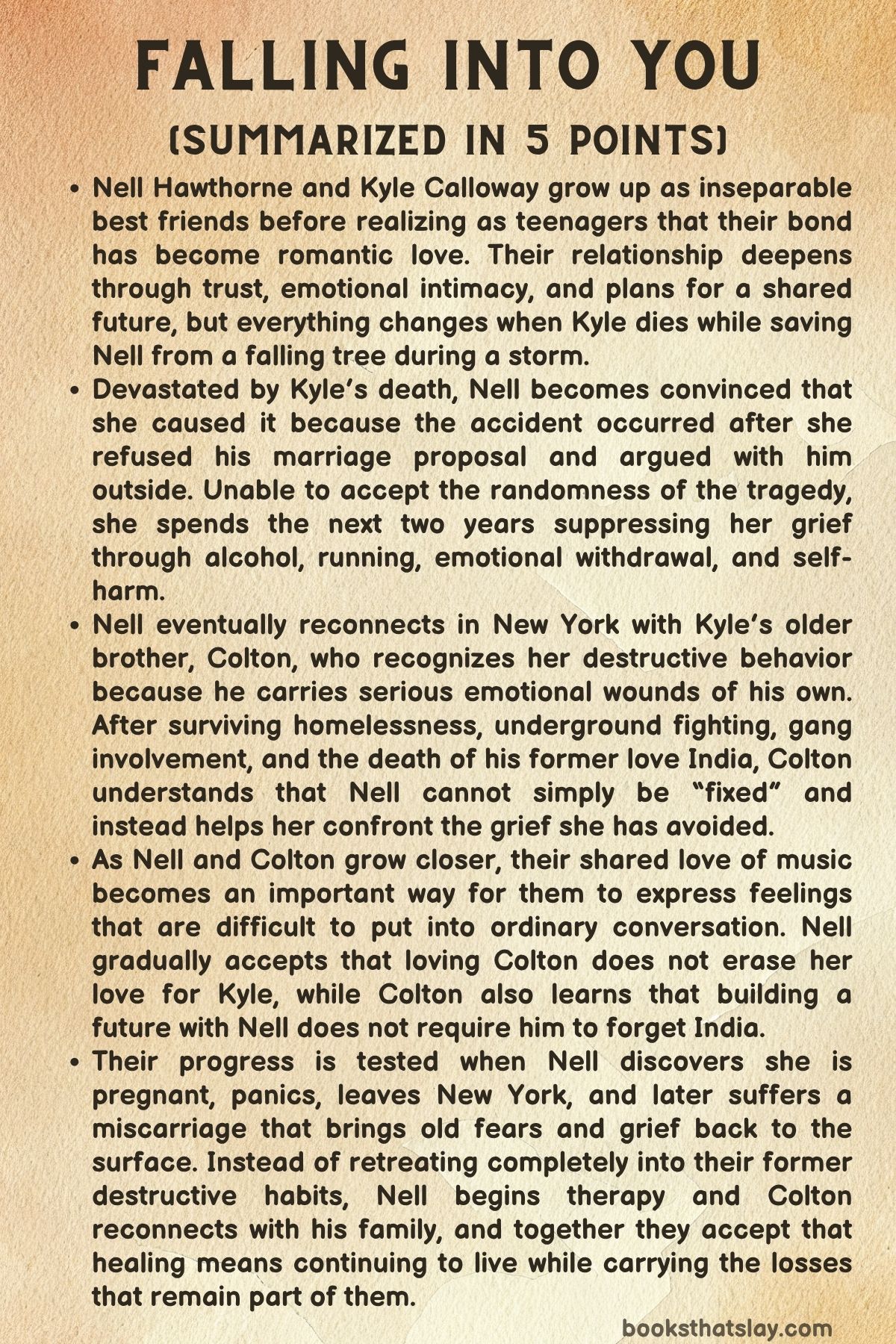
Summary
Sixteen-year-old Nell Hawthorne has spent nearly her entire life with Kyle Calloway, the boy next door and her closest friend. Their families have long assumed they might eventually become a couple, but Nell and Kyle have always treated their closeness as friendship until another boy, Jason Dorsey, asks Nell on a date.
Kyle’s jealousy forces both of them to reconsider emotions they have taken for granted. Nell soon realizes that the thought of dating Jason feels unnatural, while imagining romantic closeness with Kyle feels surprisingly right.
After an emotionally charged conversation, Nell cancels her date with Jason and encourages him to ask her friend Becca out instead. Nell and Kyle finally kiss, turning years of comfortable familiarity into a romantic relationship that feels both new and deeply familiar.
As the relationship develops, Nell becomes increasingly aware of the difference between emotional readiness and physical attraction. Becca confides that she has already slept with Jason and admits that although she wanted the experience, pressure from him may have influenced the timing.
Nell decides that she will not take that step until she feels completely certain. Kyle respects her hesitation, and his willingness to stop even when their desire becomes intense strengthens Nell’s trust in him.
During a frightening drive through a snowstorm, Kyle nearly crashes while avoiding a deer. The adrenaline of the experience brings them physically closer, but Kyle deliberately prevents the moment from going further because he wants their first time to have meaning rather than happen impulsively.
The experience leads Nell to tell Kyle that she loves him. He admits that he loves her too, and their relationship gradually becomes the emotional center of Nell’s life.
On Valentine’s Day, Kyle carefully prepares for the possibility that they may decide to have sex. He reserves a hotel room but makes it clear that Nell can choose to go home or do something else instead.
He also gives her a handwritten letter recalling their shared childhood and describing how their friendship has grown into love. Nell chooses to go to the hotel, and after repeatedly checking that they are both ready, they have sex for the first time.
The experience is awkward in some ways, but its emotional importance is enormous for Nell. She understands that she and Kyle have crossed into a different stage of their relationship and that their connection now carries memories she will never be able to separate from the person she is becoming.
Two years later, they remain together and are preparing for college. Their plans create tension because Nell wants to pursue business studies on the East Coast while Kyle has received a football scholarship from Stanford.
Nell eventually decides that she wants to follow him to California, but before she can tell him, Kyle proposes marriage while they are staying at the Calloway family cabin. Nell loves him and believes she will marry him one day, yet she thinks they are too young to become engaged.
She tells Kyle that her answer is not a rejection of him but a refusal to rush into marriage at eighteen. Kyle is hurt, and their disagreement continues outside during a violent storm.
A massive pine tree suddenly breaks and falls toward Nell. Kyle throws himself at her, pushing her out of the tree’s path but taking the impact himself.
Nell’s arm is badly broken, while Kyle is trapped beneath the tree with fatal injuries. Unable to save him and knowing emergency assistance will not arrive in time, Nell holds his hand as he repeatedly tells her he loves her before dying.
Kyle’s death changes Nell completely. Instead of accepting the accident as an unpredictable tragedy, she begins constructing a private argument against herself: if she had accepted his proposal, they would have gone inside, the argument would have ended, and Kyle would still be alive.
At his funeral, Nell wears the engagement ring on her right hand and carries his love letter. She tells those present that Kyle proposed and that she answered “not yet,” but the full extent of her self-blame remains trapped inside her.
There she encounters Kyle’s older brother, Colton Calloway, who has been largely absent from their lives. He does not try to comfort Nell with conventional reassurances, and that restraint makes his presence easier for her to accept.
Later, Nell finds him near the lake playing guitar and drinking whiskey. His music reaches emotions she has been trying to suppress, and she begins to release some of the grief she has been holding back.
Their closeness unexpectedly results in a brief kiss. Nell immediately recoils, horrified by the fact that she has kissed Kyle’s brother almost immediately after burying Kyle, and the moment becomes another source of guilt.
Two years pass before Nell and Colton meet again in New York. Colton now owns an automobile-repair business and also performs music, while Nell has learned to sing and play guitar.
Music allows them to communicate before either is willing to discuss their history directly. Colton quickly sees that Nell has never truly processed Kyle’s death.
He also discovers that she relies heavily on alcohol when memories and emotions become too painful. Nell insists there can never be a relationship between them because Colton is Kyle’s brother, although the attraction between them remains obvious.
Colton recognizes Nell’s destructive behavior partly because he has lived through his own forms of darkness. He does not imagine that love alone can repair her, but he becomes determined not to abandon her when her emotional defenses finally collapse.
That concern becomes more urgent when Nell becomes involved with Dan Sikorsky, a powerful professional fighter who behaves possessively toward her. One night Colton overhears Dan pressuring Nell for sex despite her repeated refusal.
When Dan becomes violent, Colton intervenes and fights him. The confrontation exposes both Colton’s capacity for violence and the dangerous experiences hidden in his past.
Afterward, Colton notices scars on Nell that reveal a history of self-harm. Rather than responding with pity, he shows her similar scars on his own body and explains that he understands the desire to replace emotional suffering with physical pain.
At Colton’s garage, Nell begins learning more about the life he built after leaving his family. He tells her that he arrived in New York at seventeen with almost no money, survived through underground fighting, and eventually became involved with the Five-One Bishops gang through his friend Split.
His history of violence has left him with guilt of his own. That honesty finally encourages Nell to tell him exactly why she believes she caused Kyle’s death.
Colton challenges her logic without dismissing her emotions. More importantly, he stays with her as she finally allows herself to cry with an intensity she has resisted for two years.
Nell and Colton become increasingly attracted to each other, but Colton repeatedly prevents their physical relationship from advancing while Nell is emotionally vulnerable. Their growing bond is built first on recognition: each understands what it means to carry memories that cannot be erased.
The situation becomes dangerous when Colton asks Nell to promise that she will never hurt herself again. Overwhelmed by the emotions the conversation releases, Nell reaches for a knife and injures herself more seriously than she intended.
Colton forces her to confront what she has been avoiding. Nell eventually understands that blaming herself for Kyle’s death has been easier than accepting the permanent fact that Kyle is gone.
Colton then reveals the loss that shaped him. Years earlier, he loved a woman named India, who was accidentally killed during gang violence.
Her death drove Colton toward self-harm, just as Kyle’s death drove Nell toward similar behavior. Colton explains that grief does not disappear completely, but people can eventually learn to live while carrying it.
Over the following weeks, Nell and Colton deliberately slow their relationship. Nell is accepted into an NYU performing-arts program, while Colton reveals that severe dyslexia has made reading extremely difficult throughout his life.
His academic struggles were misunderstood by his father, contributing to the conflict that led Colton to leave home at seventeen. Nell responds by recognizing forms of intelligence that formal education failed to measure: his musical ability, mechanical skill, survival instincts, and success in creating a business.
Music increasingly becomes part of Nell’s new identity. She begins performing publicly with Colton, and their shared performances turn a private form of emotional survival into something creative and communal.
Eventually they decide to stop resisting their relationship. Colton repeatedly makes sure that Nell is choosing him because she wants him, not because she is trying to escape Kyle’s memory.
Their intimacy marks an important change in Nell’s relationship with her own emotions. She begins allowing herself to experience closeness and pleasure without immediately converting those feelings into guilt or punishment.
She tells Colton she is falling in love with him. His answer expresses something even more consuming: he feels as though he is falling into her completely.
For Nell, the moment is especially important because she cries from happiness rather than grief. She does not stop missing Kyle, but she begins accepting that sorrow and happiness can exist together.
The stability Nell has slowly developed is tested when she discovers that she is pregnant. Remembering an earlier comment from Colton about not needing a pregnancy, she becomes convinced that he will not want the child.
Instead of calling him, Nell reacts according to her old pattern of fear and escape. She flies to Detroit and leaves the positive pregnancy test taped to her apartment door with an apology.
Colton finds it and immediately follows her. By the time he reaches Detroit, Nell has gone running, and he eventually discovers her collapsed in a field and bleeding heavily.
Nell has suffered a miscarriage. Although she had been terrified by the pregnancy, losing it without having the chance to decide what she wanted leaves her devastated.
The loss also reopens Colton’s memories of India. After India died, Colton learned that she had been pregnant, meaning he had already lost an unborn child once without ever knowing about the pregnancy beforehand.
At the hospital, Colton’s father apologizes for the way he treated his son when Colton was young, beginning a cautious attempt at reconciliation. A doctor also makes it clear to Nell that her running did not cause the miscarriage, interrupting her instinct to transform another tragedy into evidence against herself.
Colton writes a song for the child they lost, allowing himself and Nell to mourn openly rather than shutting down separately. Their response shows how much both have changed: pain remains painful, but neither now believes that survival requires silence.
In the weeks that follow, Nell begins therapy and grief counseling, while Colton spends more time with his parents and cautiously rebuilds his relationship with his father. Neither person claims to be fully healed.
They return together to the Calloway dock where their connection first became visible after Kyle’s funeral. There, Nell recognizes that freedom from grief does not mean permanent happiness and that continuing to live is itself an active choice.
Kyle remains part of her past, the miscarriage remains a real loss, and Colton’s own scars remain part of him. What has changed is their willingness to experience pain together rather than escape from it alone.
The story closes with Nell and Colton choosing one another while accepting that love cannot erase everything that came before. Their future is defined not by complete recovery, but by the decision to keep moving forward one breath at a time.
Characters
Nell Hawthorne
Nell is the emotional center of Falling Into You, and her character develops through the contrast between the girl she is before Kyle’s death and the woman she becomes afterward. As a teenager, she is thoughtful about intimacy, capable of questioning social pressure, and unwilling to make major decisions simply because other people expect them from her.
Her decision not to accept Kyle’s proposal immediately is an important example of that independence. She loves him completely, yet she still believes that love does not require two eighteen-year-olds to become engaged before they are ready.
Kyle’s death destroys Nell’s ability to trust that reasoning. Because the accident follows their argument, she turns a sensible decision into the supposed cause of his death, revealing how grief can distort memory and responsibility.
This guilt gradually becomes part of her identity rather than remaining one painful thought. Drinking, running, emotional withdrawal, and self-harm allow her to avoid directly confronting the permanent nature of Kyle’s absence.
Her attraction to Colton creates another conflict because every positive feeling seems to her like evidence of betrayal. Nell initially behaves as though loyalty to Kyle requires her to remain emotionally frozen in the life she had before he died.
Her relationship with Colton does not simply give her another romantic partner. It forces her to distinguish remembrance from self-punishment and to understand that continuing to love Kyle does not require rejecting every possibility of future happiness.
The miscarriage proves that her recovery is incomplete. Faced with sudden fear, Nell immediately returns to flight and assumption rather than communication, showing that deeply established coping patterns do not vanish simply because a person has experienced temporary stability.
By the ending, her greatest development lies in her willingness to remain emotionally present. Therapy, shared mourning, music, and her growing ability to speak directly about pain suggest that she is learning to live without demanding that grief disappear first.
Kyle Calloway
Kyle represents Nell’s first experience of romantic love, but his importance extends beyond the period in which he is physically present. His relationship with Nell grows from childhood friendship, making their romance feel connected to nearly every part of her early identity.
He is affectionate and intensely attached to Nell, yet several moments also show emotional maturity. His decision to stop their physical intimacy when circumstances feel too impulsive demonstrates that he values Nell’s readiness and wants their relationship to carry emotional meaning.
Kyle’s proposal reveals both the depth of his commitment and the limitations created by youth. He sees marriage as the natural confirmation of what he already believes about their future, while Nell sees the same future without believing that engagement must happen immediately.
His death gives him an unusual position in the rest of the story because Nell’s memory gradually turns him into something different from the living young man he actually was. She converts their final disagreement into a moral judgment against herself and begins treating an accident as though it were punishment for refusing him.
Kyle therefore remains important through absence. Nell must eventually learn to remember him as someone she loved rather than as a permanent accusation that prevents her from living.
His relationship with Colton also makes Nell’s later romance emotionally complicated. Because Colton is Kyle’s brother, Nell cannot easily separate new love from old loyalty, and Kyle’s memory becomes the standard against which she repeatedly judges her own right to move forward.
Colton Calloway
Colton is both Nell’s romantic partner and a character with an independent history of abandonment, violence, grief, and survival. In Falling Into You, his ability to understand Nell does not come from unusual emotional perfection but from having made destructive choices of his own.
His dyslexia and conflict with his father shaped his early belief that he was misunderstood and unwanted. Leaving home at seventeen forced him into an environment where survival depended on physical strength, adaptability, and association with people involved in violence.
The garage he later owns is therefore important to his characterization. It represents competence, independence, and a life built through skills that his family and formal education failed to value properly.
His history with the Five-One Bishops also prevents him from being presented as a conventionally ideal romantic figure. He knows how to fight with frightening efficiency and carries guilt connected to the violence of his younger years.
India’s death provides the clearest connection between Colton and Nell. He understands self-harm and emotional avoidance because he has also attempted to convert unbearable grief into pain he could physically control.
His approach to Nell is strongest when he refuses to pretend that he can repair her. He challenges her destructive behavior, protects her when necessary, and stays present during emotional collapse, yet he repeatedly recognizes that she must eventually make her own decisions about living.
Colton also shows restraint in their physical relationship. Even when attraction is obvious, he repeatedly stops because he does not want Nell’s vulnerability to become the reason they become intimate.
The miscarriage exposes how much loss he is still carrying. Learning that India had been pregnant means the new loss echoes an earlier one, but instead of retreating completely into violence or self-harm, he expresses grief through music and shares it with Nell.
His development also includes his relationship with his father. The tentative reconciliation near the end suggests that Colton’s movement forward is not limited to romance; he is beginning to reconsider relationships he once believed were permanently destroyed.
Becca
Becca functions as an important contrast to Nell during the earliest stage of Nell and Kyle’s romantic relationship. Her relationship with Jason introduces the question of sexual readiness before Nell has decided what she wants for herself.
When Becca explains that she slept with Jason but might have waited longer without his pressure, the conversation gives Nell a concrete reason to examine the difference between desire and genuine readiness. Becca’s experience does not simply frighten Nell away from intimacy; it helps Nell clarify the terms on which she wants intimacy to happen.
Although Becca has a smaller role than Nell, Kyle, or Colton, her presence helps establish the social world surrounding the teenage characters. She demonstrates that relationships among their peers can contain affection, uncertainty, pressure, and imperfect decision-making at the same time.
Her relationship with Jason also allows the story to contrast Nell and Kyle’s careful communication with a relationship in which one partner appears to exert more pressure. Through that contrast, Becca indirectly contributes to Nell’s early understanding of boundaries.
Jason Dorsey
Jason serves as the external event that pushes Nell and Kyle into recognizing their feelings for each other. By asking Nell on a date, he creates a situation in which Kyle can no longer comfortably treat her as only his childhood friend.
Jason is therefore less significant for the romance he might have had with Nell than for the jealousy his interest exposes in Kyle. Nell’s own reaction also becomes revealing because imagining herself with Jason makes her recognize how naturally she thinks of Kyle in romantic terms.
His later relationship with Becca adds a less flattering dimension. Becca’s admission that she might have delayed sex without some pressure from Jason suggests that he does not approach physical boundaries with the same care Kyle shows toward Nell.
The material does not give Jason enough attention to make him a fully developed antagonist, and he should not be reduced to one either. His primary function is to reveal differences in how the young characters understand attraction, pressure, consent, and emotional readiness.
Dan Sikorsky
Dan represents a dangerous form of possessiveness that stands in sharp contrast to genuine intimacy. Although he behaves as though he has a claim over Nell, she does not appear to view him as a meaningful romantic partner.
His refusal to respect Nell’s rejection is central to his characterization. The moment he pressures her for sex and forces his way inside transforms his possessiveness from unpleasant behavior into an immediate threat.
Dan also exposes another side of Colton. The violent confrontation demonstrates how easily Colton’s protective instincts can activate the fighting abilities he developed during his earlier life.
The character consequently functions as both a direct danger to Nell and a reminder that physical power can be used in radically different ways. Dan uses strength to intimidate and violate boundaries, while Colton uses comparable violence to stop him, though Colton’s near loss of control shows that even protective violence carries risks.
Kelly
Kelly has a limited role, but his behavior demonstrates practical awareness of Colton’s temperament. When tensions rise between Colton and Dan, Kelly attempts to prevent a confrontation before violence becomes unavoidable.
That intervention suggests he understands both the danger Dan represents and the potential consequences of Colton losing control. He occupies the position of someone familiar enough with Colton to recognize warning signs that others might miss.
Kelly’s bar also provides an important social setting for Colton’s music. It connects Colton’s private emotional identity as a songwriter with the public world in which he performs.
Although the source material provides comparatively little personal background for Kelly, his presence contributes to the sense that Colton has created relationships and a community in New York independent of his family.
Split
Split belongs to the darker period of Colton’s past and represents the complicated relationships created by survival. Colton’s connection with him developed through the Five-One Bishops, where violence and criminal activity formed part of everyday life.
Yet Split cannot be understood only as a symbol of danger. Colton trusts him enough to call him after the confrontation with Dan, expecting him to make sure Dan no longer threatens Nell.
More importantly, Split helped Colton survive the period following India’s death. That detail suggests loyalty beneath the violent environment in which their friendship developed.
His role complicates any simple division between respectable people and dangerous people. Split comes from a destructive world, but within that world he is also someone Colton relied on during one of the worst periods of his life.
India
India appears primarily through memory, but her influence on Colton is profound. She was the first woman he truly loved, and her accidental death during gang violence became one of the defining traumas of his life.
Her death helps explain why Colton recognizes Nell’s behavior so quickly. He has already experienced the desire to escape unbearable grief through self-inflicted pain, so Nell’s scars do not frighten him into judgment or simplistic reassurance.
The later revelation that India had been pregnant adds another layer to Colton’s grief. He lost not only the woman he loved but also a child he never knew existed until both possibilities had already disappeared.
India therefore remains important to Colton even after he falls in love with Nell. Just as Nell does not have to erase Kyle in order to love again, Colton does not have to erase India.
The parallel makes their relationship more balanced. Both enter it with emotional histories that remain real, and neither can demand that the other pretend a previous love never existed.
Colton’s Father
Colton’s father is closely connected to his son’s earliest sense of rejection. Unable or unwilling to understand Colton’s severe dyslexia, he interprets his academic struggles as laziness and continues expecting him to follow a conventional educational path.
That failure is especially damaging because Colton possesses clear intelligence in other forms. His mechanical ability, musical talent, business success, and practical survival skills all demonstrate qualities his father failed to recognize when Colton was young.
Their conflict eventually becomes physical and contributes to Colton leaving home at seventeen. The consequences are enormous because his departure exposes him to homelessness, underground fighting, gang involvement, and years of violence.
The apology offered later therefore carries significance without instantly erasing what happened. It opens the possibility of reconciliation while acknowledging that relationships damaged over many years cannot be repaired by a single conversation.
Colton’s willingness to spend time with his parents afterward shows an important change in him as well. Instead of defining strength solely as independence, he begins allowing the possibility that confronting old family pain may be another form of courage.
Kyle’s Mother
Kyle’s mother appears briefly but contributes an important warning when Nell and Kyle first become a couple. She understands that turning a lifelong friendship into romance changes the relationship in a way that cannot easily be reversed.
Her observation becomes especially meaningful because Nell and Kyle’s romance eventually becomes inseparable from Nell’s memories of childhood, first love, sexuality, future plans, and loss. What begins as a teenage relationship ultimately alters the direction of Nell’s adult life.
She also represents the awareness of the families surrounding Nell and Kyle. Their relationship does not develop in isolation because both families have watched them grow up together and have long recognized the possibility that friendship might become something more.
The limited material prevents a deeper psychological portrait of her, but her warning gives the early romance a sense of consequence. She recognizes before Nell and Kyle do that changing the nature of such a longstanding bond means neither person will ever return completely to the emotional position they occupied before.
Themes
Grief as Something That Must Be Lived Through
Grief in Falling Into You is not treated as a problem that disappears once a character finds love, receives reassurance, or reaches a moment of emotional understanding. Nell spends years trying to avoid the full reality of Kyle’s death, while Colton carries unresolved pain connected to India long after building a successful adult life.
Both characters discover that suppressed grief does not become harmless simply because it is hidden. Nell’s drinking, running, emotional withdrawal, and self-harm allow her temporary relief, but those behaviors also keep her from confronting the fact that Kyle is permanently gone.
Colton’s experience provides an alternative perspective because he has already lived through a similar attempt to escape emotional suffering. He knows that grief can become quieter without vanishing and that accepting its presence is different from surrendering to it.
The miscarriage reinforces this idea by creating a new loss after Nell and Colton have already made substantial progress. Their pain returns intensely, showing that recovery from one trauma does not create immunity from future suffering.
What changes is their response. Instead of isolating themselves completely, they mourn together, seek help, communicate, and allow the loss to remain painful.
The final emphasis on continuing one breath at a time expresses the novel’s understanding of survival. Healing is presented less as becoming untouched by the past and more as learning that sorrow can exist without requiring life to stop.
Guilt, Responsibility, and Self-Punishment
Nell’s guilt after Kyle’s death demonstrates how easily a grieving mind can confuse sequence with responsibility. Because Kyle dies shortly after their argument about his proposal, Nell convinces herself that accepting him immediately would have prevented the accident.
The reasoning gives her an illusion of control over something fundamentally uncontrollable. If she caused Kyle’s death, then the tragedy has an explanation; accepting that a tree fell at exactly the wrong moment means accepting that someone can lose everything without there being a moral reason.
That false responsibility becomes the foundation of Nell’s self-punishment. She behaves as though suffering is the price she must continue paying for remaining alive when Kyle did not.
The same tendency appears after the miscarriage. Despite being medically told that she did not cause it, Nell’s established instinct is to look for something she did wrong.
Her development depends on separating responsibility from pain. An event can devastate her without being her fault, and feeling guilty does not prove that guilt is deserved.
The story also shows why reassurance alone is insufficient. Colton can tell Nell that she did not kill Kyle, but she has to understand why she needs the belief before she can begin releasing it.
By recognizing that self-blame was easier than confronting permanent loss, Nell begins challenging the emotional logic that has governed her life. Self-forgiveness becomes possible only after she accepts that there may be nothing for which she needs forgiveness.
Loving Again Without Erasing the Past
Nell’s relationship with Colton raises a difficult emotional question: does loving someone new weaken the meaning of a love that ended through death? Her guilt becomes even more intense because the new person is Kyle’s brother, making past and present impossible to keep completely separate.
At first, Nell treats love as though it were exclusive across time. If Kyle was truly the love of her life, she assumes that wanting Colton must somehow betray him.
Colton’s history with India creates the same issue from another direction. He also knows what it means to fall in love after losing someone whose importance cannot simply be removed.
Their relationship gradually rejects the idea that emotional loyalty requires permanent loneliness. Neither character asks the other to forget the person who died or pretend that the earlier relationship mattered less.
Instead, new love develops alongside old memory. Nell can miss Kyle while wanting Colton, and Colton can remember India while choosing a future with Nell.
That distinction is one of the story’s most important emotional developments because it allows both characters to understand memory as part of life rather than competition with it. Love does not need to replace what existed before in order to be authentic.
Their intimacy therefore carries meaning beyond physical attraction. Choosing each other becomes an acknowledgment that surviving a loved one does not require preserving the exact emotional life that existed before that person died.
Music as Communication, Memory, and Emotional Release
Music gives Nell and Colton a language for feelings that ordinary conversation often cannot contain. When Nell first encounters Colton after Kyle’s funeral, his guitar reaches an emotional part of her that condolences and explanations have failed to touch.
Years later, their reunion in New York again develops through performance before direct conversation. The songs they choose communicate unresolved pain, attraction, memory, and recognition without requiring either person to immediately explain everything in conventional language.
For Colton, songwriting has long been a survival mechanism. His music allows him to process loneliness, India’s death, his love for Nell, and eventually the miscarriage.
For Nell, learning guitar and singing marks an important transformation. She moves from being someone overwhelmed by feeling to someone capable of giving that feeling creative form.
Public performance expands that change further. Emotions that once drove her toward secrecy, alcohol, or physical harm can now become something expressed in front of other people.
Music also allows pain to be shared without being solved. Colton’s song for the unborn child does not undo the miscarriage, just as songs about grief do not bring Kyle or India back.
Their purpose is different: they give sorrow a form that can be experienced without being denied. In that sense, music becomes one of the clearest signs that Nell and Colton are learning to remain present inside difficult emotions instead of escaping them.