Falling for You Summary, Characters and Themes
Falling for You by Natasha Madison is a romance centered on two people whose chance meeting turns into an unexpected and life-changing relationship.
Collins Henderson is a hardworking paramedic who has spent years surviving the damage caused by her exploitative parents, while Theo Williams has protected himself from commitment after an earlier heartbreak. Their connection begins casually, but an unplanned pregnancy forces them to confront questions of trust, responsibility, family, and love. Alongside the romance, the book follows Collins’s struggle to separate her identity from her parents’ actions and to accept that independence does not have to mean facing every difficulty alone.
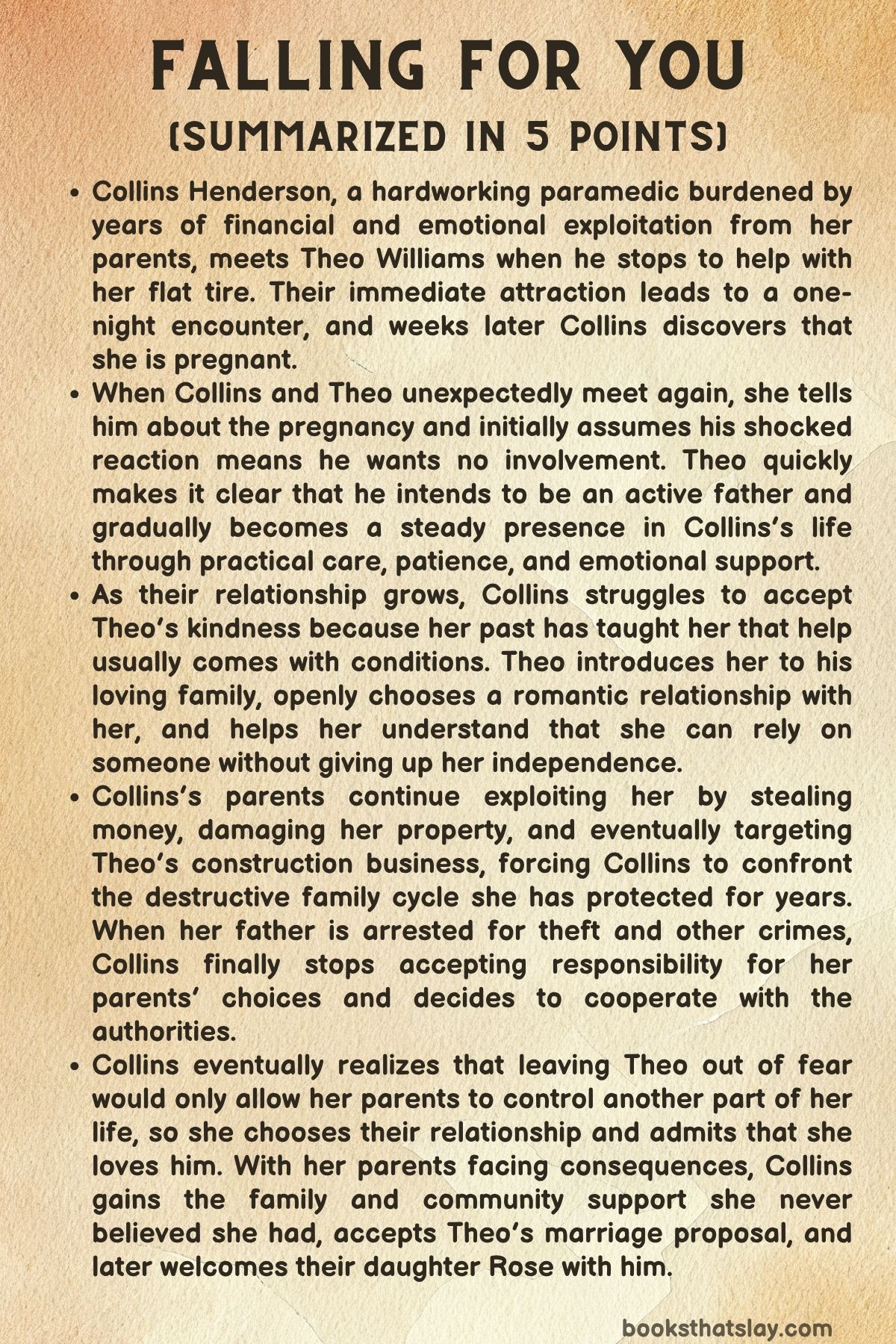
Summary
Collins Henderson is driving home after an exhausting paramedic shift when one of her tires goes flat on an isolated road outside Montgavin. She is trying to change it herself when Theo Williams stops to help, and although Collins initially treats the stranger with suspicion, his humor and willingness to respect her caution gradually make her comfortable around him.
Theo follows Collins home because he is worried about the condition of her spare tire, and she invites him inside to wash the grease from his hands. Their immediate attraction becomes physical, and they spend the night together, but Collins wakes the next morning to discover that Theo has already left.
Nine weeks later, Theo has permanently settled in Montgavin and is working with his cousin Caleb at CW Construction. His return to town is interrupted by an emergency when Sierra, Caleb’s girlfriend, is shot, and Theo rushes to the scene only to discover that Collins is one of the paramedics treating her.
The unexpected reunion forces Collins and Theo to confront the unfinished business between them. Collins agrees to meet Theo at a bakery, but she has a far more serious reason for wanting to see him: she has discovered that she is pregnant.
Collins’s fear about telling Theo is shaped by a lifetime of instability. Her parents have repeatedly exploited her, opened accounts in her name, damaged her finances, interfered with her employment, and forced her to rebuild her life through relentless work, leaving her determined never to depend on anyone financially.
At the bakery, Theo apologizes for disappearing after their night together, believing they are simply going to clear the air. Collins finally tells him she is pregnant, but his stunned silence feels like rejection to her, so she promises that she will not ask him for money or reveal that he is the father before leaving in tears.
Theo needs time to absorb the news, but once the shock passes, he reaches an important decision. Whatever happens between him and Collins romantically, he intends to be fully involved in his child’s life, and he refuses to become an absent father.
He later visits Collins after her overnight shift so they can talk privately. Collins makes it clear that she intends to keep the baby and expects nothing from him, while Theo makes it equally clear that she cannot decide on his behalf that he will be uninvolved.
From that point onward, Theo begins making himself part of Collins’s daily life. He brings food, helps cool her uncomfortable house, looks after her during severe pregnancy sickness, and repeatedly reminds her that his involvement comes from choice rather than obligation.
Collins finds his attention difficult to accept because she has learned that favors usually come with expectations attached. Her fears become stronger when her parents arrive asking for money, invading her home and ignoring her boundaries until she pays them simply to make them leave.
Theo becomes increasingly involved in the pregnancy and accompanies Collins to a prenatal appointment. Seeing the baby during the ultrasound has a powerful effect on him, and his excitement reassures Collins that he views the child as part of his life rather than as an unwanted responsibility.
As they spend more time together, their attraction develops into genuine emotional closeness. Theo begins reorganizing his routine around Collins, while she slowly reveals how deeply her parents and Montgavin’s judgment have influenced the way she sees herself.
Theo eventually asks Collins to travel with him to meet his parents. The invitation terrifies her because she believes a loving and respectable family will judge her once they understand her background, but Theo convinces her that a serious relationship requires both of them to be honest about their pasts.
During the journey, Theo explains that he was once engaged and that his fiancée ended their relationship only two days before their wedding. The experience left him afraid of serious commitment and explains why he later preferred relationships that could remain emotionally uncomplicated.
Collins responds by telling Theo more about her own family. She explains that her parents are longtime scammers who have repeatedly used her identity and finances, and she admits that one of her greatest fears is that they will eventually target Theo because they recognize that he has money.
Meeting Theo’s parents, Blake and Samantha, initially confirms Collins’s worst fears when their shock at the pregnancy feels like disapproval. Because Collins is accustomed to being judged through her parents, she assumes their surprise means that they believe she is unsuitable for their son.
Theo immediately defends her, but Blake and Samantha quickly correct the misunderstanding themselves. Samantha shares parts of her own difficult history and assures Collins that the family welcomes both her and the baby, allowing Collins to experience acceptance from parental figures in a way that is almost entirely new to her.
Theo then asks Collins to become his girlfriend. The distinction matters because he has already committed himself to fatherhood, meaning that the romantic relationship is something he wants separately from his responsibility toward their child.
Collins initially hesitates because she fears that being publicly associated with her will damage Theo’s reputation. Theo refuses to treat her parents’ actions as evidence against her, and Collins finally accepts that he genuinely wants a relationship with her.
Their relationship becomes increasingly comfortable and intimate. Collins begins experiencing what affection looks like when it is not transactional, while Theo discovers that emotional commitment no longer seems as threatening when the person he is choosing is Collins.
At the same time, trouble begins developing around them. CW Construction experiences repeated thefts and break-ins, Collins senses that someone has been watching her, and Theo initially suspects Claire, a former casual partner who reacted angrily when he rejected her attempt to resume their relationship.
Collins soon discovers a more immediate betrayal when a payment toward her rent-to-own house fails. She checks her finances and realizes that her parents stole one of her checks, forged it for one thousand dollars, and once again damaged the stability she has worked for years to create.
The theft affects Collins differently now because she is preparing to become a mother. She begins realizing that protecting her parents from consequences could eventually expose her own child to the same cycle of manipulation and instability.
Soon afterward, the electricity at Collins’s house suddenly fails even though nearby homes still have power. Theo discovers signs suggesting that the problem is specific to her property, and later evidence confirms that someone deliberately interfered with the wiring.
Theo insists that Collins stay with him until the house is safe. Although she worries about losing her independence and creating gossip by moving into her boyfriend’s home so quickly, her friend Finley helps her recognize that accepting help does not automatically mean surrendering control over her life.
Living with Theo becomes unexpectedly natural. Collins sees that he makes room for her without demanding that she change who she is, and she begins telling trusted coworkers about her pregnancy, only to discover that people such as Roman and her captain respond with support rather than judgment.
The harassment escalates when several of Collins’s tires are deliberately damaged. Instead of calling Theo, Collins automatically tries to manage the problem herself, illustrating how deeply self-reliance has become part of her survival instincts.
Theo learns what happened and is upset not because Collins has created extra work for him, but because she did not think of him as someone she could call during a crisis. He explains that partnership requires Collins to learn that she no longer has to respond to every emergency alone.
Meanwhile, Collins’s parents become increasingly interested in Theo’s financial position. They begin treating his home and business as evidence that Collins now has access to money, and when she refuses further demands, they imply that they can approach Theo directly.
Theo eventually overhears enough to understand what Collins has spent years enduring. Instead of blaming her, he becomes angry on her behalf and insists that her parents’ crimes say nothing about her character.
Collins finally begins refusing her father’s demands more openly. Brock intervenes during one confrontation, and his support becomes another sign that the town does not universally despise Collins in the way she has always believed.
Eventually Collins tells Theo the full extent of her suspicions. She believes her father was responsible for damaging her tires and interfering with her electricity, and the mounting stress becomes so intense that it begins affecting her physically.
Theo turns to his parents for support, while evidence from CW Construction’s security cameras finally reveals the truth behind the business thefts. Collins’s father has been stealing from company properties, and the evidence is strong enough for the police to arrest him.
For Collins, the arrest feels like confirmation of everything she feared. Her parents have now damaged Theo’s business as well as her own finances and property, so she concludes that loving her will only expose Theo to further trouble.
Theo refuses to accept that reasoning. He points out that Collins did not steal equipment, forge checks, destroy property, or commit any of the other crimes, and he tells her that she has spent her life punishing herself for decisions other people made.
He also admits that he loves her. Rather than forcing her to answer immediately, he gives Collins emotional space while remaining close enough to support her.
Collins thinks about everything Theo has done for her and realizes that leaving him would not truly be her own choice. It would simply allow her parents to control another part of her life, so she decides that she will no longer define herself by their behavior.
She tells Theo that she loves him as well, and they reconcile. Blake and Samantha arrive soon afterward and reinforce the same lesson: Collins is responsible for her own choices, not for the crimes committed by her parents.
Officer Burke later asks Collins to provide a statement after stolen property and fraudulent credit cards are discovered at her house in connection with her father. This time she refuses to protect him, confirms that he had no permission to enter the property, and decides to pursue action over the trespassing and forged check.
The decision marks a major change in Collins’s relationship with her family. Instead of allowing guilt to shield people who repeatedly hurt her, she begins prioritizing herself, Theo, and their child.
Another surprise follows when people from Montgavin arrive with food and handmade gifts for the baby. Collins is deeply affected by the realization that many people she assumed disliked her actually care about her and have judged her on her own actions rather than those of her parents.
Several months later, Collins and Theo are securely building a life together while her parents finally face legal consequences. Collins cooperates with the authorities, her damaged house is repaired and rented to another family, and she allows herself to keep the property she worked so hard to obtain instead of letting her parents destroy another achievement.
Theo surprises Collins with a baby shower attended by friends, relatives, coworkers, and people from Montgavin. Surrounded by people celebrating her and the baby, Collins finally receives undeniable proof that she has a community around her.
Theo then proposes, and Collins accepts immediately. Their relationship, which began with a flat tire and an impulsive night together, has become a deliberate commitment built on trust, responsibility, acceptance, and mutual love.
Later, Theo secretly prepares an entire nursery and worries that Collins may dislike the surprise. Instead, Collins is relieved because the nursery confirms once again how excited and committed Theo is about becoming a father.
Collins’s water breaks shortly afterward, sending the usually calm Theo into nervous panic. At the hospital, Collins gives birth to their daughter, and they name her Rose.
Holding Collins and Rose, Theo recognizes how completely his understanding of love has changed. The man who once protected himself by avoiding emotional risk now sees his future in continuing to choose the woman and child who transformed his life.
Characters
Collins Henderson
Collins is the emotional center of Falling for You, and much of her characterization develops from the conflict between the capable woman she has become and the frightened child her parents trained to expect betrayal. Professionally, she is hardworking, reliable, and strong enough to complete exhausting paramedic shifts, yet emotionally she has difficulty believing that anyone can help her without eventually demanding something in return.
Her independence is therefore more than a personality trait. It is a survival mechanism created after years of identity theft, financial exploitation, homelessness, family manipulation, and public judgment, so even Theo’s simplest acts of generosity can initially make her uncomfortable.
Collins also carries a damaging sense of inherited guilt. Because Montgavin knows her parents’ reputation, she assumes that their dishonesty has permanently marked her as untrustworthy, and this expectation causes her to interpret surprise, curiosity, or concern as condemnation even when no judgment is actually intended.
Pregnancy becomes the force that changes the way Collins responds to her parents. She has tolerated enormous harm when she was the only victim, but the possibility of allowing the same people to threaten her child forces her to reconsider whether silence and forgiveness are actually forms of kindness.
Her relationship with Theo challenges another deeply rooted belief: that needing someone automatically makes her vulnerable to control. Theo does not ask her to abandon independence; instead, he teaches her that partnership can mean remaining capable while also trusting another person enough to accept support.
Collins’s strongest growth arrives when she stops treating her parents’ crimes as evidence against herself. By choosing Theo, cooperating with the authorities, protecting her property, and allowing Montgavin’s affection to reach her, she begins building an identity based on her own choices rather than the family name she inherited.
Theo Williams
Theo begins Falling for You as a man who has carefully separated physical intimacy from emotional commitment. His casual relationships are not presented merely as irresponsibility; they are eventually connected to the humiliation and pain of having his fiancée cancel their wedding shortly before the ceremony.
The pregnancy immediately reveals a more serious side of him. Although he is shocked and needs time to understand what has happened, he quickly decides that fatherhood is not something Collins can excuse him from, establishing responsibility as one of his strongest qualities.
Theo expresses affection primarily through action. He cooks, brings groceries, accompanies Collins to appointments, repairs problems, arranges transportation, considers her physical comfort, and repeatedly makes practical adjustments to his own life without treating those efforts as sacrifices.
His protectiveness occasionally risks becoming overwhelming because Collins is accustomed to complete self-reliance, but Theo generally learns to distinguish support from control. Even when he disagrees with her decisions, he tries to persuade rather than erase her agency.
Theo’s emotional development is as significant as Collins’s. A man who once preferred temporary relationships gradually becomes comfortable discussing family, sharing his personal history, admitting love, seeking advice from his father, and building a permanent home with someone else.
His greatest contribution to Collins’s growth is his refusal to accept her shame as truth. Theo consistently separates Collins from her parents’ behavior, and by doing so he gives her a model for seeing herself with the same fairness that she easily extends to other people.
Caleb
Caleb functions as Theo’s cousin, business partner, and one of his closest sources of stability. Theo’s decision to settle permanently in Montgavin is closely connected to helping Caleb manage the increasing workload at CW Construction, which gives Caleb an important role in establishing Theo’s adult life in the town.
His relationship with Sierra also provides Theo with an example of serious commitment before Theo is ready to pursue it himself. When Sierra is shot, Theo’s immediate panic over Caleb’s safety demonstrates the strength of their family bond.
Caleb later becomes someone Theo trusts with the truth about the pregnancy and the problems affecting CW Construction. His questioning of Theo’s motives is valuable because he distinguishes responsible fatherhood from genuine romantic commitment, forcing Theo to consider whether he wants Collins herself or merely wants to do the right thing for the baby.
He also works beside Theo as the thefts escalate, helping move the situation from suspicion to evidence and police involvement. Caleb therefore combines family loyalty, business partnership, and a grounded perspective that helps Theo evaluate his increasingly serious choices.
Sierra
Sierra initially enters the story through violence, as her shooting unexpectedly brings Collins and Theo back into one another’s lives. Her injury therefore becomes an important structural turning point even though the larger romance is not centered on her.
Her relationship with Caleb also represents an established romantic partnership beside Theo’s initially commitment-avoidant lifestyle. As she recovers, Sierra becomes part of the circle into which Collins is gradually welcomed.
Sierra’s gratitude toward Collins is particularly important because it challenges Collins’s belief that the town sees only her family reputation. By openly recognizing Collins’s work as the paramedic who helped save her after the shooting, Sierra reinforces the idea that Collins has created a respected identity through her own actions.
Her presence therefore supports both leads differently. For Caleb and Theo, she belongs to the family network that makes commitment visible, while for Collins she represents evidence that good actions have been noticed even when Collins is too defensive to believe it.
Blake
Blake is Theo’s father and represents a model of dependable parental involvement that sharply contrasts with Collins’s experience. His presence helps explain why Theo, despite his fear of romantic commitment, never seriously considers abandoning his responsibilities toward his unborn child.
Blake is not blindly approving, however. He questions whether Theo may be moving too quickly because of the pregnancy, showing that his support includes asking difficult questions rather than simply validating every choice Theo makes.
His most important moment comes when Theo reaches a point of emotional exhaustion and calls him for help. Theo’s simple admission that he needs his father is answered immediately, demonstrating the dependable family structure that Collins has never possessed.
Blake therefore represents both guidance and availability. His relationship with Theo shows that adulthood does not require a person to stop needing family, an idea that quietly supports Collins’s gradual acceptance that dependence and weakness are not the same thing.
Samantha
Samantha becomes one of the most important supporting figures in Collins’s emotional development. Collins initially expects Theo’s mother to judge her, but Samantha responds to Collins’s fear by revealing that her own history also contains painful and complicated experiences.
That honesty allows Samantha to reach Collins in a way simple reassurance might not. Instead of presenting herself as a perfect woman deciding whether Collins deserves acceptance, she speaks as someone who understands that a difficult past does not prevent a person from building a loving future.
Samantha later reinforces the principle that Collins is responsible only for her own behavior, not for her parents’ actions. This directly addresses the false guilt Collins has carried for years.
Through Samantha, Collins experiences something close to the maternal support she has always lacked. Her acceptance is significant because it is not limited to the unborn baby; Samantha makes Collins herself part of the family.
Finley
Finley is Collins’s closest friend and one of the few people who knows about the pregnancy before it becomes public. Their friendship began through an online cold-case forum, which reflects Collins’s tendency to form meaningful connections outside the social environment in which she has long felt judged.
Finley provides Collins with a perspective that is both supportive and less emotionally burdened than Collins’s own thinking. When Collins worries that staying at Theo’s house would compromise her independence or invite gossip, Finley points out that Collins is already building a relationship with him regardless of where she sleeps.
Her value lies in helping Collins distinguish genuine caution from fear-driven avoidance. Unlike Theo, Finley has no romantic stake in Collins’s decisions, which gives her observations a different kind of credibility.
Finley therefore acts as a quiet voice of balance. She supports Collins’s independence while also challenging the belief that refusing help is automatically stronger than accepting it.
Brock
Brock gradually becomes evidence that Collins has misunderstood how completely Montgavin has judged her. At the bakery, he treats her casually and kindly, which surprises her because she has learned to expect suspicion from people who know her family history.
His protectiveness becomes clearer when her tires are damaged. Brock works with Theo to handle the repairs, and later he refuses to allow Collins’s financial vulnerability to become another source of humiliation.
Brock also intervenes when Collins’s father confronts her publicly. That decision matters because he does not remain neutral simply because the conflict belongs to another family; he recognizes that Collins is being mistreated and acts accordingly.
Through Brock, the book demonstrates that community support may exist long before the person who needs it is emotionally prepared to recognize it.
Everleigh
Everleigh’s role is smaller, but she contributes to the atmosphere of ordinary acceptance that Collins finds so difficult to trust. She welcomes Collins at the bakery rather than treating her as an extension of her parents’ reputation.
After Collins reveals the pregnancy to Theo and leaves, Everleigh is also part of the conversation that encourages Theo to understand Collins’s vulnerability. She and Brock recognize that Theo’s reputation for casual relationships could damage Collins far more seriously because the town already views her through a harsher lens.
Her function is therefore partly social and partly moral. Everleigh helps remind Theo that two people can enter the same relationship with very different levels of reputational risk.
Officer Burke
Officer Burke connects the romantic storyline with the escalating criminal conflict. He first appears as a CW Construction client, but his professional role becomes increasingly important as violence, theft, vandalism, and Collins’s family problems begin overlapping.
Burke represents formal accountability in a story where Collins has spent years preventing accountability from reaching her parents. Once security footage provides evidence against her father, Burke follows that evidence rather than allowing family excuses to obscure the crimes.
His later request for Collins’s statement forces her to make a decisive choice. She can continue protecting her father or tell the truth and allow the legal consequences to proceed, and this time she chooses herself.
Burke therefore matters less for personal transformation than for providing the external structure that makes Collins’s new boundaries meaningful.
Roman
Roman is one of Collins’s coworkers and represents the professional respect she has earned independently of her parents. When Collins begins revealing her pregnancy at work, she fears that colleagues will see her differently because of the circumstances surrounding it.
Roman responds in the opposite way. He continues treating Collins as a capable colleague, looks after her during difficult shifts, reminds her to eat, and jokes about Theo’s constant concern without reducing Collins to her pregnancy.
His behavior helps demonstrate that Collins’s imagined social rejection is broader than the reality around her. She has spent so long anticipating contempt that ordinary loyalty can surprise her.
Roman therefore reinforces one of the book’s central lessons about identity: people who work beside Collins and actually know her are capable of evaluating her on her own character.
Claire
Claire represents Theo’s former approach to relationships and also serves as an early source of suspicion once the harassment begins. She had previously been involved with Theo casually and appears at his home expecting that their physical relationship can simply resume.
Theo’s rejection of Claire marks an early sign that his priorities have already changed. Even before he fully understands what he and Collins will become, he is no longer willing to continue behaving as though his romantic life has no emotional consequences.
Claire later appears near places connected with Theo’s work, causing him to suspect that her anger may be connected to the thefts or harassment. The suspicion ultimately proves misplaced, but it gives the criminal storyline an alternative explanation before the evidence turns toward Collins’s father.
Her character therefore functions mainly as a reminder of Theo’s past and as a temporary source of uncertainty.
Mikaela
Mikaela is the business manager at CW Construction and helps establish Theo’s reputation before Collins becomes a serious part of his life. Her teasing about his casual dating habits reveals that his avoidance of commitment is well known among the people around him.
Although her role is limited, this early characterization becomes important later. The contrast between the man Mikaela jokes about and the man who reorganizes his entire routine around Collins makes Theo’s development more visible.
She also contributes to the sense that Theo belongs to an established workplace community rather than existing only inside the romance. His changing behavior can therefore be measured against a social identity he had already built.
Lilah
Lilah has a very limited direct role, appearing primarily as one of the people Caleb wants contacted when Sierra is taken to the hospital. Her inclusion nevertheless helps establish that Sierra has relationships and a support structure outside Caleb alone.
Because the book provides little direct action or dialogue from Lilah, her personality cannot be analyzed with the same depth as the central and recurring supporting characters. Her main narrative function is to expand the network of people connected to Sierra during the immediate crisis.
Collins’s Father
Collins’s father is the primary human source of conflict in Collins’s personal life. His relationship with his daughter is defined not by parental care but by entitlement, manipulation, financial exploitation, and the assumption that anything Collins earns can ultimately be claimed for his benefit.
His behavior is particularly damaging because he has trained Collins to confuse family loyalty with submission. Even after identity theft and financial ruin, she has previously avoided pressing charges because some part of her still feels responsible for protecting him.
His interest in Theo exposes the full extent of that entitlement. Theo’s successful business and comfortable home are not signs to him that Collins has found a supportive partner; they are new resources he believes he should somehow be able to access.
The thefts from CW Construction and the evidence discovered by the police finally move his behavior beyond private family abuse into consequences Collins can no longer conceal. His arrest becomes crucial because Collins must decide whether protecting her father is worth continuing to harm herself, Theo, and her unborn child.
He ultimately represents the cycle Collins has to end. Her growth becomes measurable through her increasing willingness to say no, tell the truth, cooperate with authorities, and stop treating his choices as her responsibility.
Collins’s Mother
Collins’s mother participates in the same exploitative family system, although she is less central to the criminal storyline than Collins’s father. She enters Collins’s home without respecting boundaries, ignores her needs, asks for money, and treats her daughter’s limited resources as available for parental use.
Her behavior becomes especially revealing after Collins’s father is arrested. Instead of acknowledging the actions that led to his arrest, she pressures Collins to arrange bail and blames Theo, demonstrating how the family repeatedly shifts responsibility away from the person who actually caused the harm.
She also contributes to the damage surrounding Collins’s house and later faces legal consequences herself. Like Collins’s father, she represents a version of family in which loyalty is demanded but never returned.
Her importance lies in showing that Collins is not escaping one uniquely destructive parent. She is rejecting an entire family pattern built around manipulation, guilt, and exploitation.
Mrs. Lambert
Mrs. Lambert appears briefly when members of Montgavin begin arriving with gifts after Collins finally takes action against her father. She brings crocheted baby booties and promises a matching blanket, a simple act that has enormous emotional significance for Collins.
The gift represents care without expectation. For a woman who has spent years believing that the town judges her and that receiving anything creates a debt, handmade baby clothes become evidence that affection can be freely offered.
Mrs. Lambert therefore acts as a representative of the wider Montgavin community. Her small gesture helps Collins recognize that she has been seen, valued, and quietly cared about by more people than she realized.
Rose
Rose is born only at the end of the story, so she does not possess a developed personality within the book. Her importance comes instead from what her existence changes in Collins and Theo.
For Theo, the pregnancy begins as a shock but quickly gives him a reason to reconsider the emotionally guarded life he has built. His commitment to fatherhood becomes one of the first clear signs that he is capable of choosing permanent responsibility even before he knows what his romantic future with Collins will be.
For Collins, Rose becomes the reason old patterns can no longer continue. Collins has tolerated exploitation when she believed only she would suffer from it, but motherhood forces her to create boundaries strong enough to prevent her parents from affecting another generation.
Rose therefore represents both continuity and change. She connects Collins and Theo permanently, while also giving them an opportunity to create the secure and loving family life that Collins never received as a child.
Themes
Identity Beyond Family Reputation
Collins has spent most of her life believing that the actions of her parents have become part of her own identity. Their scams, financial crimes, dishonesty, and repeated exploitation have not only damaged her credit and financial security but have also shaped the way she believes Montgavin sees her.
That belief becomes one of the strongest internal conflicts in Falling for You. Collins interprets social situations through the expectation of rejection, meaning that even Theo’s parents’ temporary shock at her pregnancy feels like proof that she is being judged for coming from the wrong family.
The story repeatedly challenges that assumption through people who judge Collins according to her own conduct. Sierra remembers the paramedic who helped her, Roman respects his capable coworker, Brock defends Collins against her father, Theo sees her integrity, and members of Montgavin eventually arrive with gifts for her baby.
The greater change, however, must occur inside Collins herself. External acceptance cannot completely free her until she accepts that she does not inherit moral responsibility for choices she did not make.
Her decision to cooperate with the authorities finally separates biological connection from personal accountability. She can acknowledge that these people are her parents without allowing their behavior to determine who she is, what she deserves, or what kind of future her child will have.
Independence and the Courage to Accept Support
Collins’s independence initially appears admirable because it reflects determination, hard work, and survival. She has supported herself through poverty, homelessness, damaged credit, professional training, exhausting shifts, and repeated financial setbacks without having dependable parents to rescue her.
Yet the story gradually reveals that independence can become restrictive when it develops from fear. Collins does not merely prefer handling problems herself; she has difficulty imagining that another person could help without eventually using that help as leverage against her.
This explains why she repeatedly insists that Theo owes her nothing regarding the pregnancy and why she feels uncomfortable when he pays expenses, provides food, repairs problems, or tries to protect her. Her instinct is to turn every act of care into a financial calculation because transactions feel easier to understand than unconditional generosity.
Theo gradually helps Collins develop a healthier definition of partnership. He does not want her helpless or dependent; he wants her to understand that being loved gives her another person to call when something goes wrong.
The damaged tires capture this conflict clearly because calling Theo never even occurs to Collins. Her eventual ability to rely on him without viewing herself as weak becomes an important form of growth, showing that strength can include knowing when a burden no longer has to be carried alone.
Breaking Cycles of Family Harm
Collins’s parents have created a repeating pattern in which they cause harm, demand loyalty, avoid responsibility, and rely on Collins’s guilt to prevent consequences. She has survived that pattern for years by paying them, hiding their behavior, refusing to press charges, and accepting losses that she cannot afford.
Pregnancy changes the moral calculation behind those choices. Collins begins recognizing that refusing to confront her parents does not simply protect them; it also preserves their ability to continue hurting other people.
Her unborn child makes the future impossible to ignore. Collins can tolerate the idea of sacrificing herself much more easily than she can accept the possibility that her daughter might eventually experience the insecurity, manipulation, or emotional damage that defined her own childhood.
The escalating crimes make that decision unavoidable. Forged checks become property damage, damaged tires, interference with her house, theft from Theo’s business, trespassing, fraudulent credit cards, and attempts to shift responsibility back onto Collins.
The cycle begins to break only when Collins stops confusing consequences with betrayal. Reporting crimes and refusing bail are not acts of cruelty; they are boundaries that prevent her parents from continuing to use family ties as permission to cause harm.
Her final cooperation with law enforcement therefore represents more than legal action. It is Collins choosing the next generation over the destructive expectations of the previous one.
Love as Choice Rather Than Obligation
The accidental pregnancy could easily make Collins question every gesture Theo offers. Because their relationship begins with a one-night encounter followed by an unexpected child, she repeatedly worries that his attention comes from responsibility rather than genuine desire.
Theo’s behavior gradually separates fatherhood from romance. He makes it clear that he will be involved with the baby regardless of whether Collins ever becomes his partner, which gives his later decision to date her greater emotional significance.
That distinction allows love to become an active choice rather than a consequence of circumstance. Theo chooses to know Collins, spend time with her, introduce her to his parents, make room for her in his home, support her through crises, and eventually admit that he loves her.
Collins must make an equally important choice. When her father’s crimes begin damaging Theo’s business, she assumes leaving is the loving thing to do because removing herself would supposedly protect him.
Theo challenges that logic by showing her that ending the relationship out of fear would simply give her parents authority over another decision. Collins ultimately stays because remaining with Theo is what she wants, not because pregnancy requires it.
Their eventual engagement and the birth of Rose complete that idea. What began accidentally becomes meaningful because both Collins and Theo repeatedly choose responsibility, trust, family, and one another.