In the Wake of the Ruined Summary, Characters and Themes
In the Wake of the Ruined by by Kalie Cassidy is a dark fantasy novel centered on power, magic, political obligation, inherited violence, and the difficult question of whether love can survive systems designed to turn people into instruments.
At its center are Imogen and Theodore, two young rulers caught between personal desire and forces that expect them to sacrifice themselves for kingdoms, gods, and family legacies. Magic in this world always demands a physical price, while divine power can be exploited just as brutally as political authority. The story follows its characters as they confront monstrous forms of control and gradually decide what kind of lives they actually want to build. It is the second and final book in the Siren Mage duology.
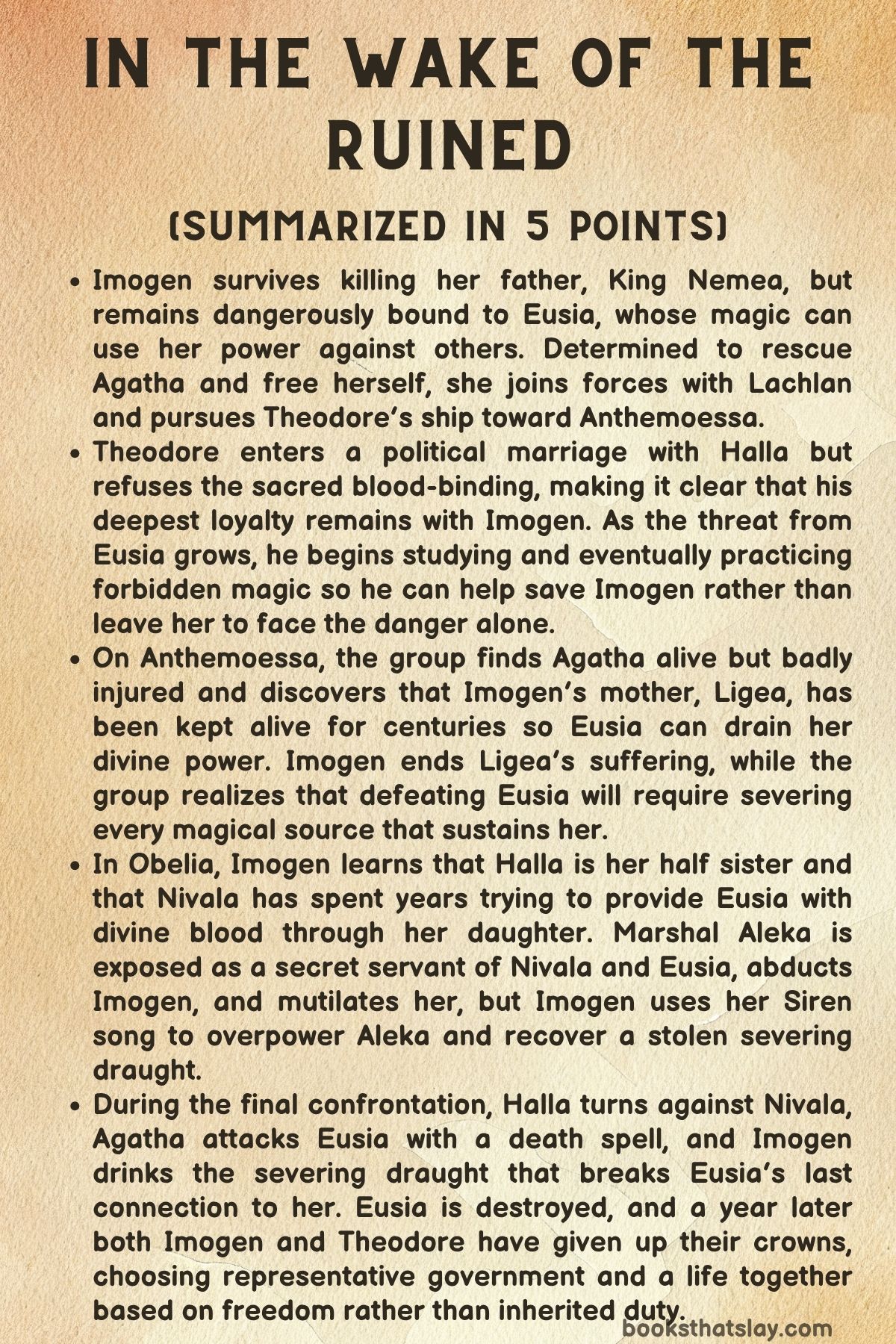
Summary
Imogen reaches the shore beneath Genevreer Palace barely alive after killing her father, King Nemea. She carries his crown and sword, but the magical spell that sealed the wound he inflicted on her is failing, and the strange hunger inside her is becoming increasingly difficult to understand.
She has returned because Empress Nivala has taken Agatha to Anthemoessa, where Eusia is believed to reside. Imogen needs Lachlan’s help, but instead of being welcomed she is arrested because the Varian council has accused her of treason, murder, endangerment, and manipulating Theodore.
Lachlan eventually listens when Imogen explains that Agatha has been taken. Theodore, however, has already departed aboard the Eleuthios to marry Halla at sea before continuing to Obelia, so Imogen and Lachlan decide to escape and pursue the ship.
Imogen needs Halla because she believes Halla possesses enough magical knowledge to help destroy her bond with Eusia. The bond prevents Imogen from deliberately casting magic against Eusia, while also allowing Eusia to enter Imogen’s power and use it for violent purposes.
Theodore, meanwhile, is studying forbidden works on magic. He learns that spells demand flesh, blood, or bodily suffering and begins to suspect that divine power and magical power may oppose one another.
His political crisis deepens when Chancellor Eftan reveals that he once murdered King Athan’s mistress and manipulated Athan into giving Theodore the crown. Eftan insists that he acted for Theodore and Varya, but the confession shows Theodore how easily the chancellor can justify murder in the name of political necessity.
Imogen and Lachlan finally board the Eleuthios in secret. Her magically sealed wound is badly infected, and a healer warns that Theodore may be the only person powerful enough to remove the spell without killing her.
Before Imogen can act, Theodore completes his marriage ceremony with Halla, although he deliberately refuses the sacred blood-binding that would make their union complete. The arrangement is political rather than personal, but Imogen initially experiences the marriage as another loss.
After learning Imogen is aboard, Theodore reroutes the ship toward Anthemoessa. The two remain apart because Imogen fears Eusia may use her corrupted power against him, and she even makes Lachlan promise to kill her if she loses control near Theodore.
Using Halla’s blood, Imogen performs a locating spell that confirms Nivala’s position near Anthemoessa. The magic hurts her but also fills her with dangerous exhilaration, suggesting that her attraction to magical power may not come entirely from Eusia.
Immediately afterward, Eftan attacks Imogen and drives a knife through the magical seal covering her old wound. Theodore responds by using his divine healing power against the spell, successfully destroying Eusia’s magic but reopening the original injury.
Imogen survives, and Theodore finally explains that his marriage to Halla is incomplete and that he still considers Imogen his true blood-bound wife. Their emotional bond survives, but the danger surrounding Imogen’s connection to Eusia continues to grow.
As the ship approaches Anthemoessa, an enormous creature appears in the surrounding waters. Imogen discovers that her bond with Eusia works in both directions when she commands the monster to release Lachlan, proving that Eusia’s creations can sometimes be controlled through the same connection that endangers her.
The group reaches the ruined island and discovers that Halla cannot bring herself to perform the spell intended to kill Eusia. Her devotion has been damaged by recent revelations, but she still cannot deliberately destroy the figure she has worshipped for most of her life.
Inside the ruined keep, Imogen and Theodore finally allow themselves a brief moment of intimacy and emotional refuge. Their peace ends when they discover Agatha, horribly mutilated but alive.
Agatha is rescued and healed as much as possible. She then volunteers to perform the death spell herself, driven by genuine hatred of what Eusia and Nivala have done to her.
Imogen also reveals to Halla that Nivala once offered Halla’s blood to Eusia when Halla was an infant. Eusia rejected the child as ordinary, exposing the cruel foundation beneath Halla’s lifelong effort to earn approval from both her mother and her saint.
When Imogen enters the magical pool beneath Anthemoessa, she discovers that Eusia has already left. Instead, she finds her mother Ligea still alive but horribly diminished, her divine power drained for centuries through the magical system sustaining Eusia.
Realizing that Ligea has not been preserved but exploited, Imogen kills her mother as an act of mercy. She thereby ends one of Eusia’s ancient sources of power and finally understands the full cruelty of a system that treats living bodies as resources.
Back aboard the ship, Theodore decides not to execute Eftan despite the chancellor’s crimes. He sentences him to lifelong imprisonment instead, deliberately rejecting the philosophy that killing political enemies is simply efficient governance.
Imogen and Theodore then discover that severing her connection with Eusia will probably require both a magical draught and a spell. They obtain severing draughts from a Mage Seer in Della, although the encounter further exposes the destructive effects magic can have on those who rely on it.
Theodore eventually volunteers to perform the death spell himself because Agatha is physically weakened and Halla remains unreliable. Imogen fears what magic will do to him, but Theodore argues that standing aside while she dies would be a far greater moral failure.
He practices the spell repeatedly, becoming violently sick each time until he finally succeeds. His experience proves that magic can be learned even by someone whose body resists it, but it also teaches him why magical power can become dangerously attractive.
The group then travels to Obelia, where Imogen learns that Halla is actually Nemea’s daughter and therefore her half sister. Nivala had hoped that Nemea would father a child with divine power, but Halla inherited none, leaving Eusia still searching for a stronger source.
Theodore’s politically promised child with Halla would therefore have been enormously valuable. As the child of a powerful living God, it might have possessed exactly the divine blood Eusia wanted.
Imogen also admits that she does not want to rule Seraf or Anthemoessa. She has begun to understand that accepting a crown simply because blood, conquest, or expectation placed it in her hands would continue the same cycle of obligation that has controlled much of her life.
Her attempt to escape Eusia is soon sabotaged when the severing draughts disappear. Imogen later discovers that Marshal Aleka, one of Theodore’s most trusted allies, has secretly served Nivala and Eusia for years.
Aleka abducts Imogen, drugs her, forces her Siren wings to emerge, and cuts one of them from her body as preparation for a binding ritual. Aleka believes power creates a natural hierarchy in which lesser beings must submit to greater ones, making her loyalty to Eusia more important than her loyalty to Theodore.
Although weakened, Imogen uses her Siren song to dominate Aleka’s will. She learns that Aleka stole one severing draught and manipulated Markis into taking the other, then kills Aleka and recovers the potion.
Elsewhere, Theodore discovers the betrayal and follows Halla toward the hidden chambers beneath the keep. Halla finally admits that her devotion to Eusia comes largely from a lifetime of believing that being ordinary made her worthless.
Theodore recognizes the similarity between Halla and Imogen: both were taught by powerful parents that their value depended on usefulness. He tries to convince Halla that being deliberately kept powerless may itself prove that those controlling her feared what she could become.
Nivala begins the final ritual, sacrificing her own blood while believing Imogen will soon be joined permanently to Eusia. Agatha casts the death spell during the confrontation, while Theodore desperately searches for the hidden chamber where Imogen is being prepared.
Halla reaches Eusia first. Rather than being welcomed after a lifetime of devotion, she is ignored because Eusia wants Imogen’s divine power instead.
Eusia offers Imogen immortality, dominion, safety, worship, and the destruction of anyone who threatens her. Imogen rejects the offer because survival without freedom, love, or moral limits would simply turn her into another version of Eusia.
Imogen drinks the severing draught. At the same time, Halla reveals that she secretly directed a death spell toward Nivala, while Agatha’s spell was actually aimed at Eusia.
The attacks converge at the precise moment Imogen’s bond breaks. With Ligea already dead and Imogen no longer sustaining her, Eusia loses the remaining sources of power keeping her alive and is finally destroyed.
Imogen nearly dies from blood loss, poisoning, and the removal of her wing, but Theodore reaches her in time. She awakens several days later aboard the Eleuthios to learn that Eusia is dead and that Theodore’s political marriage to Halla has been annulled.
Halla appears likely to inherit Obelia, though her continuing fascination with Eusia’s magic leaves uncertainty about the future. Imogen, meanwhile, remains certain that she does not want either of the crowns she has inherited.
A year later, she has abdicated both thrones and helped Seraf move toward representative government. Instead of becoming another destructive Mage Seer, she uses her natural Siren abilities to help others without demanding flesh or blood as payment.
Theodore eventually arrives after Varya also moves away from hereditary monarchy. No longer king, he is finally free to choose a life rather than inherit one.
He chooses Imogen. When he asks her to marry him, she offers her palm so that they can bind themselves again, this time not as rulers fulfilling political obligations but as two people freely choosing the same future.
Characters
Imogen
Imogen is the emotional, magical, and moral center of In the Wake of the Ruined, and much of her development concerns the difference between possessing power and allowing power to determine who she becomes. She begins the book physically devastated after killing her father, yet her greatest struggle is not simply survival but deciding whether survival justifies the increasingly frightening abilities available to her.
Her relationship with magic is especially complex because magic both saves and threatens her. The spell that seals her fatal wound allows her to live, yet it slowly harms her body, while her bond with Eusia gives her extraordinary influence even as it opens a path through which Eusia can control her.
This creates one of Imogen’s deepest fears: she cannot always tell whether her violent impulses come from Eusia or from herself. Her uneasiness after experiencing pleasure and strength through spellwork shows that she is not written as someone morally pure who is merely corrupted from the outside.
She is capable of anger, jealousy, possessiveness, cruelty, and a genuine attraction to power. What matters is that she repeatedly examines those impulses rather than treating them as automatic permission to act.
Her love for Theodore becomes one of the main ways she distinguishes her authentic self from Eusia’s influence. She eventually recognizes that tenderness, vulnerability, desire, trust, and the wish to be comforted belong to her even when darker instincts exist beside them.
Imogen’s relationship with rulership develops in a similar way. She initially claims Nemea’s crown partly because circumstances force her to accept responsibility for the political consequences of his death, but she gradually realizes that possessing a lawful claim does not mean she is obligated to spend her life ruling.
Her decision to abdicate is therefore not an escape from responsibility. She helps create an alternative political structure before leaving, showing that she can reject monarchy without abandoning the people affected by her choices.
Her mercy killing of Ligea is another defining moment because it requires her to reject the idea that continued existence is always preferable to death. She sees that Eusia has transformed survival into exploitation and chooses to end her mother’s suffering even though doing so causes immense personal grief.
By the end of the novel, Imogen’s greatest achievement is not defeating Eusia or claiming multiple crowns. It is becoming capable of choosing a life that is not organized around fear, inherited duty, divine expectation, or the need to prove her worth.
Theodore
Theodore begins In the Wake of the Ruined as a king whose power is immense but whose personal freedom is extremely limited. His divine abilities, political office, arranged marriage, inherited expectations, and dependence on advisers have taught him that duty frequently requires suppressing personal desire.
His relationship with Imogen challenges that understanding because loving her repeatedly forces him to ask whether obedience to political necessity is automatically moral. His altered marriage agreement with Halla shows that he is willing to perform the public role required of him while refusing to surrender every private and sacred part of himself.
Theodore’s relationship with Eftan is central to his growth as a ruler. Eftan represents an older political philosophy in which murder, manipulation, and coercion can be excused whenever they supposedly strengthen the state.
Learning that Eftan murdered Athan’s mistress and manipulated the succession destroys Theodore’s remaining trust in him. More importantly, Theodore eventually refuses to reproduce Eftan’s methods when he chooses imprisonment rather than execution.
That decision demonstrates that Theodore is beginning to define strength differently. He recognizes that possessing the legal power to kill someone does not mean using that power is the only serious response to wrongdoing.
His study and eventual practice of magic also change him. Initially, magic is something he approaches intellectually, but learning the death spell forces him to experience its physical cost and its intoxicating sense of achievement firsthand.
His willingness to learn is motivated primarily by partnership with Imogen. He refuses the comfortable position of allowing her to carry every supernatural risk while he remains morally clean and physically protected.
Theodore can nevertheless be stubborn and self-sacrificing to an unhealthy degree. Like Imogen, he often believes risking himself is acceptable while being unable to tolerate the person he loves doing the same.
Their arguments reveal that both must learn a more reciprocal understanding of love. Protecting another person cannot mean denying that person the right to decide what risks they are willing to accept.
Theodore’s final abdication completes his development. Kingship has defined him for so long that giving it up creates the first real opportunity he has had to discover what he wants without confusing desire with obligation.
His decision to build a future with Imogen therefore carries more meaning than a conventional romantic ending. He chooses her only after both of them have become free enough for that choice to belong entirely to themselves.
Halla
Halla is one of the most psychologically complicated figures in the book because many of her harmful decisions grow from emotional deprivation rather than simple cruelty. Her deepest need is to feel significant to the people and powers whose approval has been withheld from her.
Nivala raises Halla in an environment where worth is measured through usefulness, divine attention, blood, power, and political value. Eusia’s rejection of Halla as an infant creates a wound that Halla does not consciously understand for much of her life but spends years attempting to repair.
Her devotion to Eusia is therefore inseparable from insecurity. She does not merely worship a saint; she wants the saint to confirm that she is special enough to deserve attention.
This explains why discovering that Eusia considered her ordinary is so destructive. The revelation means that the devotion around which she built her identity never produced the recognition she believed it might eventually earn.
Halla’s relationship with Theodore is also shaped by this hunger for value. Her attempt to introduce blood into their wedding ceremony suggests a desire to make their political arrangement more binding than Theodore intended.
Yet Halla is not simply seeking romance. Marriage to a divine king would also transform her political and symbolic importance in ways that directly answer the insecurity created by her mother and Eusia.
Her eventual betrayal of Nivala marks a major change. Directing the death spell toward her mother shows that Halla finally acts against the person whose approval has controlled her life.
The act is still morally complicated because Halla remains emotionally attached to Eusia even after recognizing the abuse surrounding her. She grieves beside Eusia’s corpse and asks Theodore for a book of magic, suggesting that liberation from one controlling relationship does not automatically erase the beliefs created by it.
Halla therefore ends the novel in a deliberately uncertain position. She has developed enough independence to destroy her mother and release Theodore from their marriage, yet she remains fascinated by the power system that damaged her.
Lachlan
Lachlan initially appears defined by practical loyalty, particularly his devotion to Agatha. His willingness to commit treason, help Imogen escape, infiltrate Theodore’s ship, and travel toward Anthemoessa shows that personal loyalty can outweigh institutional obedience when the institution fails to protect someone he loves.
He is also one of the characters most willing to confront Imogen rather than simply accommodate her. When she behaves recklessly or contradicts herself, Lachlan challenges her choices and forces her to recognize that other people are also risking their lives because of decisions connected to her.
His relationship with Imogen becomes especially important because she entrusts him with the possibility of killing her. Agreeing to stop her permanently if Eusia takes control places Lachlan in an almost unbearable position, but he accepts because he understands the seriousness of the threat.
That agreement shows the unusual form of trust between them. Imogen does not need Lachlan to reassure her that everything will be fine; she needs him to respect her judgment about what must happen if she becomes dangerous.
Lachlan’s love for Agatha gives him a softer emotional dimension. His desperation to recover her and his horror when she volunteers to perform destructive magic reveal how deeply he wants to protect her from further suffering.
Yet he must eventually accept that loving Agatha also means allowing her agency. After captivity and mutilation, she refuses to remain only the person everyone else protects, and Lachlan cannot simply overrule that decision because he is afraid.
By the end, their shared life suggests that Lachlan’s loyalty has finally moved away from crisis and survival toward ordinary companionship. That is a meaningful reward for a character who spends much of the story prepared to sacrifice everything for another person’s safety.
Agatha
Agatha occupies an important emotional position because she has functioned as both sister and maternal figure to Imogen. Imogen’s memories of being cared for by her establish Agatha as one of the earliest sources of genuine affection in a childhood otherwise shaped by manipulation and family violence.
Her abduction therefore has meaning beyond the immediate rescue mission. Taking Agatha attacks one of the relationships that helped Imogen develop a sense of love independent of political or magical usefulness.
When Agatha is finally found, she has been subjected to severe physical and psychological violence. The book does not treat her survival as an instant restoration of the person she was before captivity.
Her decision to volunteer for the death spell is consequently important. Having been transformed into an offering and stripped of control, Agatha chooses to act directly against the force responsible for her suffering.
The decision also complicates the desire of others to protect her. Lachlan understandably wants to prevent her from enduring further pain, but Agatha insists on participating in the struggle rather than remaining passive because she has been injured.
Her successful attack on Eusia becomes an act of reclaimed agency. Although her body has been damaged, the people who harmed her do not retain ownership over what she does with the rest of her life.
Her later happiness with Lachlan does not erase what happened to her. Instead, it shows that trauma and continued life can exist together without requiring the character to be reduced to either permanent victimhood or miraculous recovery.
Eusia
Eusia is the central supernatural antagonist and represents power stripped of empathy, reciprocity, and restraint. She measures nearly every living being according to what can be extracted from that being.
Blood, divine energy, magical capability, devotion, bodies, and even children become resources within her worldview. Her offers of immortality and protection therefore hide a system based on consumption.
Her greatest ideological weapon is the claim that power offers more security than temporary human attachments. Because love, beauty, family, and home can disappear, Eusia argues that acquiring enough strength is the only reliable defense against suffering.
Imogen rejects this logic by recognizing that impermanence does not make affection meaningless. In fact, the possibility of loss contributes to the value of the relationships Eusia dismisses.
Eusia’s treatment of Ligea exposes the emptiness of her promise to protect others from death. She keeps Ligea technically alive only because the woman’s divine power remains useful, turning continued existence into centuries of suffering.
Her treatment of Halla is equally revealing. Halla gives her lifelong devotion, yet Eusia remains uninterested because devotion without valuable blood offers her little practical benefit.
Eusia therefore creates followers by encouraging them to believe closeness to power will give them value while never truly valuing them as people. Nivala, Halla, Nemea, Aleka, and others are meaningful to her only according to what they can provide.
Her defeat occurs when several people she has treated as lesser instruments act according to their own intentions. Imogen rejects her bond, Agatha attacks her through magic, Halla turns against Nivala, and Ligea is released from the system that exploited her.
Empress Nivala
Nivala represents political authority transformed into ritualized sacrifice. She does not merely tolerate Eusia’s worldview but structures her identity around the belief that suffering and domination are legitimate prices for power.
Her throne provides the clearest physical symbol of that belief. By drawing blood from its occupant, it turns rulership into a continuous offering and shows how completely Nivala has joined political leadership with magical submission.
Her treatment of Halla is especially cruel because she teaches her daughter that love and worth must be earned through usefulness. Halla grows up believing that being ordinary explains why she is kept distant from Eusia and denied the approval she desperately seeks.
Nivala’s willingness to offer Halla’s blood as an infant reveals that motherhood never outweighs ambition in her hierarchy of values. Even her daughter’s body can become material in a bargain if it promises access to greater power.
Her relationship with Nemea follows the same logic. Their child is valuable partly because Nivala hopes Halla will inherit the divine qualities Eusia desires.
When that attempt fails, Nivala’s interest shifts toward the possibility of a child between Halla and Theodore. Once again, family relationships become breeding grounds for power rather than bonds with moral value of their own.
Her abduction of Agatha also demonstrates her strategic understanding of Imogen. She correctly recognizes that Imogen’s strongest attachments can be manipulated, but she wrongly assumes caring for others makes Imogen fundamentally easier to control.
Nivala ultimately dies because Halla turns against her. The daughter she treated as insufficient becomes the person who ends her life, making Nivala’s failure as a mother inseparable from her political and magical downfall.
Aleka
Aleka is effective as an antagonist because her betrayal comes from someone previously associated with reliability, discipline, and service. Imogen and Theodore both treat her as one of the safer people around them before discovering her longstanding connection to Nivala.
Her philosophy of hierarchy explains how she maintains competing loyalties without viewing herself as dishonest. Aleka believes stronger beings naturally possess greater claims to obedience, so serving Eusia over Theodore seems rational because Eusia occupies a higher position in her imagined order.
This belief allows her to excuse terrible violence. Cutting Imogen’s wing from her body is not treated by Aleka as an act requiring emotional hatred; it is simply the preparation of a weaker body for the purposes of a greater power.
That emotional detachment makes her especially disturbing. She converts cruelty into procedure and treats suffering as insignificant whenever the victim occupies a lower place within her hierarchy.
Imogen’s use of Siren song against her reverses that philosophy. Aleka is forced to experience what it means to lose control of her own will to someone capable of dominating her.
Her death therefore carries deliberate irony. The person who believes smaller creatures should submit to larger predators is destroyed when the woman she classified as manageable proves more powerful than expected.
Chancellor Eftan
Eftan is a political antagonist whose danger comes from his certainty that extreme actions become acceptable when performed for the state or its ruler. He genuinely appears to believe that love for Theodore and Varya justifies manipulation, deception, and murder.
His confession about killing Athan’s mistress is essential to understanding him. Eftan does not confess with the moral horror of someone who recognizes the act as indefensible; he explains it as part of the work required to secure the succession he considered best.
That reasoning makes his later attack on Imogen predictable. Once she becomes a perceived threat to Theodore or Varya, Eftan believes removing her is another necessary intervention.
His relationship with Theodore is therefore deeply paternal but also controlling. He claims to act for Theodore while repeatedly denying Theodore the right to determine what kind of ruler he wants to become.
Theodore’s eventual rejection of execution is particularly important because it prevents Eftan from controlling him even through punishment. Killing Eftan according to the logic of political necessity would have confirmed the worldview Theodore is trying to escape.
Life imprisonment instead deprives Eftan of influence while forcing Theodore to establish a different moral framework for his rule. Eftan loses not only political power but also the ability to define what strength means for the king he tried to shape.
King Nemea
Nemea’s influence remains powerful even after his death because Imogen’s struggle with authority, violence, magic, and self-worth has been shaped by her relationship with him. Killing him frees her physically while immediately forcing her to inherit the political consequences of his reign.
His connection to Eusia reveals that his corruption did not begin only with his treatment of Imogen. He was introduced to sacrificial magic earlier in life and became part of a wider system in which power was pursued through exploitation.
Nemea’s involvement with Nivala further demonstrates his willingness to use family and reproduction politically. Fathering Halla becomes connected to the search for divine blood rather than merely a private relationship.
His importance also lies in the emotional damage he leaves behind. Imogen repeatedly fears that her own attraction to magical strength may make her similar to the father she killed.
The story ultimately rejects the idea that inheritance determines identity. Imogen can inherit Nemea’s blood, crown, magical history, and political consequences without being required to become another version of him.
Ligea
Ligea is largely encountered through memory, supernatural revelation, and the terrible condition in which Imogen ultimately finds her. Even so, she is essential because her fate reveals the real meaning of Eusia’s promise to preserve life through power.
For centuries, Ligea’s body remains alive while her divine strength is extracted. Her continued existence has therefore ceased to serve her and instead serves the magical structure consuming her.
This discovery changes Imogen’s understanding of both Eusia and sacrifice. The language of protection, survival, and divine purpose can hide exploitation when the supposedly protected person has no meaningful freedom.
Imogen’s decision to kill Ligea is painful precisely because she loves the idea of recovering her mother. Choosing mercy means abandoning the fantasy that physical survival alone can restore the relationship she lost.
Ligea’s death also weakens Eusia materially. Her personal release and the larger defeat of the antagonist therefore occur through the same act, linking compassion with resistance.
The surviving flower Theodore later places in Imogen’s hair gives Ligea’s memory another meaning. Imogen can carry something from her mother forward without preserving the system that destroyed her.
Rohana
Rohana remains a comparatively distant figure, but her position as Varya’s Mage Seer connects her to the book’s larger questions about magical labor and bodily cost. Mage Seers occupy roles that societies depend upon even though the magic they perform can gradually destroy them.
Her disappearance after Eusia’s defeat keeps the future of magic unsettled. The destruction of one supernatural tyrant does not automatically eliminate every dangerous practice or unanswered mystery surrounding magical power.
Imogen’s dreams of Rohana alone in the snow suggest that her story may continue beyond what the characters presently understand. Rohana therefore functions partly as evidence that consequences extend beyond the central conflict.
Her abandoned hut also becomes important to Imogen’s new life. By using the space to help people through natural Siren abilities rather than destructive spellwork, Imogen begins redefining what the social role associated with a Mage Seer could become.
Markis Gabros
Markis functions primarily within the political world surrounding Theodore. Early in the story, he offers Theodore a pragmatic view of marriage and love, suggesting that emotional attachment eventually weakens and political arrangements should be evaluated practically.
This perspective contrasts sharply with Theodore’s belief that meaningful love can remain powerful even after loss. Markis therefore helps reveal how unusual Theodore’s emotional commitments are within a court that expects rulers to subordinate private feeling to public duty.
Markis later becomes involved in the disappearance of the severing draught, but his role is different from Aleka’s deliberate betrayal. Aleka manipulates him into taking the vial for supposed safekeeping, revealing that he can be influenced by people who present themselves as acting responsibly.
His weakness is therefore less ideological fanaticism than insufficient judgment. In a political environment filled with hidden loyalties, that weakness becomes dangerous even without malicious intention.
Healer Carras
Carras has a limited but important role in establishing the seriousness of Imogen’s magical wound. The healer recognizes that ordinary treatment can address infection and physical deterioration but cannot safely remove the supernatural structure holding the injury closed.
This limitation helps define the boundary between medicine, magic, and divine power. Carras’s inability to solve the problem is not presented as incompetence but as evidence that Imogen’s condition falls outside conventional healing.
The warning that Theodore may be uniquely capable of helping her also prepares for his later use of divine power against Eusia’s spell. Carras therefore contributes to the story’s developing understanding that magic and God-given abilities can counteract one another.
King Athan
Athan is important largely through the political consequences of his past. His love for his mistress becomes the vulnerability Eftan exploits when the chancellor murders her and manipulates Athan toward surrendering the crown.
His story demonstrates how private grief can be weaponized within systems of succession. The event also complicates Theodore’s kingship because his accession was shaped by manipulation long before he understood the truth.
Athan’s earlier expedition toward Anthemoessa adds another dimension to his legacy. His encounter with the horrors surrounding the island confirms that the threat posed by Eusia’s influence existed before the central characters began confronting it directly.
Themes
Power, Consumption, and the Moral Limits of Survival
Power throughout In the Wake of the Ruined becomes dangerous when survival is treated as the highest possible good. Eusia repeatedly promises safety, immortality, strength, and protection, but every promise requires someone else’s body, blood, freedom, or divine energy to become fuel.
Her treatment of Ligea provides the clearest example. Ligea survives for centuries, yet the survival Eusia preserves has no dignity or freedom because her body exists mainly as a source from which power can continuously be extracted.
Imogen faces a related temptation when magic begins to strengthen rather than merely weaken her. She discovers that power can feel exhilarating and useful even when she understands its dangers, making her moral struggle more complicated than simply resisting an external evil.
What ultimately separates Imogen from Eusia is not lack of ambition or violent capacity. It is her refusal to make continued existence more valuable than every relationship, moral boundary, and freedom that gives existence meaning.
The severing draught therefore represents more than escape from magical control. Imogen knowingly risks death because living permanently as Eusia’s vessel would preserve her body while destroying the conditions under which she considers life worth choosing.
The story consequently treats survival as valuable but not absolute. Life becomes meaningful through autonomy, affection, responsibility, choice, and limits on what a person is willing to consume in order to continue possessing it.
Love as Choice Rather Than Possession
Love repeatedly becomes distorted when characters confuse affection with ownership, obedience, protection, or usefulness. Nivala treats Halla’s body as material for political and divine ambition, while Eftan claims that his manipulation and murders come from love for Theodore and Varya.
Both characters use the language of devotion while denying the people they supposedly value meaningful control over their own lives. Their love becomes dangerous because it assumes that wanting someone’s good gives them permission to decide what that good must be.
Imogen and Theodore initially reproduce milder forms of the same problem. Each repeatedly wants to sacrifice themselves while demanding that the other remain safe, creating conflicts in which protection can become another way of denying agency.
Their relationship improves when they begin accepting that partnership requires shared risk. Theodore must respect Imogen’s decisions even when they frighten him, while Imogen must allow Theodore to learn magic once he has fully understood the possible consequences.
The ending completes this idea by removing political necessity from their relationship. Their earlier blood bond existed in a world of crowns, dynastic expectation, and competing obligations, but their final decision to bind themselves happens after both have surrendered their thrones.
Marriage therefore becomes meaningful because neither requires the other for political legitimacy. Love stops being an arrangement demanded by kingdoms and becomes an act two free people deliberately choose.
Inherited Power and the Freedom to Refuse It
Inheritance appears repeatedly as something that can determine circumstances without determining identity. Imogen inherits Nemea’s blood, crown, political enemies, magical history, and consequences, while Theodore inherits a monarchy whose institutions and advisers expect him to continue older patterns of rule.
Halla also inherits a political role she never fully controls. Her value to Nivala is connected to bloodline, marriage, and the possibility of producing a child whose divine power could satisfy Eusia.
Each of these characters must decide whether receiving something from a parent or kingdom creates a permanent obligation to preserve it. Imogen’s answer gradually becomes no.
She claims the Serafi throne when responsibility requires her to address the consequences of Nemea’s death, but later refuses the assumption that successfully becoming queen means she must remain queen forever. Her abdication distinguishes temporary responsibility from permanent submission to inheritance.
Theodore follows a similar path. His willingness to participate in representative government and eventually leave kingship behind shows that political power can be surrendered without treating that surrender as personal failure.
These choices challenge the idea that blood automatically creates legitimacy for hereditary control. A crown may explain how a person obtained power, but the story repeatedly asks whether that explanation is sufficient reason for the system itself to continue.
Freedom therefore involves more than escaping an abusive individual. It also requires questioning institutions and traditions that teach people to mistake inheritance for destiny.
The Search for Worth and the Damage Caused by Conditional Approval
Several major conflicts grow from characters being taught that their worth depends upon usefulness to someone more powerful. Halla’s life is shaped by the belief that being ordinary makes her undeserving of Eusia’s attention and perhaps even her mother’s love.
Because approval is continually withheld, she becomes more devoted rather than less. She hopes that obedience, sacrifice, marriage, political importance, or access to greater power will eventually transform her into someone her mother and saint are forced to recognize.
Imogen experiences a related form of damage through Nemea and the broader systems surrounding her. Her exceptional abilities repeatedly make others interested in what she can provide, leaving her vulnerable to the belief that being wanted for power is equivalent to being valued as a person.
Eusia deliberately exploits this insecurity. She offers worship, immortality, dominance, and recognition, attempting to convince Imogen that enormous power can permanently solve the fear of being abandoned or diminished.
The contrast between Eusia’s offers and the relationships Imogen forms becomes essential. Agatha, Lachlan, and Theodore care about her continued existence without requiring her to become endlessly useful to them.
Halla’s story shows how difficult it is to recover once conditional approval has shaped an entire identity. Even after turning against Nivala, she still mourns Eusia and remains curious about her magic.
The lasting damage therefore does not disappear with the death of the controlling figures. Learning to believe that worth can exist without performance, sacrifice, divine attention, or political usefulness becomes a much longer form of liberation.