Fabulous Bodies Summary, Characters and Themes
Fabulous Bodies by Chuck Tingle is a horror novel about Poppy Stringer, a Palm Springs influencer whose polished online identity hides a secret business trafficking stolen corpses.
Her life changes when she is paid to steal the body of her musical idol, Eddie Michaels, only to discover that Eddie is neither properly dead nor entirely human. What follows combines supernatural horror, bodily transformation, dark comedy, celebrity culture, parenthood, and questions about personal worth. Beneath its extreme violence, the story examines what happens when people treat bodies, fame, beauty, and even relationships as commodities, while following Poppy toward a radically different understanding of herself and her daughter.
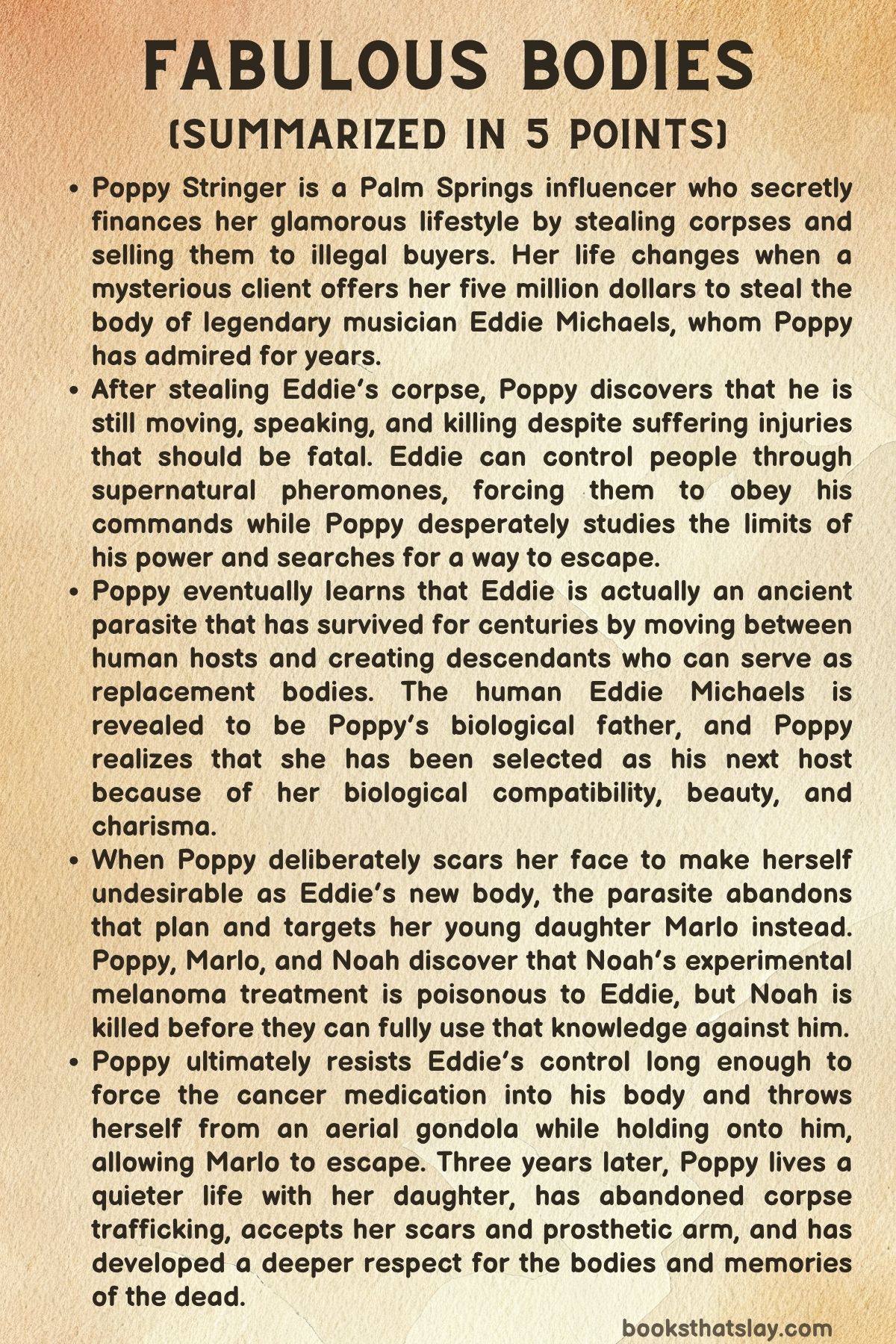
Summary
Poppy Stringer has constructed an impressive public life as a Palm Springs influencer, presenting herself as fashionable, ambitious, successful, and financially comfortable. Behind that carefully maintained image, however, she earns much of her money by stealing corpses and selling them illegally, using disguises, forged explanations, bureaucratic confusion, and her natural talent for persuasion to obtain bodies without attracting immediate suspicion.
During one theft, Poppy poses as an organ-donation transporter and collects the corpse of Tyler Fleming from a funeral home after manipulating an inexperienced employee named Robin. The refrigerated truck already contains other stolen bodies, and even the gruesome condition of one damaged corpse barely disturbs her because she has trained herself to think of the dead primarily as products rather than people connected to grieving families.
Her emotional detachment disappears when the death of Eddie Michaels dominates social media. Eddie is a legendary musician whose flamboyant public identity had a major influence on Poppy when she was younger, particularly in helping her understand and accept her sexuality, so watching footage of his violent death genuinely devastates her.
Yet even sincere grief becomes material for Poppy’s online career. She photographs herself crying, considers which music will perform best with viewers, and shapes a private emotional experience into public content, showing how thoroughly she has learned to measure moments according to visibility and engagement.
Her home life exposes the cost of that mentality. Poppy loves her five-year-old daughter Marlo fiercely, but Marlo repeatedly has to compete with her mother’s phone, work, financial anxiety, and desire to maintain an expensive lifestyle that Poppy insists she is building for the child’s benefit.
Poppy’s closest friend, Noah Doyle, recognizes the contradiction. He spends so much time helping with Marlo that she affectionately calls him Uncle Noah, and he challenges Poppy’s belief that material comfort requires constant work, particularly when a simpler lifestyle could allow her to be more present.
Noah is also facing metastatic melanoma and undergoing an experimental treatment. His awareness of mortality makes him more willing than Poppy to admit fear and emotional dependence, while Poppy responds to vulnerability by seeking greater control.
Everything changes when an unknown client contacts Poppy and offers five million dollars to steal Eddie Michaels’s body. A five-hundred-thousand-dollar advance proves that the offer is real, and although the assignment is far more dangerous than her ordinary thefts, the combination of money, ambition, and her personal fascination with Eddie makes refusal almost impossible.
The medical examiner’s office has supposedly been prepared by an insider, allowing Poppy to obtain Eddie’s body with suspicious ease. After loading him into her truck, however, she discovers that the corpse has disappeared, her keys are missing, and an abandoned café nearby has suddenly come alive with light and music.
Inside, Eddie appears before her in his bloodstained stage clothes, moving, singing, speaking, and smiling despite the catastrophic injuries that should have made life impossible. Poppy’s practical response is to use a gun, but Eddie has already removed its bullets, and even when she surprises him with a spare magazine and shoots him directly in the head, the wound does not stop him.
Eddie soon reveals a more frightening ability: commands spoken in his presence can seize control of another person’s body. He can make Poppy move against her will, restrict her attempts to escape, and later even influence what she feels, turning human beings into unwilling performers in a private spectacle that amuses him.
Poppy witnesses the consequences when Eddie forces a young skateboarder into a lethal stunt. The victim remains mentally aware and visibly terrified while his body obeys instructions that lead to his own mutilation and death, confronting Poppy with a form of exploitation more immediate than her own trade in corpses.
At a nightclub filled with people celebrating and mourning Eddie, the real Eddie can walk almost unnoticed among fans wearing costumes inspired by him. He mocks Poppy’s influencer career, forces her to admit that she is actually a grave robber, and simultaneously flatters her ambition by claiming that he sees something of himself in her.
His approval affects her because he represents a figure she has idolized for years. Even while fearing him, she is vulnerable to the attention of someone whose image once helped shape her identity, allowing Eddie to manipulate not only her body but also her hunger for recognition.
Poppy gradually studies the limits of his supernatural influence. A major clue appears when a sick security guard, congested and taking cold medicine, proves unusually resistant to Eddie’s commands, leading Poppy to realize that his power depends on smell and the strange odor or pheromones surrounding him.
When Eddie accidentally gives Poppy an order to flee that overrides an earlier prohibition against escape, she reaches a motel and protects herself by blocking her nose. Once his pheromones can no longer reach her properly, she discovers that she can resist his commands while pretending to remain obedient.
The advantage allows her to observe Eddie more carefully. She finds records of strange historical incidents in which groups of people apparently mutilated or skinned themselves near famous artists, suggesting that the entity behind Eddie has existed under other identities for centuries rather than beginning with the musician’s death.
Eddie continues killing people while growing increasingly anxious about completing a mysterious list before time runs out. His human body begins behaving as though something inside it is preparing to emerge, and Poppy realizes that the night’s murders are serving a practical purpose despite Eddie’s habit of presenting them as entertainment.
At the home of Mary Fimi, Eddie restrains Poppy while compelling Mary to cut strips of skin from her own body. Eddie consumes the flesh, and Poppy finally understands that his victims have been selected for a biological reason rather than randomly.
When physical attacks fail to kill Eddie, Poppy keeps him talking by appealing to his ego and desire to perform. Eddie reveals that he has lived for centuries through different identities and then tells Poppy that the human body known as Eddie Michaels is her biological father.
The revelation explains why Eddie has shown such personal interest in her. The parasite has produced children across generations so that biologically compatible descendants will exist whenever it needs to abandon a failing human host and occupy a new one.
Poppy is the intended replacement because she is physically compatible and because Eddie approves of her beauty, charisma, ambition, and attraction to attention. Realizing that she cannot destroy him through ordinary violence, Poppy attacks his vanity instead by cutting and permanently scarring her own face, deliberately ruining the appearance he wanted to possess.
The damaged Eddie body finally splits apart, revealing a huge insect-like parasite equipped with legs, tentacles, and clouds of controlling pheromones. Furious that Poppy has destroyed his preferred new body, the creature decides to find a younger compatible host, causing Poppy to realize immediately that he intends to take Marlo.
Poppy races home after discovering another pattern among Eddie’s victims: each suffered from metastatic skin cancer. She concludes that the parasite has been consuming cancerous tissue because rapidly reproducing cells somehow assist the process of transferring between hosts.
At home, Poppy protects Noah and Marlo with swimming nose clips, but Eddie has already spread his pheromones throughout the neighborhood. Ordinary neighbors become a violent mob acting under his control, transforming Poppy’s familiar surroundings into another extension of Eddie’s will.
When Eddie reaches them, he unexpectedly becomes interested in Noah’s melanoma scar and bites away some of his skin. Instead of strengthening the creature, the bite makes Eddie violently ill and temporarily weakens him, revealing that something associated with Noah’s experimental cancer treatment is poisonous to the parasite.
Poppy, Noah, and Marlo determine that Noah’s topical medication is probably responsible. The remaining container is stored at the Palm Springs Aerial Tramway, so they race there hoping that even the small amount left behind might provide a weapon.
At the station, Noah retrieves the cream, but Eddie’s influence has already reached Noah’s coworker Kenny Hall. Kenny suddenly shoots Noah in the chest, killing Poppy’s closest friend before they can carry out their plan.
Poppy barely has time to process the loss because Kenny immediately attacks her. Marlo helps save her mother by striking Kenny with Noah’s baseball bat, forcing Poppy to confront another painful question: how can she teach her daughter to survive without passing on the ruthless worldview that has distorted her own life?
Mother and daughter escape into an aerial gondola carrying Noah’s medication. During the ascent, Poppy admits to herself that her criminal career was never solely about providing for Marlo; much of the money, glamour, attention, and expensive lifestyle had served Poppy’s own ego while she used motherhood as a moral excuse.
Eddie climbs onto the gondola and attacks. When part of Poppy’s protection becomes dislodged, his pheromones regain access to her and he commands her to stop moving, leaving her physically unable to defend Marlo as the parasite prepares to claim the child.
Marlo’s cries force Poppy toward a kind of resistance she had previously believed impossible. Her devotion to her daughter allows her to move despite Eddie’s control, first with enormous effort and then with enough determination to seize the medication.
Poppy drives her arm directly into Eddie’s mouth and throat so that the experimental cream reaches him internally. She then locks herself around the parasite and throws both of them from the moving gondola, deliberately separating Eddie from Marlo even though the fall may kill her.
They crash onto the mountainside, where the drug begins destroying Eddie’s true body. Before dying, he gives Poppy a final word of approval, and she also learns that her childhood rejection by her adoptive parents was not proof that she had been unworthy of love; Eddie had forced unwilling people to raise one of his future host bodies near him.
Despite catastrophic injuries and the loss of part of an arm, Poppy survives and climbs toward Marlo. Her decision represents the complete reversal of the philosophy she once used to justify herself: survival no longer means becoming the most ruthless person in the room, but remaining alive and present for someone she loves.
Three years later, Poppy and Marlo live in a smaller and more affordable home. Poppy has permanently abandoned corpse trafficking, while her facial scars and prosthetic forearm have unexpectedly given her fashion platform greater meaning for people who previously felt excluded by conventional images of beauty.
She earns enough legitimately to support her family and donates money to cancer research in Noah’s memory. Although the authorities never discover the full truth about Eddie, Poppy no longer needs the world to validate her version of events.
Most importantly, her relationship with Marlo has changed. Poppy stops trying to shape her daughter into the hardened predator she once thought a person needed to become, and Marlo rejects even Poppy’s improved animal metaphors by reminding her that she is simply a person.
Poppy also reaches a new understanding of the dead bodies she once treated as merchandise. Whether or not anything spiritual survives death remains unknowable to her, but she now understands that a body matters because of the relationships, histories, memories, and love attached to the person who inhabited it, giving her former obsession with bodies an entirely different meaning.
Characters
Poppy Stringer
At the center of Fabulous Bodies, Poppy Stringer is built around contradiction. She can be manipulative, vain, dishonest, materially ambitious, and frighteningly indifferent to the dignity of strangers, yet she is also intelligent, resourceful, capable of deep loyalty, and intensely devoted to Marlo.
Her work as a corpse thief establishes the moral distance she has created between herself and other people. She does not initially need to hate her victims or enjoy suffering; instead, she turns bodies into objects and convinces herself that death has removed any meaningful obligation toward the person who once occupied them.
That emotional compartmentalization also shapes her public identity. Poppy turns grief into social-media content almost automatically, showing that she has spent so long presenting herself for an audience that even authentic emotion is immediately accompanied by thoughts about framing, attention, trends, and engagement.
Her fixation on wealth is equally complicated. She repeatedly claims that her expensive lifestyle exists for Marlo, but Noah recognizes that Poppy could work less and still provide a safe childhood if she were willing to surrender some status and luxury.
Poppy eventually reaches the harder conclusion herself: motherhood became a convenient justification for desires that were partly her own. This recognition matters because her transformation is not based on suddenly discovering that she loves Marlo; she has loved her throughout the book, but she must learn that love cannot excuse every decision made in another person’s name.
Her childhood helps explain her defensive worldview without absolving her behavior. Growing up in a group home and later with emotionally rejecting adoptive parents teaches her to interpret vulnerability as danger and success as protection, encouraging the belief that she must become predatory before someone else can exploit her.
Eddie’s revelation about her upbringing therefore attacks one of Poppy’s deepest assumptions. Learning that the rejection she experienced was manipulated by him separates the genuine pain of her childhood from the conclusion she drew from it: that she had somehow failed to deserve affection.
Her intelligence becomes especially visible once Eddie takes control of her. Rather than relying only on physical resistance, she studies the supernatural rules governing him, notices inconsistencies, experiments with the weakening of his commands, identifies the importance of smell, and later pretends to remain controlled after protecting herself from his pheromones.
That adaptability distinguishes her from Eddie. Both characters are performers and manipulators, but Eddie believes superiority means controlling every audience permanently, while Poppy survives because she can revise her assumptions when reality proves them wrong.
Her decision to scar her own face is one of the most significant expressions of that change. Earlier Poppy builds much of her identity around appearance and the attention it can purchase, but when beauty becomes the reason Eddie wants her body, she chooses permanent disfigurement over surrendering herself to him.
The act is therefore both strategic and symbolic. Poppy damages the surface she once treated as essential in order to defend the self beneath it, refusing Eddie’s belief that a body is simply a desirable container waiting to be possessed.
Her final resistance to his pheromones extends this movement from objectification toward agency. Eddie’s command should make physical rebellion nearly impossible, yet Marlo’s danger gives Poppy a reason to act that is stronger than the self-interested survival philosophy she previously trusted.
The older Poppy who appears three years later is not presented as morally spotless. What has changed is her relationship to ambition, appearance, work, motherhood, and the physical body, allowing her scars and prosthetic limb to become parts of a life rather than evidence that the life has lost value.
Eddie Michaels
Eddie Michaels begins as an icon before becoming a monster, and the gap between those identities gives him unusual power over Poppy. His music and public queerness genuinely mattered to her development, meaning that her eventual confrontation with him is also a confrontation with the difference between what a cultural figure represents to an admirer and what that person may actually be.
Within Fabulous Bodies, Eddie also functions as Poppy’s darkest possible mirror. Both understand performance, crave attention, manipulate perception, admire ambition, and recognize that spectacle can sometimes matter more than truth, but Eddie has carried those impulses to the point where other beings possess value only when they can entertain, nourish, serve, or house him.
His supernatural commands make that worldview literal. Eddie does not merely persuade people; he can seize bodily autonomy, forcing victims to injure themselves while their minds remain aware of what is happening.
His cruelty is intensified by his preference for presenting suffering as entertainment. Death alone is rarely sufficient for him, because he wants staging, reactions, suspense, jokes, dramatic timing, and an audience capable of recognizing the performance.
That need for theatricality becomes a genuine weakness. Poppy learns that Eddie cannot resist showing off, explaining himself, delivering dramatic revelations, and turning confrontations into scenes, which allows her to buy time and obtain information that a more disciplined enemy would have kept hidden.
Eddie’s paternal relationship to Poppy is biological but never meaningfully parental. He creates descendants so that they can serve as replacement bodies, reducing parenthood to a system of biological inventory in which children exist to extend the parent’s life.
His interest in Poppy’s appearance makes the violation even clearer. He admires her not as an independent daughter whose life deserves respect but as a suitable future body whose beauty and charisma fit the public identity he wants to continue performing.
The parasite’s long existence also changes the meaning of Eddie Michaels as a celebrity. The famous musician is ultimately revealed as one identity in a much older cycle, suggesting that the persona Poppy worshipped was partly another costume worn by an entity obsessed with remaining visible across generations.
Yet the character is not effective merely because he is physically difficult to kill. He is dangerous because he understands what people want to hear, particularly Poppy, and alternates humiliation with praise in ways that keep her psychologically unsettled.
His final approval of Poppy is therefore deliberately complicated. Poppy has spent much of her life wanting validation from powerful figures, but by the time Eddie praises her after their fall, she is finally capable of accepting the recognition without allowing the giver to define what it means.
Marlo Stringer
Marlo functions as Poppy’s emotional center while also challenging many of her mother’s assumptions. Although she is only five during the main events, she repeatedly expresses ideas with a clarity that exposes how unnecessarily complicated Poppy’s defensive philosophies have become.
Her early desire is strikingly ordinary: she wants her mother’s attention. This makes Poppy’s claim that she is sacrificing everything for her daughter difficult to sustain, because Marlo consistently values Poppy’s presence more than the expensive lifestyle that Poppy believes she must maintain.
Marlo’s rejection of the shark metaphor is especially important. Poppy wants to teach her that survival requires becoming dangerous, competitive, and impossible to exploit, but Marlo does not naturally understand human relationships through predator-and-prey categories.
Her bond with Noah also reveals the emotional space created by Poppy’s work. Calling him Uncle Noah shows how securely he has become part of her family, but it also triggers Poppy’s jealousy because Noah is offering Marlo the time and attention Poppy frequently postpones.
During the crisis, Marlo proves brave without becoming a miniature version of her mother. She uses Noah’s baseball bat against Kenny when Poppy is in immediate danger and later proposes the practical solution of putting the poisonous medication into Eddie’s mouth, demonstrating observation and decisiveness rather than cruelty.
Her presence forces Poppy to think carefully about what survival lessons should actually be passed from parent to child. Protecting Marlo physically is only part of Poppy’s responsibility; she must also decide whether keeping her daughter alive is enough if she teaches her to become emotionally hardened in the process.
The older Marlo’s correction that she is simply a person becomes one of the clearest statements of the book’s final outlook. She refuses to be categorized as either shark or bear, rejecting Poppy’s habit of turning identity into a survival metaphor and insisting on a more ordinary, humane understanding of herself.
Noah Doyle
Noah Doyle represents the most stable form of love in Poppy’s adult life. He helps raise Marlo, challenges Poppy without abandoning her, and offers a kind of emotional honesty that contrasts sharply with Poppy’s preference for controlling how she appears.
His melanoma gives him a close relationship with mortality long before supernatural horror enters the story. Rather than making him completely fearless, illness makes him willing to acknowledge uncertainty, including the frightening possibility that treatment may fail despite encouraging signs.
That vulnerability troubles Poppy because Noah accepts a truth she tries to avoid: bodies cannot always be controlled through planning, money, discipline, or force of personality. His illness therefore anticipates the book’s larger challenge to Poppy’s belief that sufficient toughness can protect a person from dependence and loss.
Noah also recognizes that Poppy’s lifestyle is consuming her. When he suggests that she work less and live more modestly, he challenges the story Poppy tells herself about providing for Marlo and offers an alternative definition of success based on presence rather than display.
His relationship with Marlo demonstrates that family in the story is not limited to biology. Eddie is Poppy’s biological father but treats descendants as resources, while Noah has no such biological claim and nevertheless behaves as a dependable family member because care, time, and responsibility create the bond.
The experimental melanoma treatment eventually becomes essential to defeating Eddie. Noah’s illness, which seems initially to represent physical vulnerability and possible death, unexpectedly produces the chemical weakness that allows Poppy to save Marlo.
His murder by Kenny is especially significant because it prevents the story from turning that discovery into an easy victory. Noah helps provide the means of defeating Eddie but does not survive to see the outcome, leaving Poppy to continue without the person who had repeatedly supported both her and Marlo.
Poppy’s later donation to cancer research ensures that Noah’s influence continues beyond his death. Her decision also demonstrates her new understanding that remembering the dead should involve respect for the life connected to the body rather than exploitation of what remains physically.
Robin
Robin is a minor character, but the encounter with Poppy establishes an important standard for understanding her manipulation. As a young funeral-home employee, Robin is not overcome through supernatural control but through ordinary social pressure, fabricated details, confidence, urgency, and Poppy’s understanding of how truthful behavior can be performed.
Robin therefore helps establish a human version of the power Eddie later exercises supernaturally. The difference in degree is enormous, yet Poppy’s ease in steering Robin shows that she already understands how another person’s uncertainty can be exploited before she becomes the victim of someone far more powerful.
Tyler Fleming
Tyler Fleming never appears as a living participant in the events supplied to us, yet his corpse has an important narrative function. Poppy’s theft of his body establishes how thoroughly she has separated a dead body from the identity and relationships of the person who once inhabited it.
To Poppy, Tyler initially represents inventory, paperwork, transportation, risk, and profit. By the end of the book, her understanding of bodies has changed enough that this early treatment of Tyler can be recognized as evidence of how morally distant she once was from the grief and human meaning surrounding the dead.
Captain Danger
The skateboarder whom Eddie cheerfully labels Captain Danger becomes one of the clearest demonstrations of the horror created by forced obedience. He remains conscious enough to cry while his own body follows instructions leading toward devastating self-injury, making the separation between intention and physical action impossible for Poppy to ignore.
His death also marks an important distinction between Poppy and Eddie. Poppy has exploited people after death, but Eddie manufactures death by converting a living person’s body into an instrument of his own entertainment, showing Poppy what complete disregard for bodily autonomy actually looks like.
Mary Fimi
Mary Fimi reveals the biological purpose hidden beneath Eddie’s theatrical cruelty. When Eddie commands her to remain calm, happy, and free from pain while forcing her to remove portions of her own skin, apparent kindness becomes another form of domination because he controls not only what she does but how she is allowed to experience what is happening.
Her metastatic skin cancer also helps Poppy recognize the pattern connecting Eddie’s victims. Mary therefore becomes central to the moment when Poppy understands that the killings are not simply random acts of cruelty but part of the parasite’s method of preparing for another host.
Kenny Hall
Kenny Hall initially appears as an ordinary coworker willing to help Noah and Poppy enter the tramway station. His sudden shift after exposure to Eddie’s influence demonstrates how difficult it is to identify danger once the pheromones have spread through ordinary communities.
His killing of Noah is particularly brutal because Kenny is not established as Noah’s enemy. Eddie’s control converts a familiar person into a weapon, reinforcing the frightening idea that the parasite does not need loyal followers when it can temporarily take possession of other people’s actions.
Kenny’s subsequent attack on Poppy also creates an important moment for Marlo. The child’s intervention with the baseball bat saves her mother, meaning Kenny becomes part of the moral challenge Poppy faces when deciding how to praise necessary self-defense without turning violence into a general philosophy for her daughter.
Alison and Bowie
Alison and Bowie are among the familiar neighborhood figures converted into members of the mob hunting Marlo. Their importance comes less from individual development than from what their transformation does to Poppy’s understanding of safety.
Eddie’s pheromones make ordinary neighbors dangerous without requiring personal hatred or ideological loyalty. Through Alison, Bowie, and the wider crowd, the threat expands from one supernatural creature into the possibility that almost anyone nearby can become an extension of his will.
Poppy’s Adoptive Parents
Poppy’s adoptive parents shape her character largely through emotional absence. Poppy grows up interpreting their rejection as evidence that affection is unreliable and that personal worth must be proven through achievement, toughness, independence, and external success.
The later revelation that Eddie compelled an unwilling couple to raise her radically changes the meaning of those memories. It does not erase Poppy’s childhood suffering, but it frees her from the assumption that their lack of love accurately measured her value.
Their role also complicates questions of responsibility. They were participants in Poppy’s neglect, yet Eddie’s supernatural interference means their behavior cannot be understood as entirely voluntary, extending the book’s interest in what happens to moral judgment when personal agency has been taken away.
Themes
Bodily Autonomy, Ownership, and Human Value
Fabulous Bodies repeatedly asks who has the right to control a body and whether physical remains can ever be separated from the person and relationships attached to them. Poppy begins by treating corpses as commodities, assuming that because the dead cannot object, their bodies can be stolen, sold, damaged, and transported according to the needs of the living.
Eddie turns that logic against living people by taking control of their bodies while their minds remain conscious. Victims can know that they do not want to move, injure themselves, attack others, or die, yet Eddie’s pheromones temporarily make their physical actions belong to him rather than to them.
Poppy herself becomes the most extreme example when Eddie reveals that her entire biological existence has been planned around his future need for a replacement host. His claim upon her body transforms the question of ownership from criminal exploitation into an assault on identity itself.
Her response is to scar the face Eddie values and later risk destroying her entire body to keep Marlo safe. These acts reject the idea that physical beauty, biological compatibility, or parental connection gives another person possession of the self.
By the end, Poppy’s attitude toward dead bodies has also changed. She does not need certainty about souls or an afterlife to recognize that physical remains deserve respect because bodies carry the histories of relationships formed during life.
Performance, Fame, and the Hunger to Be Seen
Poppy and Eddie both understand life through audiences. Poppy carefully manufactures an online identity of wealth and confidence, while Eddie has spent decades turning charisma, music, appearance, and theatrical behavior into a legendary public image.
The danger arises when visibility stops being a form of expression and becomes the measure of personal value. Poppy can sincerely mourn Eddie while simultaneously calculating how best to photograph her grief, demonstrating how difficult it has become for her to experience an emotion without also imagining how that emotion will appear to strangers.
Eddie represents the endpoint of this obsession. Even murder becomes a performance for him, complete with dramatic entrances, jokes, staged suffering, costumes, timing, and demands for attention.
His need to perform also exposes insecurity beneath his power. An immortal creature should have little practical reason to care about applause or appearance, yet Eddie chooses beautiful hosts, cultivates celebrity identities, responds strongly to admiration, and repeatedly risks giving Poppy information because he cannot resist an opportunity to deliver a dramatic explanation.
Poppy eventually keeps parts of performance without allowing them to control her. Her later fashion career still places her before an audience, but scars and disability no longer need to be hidden to protect a fantasy of perfection.
The change suggests that being seen is not inherently corrupting. The real question is whether a person controls the image as one expression of a larger self or begins sacrificing the self in order to maintain the image.
Parenthood, Inheritance, and Breaking Cycles
Biological parenthood and actual care are repeatedly separated from one another. Eddie is Poppy’s biological father, yet his decision to have children is motivated by self-preservation, since descendants provide genetically compatible bodies that he may later occupy.
Poppy initially risks reproducing a less extreme version of the same mistake. She genuinely loves Marlo, but she sometimes treats her daughter’s future as something Poppy can define unilaterally, insisting that wealth, toughness, status, and a predatory approach to life are necessary even when Marlo repeatedly expresses different needs.
Noah provides an alternative model of family. He has no biological requirement to care for Marlo, but time, affection, responsibility, honesty, and consistency make him an uncle in every meaningful emotional sense.
Poppy’s development therefore involves learning that parenthood is not proven by biological connection or by claiming that every sacrifice is being made for a child. It requires listening to the person the child already is rather than turning that child into evidence of the parent’s success.
Her willingness to sacrifice herself for Marlo is important, but equally significant is what happens afterward. Poppy changes the conditions of their daily life, works legally, chooses a smaller home, spends more meaningful time with her daughter, and abandons the worldview she once intended to pass down.
Marlo’s insistence that she is simply a person completes that shift. Poppy breaks the cycle not by finding a better predator metaphor for motherhood, but by finally allowing her daughter to exist outside the survival identities inherited from Poppy’s own damaged childhood.
Beauty, Identity, and the Difference Between Appearance and Self
Beauty gives Poppy influence long before it becomes a source of danger. Her career depends partly on presenting an attractive, controlled image, and she has learned to associate physical appearance with opportunity, admiration, persuasion, social status, and financial survival.
Eddie shares this valuation but takes it further. His selection of Poppy as a future host depends not only on biology but on his belief that her beauty and charisma will provide a suitable new public identity for him.
Poppy’s deliberate facial mutilation therefore attacks more than Eddie’s plan. She destroys a form of social power she has spent years cultivating because preserving her independent identity has finally become more important than preserving the appearance through which she once defined much of that identity.
The later condition of her body deepens this idea. Poppy survives with severe facial scars and a prosthetic forearm, physical changes that might once have seemed incompatible with the influencer life she wanted.
Instead, those differences expand the meaning of her fashion work by allowing people excluded from narrow beauty standards to recognize something of themselves in her. Her body is not restored to its earlier condition, and the story does not require restoration in order to grant her a meaningful future.
Appearance remains visible, significant, and capable of shaping how others respond, but it no longer determines the worth of the person underneath it. Poppy’s final life shows that identity can survive radical physical change because the self is created through choices, attachments, memory, responsibility, and continued participation in the lives of others.