The Bone Dagger Summary, Characters and Themes
The Bone Dagger by Clara Rhodes is a dark fantasy centered on Princess Helaina Ironblood, a young woman raised to believe that the supernatural power inside her is a curse that must remain hidden.
After years of isolation, family tragedy, and crushing guilt, Helaina is pulled into the secret world beneath Ash Cliff, where ancient bloodlines, forgotten gods, divine relics, and immortal warriors shape the fate of Lynor. Her journey becomes as much about recovering control over her own life as it is about learning to command her dangerous magic. The novel combines political betrayal, divine conflict, romance, revenge, and personal transformation. It’s the 1st book of the Out of Darkness series.
Summary
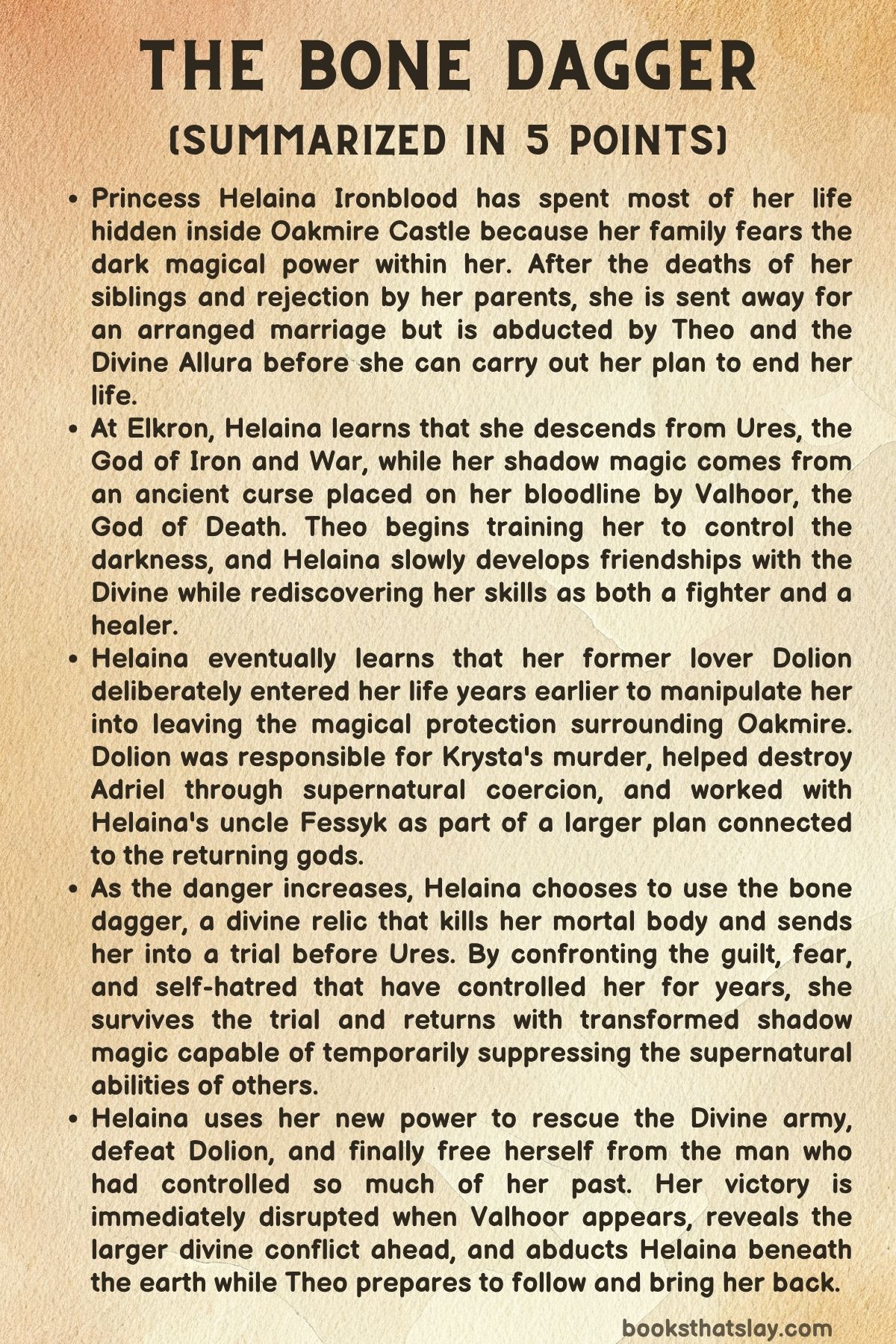
Princess Helaina Ironblood’s life changes irreversibly when she secretly finds her older brother, Crown Prince Adriel, dead in an inn. Adriel had once been a respected prince and political leader, but after the death of their sister Krysta, he descended into years of drinking and despair.
Helaina brings his body home in secret because she refuses to let his final years define how Keles remembers him. Her grief, however, awakens the strange black shadow magic she has spent her life trying to suppress with a bracelet of blue tempest tears.
Her family has already been damaged beyond recognition. Queen Jayda treats Helaina with coldness, King Oren has withdrawn from his duties, and Oren’s brother Fessyk increasingly controls the kingdom.
Soon after Adriel’s death, Fessyk informs Helaina that she is being sent away to marry Prince Jordon Poroma of the Mirrored Deserts. Helaina initially believes he has arranged the marriage without her parents’ knowledge, only to discover that both Oren and Jayda support removing her from Keles because they believe her continued presence places everyone in danger.
Oren goes even further when confronted. He blames Helaina for the tragedies surrounding Krysta and Adriel, calls her a burden, and reveals that the fae king Matthias once created a magical shield around Oakmire specifically to protect and conceal her.
The rejection destroys what remains of Helaina’s desire to live. She leaves Keles intending never to reach her arranged marriage, secretly carrying a knife with which she plans to kill herself during the journey.
Unknown to Helaina, Captain Theodon Wrenn has been searching for the source of an unusual magical presence for years. Theo leads the Divine Allura, an immortal army hidden beneath Ash Cliff whose members descend from the gods and defend Lynor against monsters emerging from the east.
Theo possesses the ability to identify people carrying dormant divine power. The mysterious force he has sensed around Keles is different from anything he normally encounters because its darkness is already awake and incredibly powerful.
Theo, Callum, and Manos follow Helaina’s caravan. Manos, who can read minds, discovers her intention to die, and Theo decides to intervene before she can act.
Callum enters Helaina’s tent just as she prepares to use her knife. What follows looks to Helaina like a violent kidnapping, especially when Theo and Manos appear and the caravan is attacked by supernatural creatures.
The men take Helaina to Elkron, the hidden underground stronghold of the Divine Allura. There she discovers that Ash Cliff is not simply the source of the monsters threatening Lynor; the Divine living beneath it are actually preventing those creatures from spreading across the kingdoms.
Theo deliberately provokes Helaina in an attempt to understand her abilities. He reveals his terrifying transformed form, complete with horns, wings, fangs, and supernatural power, and tries to use a fear-based ability that normally overwhelms anyone he touches.
Nothing happens.
Helaina is immune to his hostile magic. When she removes her tempest-tear bracelet, her own shadows erupt and strike Theo with extraordinary force.
The Divine explain that their members reclaim ancestral abilities through an ancient relic called the bone dagger. The dagger kills the mortal body and sends the person into a trial before their ancestral deity; survival restores divine power and grants an existence no longer governed by normal aging.
Helaina initially refuses. She has spent her entire life having decisions made for her, and joining an immortal army appears to be another destiny imposed without consent.
Gradually, however, she learns the truth about her power. She descends from Ures, God of Iron and War, but the shadows inside her are the result of a curse placed upon Ures’s bloodline by Valhoor, God of Death.
A prophecy foretold that a future descendant marked by silver eyes and darkness would become connected to Valhoor’s return. Theo believes Helaina must reach Ures through the bone dagger before Valhoor can claim the curse and turn her into the weapon he intended.
Helaina chooses to train rather than continue hiding. Theo teaches her that the darkness does not have to appear only when she is afraid or angry; she can summon and shape it deliberately.
Her relationship with the Divine also begins changing. Breyer initially treats her with hostility, but Helaina eventually trains alongside Breyer and her mate Fee. Callum, who first frightened Helaina during her abduction, becomes one of her closest friends.
The turning point comes when creatures attack the south watchtower. Aaron, Callum’s younger brother, is critically wounded, while Agatha is taken and killed.
Helaina refuses to abandon Aaron. She forms a protective cocoon of shadows around him and later uses the medical knowledge she learned in Oakmire to perform an emergency procedure that drains blood from around his lung and keeps him alive until the Divine healer Lionel returns.
Saving Aaron changes Callum’s opinion of her. He tells Helaina about the brutal childhood that shaped his determination to protect his younger brother and challenges her to decide what purpose she will create from her own suffering.
Meanwhile, Helaina and Theo develop an increasingly intense attraction. Theo is fascinated by the fact that Helaina can touch him without being harmed by his fear magic, while Helaina gradually recognizes loyalty and vulnerability beneath his frightening appearance.
Their connection is complicated by Helaina’s past with Dolion Creed.
Years earlier, Dolion arrived at Oakmire pretending to be the son of a stable master. Helaina, desperately lonely after a childhood of confinement, became close to him and eventually entered a secret romance.
Krysta distrusted Dolion from the beginning, but Helaina interpreted her sister’s warnings as another attempt to control her. Dolion carefully presented himself as patient, affectionate, and respectful, giving Helaina the sense of choice she had been denied elsewhere.
Eventually Helaina revealed everything to him: the prophecy, her shadows, Matthias’s protection, and the danger surrounding her. Dolion responded by asking her to escape Oakmire and marry him.
Helaina agreed.
On the night she tried to run away, Dolion exposed the truth. He had murdered the real Glen Creed and his son, assumed their identity, and entered Oakmire specifically to find Helaina.
His allies Benon and Balor set the stables ablaze as part of the escape plan. Dolion revealed that their relationship had been a long manipulation designed to lure Helaina voluntarily beyond Matthias’s shield.
Krysta arrived and tried to save her sister. Although Krysta stabbed Dolion through the chest, he healed immediately because he had already become undead.
Dolion then murdered Krysta with her own blade while Helaina watched. Helaina’s shadows exploded from the trauma, but Dolion escaped after burning a serpent-shaped mark into her chest and promising that he would find her again.
The guilt from that night destroyed the Ironblood family. Helaina blamed herself, while Adriel deteriorated into alcoholism.
In the present, Helaina learns that Adriel’s decline was not entirely his own doing. Fessyk secretly supplied Dolion with Adriel’s blood, allowing supernatural coercion to intensify the prince’s self-destructive behavior.
Fessyk had traded information about Helaina in exchange for the promise of Keles’s crown. When the earlier attempt to capture her failed, the conspirators systematically damaged the Ironblood family until they would eventually send Helaina beyond Oakmire’s protection themselves.
Dolion finally reappears while Helaina and Callum are outside Elkron. He is now openly undead and serves Drayella, Goddess of Nightmares.
A confrontation follows, and Theo arrives to protect Helaina. She destroys her tempest-tear bracelet and consciously releases her shadows, now beginning to show traces of silver light.
Dolion escapes, but the confrontation reveals an even greater danger. Drayella has returned to Lynor through an artifact called the blood crown, whose magic requires enormous quantities of blood.
The disappearances and drained bodies across Lynor were sacrifices used to restore the banished goddess. Drayella is building an undead army while waiting for Valhoor’s return.
Realizing there is no longer enough time for gradual preparation, Helaina agrees to use the bone dagger. Before the ritual, she and Theo finally acknowledge the emotional and romantic connection between them.
Helaina drives the dagger through her heart and awakens in the realm of Ures. There she discovers that the God of Iron and War is far removed from the imposing warrior depicted in mortal art.
Ures explains the origin of Valhoor’s hatred. Valhoor once loved a mortal woman named Fessa, but Fessa was Ures’s bonded, a uniquely destined partner connected to a god. Jealousy and resentment eventually pushed Valhoor toward violence, Drayella, and revenge against Ures’s descendants.
Helaina’s trial takes her into the dark room that has haunted her dreams for years. There she confronts a starved, broken version of herself that repeats every accusation she has internalized: that she is selfish, weak, destructive, and responsible for the deaths around her.
Instead of trying to destroy or deny that part of herself, Helaina accepts that she has been frightened, damaged, and selfish at times while refusing to believe those moments must define her future.
Her shadows change. Silver light enters the darkness, and she breaks free from the room.
Krysta and Adriel then appear. They tell Helaina that they never blamed her, allowing her to release years of grief and finally cry.
Adriel’s final note confirms that he fought Dolion’s coercion until the end. He urges his sister to stop sacrificing herself to what cannot be repaired and instead protect what can still be saved.
While Helaina completes the trial, Dolion attacks Elkron. By controlling Manos, whose mind is connected to the Divine army, Dolion immobilizes nearly every soldier.
He also reveals Theo’s greatest secret: Theo is not merely descended from a god. Valhoor is his father and Drayella is his mother, making Theo a god by birth.
Theo nevertheless chose centuries earlier to oppose his parents and defend mortals.
As undead syren hounds attack the helpless Divine, Theo and Callum fight alone. Benon eventually takes Aaron hostage, leaving Callum with an impossible choice between saving his brother and defending the army.
Helaina returns before he must choose.
Now Divine, her shadows contain brilliant silver light. She immobilizes Benon and crushes him inside his armor before spreading her power across the battlefield.
The true nature of the curse is finally revealed. Helaina is a magical dampener whose shadows can suppress supernatural abilities.
Divine soldiers, undead monsters, Theo, and Dolion all become temporarily mortal when touched by her power. The undead creatures lose the regenerative abilities that previously made them extraordinarily difficult to kill, allowing the restored Divine army to defeat them with ordinary weapons.
Helaina then confronts Dolion herself.
He tries to manipulate her with the same guilt and affection he once used to control her. When his undead abilities disappear beneath her shadows, he claims that Drayella forced him into everything and insists that he always loved Helaina.
She allows him to believe she has fallen for his deception once again.
When he secretly attempts to stab her, her shadows stop him.
Theo offers to imprison Dolion and punish him for years, but Helaina refuses to let him occupy any more of her life. She kills him with the power he spent years trying to control, ending the man responsible for Krysta’s murder, Adriel’s destruction, and much of her own suffering.
After the battle, Helaina tells Theo that she has come home, meaning Elkron and the life she has chosen rather than Keles.
Theo finally recognizes why he has felt drawn toward her from the moment he sensed her magic. Helaina is his bonded, the one soul uniquely connected to him.
Their reunion is immediately interrupted.
The earth opens and Valhoor himself emerges. The God of Death resembles Theo closely enough to make their relationship unmistakable.
Valhoor mocks his son for choosing mortals over his divine parents and then announces that Helaina is coming with him.
Before Theo or the others can stop him, Valhoor seizes Helaina with shadow and drags her beneath the earth. Theo tries to follow, but the opening closes.
Having finally found both his bonded and an equal capable of standing beside him, Theo refuses to lose her. He orders Callum and Manos to prepare because they are going after Valhoor and bringing Helaina home.
Characters
Helaina Ironblood
Helaina is the emotional and narrative center of The Bone Dagger, beginning as a deeply isolated princess who has internalized the belief that her existence is dangerous. Years of confinement, secrecy, family rejection, Krysta’s death, and Adriel’s collapse leave her carrying an enormous amount of guilt that she converts into self-punishment.
Her refusal to eat properly, her emotional numbness, and her plan to die during the journey to the Mirrored Deserts show how completely she has stopped imagining a meaningful future. What makes her development important is that recovery does not come from being told that she is powerful; it comes from repeatedly discovering that her choices can still matter.
Her medical ability is equally important to understanding her character. Long before she accepts herself as a fighter, she wants to heal people, and that instinct survives everything that happens to her.
Saving Aaron demonstrates that compassion remains part of her even when she has nearly abandoned compassion toward herself. Her later transformation therefore does not replace the healer with the warrior; it allows both identities to exist together.
Helaina’s central conflict concerns control. Oren, Adriel, Krysta, Fessyk, Dolion, Theo, prophecy, and even the gods repeatedly attempt to decide where she should go or what she should become.
Her strongest development occurs when she stops choosing between obedience and escape. Training, taking the bone dagger, accepting her shadows, confronting Dolion, and returning to battle all become decisions she makes for reasons she has personally accepted.
Theodon Wrenn
Theo functions in The Bone Dagger as Helaina’s captor, teacher, protector, romantic partner, and eventual divine equal. His first actions toward her are deliberately coercive because he thinks primarily like a commander responsible for preventing catastrophe.
His harshness makes him difficult to trust, especially because Helaina has spent her life surrounded by people who justified controlling her as protection. Theo must gradually recognize that keeping someone alive is not the same as respecting that person’s autonomy.
His frightening appearance contrasts strongly with his actual moral loyalties. Although he possesses demonic characteristics and fear magic capable of psychologically destroying others, he has spent centuries protecting mortals from the very supernatural forces to which he is biologically connected.
The revelation that Valhoor and Drayella are his parents makes this contrast even stronger. Theo’s identity is based not on blood but on the side he has deliberately chosen.
His relationship with Helaina also exposes his deepest insecurity. Because physical contact can activate his destructive power, intimacy has always carried danger for him.
Helaina’s immunity gives him the possibility of closeness without fear, which partly explains why his attachment becomes so intense. His development therefore involves accepting vulnerability rather than simply maintaining command.
Callum
Callum initially appears as the most openly threatening member of Theo’s group because he is the man who physically enters Helaina’s tent and places a blade against her throat. His enormous strength, combat ability, and casual attitude toward violence make Helaina’s early fear of him understandable.
His deeper personality emerges through Aaron. Callum’s entire existence has been shaped by protecting his younger brother, beginning in childhood when he endured abuse so Aaron could remain hidden from the men who intended to harm them.
That history explains both his ruthlessness and his loyalty. Callum does not see violence as inherently corrupt; he judges it according to whom it protects and whom it punishes.
His relationship with Helaina changes after she saves Aaron. Gratitude develops into real friendship, and Callum becomes one of the people most capable of challenging Helaina without treating her as a prophecy or weapon.
His question about what purpose she will give her pain becomes central to her transformation. Callum never argues that suffering is good, only that the person who survives it still has some power over what follows.
Manos
Manos plays a quieter but extremely important role because his mental abilities repeatedly provide information no ordinary investigation could reveal. He detects Helaina’s intention to kill herself before Theo’s group intervenes and later reads memories that help the Divine understand attacks on Elkron.
His powers also make him strategically dangerous. Because he is connected to the minds of the Divine, Dolion eventually uses him as the point through which the entire army can be controlled.
This vulnerability shows that extraordinary abilities can create weaknesses as well as advantages. Manos is valuable precisely because his mind reaches others, yet that same connection allows an enemy to turn one person into a doorway to thousands.
Despite possessing powers that could easily violate personal boundaries, he is not portrayed as casually cruel. His position within Theo’s leadership reflects trust earned over a long period.
Adriel Ironblood
Adriel is one of the most important absent presences in the story. His death occurs at the beginning, but his choices, failures, love for Helaina, and hidden struggle against coercion continue shaping events long afterward.
As a younger man, Adriel is politically capable and unusually forward-thinking. He works to build alliances between humans and fae because he understands that the threat from beyond Ash Cliff cannot be handled by isolated kingdoms.
His relationship with Helaina is protective but complicated. He loves her, gives her the tempest-tear bracelet, eventually trains her with a sword, and argues that hiding her without preparing her is dangerous.
At the same time, years of secrecy contribute to Helaina’s belief that she is useless and unwanted.
After Krysta dies, Adriel collapses emotionally. Helaina assumes his alcoholism proves that she destroyed him, but the later revelation that Dolion used supernatural coercion changes the meaning of his decline.
His final message confirms that he continued fighting internally and wanted Helaina to stop defining herself through irreversible losses.
Krysta Ironblood
Krysta is Helaina’s sister, protector, source of conflict, and one of the greatest influences on her guilt. Their relationship is convincing because affection and frustration exist together.
They share books, jokes, personal conversations, and genuine sisterly closeness, yet Krysta also represents the freedom Helaina believes she has been denied. Krysta travels, forms relationships, and prepares for marriage while Helaina remains confined.
Krysta’s distrust of Dolion proves tragically correct. She recognizes inconsistencies in his story long before anyone else takes them seriously and repeatedly tries to protect Helaina.
Because Helaina is desperate for independence, however, she interprets that concern as control.
Krysta’s final actions define her loyalty. She follows Helaina beyond Oakmire, attacks Dolion, and continues telling her sister to escape even while being restrained and fatally wounded.
Her death becomes the event around which Helaina organizes years of self-hatred, making their reunion during the divine trial essential to Helaina’s emotional recovery.
Dolion Creed
Dolion is effective as an antagonist because his greatest weapon is not supernatural strength but emotional manipulation. He identifies exactly what Helaina lacks—freedom, attention, romance, trust, and the feeling of being chosen—and patiently supplies those things.
His deception lasts because he does not initially behave like an obvious villain. He listens, waits, respects apparent boundaries, and allows Helaina to believe that their relationship belongs entirely to her.
That patience makes the betrayal especially destructive. Dolion did not simply deceive Helaina about his identity; he deliberately shaped her emotional development for years so that she would eventually reveal information and leave Matthias’s protection voluntarily.
His cruelty becomes unmistakable once she is outside Oakmire. He mocks the loneliness he previously comforted and turns private trust into evidence of how effectively he manipulated her.
His later attempts to regain control rely on the same method. Even after losing his supernatural power, he instantly returns to emotional deception by claiming Drayella forced him and that his love was genuine.
Helaina’s final rejection matters because she no longer needs to prove anything to him. Killing him ends not only a physical threat but his remaining psychological claim on her.
King Oren Ironblood
Oren is a tragic example of fear becoming cruelty. He knows Helaina faces a genuine supernatural threat and accepts Matthias’s shield as the safest way to hide her.
His central failure is believing that protection justifies keeping Helaina uninformed and powerless. When Adriel argues that she should be trained, Oren refuses because he trusts concealment more than preparation.
After Krysta’s death and Adriel’s collapse, grief turns him against Helaina. Instead of recognizing her as another traumatized member of the family, he makes her responsible for everything they have lost.
Calling his daughter a burden and sending her away ultimately assists the very enemy he spent years trying to keep away from her. His actions show how fear can produce the outcome it was meant to prevent.
Queen Jayda Ironblood
Jayda appears less frequently than Oren, but her emotional rejection has enormous impact on Helaina. When Helaina seeks comfort after Adriel’s death, Jayda makes clear that she supports sending her surviving daughter away.
Her reaction reflects a mother whose grief has overwhelmed her capacity to distinguish blame from pain. Krysta and Adriel have become symbols of what Helaina supposedly cost the family.
Jayda’s failure is particularly painful because Helaina approaches her hoping that the bond between mother and daughter might survive. Instead, Jayda confirms Helaina’s deepest fear: that her family would rather live without her than continue protecting her.
Fessyk
Fessyk transforms from an unpleasant political relative into one of the story’s central human betrayers. Acting as ruler while Oren withdraws, he presents Helaina’s marriage as a political decision and helps remove her from Keles.
The later revelation exposes much darker motives.
Fessyk secretly collaborates with Dolion because he expects to receive the throne. He provides information about Helaina and even supplies Adriel’s blood so supernatural coercion can worsen the prince’s collapse.
His betrayal is especially significant because the enemy does not defeat Oakmire’s defenses through superior force. Fessyk helps destroy the family from within until they make the decision Dolion needs.
King Matthias Lavertus
Matthias recognizes Helaina’s significance when she is still a child. His unusual attention toward her silver eyes suggests that he understands immediately that the prophecy has taken physical form.
Rather than treating the child as guilty for what she might become, Matthias helps protect her. He provides the magical shield around Oakmire and enchants the tempest tears that suppress her shadows.
His role therefore contrasts with the fear shown by others in Azaros who apparently wanted Helaina killed before she could become dangerous. Matthias accepts risk in order to give a child time to live.
Even though his protection contributes indirectly to Helaina’s confinement, his intentions differ from those who merely want the problem removed.
Breyer
Breyer begins as one of Helaina’s strongest opponents inside Elkron. She has heard old rumors about the mortal child marked by Valhoor and suspects that Helaina might be responsible for disappearing soldiers and increasing attacks.
Her hostility is therefore rooted in fear for the people she considers family.
Their arena fight becomes important because each woman is forced to reconsider the other. Breyer discovers Helaina is far more skilled and determined than expected, while Helaina learns that the Divine will not treat her delicately simply because she is royal.
After the conflict, Breyer becomes one of the people who rebuild Helaina physically. Training with her turns former hostility into respect.
Fiona “Fee”
Fee provides a gentler entry point into Divine society than Breyer. She apologizes for earlier hostility, explains customs surrounding mates and the bone dagger, and eventually becomes one of Helaina’s trainers and friends.
Her relationship with Breyer also expands Helaina’s understanding of bonds beyond conventional marriage. The two women regard their connection as something deeper and permanent.
Fee’s role becomes especially valuable during Helaina’s adjustment to Elkron because she offers companionship without demanding immediate loyalty.
Aaron
Aaron is initially important because of his relationship with Callum, but he develops a meaningful connection with Helaina after she saves his life. The attack that costs him an arm could easily make him resent her, especially because the creatures were searching for Helaina.
Instead, Aaron openly credits her with keeping him alive.
His response helps dismantle Helaina’s belief that everyone harmed around her must eventually hate her. Aaron experiences a permanent loss and still refuses to transform that loss into blame.
Agatha
Agatha has relatively little time in the story, but her death becomes significant because she treats Helaina kindly before the attack. As another descendant of Ures, she demonstrates what Helaina might become after reclaiming ancestral power.
Agatha’s disappearance and death also force Helaina to confront the real cost of the war being fought around Ash Cliff. The permanent candle later burning in her memory shows Helaina that the Divine do not survive loss by refusing to grieve.
They remember their dead while continuing the work for which those people died.
Lionel
Lionel represents the healing side of the Divine world. His ability to restore severe injuries gives Helaina a direct parallel to her own medical interests.
He helps repair her body after the river attack and later saves Aaron after Helaina stabilizes him.
Lionel’s presence also confirms that becoming Divine does not mean every supernatural gift is designed for combat. His work allows Helaina to see that power can preserve life just as easily as destroy it.
Madge
Madge is one of the few adults from Oakmire associated with encouragement rather than control. As a senior healer, she supports Helaina’s interest in medicine and recognizes her ability to help others.
Her influence becomes clear much later when Helaina treats Aaron. The technical knowledge that keeps him alive comes from the part of Helaina’s identity developed under Madge rather than from prophecy, royal training, or divine instruction.
Madge therefore represents an ordinary form of mentorship that becomes just as important as supernatural preparation.
Ures
Ures overturns Helaina’s assumptions about gods almost immediately. She expects the God of Iron and War to resemble the powerful armored figure of mortal art and instead meets someone tending flowers near a farmhouse.
His appearance reinforces his lesson that identity should not be reduced to reputation or expectation.
Ures does not remove Helaina’s darkness for her. He makes her confront it.
His explanation of Valhoor, Fessa, and the curse gives Helaina historical knowledge, but the trial demands personal acceptance. Only after she accepts the damaged version of herself without surrendering to it does Ures strengthen her shadows with divine light.
Valhoor
Valhoor is both the origin of Helaina’s curse and Theo’s father. His hatred began in jealousy connected to Fessa and Ures, but that ancient grievance eventually expanded into revenge against an entire bloodline.
His curse creates Helaina’s shadow power with the expectation that she will eventually become a weapon against divine beings.
The irony is that the weapon he creates develops an independent will.
Valhoor’s arrival after Dolion’s defeat immediately establishes that the human and undead conspiracies were only parts of a much larger conflict. His effortless abduction of Helaina also demonstrates that her victory has not ended the threat.
Drayella
Drayella operates for much of the story as an unseen force behind the undead attacks. As Goddess of Nightmares, she is connected to the supernatural army being built beyond Ash Cliff and to Dolion’s transformation.
The blood crown allows her to return despite the banishment of the Hell Gods.
Her relationship with Theo adds another layer to the conflict. She is not simply a distant divine enemy; she is his mother.
Theo’s decision to protect mortals therefore represents a rejection of both parents and the destructive identity they might expect him to accept.
Benon
Benon is one of Dolion’s undead enforcers and participates directly in the destruction surrounding Helaina. He helps trap her during the original betrayal and later takes Aaron hostage during the attack on the Divine.
His role is defined by physical intimidation and cruelty rather than manipulation.
His final confrontation with Helaina demonstrates how completely the balance has changed. Once her newly transformed shadows remove his supernatural advantages, she destroys him before he can use Aaron as leverage.
Balor
Balor operates alongside Benon during many of Dolion’s crimes. He participates in the attack that leaves Aaron critically wounded and Agatha captured.
After Dolion escapes, Balor is taken alive because the Divine need information.
Callum eventually kills him after Manos extracts what they need. His death reflects Callum’s harsh approach to justice: once Balor can no longer provide useful intelligence, Callum sees no reason to spare someone responsible for immense suffering.
Laurelai
Laurelai is part of Helaina’s limited support system at Oakmire and assists her during the years when she secretly meets Dolion. Her willingness to cover for Helaina gives the princess moments of freedom that her guards and family would otherwise prevent.
Although that assistance unintentionally makes Dolion’s manipulation easier, Laurelai is not presented as malicious. She reflects how difficult it is for ordinary people around Helaina to distinguish between helping her exercise personal freedom and unknowingly exposing her to a danger no one fully understands.
Prince Ildhor
Ildhor appears mainly through his relationship with Krysta. Unlike the political arrangements surrounding Helaina, Krysta genuinely loves him and looks forward to building a life in Creston.
The ceremonial blade he gives her becomes tragically significant because Krysta uses it against Dolion before Dolion turns the same weapon against her.
Ildhor’s arrival after Krysta’s death broadens the consequences of the tragedy. Helaina does not only see the destruction of her own family; she watches another person lose the future he believed was about to begin.
Prince Jordon Poroma
Jordon remains largely outside the direct events of the novel, but his arranged marriage to Helaina is structurally important. He represents the destination chosen for her by people who no longer want responsibility for protecting her.
Importantly, the marriage itself is later revealed to have been genuine. Jordon is therefore not part of Dolion’s conspiracy.
The plan depends instead on Helaina never surviving the journey to meet him, making the proposed marriage another example of a legitimate political arrangement being exploited by hidden enemies.
Themes
Choice, Control, and Personal Autonomy
Nearly every major conflict in The Bone Dagger asks who has the right to decide Helaina’s future. Her childhood is built around restrictions that other people consider necessary: she cannot travel, cannot understand why she is being hidden, cannot determine how her strange power should be handled, and eventually cannot even choose whether she remains in her own kingdom.
Protection and control become dangerously difficult to separate. Oren hides information because he believes knowledge will expose Helaina to danger, Adriel trains her because he believes ignorance leaves her helpless, Dolion offers apparent freedom while secretly manipulating her, and Theo abducts her because he believes the consequences of allowing her to die are too great.
Helaina’s development requires her to recognize that rejecting control does not mean rejecting every responsibility placed before her. Early in the story, escape is her main expression of choice: she wants to disappear, leave Oakmire, run from Elkron, or die rather than participate in a life directed by others.
Her later decisions operate differently. She trains because she chooses strength, uses the bone dagger because she understands the threat, accepts Theo because she wants the relationship, and confronts Dolion because she refuses to let him govern her emotions any longer.
Freedom becomes not the absence of obligation but the ability to understand consequences and still make the decision personally.
Grief, Guilt, and the Creation of Purpose
Helaina initially treats grief as evidence against herself. Krysta’s murder becomes proof that her desire for independence was selfish, while Adriel’s deterioration appears to confirm that one terrible decision destroyed everyone she loved.
Because she cannot undo what happened, she turns punishment inward. Hunger, isolation, emotional withdrawal, and suicidal thoughts become ways of continuing the sentence she believes she deserves.
Callum introduces a different understanding of suffering when he asks Helaina what purpose she intends to give her pain. His own history does not suggest that suffering automatically creates wisdom; instead, he consciously turns his past into a determination to protect Aaron and punish people who prey on the vulnerable.
The Divine memorial chamber offers another version of the same idea. Thousands of permanent candles prove that immortality does not eliminate grief, but the surviving soldiers continue acting despite carrying the memory of those they lost.
Helaina’s divine trial finally requires her to face the cruel internal voice created by guilt. Recovery does not require pretending that every choice she made was correct.
She acknowledges fear, selfishness, and weakness while refusing to believe that these qualities represent her permanent identity. Adriel’s message gives that realization direction: what cannot be changed does not need to consume the future.
Appearance, Trust, and the Meaning of Monstrosity
Theo and Dolion create an intentional contrast between frightening appearances and genuine danger. Theo visually resembles the kind of creature Helaina has been taught to fear: horns, wings, fangs, darkness, overwhelming strength, and a magical ability capable of producing unbearable terror.
Dolion appears attractive, patient, gentle, and attentive.
Helaina’s early life teaches her to associate safety with familiar appearances and danger with visible monstrosity. Her experience reverses that assumption.
Dolion’s attractive exterior allows him to manipulate her for years because he gives her exactly the emotional experience she wants. He does not need to imprison her physically when trust can persuade her to walk beyond Oakmire’s shield by choice.
Theo frightens her immediately because nothing about him conceals his danger. Yet over time his actions repeatedly reveal loyalty beneath that appearance.
He saves Helaina when she runs, feeds her when she neglects herself, searches for missing soldiers, accepts responsibility when his choices place others at risk, and stands against his own divine parents to defend mortals.
By the time Dolion returns, Helaina finally understands the distinction. Theo’s monstrous form no longer determines whether she trusts him, while Dolion’s familiar human face no longer carries emotional authority.
Monstrosity becomes a matter of action rather than appearance.
Darkness, Self-Acceptance, and Transformation
Helaina spends most of her life treating her shadows as physical evidence that something is fundamentally wrong with her. The tempest-tear bracelet suppresses the power, her family hides her because of it, and unexplained eruptions strengthen her belief that the darkness must always be controlled from outside.
Training changes that relationship gradually.
Theo first teaches Helaina to summon tiny strands of shadow deliberately rather than waiting for fear or anger to trigger them. Later she crosses the sinkhole on a bridge created from her own darkness and eventually removes the bracelet without viewing its absence as immediate danger.
The deepest transformation occurs during the trial before Ures. The dark room from Helaina’s recurring nightmare turns out to be a psychological space built from everything she refuses to accept about herself.
The broken reflection attacking her cannot be defeated simply by insisting that it is false because parts of its accusations contain truths Helaina already knows. She has been afraid. She has made destructive decisions. She has hurt others and herself.
Acceptance becomes powerful precisely because it does not require innocence.
Once Helaina admits those parts of herself without allowing them to dictate who she must remain, silver light enters the shadows. The darkness does not disappear after healing; it changes because she finally controls it as part of herself rather than treating it as an enemy living inside her.