The Country Road Murders Summary, Characters and Themes
The Country Road Murders by James Patterson follows Silas Tucker Jr., a gifted athlete whose expected NFL career is destroyed almost immediately after he reaches professional football.
Returning to his North Carolina hometown, Silas finds Cross Rivers damaged by drugs, corruption, disappearances, and the criminal power of the Crockett family. What begins as a story about physical recovery becomes a fight over identity, justice, loyalty, and community. Silas must decide who he is without the future he spent his entire life preparing for, even as his father’s unsolved murder and a new wave of violence force him into increasingly dangerous choices.
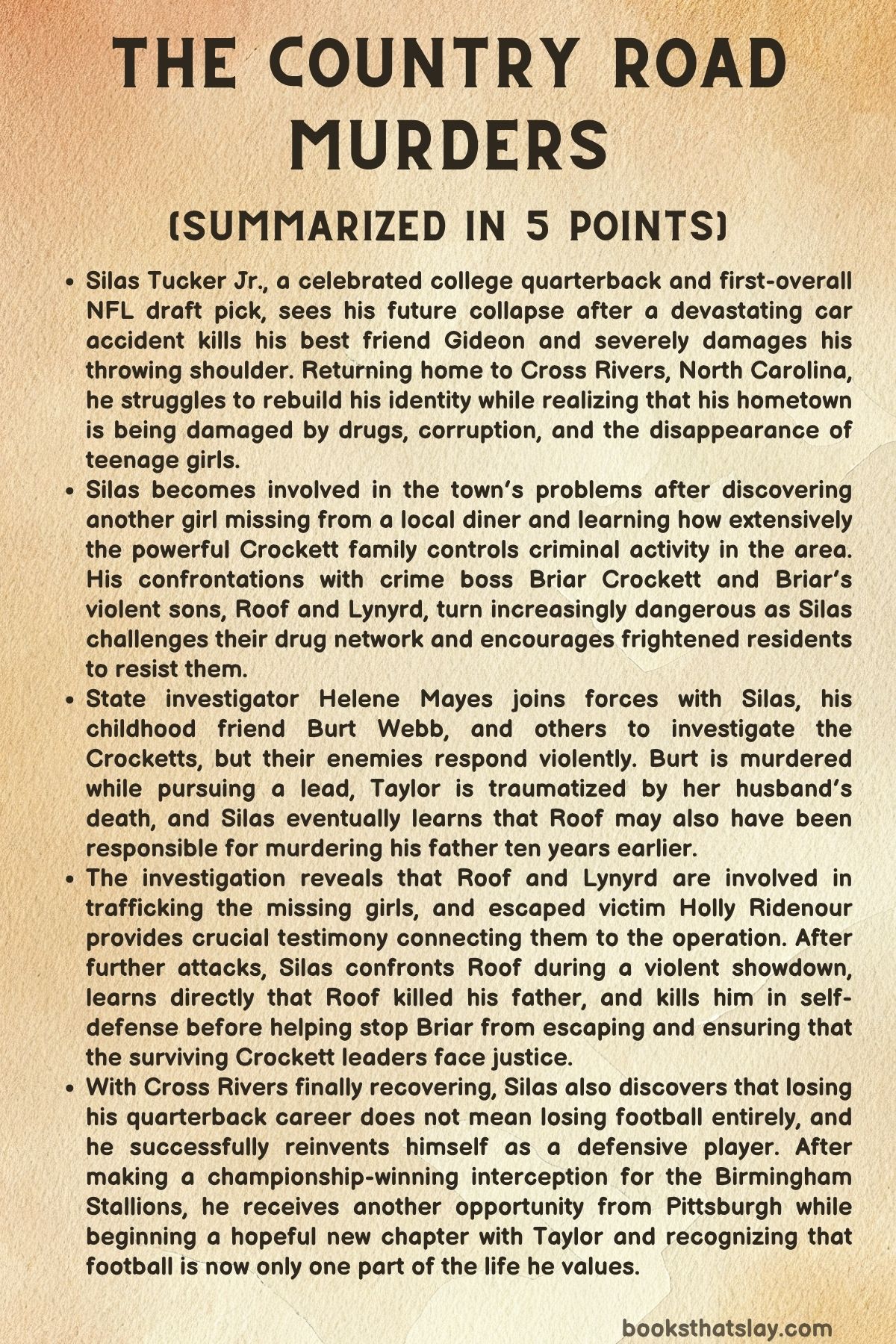
Summary
Ten years before Silas Tucker Jr.’s adult life changes forever, his father, Silas Tucker Sr., is murdered on a country road outside Cross Rivers. The respected high-school principal stops to help what appears to be an injured teenager beside a motorcycle, only to discover that the scene has been staged; the boy shoots him repeatedly, takes his wallet as a souvenir, and disappears, leaving the murder unsolved.
A decade later, Silas Jr. has become one of the most celebrated young athletes in America. Famous for once throwing a baseball 109 miles per hour and later for becoming a championship quarterback at the University of North Carolina, he is chosen first overall in the NFL draft by the Pittsburgh Steelers.
His future appears limitless, although his success cannot erase the absence of his father or his mother, who died from cancer. He was largely raised by his formidable grandmother EmmaJean, known as EJ, and remains close to childhood friends Taylor McCarter Webb and her husband, police officer Burt Webb.
During the celebration of his NFL selection, Silas receives a Porsche from his agent, Laurance Most. His best friend and receiver Gideon Garland drives the car afterward, loses control while traveling at high speed, and crashes into the woods.
Gideon dies, while Silas survives with catastrophic injuries to his spine, leg, internal organs, and especially his throwing shoulder. Although the Steelers honor his contract, doctors cannot assure him that he will ever throw a football effectively again, and rehabilitation proves that the extraordinary arm on which his career was built has been permanently changed.
Silas returns to his family farm in Cross Rivers, believing professional football is finished. Farm manager Charlie Hall gives him useful work without pity, EJ pushes him toward responsibility, and Silas tries to rebuild himself through physical labor and exhausting workouts.
His hometown, however, has deteriorated badly. Teenage girls have begun disappearing throughout the county, opioid addiction is destroying young lives, and the Crockett family, led by crime boss Briar Crockett and his sons Roof and Lynyrd, dominates the region through fear, money, violence, and influence over local authorities.
Silas becomes personally involved after visiting Scobee’s Diner one night and discovering that teenage employee Molly Brendle has vanished. Burt believes a serial predator or trafficking operation may be responsible for the growing number of missing girls, while desperate farmer Leamon Ridenour asks Silas to help find his missing daughter Holly.
Silas’s anger grows when he sees young dealers operating openly near the high school and the football stadium named after his father. He confronts them physically, beginning a pattern in which his old quarterback instinct to take control turns into dangerous personal intervention.
The conflict soon places Silas directly against the Crockett family. He fights Roof and Lynyrd, challenges Briar at his estate, survives a shotgun warning and a violent ambush at his farm, and becomes increasingly suspicious that Sheriff Nash Hader is protecting the Crocketts rather than enforcing the law.
At the same time, Silas becomes a public symbol of resistance. Speaking at a community gathering, he condemns the drug trade and tells residents that Cross Rivers belongs to them rather than to criminals, but the speech is followed almost immediately by the overdose death of sixteen-year-old Riley Millsap.
Silas refuses a lucrative advertising offer from a pain-relief company because he cannot promote medication while his community is being devastated by opioid addiction. His priorities have shifted from fame and professional success toward responsibility for the place that formed him.
State investigator Helene Mayes eventually arrives as part of an organized-crime task force. She recognizes that Briar’s strength comes not simply from criminal activity but from corrupt institutions, frightened residents, loyal associates, and compromised officials, and she sees Silas’s public credibility as something law enforcement can use.
A secret meeting involving Helene, Silas, Burt, Taylor, EJ, and local leaders forms the basis of a coordinated campaign against the Crocketts. Almost immediately, however, Briar reveals that he somehow knows about the gathering, confirming that his organization has access to information that should have remained confidential.
The conflict becomes even more personal when EJ tells Silas that she has long believed Roof Crockett was the teenager who murdered Silas Sr. Silas has no proof, but the possibility turns his struggle against the Crocketts into a battle against the man who may have caused the defining loss of his childhood.
Meanwhile, Burt develops a lead involving a white van connected to the missing girls. Before he can meet an informant, men in a distinctive red-and-white Ford Fairlane ambush him and shoot him repeatedly.
Burt initially survives surgery but later dies. Taylor, who witnessed the attack, is devastated and temporarily loses her sight through a trauma-related psychological reaction, while Silas becomes even more determined to identify the killers.
The truth about the missing girls is eventually revealed to the reader: Roof and Lynyrd are operating a human-trafficking scheme that moves kidnapped teenagers through a larger network. They later murder Carlton Fish and attempt to frame him as the lone kidnapper, hoping authorities will accept a convenient dead suspect and stop investigating.
While all this is happening, Silas discovers another possible future. Coach Gus Blasingame notices that Silas has rebuilt his body and wonders whether the former quarterback could become a defensive player.
Silas trains secretly as an edge rusher and performs impressively in a Steelers tryout, using his knowledge of quarterbacks and offensive systems to compensate for his lack of defensive experience. Pittsburgh ultimately refuses to sign him because of medical, contractual, and organizational concerns, but the attempt proves that his athletic life may not be over.
Another betrayal soon becomes clear. Abby Wells, Silas’s former girlfriend who has recently reentered his life, is secretly involved with Roof and has been passing information about Silas and the investigation to the Crocketts.
Once Abby tells Briar that authorities are closing in, he murders her because he considers informants inherently untrustworthy. When police later raid a Crockett safe house, arrested dealers reveal Abby’s connection to Roof, forcing Silas to understand that someone he trusted had helped his enemies monitor him.
The investigation finally gains its strongest witness when Holly Ridenour escapes from the trafficking network and returns home. Her testimony directly connects Roof and Lynyrd to the kidnapped girls and gives Helene the evidence needed to obtain arrest warrants.
The Crocketts answer with escalating violence. Gunmen attack Silas at his farm, where he kills the tattooed man believed to have murdered Burt in self-defense, shots are fired into Taylor’s house, and Helene is critically injured when a bomb destroys her car.
With Helene hospitalized, Jake Courville and the tactical team locate Roof, Lynyrd, Nash Hader, and their armed associates at a remote cabin. A gun battle begins, Hader attempts to surrender, and Roof shoots him in the back before fleeing.
Silas chases Roof through the darkness. During the pursuit, Roof finally admits that he murdered Silas’s father, confirming the truth Silas has been seeking for ten years.
Roof continues shooting and refuses to surrender, forcing Silas to kill him. The confrontation gives Silas certainty about his father’s death, but it cannot undo the loss or restore what was taken from him.
Lynyrd is captured alive, and information obtained before Hader dies leads Silas and Jake to Briar’s lakeside property. Briar tries to escape by seaplane and falsely claims that Taylor and EJ will be killed unless Silas lets him go.
When Briar reaches for his revolver, Silas shoots him in the shoulder rather than killing him. Taylor confirms that she and EJ are safe, and Briar survives to face prosecution along with the collapse of the criminal organization he built.
By the following spring, Cross Rivers is changing. Briar and Lynyrd are awaiting trial, Helene has recovered, the trafficking investigation has expanded with federal involvement, and the kidnapped girls investigators can trace have been returned home.
Taylor finishes her degree and prepares to teach at Cross Rivers High. She and Silas gradually move toward a romantic relationship, although both respect the memory of Burt and refuse to force a future before they are ready.
Silas also receives another chance at professional football when the Birmingham Stallions need defensive help. He signs a short-term contract, chooses his father’s number 77, survives the physical demands of professional defense, and reaches the league championship.
Late in the game, Silas uses his old quarterback knowledge to anticipate the opposing quarterback’s decision. He intercepts a pass near the goal line and returns it the length of the field for a championship-winning touchdown, completing his transformation from injured former quarterback into successful defensive player.
Afterward, Pittsburgh offers him the possibility of returning to training camp as a defender. For the first time, Silas does not immediately allow football to determine his answer because he now understands that his life also belongs to Taylor, EJ, the farm, his community, and the person he has become through loss and recovery.
On the way home, Silas throws a tennis ball and discovers that his damaged shoulder feels unexpectedly strong. The ending leaves his athletic future open, but the greater change is already complete: Silas no longer needs one particular version of success to know who he is.
Characters
Silas Tucker Jr.
Silas Tucker Jr. is the emotional and narrative center of The Country Road Murders, beginning as a young man whose entire identity has been built around exceptional athletic talent. His famous arm, national championship, and first-overall NFL selection give him a clearly defined future until the automobile accident kills Gideon and leaves Silas physically incapable of being the quarterback everyone expected him to become.
His deepest struggle is not simply physical rehabilitation but the collapse of identity that follows it. Silas has spent years measuring himself by performance, leadership, preparation, and his ability to control outcomes, so losing football creates a frightening emptiness that farm work, exercise, and eventually involvement in Cross Rivers begin to fill.
Silas is courageous, loyal, intelligent, stubborn, and frequently reckless. The same instinct that once made him want the ball when a game was at stake causes him to confront drug dealers, challenge the Crocketts, ignore tactical instructions, and repeatedly expose himself to dangers that trained law-enforcement officers tell him to avoid.
His relationship with violence develops carefully across the story. Silas begins as someone accustomed to controlled athletic aggression, but the attacks on his home, Burt’s murder, and the discovery of Roof’s responsibility for his father’s death force him into situations where genuine lethal force becomes necessary.
What ultimately distinguishes Silas is his capacity for reinvention. He learns that he can lose the role he considered central to his existence without losing the discipline, loyalty, intelligence, and competitive will that made that role possible in the first place.
Taylor McCarter Webb
Taylor is Silas’s childhood best friend, emotional confidante, and one of the few people who sees him as a complete person rather than as a celebrity athlete. Even before his accident, her presence reminds him that professional success cannot satisfy every emotional need, because his attachment to her has survived distance, adulthood, and her marriage to Burt.
She is practical enough to recognize the danger in Silas’s behavior long before he fully accepts it. Taylor repeatedly warns him that Cross Rivers cannot be approached like a football game and that courage becomes dangerous when Silas assumes every crisis is his personal responsibility.
Her relationship with Burt gives her position unusual emotional complexity. She genuinely loves her husband while also sharing a lifelong bond with Silas, and the novel avoids reducing these connections to a simple competition between two men.
Burt’s murder destroys the stability of Taylor’s life. Her temporary blindness reflects the overwhelming trauma she has experienced, yet her recovery also reveals her refusal to remain permanently defined by victimhood.
Taylor ultimately represents both Silas’s past and the possibility of his future. Their eventual movement toward romance works because it develops only after grief, loyalty, and time have been respected rather than treated as obstacles to be quickly removed.
EmmaJean “EJ” Tucker
EJ is Silas’s grandmother, guardian, moral anchor, and one of the strongest personalities in the story. After the deaths of Silas’s parents, she becomes the stable force who raises him without allowing tragedy to become an excuse for weakness or entitlement.
Her love is expressed through expectations rather than excessive protection. When Silas returns from rehabilitation believing his life has collapsed, EJ gives him work, responsibilities, humor, criticism, and the clear message that survival means continuing to participate in life.
She also carries unresolved grief about her son’s murder. Her belief that Roof Crockett killed Silas Sr. has remained with her for years, and revealing that suspicion to Silas becomes one of the most consequential decisions she makes.
EJ understands both generations of Tucker men well enough to recognize the danger of their shared refusal to tolerate intimidation. She admires Silas’s courage while fearing that the same quality may lead him toward the fate that took his father.
Burt Webb
Burt begins as Silas’s childhood friend and Taylor’s husband, but he grows into one of the novel’s most important representations of responsible public service. Unlike Silas, who can act from instinct and anger, Burt must constantly balance friendship, emotion, evidence, procedure, and the legal limits of his authority.
He understands the seriousness of the missing-girls investigation before many others do. His recognition that the disappearances may involve an organized predator or trafficking system makes him one of the first characters to see that Cross Rivers faces something larger than ordinary local crime.
Burt also provides Silas with an important moral boundary. He understands Silas’s anger about his father and the Crocketts, but repeatedly argues that revenge cannot replace justice and that information must be turned into evidence rather than private punishment.
His murder changes the emotional direction of the story. For Taylor it creates profound grief, while for Silas it removes a lifelong friend and strengthens the temptation to answer criminal violence personally.
Briar Crockett
Briar Crockett is the principal criminal authority in The Country Road Murders, but his danger comes from restraint rather than constant displays of uncontrolled rage. He thinks like an executive, values loyalty as a business necessity, and treats murder as an instrument to protect his organization rather than merely as an emotional act.
His killing of Klay Monroe establishes his method clearly. Briar remains calm while executing someone he believes has stolen from him, showing that violence has become an ordinary management tool within his criminal world.
Briar also understands power at a social level. He knows that his organization survives because people believe resistance is futile, which is why Silas threatens him even before law enforcement develops a strong case.
His attempts to recruit Silas demonstrate his preference for neutralizing opponents through influence when possible. When persuasion fails, Briar turns to intimidation, surveillance, murder, and attacks on the people surrounding Silas.
His final defeat is therefore appropriate. Roof dies violently, but Briar survives to face a legal system that strips away the fear and impunity on which his authority depended.
Roof Crockett
Roof is violent, arrogant, insecure, and deeply dependent on the reputation created by his family name. He repeatedly tries to humiliate Silas in public because Silas’s refusal to fear him threatens the image that has protected the Crockett brothers for years.
He is also personally connected to the oldest wound in Silas’s life. Roof eventually admits that he was the teenager who staged the roadside accident and murdered Silas Sr., turning what initially appeared to be an unsolved random killing into an act connected directly to the Crockett family.
His involvement in trafficking reveals an even darker level of cruelty. Roof does not merely participate in his father’s drug network; he helps treat abducted teenage girls as commodities to be transferred for profit.
Roof’s murder of Hader when the former sheriff attempts to surrender shows that loyalty means nothing to him once someone becomes a liability. His final confrontation with Silas is the inevitable result of years of violence, arrogance, and confidence that nobody could make him answer for his actions.
Lynyrd Crockett
Lynyrd operates largely beside Roof and shares his brother’s entitlement, aggression, and dependence on the Crockett reputation. He participates in intimidation, criminal violence, and the trafficking network while repeatedly presenting himself publicly as an unfairly accused member of a respected local family.
Compared with Roof, Lynyrd receives less personal connection to Silas’s history, which makes him function more clearly as evidence that the family’s corruption extends beyond a single violent individual. His participation demonstrates that the organization has produced an entire culture in which cruelty becomes routine and other people’s suffering becomes business.
His capture rather than death is important because it represents the return of institutional justice. Lynyrd must face prosecution, testimony, and evidence rather than disappearing through another private act of violence.
Helene Mayes
Helene Mayes enters the story as the professional force capable of confronting corruption on a scale local authorities cannot manage. Her background in major-city law enforcement and organized-crime work gives her the confidence to treat the Crocketts not as untouchable local figures but as targets of a structured investigation.
She immediately understands that Briar’s organization is protected by more than armed criminals. Money, compromised officials, frightened witnesses, and information networks all support the criminal system, so Helene focuses on dismantling those protections as well as arresting individual offenders.
Her relationship with Silas is pragmatic. She recognizes that he is reckless and untrained, but she also sees the public legitimacy he carries in Cross Rivers and uses his influence to encourage cooperation and resistance.
The bombing of her vehicle demonstrates how seriously the Crocketts view her threat. Her eventual recovery and continued involvement in expanding the trafficking investigation show that the campaign against organized crime cannot depend on one heroic confrontation alone.
Vince Tarplay
Vince is one of Silas’s most dependable friends and one of the few people who understands the psychological consequences of losing an athletic career. Because his own football experience was affected by injury, he recognizes that Silas cannot simply stop thinking like an athlete because doctors tell him the old future is gone.
He helps Silas test his throwing arm, trains with him, supports his defensive experiment, and refuses to let disappointment become self-definition. Vince frequently uses humor and companionship rather than lectures, which makes him a stabilizing presence during some of Silas’s most difficult periods.
His later work as a coach creates another bridge back to football. Through Vince, Silas’s second athletic life becomes possible without requiring him to return to the exact role he originally lost.
Abby Wells
Abby initially appears to represent a comforting return to Silas’s past. As a former high-school girlfriend, she remembers him before professional expectations, catastrophic injuries, and the conflict with the Crocketts transformed his life.
Her true role is far more complicated. Abby has a connection with Roof and uses her renewed closeness with Silas to gather information about his movements, conversations, and the law-enforcement effort.
The betrayal makes earlier moments of affection uncertain because Silas can no longer know how much was genuine. Yet Abby is not ultimately protected by the side she serves, and Briar murders her precisely because her willingness to inform makes him believe she could eventually betray him too.
Abby therefore becomes an example of how the Crockett system consumes even people who cooperate with it. Her death turns betrayal into tragedy rather than allowing Silas to reduce her to a simple enemy.
Gideon “Giddyup” Garland
Gideon is Silas’s close college friend and favorite receiver, representing the football life Silas loses in the crash. His enthusiasm and friendship are established during the celebration of Silas’s draft selection, making his sudden death especially consequential.
Although Gideon disappears from the living action early, his absence remains central to Silas’s emotional development. Silas’s survivor’s guilt makes rehabilitation harder because every improvement reminds him that he survived a crash his friend did not.
Gideon also becomes part of Silas’s larger confrontation with uncontrollable loss. Unlike the deaths caused by the Crocketts, Gideon’s death offers no villain to punish, forcing Silas to face the reality that some suffering cannot be converted into a fight.
Silas Tucker Sr.
Silas Sr. is dead for almost the entire story, yet his influence remains everywhere. He was a respected principal, an intelligent former athlete, a devoted father, and someone remembered for refusing to accept intimidation or criminal influence within his community.
His parenting philosophy shapes his son long after his death. He teaches Silas to value education as well as athletics and reminds him that games and life offer no guarantee of fairness.
The unresolved murder also creates an emotional absence that Silas carries into adulthood. When Roof finally confesses, Silas gains knowledge but not true restoration, reinforcing the idea that discovering the truth cannot return the parent whose guidance has been missing for ten years.
Charlie Hall
Charlie Hall manages the Tucker farm and functions as a quiet substitute father figure after Silas Sr.’s death. His importance comes from treating Silas neither as a celebrity nor as a fragile survivor.
When Silas returns home, Charlie gives him practical work. The farm becomes a place where effort produces visible results and where Silas can rediscover discipline without the public attention surrounding professional athletics.
Charlie’s understated concern also contrasts with people who openly pity Silas. He watches his physical limitations carefully but respects Silas enough to let him determine what he can handle.
Les Hall
Les, Charlie’s son, is a young football player who unintentionally reminds Silas of everything he believes he has lost. His excitement about throwing with the famous local quarterback creates envy in Silas because Les still possesses the open athletic future that Silas once assumed was guaranteed.
At the same time, Les represents continuity. Younger players still look toward Silas for inspiration even when Silas himself believes his athletic identity has disappeared.
Leamon Ridenour
Leamon is the father whose desperation helps redirect Silas from private despair toward public purpose. After losing other members of his family, Holly becomes the center of his remaining emotional world, making her disappearance almost unbearable.
He approaches Silas because he believes Silas possesses influence ordinary residents lack. By asking him to help bring Holly home, Leamon becomes one of the first people to define Silas according to what he can still do rather than what the accident took from him.
The eventual return of Holly gives Leamon one of the story’s most emotionally significant outcomes. It also proves that Silas’s decision to become involved has consequences beyond his own need for purpose.
Holly Ridenour
Holly begins as one of the missing teenagers whose absence gives the crime story personal stakes. Because her father directly appeals to Silas for help, she becomes the victim most closely linked to his decision to challenge the people controlling Cross Rivers.
Her later escape reveals considerable intelligence and courage. She recognizes that being moved again may eliminate her final chance of returning home, pretends to be more impaired than she is, attacks a guard, and uses her athletic ability to reach safety.
Holly’s testimony transforms the investigation. She becomes a living witness who can directly connect Roof and Lynyrd to the trafficking operation, replacing suspicion with evidence capable of supporting warrants and prosecutions.
Nash Hader
Nash Hader represents corrupted authority. As sheriff, he repeatedly treats Silas as a greater problem than the criminals operating openly around Cross Rivers, creating the impression that law enforcement itself has become part of the structure protecting the Crocketts.
Helene eventually confirms that Hader’s finances and relationships point toward serious corruption. His usefulness to Roof and Lynyrd continues even after his authority weakens because his files and local knowledge help them construct a false suspect in Carlton Fish.
His final attempt to surrender suggests that his loyalty to the Crocketts has limits once his own survival is threatened. Roof’s decision to shoot him in the back demonstrates the ultimate emptiness of his bargain with the criminal organization he helped protect.
Laurance Most
Laurance Most begins as Silas’s agent and a representative of the professional future that once seemed certain. His extravagant Porsche gift unintentionally becomes connected to the crash that destroys that future, although he is not responsible for Gideon’s decision to drive recklessly.
Laurance continues caring about Silas while also viewing situations through a commercial lens. His attempt to arrange a pain-relief endorsement is especially revealing because the offer makes financial sense but clashes completely with Silas’s growing opposition to the opioid crisis.
He therefore helps demonstrate how dramatically Silas’s priorities change. Opportunities that once would have appeared automatically attractive are eventually judged according to their wider meaning rather than money or fame.
Gus Blasingame
Gus Blasingame serves as the bridge between Silas’s lost football identity and his reinvention. Instead of treating the damaged quarterback as finished, he notices the powerful body Silas has rebuilt and imagines a completely different athletic role for him.
Although the Steelers reject Silas after his defensive tryout, Gus takes the experiment seriously rather than using it as publicity. His later invitation to training camp confirms that Silas’s transformation has become credible within professional football.
Gus therefore represents an important distinction between recovering the past and building something new. He does not restore Silas’s original career; he helps him recognize another possible version of it.
Jake Courville
Jake Courville brings tactical discipline to Helene’s expanding operation. His SWAT background makes him one of the professionals capable of responding once the Crocketts move from intimidation and corruption toward direct armed conflict.
After Helene is injured, Jake assumes greater responsibility and leads the final movement against the fugitives. His willingness to let Silas take the lead against Briar also shows that he understands the personal history driving Silas, even if Silas is not formally part of the tactical team.
Eli McCann and Sammy Chu
Eli McCann and Sammy Chu are experienced tactical operators recruited when the investigation requires capabilities beyond ordinary local policing. Their presence marks the point at which the campaign against the Crocketts becomes a coordinated effort against an armed criminal organization.
They help raid safe houses, capture suspects, and eventually take Lynyrd alive. Their effectiveness provides an important contrast with Silas’s individualistic approach, showing what disciplined teamwork can accomplish when institutional power is finally directed against the criminals.
Bumper
Bumper, the Tucker family’s aging border collie, provides humor, companionship, and a repeated image of resilience. The dog survives being struck accidentally by Silas and later being deliberately hit while defending him during the farm ambush.
Silas comes to recognize something of himself in Bumper. Both are injured repeatedly, underestimated, and somehow keep getting back up, making the dog a simple but effective reflection of the story’s broader concern with endurance.
Themes
Identity Beyond Achievement
Silas’s crisis begins when the ability that organized his entire sense of self is taken away. In The Country Road Murders, football is not simply a profession he loses; it is the language through which he has understood discipline, belonging, leadership, competition, public admiration, and his future since childhood.
The accident therefore creates a question larger than whether his shoulder will heal. Silas must discover whether the qualities that made him a quarterback have value when he can no longer perform the specific action that made him famous.
Farm work provides the first answer because effort, precision, endurance, and responsibility still matter outside a stadium. His involvement in Cross Rivers provides another, as leadership becomes the ability to influence frightened residents, protect young people, and stand against people who have built power from intimidation.
His eventual move to defense completes the idea. Silas does not regain the exact identity he lost; he applies the same intelligence, competitiveness, preparation, and courage in a different role.
By the ending, even the possibility of returning to Pittsburgh no longer controls his decisions. Football remains important, but Silas finally understands that achievement can express identity without completely defining it.
Justice, Revenge, and Moral Restraint
Silas repeatedly encounters situations in which justice and revenge point toward the same people but demand different behavior. He suspects the Crocketts of destroying Cross Rivers, later learns that their organization is connected to Burt’s murder and the missing girls, and finally discovers that Roof personally murdered his father.
The emotional temptation is obvious. Silas has spent years without an answer for his father’s death, and each new loss makes private retaliation feel increasingly understandable.
Burt consistently represents the argument for legal restraint. He tells Silas that evidence matters, crimes must be reported, and personal certainty cannot replace lawful proof.
The later violence makes these principles more difficult to maintain. Silas kills Burt’s suspected murderer during an armed attack and later kills Roof while Roof is actively firing at him, meaning the story repeatedly places him in situations where self-defense and vengeance exist dangerously close together.
His restraint after shooting the tattooed gunman is especially important. Silas wants to fire again but recognizes that doing so would transform survival into execution.
Briar’s fate completes the distinction. Silas wounds him when necessary but allows him to live and face prosecution, showing that defeating an enemy does not require becoming governed by the enemy’s moral rules.
Community, Fear, and Collective Resistance
The Crocketts control Cross Rivers because fear has become ordinary. Residents know who sells drugs, who intimidates witnesses, and who possesses influence over public officials, but knowledge without collective action leaves criminal power largely untouched.
Silas becomes dangerous to Briar because his importance is symbolic as well as physical. He is famous, locally trusted, associated with his respected father, and willing to say publicly what many residents have been afraid to say privately.
His speeches do not solve the drug crisis or immediately stop violence. Riley’s overdose death directly after one community gathering demonstrates how inadequate words can feel against a system that has already caused enormous damage.
Yet public resistance changes the environment in which the criminals operate. Helene’s arrival adds institutional force to the local courage Silas encourages, allowing frightened suspicion to develop into witnesses, raids, arrests, warrants, and prosecutions.
The transformation of Cross Rivers by the following spring demonstrates that communities can become accustomed to intimidation just as they can eventually reject it. Removing the threatening town sign symbolizes a deeper change: the community no longer accepts criminal domination as an unavoidable feature of local life.
Loss, Recovery, and Reinvention
Nearly every major development grows from some form of loss. Silas loses his father, mother, Gideon, his expected NFL career, and later Burt and Abby, while Taylor loses her husband and temporarily her sight, Leamon nearly loses Holly, and the wider community loses young people to addiction, kidnapping, and violence.
Recovery is never presented as returning completely to the condition that existed before the loss. Silas cannot restore Gideon, recover the decade with his father, erase Burt’s death, or simply become the same quarterback whose arm once defined him.
Instead, recovery requires adaptation. Silas works on the farm, rebuilds his body, accepts responsibility in Cross Rivers, experiments with playing defense, and gradually allows his relationship with Taylor to become something new rather than pretending their earlier lives can be recreated.
Taylor follows a similar pattern. Her sight returns, but Burt does not; regaining physical independence does not erase grief, and her developing closeness with Silas must coexist with the history she shared with her husband.
The championship ending reinforces this approach. Silas succeeds not by recovering the exact career that disappeared but by turning old knowledge and surviving abilities toward a role he never expected to occupy, proving that a changed future can still become meaningful.