Daisy Darker Summary, Characters and Themes
Daisy Darker by Alice Feeney is a modern twist on the classic locked-room mystery, set against the haunting backdrop of a tidal island in Cornwall. The story revolves around Daisy, a fragile woman born with a heart condition, who grew up in a deeply fractured family where love was scarce and secrets ran deep.
On Halloween night, her eccentric grandmother gathers the entire family at Seaglass, her crumbling seaside mansion, to celebrate her eightieth birthday. Cut off by the rising tide, the family is forced to confront old wounds, simmering resentments, and a series of shocking deaths that expose their darkest truths. What follows is a chilling unraveling of family history, betrayal, and long-buried secrets.
Summary
Daisy Darker’s life begins under a shadow when her father chooses to save her mother during childbirth, only for Daisy to be revived by the midwife. Born with a serious heart defect, Daisy is unwanted by her mother and marked as fragile, both physically and emotionally.
She grows up isolated, scarred by surgeries and neglect, except for the unwavering love of her grandmother, Nana Beatrice. Nana, a famous author, immortalizes Daisy in a bestselling children’s book, though the royalties it generates fuel further discord among family members.
By 2004, Nana is nearing her eightieth birthday—a milestone she fears because of a prophecy that she won’t live beyond it. She gathers her fractured family at Seaglass, a decaying Victorian mansion on a tidal island.
Daisy arrives early, reflecting on her lonely childhood in the house, and is soon joined by her estranged parents, Nancy and Frank, her sisters Rose and Lily, and Lily’s teenage daughter Trixie. Their reunion is fraught with tension, old grievances, and bitter rivalries.
At dinner, Nana surprises everyone by reading her will: most of her estate will go to Trixie, while the rest of the family receives only symbolic gifts. The announcement leaves Lily furious and Nancy quietly seething.
Later that evening, an unexpected guest arrives—Conor Kennedy, a childhood friend with complicated ties to the Darker sisters. His reappearance unsettles Daisy, who has long loved him in silence, and raises suspicions among the rest of the family.
At midnight, the eighty clocks in Seaglass chime, and a scream reveals Nana lying dead with a cryptic poem written on the wall, foreshadowing the fates of each family member. Trixie insists Nana is cold and lifeless, but Daisy begins to suspect something darker is at play.
The family’s attempts to seek help fail when they discover the boat has been sabotaged and the storm isolates them completely. Old home movies begin playing mysteriously on the television, exposing moments of cruelty, jealousy, and betrayal among the sisters.
Memories of Daisy’s near-death experiences, her sisters’ bullying, and Conor’s complicated presence resurface. Tensions rise as another family member—Frank—is found dead, poisoned near his piano, his death marked as part of the chilling poem.
Nancy is later discovered strangled in her beloved garden, clutching flowers and a locket that reveals she secretly cherished Daisy, despite years of coldness.
One by one, family members are targeted. Lily succumbs after her perfume bottle is laced with poison, and suspicion mounts that the killer is among them.
Rose takes charge but is fatally shot, leaving only Daisy, Conor, and Trixie. When Conor is found dead as well, suspicion falls on Trixie, who shockingly confesses that she did not kill everyone alone—she had help.
She reveals to Daisy a truth that upends everything: Daisy has been dead since 1988, when Conor, drunk and unlicensed, accidentally hit her with a car. Rose and Lily, fearful of the consequences, helped cover it up by throwing Daisy’s body into the sea, even though she briefly regained consciousness.
Since then, Daisy has been a ghost, bound to Seaglass, visible only to animals and those close to death—like Trixie, who has her own heart condition.
The shocking revelation reframes the entire night. Nana, with Trixie’s help, orchestrated the murders to punish her children for their cruelty and to finally tell Daisy’s story.
Nana faked her own death first, then methodically poisoned, tricked, or staged the others’ demises using their own flaws and sins against them. She wanted the surviving family to feel fear, guilt, and loss, just as Daisy had.
Before dying from poison she ingested deliberately, Nana tells Daisy she must write her own story to find peace. Trixie, deeply loyal to both Daisy and Nana, leaves the island with the dog Poppins, carrying the burden of truth into her future.
Left alone, Daisy begins typing her story on a laptop, titling it “DAISY DARKER.” As she writes, she hopes that truth and release will finally free her spirit from Seaglass, bringing an end to years of silence and haunting. The novel closes on this note, blending tragedy with a sense of resolution as Daisy claims the voice denied to her in life.
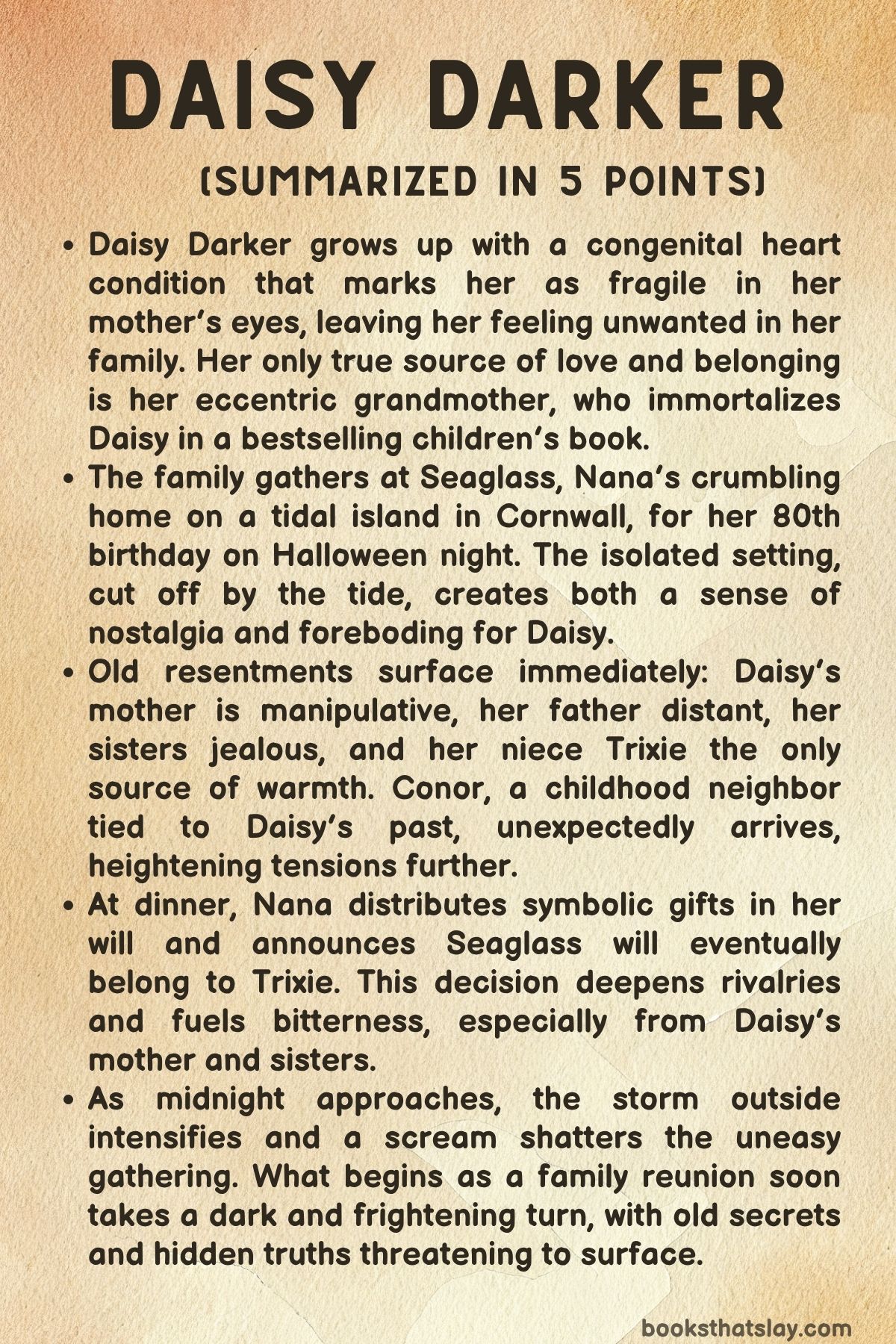
Characters
Daisy Darker
Daisy is the central figure of Daisy Darker, a narrator whose entire existence is defined by fragility, exclusion, and an enduring quest for love and recognition. Born with a heart defect and scarred both physically and emotionally, Daisy grows up as the neglected daughter, always reminded of her near-death beginning and her mother’s rejection.
Despite her family’s cruelty, she clings to life with resilience, finding her only solace in her grandmother Nana’s unconditional affection. Her relationship with her sisters is fraught with betrayal and jealousy, as they repeatedly subject her to cruelty, which cements her feelings of alienation.
Daisy’s unrequited love for Conor adds another layer of quiet suffering, intensifying her loneliness. Ultimately, her true tragedy lies in her ghostly existence—having died as a teenager but lingering invisibly, condemned to watch the lives of those who wronged her unfold.
Daisy is both a victim and a silent witness, her voice finally reclaimed when she begins writing her story.
Nana Beatrice Darker
Nana is the eccentric matriarch, the one figure who truly cherishes Daisy. A celebrated children’s author, she immortalizes Daisy’s name in her books, inadvertently fueling family envy.
Nana is willful, unconventional, and deeply protective, though her methods later reveal a darker pragmatism. In her eightieth year, she orchestrates the macabre unraveling of her family’s sins, staging deaths and exposing secrets in a bid for truth and retribution.
While her actions blur the line between justice and vengeance, they stem from her fierce loyalty to Daisy and her desire to rectify years of cruelty. Her final act—poisoning herself to join Daisy in a last moment of communion—shows her unwavering love and her conviction that truth and storytelling can set the spirit free.
Nancy Darker
Nancy, Daisy’s mother, embodies coldness, manipulation, and vanity. From Daisy’s birth, she rejects her, unable to hide her preference for beauty and perfection, qualities she sees in Rose and Lily but never in Daisy.
Her maternal instincts are channeled instead into her garden, the only creation she tends with genuine care. Throughout the story, Nancy is portrayed as shallow and selfish, entrapping Frank into marriage and controlling her children with emotional cruelty.
Yet, in her death, Daisy discovers that Nancy carried a locket with Daisy’s picture and a pressed daisy, a revelation that complicates her character. This hidden gesture suggests that despite her outward disdain, she harbored a buried love for Daisy, making her one of the most tragic and contradictory figures in the family.
Frank Darker
Frank is a detached and weak father, a man more devoted to music and his orchestra than to his children. His marriage to Nancy is marred by manipulation and distance, and his relationship with his daughters is almost nonexistent.
Frank represents neglect in its most passive form, standing as a man who chose indifference over conflict. His symbolic inheritance of clocks from Nana emphasizes his obsession with time and rhythm but also his inability to invest that time in his family.
His death by poisoned whisky and his eerie connection to music in the moment of discovery reinforce his identity as a man consumed by his own pursuits, rather than by those who should have mattered most.
Rose Darker
Rose, the eldest sister, is practical, intelligent, and calculating, yet emotionally distant. She embodies a cold pragmatism, rescuing Daisy in moments of crisis yet also subjecting her to cruelty in childhood.
Rose’s aloofness masks bitterness and suppressed resentment, and her role as the rational one in the family often makes her seem heartless. Though she prides herself on being level-headed, her inability to show genuine warmth estranges her from her sisters.
Her symbolic inheritance of Nana’s artwork represents her pragmatic but detached nature—someone who appreciates control over creation. Rose’s eventual death at the hands of Trixie underscores the loneliness that Nana predicted for her, a consequence of her inability to form bonds rooted in love rather than calculation.
Lily Darker
Lily, the youngest daughter, is self-absorbed, volatile, and often cruel. She thrives on attention, indulging in vanity and selfishness, and frequently bullies Daisy as a child, treating her as an object of ridicule.
Her relationship with her daughter Trixie reveals a pattern of neglect masked by indulgence, as she drugs Trixie to control her rather than nurture her. Nana’s gift of mirrors to Lily is a biting acknowledgment of her narcissism, reflecting her obsession with appearance over substance.
Lily’s vanity and recklessness ultimately contribute to her downfall, and her role in Daisy’s death years earlier cements her as both complicit and destructive, consumed by her inability to look beyond herself.
Trixie
Trixie, Lily’s daughter, emerges as one of the most complex characters, embodying both innocence and darkness. To Daisy, she is a source of warmth and genuine affection, someone who sees and acknowledges her when no one else can.
Yet, Trixie also becomes an active participant in Nana’s orchestrated revenge, helping expose the family’s sins and even pulling the trigger herself. Her actions are fueled by her own pain—living under secrecy about her heart condition, experiencing neglect, and longing for truth.
Trixie’s ability to see Daisy as a ghost links her to themes of death, innocence lost, and the thin line between justice and vengeance. She represents a new generation burdened by the legacy of cruelty, yet she also acts as Daisy’s ally in reclaiming her voice.
Conor Kennedy
Conor is the childhood neighbor whose presence haunts the Darker family dynamics. Charismatic yet flawed, he becomes entangled with all three sisters, fostering rivalries and broken hearts.
To Daisy, he is the embodiment of unfulfilled love, the boy she cherished but who never returned her devotion. His adult career as a crime correspondent reflects his lifelong entanglement with tragedy and truth, yet he remains evasive and self-serving.
His ultimate betrayal lies in his role in Daisy’s death, persuading the sisters to cover up the accident that killed her. Conor’s downfall—dying by choking on his own words—serves as poetic justice for a man whose lies and silence shaped the ruin of those around him.
Themes
Family Dysfunction and Resentment
The foundation of Daisy Darker rests on the cracks within the Darker family, where affection is scarce and resentment becomes the unifying thread. Daisy’s childhood is marked by neglect from her mother, Nancy, who makes little effort to disguise her disappointment in having a weak, unwanted child.
Her father, Frank, distances himself emotionally, preferring his orchestra to his family. Rose and Lily, Daisy’s sisters, oscillate between cruelty and indifference, leaving Daisy isolated even within the walls of her home.
What emerges is a family environment where love is conditional and competition takes precedence over compassion. Nana’s presence offers a temporary refuge, but even her affection is entangled in family politics through the financial success of her books.
The tension crescendos during the reunion at Seaglass, where the will’s announcement lays bare the suppressed envy and bitterness. Each gift Nana bestows is a cutting commentary on her children’s failures, revealing how resentment festers when truth is buried beneath years of avoidance.
The dysfunctional dynamic is not only emotional but destructive, as it creates the perfect breeding ground for betrayal, lies, and eventual violence. This theme underscores how families, when fractured by neglect and rivalry, can become more dangerous than any external threat.
The novel demonstrates that the Darkers’ undoing was not brought by an outsider but by the poison they nurtured within their own walls.
Isolation and Entrapment
Seaglass, the decaying Victorian home on a tidal island, is more than just the novel’s setting; it is a physical embodiment of the theme of isolation. Cut off by the tides, surrounded by the raging sea, and battered by storms, the family is trapped both physically and psychologically.
The setting amplifies the claustrophobia of their gathering, forcing them to confront truths they had long avoided. The inability to escape becomes symbolic of how inescapable their past is, no matter how far they try to distance themselves.
For Daisy, isolation was a lifelong condition—her heart defect and her mother’s rejection made her a perpetual outsider even before the geographical seclusion of Seaglass. The house, with its salt-stained walls, creaking floors, and relentless ticking of clocks, mirrors Daisy’s fragile existence: beautiful yet vulnerable, full of history yet on the brink of collapse.
The storm outside acts as a parallel to the storm within, intensifying the sense of entrapment. Each revelation, each death, and each VHS tape makes escape not only impossible but meaningless, because the greatest prison lies in the truths that resurface.
Isolation here is not just a backdrop but a central force shaping fear, paranoia, and eventual destruction.
Secrets, Lies, and Hidden Truths
The narrative of Daisy Darker thrives on secrets, both personal and familial, that corrode relationships from the inside out. The family’s home movies and the mysterious chalk poems serve as haunting reminders of their sins, dragging into the light the moments each member wanted buried.
Daisy’s childhood memories, including her near-death experiences and the cruel pranks of her sisters, are no longer silent wounds but evidence replayed for all to see. The greatest secret, however, is the truth of Daisy’s death decades earlier and the collective guilt that her sisters and Conor carry.
This revelation transforms the entire narrative, reshaping Daisy from victim to ghost, and reframing the family gathering as a reckoning rather than a reunion. Nana’s role in orchestrating the night exposes another layer of secrecy: she not only knew the truth but chose to stage a macabre performance to expose her family’s flaws and demand accountability.
Lies in this story are not benign—they are active forces that trap people in cycles of shame and self-destruction. The novel illustrates how secrets, when left to rot in silence, metastasize into something far deadlier than the truth itself.
Death, Legacy, and Ghostly Presence
Death permeates every page of the novel, not simply as an event but as an omnipresent theme shaping choices and destinies. Daisy’s fragile heart places her under the constant shadow of mortality, making her both aware of life’s fleeting nature and oddly detached from it.
The family’s successive deaths throughout the night emphasize how mortality exposes true character—some respond with fear, others with selfishness, and a few with clarity. Nana’s own obsession with her impending eightieth birthday highlights the human preoccupation with legacy: what is left behind, who inherits it, and how one’s story will be remembered.
Daisy’s ghostly narration reframes the theme of death entirely, suggesting that death is not always an end but can also be a lens through which truth is finally revealed. Her presence allows the story to be told with both intimacy and detachment, blurring the line between life and afterlife.
Legacy is not only about material possessions but also about memories, stories, and the truths people choose to confront or suppress. In the end, Daisy’s act of writing her own story becomes the ultimate legacy, one that cannot be distorted by her family’s lies or betrayals.
Justice, Revenge, and Moral Ambiguity
The orchestrated series of deaths in Daisy Darker raises unsettling questions about justice and revenge. Nana’s calculated actions, assisted by Trixie, are designed to mirror the pain Daisy endured and to expose the sins of her children.
Each murder carries symbolic weight, from poisoned whisky to suffocating words, transforming the killings into punishments tailored to the victim’s flaws. Yet the morality of these acts is intentionally ambiguous.
While the reader can understand the motivations—neglect, cruelty, betrayal—they also confront the disturbing reality that justice here is inseparable from vengeance. Daisy herself becomes caught between empathy for her grandmother’s choices and the horror of watching her family destroyed.
Trixie, too, embodies this ambiguity; her loyalty to Nana and Daisy is tinged with the cold efficiency of her role in the murders. The theme emphasizes that justice within families cannot be measured by legal or societal standards but is often distorted by emotion, pain, and history.
By the end, the novel suggests that sometimes justice is less about fairness and more about balance—making the guilty feel what the victim once felt, even if it requires crossing the line into cruelty. This moral complexity lingers, leaving the reader to question whether vengeance can ever truly set the past to rest.