The Final Score Summary, Characters and Themes
The Final Score by Lana Ferguson is a contemporary sports romance centered on two people whose public identities hide far more complicated private struggles.
Professional hockey player Jack Baker has spent years defining himself through the game and through caring for others, while psychology graduate student Abby Thompson is trying to separate herself from a painful family history that has shaped how she sees trust, love, and independence. Their reluctant friendship becomes a relationship that forces both to reconsider what gives a person value, how much control fear should have over the future, and what it means to choose someone without losing yourself.
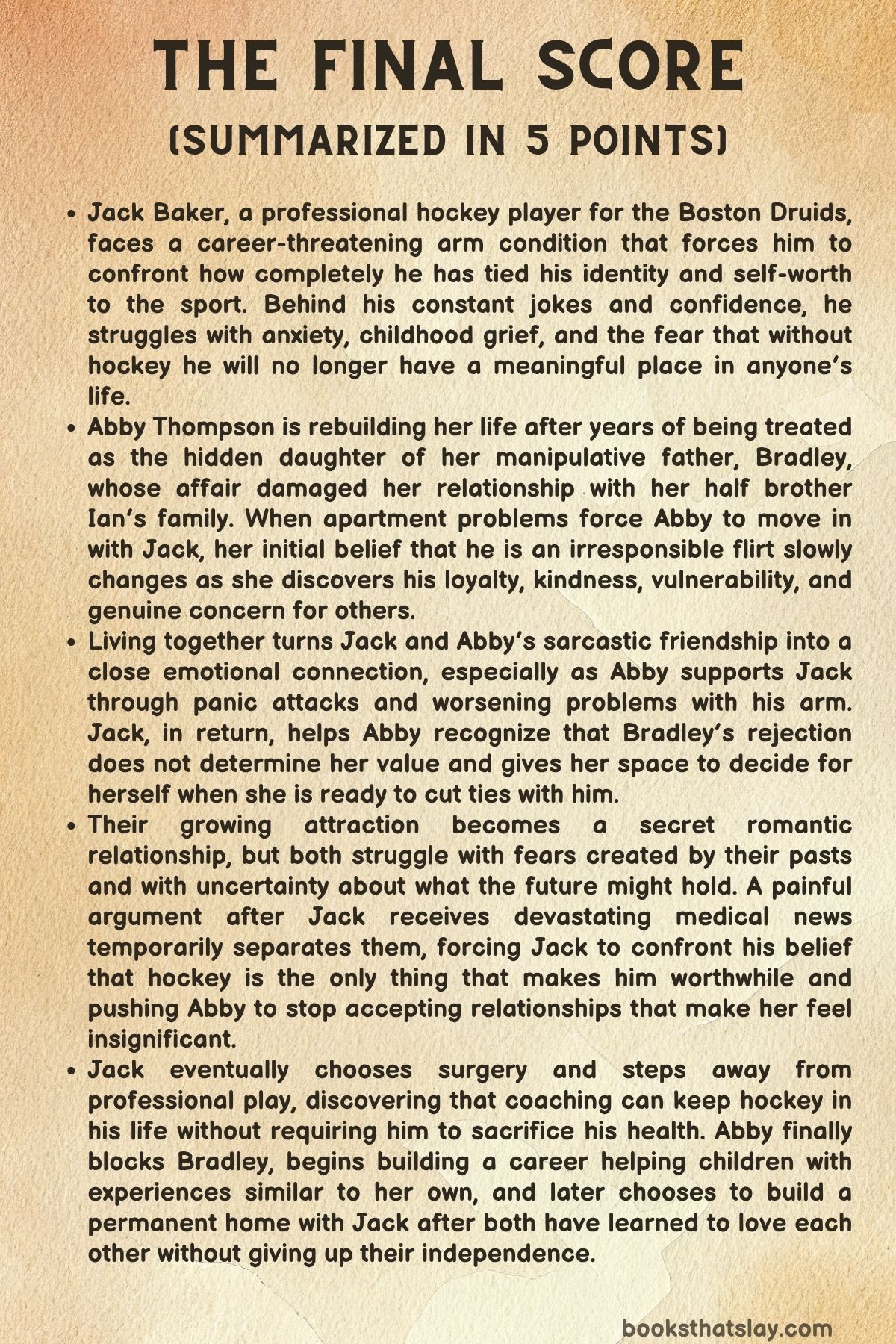
Summary
Jack Baker has spent most of his life smiling whenever he actually wants to fall apart. Orphaned at twelve and forced to become a protector for his younger sister, Lila, he learned to disguise fear with humor, but that defense begins failing when chronic pain in an arm he previously broke threatens his professional hockey career.
Abby Thompson enters Jack’s life through a complicated network of family connections. She is the younger half sister of Jack’s best friend, Ian, and her existence was hidden for years because their father, Bradley, had an affair with Abby’s mother; after the truth became public, Abby became the subject of unwanted attention and found herself carrying guilt for damage she never caused.
Jack and Abby initially clash because she sees his constant flirting and carefree image as evidence that he is shallow and unreliable. Her distrust is intensified by her experiences with Bradley, whose charm concealed dishonesty and selfishness, yet her perception begins changing after she watches Jack suffer an injury during a Druids hockey game and notices genuine terror beneath his usual jokes.
At the hospital, doctors determine that Jack has not broken his arm again but has developed radioulnar synostosis, a condition causing bones in his forearm to fuse. Surgery can correct it, but continuing to play creates an increasing risk of serious damage, and Jack refuses to accept the idea of stepping away during one of the strongest seasons of his career.
The diagnosis frightens Jack because hockey has become much more than employment. He believes it is the primary thing that makes him worthwhile, and he hides both that insecurity and his anxiety from most people, even keeping his panic medication secret so Lila will not worry about him.
Abby unexpectedly becomes one of the few people able to see through his defenses. When she challenges him to stop joking about his fear, Jack admits that he is genuinely scared, giving her the first evidence that the public version of him is not the whole man.
Meanwhile, Abby’s own life becomes more unstable when a burst pipe causes serious damage to her apartment and mold forces her to leave temporarily. She moves onto Ian and Lila’s couch, but their constant concern makes her feel less like an independent adult and more like someone who needs supervision.
Jack encounters Abby at the coffee shop where she works and learns how uncomfortable she is with the arrangement. Because he understands what it feels like to have people constantly telling him what he needs, he offers her Ian’s former bedroom in his apartment, and although she initially considers the idea ridiculous, she eventually accepts.
Their life as roommates starts surprisingly well. Jack respects the things Abby tells him in confidence and refrains from using her complaints about Ian and Lila against them, while Abby begins seeing that his instinct is often to help rather than manipulate.
She also learns more about the childhood that shaped him. After Jack and Lila lost their parents, Jack assumed enormous responsibility for his younger sister, and the humorous personality Abby once dismissed as immaturity began partly as an attempt to make Lila smile when both of them were grieving.
Their friendship deepens at the same time Jack’s physical condition worsens. After he finally admits his diagnosis to Coach, his playing time is severely restricted, and the possibility of becoming less essential to the Druids triggers a panic episode at home.
Abby finds him during the attack, retrieves his medication, and remains beside him until his breathing steadies. Rather than reacting with alarm or treating him as fragile, she listens when Jack finally explains why hockey is connected to his father, his childhood losses, his family, and his belief that he must always be useful.
As the Druids enter the playoffs, reduced playing time becomes increasingly difficult for Jack. Ian takes him to St. Michael’s, the children’s home where he mentors a young boy named Kyle, and Jack unexpectedly discovers that he is good at teaching the boy hockey and helping him recover from mistakes.
Ian suggests that coaching might give Jack another path within the sport, although Jack is not yet ready to imagine himself anywhere except on the ice. The idea nevertheless introduces a possibility he will later need: losing one form of hockey does not necessarily mean losing everything the sport represents to him.
At home, the emotional distance between Jack and Abby continues disappearing. They share ordinary evenings, favorite ice cream, jokes, homemade food, and small acts of attention, including an absurd armadillo keychain Jack buys because it reminds him of Abby.
Their attraction eventually becomes impossible to ignore. A playful encounter leaves them physically close, and after Jack supports Abby during another abusive phone call from Bradley and sincerely tells her how highly he thinks of her, Abby kisses him.
Their relationship becomes physically intimate, although Jack repeatedly checks Abby’s boundaries and allows her to determine what she is comfortable doing. Abby is surprised by his patience and attentiveness because it contradicts the careless playboy image she had assigned to him.
The following morning nearly creates an immediate rupture when Jack casually calls the previous night “fun.” Abby assumes this means it was meaningless to him and calls the encounter a mistake, but Jack explains that he has not been casually sleeping with other women and makes clear that his interest in her is genuine.
They agree to continue seeing each other while temporarily hiding the relationship from Ian and Lila. What neither initially admits is that ordinary domestic moments are quickly becoming as important as physical attraction.
A visit to St. Michael’s strengthens Jack’s awareness of how much Abby matters to him. Ian and Lila reveal that they are becoming engaged and moving forward with adopting Kyle, wonderful news that nevertheless makes Jack wonder what his role will be now that the sister he spent his youth protecting is building a family of her own.
Jack later takes Abby to a playground where he once cared for young Lila and admits that joking became a mask he used to survive grief and responsibility. Abby acknowledges that she judged him badly and tells him she prefers the person she now sees underneath that performance.
Their emotional commitment continues growing. Abby eventually stays in Jack’s bed rather than retreating to her room afterward, and both admit that they genuinely like each other, even though humor remains their safest way of discussing how serious the relationship is becoming.
When a woman flirts with Jack during a night out, he immediately declines and tells her he is seeing someone. Jack begins wishing they could stop hiding, while Abby remains afraid of defining the relationship because she worries she might become more invested than he is.
Christine, Ian’s mother, becomes an important source of perspective for Abby. She rejects Abby’s comparison between Jack and Bradley, explaining that Jack has always been dependable and caring, and she encourages Abby to allow the relationship to develop instead of demanding certainty before she permits herself to enjoy it.
Jack and Abby grow even closer during a period when the team travels for playoff games. Their conversations make Jack realize something that once would have seemed impossible: there are moments when thoughts of Abby occupy him more completely than worries about hockey.
Abby’s own confrontation with childhood trauma arrives during a psychology lecture about abandonment and emotional neglect. Overwhelmed by how accurately the material describes her relationship with Bradley, she calls Jack, who immediately comes for her and takes her to an aquarium associated with one of his final memories of his father.
Jack tells her how his father once taught him that limitations do not determine a person’s worth or future. He applies the lesson to Abby, reminding her that Bradley’s inability to be the father she deserves does not give him the power to define who she becomes.
The outing changes something fundamental between them. Abby publicly kisses Jack, tells him she wants everything he is prepared to give, and later becomes ready for their physical relationship to progress further.
Jack then asks Abby on a proper date because he no longer wants their connection to remain an undefined arrangement. She agrees, and their relationship begins moving from secret companionship toward an acknowledged partnership.
Their first official date takes place at Blue Hills, where Jack plans a hike, brings a picnic, and takes Abby to a private viewpoint that once gave him somewhere to think as a teenager. Abby is affected by the care he has put into the outing and by the realization that the man she once dismissed as irresponsible pays close attention to what matters to her.
At the same time, Jack’s injury is becoming impossible to ignore. His family repeatedly urges him to stop playing, and he resents hearing everyone else decide what his future should look like, even as he privately begins wondering whether they may be right.
Abby handles the conflict differently. She supports his right to make his own choice while helping him recognize that continuing to play could cost him far more than a season or career.
A follow-up appointment provides the worst medical news yet. The bone fusion has progressed, and another hit has caused a hairline fracture in Jack’s ulna; continuing professional hockey could result in a major break, nerve damage, blood-vessel damage, permanent loss of mobility, or reduced chances of successful surgery.
Jack returns home devastated and reacts to fear by lashing out. He declares that hockey is the only good thing in his life and that without it he has nothing, unintentionally making Abby feel that their relationship means nothing to him.
Abby refuses to remain where she can become the target of his anger whenever he is frightened. She leaves for Ian and Lila’s apartment, telling Jack that he must decide whether he possesses an identity apart from hockey.
The separation forces both of them to confront older beliefs. Lila reminds Jack that his value has never depended solely on athletic achievement, describing the brother who raised her, comforted her, protected her, and repeatedly sacrificed for her long before professional hockey entered the picture.
Jack recognizes that after losing his parents, his identity became divided between being Lila’s substitute parent and being a hockey player. Once Lila no longer needed him in the same way, he invested even more of himself in hockey and treated the sport as proof that his existence had purpose.
His realization leads him to understand another truth: he is in love with Abby. He decides to speak honestly to Coach about his future and then repair the damage he caused in his relationship.
Abby undergoes a parallel breakthrough while staying with Ian and Lila. Ian reassures her that she never destroyed his family by existing and tells her that he wants her present in his wedding, Kyle’s life, future holidays, and the family they are building together.
The conversation finally weakens the guilt Bradley spent years reinforcing. When Bradley calls again, Abby answers, firmly tells him to stop contacting her, threatens legal action if necessary, blocks his number, and experiences a freedom she had previously been unable to give herself.
Moments later she is struck by a bicycle while distractedly crossing the street. The accident causes only a cut requiring stitches, but when Jack receives the hospital call, his fear of losing Abby instantly becomes more important than anything connected with his career.
At the hospital, Jack apologizes and tells her she is one of the most important people in his life. Their reconciliation occurs in front of Ian and Lila, finally exposing the secret relationship, but Jack is no longer interested in hiding what Abby means to him.
Back home, Jack tells Abby that he loves her, and she admits that she loves him as well. Abby also tells him she has blocked Bradley, and both recognize that their relationship has helped them see possibilities beyond the identities fear once imposed on them.
Jack ultimately withdraws from the playoffs and schedules corrective surgery. Instead of dressing for the next game, he joins Abby in the stands and tells her that Coach has raised the possibility of returning as an assistant coach, giving him a way to remain connected to hockey without sacrificing his health.
Abby makes an equally important decision by temporarily moving into Ian and Lila’s guest room. She loves Jack but wants their relationship to develop through deliberate choices rather than dependence created by her housing crisis, asking him to invite her back only when he is certain they are building something permanent.
Six months later, both have established lives that are no longer controlled by their old fears. Abby has graduated, begun working as a counselor at St. Michael’s, and obtained legal protection from Bradley, while Jack has successfully recovered from surgery and chosen coaching over returning to professional play.
Jack finally brings their story full circle by dropping to one knee in the Druids’ locker room and presenting Abby with a box. Instead of an engagement ring, it contains a key to his apartment, and he asks her to move back because he is now completely certain that he wants their shared home to be permanent.
Abby accepts, understanding that the key represents exactly what she asked for: commitment based on certainty rather than circumstance. Hockey remains part of their lives, but neither Jack nor Abby needs the sport, a parent, or another person’s approval to determine their worth anymore.
Characters
Jack Baker
Jack Baker is the emotional center of The Final Score, a man whose energetic humor initially makes him appear much less complicated than he is. His constant jokes, flirting, and exaggerated confidence are not simply personality traits; they are habits developed during childhood when he learned that appearing cheerful could reassure his younger sister even when he was frightened himself.
The death of his parents places Jack in an adult role before he is emotionally ready for it. He becomes Lila’s protector and develops a strong belief that his usefulness to other people determines whether he deserves love, security, and belonging.
That belief later transfers to hockey. Because the sport connects him to memories of his father, friendship with Ian, family support, and professional achievement, Jack gradually treats playing as proof that he possesses value.
His arm condition therefore threatens far more than his employment. When doctors warn that continuing could permanently damage his body, Jack experiences the possibility of retirement as an identity crisis because he has never learned to separate who he is from what he can do for other people.
Jack’s anxiety reveals the psychological cost of maintaining this identity. His panic episodes occur when control begins disappearing, while his embarrassment about needing medication shows how deeply he has associated vulnerability with failure.
His relationship with Abby changes this pattern because she does not demand that he always be entertaining, competent, or reassuring. She notices when his jokes are covering distress and creates situations in which he can admit fear without feeling that he has disappointed someone.
Jack is also distinguished by the care he gives Abby in their romantic relationship. He consistently checks her boundaries, takes her uncertainty seriously, and respects her choices even when he wants their relationship to progress faster.
His worst moment comes after receiving devastating medical news. Terrified by the possibility of losing hockey, he declares that nothing else in his life is worthwhile, hurting Abby precisely because she has begun trusting that she matters to him.
What makes his development convincing is that the story does not excuse the cruelty of that moment simply because he is frightened. Jack must acknowledge that fear cannot become permission to hurt someone else, and Abby’s departure forces him to confront the damage his defensive behavior can cause.
Lila finally helps him recognize that he has always possessed value outside hockey. Remembering the brother who raised her allows Jack to see that his kindness, loyalty, humor, patience, and ability to support others existed before his professional success and will continue after it.
His eventual decision to undergo surgery represents genuine growth because it comes from his own judgment rather than submission to pressure from his family. By considering coaching, Jack discovers that losing his role as a player does not require abandoning the part of hockey that gives him joy.
The genuine smile he can finally give at the arena reflects how dramatically his understanding of himself has changed. He no longer needs athletic performance to prove he deserves a future, and his decision to ask Abby to move back months later shows that he has also learned to build commitment through certainty rather than fear.
Abby Thompson
Abby Thompson begins the novel emotionally guarded, independent, and deeply suspicious of charm. Years of being treated as Bradley’s hidden daughter have taught her that affection can be conditional and that the actions of other people may somehow become her responsibility.
Her original hostility toward Jack is therefore psychologically understandable. His flirtation and easy confidence remind her of Bradley, so she interprets Jack through the framework created by the man who repeatedly disappointed her.
Abby’s central insecurity is the belief that her existence caused damage. Because Bradley’s affair and lies destabilized Ian’s family after the truth emerged, Abby carries guilt for events that occurred before she had any control over them.
Public attention makes that burden worse. She wants anonymity and independence because being examined, discussed, pitied, or protected reminds her of a life in which other people repeatedly defined who she was.
This explains why Ian and Lila’s care sometimes frustrates her even though she loves them. Their desire to protect Abby can unintentionally make her feel powerless, and moving into Jack’s apartment becomes an assertion that she is capable of choosing what she needs.
Her feelings for Jack develop gradually because he gives her something different from both Bradley and her overprotective family. He listens without immediately trying to fix her, respects information she shares privately, and allows her to decide what actions she is ready to take.
Abby’s psychology training gives her language for understanding trauma, but the novel deliberately shows that professional knowledge does not make her immune to her own emotional wounds. A lecture about abandonment overwhelms her because intellectual understanding and personal healing are not the same process.
Her inability to block Bradley demonstrates this conflict especially clearly. Abby understands that he manipulates her, yet part of her continues waiting for evidence that he might eventually love her properly.
Christine helps Abby accept that this attachment cannot be eliminated merely because it is unhealthy. Jack also avoids ordering her to cut Bradley off, giving Abby the emotional space to make the decision herself when she is genuinely ready.
The confrontation with Bradley is consequently one of Abby’s most significant moments. By threatening legal action and blocking him, she stops asking the person who caused her pain to become the source of her validation.
Her relationship with Jack undergoes a similar process of learning to choose rather than react. At first she hides their connection because secrecy feels safer, but she gradually becomes willing to be seen loving someone without treating visibility as danger.
Abby’s decision to move out after Jack’s surgery plans are made is equally important. Although she loves him, she recognizes that living together began because of a housing emergency and refuses to let convenience become the foundation of permanent commitment.
That choice demonstrates the maturity of her development in The Final Score. Abby ends the story capable of accepting love without sacrificing autonomy, and her career helping children at St. Michael’s transforms painful experience into empathy without allowing that experience to dictate the limits of her future.
Lila Baker
Lila is essential to understanding Jack because much of his adult identity was formed around protecting her. After their parents died, he became a substitute parental figure even though he was still a child himself, and his determination to keep Lila happy contributed directly to his habit of hiding fear behind humor.
As an adult, Lila loves Jack enough to challenge the very protective dynamic he created. She worries about his arm and becomes frustrated with his refusal to stop playing, but her strongest contribution occurs when Jack finally admits how terrified he is of losing hockey.
Lila reminds him that his importance to her has never depended on professional success. Her memories of him learning practical skills, driving her places, protecting her, and repeatedly making sacrifices help Jack recognize that his identity is far larger than the sport.
Her engagement to Ian and their adoption plans with Kyle also mark an important transition. Lila is building a family of her own, forcing Jack to accept that being needed is not the same thing as being loved.
She also understands Jack’s romantic feelings for Abby earlier than he is willing to admit them. Her presence therefore connects Jack’s past responsibilities to his future, showing him that relationships can change form without disappearing.
Ian
Ian occupies a complicated position as Jack’s best friend and Abby’s half brother. His loyalty to both creates many opportunities for conflict, especially because Jack and Abby initially hide their relationship from him.
His history with Abby is shaped by Bradley’s betrayal, but Ian eventually becomes one of the people who most directly dismantles Abby’s belief that she caused his family pain. He tells her clearly that he wants her involved in his wedding, Kyle’s upbringing, holidays, and the future family he is creating.
That reassurance is important because it comes from the person Abby imagines she harmed most. Ian effectively separates Bradley’s choices from Abby’s existence, giving her permission to stop treating herself as evidence of someone else’s wrongdoing.
Ian also contributes strongly to Jack’s growth. He brings Jack to St. Michael’s, notices his natural talent for teaching Kyle, and introduces the possibility that coaching could provide another meaningful relationship with hockey.
Unlike people who simply demand that Jack stop playing, Ian often gives him space to reach his own conclusions. His friendship represents a form of loyalty that can challenge without controlling.
His reaction when he finally learns about Jack and Abby is partly comic, but he quickly prioritizes Abby’s emotional well-being over his discomfort. That response confirms his development as a brother who wants to protect Abby without denying her the right to make adult choices.
Bradley
Bradley functions as the major source of Abby’s emotional wounds even though he is not constantly physically present. His affair created the circumstances of Abby’s hidden childhood, while his later treatment of her encouraged the belief that she was responsible for the consequences of his decisions.
His repeated messages are manipulative because he understands that Abby still wants a relationship with him. Rather than offering genuine parental affection, he uses that desire to demand attention, assign blame, and attempt to make Abby repair the reputation he damaged himself.
Bradley’s influence also affects Abby’s romantic judgment. She initially distrusts Jack because she sees similarities between their charm, demonstrating how one damaging relationship can become a template through which later people are evaluated.
The story gradually separates those two men through behavior rather than appearance. Jack takes responsibility when he hurts Abby, respects her autonomy, and repeatedly demonstrates care, while Bradley avoids responsibility and treats Abby’s emotions as tools he can exploit.
Abby’s eventual decision to block him is therefore not simply rejection of an unpleasant parent. It represents her acceptance that continuing to seek validation from Bradley gives him authority over her sense of worth.
Christine
Christine has an unusual relationship with Abby because she is Ian’s mother and the woman whose marriage was directly affected by Bradley’s affair. Rather than blaming Abby for circumstances beyond her control, Christine becomes one of the people who offers her acceptance without pity.
Her perspective is especially valuable because she understands both Bradley and Jack. When Abby admits that she originally feared Jack because he reminded her of her father, Christine firmly rejects the comparison and describes the dependable person she has known since his youth.
Christine also refuses to pressure Abby into cutting Bradley out of her life before she is ready. She understands that emotional attachment to a harmful parent cannot always be ended simply because someone recognizes the relationship is unhealthy.
Her approach respects Abby’s autonomy while still providing clarity. In this sense, Christine models the kind of support both Abby and Jack need throughout the book: honest guidance without control.
Kyle
Kyle has a relatively small role in terms of page time but considerable importance in Jack’s development. As a child living at St. Michael’s and later preparing to become Ian and Lila’s adopted son, he represents both vulnerability and the possibility of building a secure family after instability.
Jack’s interaction with Kyle reveals skills he has never considered professionally important. He patiently teaches him hockey, encourages him after mistakes, and discovers satisfaction in helping someone else improve.
The experience becomes early evidence that Jack’s future within hockey does not have to depend on playing. Ian’s observation that Jack could become a good coach gains credibility because readers have already seen that ability emerge naturally around Kyle.
Kyle also strengthens the broader idea that family can be deliberately created. His adoption parallels Abby’s growing acceptance into Ian’s family and reinforces the idea that belonging is determined by care rather than biology alone.
Aunt Bea
Aunt Bea represents the family structure that helped Jack and Lila survive after losing their parents. Her presence reminds the reader that Jack was not entirely alone, even though he emotionally assumed responsibilities beyond what should have been expected from him at such a young age.
Her concern about Jack’s injury comes from genuine love, but her description of hockey as “just a game” triggers one of his strongest reactions. To Jack, the sport contains memories of his father, his friendship with Ian, his professional identity, and years of emotional survival, so dismissing it unintentionally dismisses something central to his understanding of himself.
The conflict demonstrates why loving advice can still fail when it overlooks what an issue means to the person experiencing it. Abby succeeds where Bea and others sometimes struggle because she acknowledges the importance of hockey even while recognizing the danger Jack faces.
Coach
Coach represents the professional reality Jack cannot avoid. Once he learns the truth about Jack’s arm, he allows him to continue playing only under strict conditions, reducing his ice time and requiring honesty about pain.
Those restrictions frustrate Jack, but Coach’s decisions are motivated by responsibility rather than punishment. He recognizes that protecting a player’s long-term health matters more than allowing him to prove his dedication through continued damage.
His later willingness to discuss an assistant coaching role is crucial because it gives practical form to the future Jack has slowly begun imagining. Coaching is no longer merely an abstract suggestion from friends; it becomes a real professional possibility.
Coach therefore helps transform retirement from total loss into transition. By the end, Jack can remain inside the hockey world while accepting that his body no longer needs to bear the cost of proving that he belongs there.
Themes
Identity Beyond Achievement
Jack’s struggle with his injured arm turns professional success into a question of personal identity. Hockey has been connected to his father, childhood recovery, friendship, family pride, financial stability, and public recognition, so the possibility of retirement feels to him like the disappearance of the person he understands himself to be.
The danger comes from treating achievement as evidence of worth. Jack assumes that if he cannot contribute on the ice, he is failing his team and eventually imagines that losing hockey would leave nothing meaningful in his life.
Several relationships challenge this belief. Ian notices Jack’s ability to teach Kyle, Lila reminds him of the brother he has always been, and Abby repeatedly separates his value from the things he accomplishes for other people.
His eventual interest in coaching demonstrates a healthier relationship with ambition. Jack does not have to reject hockey or pretend the sport never mattered; instead, he learns that one role can end without erasing every quality that made that role meaningful.
The Final Score ultimately treats identity as something larger than occupation, reputation, usefulness, or performance. Jack can remain competitive, funny, caring, knowledgeable about hockey, and deeply connected to the sport even when he is no longer the player everyone watches from the stands.
Abandonment, Guilt, and the Need for Approval
Abby and Jack experience different forms of childhood loss, yet both grow into adults who seek security by controlling how much they need from other people. Jack responds to parental loss by becoming indispensable, while Abby responds to Bradley’s rejection by trying to become independent enough that no one can hurt her through abandonment again.
Abby’s connection with Bradley shows how difficult it can be to release the desire for parental approval. She knows his messages are manipulative, but knowledge alone does not erase the hope that he might eventually become the father she wanted.
Her guilt also demonstrates how children can internalize responsibility for adult failures. Abby treats herself as a source of damage within Ian’s family even though Bradley, not Abby, made the decisions that caused the betrayal.
Ian’s reassurance becomes transformative because he rejects the entire premise of her guilt. He does not merely forgive Abby; he explains that there is nothing for him to forgive and insists that she belongs in the family’s future.
Jack carries a related fear that people may stop needing him. Lila’s growing independence and new family initially unsettle him because being her protector has defined him for so long.
Both characters gradually replace approval-seeking with internal certainty. Abby blocks Bradley only when she is ready, while Jack chooses surgery only after deciding for himself that his future is worth protecting.
Love Without Control
Healthy love in the story is repeatedly distinguished from control. Ian, Lila, Bea, Abby, and Jack all want to protect people they care about, but the novel continually asks when protection becomes an attempt to make another person’s decisions for them.
Abby’s frustration while living with Ian and Lila demonstrates the problem early. Their intentions are generous, yet constant supervision makes her feel incapable, pushing her to seek a living arrangement in which she can regain some independence.
Jack encounters the same tension over his injury. Nearly everyone tells him to stop playing, but the pressure often makes him more resistant because he hears concern as evidence that other people believe they should control his future.
Abby’s support becomes particularly effective because she respects his authority over his own decision. She explains the risks, offers perspective, and even suggests possible alternatives, but she makes clear that the final choice must belong to Jack.
Jack tries to give Abby the same freedom in her relationship with Bradley. He calls Bradley’s behavior cruel but does not demand that Abby cut contact before she is emotionally prepared to do so.
Their romantic relationship follows the same principle. Jack repeatedly checks Abby’s boundaries, while Abby eventually chooses temporary separate living arrangements because she wants commitment to develop intentionally rather than through dependence.
Vulnerability, Trust, and Emotional Honesty
Jack and Abby both begin by presenting controlled versions of themselves. Jack performs confidence because vulnerability once felt dangerous, while Abby relies on guarded independence because trusting other people has repeatedly exposed her to disappointment.
Their relationship changes when those performances begin failing. Abby first sees Jack differently when he admits that he is frightened about his arm, and Jack begins trusting her more fully after she remains calm during his panic episode instead of treating his anxiety as weakness.
Emotional honesty is not presented as something either character learns instantly. Jack still lashes out when the medical news becomes overwhelming, and Abby still retreats when uncertainty convinces her that she might care more than he does.
Trust therefore develops through repair as much as through affection. Jack apologizes without using fear as an excuse, while Abby learns that leaving an unhealthy interaction does not automatically mean abandoning the relationship forever.
Their eventual declarations of love matter because both have stopped treating need as humiliation. Jack can admit that Abby is more important to him than hockey, and Abby can accept that loving him does not require surrendering her independence.
The final key symbolizes the form of trust they have earned. Abby returns to Jack’s home not because she lacks somewhere else to live, but because both now understand that sharing a life is something they are deliberately choosing.