The Good Parts Summary, Characters and Themes
The Good Parts by Evann Normandin is a speculative novel about love, grief, memory, and the impossible question of whether a person can escape pain without also losing the experiences that gave life meaning.
At its center are Rose and Landon, a married couple whose relationship is shattered by the death of their daughter and by the guilt that follows. When Rose uses a revolutionary drug to erase her autobiographical memories, Landon refuses to believe their connection has disappeared completely. Their story examines whether identity survives forgetting and whether love can remain meaningful when its happiest moments are separated from its failures, losses, and regrets.
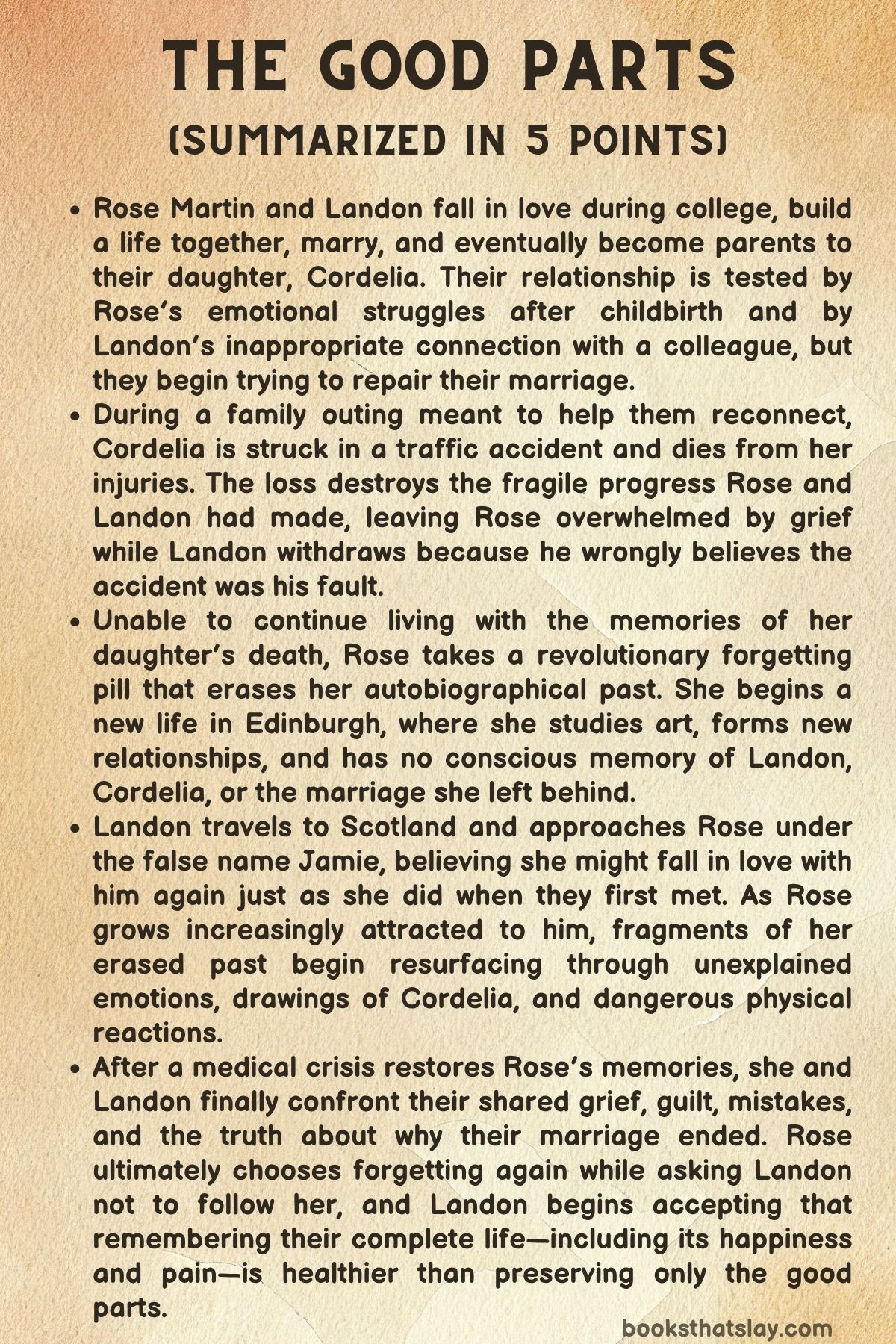
Summary
Rose Martin arrives at college in Vermont determined to reinvent herself. She has grown up carrying the emotional weight of her father’s declining health and her mother’s distance, and although she intends to study English because of her connection to literature and her father, college immediately begins opening other possibilities.
Her roommate, Penelope “Poppy” West, is confident, wealthy, outspoken, and far more willing to take risks than Rose. Poppy encourages Rose to experiment with clothes, theater, parties, and a freer version of herself, and during an orientation event Rose meets Landon, an awkward young man whose nervous humor and honesty immediately catch her attention.
Rose and Landon meet again when Rose participates in a theater initiation challenge requiring her to persuade a stranger to jump into a pond with her. Landon volunteers, and on the walk there they exchange personal details about their families and fears before eventually stripping down and jumping together, creating an early connection based on vulnerability and shared risk.
Their relationship grows quickly. During their first real dinner together, Landon’s awkwardness makes Rose comfortable, and later, at a party built around a mock-wedding theme, they exchange candy rings beneath an inflatable chapel and joke that perhaps they could succeed where so many marriages fail.
Rose becomes increasingly committed to acting, finding that performance allows her to express emotions she cannot easily confront in ordinary life. Landon supports her without hesitation, attends her performances, encourages her ambitions, and becomes the person Rose turns toward as their emotional and physical relationship deepens.
That growing happiness is interrupted when Rose’s father dies after years of dementia. His decline has been particularly painful because he began forgetting Rose before his physical death, establishing an association between memory, recognition, and love that will later become central to her choices.
At the funeral, Rose finally admits how deeply her parents’ suffering affected her. She confesses that her father’s illness and her mother’s dependence on alcohol made her feel that she gradually lost both parents, while Landon simply listens without judging her; soon afterward, they tell each other that they are in love.
After college, Rose tries to become a professional actor in New York. Repeated rejection, financial pressure, and an exhausting restaurant job eventually force her to abandon that career, but Landon never treats the decision as a personal failure and eventually proposes with his grandmother’s star-sapphire ring.
Their married life initially appears stable. Rose later worries that she may be pregnant and is surprised when a negative test disappoints her; after discussing parenthood honestly with Landon, she realizes that she may want a child after all, and eventually another test confirms that she is pregnant.
Around the same time, society begins discussing a new “forgetting pill,” a drug capable of removing autobiographical memories while allowing users to preserve selected people or pieces of information. Rose sees reports describing the almost euphoric optimism experienced by people freed from painful histories, though at this stage the drug has little relevance to her apparently hopeful future.
Rose’s pregnancy ends in a traumatic labor. After complications threaten both mother and child, doctors deliver a daughter whom Rose names Cordelia, connecting the baby to King Lear, to her father, and to a name that already holds deep personal meaning.
Immediately after the delivery, Rose suffers a severe hemorrhage and nearly dies. Although she survives physically, the birth leaves serious psychological consequences, and after returning home she sometimes feels detached from Cordelia and describes herself as ghostlike, frightening Landon and creating new strain inside their marriage.
As Rose struggles with exhaustion, work, motherhood, and unresolved trauma, Landon becomes increasingly focused on his career. At a dinner hosted by his boss, Rose meets his colleague Olivia and realizes that there has been an emotionally inappropriate connection between Olivia and Landon, even though Landon later insists that nothing physical occurred.
The discovery damages a marriage that is already fragile. Rose becomes obsessed with what may or may not have happened, while Landon tries to persuade her that the incident meant little; Cordelia remains the strongest connection between them, and therapy slowly creates the possibility that Rose and Landon may eventually repair their relationship.
They finally agree to spend a day together as a family. During a walk with Cordelia, Landon begins imagining future trips, but a small disagreement about whether Rose once described an ice cream as tasting like childhood becomes symbolic of a deeper conflict over memory and Landon’s tendency to trust his recollections absolutely.
Rose runs ahead to calm herself while Landon remains with Cordelia’s stroller. Seconds later, a speeding vehicle strikes them; Landon is thrown to the ground, the stroller overturns, and Cordelia suffers catastrophic injuries.
Rose and Landon wait at the hospital imagining every future milestone their daughter might still experience. Those imagined possibilities disappear when the doctor finally arrives and they learn that Cordelia has died.
Afterward, Rose becomes almost incapable of functioning. She cannot sleep without dreaming of Cordelia, barely eats, suffers panic attacks, and spends hours near the empty crib, while Poppy moves in and cares for her through the worst period of her grief.
Landon withdraws because he believes Cordelia’s death is his fault. He had been pushing the stroller, and his extraordinary memory allows him to replay every second of the accident endlessly, convincing himself that some tiny different action might have saved his daughter.
Rose interprets his absence differently. She cannot understand why the one person who loved Cordelia as she did is not beside her, and eventually stories about bereaved people using the forgetting pill begin to seem less like frightening warnings and more like evidence that she might still have a way to survive.
Rose finally chooses the pill. Before taking it, she leaves her future self instructions identifying Poppy as trustworthy, providing practical information about her life, and giving one crucial warning: she must not attempt to recover what she has forgotten.
When Rose awakens in a Boston hotel without autobiographical memory, the world feels astonishingly new. Ordinary food, streets, noises, and experiences fill her with excitement, and after reading that her former self wanted her to pursue happiness, she decides to build a new life somewhere beautiful and unfamiliar.
That search eventually brings her to Edinburgh, where she begins painting, works in a bookstore, remains close to Poppy, and starts a relationship with Graham, another person who has taken the pill. Meanwhile, Landon remains trapped in the memories Rose has deliberately escaped.
Landon eventually writes to Rose proposing that they both erase their worst experiences while preserving written accounts of the happiest parts of their marriage. The letter arrives only after Rose has taken the pill, and her response tells him that she has deliberately chosen not to read his message and suggests that he consider forgetting as well.
Instead, Landon decides to travel to Scotland. He convinces himself that because Rose fell in love with him once when they were strangers, she may do so again, even though Poppy strongly warns him that the woman now living in Edinburgh has no knowledge of their marriage and deserves control over the life she has created.
With help from Dave, a fellow pill user he meets while traveling, Landon enters Rose’s artistic world. He attends a life-drawing class where Rose is the model, introduces himself falsely as “Jamie,” and claims that he too has taken the forgetting pill, giving Rose a reason to trust him.
Rose and “Jamie” quickly become close. She invites him into gatherings with other pill users, takes him around Edinburgh, reads with him, shares her thoughts about identity and memory, and increasingly feels that he understands her in ways Graham does not.
Small signs suggest that Rose’s erased history has not disappeared completely. She experiences mysterious emotional reactions, feels the touch of a small child’s hand during a ghost tour, and repeatedly draws portraits of someone she cannot identify.
The person in those drawings is Cordelia. Landon realizes that although Rose has no conscious knowledge of her daughter, some part of her continues searching for the child she lost, challenging the idea that memory can be cleanly separated from identity.
Rose also begins suffering dangerous nosebleeds as suppressed memories threaten to return. Her attraction to Landon grows strong enough that they sleep together, leaving Landon disturbed by the difference between physical familiarity and emotional recognition because only he understands what their intimacy once meant.
Eventually Rose suffers a catastrophic reaction and is rushed to the hospital. Landon learns that other pill users have experienced serious complications when suppressed memories are triggered, making his efforts to awaken Rose’s past physically dangerous as well as ethically questionable.
At her bedside, Landon finally tells Rose everything: how they met, how they loved each other, how Cordelia was born, how their marriage failed, and how their daughter died. He admits that his original plan was to preserve only their happiest memories so that after forgetting they could rebuild a cleaner version of their relationship.
Rose wakes and speaks his real name. Her memories have returned, but rather than accepting Landon’s fantasy of beginning again through selected happiness, she tells him that their relationship cannot be truthful if its painful parts are removed.
Their reunion allows one misunderstanding to be corrected. Landon confesses that he abandoned Rose after Cordelia’s death because he blamed himself, while Rose tells him she never considered him responsible and admits that she too has spent years imagining alternate actions that might have prevented the accident.
They still do not reunite. Rose explains that she did not take the pill because she hated Landon but because living with Cordelia’s death had become unbearable, and she decides to undergo the procedure again despite the risks.
This time Rose plans to leave fuller instructions for the person she will become, including information about Landon and enough of their painful history to explain why she chose forgetting. She also gives Landon a clear instruction not to follow her again.
For the first time, Landon accepts that loving Rose may require respecting a decision he cannot share. Conor urges him not to erase himself immediately but to discover whether he can live with memory instead of allowing grief to dominate every moment.
Landon eventually leaves Edinburgh. Poppy tells him that although he hurt Rose, their relationship also contained tremendous love, and she offers to remember Cordelia with him whenever he needs someone who knew the child they lost.
Rather than returning directly to his old life, Landon travels to Cinque Terre and begins writing the story of The Good Parts as he now understands them. He no longer records only beautiful memories but includes arguments, failures, ordinary moments, mistakes, humor, tenderness, and grief, recognizing that a life cannot be divided honestly into experiences worth keeping and experiences that should simply disappear.
He leaves the story without a definitive ending. Rose may no longer share his remembered life, but Landon finally accepts that memory can hold pain without being reduced to pain, and that preserving the complete truth of what happened is different from being imprisoned by it.
Characters
Landon
Landon is defined by an extraordinary ability to remember. He retains conversations, dates, gestures, physical details, and emotional moments with unusual precision, a gift that initially makes him attentive and romantic but eventually becomes one of the greatest sources of suffering in The Good Parts.
His devotion to Rose is genuine, yet that devotion frequently becomes possessive because he assumes that the relationship he remembers must still have meaning for the woman who no longer remembers it. By following her to Scotland, presenting himself as Jamie, and lying about taking the forgetting pill, he crosses significant ethical boundaries while convincing himself that love justifies the deception.
Landon’s deepest psychological wound comes from Cordelia’s death. Because he was pushing the stroller when the accident occurred, he converts grief into personal guilt and withdraws from Rose at the exact moment when she needs him most, believing that his presence would only expose the person responsible for their daughter’s death.
His development depends on abandoning the fantasy that memory can be edited into something safe. By the end, he begins preserving the arguments, mistakes, failures, tenderness, laughter, and grief together, showing that his real growth lies not in forgetting Rose but in remembering without allowing memory to control every future choice.
Rose Martin
Rose is the emotional center of The Good Parts, and much of her life is shaped by repeated experiences of being forgotten, losing people, and fearing that suffering can consume identity. Her father’s dementia teaches her early that recognition can disappear before love itself disappears, creating a painful connection between memory and emotional security.
At college, Rose begins transforming herself through Poppy, theater, and her relationship with Landon. Acting becomes especially important because it gives her permission to express feelings she usually controls, showing that Rose has always needed forms of emotional release even before the later tragedies of adulthood.
Motherhood exposes both Rose’s strength and vulnerability. Cordelia’s traumatic birth leaves Rose physically and psychologically damaged, and she struggles with feelings of detachment that frighten her because she loves her daughter even when she cannot always feel like the mother she believes she should be.
Cordelia’s death becomes the experience Rose cannot integrate into her identity. Her choice to take the forgetting pill is therefore not primarily an attempt to erase Landon or punish him but an act of desperate self-preservation from a grief that has made ordinary existence unbearable.
Even after forgetting, however, Rose reveals continuities between her former and new selves. Her artistic impulses repeatedly produce images of Cordelia, her attraction to Landon returns without conscious knowledge of him, and emotional traces of the past emerge despite the drug, suggesting that the person she becomes is neither completely new nor simply the old Rose restored.
Her final choice remains difficult because she knowingly chooses forgetting again. Yet unlike before, she plans to leave her future self a fuller account and explicitly demands that Landon respect her autonomy, making her ending less about escaping responsibility than about asserting her right to determine what form of life she is capable of continuing.
Penelope “Poppy” West
Poppy initially appears as the confident roommate who teaches Rose to take risks, but she gradually becomes one of the most enduring relationships in Rose’s life. Her influence encourages Rose to experiment with theater, clothes, social experiences, and a more assertive identity when Rose first leaves home.
Her importance becomes far greater after Cordelia’s death. While Landon disappears into guilt, Poppy moves in with Rose, cleans her, feeds her, stays through nightmares, and provides the physical presence Rose desperately needs.
Poppy also functions as the strongest defender of Rose’s autonomy after the pill. She recognizes that Landon possesses information and emotional advantages Rose does not have and repeatedly warns him that recreating their relationship without revealing the truth is unfair to someone who cannot give fully informed consent.
Her eventual forgiveness of Landon does not erase his mistakes. Instead, it reflects Poppy’s ability to acknowledge contradictory truths at once: Landon hurt Rose badly, yet he also loved her profoundly, and Cordelia’s memory belongs to both of them rather than to one grieving survivor alone.
Conor
Conor is Landon’s closest long-term friend and one of the few people willing to confront him directly. He understands the depth of Landon’s attachment to Rose but refuses to confuse devotion with healthy behavior, repeatedly arguing that Landon must eventually accept what Rose has chosen.
His role becomes particularly important because Landon’s memory encourages obsession. Conor offers a counterweight, insisting that continuing to pursue Rose may simply be another way for Landon to avoid grieving the end of their shared life.
Near the end, Conor gives Landon perhaps the most important advice he receives: before deciding to erase his own past, he should try living with it. That suggestion opens the possibility that pain does not have to disappear before life can continue.
Dave
Dave initially enters the story as a stranger sitting beside Landon during a frightening flight to Scotland. Because he has taken the forgetting pill himself, he gives Landon direct access to someone who considers the drug liberating rather than tragic.
His optimism creates an important contrast with Rose’s experience. Dave associates forgetting with freedom from old fears and emotional restrictions, demonstrating why the pill is so attractive even though the novel later reveals its psychological and physical complications.
Dave also becomes an unexpectedly loyal friend. Although he recognizes that Landon’s plan is irrational and deceptive, he helps him enter Rose’s artistic world, accompanies him socially, and remains present during the hospital crisis, providing companionship during a period when Landon has alienated many of the people closest to him.
Graham
Graham represents the life Rose constructs after deliberately separating herself from her previous identity. Because he has also taken the forgetting pill, he understands the unusual experience of existing without a normal autobiographical relationship to the past.
His presence forces Landon to confront an uncomfortable truth: Rose has not simply been waiting in suspended emotional existence. She has formed new relationships, new preferences, and new routines that belong to the woman she is now rather than to the wife Landon remembers.
Graham’s anger after discovering Landon’s deception and his sexual relationship with Rose is understandable because Landon entered their lives under false pretenses. Yet Graham ultimately accepts Rose’s choices more readily than Landon does, illustrating both his respect for her independence and the unusual emotional distance that can accompany life after the pill.
Cordelia
Cordelia is present for only a small portion of the story’s chronology, but her existence determines nearly everything that happens afterward. Her birth transforms Rose and Landon from partners into parents and temporarily creates a shared source of joy even while their marriage becomes increasingly unstable.
Her name connects generations of Rose’s emotional life. Cordelia refers back to King Lear, to Rose’s relationship with her father, and to the identity Rose developed through literature and acting, making the child part of a chain of memory long before memory itself becomes something Rose tries to destroy.
Cordelia’s death transforms both parents in different directions. Landon responds by remembering compulsively and blaming himself, while Rose becomes unable to survive the repeated mental experience of losing her daughter.
Most significantly, Rose continues drawing Cordelia after the forgetting pill has removed conscious knowledge of her. The images suggest that the emotional significance of Cordelia survives somewhere beneath explicit memory, making the child central to the book’s questions about whether love can ever be fully erased.
Rose’s Father
Rose’s father shapes her understanding of memory long before the forgetting pill enters her life. His dementia causes him to lose recognition of his daughter before his death, forcing Rose to experience a form of bereavement while he is still physically present.
He also gives Rose important connections to literature, Shakespeare, and King Lear. Those associations later influence her acting and the naming of Cordelia, meaning that even after his death he remains embedded in the language Rose uses to understand family, loss, and continuity.
His illness foreshadows Rose’s later voluntary destruction of memory. Where her father’s forgetting is involuntary and tragic, Rose eventually chooses forgetting as protection, creating a painful reversal of the experience that first taught her how devastating it is to be erased from someone else’s mind.
Rose’s Mother
Rose’s mother is emotionally distant and becomes increasingly dependent on alcohol as her husband’s condition worsens. Rose experiences this period as the gradual disappearance of both parents, one through dementia and the other through emotional withdrawal.
Her statement that love is a behavior rather than a feeling remains important because much of Rose’s adult life tests exactly that idea. The story repeatedly separates emotional states from actions, asking whether love is defined by what someone remembers feeling or by what they continue choosing to do for another person.
Olivia
Olivia appears briefly but has enormous consequences for Rose and Landon’s marriage. Her obvious attraction to Landon causes Rose to reinterpret late nights, unfamiliar scents, and other small details as signs that an emotional boundary has been crossed.
Whether Landon’s involvement with Olivia became physical matters less than the collapse of trust it creates. Rose is already psychologically vulnerable after Cordelia’s traumatic birth, and Landon’s insistence that the connection “didn’t mean anything” fails because emotional damage cannot simply be reasoned away once trust has changed.
Olivia therefore functions less as a romantic rival than as a catalyst. Her presence exposes existing fractures in the marriage and begins the period of separation and attempted reconciliation that ultimately places Rose, Landon, and Cordelia together on the day of the accident.
Themes
Memory and Identity
Memory is treated not simply as a record of experience but as one of the foundations from which identity is constructed. Landon remembers almost everything, while Rose deliberately removes almost everything, placing them at opposite extremes of the same question: how much of a person survives when the past changes or disappears?
The Good Parts repeatedly suggests that conscious memory is only one component of identity. Rose does not remember Cordelia, yet she draws her face repeatedly; she does not remember Landon, yet attraction and familiarity develop between them again; and she experiences physical and emotional reactions connected to events she cannot name.
At the same time, the book never argues that these traces make Rose unchanged. The woman living in Edinburgh has developed new interests, relationships, habits, and ambitions, and Landon’s greatest mistake is sometimes assuming that familiarity gives him ownership over the person she has become.
Memory therefore acts as both continuity and burden. Landon’s complete recollection prevents him from escaping pain, while Rose’s deliberate forgetting cannot fully remove the emotional structures created by her former life.
The ending rejects the idea that a person must either preserve everything exactly or eliminate everything completely. Landon begins learning that memories can remain true without governing every future decision, while Rose insists that any account of a life must acknowledge pain instead of preserving only comfortable versions of what happened.
Grief, Avoidance, and Survival
Cordelia’s death exposes two radically different ways of responding to unbearable grief. Landon moves toward memory, replaying the accident repeatedly and searching for the tiny decision that might have produced a different outcome, while Rose moves toward erasure because remembering her daughter makes ordinary life almost impossible.
Neither response is portrayed as simple weakness. Landon’s guilt grows from enormous love, while Rose’s desire to forget emerges after insomnia, panic attacks, loss of appetite, recurring dreams, and an inability to exist comfortably inside the home where Cordelia once lived.
Their suffering becomes worse because they experience grief separately. Rose desperately needs Landon after the accident, but Landon disappears because he believes himself responsible, creating a tragic misunderstanding in which both people are trying to protect the other while actually increasing the other’s isolation.
The forgetting pill transforms avoidance into a literal medical possibility. Rose can remove the memories that make life intolerable, but the later nosebleeds and involuntary returns of suppressed material suggest that trauma cannot always be separated cleanly from the person who survived it.
The story ultimately avoids offering one universal answer about how grief should be managed. Rose still chooses forgetting, while Landon chooses remembering, allowing their different decisions to reflect two different attempts to remain alive after the same devastating loss.
Love as Action Rather Than Possession
Rose’s mother tells her early that love is a behavior rather than a feeling, and the rest of the story repeatedly tests that idea. Love appears through presence, patience, listening, protection, sacrifice, forgiveness, and sometimes through the difficult decision to release someone rather than keep pursuing them.
Young Landon demonstrates love by supporting Rose’s acting ambitions and remaining beside her through her father’s death. Poppy demonstrates it by caring physically for Rose after Cordelia dies, staying with her when grief makes even basic daily functioning difficult.
Adult Landon complicates this definition because his feelings for Rose are sincere while some of his actions are deeply questionable. He follows her despite her decision to begin again, lies about his identity, pretends to be a pill user, and uses knowledge of their shared past to create closeness with someone who cannot understand the advantage he possesses.
His eventual growth requires recognizing that intense love does not automatically justify access to another person. When Rose decides to forget again and explicitly tells him not to follow, respecting that request becomes a more mature expression of love than trying once more to make her choose him.
The story therefore separates devotion from possession. Loving someone may sometimes mean remaining, but it may also mean accepting a boundary that destroys the future one hoped to have.
Guilt, Responsibility, and Forgiveness
After Cordelia’s death, both Rose and Landon become trapped by imagined alternatives. Landon believes that because he was pushing the stroller, he must have failed his daughter, while Rose also considers choices she might have made differently, even though the direct cause of the accident was the speeding driver.
Their guilt reveals how grief can create a false sense of control. If one small personal mistake caused the tragedy, then perhaps the world remains understandable; accepting that an ordinary day can be destroyed by another person’s reckless action is far more frightening.
Landon’s earlier behavior with Olivia adds another layer of responsibility. He has genuinely hurt Rose and damaged their marriage, but that wrongdoing becomes psychologically mixed with Cordelia’s death until he begins treating himself as responsible for every terrible thing that happened to the family.
Rose’s restored memories finally allow them to separate these events. She does not excuse Landon’s marital failures, but she refuses to let him claim responsibility for an accident she never blamed him for, giving both of them permission to recognize that guilt and accountability are not identical.
Poppy’s eventual forgiveness follows the same principle. She acknowledges that Landon caused real pain while also acknowledging the love he gave Rose and Cordelia, showing that forgiveness does not require rewriting the past into innocence.
The final movement toward healing therefore depends on accepting complete histories rather than simplified judgments. People can be loving and harmful, responsible for some wounds but not others, and capable of moving forward without denying what they did or what they lost.