The Museum of Second Chances Summary, Characters and Themes
The Museum of Second Chances by Jo Leevers is a contemporary novel about memory, family secrets, belonging, and the stories people attach to ordinary objects. At its center is Evelyn Silver, a solitary museum curator whose threatened livelihood forces her into contact with the community she has spent years keeping at a distance.
What begins as a campaign to save an eccentric maritime museum gradually becomes something much larger, as forgotten possessions expose concealed relationships, family betrayals, crimes, lost love, and suppressed histories. The novel ultimately asks what should be preserved, what should be returned, and whether people can build different futures after discovering that the past was not what they believed.
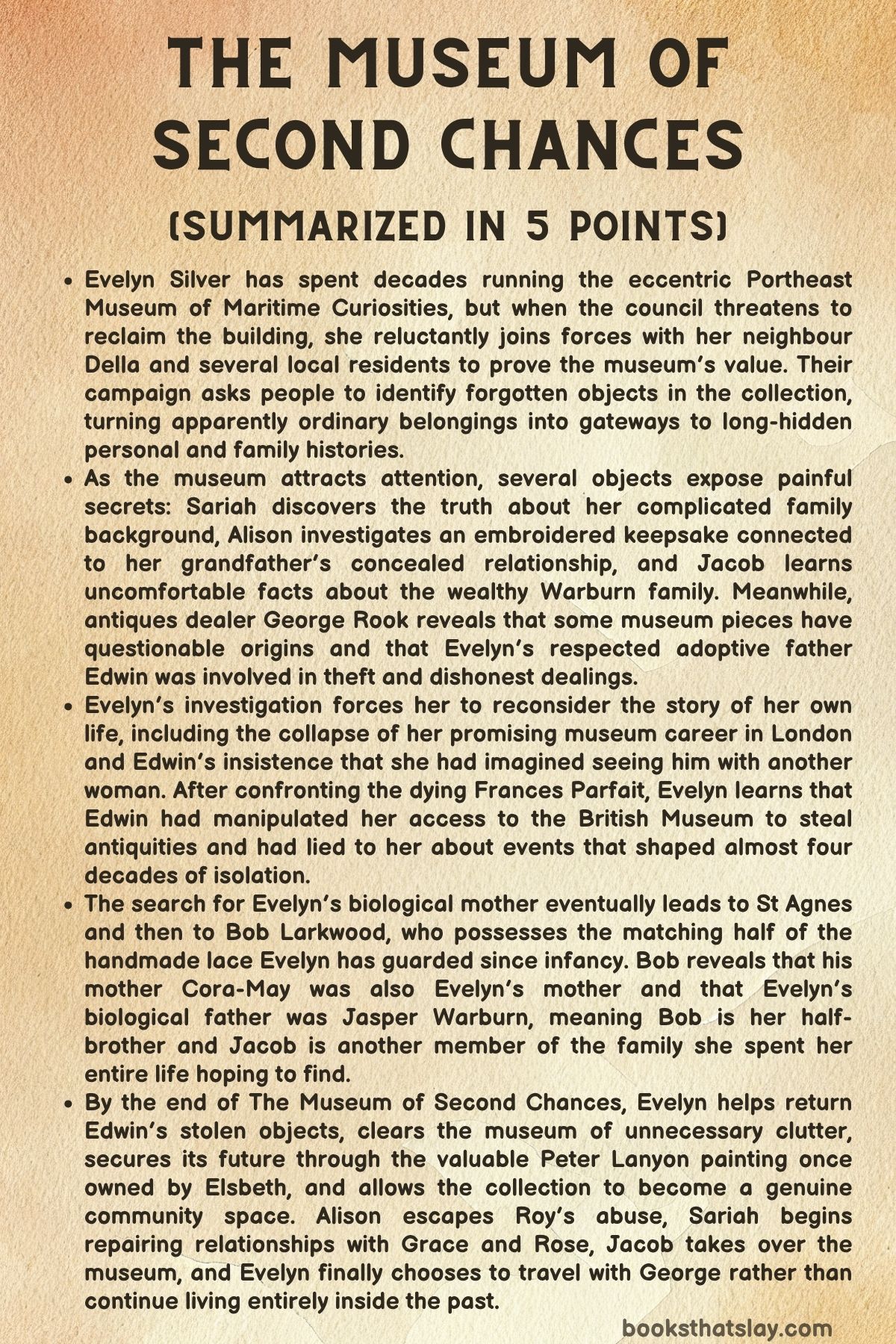
Summary
Evelyn Silver has spent decades running the Portheast Museum of Maritime Curiosities, an unusual collection created by her adoptive father, Edwin. She spends her mornings walking the beach and collecting abandoned objects that others would probably classify as rubbish, convinced that apparently worthless things may still contain stories worth preserving.
The museum is more than Evelyn’s workplace. It is the structure around which she has organized her life, particularly since Edwin’s death left her financially insecure and living in a static caravan called The Mirage. Her emotional investment in the museum becomes especially clear through a tiny piece of handmade Cornish lace displayed there, supposedly found with her when she was abandoned as a baby in 1964.
Evelyn has always hoped that someone will recognize the lace and tell her who her biological mother was. That hope is threatened when the local council informs Evelyn and her neighbour Della Dayvon that it intends to reclaim the adjoining boat sheds housing the museum and Della’s struggling ice-cream business.
Della, an energetic Australian who once worked in television journalism, refuses to accept defeat. Her first inspiration comes after Evelyn finds an old dog lead on the beach and Della tracks down its owner, Leonard, whose spaniel Jago has died.
Leonard had thrown Jago’s collar and lead into the sea after scattering the dog’s ashes, then regretted losing them. When the lead unexpectedly returns to him, he describes the experience as a second chance.
Della realizes that other discarded objects in Evelyn’s museum may also be connected to local people. If residents identify them and provide their histories, the museum might prove its importance to Portheast and persuade the council to renew its lease.
Evelyn reluctantly agrees to invite the community into the museum. She creates posters featuring four objects: an embroidered piece of sailcloth, a small painting, a cracked golden-lily teacup, and her own fragment of lace.
Several residents answer the call, including hotel manager Sariah Carnie, former public-relations professional Alison Blake, young Jacob Warburn, antiques dealer George Rook, and others. Their involvement begins transforming Evelyn’s private museum into a shared local project.
Each of the four objects carries a hidden story. Sariah recognizes the teacup as part of her grandmother Karensa’s picnic set. She cracked it as a terrified thirteen-year-old, and her Aunt Rose concealed the damage to protect her from Sariah’s volatile mother, Grace.
Alison recognizes the embroidery as the work of her grandfather Fred Blake. A similar piece belongs to her father, Keith, but the museum’s version contains a declaration of love addressed to someone identified only as “SW.”
George recognizes the little painting for a more dangerous reason. It is supposedly an Alfred Wallis, but George knows it is a forgery because he painted it himself under pressure from his dishonest father.
Most significantly for Evelyn, an unknown person recognizes her lace and possesses a matching half. Evelyn does not know this yet, and her search for answers continues.
As the campaign grows, Jacob helps Evelyn understand that the fake Wallis once belonged to his grandmother Catherine at Warburn Hall. At first, Evelyn believes the painting might be genuinely valuable and perhaps save the museum financially.
George eventually admits the truth about the forgery. He also warns Evelyn that other objects in her museum may have troubling origins connected to his father and Edwin Silver. Evelyn initially rejects any suggestion that Edwin could have been involved in criminal activity.
Meanwhile, the museum campaign begins changing the people working on it. Sariah creates a website but deliberately minimizes the teacup because she does not want her estranged family finding it.
Her attempt fails when Grace recognizes the cup from one of Evelyn’s original posters and arrives demanding its return. Sariah is forced to admit her connection to the object and eventually agrees to meet Grace again.
Their meetings slowly expose gaps in Sariah’s childhood story. Grace’s complicated resentment toward Rose, Rose’s strange absences, and long-standing family secrecy eventually lead Sariah to a shocking conclusion: Rose is actually her biological mother.
Rose became pregnant very young, and Grace, newly married, was persuaded to raise Sariah as her own. The truth does not erase the cruelty Sariah experienced from Grace, but it allows her to understand some of the pressures under which both sisters lived.
Alison is also living with a concealed reality. Her partner Roy is controlling and physically violent, and he becomes increasingly angry as Alison spends more time working on the museum campaign.
Roy eventually confiscates her phone, restricts her movements, and isolates her from the group. Alison initially continues making excuses for him, believing she can prevent violence by managing his moods more carefully.
The museum’s Second Chances exhibition brings these tensions into public view. Roy appears, confronts Jacob, and becomes violent, injuring him.
The exhibition is otherwise a success, demonstrating how objects once dismissed as junk can recover histories that matter to the community. However, Evelyn is emotionally devastated when a woman named Edie appears to recognize her lace.
Evelyn assumes Edie knows something about her birth. Instead, Edie is connected to the proposed redevelopment of the boat sheds and has merely used ambiguous language that encouraged Evelyn’s misunderstanding.
The incident forces Evelyn to reconsider something much older. In 1987, while working as a trainee at the British Museum, Evelyn had been happy, independent, and in love with fellow trainee Asa Lingard.
Then she saw Edwin behaving intimately with Frances Parfait, the woman with whom Evelyn was staying. Distraught and drunk before an important museum event, Evelyn lost control and accidentally destroyed valuable Egyptian artifacts.
Her career ended. Edwin denied having an affair with Frances and insisted Evelyn had imagined what she saw.
Ashamed, Evelyn believed him, returned to Portheast, ignored Asa’s attempts to contact her, and gradually built a life around her father’s museum. Now, decades later, she begins to consider that her breakdown could have been real while Edwin’s denial was also a lie.
Evelyn travels to London and finds Frances still living at the old Bloomsbury address, gravely ill with cancer. Frances confirms that she and Edwin had indeed been lovers.
The larger revelation is far worse. Edwin had exploited Evelyn’s British Museum position to steal valuable objects before they were catalogued.
Frances had eventually been connected to the missing material, damaging her career. Evelyn’s disastrous accident inadvertently stopped Edwin’s thefts because he lost access once she returned home.
Frances provides one further clue concerning Evelyn’s birth: Edwin once mentioned something that sounded like “Agnes.” Evelyn initially searches for a woman by that name, but later realizes Frances may have heard a place rather than a person.
The clue could refer to St Agnes, where a mother-and-baby home once operated. Evelyn investigates its history and learns how unmarried pregnant women were sent away, separated from their babies, and given little power over adoption decisions.
At the same time, George confirms Edwin’s criminal relationship with the Rook family. Valuable antiquities stolen from legitimate collections were stored or moved through arrangements between the two men.
Evelyn discovers that some stolen objects are still inside her museum. With George’s help, she separates them from the legitimate collection.
She arranges for the stolen material to be sent to Frances’s home. After Frances dies, her nurse Samuel anonymously returns the collection to the British Museum.
Removing Edwin’s stolen property is part of a broader transformation. Evelyn begins clearing rubbish from the museum and recognizing that preserving everything is not the same as respecting the past.
She even dismantles the Cornish Life display whose mannequins wore her adoptive parents’ clothing. For years, it allowed her to imagine Edwin and Elsbeth remaining unchanged; removing it signals her growing willingness to let the dead become part of memory rather than permanent physical presences.
Jacob also discovers the truth about the supposed Alfred Wallis. Behind its frame, he finds a letter from Catherine explaining that she knew the painting was probably fake and deliberately donated it to a jumble sale so that someone could simply enjoy it.
Her letter also reveals that Jasper Warburn, Jacob’s grandfather, repeatedly betrayed Catherine and once attempted to return to an old love. The respectable Warburn family history becomes increasingly unstable.
Alison, meanwhile, finally reaches the point where remaining with Roy becomes more frightening than leaving. When Sariah and Jacob come looking for her, their presence gives Alison the opportunity she needs.
She escapes with Will, goes to Keith’s home, records her injuries, and begins rebuilding her independence. She also resolves her family mystery surrounding the embroidered sailcloth.
“S. West” is Steven West, the man Fred Blake loved at a time when their relationship had to remain hidden. Alison decides the embroidery should be returned to Steven rather than kept behind museum glass.
The decision changes Evelyn’s understanding of curatorship. Sometimes preserving an object means giving it back to the person whose history it carries.
A further discovery transforms the museum’s financial prospects. George examines an abstract painting Elsbeth had purchased and Edwin had dismissed as worthless.
The painting appears to be by Peter Lanyon and could sell for a substantial amount. Evelyn is especially pleased because the discovery belongs to Elsbeth’s legacy rather than Edwin’s corruption.
While preparing an exhibition around the painting, Evelyn wants to include an old fragment of a boat name board marked “-ORA-.” George identifies it as part of Cora-May, a fishing boat whose sinking killed its crew.
Bob Larkwood, whose father died aboard the vessel, finally approaches Evelyn. But instead of beginning with the boat, he produces a piece of daisy-patterned handmade lace.
The torn edge matches Evelyn’s fragment.
Bob explains that the lace belonged to his mother, Cora-May, who had been Evelyn’s biological mother. Cora-May became pregnant at sixteen by her eighteen-year-old sweetheart and was sent to the mother-and-baby home in St Agnes.
Her baby was removed and placed with Edwin and Elsbeth Silver. The story that Evelyn had simply been abandoned was false.
Cora-May’s sweetheart was Jasper Warburn.
The Warburn family had rejected the relationship between their heir and a young servant. Jasper was sent away while Cora-May lost her child.
Bob is therefore Evelyn’s maternal half-brother, while Jacob is related to her through Jasper. Cora-May later discovered where Evelyn lived and repeatedly returned to Portheast simply to watch the daughter she had never been allowed to reclaim.
Evelyn grieves that she has discovered her mother only after Cora-May’s death, but the truth also gives her something she has wanted throughout her life: living family.
When Evelyn tells Jacob about their connection, she fears he will regard her as an embarrassing addition to the Warburn family history. Instead, Jacob immediately celebrates the fact that they are relatives.
Further evidence arrives from Jacob’s father, Simon. Old letters prove Jasper and Cora-May genuinely loved each other, but Jasper’s family intervened.
Simon also reveals that he secretly purchased Elsbeth’s Lanyon painting at an inflated price as a form of compensation for what the Warburn family did to Evelyn and Cora-May. Evelyn accepts the money, not as charity, but as overdue repayment for a life shaped by decisions made without her consent.
Sariah also meets Grace and Rose together. For the first time, they openly discuss Rose’s teenage pregnancy and the arrangement that made Grace Sariah’s legal mother.
Their reconciliation cannot restore the years lost to secrecy, but it creates the possibility of a relationship based on truth rather than concealment.
Alison continues rebuilding her life as well. She confronts Roy about returning her car and, with intervention from his brother Grant, gets her keys back.
She now sees Roy’s intimidation clearly and no longer organizes her decisions around keeping him calm. Her growing friendship with Jacob suggests another possibility, although her immediate priority remains safety and independence.
Evelyn’s new exhibition, Horizons, finally opens. It includes the Lanyon, Elsbeth’s paintings, work about marine pollution, and the restored Cora-May name board commemorating the men who died at sea.
At the event, the council announces that the museum and café can keep their leases only if they pay several years of market-rate rent in advance. Della is furious, but Evelyn calmly announces that she can pay for both sheds using the money from the painting.
The museum is saved.
More importantly, Evelyn no longer treats it as a private monument to the past. It belongs to the community around her, and its purpose has changed from simply storing objects to reconnecting people with stories, relatives, memories, and one another.
Three months later, Evelyn’s formerly solitary beach walk has become a community clean involving Bob, George, Della, Sariah, Jacob, Alison, and Will.
Jacob will take over daily management of the museum, Alison will handle publicity and community work, Bob will help with coastal activities, and Della and Sariah will run The Cake Shed.
Evelyn is finally ready to leave Portheast for a while. George will travel with her as she visits museums and historical sites and begins drawing again.
After spending most of her life preserving what was lost, Evelyn chooses movement. The museum survives, but she no longer needs to live inside it.
Characters
Evelyn Silver
Evelyn is the emotional and structural center of The Museum of Second Chances. At the beginning of the novel, she has built her entire identity around collecting, classifying, and preserving objects because objects feel more reliable than people.
Her attachment to the museum is partly professional, partly familial, and partly defensive. It contains Edwin’s legacy, Elsbeth’s possessions, and the lace that Evelyn believes may someday connect her to the mother who gave her away.
Evelyn’s social awkwardness and resistance to change initially make her appear rigid, but the book gradually reveals the pain beneath those habits. Her failed British Museum career, Edwin’s manipulation, her separation from Asa, and decades of uncertainty about her origins all encouraged her to retreat into routines that offered predictability.
Her growth involves learning that preservation can become another form of avoidance. Clearing the museum, returning stolen objects, dismantling the mannequins wearing her parents’ clothes, and returning personal keepsakes to their rightful owners all represent changes in how she relates to memory.
Finding Cora-May’s identity gives Evelyn the answer she has wanted for sixty-one years, but her greatest transformation comes from discovering living relationships rather than merely solving an old mystery. Bob, Jacob, Sariah, Della, Alison, and George give her a community that cannot be displayed in a cabinet.
By the end, Evelyn can leave the museum because she no longer needs it to guarantee her identity. She has accepted that her past matters without allowing it to determine the boundaries of her future.
Della Dayvon
Della initially functions as Evelyn’s energetic opposite. Where Evelyn is cautious, solitary, and suspicious of change, Della is sociable, inventive, impulsive, and comfortable involving other people.
Her eccentricity is partly self-created. Della once worked successfully in Australian television journalism, where maintaining a polished public identity eventually became exhausting.
Her move to Portheast and decision to operate an unsuccessful experimental ice-cream business represent an attempt to escape performance and ambition. She deliberately chooses a life that seems unserious because seriousness once consumed her.
The campaign allows Della to recover valuable parts of her former identity without returning to the person she used to be. Her publicity skills, confidence before crowds, organizational ability, and understanding of media become essential to saving the museum.
Della also has strong emotional intelligence. She often recognizes what people need before Evelyn does, yet she generally avoids forcing confidences that others are not ready to share.
Her plan to transform her business into The Cake Shed shows another form of growth. She accepts that her original idea has failed without treating failure as personal defeat.
Della’s importance lies partly in her ability to create momentum. Leonard’s recovered dog lead gives her the original idea for the museum project, and her instinct that forgotten objects can restore human connections becomes the principle that changes almost every major character.
Sariah Carnie
Sariah has built her adult identity around competence. Having left home at fifteen after a painful upbringing, she works her way from modest hospitality jobs to managing the Warburn Spa and takes considerable pride in being more capable than people expect.
Her efficiency initially makes her clash with Evelyn. Sariah wants inventories, systems, schedules, and control, while Evelyn has spent decades operating through personal memory and instinct.
Sariah’s need for control is closely connected to her childhood. She grew up fearing Grace’s anger, believing Rose was simply an aunt, and carrying resentment toward a family she considered cruel and dysfunctional.
The cracked golden-lily teacup becomes the object that defeats her attempt to keep the past contained. Although she tries to prevent it appearing prominently on the museum website, Grace recognizes it elsewhere and forces Sariah back into contact with the family she abandoned.
The discovery that Rose is her biological mother destabilizes Sariah because her identity has been based on an incomplete story. Yet her response demonstrates maturity: she does not excuse Grace’s behaviour simply because she now understands its context.
Instead, Sariah learns to hold several truths simultaneously. Grace harmed her, Grace was also placed in an extraordinarily difficult position, Rose lost her daughter through family pressure, and Rose’s later distance was connected to her own unresolved trauma.
Her eventual reconciliation with both women is cautious rather than sentimental. Partnership with Della in The Cake Shed offers Sariah another form of second chance: a future based not only on proving herself but on choosing work and relationships that genuinely satisfy her.
Alison Blake
Alison’s storyline examines how confidence in one part of life can coexist with severe vulnerability in another. She is intelligent, energetic, professionally experienced, and initially one of the strongest organizers behind the museum campaign.
At home, however, she has gradually surrendered control of her life to Roy. His jealousy, criticism, physical aggression, and surveillance have developed slowly enough that Alison has learned to reinterpret each escalation as something temporary or manageable.
Her behaviour demonstrates the psychological effect of coercive control. She monitors her words, conceals injuries, withdraws from friends, and becomes increasingly focused on preventing Roy’s next outburst.
Will becomes central to Alison’s change in perspective. She eventually understands that enduring Roy is not preserving a family for her son; it is teaching Will that fear and aggression belong inside ordinary family relationships.
Her escape succeeds partly because Sariah and Jacob refuse to ignore her disappearance. Their decision to remain nearby gives Alison practical proof that Roy has not completely isolated her.
After leaving, Alison does not suddenly become fearless. She documents injuries, protects Will’s nursery arrangements, worries about contact with Roy, and gradually rebuilds practical independence.
The discovery that Fred Blake loved Steven West adds another dimension to her development. Alison argues against preserving secrecy merely for the sake of appearances because her own life has taught her how damaging silence can become.
By the end, reclaiming her car, professional abilities, friendships, and authority over her own decisions shows Alison recovering pieces of herself that Roy had slowly taken away.
Jacob Warburn
Jacob begins the novel uncertain about his direction. He abandoned his archaeology studies after personal disappointment and now works at a newsagent despite having knowledge and interests that could support a more fulfilling career.
His connection to the wealthy Warburn family also troubles him. Jacob has affectionate memories of his grandparents but is uncomfortable with the emotional limitations of his father Simon and with the privilege attached to his surname.
Working with Evelyn gives Jacob a sense of purpose. His archaeological background makes him naturally interested in provenance and historical objects, while his patience helps him become one of the few people capable of assisting Evelyn without making her feel controlled.
The fake Wallis forces him to reconsider the mythology surrounding his grandparents. Catherine’s hidden letter exposes Jasper’s repeated infidelity and the compromises inside their marriage.
The greater revelation is Evelyn herself. Learning that Jasper fathered Evelyn with Cora-May confronts Jacob with the damaging consequences of his family’s power.
His response is crucial because he refuses the shame-based logic that shaped previous generations. Rather than treating Evelyn as a scandal, he immediately welcomes her as family.
Jacob’s support for Alison also develops without turning her recovery into his achievement. He is present when she needs help and later reconnects with her as she becomes more independent.
Taking responsibility for Max, reconsidering his career, and becoming the museum’s curator all indicate that Jacob is moving away from passivity. He finally begins constructing a life based on his own interests rather than remaining suspended between the expectations of his family and the disappointment of his abandoned degree.
George Rook
George carries one of the book’s clearest burdens of inherited wrongdoing. His father exploited his artistic talent and trained him to create convincing forgeries, turning what might have become a creative gift into part of a dishonest business.
His knowledge makes him threatening to Evelyn at first. George recognizes objects whose origins she does not understand and knows that investigating the museum may expose crimes connecting both their fathers.
Yet George ultimately becomes valuable precisely because he is willing to admit the truth. He confesses that the Wallis is fake, explains his father’s arrangement with Edwin, and helps Evelyn identify stolen antiquities.
George and Evelyn gradually recognize that they share a particular experience: each grew up under the influence of a deceptive father whose reputation shaped the child’s adult life.
Neither can undo what those men did. What they can do is refuse to continue protecting them.
George’s relationship with art is especially significant. He has genuine ability, but decades of association between painting and forgery have damaged his connection with creativity.
His developing relationship with Evelyn offers the possibility that both of them can reclaim interests distorted by their fathers. Their decision to travel together suggests companionship grounded in shared understanding rather than dependency.
In The Museum of Second Chances, George demonstrates that guilt by association does not have to become permanent identity. His choices matter more than the dishonest world into which he was introduced.
Edwin Silver
Edwin dominates much of the novel despite being dead before the main action begins. Evelyn initially remembers him as an intelligent naturalist, museum founder, and adoptive father whose worldview shaped her understanding of knowledge and history.
Gradually, that image collapses. Edwin lied about his relationship with Frances, manipulated Evelyn after her British Museum breakdown, and allowed her to believe for decades that she could not trust her own perception.
Worse, he appears to have used Evelyn’s curatorial traineeship to gain access to valuable objects and steal them. His relationship with the Rook family extended this criminal activity beyond a single institution.
Edwin’s actions toward Evelyn are particularly damaging because they are mixed with real parental involvement. He raised her, educated her, encouraged intellectual curiosity, and gave her a life, yet he also controlled the story of her origins and benefited from her vulnerability.
This complexity prevents him from becoming a simple villain. Evelyn cannot erase the father she knew merely because she discovers the criminal he also was.
Her eventual independence comes from accepting that contradictory versions of Edwin can coexist. He may have cared for her in some ways while also deceiving and exploiting her.
The removal of Edwin’s stolen objects from the museum symbolically ends his authority. Evelyn can preserve whatever genuine love existed without continuing to protect his lies.
Elsbeth Silver
Elsbeth is quieter in Evelyn’s memories than Edwin, reflecting the position she often occupied within the family. She helped raise Evelyn and shared Edwin’s interest in natural history, but she appears less controlling and less invested in defining Evelyn’s identity.
Her emotional restraint contributed to Evelyn’s unusual childhood. Evelyn was cared for and educated but often felt that her parents approached life scientifically rather than through open affection.
The rediscovered Peter Lanyon painting gives Elsbeth greater posthumous importance. Edwin mocked the work as worthless, yet Elsbeth had seen something valuable in it and kept it.
Its eventual recognition as an important painting becomes a symbolic correction of Edwin’s judgment. Something he dismissed becomes the very object that gives Evelyn financial freedom.
For Evelyn, the painting is especially meaningful because its history is clean. It does not carry Edwin’s thefts or fraudulent arrangements.
Elsbeth’s legacy therefore becomes associated with possibility rather than corruption. Even after her death, her independent taste helps secure both boat sheds and allows the museum and café to survive.
Cora-May
Cora-May is absent physically but becomes one of the most important figures in Evelyn’s identity. As a sixteen-year-old servant who became pregnant by Jasper Warburn, she had little power against the wealthy family that disapproved of the relationship.
She was sent to St Agnes, separated from her baby, and denied the possibility of raising Evelyn herself. The story of voluntary abandonment that shaped Evelyn’s entire life was therefore fundamentally false.
The matching lace transforms Cora-May from an abstraction into a mother who prepared something by hand for her unborn child. It proves that Evelyn was anticipated and loved even though mother and daughter were separated.
Cora-May’s later visits to Portheast are especially painful. She discovered where Evelyn lived but could only watch from a distance, apparently unable or unwilling to disrupt the arrangement made years earlier.
Her life demonstrates how social power can determine family histories. Jasper’s family had status, money, and influence, while Cora-May was young, economically vulnerable, and easily controlled.
Although Evelyn never meets her, discovering Cora-May allows her to reinterpret abandonment as enforced separation. The difference fundamentally changes how Evelyn understands herself.
Bob Larkwood
Bob appears for much of the story as an ordinary member of the Portheast community before becoming central to Evelyn’s personal history. His mother Cora-May makes him Evelyn’s maternal half-brother.
Bob carries his own trauma surrounding the sea because his father died when the fishing vessel Cora-May sank. The name board Evelyn collected years earlier therefore connects two major parts of Bob’s family history: his mother’s identity and his father’s death.
His decision to tell Evelyn the truth creates the family relationship she has spent her life seeking. He does not treat her as a curiosity or an old secret but begins exchanging family photographs and memories with her.
Bob’s presence also gives Evelyn access to Cora-May as a real person rather than a mystery. Through him, she can learn ordinary details that official documents could never provide.
Their developing sibling relationship is understated, which makes it convincing. Neither can recover the decades they lost, but both can decide what their relationship becomes now.
Jasper Warburn
Jasper represents the intersection of genuine feeling and moral weakness. Evidence suggests that he loved Cora-May and at one point hoped to build a life with her.
Yet when his powerful family intervened, Jasper ultimately complied. Cora-May was sent away, Evelyn was removed from her, and Jasper continued into the socially acceptable future expected of him.
His later marriage to Catherine was damaged by repeated infidelity and unresolved attachments. Catherine’s letter reveals how often Jasper allowed his desires to injure other people while still maintaining a respectable public image.
Jasper is therefore not simply someone whose true love was tragically prevented. He was also a privileged young man who benefited from a system that gave his family the power to manage consequences on his behalf.
His failure contrasts sharply with Jacob’s later behaviour. When Jacob discovers an inconvenient family truth, he immediately accepts Evelyn instead of hiding her.
That contrast shows how inherited patterns can be broken when someone chooses relationship over reputation.
Grace
Grace initially appears through Sariah’s memories as an angry, frightening mother whose volatility helped drive her daughter from home at fifteen. Those experiences remain real even after the family secret is revealed.
Grace’s history, however, complicates the picture. She was a young newly married woman who was expected to raise her sister Rose’s baby while managing financial difficulties, family expectations, and secrecy.
Her resentment toward Rose therefore had roots Sariah could not understand as a child. Grace experienced Rose as someone who escaped while she remained responsible for the consequences.
None of this excuses the fear Grace created in Sariah’s childhood. The novel does not require Sariah to transform past harm into something acceptable simply because she learns why it happened.
Grace becomes more sympathetic when she begins admitting regret and speaking honestly. Her eventual willingness to embrace both Rose and Sariah indicates that she is capable of changing the relationships produced by decades of resentment.
Rose
Rose spent much of Sariah’s childhood occupying the role of a distant and comparatively glamorous aunt. Her restraint made her appear detached, especially beside Grace’s intense emotional presence.
The revelation that Rose is Sariah’s biological mother redefines earlier memories. Her occasional tenderness, particularly the moment when she braided Sariah’s hair and responded gently to signs of anxiety, carries new meaning.
Rose became pregnant as a teenager and was removed from ordinary life because her family considered the pregnancy shameful. After Sariah was born, Grace raised the child while Rose left and constructed a respectable adult identity elsewhere.
Her later work as a teacher of very young children gives her story an added sadness. She spent her professional life caring for children after being prevented from openly raising her own.
Rose’s distance cannot be understood purely as indifference. It is also connected to shame, grief, and the need to become someone separate from the girl whose life had been controlled by her family.
Her eventual honesty with Sariah gives them an opportunity to build a relationship based on choice rather than secrecy.
Roy
Roy is the clearest representation of coercive control in the novel. His abuse of Alison includes physical violence, jealousy, monitoring, isolation, possession of her phone, control over transportation, and intimidation.
One of the most significant aspects of his behaviour is gradual escalation. Alison does not remain with him because she fails to understand that violence is wrong; she has been conditioned over time to interpret each incident separately and adjust herself in response.
Roy also understands how to use apology and normality after aggression. This helps maintain the cycle in which Alison repeatedly believes that circumstances, stress, or her own behaviour contributed to his actions.
His confrontation with Jacob at the exhibition reveals publicly what Alison has been concealing privately. Later intimidation, including suspicion surrounding the destruction of Jacob’s car, shows how Roy reacts when his control is challenged.
His eventual confrontation with Alison demonstrates the shift in their power dynamic. Roy still performs anger, but Alison can finally recognize the insecurity beneath it.
The novel does not redeem him. Instead, Alison’s development depends on abandoning the belief that his behaviour is hers to manage.
Keith Blake
Keith is a loving father who senses that something is wrong with Alison before she is ready to tell him. His support becomes especially important after she leaves Roy.
Rather than blaming Alison for staying, Keith helps her understand how abuse can become normalized through gradual escalation. His willingness to provide safety without judgment makes it easier for her to begin rebuilding.
Keith also carries his own family secrets. The revelation that his father Fred loved Steven West deeply affects him, showing that silence has shaped more than one generation of the Blake family.
Alison’s experience with Roy eventually changes how she approaches that secret. She sees concealment as something potentially damaging rather than automatically protective.
Keith represents a gentler form of parental imperfection than Edwin or Grace. He has sometimes hidden pain and difficult truths, but his instinct is ultimately to protect his daughter without controlling her.
Frances Parfait
Frances is initially remembered as the woman whose apparent affair with Edwin triggered Evelyn’s disastrous breakdown in London. For decades, Evelyn associates Frances with humiliation and the collapse of her career.
Their reunion radically changes that interpretation. Frances confirms that Evelyn correctly understood what she saw and that Edwin lied about their relationship.
Frances also reveals the larger truth about Edwin’s thefts. Her testimony gives Evelyn the information necessary to separate her father’s actual behaviour from the version he imposed on her.
Frances herself suffered consequences from Edwin’s criminal activity. Suspicion surrounding missing objects damaged her career, making her another person harmed by his ability to manipulate separate parts of his life.
Her decision to assist Evelyn with returning the stolen antiquities gives both women some form of resolution before Frances dies. They cannot recover the decades lost to misunderstanding, but they can correct part of what Edwin did.
Asa Lingard
Asa represents the future Evelyn might once have chosen. As a fellow museum trainee in London, he shares her intellectual interests and gives her the experience of being understood outside her parents’ influence.
Their relationship helps Evelyn discover independence, intimacy, and the possibility of an adult identity separate from Portheast. That makes its abrupt ending especially significant.
After Evelyn’s museum accident, she refuses Asa’s calls and disappears from his life because she has accepted Edwin’s judgment that she cannot cope independently. Asa therefore becomes linked in her memory with everything she lost.
When Evelyn later learns that Asa built a career in Rome, she briefly considers investigating his life further. Her decision not to do so is an important sign of growth.
She no longer needs to reconstruct the life she might have had. Asa remains meaningful, but Evelyn chooses the future that actually exists rather than becoming trapped by another version of the past.
Simon Warburn
Simon inherits many habits associated with the Warburn family, especially emotional distance and reliance on money to solve uncomfortable problems. Jacob experiences him as a father more comfortable with financial responses than affection.
His reaction to discovering Evelyn reflects that limitation. He does not immediately embrace the possibility of a new relative as Jacob does.
Instead, Simon secretly buys the Lanyon painting for more than its likely value. He views the payment as compensation for the damage his family inflicted on Cora-May and Evelyn.
The gesture is imperfect because money cannot repair decades of separation. Yet Evelyn accepts it precisely because the Warburn family benefited from the power that destroyed her mother’s choices.
Simon’s decision also has practical consequences. His money secures both boat sheds and gives Evelyn independence.
He remains emotionally limited, but his actions show some recognition of inherited responsibility.
Steven West
Steven West is initially present only through mysterious initials on Fred Blake’s embroidery. Alison assumes “SW” may identify a woman with whom her grandfather had an affair.
The truth reveals a hidden relationship shaped by the restrictions of its time. Fred loved Steven, and the embroidered sailcloth preserved feelings that could not be openly acknowledged.
Returning the object to Steven becomes one of the clearest examples of the museum changing its purpose. The keepsake has greater meaning in Steven’s hands than behind glass.
His reaction also gives Fred’s concealed life recognition after death. What previous generations treated as something that had to remain hidden can finally be acknowledged without shame.
Themes
Memory, Objects, and the Stories People Preserve
Objects throughout The Museum of Second Chances function as physical containers for experiences that might otherwise disappear. The dog lead, teacup, embroidery, forged painting, stopped watch, lace, boat sign, and Lanyon all acquire importance because people attach memory to them rather than because of their material worth.
Evelyn initially believes preservation itself is enough. If an object survives inside the museum, she assumes its history has somehow been protected.
The campaign teaches her that objects without human stories can become empty shells. Their meaning becomes clearer only when people speak, remember, argue, identify, return, or reinterpret them.
The novel also questions whether museums should keep everything they acquire. Fred’s embroidery belongs more meaningfully with Steven, the forged Wallis belongs with Jacob because of Catherine’s letter, and Edwin’s stolen antiquities belong back at the British Museum.
Even Evelyn’s own lace changes meaning repeatedly. It begins as proof of abandonment, becomes a possible fabrication after Edwin’s lies are exposed, and finally becomes evidence that Cora-May loved the child taken from her.
The theme therefore moves beyond nostalgia. Objects matter, but they cannot replace relationships.
The healthiest use of the past is not endless accumulation. It is allowing surviving things to help people understand history while remaining willing to release them when keeping them would serve only fear, guilt, or habit.
Family Secrets and the Cost of Silence
Nearly every important family in the story has built part of its identity around something unspoken. Evelyn is given a false story about being abandoned, Sariah grows up believing Grace is her biological mother, Alison’s family hides Fred’s relationship with Steven, Jacob idealizes a marriage whose private history was far more complicated, and Edwin maintains an entire respectable identity while committing theft.
These secrets survive because different generations believe silence protects someone. The Warburns protect reputation, Grace and Rose preserve a socially acceptable family structure, Fred’s relationship remains hidden because of prejudice, and Edwin protects himself by convincing Evelyn that her perceptions are unreliable.
Yet silence rarely prevents damage. Instead, it transfers unresolved consequences to people who do not understand why their families behave as they do.
Sariah spends years interpreting Grace’s resentment without knowing its source. Evelyn spends most of her life believing she was voluntarily abandoned. Keith reacts strongly to knowledge about Fred because he has inherited an incomplete account of his father.
The book distinguishes secrecy from privacy. Not every personal experience must become public, but concealment becomes destructive when it forces other people to construct their lives around falsehoods.
Truth creates pain when it arrives, but it also gives characters the ability to make informed choices. Once secrets are named, relationships can become more difficult in the short term but more authentic in the future.
Second Chances and the Possibility of Change
Second chances in the novel are rarely opportunities to recreate what existed before. Leonard cannot bring Jago back, Evelyn cannot meet Cora-May, Sariah cannot recover a childhood with Rose, Alison cannot erase Roy’s abuse, and Evelyn cannot return to 1987 and choose Asa differently.
The second chance comes from deciding what to do after loss has already become permanent.
Evelyn’s development demonstrates this most clearly. She begins by trying to preserve the past unchanged, surrounding herself with objects and even mannequins dressed in her dead parents’ clothing.
Gradually, she learns that moving forward does not require pretending the past never mattered. She can honor Elsbeth without keeping the old diorama, acknowledge Edwin’s role in raising her without hiding his crimes, and mourn Cora-May without allowing grief to prevent relationships with Bob and Jacob.
Other characters undergo comparable changes. Sariah does not become a child with a restored family; she begins an adult relationship with Grace and Rose based on truth.
Alison cannot return to the confident person she was before Roy, but she can construct a safer life with greater understanding of coercion and personal boundaries. George cannot undo the forgeries he made, yet he can admit them and rediscover art outside his father’s influence.
Change becomes possible once characters stop defining repair as restoration. Their lives remain marked by damage, but damage does not prevent something worthwhile from being built afterward.
Belonging, Community, and Redefining Home
Evelyn begins the story believing that belonging is something hidden in the past. She assumes that discovering the person connected to her lace will finally explain where she comes from and therefore where she belongs.
Her search eventually does reveal Cora-May, Bob, Jasper, and Jacob, but biological connection is only part of what she gains. The museum campaign creates relationships with people who choose to remain in her life.
This distinction between inherited family and chosen community is central to the novel. Bob and Jacob matter because they are relatives, but Della, Sariah, Alison, and George become equally important through repeated acts of loyalty and care.
The same principle applies elsewhere. Alison’s escape becomes possible because Sariah and Jacob notice her absence and refuse to dismiss it. Della and Sariah build a new business partnership. George and Evelyn form a relationship based on understanding each other’s damaged family legacies.
Portheast itself also changes meaning. At first, Evelyn lives beside the community rather than within it, known mainly as the strange woman who collects debris.
By the end, her beach walk has become a shared community activity, and the museum is no longer her private refuge.
Home therefore becomes less about preserving the place associated with one’s past and more about participating in relationships in the present. Evelyn can finally travel because leaving Portheast no longer feels like losing herself; she now knows that belonging can survive movement.