The Mortons Summary, Characters and Themes
The Mortons by Justine Larbalestier and Scott Westerfeld is a dark campus novel about a family that turns loyalty, wealth, violence, and emotional control into a system of power.
At its center is Jessica Morton, a gifted young operative raised to believe that caring makes people weak and that even family members can be sacrificed when necessary. Her certainty begins to fracture after she kills her cousin Peter and later falls in love with someone her family orders her to destroy. What follows is both a conspiracy story and a study of whether empathy can survive when it has been trained, manipulated, chemically intensified, and repeatedly punished.
Summary
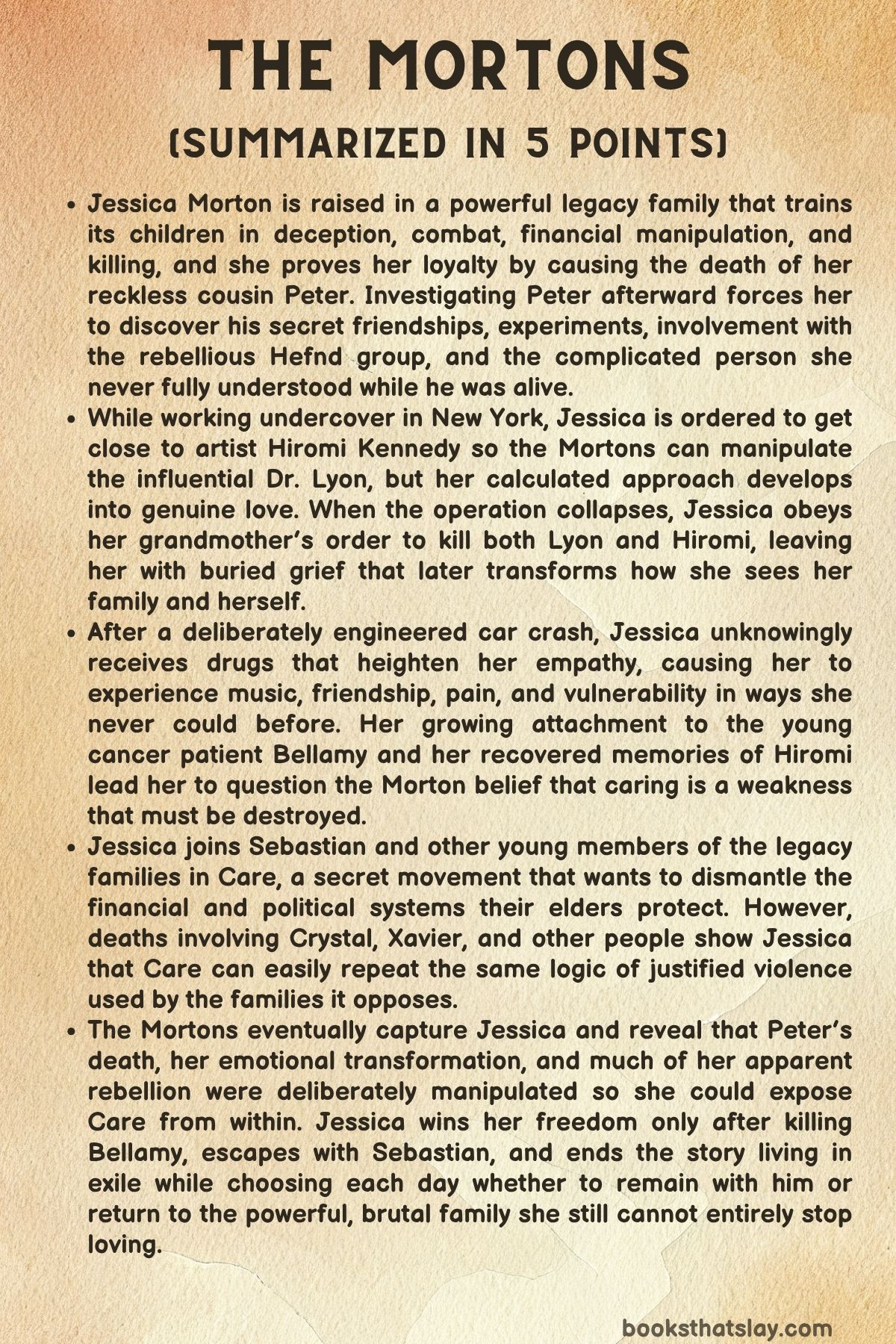
Twenty-year-old Jessica Morton has been raised inside an old family whose children learn climbing, deception, fighting, surveillance, financial manipulation, and killing. Her first major step into adulthood comes when Grandmother Elizabeth orders her to test her cousin Peter, who has become reckless enough to threaten the family’s stability.
Jessica takes Peter climbing on Dewitt Hall and quietly engineers the conditions that cause him to fall to his death. She then returns to ordinary college life, publicly behaving like a devastated cousin while privately accepting that Peter’s trust in her was the reason the killing succeeded.
Peter’s funeral reveals more of the world Jessica has inherited. The Mortons are not simply a rich eccentric family but part of a network of old legacy houses that control money, influence, violence, and client families through private systems of obligation.
At the estate, Jessica is formally recognized as a blooded adult, even by Peter’s father, Cyrus, who correctly deduces that she caused Peter’s death. Jessica realizes that she loved Peter despite killing him, but she initially sees no contradiction between affection and obedience because Morton teaching distinguishes love from protective care.
Jessica is also cultivating Faraday Wilbert-Lee, a wealthy college friend whose family business is in trouble. The Mortons solve the Wilbert-Lees’ financial crisis in exchange for a blank signed agreement that effectively places the family under Morton protection and control.
Faraday is delighted by the results and gradually becomes fascinated by Morton confidence, wealth, intimidation, and violence. Jessica initially treats Faraday’s growing dependency as proof that she has succeeded at incorporation.
Peter’s death, however, refuses to remain simple. Jessica discovers that he had been secretly lending money, cultivating useful connections, and participating in a hidden tradition with members of rival legacy families.
Sebastian, Jessica’s adopted cousin, finally reveals that Peter had joined Hefnd, an underground practice in which young legacies commit acts of personal vengeance without their elders’ approval. Peter had planned a spectacular act of his own and had been experimenting with chemicals and explosives.
Jessica follows Peter’s clues into a concealed laboratory where she finds rabbits he had been helping care for and an incendiary device containing dangerous materials. The discovery confirms both sides of Peter: he possessed genuine tenderness toward vulnerable creatures, yet he was also preparing something capable of causing enormous destruction.
Instead of surrendering the device to her family, Jessica uses it to destroy Halcyon Hall, where Hefnd members met. Her action is revenge against the people she believes encouraged Peter’s recklessness, but it is also an unauthorized act that begins her own pattern of secrecy.
Sebastian is horrified when Jessica admits that she personally killed Peter. He understands immediately that if Jessica can be ordered to kill someone she loved, then none of them is safe from the family.
Their relationship, already built from rivalry, shared childhood trauma, attraction, and competition, becomes more strained. Jessica nevertheless leaves Helshire for a summer assignment in New York, believing she is still a loyal Morton operative.
In New York, Garrett and Arabella construct a false identity for Jessica and assign her to infiltrate the social circle of Dr. Lyon, a powerful psychiatrist who has created a cultlike network of wealthy and influential followers. Lyon’s greatest weakness appears to be his obsession with artist Hiromi Kennedy, whom Jessica met at Peter’s funeral.
Jessica is instructed to get close to Hiromi so Lyon can eventually be brought into Morton control. The problem is that Jessica genuinely likes her.
Hiromi introduces Jessica to art, friendship, uncertainty, and forms of connection that cannot be reduced to usefulness. Their attraction develops into a sexual and emotional relationship, and Jessica begins experiencing surrender and vulnerability in ways her upbringing taught her to avoid.
The Morton operation succeeds in provoking Lyon. At his Catskills gathering, Lyon reveals that he has recognized Jessica as an infiltrator and attempts to use his psychological knowledge against her.
He also admits his obsession with Hiromi and has her drugged. Jessica calls her family for help, and Grandmother ultimately authorizes Lyon’s death after concluding that he cannot be incorporated.
Jessica initially believes she will protect Hiromi, especially after Hiromi tells her that she loves her. Grandmother suddenly changes the plan, however, and Jessica later suppresses the full memory of what happened.
The truth returns after Jessica survives a suspicious car crash and spends time recovering from severe head injuries. She begins experiencing empathy with a physical intensity she has never known, particularly through her friendship with Bellamy, a young cancer patient.
Jessica also begins responding differently to music, pain, beauty, friendship, and ordinary life. Her old abilities remain, but killing no longer feels emotionally neutral, and her family starts to appear strangely unreal to her.
At home, a violent family ceremony performed by young Mary triggers Jessica’s suppressed memories. Jessica finally remembers that Grandmother ordered her to kill Hiromi as well as Lyon in order to erase the connection between Jessica’s false identity and the Mortons.
Jessica obeyed. Hiromi died still expressing love for her, while Jessica arranged the deaths to resemble a murder-suicide. The recovered memory destroys Jessica’s belief that her family’s violence can always be defended as necessary.
Sebastian then shows Jessica one of Hiromi’s hidden artworks and introduces her to Care, a secret resistance movement composed of young members of all four legacy families. Care believes the families have become mechanisms for preserving corrupt wealth and power instead of improving society.
Jessica joins after admitting that Hiromi was not merely a target but a person she loved. She begins forming ordinary friendships at college, thinking about structural injustice, and imagining how financial knowledge could be used to dismantle the networks that make the legacy families powerful.
Her transformation does not make her morally pure. Jessica, Sebastian, and their allies remain capable of manipulation and killing, and Care itself contains people whose ideas about necessary violence resemble those of their elders.
Faraday becomes a particularly disturbing example of this influence. After watching the Mortons use calibrated violence against enemies, she begins copying their methods and eventually becomes involved in the death of Crystal, one of Hiromi’s friends who is investigating Jessica’s disappearance.
Jessica tries to avoid killing Crystal, but Faraday attacks her, and Sebastian finishes the job to prevent exposure. The event forces Jessica to recognize that incorporation has not merely protected Faraday; it has taught her to imitate Morton brutality.
Jessica and Sebastian conceal Faraday’s involvement, but the lie is eventually exposed. When the family closes in, they attempt to flee Helshire.
Jessica is captured by Grandmother and imprisoned at the Morton estate. There Elizabeth reveals the greatest deception of Jessica’s life: her apparent emotional awakening was itself part of a Morton operation.
The drugs Jessica believed were preventing seizures after her car crash were actually empathogens designed to increase empathy, emotional openness, and connection. Peter’s death, the Hiromi assignment, and even Jessica’s crash had been arranged so that the family’s most loyal prodigy could be transformed into someone capable of convincingly infiltrating Care.
Elizabeth assumes Jessica’s empathy will disappear once the drugs leave her system. Jessica insists that chemically induced feelings do not make her love, grief, or moral change unreal.
She pretends to return toward Morton loyalty and successfully lies during family tests, but Grandmother eventually demands stronger proof. Jessica is ordered first to kill Mary, and she refuses despite every rational argument she can construct.
The family then finds Bellamy. Jessica understands that Bellamy represents the purest form of her new caring because the child offers no money, power, family advantage, or strategic value.
To convince the Mortons that she has recovered, Jessica kills Bellamy with a quick embrace and broken neck. The act earns her release, but it also proves how deeply the family can still force her into the very logic she is trying to escape.
Jessica returns briefly to Helshire and performs loyalty convincingly before escaping to Sebastian. Together they disappear, eventually leaving the country.
Jessica finally tells Sebastian about Bellamy. His description of the killing as necessary triage terrifies her because it shows that Care can reproduce the same moral calculations used by their families.
As the empathogens wear off, Jessica notices her intensified emotional responses fading. Music becomes less powerful, memories of Hiromi lose some of their force, and even her bond with Sebastian feels different.
The novel ends with Jessica and Sebastian living anonymously in a foreign mountain town. Sebastian gives her poison and tells her she can use it on him if she ever decides to return to the Mortons.
Every morning Jessica makes him tea while the poison sits nearby. Each cup therefore becomes an unspoken decision: for one more day she chooses Sebastian and exile over the cruel family she still, in some complicated way, loves.
Characters
Jessica Morton
Jessica is the central consciousness of The Mortons, and her development is built around the conflict between conditioning and choice. At the beginning, she takes pride in being the family prodigy: controlled, observant, physically skilled, financially intelligent, and capable of killing a cousin she loves because the elders have judged his existence dangerous.
Her early morality is not based on pleasure in cruelty. Instead, she believes usefulness determines whether violence is justified, which makes her more unsettling because she can perform terrible acts without considering herself malicious.
Peter’s death opens the first contradiction in that belief system. Jessica discovers that love does not disappear simply because she kills someone, and her investigation into Peter’s secret life gradually teaches her that understanding another person requires more than knowing how to predict or manipulate them.
Hiromi changes Jessica more dramatically because their relationship exposes her to intimacy without strategic certainty. Although Jessica initially approaches Hiromi as part of an operation, genuine attraction turns manipulation into betrayal, and Hiromi’s death becomes the event that permanently damages Jessica’s faith in Morton authority.
The empathogens complicate her transformation without invalidating it. Jessica must confront the possibility that chemistry created or intensified many of the emotions she regards as evidence of growth, yet she ultimately decides that the origin of a feeling does not erase the meaning of what she did while experiencing it.
Her killing of Bellamy shows that Jessica never becomes a clean moral opposite of her family. She remains capable of choosing survival over innocence, and the final uncertainty about whether she will stay with Sebastian or return to the Mortons preserves her as a character suspended between competing versions of herself.
Sebastian Morton
Within The Mortons, Sebastian functions as Jessica’s rival, emotional counterpart, lover, and eventual partner in rebellion. Adopted into the family after an already violent childhood, he understands earlier than Jessica that Morton protection is inseparable from the threat that the same family can destroy its own children.
Sebastian cares about Peter enough to hide evidence of his misconduct and later becomes furious when he learns Jessica killed him. Yet even this compassion is mixed with competition, since he admits that Peter’s failures strengthened his own position inside the family.
His relationship with Jessica is shaped by shared survival. They helped stop Uncle Max as children, grew up competing for excellence, and developed an attraction neither wanted to act on because both associated surrender with defeat.
Once Jessica begins changing, Sebastian becomes the person most determined to believe that the new version of her matters. He brings her into Care, gives her access to a larger political interpretation of legacy power, and offers her a future outside the family.
At the same time, Sebastian demonstrates the dangers within the rebellion. He kills when he believes secrecy or strategy requires it, manipulates Xavier into removing a witness, and describes Bellamy’s death as necessary triage.
His final trust in Jessica is therefore both loving and disturbing. By knowingly drinking the tea she prepares beside a vial of poison, he accepts that neither of them can completely prove what the other will choose, making trust a repeated act rather than a secure fact.
Peter Morton
Peter is dead for almost the entire novel, yet he remains one of its most influential characters. His death creates the investigation that forces Jessica to reconsider both the family and her own certainty about who Peter was.
As a child and young adult, Peter is reckless, theatrical, curious, and desperate for recognition. He loves experiments, dangerous chemicals, riddles, animals, and dramatic gestures, qualities that make him difficult for a family built around disciplined usefulness.
His secret activities reveal a person divided between compassion and destructive impulses. He cares for research rabbits and helps friends financially, yet he also experiments with explosives, joins Hefnd, starts fires, bullies Tom, and apparently fears that he may someday become dangerously unstable.
That fear creates one of the book’s most unsettling possibilities: Peter may have consciously or unconsciously accumulated enough failures to make his own culling inevitable. Sebastian’s belief that Peter feared becoming another Uncle Max suggests his reckless behavior may partly have been an attempt to force the family to stop him before he lost control.
For Jessica, Peter becomes more human after death than he ever was while alive. She moves from seeing him as a failed Morton to recognizing the private friendships, fears, ambitions, tenderness, and secrets that she never bothered to understand.
Grandmother Elizabeth
Elizabeth is the clearest embodiment of Morton authority. She rarely needs to shout or threaten because everyone around her already understands the extent of her control.
Her power comes from combining genuine family attachment with an absolute willingness to use relatives as instruments. She can speak lovingly to Jessica while arranging Peter’s death, engineering Jessica’s emotional breakdown, manipulating her medication, and placing children in front of her as tests of loyalty.
Elizabeth does not regard herself as cruel. She believes the family protects its members by making them strong enough to survive and by placing collective continuity above individual feeling.
That certainty makes her more complicated than a conventional villain. She can make persuasive arguments about the family’s usefulness, its ability to protect clients, and its efforts to redirect wealth toward constructive projects.
Her fatal moral limitation is that she recognizes no boundary beyond which another person should stop being usable. Love, for Elizabeth, does not prevent manipulation because manipulation itself can be presented as evidence of how seriously the family values someone.
Hiromi Kennedy
Hiromi is the person who most directly exposes Jessica to a life organized around creativity, friendship, pleasure, grief, and voluntary connection. She does not defeat Jessica through strength or strategy; she unsettles her simply by responding best when Jessica stops performing.
Her artwork values unpredictability, physical process, memory, and transformation. This contrasts strongly with Jessica’s preference for precision, control, and measurable usefulness.
Hiromi is also a survivor of Dr. Lyon’s psychological manipulation. Her fear of him gives Jessica a chance to play protector, but it also makes Jessica’s original mission especially exploitative because the Mortons deliberately use Hiromi’s vulnerability as a route toward Lyon.
The relationship becomes real because Hiromi notices inconsistencies without treating Jessica as a puzzle to conquer. She sees loneliness behind the confident persona and encourages Jessica to experience intimacy as something other than domination.
Hiromi’s death therefore becomes more than a personal loss. It forces Jessica to recognize that Morton logic can destroy someone completely innocent simply because leaving that person alive creates an inconvenient connection.
Faraday Wilbert-Lee
Faraday begins as one of Jessica’s long-term social investments. Jessica cultivates her because the wealthy Wilbert-Lee family may eventually become useful, and this strategy succeeds when financial trouble pushes Faraday toward Morton protection.
What makes Faraday especially important is the way incorporation changes her. Initially she is fascinated by the Mortons’ confidence and ability to solve problems that ordinary law cannot fix.
Gradually she begins imitating their clothes, attitudes, entitlement, and willingness to intimidate enemies. Violence becomes something she sees as part of the service she purchased.
Her eventual involvement in Crystal’s death demonstrates the deeper cost of incorporation. Faraday does not merely become protected by the Mortons; she learns to reproduce their methods, showing how systems of violence expand by teaching dependent people to imitate those who control them.
Jessica still cares about Faraday, which complicates the situation further. She must confront the uncomfortable fact that her own successful manipulation helped create the person Faraday becomes.
Gertie Morton
Gertie is one of the most openly unconventional Mortons. She is brilliant at forgery, counterfeiting, false identities, and document manipulation, but her colorful social world and irreverence contrast with Jessica’s controlled seriousness.
She also carries the trauma of surviving Uncle Max’s attack. Unlike Jessica, Gertie is willing to describe the survivors as a smaller family within the larger family and refuses to accept that Peter’s flaws justified abandoning him.
Her anger toward Jessica after Peter’s death reveals a moral position Jessica initially cannot understand. Gertie believes survival should have produced greater loyalty among the cousins who endured the massacre together.
At the same time, she recognizes that secrecy helped destroy Peter. Her warning that hidden mistakes are more dangerous than acknowledged ones becomes important because the family’s obsession with competence encourages everyone to conceal weaknesses until they become catastrophic.
Gertie’s eventual recruitment into Care feels natural because she has already spent years resisting the family’s emotional expectations, even while continuing to use its skills.
Mary Morton
Mary is one of the clearest examples of what the family considers successful conditioning. From childhood she approaches violence, rabbits, death, and family rituals with unsettling confidence.
Her mors curae ceremony deliberately recreates the imagery of Uncle Max’s massacre. Rather than merely killing her rabbit, she turns the act into a performance aimed at the survivors, demonstrating both her intelligence and her willingness to use trauma as material.
Mary becomes especially important when she calls Jessica a bunny. The insult reverses Morton symbolism: Jessica, once the perfect killer, has become the vulnerable creature who cares enough to hesitate.
When Grandmother later orders Jessica to kill Mary, the younger girl refuses to defend herself. By exposing her throat and then dancing, Mary forces Jessica to see not an abstract future killer but a living child with specific possibilities.
Mary is frightening because she combines innocence, discipline, theatricality, and cruelty. She shows Jessica what she herself may have looked like to adults who understood the consequences of Morton upbringing.
Bellamy
Bellamy has almost no strategic value, which is exactly what makes her so important. Jessica meets her during hospital recovery, when the young cancer patient is struggling to walk and remains cheerful despite serious illness.
Jessica experiences Bellamy’s vulnerability with an intensity that feels almost physical. Their connection becomes the clearest evidence that Jessica can care about someone without expecting advantage, loyalty, wealth, information, or usefulness in return.
Bellamy’s letters deepen this connection because she repeatedly asks Jessica to participate in an ordinary friendship. She wants news about college, romance, friends, and daily life rather than the calculated exchanges Jessica understands best.
The family eventually identifies Bellamy as the ideal final loyalty test because her importance cannot be explained strategically. Jessica’s decision to kill her becomes one of the darkest moments in the story.
Bellamy therefore represents both the possibility and cost of empathy. Caring about her proves Jessica has changed, while killing her proves that change alone does not guarantee courage.
Arabella Morton
Arabella first appears to be an accomplished adult operative who embodies the family’s ideals. She is competent, pragmatic, and heavily involved in Jessica’s New York assignment.
The discovery that Arabella belongs to Care changes the meaning of her character. She has spent years functioning successfully within Morton structures while secretly believing that parts of the system must be destroyed.
This makes her a model for the kind of double life Jessica may need to live. Arabella proves that rebellion does not always look like open rejection; sometimes it requires performing loyalty with extraordinary skill.
Her participation in both Hefnd and Care also shows the historical continuity of resistance among younger legacies. Jessica initially thinks rebellion began with her generation, but Arabella demonstrates that dissatisfaction has existed for years beneath the family’s polished surface.
Dr. Lyon
Lyon represents a different form of domination from the Mortons. Instead of controlling people through inherited loyalty, financial systems, and explicit violence, he creates dependency through psychological attention.
His followers are wealthy and accomplished, yet many lack belonging. Lyon makes himself emotionally essential to them and converts that emotional centrality into influence.
His obsession with Hiromi exposes the predatory core of his methods. He wants access to her not because he respects her but because he believes he can reshape her.
His confrontation with Jessica is effective because he identifies truths she has avoided, particularly the possibility that her childhood training was abuse rather than education. Yet his insight does not make him morally superior, since he immediately attempts to exploit those vulnerabilities for control.
Lyon therefore serves as an uncomfortable mirror of the Mortons. Both systems claim to understand what people need, and both turn that understanding into power.
Bianca Lindqvist
Bianca initially appears reckless, provocative, and fascinated by personal vengeance. Her participation in Hefnd places her close to the type of undisciplined violence Jessica has been trained to despise.
She nevertheless develops an unusual understanding with Jessica after learning the truth about Peter and Halcyon Hall. Bianca recognizes Jessica’s destruction of the building as personal revenge rather than official Morton action.
Her ability to interpret Jessica outside the elders’ framework helps prevent an old family conflict from restarting. She also supports Jessica’s eventual admission into Care.
Bianca remains morally inconsistent, however. Her later determination to avenge Xavier shows that rebellion against family systems does not automatically free someone from the same cycles of loyalty and revenge those systems encourage.
Xavier Lindqvist
Xavier occupies the unstable space between ally, rival, and threat. He participates in the younger legacies’ secret traditions and provides Jessica with access to parts of Peter’s hidden life.
His later decision to murder the motel employee demonstrates how easily unauthorized violence can be presented as generosity. Xavier believes he is helping Jessica by eliminating someone who could connect her to Crystal.
Jessica’s false accusation against him is therefore believable because he already has a history of Hefnd activity and independent killing. She sacrifices him strategically to protect actual Care members.
The choice saves others but eventually creates consequences when Bianca seeks revenge. Xavier’s role reinforces the idea that every manipulation produces further obligations, resentments, and dangers.
Veronica Morton
Veronica combines mentorship with skepticism toward the family’s harsher decisions. She has helped train Jessica and understands her abilities well enough to recognize when something about her has changed.
Unlike Elizabeth, Veronica does not appear entirely comfortable with the operation built around Peter’s death. She eventually admits that she voted against it.
Her archery interrogation of Jessica shows her professional intelligence. She tests Jessica’s emotional and physical responses while appearing merely to help her regain an old skill.
At the same time, Veronica’s willingness to prefer Sebastian alive suggests that disagreement can exist even among senior Mortons. The family is powerful partly because dissent is absorbed into internal debate rather than necessarily producing open rebellion.
Cyrus Morton
Cyrus is Peter’s father, but his response to Peter’s death demonstrates the severity of Morton loyalty. He discovers that Jessica was responsible yet does not seek revenge because he participated in the decision that Peter had to be culled.
His formal blooding of Jessica is disturbing precisely because grief and approval exist together. He can love his son while accepting the judgment that his son became too dangerous.
Cyrus also helps show Jessica that Morton adulthood requires more than competence. It requires accepting the possibility that anyone, including one’s own child, may become expendable.
Later, when he helps the family capture Jessica, his loyalty remains directed toward the institution rather than her individual wishes. His affection does not weaken his commitment to family discipline.
Tom Morton
Tom offers one of the strongest contrasts with Jessica’s transformation. He also survived Uncle Max’s massacre, but instead of rejecting Morton ideology he embraces it more firmly.
Peter bullied Tom after the massacre, creating resentment that matters when Grandmother quietly asks whether Peter should be removed. Tom’s willingness to say he would not mind if Peter never returned becomes one of the hidden factors behind the culling.
He later chooses Jessica as a model and views her apparent return to family values with satisfaction. To him, discipline and emotional control remain solutions rather than sources of harm.
Tom therefore demonstrates that trauma does not produce a single moral outcome. People exposed to the same violent system can respond by resisting it, reproducing it, or seeking greater security inside it.
Garrett Morton
Garrett represents the sophisticated financial and cultural side of Morton power. His gallery is both a legitimate art-world institution and part of a larger system through which wealth, influence, reputation, and hidden financial interests can be managed.
He helps Jessica understand that power is not only about money itself. Wealthy collectors buy art partly to construct identity, status, relationships, and access.
His role in the Lyon operation places him between mentorship and exploitation. He recognizes Jessica’s connection with Hiromi as strategically valuable and encourages her to turn genuine attraction into leverage.
Later, the retrospective of Hiromi’s work suggests that the family remains willing to manipulate art and memory even after her death. Garrett therefore represents the polished surface of Morton power: elegant, cultured, commercially intelligent, and inseparable from coercion.
Themes
Care, Empathy, and the Meaning of Weakness
The Mortons repeatedly questions the family belief that caring makes people vulnerable. Morton children are taught to kill animals they have raised precisely because affection is considered a weakness that enemies can exploit, and Peter’s death follows the same principle on a larger scale.
Jessica initially accepts this idea so completely that she can love Peter and still kill him. Her training has taught her that love may exist as long as it never interferes with usefulness.
Her relationship with Hiromi, friendship with Bellamy, renewed closeness with Sebastian, and eventual connection with ordinary students challenge that division. She gradually discovers that caring causes pain because another person’s fate can no longer be reduced to strategy.
The empathogens complicate the issue by raising a difficult question about authenticity. If Jessica’s empathy was chemically intensified, does that make the resulting moral awareness artificial?
The novel rejects an easy answer. Jessica’s emotions may have been initiated or strengthened by drugs, but the people she harmed were real, the relationships she formed were real, and the choices she later makes still belong to her.
Care is therefore presented as both vulnerability and moral knowledge. It creates fear, grief, hesitation, and suffering, yet without those things Jessica cannot fully recognize other people as lives rather than assets, obstacles, clients, or targets.
Family Love and Institutional Control
The Morton family insists that affection and discipline are compatible even when discipline becomes deadly. Parents can approve the killing of their children, cousins can be assigned to kill one another, and elders can manipulate younger relatives while sincerely claiming to treasure them.
This makes family love one of the novel’s most disturbing ideas. The danger does not come from an absence of attachment but from attachment being used to justify control.
Elizabeth embodies this contradiction most clearly. She believes Jessica is precious, yet that belief does not stop her from arranging Peter’s death, altering Jessica’s emotions, imprisoning her, or forcing her to prove loyalty by killing people she cares about.
The family’s version of love is therefore conditional in a specific way: individuals matter as members of a system whose survival is more important than their autonomy. A person can be cherished while still being treated as material.
Jessica’s eventual rebellion does not allow her to simply stop loving the family. She continues to value its traditions, abilities, history, and sense of belonging even after recognizing its cruelty.
That lingering attachment gives the conflict greater complexity. Leaving an abusive institution is difficult when the institution is also home, identity, education, memory, protection, and the only language of love a person has ever been taught.
Violence, Usefulness, and Moral Justification
Violence is rarely treated as random within the legacy world. The Mortons distinguish themselves from reckless killers by insisting that harm must serve a purpose: protect a client, remove a liability, intimidate an enemy, preserve secrecy, or strengthen the family.
Jessica initially considers this distinction morally meaningful. She disapproves of Hefnd because its members kill for personal revenge rather than strategic value.
Experience gradually reveals how unstable that distinction is. A killing can always be described as useful if the person making the decision controls the definition of usefulness.
Peter is killed because he represents instability. Hiromi is killed because she represents exposure. Crystal is killed because she represents a loose end, while Bellamy becomes expendable because Jessica needs to prove loyalty.
Care claims to offer a more ethical alternative by directing violence against corrupt systems, but Sebastian’s actions reveal how quickly revolutionary necessity can reproduce the same reasoning. His description of Bellamy’s death as triage particularly alarms Jessica because it sounds almost identical to Morton logic.
The novel therefore refuses to divide violence neatly into good and bad categories based only on motive. Once people become calculations, even idealistic causes can begin treating innocent lives as acceptable losses.
Identity, Conditioning, and Choice
Jessica spends most of her life believing she knows exactly who she is. She is a Morton prodigy, the last Jessica, a survivor of Uncle Max, a gifted climber, an excellent accountant, and someone capable of doing what weaker people cannot.
The novel gradually dismantles the certainty behind each label. Her family constructed many of the conditions that produced her personality, rewarded the traits they wanted, and suppressed emotional responses that interfered with obedience.
The later revelation that her empathy was intentionally intensified makes identity even harder to define. Jessica cannot simply say that the emotional version of herself is the authentic one while the cold version is false, because both emerge from external conditioning.
Her problem becomes one of choice rather than purity. She may never know which reactions are natural, trained, drug-induced, trauma-driven, or strategically performed.
The ending preserves this uncertainty rather than resolving it. Jessica’s feelings for Sebastian are fading, her memories of Hiromi are losing intensity, and the attractions of the Morton world have not disappeared.
Yet each morning she still prepares Sebastian’s tea without poisoning him. Identity is therefore presented less as a fixed inner truth than as a repeated decision about which loyalties, habits, and values a person will continue choosing when certainty is impossible.