The Roommate Rule Summary, Characters and Themes
The Roommate Rule by Georgia Stone is a contemporary romance about two people whose opposing attitudes toward life are challenged when they unexpectedly become roommates during a six-week coastal retreat.
Dylan values order, responsibility, stability, and long-term plans, while Max lives through movement, spontaneity, and the determination to appreciate the present. Their attraction begins as an inconvenient complication, but sharing a tiny cabin gradually exposes the fears behind their habits. Alongside the romance, the novel explores self-worth, family responsibility, illness, uncertainty, personal ambition, and the difficult distinction between protecting yourself from pain and preventing yourself from living.
Summary
Dylan leaves London for six weeks at Haven by the Sea, an eco-resort on the Welsh coast, with Max Monroe, the twin brother of her close friend Ava. The journey is completely outside Dylan’s normal routine, particularly because she had expected to spend her annual leave traveling with Jeremy, the boyfriend who unexpectedly ended their relationship.
Dylan has always preferred stability and responsibility, especially because she feels obligated to support her younger sister Tahlia while preparing to begin an accountancy graduate scheme. Max appears to represent everything she normally avoids: he is spontaneous, flirtatious, disorganized, comfortable with uncertainty, and determined to experience life rather than carefully prepare for it.
Their differences become apparent almost immediately. Dylan worries about rules and inconveniencing people, while Max makes casual decisions without much concern about appearances, yet he also surprises her by encouraging her to express irritation rather than automatically suppressing it.
They meet lifestyle creator Jude Lamarra during the journey and quickly form a small social group. Once they reach Haven by the Sea, Dylan begins relaxing in the coastal environment, but a mistake by Max creates an immediate complication: their supposedly two-bedroom cabin actually contains one bedroom and a sofa bed.
Sharing such a small space emphasizes their incompatible habits. Dylan is tidy and structured, whereas Max scatters belongings around the cabin, leaves wet towels and dirty dishes behind, forgets basic household courtesies, and repeatedly tests her patience.
Instead of continuing to tolerate everything silently, Dylan eventually writes a set of roommate rules. Max unexpectedly respects the boundaries, including requests concerning cleanliness and privacy, while Jude jokingly adds another rule forbidding Dylan and Max from sleeping together.
The joke becomes increasingly relevant because their attraction is already obvious. Max initially views himself as an ideal temporary distraction for Dylan after her breakup, while Dylan insists that casual relationships have no place in the future she wants.
Dylan imagines falling in love with someone dependable, creating a stable partnership, and building a permanent life. Max openly tells her that he cannot offer that kind of future, although he makes it clear that he would happily offer something temporary if she ever decides she wants a break from her plans.
What Dylan does not initially understand is that Max’s attitude toward the future comes from more than irresponsibility. He developed cancer at twenty, underwent severe treatment, nearly died after sepsis caused his heart to stop, and later experienced a recurrence.
Waiting for new medical results brings back intense anxiety. Max has spent years treating the present as something precious because illness taught him how quickly an imagined future can disappear, and his love of travel, extreme activities, movement, and physical risk partly comes from the need to feel fully alive.
When his latest scans show no active disease, Max finally tells Dylan about his medical history. She listens without pitying him or suddenly treating him as fragile, which creates a level of trust he rarely experiences after revealing his past.
Their daily life also becomes more intimate. Dylan realizes that Max’s sofa bed is miserable and eventually suggests sharing the bedroom, leading to nights when they sleep beside each other and mornings when they wake accidentally tangled together.
Max begins noticing that Dylan is much less certain about her own life than she pretends. She once loved baking and working in a café, yet she abandoned that interest in favor of the supposedly sensible path of accountancy.
Dylan, meanwhile, begins noticing the difference between Max’s commercial social-media work and the cinematic photography he genuinely loves. Each encourages the other to reconsider choices built around practicality, fear, or habit rather than personal satisfaction.
The retreat also challenges Dylan physically and socially. She agrees to unfamiliar activities, jumps from a high quarry ledge despite being afraid, develops a genuine friendship with Jude, and becomes increasingly capable of saying what she thinks without apologizing for taking up space.
Her growing confidence affects her relationship with Max. After several near-kisses and arguments fueled by jealousy, frustration, and attraction, they finally kiss during an early outing near the sea.
Dylan initially retreats because she knows that Max cannot promise permanence. Eventually, however, she decides that choosing something temporary does not automatically mean betraying her desire for a committed future.
Their physical relationship begins only after Dylan clearly states what she wants. The experience changes her understanding of herself because her years with Jeremy had convinced her that she was naturally uninterested in sex, whereas her relationship with Max shows her how strongly desire depends on attraction, trust, communication, and feeling valued.
They continue calling the arrangement casual, but almost nothing about their behavior remains casual. They sleep together, share meals, learn each other’s routines, provide emotional support, discuss fears and ambitions, and increasingly resemble an established couple.
Max also helps Dylan confront her belief that she must personally solve every problem in Tahlia’s life. When a crisis surrounding Tahlia’s university move makes Dylan prepare to leave Wales, Max helps arrange assistance from Ava and Finn instead, showing Dylan that loving her sister does not require carrying every responsibility alone.
At the same time, Dylan becomes more aware of the emotional consequences of Max’s recklessness. When he ignores warnings near a cliff while trying to take photographs, her fear turns into anger, and she accuses him of acting as though surviving cancer gives him permission to treat his life as disposable.
Max interprets her concern as another attempt to control a body that doctors and relatives have monitored for years. After therapy and further conversation, however, he understands that Dylan is frightened precisely because his survival matters to her.
Their reconciliation forces both to confront deeper patterns. Dylan explains that childhood instability taught her to associate organization, usefulness, and avoiding mistakes with safety, while Max admits that danger sometimes helps him prove to himself that he is still alive.
As the weeks pass, they become increasingly comfortable in ordinary domestic life. Max accompanies Dylan on walks, they share food and coffee, he becomes involved in conversations with Tahlia, and Dylan encourages him to return to the photography style that originally gave his creative work meaning.
Max plans an elaborate celebration for Dylan’s twenty-fifth birthday, proving that his apparent chaos does not prevent him from being thoughtful and organized when something deeply matters to him. His attention also helps Dylan reconsider the insecurity she has always felt about being noticed and about occupying physical and emotional space.
Dylan, in return, becomes a source of calm for Max. He sleeps more peacefully beside her and begins discovering that stillness does not necessarily resemble the confinement he experienced during illness.
Yet their original agreement continues hanging over them. Dylan increasingly understands that she wants Max beyond Wales, while Max becomes frightened because loving her has made the future matter to him in a way he spent years trying to avoid.
Jude encourages Dylan to stop calling the relationship casual simply because that was its original label. She also helps Dylan reconsider her career, her relationship with Jeremy, and the many ways she previously made herself quieter and less demanding in order to remain acceptable to other people.
Dylan finally recognizes that her former relationship trained her to believe that asking for attention made her difficult. With Max, she has experienced something different: disagreement does not automatically produce rejection, her needs can be spoken openly, and intimacy does not require her to diminish herself.
Max reaches a similar realization but reacts differently. He wants the ordinary routines he shares with Dylan, yet his experience with cancer makes him imagine permanence primarily through the possibility of eventually losing it.
When Dylan finally asks whether their relationship can continue after the retreat, Max refuses. He insists that he cannot give her the secure future she deserves, even though everything about his behavior has already communicated the depth of his attachment.
Dylan refuses to pretend that the original arrangement is still enough. She tells him directly that she wants him to choose her beyond the cabin, demonstrating how far she has come from the woman who automatically adjusted herself to keep everyone else comfortable.
Max remains trapped by fear. He convinces himself that leaving Dylan now will protect her from the possibility that his cancer may return or that he may die younger than either of them hopes.
To force the separation, he becomes deliberately colder and reduces what they shared to something temporary that was never supposed to become more. Dylan sees what he is doing but cannot make the decision for him, and they return to London heartbroken.
Back home, Dylan does not allow the breakup to erase what she learned in Wales. Tahlia reassures her that pursuing an independent life will not weaken their relationship, and Dylan seriously considers abandoning the accountancy path in favor of a future based more closely on her own interests.
Max responds to the breakup by returning to therapy. His therapist Marianne challenges his belief that rejecting Dylan is selfless, pointing out that fear of an unknowable ending is now preventing him from living according to his own philosophy of valuing the present.
Ava makes the same argument more personally. She reminds Max that he once criticized her for allowing fear to make life smaller and points out that he now embraces physical risk everywhere except in the relationship that matters most.
Max finally recognizes that his happiest experiences in Wales were often not dramatic adventures. They were the ordinary moments of returning to the cabin, sharing routines, knowing Dylan was there, and feeling that staying somewhere could be chosen rather than imposed.
Dylan later watches Max’s new video from Haven by the Sea and realizes how lovingly his camera captured her. Soon afterward, Max appears in person and admits that he ended the relationship because he was terrified by how much she mattered to him.
He cannot promise perfect health or decades of certainty, but he finally accepts that nobody possesses those guarantees. Instead, he tells Dylan that he wants ordinary future days with her and is willing to risk wanting more than the present moment.
Dylan does not surrender her own growth during the reconciliation. She explains that she wants freedom to reconsider her career, travel, home, and identity, and Max responds with a carefully researched travel plan that combines his spontaneity with her preference for structure.
Rather than demanding a lifetime guarantee, Dylan asks him for the next day, something Max can genuinely promise. Their reconciliation accepts uncertainty without allowing it to determine every choice.
Five years later, Dylan and Max remain together and return to the Pembrokeshire coast around her thirtieth birthday. They are engaged, surrounded by lasting friendships, and have built a shared life that still contains travel, humor, affection, therapy, personal ambitions, and the private gesture of three hand squeezes.
Max has learned that adventure does not require constant escape, while Dylan has learned that security does not require suppressing herself. Their relationship succeeds because both eventually stop treating fear as instructions for how their lives must be lived.
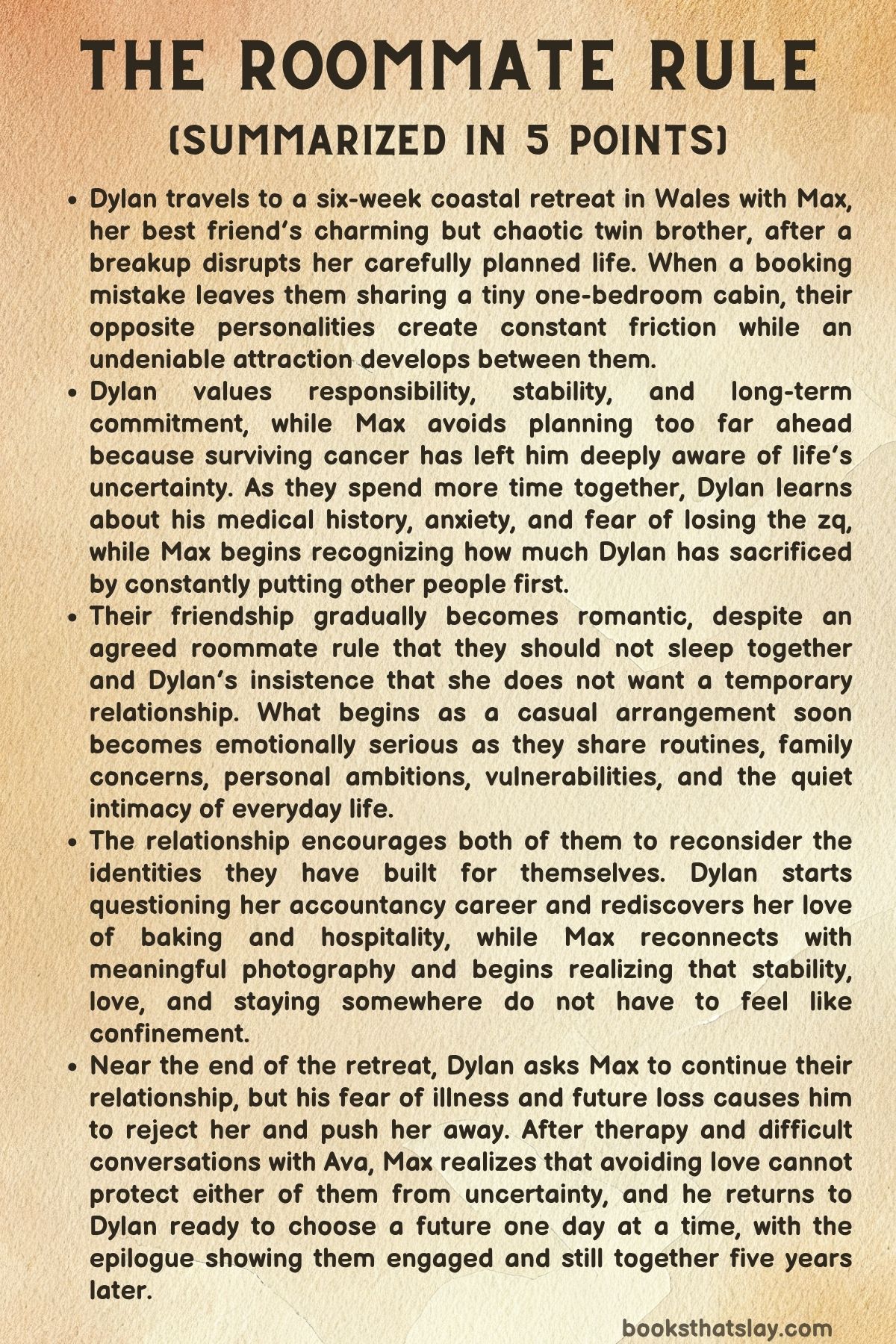
Characters
Dylan
Dylan is the central figure through whom The Roommate Rule examines the difference between responsibility and self-erasure. At the beginning of the novel, she considers herself practical, organized, sensible, and future-focused, but those apparently positive qualities also conceal how completely she has learned to organize her life around other people’s expectations.
Her devotion to Tahlia demonstrates genuine love, yet Dylan has turned being needed into a major source of identity. Family instability taught her that preventing problems and managing responsibilities could create safety, so she developed the habit of assuming that if something went wrong, she should either fix it or blame herself for not having prevented it.
Her relationship with Jeremy intensified this pattern. She learned to make herself less demanding, less emotional, and easier to manage because Jeremy treated ordinary needs for attention and affection as inconveniences.
Max initially unsettles Dylan because he refuses to accept the polished version of her personality. He actively enjoys her irritation, challenges her automatic apologies, and treats disagreement as something a relationship can survive rather than evidence that she has become difficult.
Dylan’s development is therefore not simply about becoming more spontaneous. She learns to recognize that boundaries, preferences, anger, desire, ambition, and selfishness in healthy proportions are legitimate parts of being a complete person.
Her changing attitude toward intimacy is particularly important. She moves from assuming something is inherently wrong with her sexual desire to understanding that comfort, attraction, trust, communication, and being genuinely valued can completely alter how she experiences closeness.
By the end of the novel, Dylan’s greatest achievement is not winning Max back. It is reaching the point where she can tell him she wants a continuing relationship and accept the possibility of rejection rather than silence herself in order to keep whatever limited version of him is available.
Max
Max is the other emotional center of The Roommate Rule, and his apparent freedom gradually reveals itself as another form of fear. He travels constantly, takes physical risks, avoids making distant plans, and presents himself as someone perfectly satisfied with temporary experiences.
His history with cancer explains the logic behind that lifestyle. Severe treatment, recurrence, sepsis, cardiac arrest, rehabilitation, and repeated medical surveillance taught him that imagined futures can disappear without warning.
For Max, movement initially becomes proof that he is alive. Extreme activities, travel, photography, sex, and novelty keep his attention focused on immediate physical experience and protect him from sitting quietly with fears he cannot control.
He is nevertheless far more emotionally perceptive than Dylan first assumes. He notices when she minimizes herself, recognizes the difference between what she says she should want and what genuinely excites her, and repeatedly encourages her to state her needs without apologizing.
His principal contradiction is that he calls himself fearless while organizing his emotional life around avoidance. He can jump from cliffs and enter dangerous environments, yet committing to Dylan terrifies him because permanence requires acknowledging that he desperately wants a future he cannot guarantee.
His relationship with Dylan changes his understanding of stillness. Sleeping peacefully beside her, sharing breakfasts, participating in family conversations, planning her birthday, and returning to the same cabin each evening reveal that staying somewhere can represent freedom when it is voluntary.
Max’s eventual reconciliation with Dylan does not mean he defeats his fear of cancer or mortality. Instead, he stops demanding certainty before allowing himself to love, accepting that an uncertain future can still be worth choosing.
Ava
Ava is Max’s twin sister and Dylan’s close friend, placing her in a unique position between the two protagonists. Her knowledge of Max’s romantic history makes her immediately protective of Dylan, and she warns him not to treat her friend as another disposable attraction.
Her protectiveness toward Max is also shaped by having witnessed his cancer treatment and near death. She understands the medical history he often hides from other people, which means she can recognize when his behavior is being driven by fear rather than by the adventurous personality he presents publicly.
Ava becomes especially important after the breakup because she refuses to accept Max’s argument that rejecting Dylan is an act of sacrifice. She recognizes that he is making Dylan’s decision on her behalf and using the possibility of future suffering to justify avoiding present vulnerability.
Her challenge is effective because she connects his behavior to his own previous advice. Max once encouraged Ava not to allow fear to make her life smaller, and she forces him to acknowledge that he is now committing the same mistake.
Tahlia
Tahlia is Dylan’s younger sister and one of the major influences on Dylan’s sense of responsibility. Dylan loves her deeply, but years of acting as a protector and problem-solver have convinced Dylan that being a good sister requires constant availability.
Tahlia gradually challenges that assumption. Although she values everything Dylan has done for her, she does not want her sister’s identity or future to remain permanently organized around taking care of her.
The university-moving crisis becomes an important turning point because Dylan initially assumes she must abandon the retreat and personally fix the situation. Once Ava and Finn solve the practical problem, Dylan has to confront the uncomfortable reality that Tahlia can receive help from people other than her.
Later, Tahlia directly reassures Dylan that pursuing a different career, home, or future will not weaken their relationship. Her independence therefore becomes essential to Dylan’s independence as well.
Jude
Jude begins as another guest at Haven by the Sea but quickly becomes one of Dylan’s most important friends. She is perceptive, socially confident, independent, and unusually good at identifying truths that Dylan and Max are attempting to disguise from themselves.
Her own career history gives her particular relevance to Dylan. Jude changed the direction of her online presence after recognizing that the identity she had successfully built no longer represented who she wanted to become.
She therefore understands that abandoning an old plan is not necessarily evidence of failure. When Dylan begins questioning accountancy, Jude encourages her to distinguish between a future she genuinely desires and one she has repeated so often that it simply feels inevitable.
Jude also acts as an observer of the romance. She recognizes early that Max’s feelings are more serious than he admits and later challenges Dylan’s insistence that the relationship is still casual when their daily behavior clearly suggests otherwise.
Jeremy
Jeremy never dominates the present-day action, but his influence remains embedded in Dylan’s expectations about relationships, desire, and her own worth. His importance comes from the habits Dylan developed while trying to remain acceptable to him.
He gave Dylan too little time and emotional attention while making her feel unreasonable for wanting more. As a result, she learned to associate successful relationships with demanding less rather than with expecting mutual care.
His influence also affected Dylan sexually. Because she rarely experienced strong desire with him, she came to believe that her own capacity for sexual enthusiasm was deficient rather than questioning whether the relationship itself lacked the emotional and physical conditions she needed.
Jeremy functions as a contrast to Max, but the contrast is not simply that one man is bad and the other good. The deeper difference is that Jeremy benefited from Dylan becoming smaller, whereas Max repeatedly pushes her to occupy more emotional space.
Bertie
Bertie is initially presented as an alternative romantic possibility for Dylan. He is openly interested in her, and his presence provokes jealousy in Max long before Max is prepared to admit how emotionally invested he has become.
For Dylan, Bertie serves a different purpose. She spends time with him partly because she is accustomed to accepting social situations rather than risk making someone uncomfortable, even when she is not particularly interested.
His eventual romantic proposition forces Dylan to establish a clear boundary and acknowledge that she views him only as a friend. The encounter helps her recognize that politeness does not require ambiguity and that her attraction toward Max is qualitatively different from her relationship with Bertie.
Bertie also exposes Max’s possessiveness. Max’s attempts to remove him from Dylan’s orbit demonstrate that the supposedly casual attraction has already developed into jealousy and emotional attachment.
Finn
Finn, Ava’s partner, represents one of the stable relationships Dylan observes from the beginning. His comfortable partnership with Ava initially reinforces Dylan’s belief that lasting commitment is what she ultimately wants.
He also becomes important during Tahlia’s moving crisis. Together with Ava, he helps solve the problem that Dylan assumes only she can manage, demonstrating that responsibility can be shared across a wider network of people who care.
Finn’s role is understated, but the stability of his relationship provides an important contrast to Dylan’s past with Jeremy and Max’s resistance to permanence. He represents partnership as ordinary cooperation rather than dramatic sacrifice.
Fiona and Greg
Fiona and Greg function as an example of enduring companionship. Watching them reminds Dylan that her desire for decades of shared life is not merely a rigid fantasy but something that real couples continue choosing through ordinary time.
Their relationship also affects Max. As the retreat approaches its end, their long marriage makes it harder for him to pretend that wanting permanence is inherently incompatible with valuing the present.
They demonstrate that long relationships are not guaranteed by certainty. Their significance lies in repeatedly choosing one another despite the same unpredictable future that Max believes makes commitment impossible.
Marianne
Marianne, Max’s therapist, plays a crucial role in exposing the psychological logic behind his avoidance. She does not dismiss the fear produced by his medical history, nor does she offer false reassurance that cancer can never return.
Instead, she challenges the conclusions Max draws from uncertainty. She points out that he has already made substantial progress by changing unhealthy coping mechanisms, continuing therapy, caring for himself more responsibly, and allowing genuine emotional intimacy into his life.
Her most important intervention comes after Max leaves Dylan. Marianne forces him to confront the contradiction between claiming to value the present and using an unknowable future as justification for abandoning someone he loves now.
Eileen
Eileen is associated with the food and hospitality side of the resort, and her importance emerges through Dylan’s response to helping her. Working with food, coffee, baking, and practical hospitality awakens an enthusiasm in Dylan that is noticeably absent whenever she discusses accountancy.
Eileen therefore becomes indirectly connected to Dylan’s career awakening. The work gives Dylan experiential evidence that stability and satisfaction do not necessarily have to exist on opposite sides of a decision.
Arun
Arun is one of the resort guests whose presence helps establish the communal environment surrounding Dylan and Max. He appears most memorably during the coasteering excursion, when a mistaken fear about a shark causes Max to move toward him immediately and help.
That moment reveals an important side of Max. His risk-taking can be reckless, but his instinct in situations involving other people is often protective rather than selfish.
David
David is one of the resort owners and helps introduce the guests to Haven by the Sea. His role is primarily practical, connecting Dylan, Max, and the others with the setting in which their personal changes occur.
Although he does not undergo a major personal development, the environment he helps maintain becomes essential to the story. Removed from London routines and expectations, Dylan and Max gain the physical and psychological space necessary to question the lives they have been living.
Themes
Living in the Present Without Abandoning the Future
Max and Dylan begin with apparently opposite relationships to time. Dylan organizes her life around a future she believes can be made safe through planning, while Max concentrates on immediate experiences because cancer has taught him that long-term certainty can disappear without warning.
Neither position is presented as entirely healthy. Dylan’s future orientation causes her to sacrifice present desires for plans she has barely questioned, while Max’s devotion to the present sometimes becomes an excuse for avoiding emotional commitments that would make the future matter.
The Roommate Rule gradually challenges the assumption that a person must choose between these attitudes. Dylan learns that present happiness deserves consideration even when it does not fit an established plan, and Max learns that imagining tomorrow does not betray the principle of appreciating today.
Their final reconciliation depends on creating a middle position. Dylan does not ask Max to guarantee decades that no human being can promise, while Max stops treating uncertainty as proof that commitment is dishonest.
Her request for the next day becomes a concise expression of this balance. A future is ultimately created through individual days, and choosing one another in the present can coexist with hoping that those choices continue for years.
Self-Worth Beyond Usefulness
Dylan has spent much of her life believing that her value comes from what she can provide. Being organized, financially responsible, dependable, emotionally undemanding, and available to her family makes her feel safe because those qualities reduce the possibility that other people will become disappointed with her.
The problem is not that caring for others is undesirable. Her devotion to Tahlia is sincere, but Dylan has difficulty distinguishing love from obligation and generosity from self-neglect.
Her past relationship with Jeremy reinforces the belief that she must earn affection by becoming convenient. She learns to suppress disappointment, tolerate insufficient attention, and question whether ordinary needs make her difficult.
Max repeatedly disrupts this pattern by refusing to reward the polished version of Dylan. He wants her honest reactions, asks her what she wants, accepts her boundaries, and insists that doing something kind for her does not create a debt she must repay.
The university crisis becomes especially important because Dylan discovers that other people can care for Tahlia without her intervention. Allowing help means accepting that her importance to her sister does not depend upon being indispensable.
By the end, Dylan becomes capable of choosing herself without interpreting that choice as abandonment. Her growth turns self-worth from something measured by usefulness into something that exists independently of how effectively she manages everyone else’s needs.
Fear, Mortality, and Emotional Risk
Max’s cancer history gives mortality an immediacy that many people can keep comfortably abstract. He has survived severe treatment, recurrence, sepsis, cardiac arrest, and the continuing anxiety of medical monitoring, so his awareness that life can end unexpectedly is based on direct experience.
His response is initially to pursue intensity. Travel, physical danger, novelty, sex, and constant movement provide powerful reminders that his body is still functioning and that he is still capable of participating fully in the world.
Yet his willingness to accept physical danger hides a deep resistance to emotional risk. Loving Dylan creates a future he genuinely wants, and wanting it immediately exposes him to the possibility that illness could someday destroy it.
This fear allows Max to disguise avoidance as generosity. He tells himself that rejecting Dylan protects her from becoming attached to someone whose health cannot be guaranteed, but Ava and Marianne expose the flaw in that argument: he is making Dylan’s decision for her.
His eventual change does not depend on believing that nothing bad will happen. Max instead accepts that uncertainty exists whether he loves Dylan or not.
The story therefore treats courage not as the absence of fear but as the refusal to allow fear to make every important decision. Emotional commitment becomes Max’s most difficult form of bravery because it requires choosing something valuable without possessing control over how long it will last.
Identity, Change, and Choosing a Life Deliberately
Both protagonists have constructed identities that once protected them but have gradually become restrictive. Dylan is the responsible planner who follows the sensible career path, while Max is the restless traveler who never stays long enough to depend on anyone.
The retreat gives both characters enough distance from their normal environments to notice that these identities are not fixed truths. Dylan discovers genuine enthusiasm for hospitality, baking, friendship, adventure, and the coast, while Max rediscovers the slower photographic work that originally gave his creativity personal meaning.
Jude’s career history reinforces the idea that changing direction does not erase previous achievement. Her decision to reshape her public identity helps Dylan understand that continuing down an established path simply because it is already familiar can become another form of fear.
Romantic change follows the same principle. Dylan does not have to become permanently spontaneous in order to grow, and Max does not have to abandon travel in order to commit.
Their eventual partnership succeeds because neither is required to become a different person for the other. Instead, each becomes more deliberate about which parts of an old identity still serve them and which were built mainly to manage anxiety.
The result is a broader understanding of stability and freedom. Stability can include movement, freedom can include commitment, and changing your mind about the life you want can represent maturity rather than failure.