The Winter Folk Summary, Characters and Themes
The Winter Folk by Jen Julian is a dark fantasy novel about memory, desire, family inheritance, and the danger of wanting a life beyond ordinary human limits.
Its central figure, Vera Stoker Whitfield, still thinks of herself as Moth, the name she once used while serving supernatural guests at Deerhaven. Decades after being expelled from that hidden world, she returns to her Appalachian hometown with her husband and daughter. What begins as a private attempt to reconnect with the past becomes a confrontation with unresolved loyalties, lost friends, magical bargains, and the consequences of choices that have affected more than one generation.
Summary
More than twenty years after leaving Little Gunning, Vera Stoker Whitfield returns to the Appalachian town with her husband Martin and their nearly nineteen-year-old daughter, Cass. Although everyone else knows her as Vera, she continues to think of herself as Moth, the name she received during the winters she spent working at Deerhaven.
Moth secretly enters the surrounding woods before dawn because she believes the strange skeletal creatures she once called ghosts may lead her back to Deerhaven. Her obsession is rooted in childhood stories told by her mother, Liberty Thornhill, who warned her about supernatural beings called the Winter Folk and a dangerous antlered figure known as the Deerman.
As a lonely child living through her parents’ failing marriage, Moth became fascinated by the possibility that another world existed beyond Little Gunning. When she was ten, she met Celosia, usually called Lo, an unsettlingly beautiful member of the Winter Folk who challenged her to capture one of the skeletal ghosts and then disappeared after healing its bite.
Moth later became an excellent student determined to escape the economic and emotional limitations she associated with her hometown. She graduated early and entered college on scholarship, but severe anxiety and academic failure destroyed the future she had imagined, forcing her back to Little Gunning.
By twenty-one, she was cleaning rooms at the Lucky 9 Motel. After her employer suggested that keeping her job might depend on presenting herself more attractively for him, Moth left humiliated and encountered Lo again, unchanged from the woman she remembered from childhood.
Lo led her through a freestanding red door into Deerhaven, a supernatural lodge ruled by the antlered Mr. Oslin. Moth negotiated a three-month housekeeping contract, asking in return for a large stone house overlooking the valley, complete with moonflowers.
The contract gave her the name Moth and imposed strict rules: guests came first, Mr. Oslin came second, and black keys were forbidden. Despite the danger implied by these conditions, Moth entered Deerhaven on the winter solstice and quickly discovered a place where ordinary physical rules had little meaning.
Rooms moved, corridors changed, and supernatural guests arrived with strange companions and impossible demands. Moth worked alongside Birch, an experienced housekeeper, and Crow, Oslin’s shy young errand boy, gradually gaining confidence in a setting where competence mattered more than her failures outside it.
Her first major crisis involved Mr. Barkus, a violent guest searching for Gilrad, a powerful knife connected to his family. After realizing Moth had been reporting information to Oslin, Barkus magically bound her so that lying caused unbearable pain and captured Birch when she attempted a rescue.
Moth, Birch, and Crow were forced into the Bag Room, a vast realm containing the objects, waste, ghosts, and debris discarded through Lo’s magical bag. There they encountered the elderly Sifters and eventually helped Barkus recover Gilrad.
Back at Deerhaven, Barkus attempted to claim both the knife and Moth, but Oslin refused to treat an employee as property. Barkus departed with Gilrad, only for the bloodstained weapon to return later after rumors spread that his family estate had been destroyed.
By the end of her first season, Moth had grown closer to Birch and Crow. Deerhaven remained dangerous, yet it offered her belonging, responsibility, friendship, and an identity she had never achieved in ordinary life.
Her promised house appeared exactly as requested through magically altered history. Everyone now remembered a dead woman who had supposedly left Moth the property, demonstrating that Oslin’s world could rewrite reality itself.
Outside Deerhaven, Moth’s relationship with her mother remained unstable. Libby became involved with a man named Dozer and suspicious financial dealings, eventually appearing injured and frightened as unknown people threatened her.
When Lo returned with another invitation to Deerhaven, Moth used her second contract to secure protection for Libby and erase whatever debts endangered her. She also discovered that Birch and Crow would return, making the supernatural lodge increasingly feel like her true home.
During the second season, the pregnant Miss Lys became the center of a dangerous conflict. She insisted that her unborn child be recognized as a guest, but after birth the child emerged as a terrifying supernatural creature capable of attacking Deerhaven itself.
Lo tried to kill the creature despite its guest status, while Moth attempted to honor the rules protecting it. Oslin transformed into his monstrous Deerman form to contain the child and was badly wounded, exposing black blood and a strange golden substance beneath it.
Seeing Oslin vulnerable intensified Moth’s attraction to him and to the power he represented. Meanwhile, Lo was tried before the Owner and other guests for attempting to kill a protected guest, and Moth’s honest testimony contributed to Lo being sentenced to forced labor in the ash-bane mines.
Before leaving, Miss Lys gave Moth a silver whistle capable of controlling her child. Lo was eventually replaced by Agnes, and tensions among Moth, Birch, and Crow increased as all three became interested in the possibility of becoming something more than human.
In the present, Moth notices disturbing similarities between herself and Cass. Cass has abandoned her expected path toward college, withdrawn from friends, spends much of her time online, and repeatedly draws strange symbols on her belongings and body.
Their relationship becomes increasingly tense when Cass accuses Moth of being ashamed of Little Gunning and using the town’s poverty to frighten her into pursuing a conventional future. Moth responds cruelly, then immediately regrets seeing how deeply her words hurt her daughter.
Moth later discovers Gilrad at a flea-market weapons stall run by an ancient woman and begins to suspect that supernatural forces remain active nearby. She also visits the magical mountain house she once earned and finds that the moonflowers once growing there became invasive even after she abandoned the property.
Memories then return to her third Deerhaven season and the revelation that Libby had once worked there under the name Briar. Libby had fallen in love with Moth’s father, Joel, after previously making a romantic promise to Mr. Guzman, the craftsman responsible for magical doors.
Mr. Guzman had helped Libby escape the consequences of breaking that promise, and Libby had secretly kept a red Deerhaven key. The discovery changes Moth’s understanding of her childhood, showing that her mother’s stories were memories disguised as folklore.
During Moth’s third negotiation with Oslin, she openly admits that she wants to remain at Deerhaven forever, become a Host, and be with him. Oslin cannot grant her transformation, but he admits that he can love, and the two begin a secret romantic relationship.
The season deteriorates with the arrival of Mrs. Mandrel, Agnes’s powerful mentor. She takes an interest in Crow, who becomes increasingly resentful, secretive, and careless before eventually using a forbidden black key.
Moth finds Crow mortally wounded near the Owner’s Hall. As he dies, he repeats his real name, Ian, and Oslin refuses to punish Mrs. Mandrel because Crow knowingly violated one of Deerhaven’s fundamental rules.
Crow’s death devastates Moth and Birch, although their shared grief eventually brings them together. They discover that Mrs. Mandrel has hidden Miss Lys’s regenerative child inside a mirror and decide to use the creature against the powers controlling Deerhaven.
Moth and Birch free the child and use Miss Lys’s whistle to direct it. The creature kills Agnes and destroys Mrs. Mandrel, but when Moth orders it to attack the Owner, Oslin transforms into the Deerman and protects his superior.
Oslin kills the creature, while Birch is severely wounded. Moth expects Mr. Guzman to provide an escape door, only to discover that he never created one.
Oslin finally carries Moth out of Deerhaven and leaves her in the mountains, telling her she can never return. She begs him to save Birch, but he walks away, and hunters later find Moth nearly frozen.
After recovering, Moth struggles to explain what happened because magical restrictions prevent her from speaking clearly about Deerhaven. She asks Libby for the red key so she can return for Birch, but her mother claims she threw it into a lake.
Moth eventually flees Little Gunning and survives through temporary jobs, theft, false credentials, and repeated reinvention. She later meets Martin, earns a legitimate degree, builds a career in environmental work, marries, and raises Cass, creating an apparently ordinary life that never completely erases Deerhaven.
Years later, Moth learns that Ian Peretti remains officially missing and then discovers that Libby has drowned. When Joel eventually gives her a box of Libby’s belongings, Moth finds both Crow’s old record and the supposedly lost red key.
The key inspires her return to Little Gunning. Soon afterward, Cass disappears from the rental cabin, forcing Moth to speak Oslin’s name aloud for the first time in decades.
Police search for Cass, while Martin realizes his wife has concealed an entire part of her history. Unable to explain everything because of supernatural interference, Moth leaves him behind and returns to the flea market.
There she meets Eddy, the elderly woman connected with the Sifters, who explains that Moth’s failed rebellion caused lasting consequences. Eddy opens an unstable passage into Deerhaven, and Moth enters carrying Gilrad.
The Deerhaven she finds has changed dramatically. Oslin has been repeatedly remade into a colder and more obedient version of himself, the lodge has become harsher, and Cass is being held prisoner in his office alongside other captives elsewhere.
Oslin hunts Moth through the collapsing building and eventually attacks her with Gilrad. Eddy’s protective magic reverses the strike, placing the knife in Moth’s hand and driving it into Oslin instead.
Wounded, Oslin admits that repeated remaking has damaged his memory. Enough of his former self survives for him to allow Moth to use Libby’s red key to rescue Cass.
As Deerhaven tears itself apart, mother and daughter escape. Cass wants to save the other prisoners, but Moth refuses to risk losing her and forces her through the unstable doorway.
Outside, Eddy reveals that Cass had already been recruited through an online roleplaying community connected to the Sifters. The symbols Cass had been drawing were protective runes, and supernatural forces had been targeting the Thornhill family.
Moth therefore ends where her mother once stood: facing a daughter who has already entered the hidden world despite every effort to keep her away from it. She waits beside Eddy among impossible winter plants, knowing that secrecy can no longer protect Cass and uncertain whether the Winter Folk, Deerhaven, or Oslin are truly finished with them.
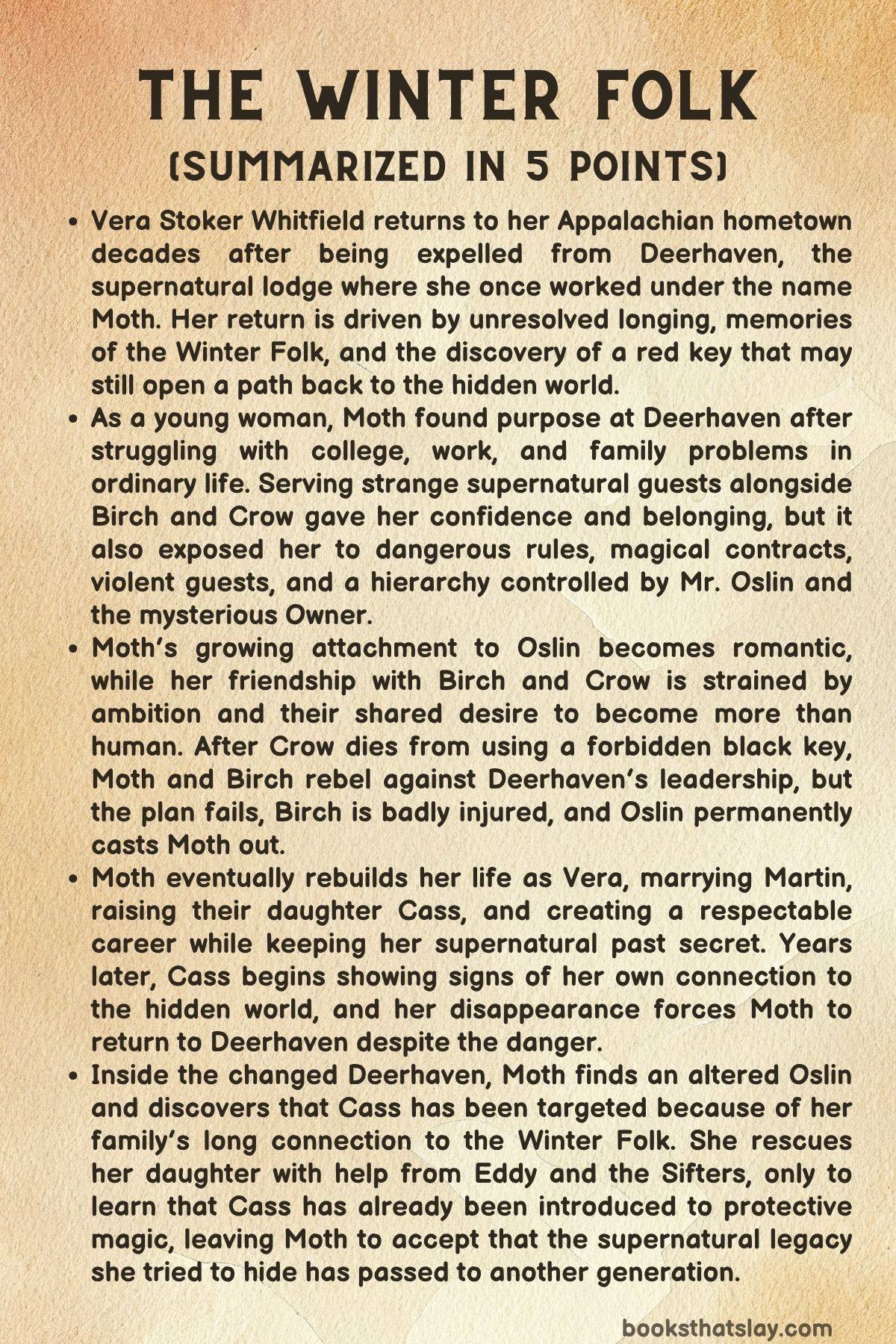
Characters
Moth / Vera Stoker Whitfield
Moth is the central consciousness of The Winter Folk, and her personality is shaped by dissatisfaction with ordinary life long before Deerhaven gives that dissatisfaction a name. As Vera, she is the daughter who wants to escape Little Gunning, the student whose early promise collapses under anxiety, the adult who reinvents herself, and the mother who desperately wants Cass to follow a safer path than the one she chose.
Her Deerhaven identity gives her what her ordinary life repeatedly denies her: usefulness, authority, competence, friendship, and access to something extraordinary. This explains why she accepts dangers that would appear irrational from the outside and why exile from Deerhaven feels less like losing a job than losing the version of herself she most wanted to become.
Moth is also morally complicated because her hunger for belonging gradually becomes hunger for transformation and power. Her attraction to Oslin cannot be separated from her attraction to what he represents, and her willingness to participate in the rebellion against the Owner shows how far she will go when the institution she loves prevents her from fully entering it.
As a mother, she repeats some of Libby’s mistakes despite believing she has built an entirely different life. She hides the supernatural past from Cass, uses fear to push her daughter toward conventional success, and discovers too late that secrecy does not prevent inheritance.
Her final return to Deerhaven demonstrates growth without erasing her flaws. She still makes ruthless choices, particularly when she refuses Cass’s desire to save the other prisoners, but this time her primary goal is not entry into the supernatural world but getting her daughter out alive.
Mr. Oslin
Mr. Oslin is both a romantic figure and one of the novel’s clearest examples of how power can exist inside another system of control. In The Winter Folk, he initially appears nearly absolute within Deerhaven: he creates contracts, commands employees, controls access to the lodge, transforms into the Deerman, and can manipulate ordinary reality to deliver impossible rewards.
Yet Oslin is never truly free. He serves the Owner, must uphold Deerhaven’s rules, cannot prevent Lo’s punishment, refuses to retaliate after Crow’s death, and ultimately protects the Owner even when Moth and Birch attempt to destroy the structure that controls him.
His relationship with Moth exposes the conflict between affection and institutional obligation. He can love her, give her access to his private space, and respond to her desire, but he cannot simply make her a Host or choose her over the forces that define his existence.
His later transformation into a colder, remade version of himself makes this conflict tragic. By the time Moth returns decades later, repeated reconstruction has damaged his memory so deeply that much of the person she once knew has been stripped away, although enough survives for him to permit Cass’s escape.
Cass Whitfield
Cass functions as both Moth’s daughter and her mirror. Her withdrawal from expected social and educational paths immediately alarms Moth because Moth recognizes the same refusal of ordinary expectations that once defined her own adolescence.
Cass is more perceptive than her mother initially understands. She recognizes Moth’s shame about Little Gunning, senses that something important is being concealed from her, and resists the assumption that college and conventional achievement are the only acceptable forms of adulthood.
Her repeated drawings appear disturbing because Moth interprets them through fear, but the final revelation changes their meaning. Cass has been learning protective runes through an online community connected to the Sifters, proving that she was already participating in the supernatural conflict while her mother believed silence could keep her outside it.
Cass also differs from Moth in her immediate concern for the other captives inside Deerhaven. Even during escape, she wants to return for people she does not know, suggesting a moral instinct that may challenge the more survival-driven choices Moth learned through years of dealing with the Winter Folk.
Birch
Birch begins as the experienced housekeeper who seems stern, practical, and somewhat controlling toward Moth. Her authority comes from familiarity with Deerhaven rather than supernatural power, making her a model of the competence Moth eventually learns to value in herself.
Over time, Birch becomes one of Moth’s closest companions. Their relationship deepens through danger, particularly after the Barkus incident, and together with Crow they create a small chosen family based on shared labor and mutual dependence.
Birch is also ambitious in ways that complicate her friendship with Moth. Like Moth and Crow, she is fascinated by the possibility that service at Deerhaven could become a path toward transformation, which turns their friendship into a quiet competition once romantic and professional desires begin overlapping.
Crow’s death exposes the depth of Birch’s private connection to him and intensifies her anger toward Moth. Their eventual reconciliation is therefore significant because it allows grief to become cooperation rather than permanent division.
Her participation in the attack on Mrs. Mandrel and the Owner shows both courage and desperation. Birch is willing to risk everything to break the system after recognizing that loyalty and competence will never necessarily earn safety or advancement.
Crow / Ian Peretti
Crow initially appears younger, quieter, and less confident than Moth or Birch. His position as Oslin’s errand boy places him close to authority without giving him much authority of his own, which becomes important as his ambitions grow.
He gradually becomes an essential part of Moth and Birch’s chosen family. His kindness, vulnerability, and artistic nature emerge through his detailed drawings, while his growing responsibilities suggest that Oslin recognizes his potential.
Crow’s desire for advancement eventually makes him vulnerable to Mrs. Mandrel. Her influence feeds his resentment and dissatisfaction until he breaks the rule against using black keys, an action that results in catastrophic injury.
His final repetition of his real name, Ian, is especially significant because Deerhaven has defined him through an assigned identity for years. In death, he reaches back toward the human self that existed beneath the role he accepted.
The later discovery that Ian Peretti remains officially missing reinforces the cost of Deerhaven’s secrecy. Outside the supernatural world, his disappearance never receives explanation, closure, or justice.
Liberty “Libby” Thornhill / Briar
Libby initially appears to be an eccentric and unreliable mother whose supernatural stories shaped Moth’s imagination. Her instability, questionable relationships, criminal associations, and difficult temperament make it easy for Moth to dismiss many of her choices as products of personal chaos.
The discovery that Libby once served Deerhaven under the name Briar radically changes that interpretation. Her stories about the Winter Folk were rooted in lived experience, and her warnings were attempts to communicate danger without fully revealing a past she could not safely explain.
Libby also represents an earlier version of Moth’s central conflict between supernatural obligation and human attachment. She promised herself romantically to Mr. Guzman but later chose Joel, placing herself at risk within Deerhaven’s system.
Her decision to preserve the red key becomes one of the story’s most important acts. Even after telling Moth she had thrown it away, Libby secretly kept it, and that key eventually allows Moth to rescue Cass.
The relationship between Libby and Moth remains painful because understanding does not automatically create reconciliation. Moth learns that her mother’s secrecy had reasons, but the discovery comes too late to repair years of resentment before Libby’s death.
Celosia “Lo”
Lo is Moth’s first direct connection to the Winter Folk and therefore occupies a powerful place in her imagination. Beautiful, unsettling, and apparently unchanged by time, she represents the possibility that the impossible stories of Moth’s childhood are real.
She serves as both recruiter and warning. Lo repeatedly opens the way to Deerhaven, yet her eventual punishment demonstrates that even supernatural beings remain vulnerable to the lodge’s rigid hierarchy.
Her decision to attack Miss Lys’s child despite its protected guest status places her in direct conflict with Deerhaven’s law. Moth’s testimony contributes to Lo’s sentence, creating a personal betrayal even though Moth is required to tell the truth.
Lo’s fate also exposes the limits of Oslin’s authority. He can delay her removal but cannot prevent the Owner from condemning her to forced labor until death.
Martin Whitfield
Martin represents the ordinary life Moth successfully builds after exile. He belongs to the identity she creates through education, career, marriage, and parenthood rather than to the hidden history that shaped her earlier adulthood.
His significance becomes strongest when Cass disappears. Martin recognizes that Moth has concealed something enormous from him, but supernatural interference prevents her from explaining it clearly.
His desire to accompany her shows both loyalty and frustration. Moth refuses, repeating the pattern of secrecy that has already damaged her relationships with Libby and Cass.
Martin therefore becomes evidence that reinvention has limits. Moth may have constructed a stable life, but she never fully integrated Deerhaven into that life, leaving even her husband unable to understand the danger when the past returns.
Mr. Guzman
Mr. Guzman is a supernatural craftsman whose skill with magical doors gives him unusual importance in the movement between worlds. His connection to Libby reveals that he was once the figure to whom she made a romantic promise before choosing Joel.
His response to rejection distinguishes him from many other supernatural figures. Although Libby’s broken promise could have led to severe punishment, Guzman helped her escape rather than insisting that Deerhaven’s rules be enforced against her.
His later recognition of Moth as Briar’s daughter links two generations of women who have entered Deerhaven. However, his failure to create the promised escape door during Moth and Birch’s rebellion shows that even apparently sympathetic figures cannot always be relied upon when survival depends on them.
Mrs. Mandrel
Mrs. Mandrel represents calculated institutional ambition. Unlike openly violent figures such as Barkus, she operates through observation, persuasion, influence, and manipulation.
Her interest in the Owner and her increasing attention to Deerhaven’s staff immediately suggest that she is seeking leverage. Crow becomes her most devastating target, gradually changing from a loyal and hopeful worker into someone resentful enough to violate Deerhaven’s most dangerous rule.
Her apparent use of Miss Lys’s child also reveals her willingness to treat living beings as instruments in a struggle for power. She does not challenge the existing hierarchy to create freedom for those beneath it; she attempts to gain control within that hierarchy.
Her destruction by the child she intended to exploit provides a severe reversal. The weapon she believed could advance her position becomes the means of her death.
The Owner
The Owner stands above Oslin and embodies the deepest level of Deerhaven’s authority. His relatively limited direct presence makes him more threatening because his power operates through rules, punishments, architecture, and the obedience of others.
He presides over Lo’s tribunal and demonstrates that legal procedure within Deerhaven does not equal fairness. The rules are presented as absolute even when their consequences are cruel, and neither loyalty nor context necessarily changes the outcome.
During Moth and Birch’s rebellion, the Owner can turn Deerhaven itself against them. Most importantly, Oslin protects him even when doing so means opposing Moth, showing that the Owner’s control reaches beyond simple command.
Miss Lys
Miss Lys arrives as a disruptive and mysterious guest whose pregnancy places Deerhaven’s rules under extraordinary pressure. Her insistence that her unborn child must be considered a guest forces Moth to confront the difference between following rules and responding to obvious danger.
After the child’s birth, its destructive nature confirms Lo’s fears, yet the protections attached to guest status remain in effect. The resulting conflict exposes the contradictions within Deerhaven’s system.
Miss Lys’s punishment with permanent banishment appears mild beside Lo’s sentence, despite the danger connected to her child. Her warning that madness and decay are spreading among the Winter Folk suggests that Deerhaven’s problems are part of a broader instability.
By giving Moth the silver whistle, she leaves behind the tool that later makes rebellion possible. Her influence therefore continues long after her departure.
Barkus
Barkus introduces Moth to the extreme danger that can hide behind Deerhaven’s emphasis on hospitality. His status as a guest gives him protections and privileges even when his behavior becomes threatening.
His magical binding of Moth makes truth itself a weapon, forcing her into obedience through pain. He also treats people as possessions, eventually attempting to claim Moth along with Gilrad.
The confrontation with Oslin clarifies an important distinction between the two men. Oslin participates in an exploitative system, but he refuses Barkus’s belief that employment makes Moth property.
Barkus’s later disappearance and the return of Gilrad transform the knife into a recurring object associated with violence, power, and unfinished supernatural conflict.
Agnes
Agnes replaces Lo after Lo’s conviction, but she never recreates the relationship Lo had with Deerhaven’s staff or the lodge itself. Her presence feels colder and more mechanical, emphasizing how much personality and knowledge had disappeared with her predecessor.
Her connection to Mrs. Mandrel places her within the growing threat surrounding the Owner’s Hall. When Moth and Birch begin their rebellion, Agnes discovers them and becomes the first major victim of the freed child.
Her death demonstrates how quickly positions within Deerhaven can become disposable. Service to the institution offers proximity to power but no guarantee of protection.
Joel Stoker
Joel is Moth’s estranged father and one of the earliest sources of her abandonment. His departure from the family contributes to the isolation that makes the supernatural world so attractive to her.
When Moth later seeks his help during Libby’s troubles, his emotional distance confirms that their relationship remains damaged. She carries resentment toward him for having escaped responsibilities that she and Libby were forced to endure.
Years later, Joel returns with Libby’s belongings and apologizes for abandoning Moth. His delivery of the box containing the hidden red key unintentionally creates the possibility of Moth’s return to Deerhaven and Cass’s eventual rescue.
Eddy
Eddy first appears as an ancient woman associated with a mysterious weapons stall where Moth rediscovers Gilrad. Her unsettling knowledge of Cass suggests from the beginning that she understands far more about Moth’s past than she initially reveals.
She later identifies herself as connected with the Sifters and explains that Moth’s failed rebellion caused lasting consequences. Unlike many supernatural figures, Eddy does not simply demand obedience; she offers Moth a means of entering the altered Deerhaven.
Her magical protection reverses Oslin’s attack and makes Cass’s rescue possible. The final revelation that the Sifters had already reached Cass through her online community also establishes Eddy as part of a larger counterforce operating against the Winter Folk.
Themes
The Inheritance of Secrets
Secrets in The Winter Folk move from parent to child with almost the same force as blood. Libby hides the truth about Briar and Deerhaven from Moth, convincing herself that incomplete stories and warnings may be safer than direct knowledge.
Moth later repeats the same behavior with Cass. She constructs a respectable adult identity, keeps her years as Moth separate from her marriage and motherhood, and refuses to explain why Little Gunning and its surrounding mountains frighten her.
The novel shows that secrecy may delay confrontation, but it does not erase inheritance. Libby’s experiences shape Moth even when Moth believes they are only fairy tales, and Moth’s history reaches Cass even though Cass has never been told the truth.
Cass’s protective symbols offer the clearest proof that suppressed knowledge finds alternate paths. While Moth assumes her daughter is isolated online and avoiding real life, Cass is actually developing her own connection with the Sifters and learning defenses against supernatural danger.
The final situation reverses Moth’s earlier assumptions about protection. She must accept that knowledge may now be safer than ignorance because Cass has already been drawn into the conflict.
Belonging, Identity, and Reinvention
Moth’s attraction to Deerhaven is rooted as much in identity as in magic. Ordinary life repeatedly makes her feel unsuccessful, misplaced, or ashamed, while Deerhaven rewards the very qualities that seem useless elsewhere.
The name Moth therefore becomes more than an assigned work identity. It represents the person she believes herself capable of becoming: competent, necessary, fearless under pressure, connected to extraordinary people, and valued by a powerful Host.
Her later life as Vera is also a reinvention. After exile, she constructs stability through education, professional work, marriage, and motherhood, proving that she can function successfully in the world she once wanted to escape.
Yet the return to Little Gunning shows that neither identity fully replaces the other. Vera cannot erase Moth, just as Moth could never completely erase the frightened young woman who failed at college and returned home humiliated.
Cass introduces another dimension by resisting the identity Moth wants for her. Her uncertain educational future forces Moth to recognize how easily concern can become pressure when a parent expects a child to follow a path created by the parent’s own regrets.
Power, Rules, and Institutional Control
Deerhaven presents itself as a world governed by contracts, responsibilities, guest protections, and formal procedures. These structures initially appeal to Moth because they appear clearer and more meaningful than the uncertainty of her ordinary life.
Gradually, however, the distinction between order and justice becomes impossible to ignore. Barkus can terrorize employees while retaining privileges as a guest, Lo receives a devastating punishment for violating guest protection, and Crow’s death is effectively accepted because he broke a forbidden rule.
Oslin’s position makes the theme more complicated because he is powerful and constrained at the same time. He can create miraculous rewards, alter reality, command staff, and become the Deerman, yet he remains unable or unwilling to violate the authority above him.
The rebellion eventually emerges from the realization that working faithfully inside the system will never guarantee freedom. Moth, Birch, and Crow originally hope service might allow them to rise, but the deaths, punishments, and betrayals around them expose how little control workers actually possess.
The later remaking of Oslin shows the endpoint of institutional domination. Even a powerful Host can be altered until memory, personality, and independent desire become secondary to obedience.
Mothers, Daughters, and Repeated Patterns
The relationships between Libby, Moth, and Cass create a three-generation pattern in which each mother attempts to protect her daughter while also transferring fear, secrecy, and unresolved conflict to her. Libby’s stories fascinate Moth while warning her, creating the very curiosity they were meant to control.
Moth spends much of adulthood believing she is different from Libby. She builds stability, earns a degree, establishes a career, marries Martin, and tries to direct Cass toward opportunities she herself once struggled to maintain.
Yet her argument with Cass reveals how much inherited shame remains active. When Cass accuses her of treating Little Gunning as evidence of failure, Moth responds with the same kind of emotionally damaging behavior she resented in her own family.
The supernatural inheritance strengthens this emotional pattern. Libby once entered Deerhaven, Moth followed without knowing the truth, and Cass becomes connected to the Sifters despite Moth’s efforts to keep her outside the hidden world.
By the end, Moth can no longer protect Cass by repeating Libby’s strategy of partial truths. Her challenge is to create a different relationship with her daughter by acknowledging that Cass already has agency, knowledge, and a role in a conflict that began before she was born.